

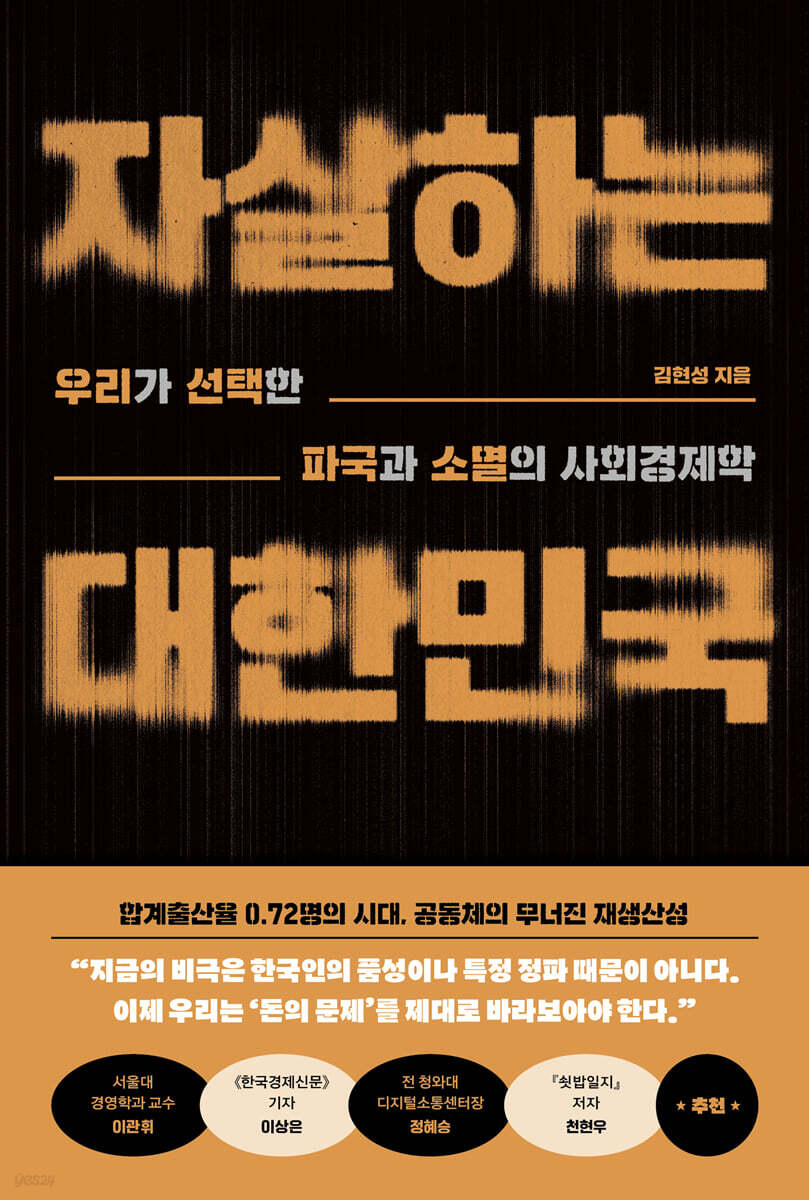
Suicidal Republic of Korea
 |
Description
Book Introduction
- A word from MD
-
A portrait of a penniless South KoreaSouth Korea, ranked 10th in GDP and boasting a per capita GDP of over $30,000, is said to be short on money? It's true.
Because they have no money, they cannot enjoy stable housing, and they give up on marriage and having children.
Whose fault is it? It's the structure we've created.
We must fix the concentration of jobs in the metropolitan area, low labor productivity, and meritocracy now.
May 14, 2024. Social and Political PD Son Min-gyu
How is Korean society destroying itself?
A country that runs on grinding people to the end
A country where everyone is sick, but no one wants to pay for medical expenses.
Leading the Republic of Korea to the path of destruction
A thorough analysis of the overall economic structure and vicious cycle.
South Korea is facing catastrophe.
At this moment in our nation's history, when the world is watching us more closely, we are witnessing the rapid decline and disintegration of our communities.
People aren't marrying, they're not having children, fat is disappearing, and we're all suffering from tremendous competitive pressures in a distorted, high-cost, and polarized society.
Some people point out the selfish nature of Koreans for this reason, or diagnose it as being due to a specific political faction seizing power.
They were all wrong.
The problem is 'money'.
Korea is heading towards destruction due to the organically and tightly intertwined 'money problem'.
We cannot properly explain the unprecedented "era of a total fertility rate of 0.72" without comprehensively examining the economic structure that has shaped us into this state.
Why has the reproductive potential of Korean society collapsed so dramatically? Why do people, from the young to the elderly, desperately flock to Seoul? Why do so many invest in high-risk assets like blockchain tokens, or focus solely on their own "vulnerability" and engage in hateful behavior? Why do we accept this quasi-taxation of private education costs as a given, and so desperately cling to "exams" and "fairness"? And why do we suffer from the world's longest working hours and poor childcare environments? Kim Hyun-sung explains.
That's because our community has avoided the issues that must be resolved in the process of development.
The rapid success of South Korea, often called the "Miracle on the Han River," was itself fraught with potential failures, but the group that should have faced it with a cool head was not properly trusted and turned a blind eye to the problem.
Therefore, the path of destruction and destruction we have chosen should be called 'suicide.'
We have chosen this contradictory and destructive socioeconomic structure for ourselves.
Instead of undertaking the "just expenditures" that were absolutely necessary for the future of this society, we have built a foundation for each person to survive, where each member must work faster, more diligently, and strive for extreme efficiency.
Instead of opening one's wallet for others, the fundamental operating principle of the community was to 'grind people and roll them over.'
So we are always short on time.
Getting married and having children is a luxury.
This is how a vicious cycle is completed, where everyone is forced to desperately struggle for their own survival.
This book is an in-depth report on a country where "everyone is sick, but no one wants to pay for treatment," and yet it is a record of fervent hope that encourages us to seek concrete solutions together, rather than simply ending in cynicism or resignation.
A country that runs on grinding people to the end
A country where everyone is sick, but no one wants to pay for medical expenses.
Leading the Republic of Korea to the path of destruction
A thorough analysis of the overall economic structure and vicious cycle.
South Korea is facing catastrophe.
At this moment in our nation's history, when the world is watching us more closely, we are witnessing the rapid decline and disintegration of our communities.
People aren't marrying, they're not having children, fat is disappearing, and we're all suffering from tremendous competitive pressures in a distorted, high-cost, and polarized society.
Some people point out the selfish nature of Koreans for this reason, or diagnose it as being due to a specific political faction seizing power.
They were all wrong.
The problem is 'money'.
Korea is heading towards destruction due to the organically and tightly intertwined 'money problem'.
We cannot properly explain the unprecedented "era of a total fertility rate of 0.72" without comprehensively examining the economic structure that has shaped us into this state.
Why has the reproductive potential of Korean society collapsed so dramatically? Why do people, from the young to the elderly, desperately flock to Seoul? Why do so many invest in high-risk assets like blockchain tokens, or focus solely on their own "vulnerability" and engage in hateful behavior? Why do we accept this quasi-taxation of private education costs as a given, and so desperately cling to "exams" and "fairness"? And why do we suffer from the world's longest working hours and poor childcare environments? Kim Hyun-sung explains.
That's because our community has avoided the issues that must be resolved in the process of development.
The rapid success of South Korea, often called the "Miracle on the Han River," was itself fraught with potential failures, but the group that should have faced it with a cool head was not properly trusted and turned a blind eye to the problem.
Therefore, the path of destruction and destruction we have chosen should be called 'suicide.'
We have chosen this contradictory and destructive socioeconomic structure for ourselves.
Instead of undertaking the "just expenditures" that were absolutely necessary for the future of this society, we have built a foundation for each person to survive, where each member must work faster, more diligently, and strive for extreme efficiency.
Instead of opening one's wallet for others, the fundamental operating principle of the community was to 'grind people and roll them over.'
So we are always short on time.
Getting married and having children is a luxury.
This is how a vicious cycle is completed, where everyone is forced to desperately struggle for their own survival.
This book is an in-depth report on a country where "everyone is sick, but no one wants to pay for treatment," and yet it is a record of fervent hope that encourages us to seek concrete solutions together, rather than simply ending in cynicism or resignation.
- You can preview some of the book's contents.
Preview
index
― Introducing: Being part of a self-destructive society
Chapter 1: Would you believe that Koreans are short on money?
Chapter 2 Seoul, Seoul, Seoul, this beautiful street
Chapter 3: Why Everyone Is Poor: Labor Productivity
Chapter 4: Youth Problems Are Just a Result of Old Age Problems
Chapter 5: This was originally a country where everyone lived for themselves.
Chapter 6: Korea's Most Expensive Choice: Marriage
Chapter 7: On Testing and Fairness, and the 'Weak'
Chapter 8: The Spicy Taste of 'Competition' That Destroys Everything
Chapter 9: What Will Our Twilight Look Like?
― Exiting: How to address 'golden ticket syndrome'
―Thank you
Chapter 1: Would you believe that Koreans are short on money?
Chapter 2 Seoul, Seoul, Seoul, this beautiful street
Chapter 3: Why Everyone Is Poor: Labor Productivity
Chapter 4: Youth Problems Are Just a Result of Old Age Problems
Chapter 5: This was originally a country where everyone lived for themselves.
Chapter 6: Korea's Most Expensive Choice: Marriage
Chapter 7: On Testing and Fairness, and the 'Weak'
Chapter 8: The Spicy Taste of 'Competition' That Destroys Everything
Chapter 9: What Will Our Twilight Look Like?
― Exiting: How to address 'golden ticket syndrome'
―Thank you
Detailed image

Into the book
But the decline our community faces in the future won't be solely due to a declining population.
This is because our society is gradually losing the sustainability of essential pillars of community, including population, social infrastructure centered on healthcare and education, and the workplace that supports the foundation of the economic structure.
Population decline is less of a "evidence" of community decline and more of a "result" resulting from various factors that will be explained in the main text of this book.
---From "Introduction: Being a Part of a Self-Destructive Society"
Therefore, we must start a completely new story to solve the problems of these communities.
The narrative that the community is in crisis because Koreans are inherently selfish or have a materialistic nature must be boldly discarded.
We need to be really honest and open about money.
I will begin by addressing the question of whether we have enough money to sustain our communities, then discuss why we are so stingy with community spending, and then broadly address a range of economic issues to consider what kind of society South Korea will become if this structural environment continues.
---From "Introduction: Being a Part of a Self-Destructive Society"
The expression "pushing people in", which is often used to describe the Korean community, can be said to be the flip side of the expression "not spending money."
However, people are the most basic physical unit that makes up a community, and if this physical unit continues to be 'split apart' for a long time, the reproductive capacity of that community will collapse.
In a situation where money is not being spent, if more people are being spent, it does not mean that money is being saved, but that resources are not being appropriately distributed to those who are spending more, and in that case, those people are losing their time as well as not receiving the resources.
Losing time means being excluded from activities that contribute to social reproduction, such as consumption, childbirth, childcare, and education.
---From "Chapter 1 | Would You Believe That Koreans Are Short on Money?"
The high level of absolute private education expenses is a problem, but the bigger problem is that private education expenses, like food prices, take up a large portion of income.
Comparing the private education expenditure figures surveyed in 2022 with the median household income data for South Korea in 2022 to investigate the proportion of private education expenditures in income yields a surprising figure.
Even if there is only one high school student, 17.3% of the national average income of a three-person household is spent on private education each month, and if Seoul is used as the standard, that proportion rises to 23.4%.
If a four-person household has two high school-age children, the proportion increases even further, reaching 28.3% of household income spent on private education, the national average, and in Seoul, that figure rises to 38.4%.
---From "Chapter 1 | Would You Believe That Koreans Are Short on Money?"
The rise in housing costs, driven by housing prices, creates two additional problems.
The first problem is that it lowers the disposable income of people living in that area.
This creates psychological resistance to policies that allocate resources to the metropolitan area to prevent the extinction of local regions (even though they are well aware that South Korea's economic power is concentrated in the metropolitan area).
The second problem is that we cannot prevent the concentration of social infrastructure in the metropolitan area.
The need for additional infrastructure to alleviate the pressure on living conditions due to population concentration is constantly increasing, and this is especially urgent for residents of the metropolitan area who pour their income into housing costs.
But such a bias leads to a vicious cycle.
While additional infrastructure may temporarily alleviate overcrowding pressures, the improved spatial conditions created by that infrastructure will soon lead to increased demand for that space, ultimately leading to overcrowding again.
---From "Chapter 2 | Seoul, Seoul, Seoul, This Beautiful Street"
Meanwhile, the concentration in the metropolitan area, previously described in a historical context, can be expanded slightly to distinguish between the period before and after 2014.
Seoul has experienced a population decline due to net outflow since 1990, and the population expansion in the metropolitan area since 1990 has been almost entirely due to the influx of people into Gyeonggi Province.
However, the population inflow to Gyeonggi Province, which had been continuously decreasing since the early 2000s, has shown some signs of rebound since 2014.
The most important role in this process was played by Pangyo Techno Valley, which began accepting new residents in 2012, and the most symbolic event was the merger of Kakao and Daum in 2014.
---From "Chapter 2 | Seoul, Seoul, Seoul, This Beautiful Street"
What makes the problem worse is that the three major industries that support more than half of domestic service industry employment are characterized by their small size.
The small-scale nature of the domestic service industry can be measured by the self-employment rate, and Korea tends to have a much higher self-employment rate in almost all service industries than other countries.
As of 2018, the self-employment rate in Korea's wholesale and retail industries reached 38.6%, in the transportation and warehousing industries 42.9%, and in the accommodation and food service industries 39.3%.
When considering the self-employment rate as a measure of small business, Korea is two to five times smaller than comparable countries in major service industries.
---From "Chapter 3 | Why Everyone Is Poor: Labor Productivity"
In conclusion, we can confirm that these three keywords in Korea—low labor productivity, high cost of living, and concentration in the metropolitan area—influence each other and build a solid fortress.
This chapter also examined in detail how easy and fragmentary methods, such as dismissing regular employees, only worsen the situation.
This situation leaves a large number of Koreans effectively poor despite their high GDP, making them psychologically and economically very stingy with their resources for the community as a whole.
---From "Chapter 3 | Why Everyone Is Poor: Labor Productivity"
Because the metropolitan area is an essential space for survival for both the elderly and the young, housing in the metropolitan area creates a dual demand.
It is essential for young people to move to the metropolitan area to increase their income and accumulate capital, and for the elderly to remain in the metropolitan area for a stable life in their old age.
Only when the elderly continue to sell their homes in the metropolitan area can the housing supply in the metropolitan area, especially in Seoul, be revitalized.
Our society is at a deadlock at this very point.
While new buyer demand continues to build, there is no supply due to selling by the elderly and the elderly who are anxious about the future.
---From "Chapter 4 | Youth Problems Are Just a Result of Elderly Problems"
Considering the examples of all countries that have maintained national pension systems for a long time, it is only natural that national pension reserves will be depleted at some point in the future. For this reason, countries that have operated national pension systems for nearly 100 years, such as Germany and Japan, are already investing more than 20% of their national finances in pension payments.
Therefore, the claim that all the money young people are paying now will be given to the elderly and that young people today will not have any money to receive later is a complete fraud and serious political propaganda.
The reason I speak so strongly on this issue is that these political arguments not only divert people's attention away from pensions, but also have the unintended consequence of forcing people to choose high-risk assets like blockchain tokens rather than focusing on reasonable retirement security through the three-tiered pension system of national pension, retirement pension, and private pension.
---From "Chapter 4 | Youth Problems Are Just a Result of Elderly Problems"
However, in Korea, if those on welfare systems encroach even slightly on the enjoyment of the middle class or higher, there is a pervasive atmosphere of forcing a kind of poverty by asking how far welfare goes, saying things like, "It's my tax money."
In other words, Korean society, while rapidly pursuing only economic development, has entered a path of serious polarization due to weak financial capacity. To overcome this, efforts have been made to gradually establish a welfare system, but due to the limitations of the background of its introduction, it can be seen as falling into the trap of selective welfare in which 'only the poor should enjoy welfare benefits.'
---From "Chapter 5 | This was originally a country where everyone lived for themselves"
People say that Korea has recently become an 'everyone for themselves' society.
But that's only half true.
Korea was originally a society where each person lived for himself, as the dictionary definition suggests, with little government care.
More precisely, since the collapse of rural communities, individuals in Korea who have always had an advantage in information gathering and selection have had a stronger survival ability.
The reason is as explained above.
This is because the Korean system has always focused on rapid growth.
This means that rather than reducing individual choices by providing diverse and standardized goods at the national level, the system has consistently maintained a form in which individuals make choices and are responsible for the results.
---From "Chapter 5 | This was originally a country where everyone lived for themselves"
What we can confirm from this data is that the upward marriage discourse we discussed at the very beginning, that is, the discourse that “women only seek out men who are more economically powerful than themselves,” is itself a lie.
It is observed that members of the Korean community are choosing economic upward marriage regardless of gender.
Also, considering that the number of upward marriages is not increasing in our society, but rather the number of marriages itself is decreasing, it cannot be said that young Koreans are putting in that much effort to find someone with better financial power than themselves.
It is logical to infer that young people in our community are choosing the 'easiest' option of avoiding marriage.
---From "Chapter 6 | Marriage, the Most Expensive Choice in Korea"
Let's summarize.
Even if your income is low, if your parents have a lot of wealth, or if you currently have a lot of wealth, or if you can reasonably expect your wealth to increase in the future, marriage may not be such an expensive option.
However, if you don't fit into any of those three, marriage is currently the 'most expensive' choice in Korea.
Moving to childbirth and childcare costs increase even more.
Having a child means giving up a portion of your future economic power with almost 100% certainty, and even if you return to work, you are not guaranteed the same level of productivity in your current work environment.
---From "Chapter 6 | Marriage, the Most Expensive Choice in Korea"
So why does Korean society cling to the illusion that exams are fair? Ultimately, it's because we mistake the transparency of exam results, revealed as "numerical figures," for fairness.
Tests, especially the CSAT, reveal not only scores but also a relatively detailed picture of where you stand among other test takers of roughly the same level.
We also acknowledge that the results of the calculations are highly reliable.
However, transparently disclosing the results and someone's position does not make the system itself fair.
Those who insist that exams are the fairest system are lying by exchanging mechanical transparency for social fairness.
---From "Chapter 7 | On Tests, Fairness, and the 'Weak'"
However, our members' reluctance to spend money on social causes is a phenomenon that occurs regardless of whether the target is mainstream or non-mainstream.
As we saw in Chapter 5, even the profession of doctors, which enjoys a certain degree of privilege in Korea, is not free from this.
Even though it is difficult to cover the cost of essential medical services, doctors are high-income earners, so we do not think it is necessary to spend additional money.
Low-productivity people can't afford to spend because they simply don't put in enough effort, and high-productivity people can't afford to spend because they're better off than me.
So, in the Korean community, no group can escape its own weakness.
Under this strangely woven balance, everything is left to wait for the synapse to disappear.
---From "Chapter 7 | On Tests, Fairness, and the 'Weak'"
As previously explained, the Korean community must pursue cost-effective consumption in all things.
The most significant characteristic of cost-effective consumption is that it always pursues extreme cost-effectiveness in all sectors.
The more we pursue such extreme efficiency, the more sensitive we become to even the smallest losses.
How can we prevent this loss from happening again? Consumers have no choice but to express strong dissatisfaction with producers.
Especially in the social media society, where everything can be evaluated by ratings, it has opened up a new hell for those who do not have a background in a large organization like a large corporation.
That's what civil complaint hell is.
---From "Chapter 8 | The Spicy Taste of 'Competition' That Destroys Everything"
Ultimately, we can see that the extreme gap and inequality in this society apply equally to both locals and foreigners.
This means that even immigrants in South Korea are subject to the same factors that are currently affecting the demise of Korean society, such as the labor productivity gap, the gap between the metropolitan and non-metropolitan areas, and the high cost of living.
Seoul is a place for those who have surpassed Korea's high standards and obtained permanent residency, and it is like a city for those who possess both income and assets.
On the contrary, it is accurate to view the provinces as places where unskilled workers and marriage immigrants gather and engage in low-productivity labor.
In Korea, the polarization of immigration has already been thoroughly established.
---From "Chapter 8 | The Spicy Taste of 'Competition' That Destroys Everything"
What form will the disappearance of the communities we live in take? Many people will first think of natural shrinkage and extinction through population decline.
However, there are only somewhat formulaic statements floating around about what will actually happen when the population declines.
Representative examples include the depletion of the national pension, the plummeting real estate prices, and the weakening of national defense capabilities.
But population decline, along with this macro-scale contraction, will exert its influence on micro-scale aspects, making our lives poorer.
Since the phenomenon of population decline itself is a result of the combined ills of the entire society, the external effects it brings about will also occur in all directions in response to each of the ills.
---From "Chapter 9 | What Will Our Twilight Be Like?"
Ultimately, unless the current low-productivity structure of the service industry is fundamentally changed, Korea's GDP will inevitably shrink dramatically.
In 2022, South Korea's GDP ranked 13th in the world, but as its population declines, its size will gradually decrease, and it is highly likely that it will be overtaken one by one by countries with growing populations.
By 2070, when the population is expected to decline to the level of the late 1970s, Korea's population is expected to drop to 37.65 million, and the overall size of the domestic market is expected to decrease to less than 70% of its current size.
In the meantime, there could be a significant change that would allow our country to attract more than 20 million foreign tourists per year, but frankly, the likelihood of this happening is low.
---From "Chapter 9 | What Will Our Twilight Be Like?"
Also, we should not interpret this as a kind of income distribution just because money is spent in areas that are far from 'economic growth'.
Strictly speaking, it is closer to gradually returning to the government the areas that were previously left to individuals to consume and spend through their own choices.
Financial support for pensions could be a starting point, and simple solutions like providing childcare and infrastructure for the elderly, or making it possible for people with strollers or electric wheelchairs to freely use buses and subways, could provide clues to gradually unraveling this massive cycle.
Until now, you have probably rarely seen strollers on buses and subways.
Because I didn't see it, I didn't even realize it was a problem, and because it wasn't a problem, I didn't even think about solving it.
---From "Going Out: How to Solve the 'Golden Ticket Syndrome'"
I ended this book by calling for a slightly more proactive government fiscal expansion.
Of course, our country is also a highly advanced capitalist society, so the market and the government each have their own roles, and in many cases, it may be more efficient to leave problems to the market.
However, the reason I proposed the somewhat hackneyed plan of fiscal expansion is as follows.
First, the problems our community faces are intricately intertwined, and all problems influence each other, creating a circularity where solving one problem exacerbates other problems.
I decided that finding solutions in a market that, if left to its own devices, would inevitably lead to imbalances, was not a viable approach to solving this problem.
Second, no matter how clear the solution may be, in the current situation, the point we must most focus on achieving is ‘social consensus.’
This is because our society is gradually losing the sustainability of essential pillars of community, including population, social infrastructure centered on healthcare and education, and the workplace that supports the foundation of the economic structure.
Population decline is less of a "evidence" of community decline and more of a "result" resulting from various factors that will be explained in the main text of this book.
---From "Introduction: Being a Part of a Self-Destructive Society"
Therefore, we must start a completely new story to solve the problems of these communities.
The narrative that the community is in crisis because Koreans are inherently selfish or have a materialistic nature must be boldly discarded.
We need to be really honest and open about money.
I will begin by addressing the question of whether we have enough money to sustain our communities, then discuss why we are so stingy with community spending, and then broadly address a range of economic issues to consider what kind of society South Korea will become if this structural environment continues.
---From "Introduction: Being a Part of a Self-Destructive Society"
The expression "pushing people in", which is often used to describe the Korean community, can be said to be the flip side of the expression "not spending money."
However, people are the most basic physical unit that makes up a community, and if this physical unit continues to be 'split apart' for a long time, the reproductive capacity of that community will collapse.
In a situation where money is not being spent, if more people are being spent, it does not mean that money is being saved, but that resources are not being appropriately distributed to those who are spending more, and in that case, those people are losing their time as well as not receiving the resources.
Losing time means being excluded from activities that contribute to social reproduction, such as consumption, childbirth, childcare, and education.
---From "Chapter 1 | Would You Believe That Koreans Are Short on Money?"
The high level of absolute private education expenses is a problem, but the bigger problem is that private education expenses, like food prices, take up a large portion of income.
Comparing the private education expenditure figures surveyed in 2022 with the median household income data for South Korea in 2022 to investigate the proportion of private education expenditures in income yields a surprising figure.
Even if there is only one high school student, 17.3% of the national average income of a three-person household is spent on private education each month, and if Seoul is used as the standard, that proportion rises to 23.4%.
If a four-person household has two high school-age children, the proportion increases even further, reaching 28.3% of household income spent on private education, the national average, and in Seoul, that figure rises to 38.4%.
---From "Chapter 1 | Would You Believe That Koreans Are Short on Money?"
The rise in housing costs, driven by housing prices, creates two additional problems.
The first problem is that it lowers the disposable income of people living in that area.
This creates psychological resistance to policies that allocate resources to the metropolitan area to prevent the extinction of local regions (even though they are well aware that South Korea's economic power is concentrated in the metropolitan area).
The second problem is that we cannot prevent the concentration of social infrastructure in the metropolitan area.
The need for additional infrastructure to alleviate the pressure on living conditions due to population concentration is constantly increasing, and this is especially urgent for residents of the metropolitan area who pour their income into housing costs.
But such a bias leads to a vicious cycle.
While additional infrastructure may temporarily alleviate overcrowding pressures, the improved spatial conditions created by that infrastructure will soon lead to increased demand for that space, ultimately leading to overcrowding again.
---From "Chapter 2 | Seoul, Seoul, Seoul, This Beautiful Street"
Meanwhile, the concentration in the metropolitan area, previously described in a historical context, can be expanded slightly to distinguish between the period before and after 2014.
Seoul has experienced a population decline due to net outflow since 1990, and the population expansion in the metropolitan area since 1990 has been almost entirely due to the influx of people into Gyeonggi Province.
However, the population inflow to Gyeonggi Province, which had been continuously decreasing since the early 2000s, has shown some signs of rebound since 2014.
The most important role in this process was played by Pangyo Techno Valley, which began accepting new residents in 2012, and the most symbolic event was the merger of Kakao and Daum in 2014.
---From "Chapter 2 | Seoul, Seoul, Seoul, This Beautiful Street"
What makes the problem worse is that the three major industries that support more than half of domestic service industry employment are characterized by their small size.
The small-scale nature of the domestic service industry can be measured by the self-employment rate, and Korea tends to have a much higher self-employment rate in almost all service industries than other countries.
As of 2018, the self-employment rate in Korea's wholesale and retail industries reached 38.6%, in the transportation and warehousing industries 42.9%, and in the accommodation and food service industries 39.3%.
When considering the self-employment rate as a measure of small business, Korea is two to five times smaller than comparable countries in major service industries.
---From "Chapter 3 | Why Everyone Is Poor: Labor Productivity"
In conclusion, we can confirm that these three keywords in Korea—low labor productivity, high cost of living, and concentration in the metropolitan area—influence each other and build a solid fortress.
This chapter also examined in detail how easy and fragmentary methods, such as dismissing regular employees, only worsen the situation.
This situation leaves a large number of Koreans effectively poor despite their high GDP, making them psychologically and economically very stingy with their resources for the community as a whole.
---From "Chapter 3 | Why Everyone Is Poor: Labor Productivity"
Because the metropolitan area is an essential space for survival for both the elderly and the young, housing in the metropolitan area creates a dual demand.
It is essential for young people to move to the metropolitan area to increase their income and accumulate capital, and for the elderly to remain in the metropolitan area for a stable life in their old age.
Only when the elderly continue to sell their homes in the metropolitan area can the housing supply in the metropolitan area, especially in Seoul, be revitalized.
Our society is at a deadlock at this very point.
While new buyer demand continues to build, there is no supply due to selling by the elderly and the elderly who are anxious about the future.
---From "Chapter 4 | Youth Problems Are Just a Result of Elderly Problems"
Considering the examples of all countries that have maintained national pension systems for a long time, it is only natural that national pension reserves will be depleted at some point in the future. For this reason, countries that have operated national pension systems for nearly 100 years, such as Germany and Japan, are already investing more than 20% of their national finances in pension payments.
Therefore, the claim that all the money young people are paying now will be given to the elderly and that young people today will not have any money to receive later is a complete fraud and serious political propaganda.
The reason I speak so strongly on this issue is that these political arguments not only divert people's attention away from pensions, but also have the unintended consequence of forcing people to choose high-risk assets like blockchain tokens rather than focusing on reasonable retirement security through the three-tiered pension system of national pension, retirement pension, and private pension.
---From "Chapter 4 | Youth Problems Are Just a Result of Elderly Problems"
However, in Korea, if those on welfare systems encroach even slightly on the enjoyment of the middle class or higher, there is a pervasive atmosphere of forcing a kind of poverty by asking how far welfare goes, saying things like, "It's my tax money."
In other words, Korean society, while rapidly pursuing only economic development, has entered a path of serious polarization due to weak financial capacity. To overcome this, efforts have been made to gradually establish a welfare system, but due to the limitations of the background of its introduction, it can be seen as falling into the trap of selective welfare in which 'only the poor should enjoy welfare benefits.'
---From "Chapter 5 | This was originally a country where everyone lived for themselves"
People say that Korea has recently become an 'everyone for themselves' society.
But that's only half true.
Korea was originally a society where each person lived for himself, as the dictionary definition suggests, with little government care.
More precisely, since the collapse of rural communities, individuals in Korea who have always had an advantage in information gathering and selection have had a stronger survival ability.
The reason is as explained above.
This is because the Korean system has always focused on rapid growth.
This means that rather than reducing individual choices by providing diverse and standardized goods at the national level, the system has consistently maintained a form in which individuals make choices and are responsible for the results.
---From "Chapter 5 | This was originally a country where everyone lived for themselves"
What we can confirm from this data is that the upward marriage discourse we discussed at the very beginning, that is, the discourse that “women only seek out men who are more economically powerful than themselves,” is itself a lie.
It is observed that members of the Korean community are choosing economic upward marriage regardless of gender.
Also, considering that the number of upward marriages is not increasing in our society, but rather the number of marriages itself is decreasing, it cannot be said that young Koreans are putting in that much effort to find someone with better financial power than themselves.
It is logical to infer that young people in our community are choosing the 'easiest' option of avoiding marriage.
---From "Chapter 6 | Marriage, the Most Expensive Choice in Korea"
Let's summarize.
Even if your income is low, if your parents have a lot of wealth, or if you currently have a lot of wealth, or if you can reasonably expect your wealth to increase in the future, marriage may not be such an expensive option.
However, if you don't fit into any of those three, marriage is currently the 'most expensive' choice in Korea.
Moving to childbirth and childcare costs increase even more.
Having a child means giving up a portion of your future economic power with almost 100% certainty, and even if you return to work, you are not guaranteed the same level of productivity in your current work environment.
---From "Chapter 6 | Marriage, the Most Expensive Choice in Korea"
So why does Korean society cling to the illusion that exams are fair? Ultimately, it's because we mistake the transparency of exam results, revealed as "numerical figures," for fairness.
Tests, especially the CSAT, reveal not only scores but also a relatively detailed picture of where you stand among other test takers of roughly the same level.
We also acknowledge that the results of the calculations are highly reliable.
However, transparently disclosing the results and someone's position does not make the system itself fair.
Those who insist that exams are the fairest system are lying by exchanging mechanical transparency for social fairness.
---From "Chapter 7 | On Tests, Fairness, and the 'Weak'"
However, our members' reluctance to spend money on social causes is a phenomenon that occurs regardless of whether the target is mainstream or non-mainstream.
As we saw in Chapter 5, even the profession of doctors, which enjoys a certain degree of privilege in Korea, is not free from this.
Even though it is difficult to cover the cost of essential medical services, doctors are high-income earners, so we do not think it is necessary to spend additional money.
Low-productivity people can't afford to spend because they simply don't put in enough effort, and high-productivity people can't afford to spend because they're better off than me.
So, in the Korean community, no group can escape its own weakness.
Under this strangely woven balance, everything is left to wait for the synapse to disappear.
---From "Chapter 7 | On Tests, Fairness, and the 'Weak'"
As previously explained, the Korean community must pursue cost-effective consumption in all things.
The most significant characteristic of cost-effective consumption is that it always pursues extreme cost-effectiveness in all sectors.
The more we pursue such extreme efficiency, the more sensitive we become to even the smallest losses.
How can we prevent this loss from happening again? Consumers have no choice but to express strong dissatisfaction with producers.
Especially in the social media society, where everything can be evaluated by ratings, it has opened up a new hell for those who do not have a background in a large organization like a large corporation.
That's what civil complaint hell is.
---From "Chapter 8 | The Spicy Taste of 'Competition' That Destroys Everything"
Ultimately, we can see that the extreme gap and inequality in this society apply equally to both locals and foreigners.
This means that even immigrants in South Korea are subject to the same factors that are currently affecting the demise of Korean society, such as the labor productivity gap, the gap between the metropolitan and non-metropolitan areas, and the high cost of living.
Seoul is a place for those who have surpassed Korea's high standards and obtained permanent residency, and it is like a city for those who possess both income and assets.
On the contrary, it is accurate to view the provinces as places where unskilled workers and marriage immigrants gather and engage in low-productivity labor.
In Korea, the polarization of immigration has already been thoroughly established.
---From "Chapter 8 | The Spicy Taste of 'Competition' That Destroys Everything"
What form will the disappearance of the communities we live in take? Many people will first think of natural shrinkage and extinction through population decline.
However, there are only somewhat formulaic statements floating around about what will actually happen when the population declines.
Representative examples include the depletion of the national pension, the plummeting real estate prices, and the weakening of national defense capabilities.
But population decline, along with this macro-scale contraction, will exert its influence on micro-scale aspects, making our lives poorer.
Since the phenomenon of population decline itself is a result of the combined ills of the entire society, the external effects it brings about will also occur in all directions in response to each of the ills.
---From "Chapter 9 | What Will Our Twilight Be Like?"
Ultimately, unless the current low-productivity structure of the service industry is fundamentally changed, Korea's GDP will inevitably shrink dramatically.
In 2022, South Korea's GDP ranked 13th in the world, but as its population declines, its size will gradually decrease, and it is highly likely that it will be overtaken one by one by countries with growing populations.
By 2070, when the population is expected to decline to the level of the late 1970s, Korea's population is expected to drop to 37.65 million, and the overall size of the domestic market is expected to decrease to less than 70% of its current size.
In the meantime, there could be a significant change that would allow our country to attract more than 20 million foreign tourists per year, but frankly, the likelihood of this happening is low.
---From "Chapter 9 | What Will Our Twilight Be Like?"
Also, we should not interpret this as a kind of income distribution just because money is spent in areas that are far from 'economic growth'.
Strictly speaking, it is closer to gradually returning to the government the areas that were previously left to individuals to consume and spend through their own choices.
Financial support for pensions could be a starting point, and simple solutions like providing childcare and infrastructure for the elderly, or making it possible for people with strollers or electric wheelchairs to freely use buses and subways, could provide clues to gradually unraveling this massive cycle.
Until now, you have probably rarely seen strollers on buses and subways.
Because I didn't see it, I didn't even realize it was a problem, and because it wasn't a problem, I didn't even think about solving it.
---From "Going Out: How to Solve the 'Golden Ticket Syndrome'"
I ended this book by calling for a slightly more proactive government fiscal expansion.
Of course, our country is also a highly advanced capitalist society, so the market and the government each have their own roles, and in many cases, it may be more efficient to leave problems to the market.
However, the reason I proposed the somewhat hackneyed plan of fiscal expansion is as follows.
First, the problems our community faces are intricately intertwined, and all problems influence each other, creating a circularity where solving one problem exacerbates other problems.
I decided that finding solutions in a market that, if left to its own devices, would inevitably lead to imbalances, was not a viable approach to solving this problem.
Second, no matter how clear the solution may be, in the current situation, the point we must most focus on achieving is ‘social consensus.’
---From "Going Out: How to Solve the 'Golden Ticket Syndrome'"
Publisher's Review
In an era of a total fertility rate of 0.72, the reproductive capacity of communities has collapsed.
“The current tragedy is not due to the character of the Korean people or a specific political party.
Now we need to look at the ‘money issue’ properly.”
Why can't we open our wallets for the community?
Why did we choose a socioeconomic structure of each person for himself and endless competition?
Is South Korea enjoying a time of glory or passing through a time of decline? The eight-character title of this book, "Suicide South Korea," is itself deeply controversial and problematic.
Some might see this title and think it's just another cliche about the doom of the nation or a repetitive exercise in fear marketing.
Moreover, the current global status of the Republic of Korea can be seen as the highest and most brilliant since the beginning of time.
We are one of the world's top ten economies, having achieved the "Miracle on the Han River" more quickly and successfully than any other nation since the Korean War. We are also a leading global culture, worthy of the pride expressed in the prefix "K."
There's constant news of Korean idol groups becoming global stars, Korean film directors winning Academy Awards for Best Picture, and people around the world becoming interested in Korea and learning the Korean language.
How can we speak of the decline and disintegration of the Republic of Korea at this point?
Many people cite the shocking figure of 0.72 children per woman in 2023 as evidence and the bleak population outlook for our society.
This trend is clearly shocking and disruptive.
The world's lowest birth rate is a figure that fundamentally undermines the reproductive capacity of our community, and it is a figure that causes all of its members to feel fear on a completely different level than in the past.
But we all living in Korea intuitively know that this number 'didn't just come out of nowhere.'
Kim Hyun-seong, author of “Suicidal Republic of Korea,” speaks at this very point.
The path of decline and collapse that our community will face in the future will not be simply due to a declining population.
In our society, the sustainability of social infrastructure and the essential pillars of community, centered around healthcare and education, is disappearing, and population decline is not so much "evidence" of community decline as a "result" that reveals the comprehensive collapse of these various elements.
The reason we must call South Korea's choice 'suicide' is that we are destroying ourselves without being able to change the structure we created.
"Suicidal Republic of Korea" comprehensively and deeply analyzes the factors that lead to the path of destruction we have chosen, thoroughly dissecting the overall economic structure and vicious cycle that is leading our community to ruin.
All the socioeconomic problems that cause us pain are organically connected, so it is meaningless to superficially shout about the 'shock and horror of the declining birth rate' without an accurate diagnosis of the root causes.
Instead, what the author of the book sees as the most essential and fundamental element of the 'suicidal Republic of Korea' is 'money'.
Some say that the reason why Korean society's reproductive capacity has collapsed and we are suffering from such misfortune is because of Koreans' obsession with money or selfish nature, or because a certain political faction has seized power and mismanaged the country.
According to Kim Hyun-seong, they were all wrong.
The problem is 'money'.
Korea is heading towards destruction due to the organically and tightly intertwined 'money problem'.
Using statistics and figures he has collected and analyzed over a long period of time, he begins to gain insight into why we cannot open our wallets for the community, and why we are forced to live in a structural environment of each-for-himself and endless competition.
“Would you believe that Koreans are short on money?”
The reality of high costs of daily life, extreme concentration in the metropolitan area, and productivity drift are intertwined.
In Chapter 1 of this book, "Would You Believe It If Koreans Were Short of Money?", the author demonstrates that despite Korea's massive economy, a significant number of Koreans are practically living in poverty.
Korea is sick.
But no one wants to pay the hospital bills.
It's not because we're selfish, it's because we don't have money to spend on the community.
Why do we lack money? First, we must focus on the high costs of daily life resulting from Korea's distorted price structure.
Kim Hyun-seong thoroughly analyzes various statistics and data to uncover the fact that South Korea has the highest cost of living in the world and its historical origins.
Despite this, we are somehow maintaining our urban living economy thanks to low energy prices and low social infrastructure costs. However, this inevitably leads to accumulated deficits in the public sector, and any attempts to improve efficiency in this sector generate strong tax resistance.
In addition, if you want to live in Korea, you cannot help but think about private education costs, which are almost like taxes.
It is an obvious reality that in Korea, raising a high school student requires spending about 30% of a household's income on private education.
The biggest problem that is taking away the available resources of Koreans who already have little money is the concentration of population in the metropolitan area.
In Chapter 2, "Seoul, Seoul, Seoul, This Beautiful Street," the author analyzes how the influx of people and money into Seoul and the metropolitan area increases people's housing and living expenses and reduces available resources.
The current situation in which 50.5% of the total population of South Korea resides in Seoul and its metropolitan area is based on the historical background of our economic growth, in which the pursuit of agglomeration profits was the primary means of achieving compressed growth.
While there have been attempts in the past to overcome this, it cannot be denied that the way policymakers have run the country, whether to a greater or lesser extent, has ultimately worked to make the metropolitan area even larger.
The author presents a wealth of data showing that the metropolitan area monopolizes the best jobs nationwide, a phenomenon that has become even more pronounced since the mid-2010s, coinciding with the rapid growth of the IT industry.
People living in Seoul and the metropolitan area agree with the basic principle of balanced regional development, but they are hesitant to actively distribute economic power to the regions, citing the theory of local power and other factors.
This is also because they are having a very hard time making a living, but it is certain that the bill for the disadvantages of concentration in the metropolitan area will come back in an increasingly large amount in the future.
However, we should not look at the reasons why Koreans lack money only from the perspective of consumption.
In terms of income, we must also ask whether Koreans are earning enough money to justify the work they do.
Not having money can mean we're spending too much, but it can also mean we're earning too little.
In Chapter 3 of the book, “Why Everyone is Poor: Labor Productivity,” Kim Hyun-seong analyzes in detail the productivity of the service industry, which accounts for 70% of employment in the Korean community, and notes that approximately 24% of employed people in our society, or about a quarter, are self-employed.
He analyzes the structural environment that forces these people to remain poor no matter how hard they work, and points out that the Korean community itself is effectively forcing "low labor costs" on the majority of its people.
It is not a recent phenomenon that only a small number of employees at large corporations in Korea monopolize high added value and dominate the economic power.
It is like a disease that has accumulated throughout the economic development of our community and is now showing signs of pain.
The export-driven economy, driven by the government during the past economic development period, propelled us to become a global economic powerhouse. However, it has now resulted in low productivity among small and medium-sized enterprises (SMEs), which account for the majority of employment. This is linked to the fact that a significant number of Korean wage earners are forced to earn incomes that are low compared to their living expenses.
Why has South Korea become a community where individuals have no choice but to take responsibility for everything?
Why Marriage and Childbirth Have Become the Most Expensive Choices
The author says:
The reasons for the demise of the Korean community are a mixture of high prices, concentration in the metropolitan area, and low labor productivity, and the problem of the elderly is the finishing touch.
In Chapter 4, “Youth Problems Are Just a Result of Elderly Problems,” he argues that although youth problems and youth discourse have been prevalent in our society over the past decade, we have not been able to accurately diagnose the root causes of these problems.
According to Kim Hyun-seong, the youth problem ultimately arose because our society failed to address the problem of the elderly and to allocate resources appropriately at the national level.
The elderly in our country are those whose income is not covered at all by the three-tier pension (national pension, private pension, and retirement pension), which is a common means of preparing for old age in advanced countries.
Because of this, they are close to the potential poor who have no way to make a living unless they move to an area with a worse living environment the moment they sell their house. These elderly people can never leave the metropolitan area to ensure a stable life in their old age.
Kim Hyun-seong points out that it was precisely in this respect that the regional balance strategy should have been pursued in parallel with the previous administration's expulsive real estate policy, which sought to force the elderly to sell their homes in the metropolitan area.
But all has failed, and now the country is engulfed in a vicious political agitation against the National Pension Service, which barely supports them financially.
Through in-depth data analysis and research on the National Pension Service, the author strongly criticizes those who are undermining the credibility of the pension system.
According to Kim Hyun-seong, the problems of the abnormally high prices of goods in the Korean community, the problem of concentration in the metropolitan area, the problem of low labor productivity, the problem of the elderly created by these combined problems, and the problem of the youth derived from these are all closely intertwined to complete the tragic structure of a "suicidal Republic of Korea."
Furthermore, as Chapter 5, "This Was a Country of Each Person for Himself," analyzes, in this structure, the "state" and "government" are invisible. The fact that general government spending is clearly among the lowest in OECD standards, and the strong tax resistance of the communities that support it, clearly demonstrates this reality.
In a society with small financial resources, especially one where welfare is largely outsourced to the private sector, everything becomes a matter of "individual choice and information power." It was precisely in this atmosphere that the problematic associations of our society, such as Mom Cafe, were born.
The expansion of medical school enrollment and the issue of medical fees are also not unrelated to the core cycle of the 'suicidal Republic of Korea.'
Rationalizing our medical community requires increasing social insurance (health insurance), which serves as a quasi-tax. However, due to the welfare attitudes of the citizens of the Republic of Korea and the related issue of real disposable income, we cannot open our wallets even on this issue.
So Kim Hyun-seong says:
People say that Korea has recently become an 'everyone for himself' society, but that is only half true.
Korea was originally a society where each person lived for himself, as the dictionary definition of it suggests, with little government care.
In a society where everyone is living in poverty, people cannot get married or have children.
In Chapter 6 of this book, “Marriage: The Most Expensive Choice in Korea,” the author analyzes why marriage in South Korea costs so much money and points out that young Koreans simply don’t have the money.
Moreover, because childbirth is a payment in time, it is clearly a choice that reduces future economic gains for relatively poorer young Korean women in a situation where the gender economic gap still exists.
According to Kim Hyun-seong, Korea is an economically advanced country with a GDP that ranks among the top ten in the world, but surprisingly, those who will shoulder the future do not have enough resources to sustain this national system.
It is a given that Koreans have no choice but to invest hundreds of millions of dollars in housing costs in order to get married.
In our country, without property, it is impossible to enter the metropolitan area, where economic opportunities still exist. However, Korea's spatial concentration, coupled with failed government policies, has led to an unchecked increase in housing prices in the metropolitan area, especially in Seoul.
Most young people do not have the means to do so, so they choose to live alone in a studio apartment or live with their parents and not get married.
In other words, marriage has become such an expensive option that young members of the Korean community have no choice but to postpone it or avoid it altogether.
Why we're all obsessed with college entrance exams and suffering from competitive pressure
And the community's predetermined future of 'a life of slow poverty'
So who in Korea are the people who can afford to marry and accumulate financial resources? According to Chapter 7 of the book, "On Testing, Fairness, and the 'Weak'," they are a small group of economically active people living in the metropolitan area and working at high-productivity, export-oriented large corporations.
So how can Koreans fit into that group? This is where Korea's uniquely competitive college entrance exam system comes into play.
If a student studies hard during his teenage years and achieves excellent college entrance exam scores, he or she can win three kinds of admissions: a ticket to Seoul, economic prosperity, and a voice in society.
South Korea operated on a system that forced some to pass exams with high scores in order to obtain the "golden ticket," and these individuals were able to receive the additional socioeconomic benefits created by the polarization of Korean society due to its imbalance.
As a result, the private education expenses that we must pay for our children in our society have become like a quasi-tax, and those who fail to meet the standards have to endure low labor productivity, a poor quality of life, and an outdated social infrastructure, all as if they were responsible for their own choices.
Those who hold the tickets blame it on 'the price they paid for not trying hard enough' and think that 'we who worked hard' do not need to pay the social cost for them.
Yet, the lingering attachment to character theory as a means of explaining our painful lives and the pressures of competition may persist.
Aren't Koreans unhappy because they tend to compare themselves to others? Are they so obsessed with what others think that leads them to engage in excessive consumption and show-off spending? According to Kim Hyun-seong, such an interpretation only looks at the superficial aspects of the problem.
In Chapter 8, “The Spicy Taste of ‘Competition’ That Destroys Everything,” Kim Hyun-seong meticulously analyzes the closed nature created by long-term authoritarian rule and the garrison-state system, as well as the high exchange costs due to Korea’s geographical characteristics, and reflects on why we have no choice but to engage in the most competitive consumption, or “unhappy consumption.”
The reason why the majority of Korean society is constantly struggling to achieve a higher average is not because the members of our society are particularly more vain.
This is because the economic structure, characterized by concentration in the metropolitan area and low labor productivity, geographical and linguistic constraints, and the weak foundation of the social safety net make it fundamentally difficult for individuals to release the competitive pressure they must endure.
Some argue that 'immigration' is the only answer to overcome the various crises in our society.
According to Kim Hyun-seong, this is nothing more than a loose and lazy alternative.
Through his analysis of various data surrounding Korean immigrants, he demonstrates that unless we address the competitive pressures and polarization we currently face, we will only increase the likelihood of accepting undesirable forms of immigration and facing undesirable consequences.
So, for the reasons explained in Chapters 1 through 8, what form will the disappearance of the community we live in take? In Chapter 9, "What Will Our Twilight Look Like?", Kim Hyun-seong foresees a dark and gloomy future for us.
Above all, the overall rise in the price level, especially as population declines and demand decreases, will likely lead to increasingly expensive imports of not only food but also consumer goods in general.
In Korea, where most service industries are concentrated in the B2C sector of the domestic market, it is clear that the shrinking of the community will force an environment where many companies cannot survive.
As companies face threats to their survival, the inevitable contraction of financial markets and the weakening of the Korean won are expected to pose serious crises.
The decline of national defense and the further rapid disappearance of local governments are also problems that our community cannot avoid.
Ultimately, unless the current low-productivity structure of the service industry is fundamentally changed, Korea's GDP size will inevitably shrink dramatically in the future.
In 2022, South Korea's GDP ranked 13th in the world.
As the population declines, its size will also gradually decrease, and it is highly likely that it will be overtaken one by one by countries with increasing populations.
By 2070, when the population is expected to decline to the level of the late 1970s, Korea's population will fall to 37.65 million, and the overall size of the domestic market will be less than 70% of its current size.
A life of slow poverty as the population declines seems to be our predetermined future.
What is the only way to solve 'golden ticket syndrome'?
Why we need to stop being cynical and think about concrete solutions now.
So should we just sit back and wait for our demise? No.
There is clearly a path we must take.
What the author emphasizes most strongly is the ‘role of the government.’
According to Kim Hyun-seong, in our realistic conditions where tax increases are not easy, a gradual increase in national debt is the only method that can be attempted 'right now'.
His view is that the government needs to spend more money now to avoid a twilight where everyone suffers from poverty.
After an in-depth analysis of Korea's debt and financial structure, Kim Hyun-sung criticizes those who say that even a small expansion of government spending will inevitably lead to a future crisis.
He first proposes that the government actively expand its finances, and at the same time, the surplus capital of Generation X and Millennials, who are still economically active, should be transferred to individuals' holdings of government bonds rather than irrational investments such as blockchain tokens.
In this way, it is possible to prepare in advance for the reduction in assets of the National Pension Service and private insurance companies during the population decline period, while leaving behind resources to prepare for the future.
Kim Hyun-sung argues that we should first address the unnecessary high-cost structures that weigh down Koreans in their daily lives, and only after a certain period of time should we begin discussing tax increases to curb the government's growing debt.
Only after this agreement is reached will the service industry be able to balance productivity through rising labor costs, and once productivity is balanced, the golden ticket will naturally lose its power.
Only then can everyone achieve comparable productivity without risking their lives for a few tickets, and only then can we finally resolve the "golden ticket syndrome," the socioeconomic structure of each-for-himself that we have been unable to let go of for so long.
In his book, “Suicidal Republic of Korea,” Kim Hyun-seong argues that the successful operation of our community depends on how willingly we open our wallets.
Therefore, it is important to face the reality that we are poor, recognize that we may become even poorer in the future, and delve more thoroughly into the logic and structure of money that surrounds this society.
Social consensus can only be reached here.
He envisions a socioeconomic structure in South Korea where everyone can trust the government a little more and agree on the expenditures necessary to maintain and repair the community.
But instead of undertaking the "just expenditures" that were absolutely necessary for the future of this society, we have built a foundation for each member to survive by working faster, harder, and more diligently than others, striving solely for extreme efficiency.
Instead of opening one's wallet for others, the fundamental operating principle of the community was to 'grind people and roll them over.'
So we are always short on time.
Getting married and having children is a luxury.
This is how a vicious cycle is completed, where everyone is forced to desperately struggle for their own survival.
Therefore, the path of destruction and destruction we have chosen should be called 'suicide.'
We have chosen this contradictory and destructive structure for ourselves.
This book is a 'comprehensive medical examination report on a country where 'everyone is sick, but no one wants to pay for treatment', and it is also a record of a passionate appeal that urges us to seek concrete solutions together rather than ending up in cynicism or resignation.
As author Cheon Hyeon-woo of "Iljikbap Diary" wrote in the book's recommendation, the reason Kim Hyeon-seong's writing resonates so deeply is probably because the conclusion he reaches after his cool-headed analysis is not cynicism, but a proposal to find hope together.
“The current tragedy is not due to the character of the Korean people or a specific political party.
Now we need to look at the ‘money issue’ properly.”
Why can't we open our wallets for the community?
Why did we choose a socioeconomic structure of each person for himself and endless competition?
Is South Korea enjoying a time of glory or passing through a time of decline? The eight-character title of this book, "Suicide South Korea," is itself deeply controversial and problematic.
Some might see this title and think it's just another cliche about the doom of the nation or a repetitive exercise in fear marketing.
Moreover, the current global status of the Republic of Korea can be seen as the highest and most brilliant since the beginning of time.
We are one of the world's top ten economies, having achieved the "Miracle on the Han River" more quickly and successfully than any other nation since the Korean War. We are also a leading global culture, worthy of the pride expressed in the prefix "K."
There's constant news of Korean idol groups becoming global stars, Korean film directors winning Academy Awards for Best Picture, and people around the world becoming interested in Korea and learning the Korean language.
How can we speak of the decline and disintegration of the Republic of Korea at this point?
Many people cite the shocking figure of 0.72 children per woman in 2023 as evidence and the bleak population outlook for our society.
This trend is clearly shocking and disruptive.
The world's lowest birth rate is a figure that fundamentally undermines the reproductive capacity of our community, and it is a figure that causes all of its members to feel fear on a completely different level than in the past.
But we all living in Korea intuitively know that this number 'didn't just come out of nowhere.'
Kim Hyun-seong, author of “Suicidal Republic of Korea,” speaks at this very point.
The path of decline and collapse that our community will face in the future will not be simply due to a declining population.
In our society, the sustainability of social infrastructure and the essential pillars of community, centered around healthcare and education, is disappearing, and population decline is not so much "evidence" of community decline as a "result" that reveals the comprehensive collapse of these various elements.
The reason we must call South Korea's choice 'suicide' is that we are destroying ourselves without being able to change the structure we created.
"Suicidal Republic of Korea" comprehensively and deeply analyzes the factors that lead to the path of destruction we have chosen, thoroughly dissecting the overall economic structure and vicious cycle that is leading our community to ruin.
All the socioeconomic problems that cause us pain are organically connected, so it is meaningless to superficially shout about the 'shock and horror of the declining birth rate' without an accurate diagnosis of the root causes.
Instead, what the author of the book sees as the most essential and fundamental element of the 'suicidal Republic of Korea' is 'money'.
Some say that the reason why Korean society's reproductive capacity has collapsed and we are suffering from such misfortune is because of Koreans' obsession with money or selfish nature, or because a certain political faction has seized power and mismanaged the country.
According to Kim Hyun-seong, they were all wrong.
The problem is 'money'.
Korea is heading towards destruction due to the organically and tightly intertwined 'money problem'.
Using statistics and figures he has collected and analyzed over a long period of time, he begins to gain insight into why we cannot open our wallets for the community, and why we are forced to live in a structural environment of each-for-himself and endless competition.
“Would you believe that Koreans are short on money?”
The reality of high costs of daily life, extreme concentration in the metropolitan area, and productivity drift are intertwined.
In Chapter 1 of this book, "Would You Believe It If Koreans Were Short of Money?", the author demonstrates that despite Korea's massive economy, a significant number of Koreans are practically living in poverty.
Korea is sick.
But no one wants to pay the hospital bills.
It's not because we're selfish, it's because we don't have money to spend on the community.
Why do we lack money? First, we must focus on the high costs of daily life resulting from Korea's distorted price structure.
Kim Hyun-seong thoroughly analyzes various statistics and data to uncover the fact that South Korea has the highest cost of living in the world and its historical origins.
Despite this, we are somehow maintaining our urban living economy thanks to low energy prices and low social infrastructure costs. However, this inevitably leads to accumulated deficits in the public sector, and any attempts to improve efficiency in this sector generate strong tax resistance.
In addition, if you want to live in Korea, you cannot help but think about private education costs, which are almost like taxes.
It is an obvious reality that in Korea, raising a high school student requires spending about 30% of a household's income on private education.
The biggest problem that is taking away the available resources of Koreans who already have little money is the concentration of population in the metropolitan area.
In Chapter 2, "Seoul, Seoul, Seoul, This Beautiful Street," the author analyzes how the influx of people and money into Seoul and the metropolitan area increases people's housing and living expenses and reduces available resources.
The current situation in which 50.5% of the total population of South Korea resides in Seoul and its metropolitan area is based on the historical background of our economic growth, in which the pursuit of agglomeration profits was the primary means of achieving compressed growth.
While there have been attempts in the past to overcome this, it cannot be denied that the way policymakers have run the country, whether to a greater or lesser extent, has ultimately worked to make the metropolitan area even larger.
The author presents a wealth of data showing that the metropolitan area monopolizes the best jobs nationwide, a phenomenon that has become even more pronounced since the mid-2010s, coinciding with the rapid growth of the IT industry.
People living in Seoul and the metropolitan area agree with the basic principle of balanced regional development, but they are hesitant to actively distribute economic power to the regions, citing the theory of local power and other factors.
This is also because they are having a very hard time making a living, but it is certain that the bill for the disadvantages of concentration in the metropolitan area will come back in an increasingly large amount in the future.
However, we should not look at the reasons why Koreans lack money only from the perspective of consumption.
In terms of income, we must also ask whether Koreans are earning enough money to justify the work they do.
Not having money can mean we're spending too much, but it can also mean we're earning too little.
In Chapter 3 of the book, “Why Everyone is Poor: Labor Productivity,” Kim Hyun-seong analyzes in detail the productivity of the service industry, which accounts for 70% of employment in the Korean community, and notes that approximately 24% of employed people in our society, or about a quarter, are self-employed.
He analyzes the structural environment that forces these people to remain poor no matter how hard they work, and points out that the Korean community itself is effectively forcing "low labor costs" on the majority of its people.
It is not a recent phenomenon that only a small number of employees at large corporations in Korea monopolize high added value and dominate the economic power.
It is like a disease that has accumulated throughout the economic development of our community and is now showing signs of pain.
The export-driven economy, driven by the government during the past economic development period, propelled us to become a global economic powerhouse. However, it has now resulted in low productivity among small and medium-sized enterprises (SMEs), which account for the majority of employment. This is linked to the fact that a significant number of Korean wage earners are forced to earn incomes that are low compared to their living expenses.
Why has South Korea become a community where individuals have no choice but to take responsibility for everything?
Why Marriage and Childbirth Have Become the Most Expensive Choices
The author says:
The reasons for the demise of the Korean community are a mixture of high prices, concentration in the metropolitan area, and low labor productivity, and the problem of the elderly is the finishing touch.
In Chapter 4, “Youth Problems Are Just a Result of Elderly Problems,” he argues that although youth problems and youth discourse have been prevalent in our society over the past decade, we have not been able to accurately diagnose the root causes of these problems.
According to Kim Hyun-seong, the youth problem ultimately arose because our society failed to address the problem of the elderly and to allocate resources appropriately at the national level.
The elderly in our country are those whose income is not covered at all by the three-tier pension (national pension, private pension, and retirement pension), which is a common means of preparing for old age in advanced countries.
Because of this, they are close to the potential poor who have no way to make a living unless they move to an area with a worse living environment the moment they sell their house. These elderly people can never leave the metropolitan area to ensure a stable life in their old age.
Kim Hyun-seong points out that it was precisely in this respect that the regional balance strategy should have been pursued in parallel with the previous administration's expulsive real estate policy, which sought to force the elderly to sell their homes in the metropolitan area.
But all has failed, and now the country is engulfed in a vicious political agitation against the National Pension Service, which barely supports them financially.
Through in-depth data analysis and research on the National Pension Service, the author strongly criticizes those who are undermining the credibility of the pension system.
According to Kim Hyun-seong, the problems of the abnormally high prices of goods in the Korean community, the problem of concentration in the metropolitan area, the problem of low labor productivity, the problem of the elderly created by these combined problems, and the problem of the youth derived from these are all closely intertwined to complete the tragic structure of a "suicidal Republic of Korea."
Furthermore, as Chapter 5, "This Was a Country of Each Person for Himself," analyzes, in this structure, the "state" and "government" are invisible. The fact that general government spending is clearly among the lowest in OECD standards, and the strong tax resistance of the communities that support it, clearly demonstrates this reality.
In a society with small financial resources, especially one where welfare is largely outsourced to the private sector, everything becomes a matter of "individual choice and information power." It was precisely in this atmosphere that the problematic associations of our society, such as Mom Cafe, were born.
The expansion of medical school enrollment and the issue of medical fees are also not unrelated to the core cycle of the 'suicidal Republic of Korea.'
Rationalizing our medical community requires increasing social insurance (health insurance), which serves as a quasi-tax. However, due to the welfare attitudes of the citizens of the Republic of Korea and the related issue of real disposable income, we cannot open our wallets even on this issue.
So Kim Hyun-seong says:
People say that Korea has recently become an 'everyone for himself' society, but that is only half true.
Korea was originally a society where each person lived for himself, as the dictionary definition of it suggests, with little government care.
In a society where everyone is living in poverty, people cannot get married or have children.
In Chapter 6 of this book, “Marriage: The Most Expensive Choice in Korea,” the author analyzes why marriage in South Korea costs so much money and points out that young Koreans simply don’t have the money.
Moreover, because childbirth is a payment in time, it is clearly a choice that reduces future economic gains for relatively poorer young Korean women in a situation where the gender economic gap still exists.
According to Kim Hyun-seong, Korea is an economically advanced country with a GDP that ranks among the top ten in the world, but surprisingly, those who will shoulder the future do not have enough resources to sustain this national system.
It is a given that Koreans have no choice but to invest hundreds of millions of dollars in housing costs in order to get married.
In our country, without property, it is impossible to enter the metropolitan area, where economic opportunities still exist. However, Korea's spatial concentration, coupled with failed government policies, has led to an unchecked increase in housing prices in the metropolitan area, especially in Seoul.
Most young people do not have the means to do so, so they choose to live alone in a studio apartment or live with their parents and not get married.
In other words, marriage has become such an expensive option that young members of the Korean community have no choice but to postpone it or avoid it altogether.
Why we're all obsessed with college entrance exams and suffering from competitive pressure
And the community's predetermined future of 'a life of slow poverty'
So who in Korea are the people who can afford to marry and accumulate financial resources? According to Chapter 7 of the book, "On Testing, Fairness, and the 'Weak'," they are a small group of economically active people living in the metropolitan area and working at high-productivity, export-oriented large corporations.
So how can Koreans fit into that group? This is where Korea's uniquely competitive college entrance exam system comes into play.
If a student studies hard during his teenage years and achieves excellent college entrance exam scores, he or she can win three kinds of admissions: a ticket to Seoul, economic prosperity, and a voice in society.
South Korea operated on a system that forced some to pass exams with high scores in order to obtain the "golden ticket," and these individuals were able to receive the additional socioeconomic benefits created by the polarization of Korean society due to its imbalance.
As a result, the private education expenses that we must pay for our children in our society have become like a quasi-tax, and those who fail to meet the standards have to endure low labor productivity, a poor quality of life, and an outdated social infrastructure, all as if they were responsible for their own choices.
Those who hold the tickets blame it on 'the price they paid for not trying hard enough' and think that 'we who worked hard' do not need to pay the social cost for them.
Yet, the lingering attachment to character theory as a means of explaining our painful lives and the pressures of competition may persist.
Aren't Koreans unhappy because they tend to compare themselves to others? Are they so obsessed with what others think that leads them to engage in excessive consumption and show-off spending? According to Kim Hyun-seong, such an interpretation only looks at the superficial aspects of the problem.
In Chapter 8, “The Spicy Taste of ‘Competition’ That Destroys Everything,” Kim Hyun-seong meticulously analyzes the closed nature created by long-term authoritarian rule and the garrison-state system, as well as the high exchange costs due to Korea’s geographical characteristics, and reflects on why we have no choice but to engage in the most competitive consumption, or “unhappy consumption.”
The reason why the majority of Korean society is constantly struggling to achieve a higher average is not because the members of our society are particularly more vain.
This is because the economic structure, characterized by concentration in the metropolitan area and low labor productivity, geographical and linguistic constraints, and the weak foundation of the social safety net make it fundamentally difficult for individuals to release the competitive pressure they must endure.
Some argue that 'immigration' is the only answer to overcome the various crises in our society.
According to Kim Hyun-seong, this is nothing more than a loose and lazy alternative.
Through his analysis of various data surrounding Korean immigrants, he demonstrates that unless we address the competitive pressures and polarization we currently face, we will only increase the likelihood of accepting undesirable forms of immigration and facing undesirable consequences.
So, for the reasons explained in Chapters 1 through 8, what form will the disappearance of the community we live in take? In Chapter 9, "What Will Our Twilight Look Like?", Kim Hyun-seong foresees a dark and gloomy future for us.
Above all, the overall rise in the price level, especially as population declines and demand decreases, will likely lead to increasingly expensive imports of not only food but also consumer goods in general.
In Korea, where most service industries are concentrated in the B2C sector of the domestic market, it is clear that the shrinking of the community will force an environment where many companies cannot survive.
As companies face threats to their survival, the inevitable contraction of financial markets and the weakening of the Korean won are expected to pose serious crises.
The decline of national defense and the further rapid disappearance of local governments are also problems that our community cannot avoid.
Ultimately, unless the current low-productivity structure of the service industry is fundamentally changed, Korea's GDP size will inevitably shrink dramatically in the future.
In 2022, South Korea's GDP ranked 13th in the world.
As the population declines, its size will also gradually decrease, and it is highly likely that it will be overtaken one by one by countries with increasing populations.
By 2070, when the population is expected to decline to the level of the late 1970s, Korea's population will fall to 37.65 million, and the overall size of the domestic market will be less than 70% of its current size.
A life of slow poverty as the population declines seems to be our predetermined future.
What is the only way to solve 'golden ticket syndrome'?
Why we need to stop being cynical and think about concrete solutions now.
So should we just sit back and wait for our demise? No.
There is clearly a path we must take.
What the author emphasizes most strongly is the ‘role of the government.’
According to Kim Hyun-seong, in our realistic conditions where tax increases are not easy, a gradual increase in national debt is the only method that can be attempted 'right now'.
His view is that the government needs to spend more money now to avoid a twilight where everyone suffers from poverty.
After an in-depth analysis of Korea's debt and financial structure, Kim Hyun-sung criticizes those who say that even a small expansion of government spending will inevitably lead to a future crisis.
He first proposes that the government actively expand its finances, and at the same time, the surplus capital of Generation X and Millennials, who are still economically active, should be transferred to individuals' holdings of government bonds rather than irrational investments such as blockchain tokens.
In this way, it is possible to prepare in advance for the reduction in assets of the National Pension Service and private insurance companies during the population decline period, while leaving behind resources to prepare for the future.
Kim Hyun-sung argues that we should first address the unnecessary high-cost structures that weigh down Koreans in their daily lives, and only after a certain period of time should we begin discussing tax increases to curb the government's growing debt.
Only after this agreement is reached will the service industry be able to balance productivity through rising labor costs, and once productivity is balanced, the golden ticket will naturally lose its power.
Only then can everyone achieve comparable productivity without risking their lives for a few tickets, and only then can we finally resolve the "golden ticket syndrome," the socioeconomic structure of each-for-himself that we have been unable to let go of for so long.
In his book, “Suicidal Republic of Korea,” Kim Hyun-seong argues that the successful operation of our community depends on how willingly we open our wallets.
Therefore, it is important to face the reality that we are poor, recognize that we may become even poorer in the future, and delve more thoroughly into the logic and structure of money that surrounds this society.
Social consensus can only be reached here.
He envisions a socioeconomic structure in South Korea where everyone can trust the government a little more and agree on the expenditures necessary to maintain and repair the community.
But instead of undertaking the "just expenditures" that were absolutely necessary for the future of this society, we have built a foundation for each member to survive by working faster, harder, and more diligently than others, striving solely for extreme efficiency.
Instead of opening one's wallet for others, the fundamental operating principle of the community was to 'grind people and roll them over.'
So we are always short on time.
Getting married and having children is a luxury.
This is how a vicious cycle is completed, where everyone is forced to desperately struggle for their own survival.
Therefore, the path of destruction and destruction we have chosen should be called 'suicide.'
We have chosen this contradictory and destructive structure for ourselves.
This book is a 'comprehensive medical examination report on a country where 'everyone is sick, but no one wants to pay for treatment', and it is also a record of a passionate appeal that urges us to seek concrete solutions together rather than ending up in cynicism or resignation.
As author Cheon Hyeon-woo of "Iljikbap Diary" wrote in the book's recommendation, the reason Kim Hyeon-seong's writing resonates so deeply is probably because the conclusion he reaches after his cool-headed analysis is not cynicism, but a proposal to find hope together.
GOODS SPECIFICS
- Date of issue: April 30, 2024
- Page count, weight, size: 344 pages | 551g | 145*215*20mm
- ISBN13: 9791191998290
- ISBN10: 1191998290
You may also like
카테고리
korean


korean

![GQ KOREA Mark (Monthly): December [2025]](http://librairie.coreenne.fr/cdn/shop/files/8ef265dbbfbf186523ed75ba7319009d.jpg?v=1765340328&width=3840)


