

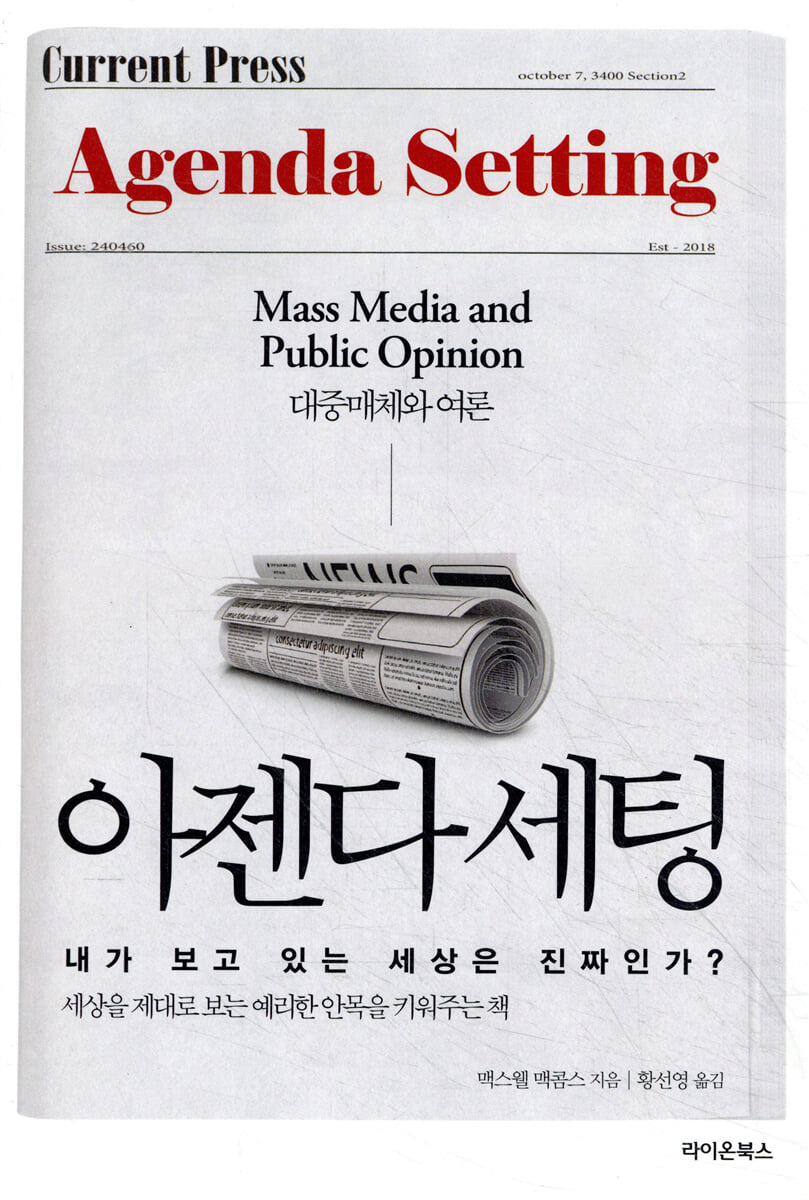
Agenda Setting
 |
Description
Book Introduction
Is the world I see real?
A book that helps you see the world clearly by foreseeing the context of the agenda-setting that controls you!
Agenda setting refers to the way mass media consciously sets the public's thoughts and opinions on current issues.
Translated into Korean, it means ‘agenda setting.’
This refers to the phenomenon in which issues that the media reports as important through news or current affairs programs soon become the 'agenda', and this is eventually transferred to the general public as an important agenda.
It is said that public opinion can be manipulated by influential media, and even public psychology can be manipulated.
Therefore, if we accept new issues and information uncritically, our thoughts will always be 'set'.
We become trapped in the frame created by the media without even realizing it.
Therefore, it is necessary to analyze and judge the agenda unilaterally set by the media from various angles.
The author of this book, Maxwell McCombs, a professor of journalism at Texas State University, coined the term "agenda setting" through the "Chapel Hill" study he conducted in 1968 with fellow researcher Professor Donald Shaw. This led to over 400 follow-up studies being actively conducted around the world, and he became widely known as the true proponent of agenda setting theory.
This book is the culmination of 45 years of research on agenda setting.
Since its first publication in the UK in 2004, it has been translated and published in over 20 languages around the world, including the US, Spain, Poland, Sweden, China, and Japan, and is considered a textbook among journalism majors and those working in the advertising industry.
Knowing the context in which agenda setting occurs allows us to understand reality more objectively and critically.
Filled with original research and engaging content, this book will help you develop a keen eye for the world.
A book that helps you see the world clearly by foreseeing the context of the agenda-setting that controls you!
Agenda setting refers to the way mass media consciously sets the public's thoughts and opinions on current issues.
Translated into Korean, it means ‘agenda setting.’
This refers to the phenomenon in which issues that the media reports as important through news or current affairs programs soon become the 'agenda', and this is eventually transferred to the general public as an important agenda.
It is said that public opinion can be manipulated by influential media, and even public psychology can be manipulated.
Therefore, if we accept new issues and information uncritically, our thoughts will always be 'set'.
We become trapped in the frame created by the media without even realizing it.
Therefore, it is necessary to analyze and judge the agenda unilaterally set by the media from various angles.
The author of this book, Maxwell McCombs, a professor of journalism at Texas State University, coined the term "agenda setting" through the "Chapel Hill" study he conducted in 1968 with fellow researcher Professor Donald Shaw. This led to over 400 follow-up studies being actively conducted around the world, and he became widely known as the true proponent of agenda setting theory.
This book is the culmination of 45 years of research on agenda setting.
Since its first publication in the UK in 2004, it has been translated and published in over 20 languages around the world, including the US, Spain, Poland, Sweden, China, and Japan, and is considered a textbook among journalism majors and those working in the advertising industry.
Knowing the context in which agenda setting occurs allows us to understand reality more objectively and critically.
Filled with original research and engaging content, this book will help you develop a keen eye for the world.
- You can preview some of the book's contents.
Preview
index
introduction
Chapter 1: How Public Opinion Is Formed
Our picture of the world
Contemporary empirical evidence
Accumulating evidence
Cause and effect
New field of communication
To summarize
Chapter 2: Why the News Differs from Reality
Strange picture
A perspective on the effectiveness of agenda setting
Content vs. Exposure
Agenda setting over the past several centuries
To summarize
Chapter 3: The World in Our Heads
Pictures of political candidates
Images of candidates running in the general election
Images of candidates in local elections
The influence of the media on a candidate's image
Attributes of the issue
The nature of environmental problems
The influence of the media on the nature of issues
a persuasive argument
The third step in agenda setting
Attribute agenda setting and framing
To summarize
Chapter 4: Why Agenda Setting Occurs
Relevance and uncertainty
Occurrence of agenda-setting effects
relevance
Personal experiences with public issues
Individual differences, media use, and agenda setting
To summarize
Chapter 5: How Agenda Setting Works
Evolution of the Issue Agenda
Explaining the transfer of importance
How long does it take for the effect to take effect?
Different ways to measure importance
To summarize
Chapter 6: The Effects and Role of Agenda Setting
Ignition of public opinion
Property agenda and opinions
opinion formation
attitudes, opinions, and behaviors
The agenda-setting role of business news
To summarize
Chapter 7: Who Sets the Media Agenda?
The President and the National Agenda
Assisting the media agenda
Occupying the media agenda
Three election agendas
Media Agenda in Local Elections
The nature of regional issues
Three elements of an election
The bigger picture
Agenda setting across media
To summarize
Chapter 8: Expanding Mass Communication and Agenda Setting Theory
Spread of culture
A new agenda-setting stage
Different cultural agendas
Concept, domain, environment
The Continuous Evolution of Agenda Setting Theory
Epilogue: The Convergence of Media Agenda Setting and Audience Agenda
annotation
References
Chapter 1: How Public Opinion Is Formed
Our picture of the world
Contemporary empirical evidence
Accumulating evidence
Cause and effect
New field of communication
To summarize
Chapter 2: Why the News Differs from Reality
Strange picture
A perspective on the effectiveness of agenda setting
Content vs. Exposure
Agenda setting over the past several centuries
To summarize
Chapter 3: The World in Our Heads
Pictures of political candidates
Images of candidates running in the general election
Images of candidates in local elections
The influence of the media on a candidate's image
Attributes of the issue
The nature of environmental problems
The influence of the media on the nature of issues
a persuasive argument
The third step in agenda setting
Attribute agenda setting and framing
To summarize
Chapter 4: Why Agenda Setting Occurs
Relevance and uncertainty
Occurrence of agenda-setting effects
relevance
Personal experiences with public issues
Individual differences, media use, and agenda setting
To summarize
Chapter 5: How Agenda Setting Works
Evolution of the Issue Agenda
Explaining the transfer of importance
How long does it take for the effect to take effect?
Different ways to measure importance
To summarize
Chapter 6: The Effects and Role of Agenda Setting
Ignition of public opinion
Property agenda and opinions
opinion formation
attitudes, opinions, and behaviors
The agenda-setting role of business news
To summarize
Chapter 7: Who Sets the Media Agenda?
The President and the National Agenda
Assisting the media agenda
Occupying the media agenda
Three election agendas
Media Agenda in Local Elections
The nature of regional issues
Three elements of an election
The bigger picture
Agenda setting across media
To summarize
Chapter 8: Expanding Mass Communication and Agenda Setting Theory
Spread of culture
A new agenda-setting stage
Different cultural agendas
Concept, domain, environment
The Continuous Evolution of Agenda Setting Theory
Epilogue: The Convergence of Media Agenda Setting and Audience Agenda
annotation
References
Detailed image

Into the book
Journalists select and deliver news stories every day, focusing our attention on the most important issues of the day and influencing our perceptions.
The role of news in identifying the important issues and topics of the day and in influencing the importance of these issues and topics on the public agenda has come to be called the "agenda-setting role" of news.
--- p.24
As a result, two distinct aspects of agenda setting emerged during the election season.
In summer and early autumn, daily newspapers wielded great influence.
This is because newspapers, which can cover news across dozens of pages, have an advantage over TV news, which only has a 30-minute newscast.
--- p.33
Lippmann argued that our behavior is a response to these fake environments, not to our real ones.
Decades of research on the agenda-setting role of mass media further emphasize the importance of distinguishing between environments and fake environments, as Lippmann does.
--- p.61
As we see with various issues in the 1960s, oil reserves in the 1970s, the drug problem in the 1980s, environmental issues from the 1970s to the 1990s, crime in the 1990s, and crime and shark attacks in the early 21st century, the media agenda bore little resemblance to the historical agenda of the event in question.
But in all of the above cases, the evidence is clear that it is the media and their portrayal of the world that sets the public agenda.
--- p.81
In one laboratory experiment, half of the subjects read a newspaper article about a fictional political candidate who was portrayed as highly corrupt.
The other half read a newspaper article portraying the candidate as a moral person.
Then, when subjects exposed to these contrasting characteristics were asked to describe the candidates, there was a significant difference in the results of the open-ended questions and the closed-ended rating scale.
--- p.99
Conversely, few Americans felt a pang of euphoria when they heard about the sex scandal involving President Bill Clinton and Monica Lewinsky in the late 20th century.
While most Americans found the president's conduct reprehensible, a majority felt it had nothing to do with the office.
Despite the news media's obsession with the scandal, the polls consistently showed Clinton doing a good job as president.
Sometimes, the public feels little desire for orientation, so there is no need to pay attention to the media agenda.
--- p.129
Education influences politics by providing voters with 'diverse' rather than 'deep' knowledge.
It's about increasing the number of issues citizens consider politically relevant and increasing the number of connections they make between their lives and domestic and international events.
--- p.156
When there were more headlines about the "sick economy," consumer sentiment was dampened, while when there were more positive headlines about the economy, consumer sentiment was revitalized.
The media's strong influence was also evident in the relationship between key indicators and headlines about the economy.
--- p.191
The central role that public relations plays in shaping the news agenda is also clearly demonstrated in a comprehensive 2006 study of five major British newspapers and four TV stations.
Nineteen percent of newspaper articles and 17 percent of TV reports were identified as “derived ‘primarily’ or ‘entirely’ from promotional materials or promotional activities.” This percentage increased even further when articles that added additional information to promotional materials were included.
Newspaper articles rose to 30%, and TV reports rose to 31%.
This powerful agenda-setting role of public relations is, in many ways, an inevitable consequence of journalists having to “select and process so many stories under economic, institutional, and organizational constraints.”
--- p.212
Who sets the media agenda? This question, which topics are presented to the public, is particularly important.
Columnist Leonard Pitts observed, “In a world where the media sets the public agenda and dictates the conversation, what the media ignores may as well not exist.”
The role of news in identifying the important issues and topics of the day and in influencing the importance of these issues and topics on the public agenda has come to be called the "agenda-setting role" of news.
--- p.24
As a result, two distinct aspects of agenda setting emerged during the election season.
In summer and early autumn, daily newspapers wielded great influence.
This is because newspapers, which can cover news across dozens of pages, have an advantage over TV news, which only has a 30-minute newscast.
--- p.33
Lippmann argued that our behavior is a response to these fake environments, not to our real ones.
Decades of research on the agenda-setting role of mass media further emphasize the importance of distinguishing between environments and fake environments, as Lippmann does.
--- p.61
As we see with various issues in the 1960s, oil reserves in the 1970s, the drug problem in the 1980s, environmental issues from the 1970s to the 1990s, crime in the 1990s, and crime and shark attacks in the early 21st century, the media agenda bore little resemblance to the historical agenda of the event in question.
But in all of the above cases, the evidence is clear that it is the media and their portrayal of the world that sets the public agenda.
--- p.81
In one laboratory experiment, half of the subjects read a newspaper article about a fictional political candidate who was portrayed as highly corrupt.
The other half read a newspaper article portraying the candidate as a moral person.
Then, when subjects exposed to these contrasting characteristics were asked to describe the candidates, there was a significant difference in the results of the open-ended questions and the closed-ended rating scale.
--- p.99
Conversely, few Americans felt a pang of euphoria when they heard about the sex scandal involving President Bill Clinton and Monica Lewinsky in the late 20th century.
While most Americans found the president's conduct reprehensible, a majority felt it had nothing to do with the office.
Despite the news media's obsession with the scandal, the polls consistently showed Clinton doing a good job as president.
Sometimes, the public feels little desire for orientation, so there is no need to pay attention to the media agenda.
--- p.129
Education influences politics by providing voters with 'diverse' rather than 'deep' knowledge.
It's about increasing the number of issues citizens consider politically relevant and increasing the number of connections they make between their lives and domestic and international events.
--- p.156
When there were more headlines about the "sick economy," consumer sentiment was dampened, while when there were more positive headlines about the economy, consumer sentiment was revitalized.
The media's strong influence was also evident in the relationship between key indicators and headlines about the economy.
--- p.191
The central role that public relations plays in shaping the news agenda is also clearly demonstrated in a comprehensive 2006 study of five major British newspapers and four TV stations.
Nineteen percent of newspaper articles and 17 percent of TV reports were identified as “derived ‘primarily’ or ‘entirely’ from promotional materials or promotional activities.” This percentage increased even further when articles that added additional information to promotional materials were included.
Newspaper articles rose to 30%, and TV reports rose to 31%.
This powerful agenda-setting role of public relations is, in many ways, an inevitable consequence of journalists having to “select and process so many stories under economic, institutional, and organizational constraints.”
--- p.212
Who sets the media agenda? This question, which topics are presented to the public, is particularly important.
Columnist Leonard Pitts observed, “In a world where the media sets the public agenda and dictates the conversation, what the media ignores may as well not exist.”
--- p.238
Publisher's Review
“Is the world I see real?”
A book that helps you develop a keen eye for seeing the world.
What is 'agenda setting'?
1.
Agenda setting.
2.
An act of highlighting an issue intentionally based on vested interests rather than its true nature.
3.
The hidden power that manipulates public sentiment.
"Agenda Setting" is a book about "agenda setting," which states that "public opinion can be manipulated by influential media, and even the public's psychology can be manipulated."
Professor Maxwell McCombs of Texas State University, the author of this book and a proponent of agenda-setting theory, explains, “When the media gives weight to an issue, the general public perceives that issue as important, and as a result, it becomes an important agenda.”
He also acknowledges that “as an entity that exerts no small amount of influence on our society, the media is inherently an agenda setter,” and emphasizes that “we must have a sense of mission and constantly consider whether that agenda is ethically and morally sound.”
By not only raising issues but also disclosing the process in detail, it can be of great help in analyzing and judging issues presented unilaterally by the media from various perspectives.
It thoroughly explains the background, operation process, properties, and effects of agenda setting, and does not miss advice on the role and mission of the agenda setter.
We also introduce the agenda-setting function of online media and social networks, which have emerged rapidly with the advancement of communication technology.
Creating a crisis, increasing anxiety, directing attention, and interfering with judgment
“Today, your thoughts are ‘set’!”
'Agenda setting' is the way mass media consciously sets the public's thoughts and opinions on current issues.
This refers to the phenomenon in which issues that the media reports as important through news or current affairs programs soon become the 'agenda', and this is eventually transferred to the general public as an important agenda.
This means that public opinion can be manipulated by influential media, and even public psychology can be manipulated.
Therefore, if we accept new issues and information uncritically, our thoughts will always be 'set'.
We become trapped in the frame created by the media without even realizing it.
Therefore, it is necessary to analyze and judge the agenda unilaterally set by the media from various angles.
How Your Thoughts Are Manipulated
To put it a bit hyperbolicly, we are not actually seeing the real world.
We are born with a 'blank slate' of thoughts, and as we grow up, the knowledge instilled in us through education fills in the blank slate.
You get information from someone and organize your thoughts by agreeing or disagreeing with the judgment presented by that person.
And as they accumulate, they naturally become accepted as ‘my thoughts’.
Someone else's thoughts become my thoughts.
But this is a misconception.
Because the subject of my thoughts is not me, but the ‘media’ I come into contact with.
It is no exaggeration to say that we live in a 'matrix of thoughts'.
Our daily lives are surrounded by media.
Wherever you go, advertisements await you and all kinds of information pours out nonstop.
Whether we want it or not, our eyes and ears see or hear something.
However, most of the information provided by the media is intentional and based on vested interests.
Professor Maxwell McCombs, author of the book Agenda Setting, quotes journalist Walter Lippmann, saying that “the information provided by the media plays a decisive role in shaping our real world.”
In other words, the world we see is a world ‘set’ by the media.
Some media outlets deny the agenda-setting influence they have on public opinion.
They claim, “We simply report objectively on what is happening in the world.”
Some agenda-setting critics, in addition to their arguments, say that “the public and the media are simply reacting to their surroundings.”
But is that really true?
The world we perceive in our minds is largely inaccurate compared to reality.
Our thoughts simply react to the pseudo-environment created by the media.
Of course, this doesn't mean that the news is 100% fabricated.
Originally, news was a product of verifiable observation.
However, the results may vary depending on how the observation was made.
When the events and situations of each day are refracted as they pass through the frame of the media, the result becomes something that is only a semblance of reality.
Moreover, it is impossible for any media organization to observe and report on every event that occurs.
Therefore, we must collect environmental samples for that day based on the norms.
As a result, the media presents a very limited picture.
It is as limited as the outside world seen through the window.
This is especially true if the windows are covered in dust.
Water riding, burying… the setup continues.
Candidates running for elections set their agendas and make promises to win over large numbers of voters.
And we do everything we can to ensure that the agenda gets the attention of more voters.
The war of nerves between candidates to solidify or undermine the agenda of the candidate or the party to which the candidate belongs cannot be left out.
Even with one agenda, opinions are divided, and it is interpreted in various ways depending on the ‘frame’ that is applied.
Public opinion poll approval ratings are analyzed differently, and even completely different results can be produced depending on the survey method or target.
The general public is confused.
What is the right agenda? But this question is healthy and productive, as it leaves room for judgment.
On the other hand, we have already experienced many instances of powerful agenda-setting influence that cannot be overcome.
Agenda setting is necessary.
No media outlet has the ability to report on every issue.
However, among the numerous issues, we should report on those that are appropriate as public agendas, and we should not try to bury important issues with agendas intended for vested interests.
Moreover, this is not just an issue for large media organizations.
With the advancement of communication technology, social media such as blogs and Twitter, as well as internet broadcasting platforms like YouTube, are emerging as new agenda setters, but these media are by no means free from this concern.
A book for you who can no longer be fooled
『Agenda Setting』 also presents various theories related to agenda setting, such as ‘gatekeeping’, which is the process by which the agenda to be set is selected by news decision makers; ‘framing’, which guides the public’s perception in the direction intended by the media by using selection, emphasis, exclusion, and amplification while providing news; ‘spiral of silence’, which states that the public remains silent rather than expressing their opinion if it is in the minority; and ‘mean world syndrome’, which states that when the public is exposed to violent videos for a long period of time, they come to regard the mean world depicted in the videos as reality.
Additionally, the data presented by the author in boxes and tables adds to understanding and trust.
Knowing the context in which agenda setting occurs allows us to understand reality more objectively and critically.
Filled with original research and engaging content, this book will help you develop a keen eye for the world.
A book that helps you develop a keen eye for seeing the world.
What is 'agenda setting'?
1.
Agenda setting.
2.
An act of highlighting an issue intentionally based on vested interests rather than its true nature.
3.
The hidden power that manipulates public sentiment.
"Agenda Setting" is a book about "agenda setting," which states that "public opinion can be manipulated by influential media, and even the public's psychology can be manipulated."
Professor Maxwell McCombs of Texas State University, the author of this book and a proponent of agenda-setting theory, explains, “When the media gives weight to an issue, the general public perceives that issue as important, and as a result, it becomes an important agenda.”
He also acknowledges that “as an entity that exerts no small amount of influence on our society, the media is inherently an agenda setter,” and emphasizes that “we must have a sense of mission and constantly consider whether that agenda is ethically and morally sound.”
By not only raising issues but also disclosing the process in detail, it can be of great help in analyzing and judging issues presented unilaterally by the media from various perspectives.
It thoroughly explains the background, operation process, properties, and effects of agenda setting, and does not miss advice on the role and mission of the agenda setter.
We also introduce the agenda-setting function of online media and social networks, which have emerged rapidly with the advancement of communication technology.
Creating a crisis, increasing anxiety, directing attention, and interfering with judgment
“Today, your thoughts are ‘set’!”
'Agenda setting' is the way mass media consciously sets the public's thoughts and opinions on current issues.
This refers to the phenomenon in which issues that the media reports as important through news or current affairs programs soon become the 'agenda', and this is eventually transferred to the general public as an important agenda.
This means that public opinion can be manipulated by influential media, and even public psychology can be manipulated.
Therefore, if we accept new issues and information uncritically, our thoughts will always be 'set'.
We become trapped in the frame created by the media without even realizing it.
Therefore, it is necessary to analyze and judge the agenda unilaterally set by the media from various angles.
How Your Thoughts Are Manipulated
To put it a bit hyperbolicly, we are not actually seeing the real world.
We are born with a 'blank slate' of thoughts, and as we grow up, the knowledge instilled in us through education fills in the blank slate.
You get information from someone and organize your thoughts by agreeing or disagreeing with the judgment presented by that person.
And as they accumulate, they naturally become accepted as ‘my thoughts’.
Someone else's thoughts become my thoughts.
But this is a misconception.
Because the subject of my thoughts is not me, but the ‘media’ I come into contact with.
It is no exaggeration to say that we live in a 'matrix of thoughts'.
Our daily lives are surrounded by media.
Wherever you go, advertisements await you and all kinds of information pours out nonstop.
Whether we want it or not, our eyes and ears see or hear something.
However, most of the information provided by the media is intentional and based on vested interests.
Professor Maxwell McCombs, author of the book Agenda Setting, quotes journalist Walter Lippmann, saying that “the information provided by the media plays a decisive role in shaping our real world.”
In other words, the world we see is a world ‘set’ by the media.
Some media outlets deny the agenda-setting influence they have on public opinion.
They claim, “We simply report objectively on what is happening in the world.”
Some agenda-setting critics, in addition to their arguments, say that “the public and the media are simply reacting to their surroundings.”
But is that really true?
The world we perceive in our minds is largely inaccurate compared to reality.
Our thoughts simply react to the pseudo-environment created by the media.
Of course, this doesn't mean that the news is 100% fabricated.
Originally, news was a product of verifiable observation.
However, the results may vary depending on how the observation was made.
When the events and situations of each day are refracted as they pass through the frame of the media, the result becomes something that is only a semblance of reality.
Moreover, it is impossible for any media organization to observe and report on every event that occurs.
Therefore, we must collect environmental samples for that day based on the norms.
As a result, the media presents a very limited picture.
It is as limited as the outside world seen through the window.
This is especially true if the windows are covered in dust.
Water riding, burying… the setup continues.
Candidates running for elections set their agendas and make promises to win over large numbers of voters.
And we do everything we can to ensure that the agenda gets the attention of more voters.
The war of nerves between candidates to solidify or undermine the agenda of the candidate or the party to which the candidate belongs cannot be left out.
Even with one agenda, opinions are divided, and it is interpreted in various ways depending on the ‘frame’ that is applied.
Public opinion poll approval ratings are analyzed differently, and even completely different results can be produced depending on the survey method or target.
The general public is confused.
What is the right agenda? But this question is healthy and productive, as it leaves room for judgment.
On the other hand, we have already experienced many instances of powerful agenda-setting influence that cannot be overcome.
Agenda setting is necessary.
No media outlet has the ability to report on every issue.
However, among the numerous issues, we should report on those that are appropriate as public agendas, and we should not try to bury important issues with agendas intended for vested interests.
Moreover, this is not just an issue for large media organizations.
With the advancement of communication technology, social media such as blogs and Twitter, as well as internet broadcasting platforms like YouTube, are emerging as new agenda setters, but these media are by no means free from this concern.
A book for you who can no longer be fooled
『Agenda Setting』 also presents various theories related to agenda setting, such as ‘gatekeeping’, which is the process by which the agenda to be set is selected by news decision makers; ‘framing’, which guides the public’s perception in the direction intended by the media by using selection, emphasis, exclusion, and amplification while providing news; ‘spiral of silence’, which states that the public remains silent rather than expressing their opinion if it is in the minority; and ‘mean world syndrome’, which states that when the public is exposed to violent videos for a long period of time, they come to regard the mean world depicted in the videos as reality.
Additionally, the data presented by the author in boxes and tables adds to understanding and trust.
Knowing the context in which agenda setting occurs allows us to understand reality more objectively and critically.
Filled with original research and engaging content, this book will help you develop a keen eye for the world.
GOODS SPECIFICS
- Publication date: December 30, 2021
- Page count, weight, size: 348 pages | 622g | 152*225*30mm
- ISBN13: 9788994643878
- ISBN10: 8994643877
You may also like
카테고리
korean


korean

![GQ KOREA Mark (Monthly): December [2025]](http://librairie.coreenne.fr/cdn/shop/files/8ef265dbbfbf186523ed75ba7319009d.jpg?v=1765340328&width=3840)


