

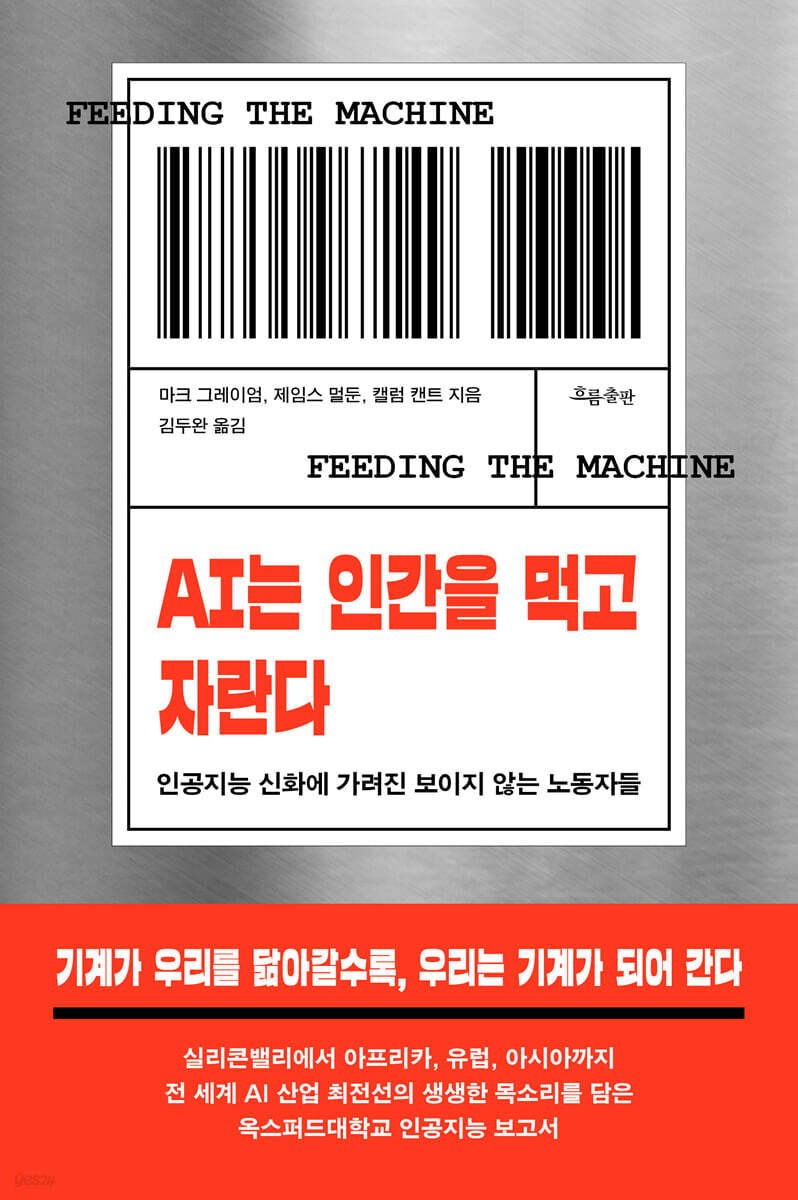
AI feeds on humans
 |
Description
Book Introduction
- A word from MD
-
When to avoid indiscriminate use of AIMany people use AI.
It makes daily life easier and brings joy.
However, after reading this book, you won't be able to use AI as easily as before. Ultimately, it's humans who drive AI.
This is because AI operates on the fuel of low-wage, simple labor and the pain of creators.
May 27, 2025. Social and Political PD Son Min-gyu
"AI Feeds on Humans" illuminates the hidden side of the artificial intelligence revolution sweeping the globe. AI is an "extractive machine" that operates by absorbing human labor, creativity, and even emotions.
The conveniences of AI we enjoy in our daily lives are built on the invisible labor of countless people, including data annotators, content reviewers, and logistics workers.
Researchers at the Oxford University Internet Institute, who have conducted on-site research in over 30 countries over the past decade, present seven vivid case studies showing how AI alienates workers, robs creativity, deepens inequality, and threatens democracy.
At the same time, it presents concrete alternatives for a fairer and more sustainable digital future.
This book is a powerful reportage and insightful record that exposes the current state of artificial intelligence and asks what future we can choose.
What is an Extraction Machine?
A technological and economic structure that absorbs human resources such as knowledge, emotions, creativity, time, and physical labor to create data, which is then processed through algorithms and converted into capital and power.
The conveniences of AI we enjoy in our daily lives are built on the invisible labor of countless people, including data annotators, content reviewers, and logistics workers.
Researchers at the Oxford University Internet Institute, who have conducted on-site research in over 30 countries over the past decade, present seven vivid case studies showing how AI alienates workers, robs creativity, deepens inequality, and threatens democracy.
At the same time, it presents concrete alternatives for a fairer and more sustainable digital future.
This book is a powerful reportage and insightful record that exposes the current state of artificial intelligence and asks what future we can choose.
What is an Extraction Machine?
A technological and economic structure that absorbs human resources such as knowledge, emotions, creativity, time, and physical labor to create data, which is then processed through algorithms and converted into capital and power.
- You can preview some of the book's contents.
Preview
index
Preface: The Age of Extraction Machines and the Invisible Workers
Chapter 1.
As machines become more like us, we become machines: Gulu, Uganda, data annotator
Mechanical, simple, and predictable labor | Gang system: We'll squeeze you.
How Machines Learn | Machines Grow by Eating Humans | The World Is Not Flat
Chapter 2. AI Doesn't Think: Machine Learning Engineer, London, UK
Can AI Replace Us? | Algorithmophobia | The Last Judgment
Digital Eugenics | The Illusion of Fairness
Chapter 3.
Data Center of Ice and Fire: Iceland, Technician
No AI without cooling and power | The data artery connecting the world
Seize Infrastructure Power | Why Google Is Drinking Our Town's Water | The AI Arms Race
Chapter 4.
Who is the owner of your voice?: Irish, artist
Art without Artists, Creativity without Humans | Creativity Test: Can AI Be Truly Creative?
"At that moment, Werther's conception was complete." | The line separating imitation and creation.
Don't be afraid of the curse of newness
Chapter 5.
Stop the Machine: Logistics Workers in Coventry, UK
Speed is determined by the system | Introducing Amazon's Extraction Machine
AI Surveillance: From Commute to Commute | Stop the Machines
Chapter 6.
Dictators Who Protect Freedom: Silicon Valley, Investors
The Gold Rush | A History of California Venture Capital | Technology Without Democracy
Self-rationalization or a choice for a better future?
Chapter 7.
People Against the Old Future: Trade Union Activists in Nairobi, Nigeria
Africa's First Data Workers' Union | So What's Changed?
Beyond the border
Chapter 8.
Redesigning Machines: Labor Strategies in the Age of AI
Strengthen the collective power of trade unions and worker organizations.
Civil society systematically checks corporations and holds them accountable.
Introduce strict regulations
Seek a structure that allows workers to participate in management.
Fighting against the inequality and injustice of the system
Conclusion: Looking at the Gaza Strip in Israel
Acknowledgements
Huzhou
Chapter 1.
As machines become more like us, we become machines: Gulu, Uganda, data annotator
Mechanical, simple, and predictable labor | Gang system: We'll squeeze you.
How Machines Learn | Machines Grow by Eating Humans | The World Is Not Flat
Chapter 2. AI Doesn't Think: Machine Learning Engineer, London, UK
Can AI Replace Us? | Algorithmophobia | The Last Judgment
Digital Eugenics | The Illusion of Fairness
Chapter 3.
Data Center of Ice and Fire: Iceland, Technician
No AI without cooling and power | The data artery connecting the world
Seize Infrastructure Power | Why Google Is Drinking Our Town's Water | The AI Arms Race
Chapter 4.
Who is the owner of your voice?: Irish, artist
Art without Artists, Creativity without Humans | Creativity Test: Can AI Be Truly Creative?
"At that moment, Werther's conception was complete." | The line separating imitation and creation.
Don't be afraid of the curse of newness
Chapter 5.
Stop the Machine: Logistics Workers in Coventry, UK
Speed is determined by the system | Introducing Amazon's Extraction Machine
AI Surveillance: From Commute to Commute | Stop the Machines
Chapter 6.
Dictators Who Protect Freedom: Silicon Valley, Investors
The Gold Rush | A History of California Venture Capital | Technology Without Democracy
Self-rationalization or a choice for a better future?
Chapter 7.
People Against the Old Future: Trade Union Activists in Nairobi, Nigeria
Africa's First Data Workers' Union | So What's Changed?
Beyond the border
Chapter 8.
Redesigning Machines: Labor Strategies in the Age of AI
Strengthen the collective power of trade unions and worker organizations.
Civil society systematically checks corporations and holds them accountable.
Introduce strict regulations
Seek a structure that allows workers to participate in management.
Fighting against the inequality and injustice of the system
Conclusion: Looking at the Gaza Strip in Israel
Acknowledgements
Huzhou
Detailed image

Into the book
Artificial intelligence is often called a mirror reflecting human intelligence.
This could be said to be an attempt to solve intelligence by reproducing the human thought process.
But from the perspective we've developed in this book, AI is more of an extraction machine.
When we, as consumers, use AI products, what we see is only the superficial results.
But beneath that sleek exterior lies a complex network of extraction machines needed to power AI.
Extraction machines absorb core elements—capital, power, natural resources, human labor, data, and collective intelligence—and transform them into statistical predictions. AI companies then convert these into profits. Understanding AI as a single machine, or extractive machine, is an attempt to strip away the veneer of objectivity and neutrality it purports to possess.
All machines have a history, designed and built by humans for specific periods and purposes. AI is also deeply rooted in existing political and economic systems.
Every process of classifying, discriminating, and predicting data reflects the interests and power structures of those who created it.
--- From the "Preface"
When we think of AI development, we often picture engineers working in air-conditioned, swanky offices in Palo Alto or Menlo Park.
Yet, roughly 80 percent of the time required for AI training is spent annotating datasets.9 Cutting-edge technologies like self-driving cars, microsurgical instruments, and unmanned drones all originate in places like Gulu.
As technology critic Phil Jones puts it, “The magic of machine learning is really just the hard work of sorting through data.” But this heavy lifting is often outsourced to third-party providers.
The data annotation market is booming worldwide.
It was valued at $2.22 billion in 2022 alone and is growing at about 30 percent annually.
It is projected to reach $17 billion by 2030.
--- From "Chapter 1"
The process of creating AI is far from this ideal picture.
Technology is not a gift from the gods, as the ancient Greeks imagined.25 Technology is designed and developed by humans, and it fully reflects the worldview and values of the humans who created it.
Technology may seem like mathematics at first glance.
It operates according to abstract, universal laws, and always appears to be 'true'.
From this perspective, certain technologies are simply considered tools for problem solving, and can be freely utilized according to the user's intention.
But a closer look reveals that these tech products are not free from certain values and desires.
Rather, a system of knowledge and power is cleverly designed within it.
Any technology cannot be completely separated from the environment in which it was created. AI is no exception. The development of AI is deeply influenced by various economic factors, the cultural backgrounds of its developers, and the values of the societies in which they live.
Therefore, it is very dangerous to assume that AI is neutral and unbiased.
--- From Chapter 2
To survive the AI arms race, we need to build an AI development ecosystem.
Building a development ecosystem requires enhancing competitiveness in various areas, including securing rare minerals, building data centers, establishing AI research labs, and attracting talent.
Although some rare minerals can be mined in Western countries, most rare mineral deposits are found in developing countries in the Global South.
This increases the likelihood of resource extraction in the region, which could lead to problems such as labor rights violations, environmental destruction, and unfair trade agreements.
--- From Chapter 3
The real danger the AI revolution poses to art is not the disappearance of human-created art, but rather the possibility that this technology could be abused by those in power to exploit creators and maximize corporate profits.
Large commercial studios will try to automate as many processes as possible, so that even when they do hire human creators, they spend as little as possible.
How technologies are actually used is determined by complex social and economic factors.
Generative AI is being criticized because it is seen as a cheap "shortcut" to replacing art, which could deprive creators of the opportunity to receive fair compensation.
--- From Chapter 4
As AI technologies are introduced into the workplace, new forms of surveillance and control are likely to proliferate.
Office workers, who were once relatively autonomous, will increasingly find themselves in a position similar to Alex.
The phenomenon of increased labor intensity is spreading across the distribution, hospitality, and service industries. AI surveillance technology plays two roles in the workplace.
One is to reduce production costs (at the expense of job quality, worker autonomy, and basic democratic rights); the other is to weaken workers' rights and strengthen management's power.
--- From Chapter 5
The principles that govern technological progress are quite different from the laws of physics that caused an apple to fall on Newton's head.
Technology is a social force, and the factors that determine technology are the same social rules we experience in our daily lives.
In other words, the logic of profit, growth, expansion, and domination drives technological development.
To truly understand technology, we must examine the systems that shape it and the conflicts that arise within it.
--- From Chapter 6
We too refuse to become raw materials fed into AI extraction machines.
We too are determined to stop the machines in the face of a system that extracts profits by grinding out human labor.
And I want to move it and make it clear to those who own it.
If Lee were not free, the machine would never work.
This could be said to be an attempt to solve intelligence by reproducing the human thought process.
But from the perspective we've developed in this book, AI is more of an extraction machine.
When we, as consumers, use AI products, what we see is only the superficial results.
But beneath that sleek exterior lies a complex network of extraction machines needed to power AI.
Extraction machines absorb core elements—capital, power, natural resources, human labor, data, and collective intelligence—and transform them into statistical predictions. AI companies then convert these into profits. Understanding AI as a single machine, or extractive machine, is an attempt to strip away the veneer of objectivity and neutrality it purports to possess.
All machines have a history, designed and built by humans for specific periods and purposes. AI is also deeply rooted in existing political and economic systems.
Every process of classifying, discriminating, and predicting data reflects the interests and power structures of those who created it.
--- From the "Preface"
When we think of AI development, we often picture engineers working in air-conditioned, swanky offices in Palo Alto or Menlo Park.
Yet, roughly 80 percent of the time required for AI training is spent annotating datasets.9 Cutting-edge technologies like self-driving cars, microsurgical instruments, and unmanned drones all originate in places like Gulu.
As technology critic Phil Jones puts it, “The magic of machine learning is really just the hard work of sorting through data.” But this heavy lifting is often outsourced to third-party providers.
The data annotation market is booming worldwide.
It was valued at $2.22 billion in 2022 alone and is growing at about 30 percent annually.
It is projected to reach $17 billion by 2030.
--- From "Chapter 1"
The process of creating AI is far from this ideal picture.
Technology is not a gift from the gods, as the ancient Greeks imagined.25 Technology is designed and developed by humans, and it fully reflects the worldview and values of the humans who created it.
Technology may seem like mathematics at first glance.
It operates according to abstract, universal laws, and always appears to be 'true'.
From this perspective, certain technologies are simply considered tools for problem solving, and can be freely utilized according to the user's intention.
But a closer look reveals that these tech products are not free from certain values and desires.
Rather, a system of knowledge and power is cleverly designed within it.
Any technology cannot be completely separated from the environment in which it was created. AI is no exception. The development of AI is deeply influenced by various economic factors, the cultural backgrounds of its developers, and the values of the societies in which they live.
Therefore, it is very dangerous to assume that AI is neutral and unbiased.
--- From Chapter 2
To survive the AI arms race, we need to build an AI development ecosystem.
Building a development ecosystem requires enhancing competitiveness in various areas, including securing rare minerals, building data centers, establishing AI research labs, and attracting talent.
Although some rare minerals can be mined in Western countries, most rare mineral deposits are found in developing countries in the Global South.
This increases the likelihood of resource extraction in the region, which could lead to problems such as labor rights violations, environmental destruction, and unfair trade agreements.
--- From Chapter 3
The real danger the AI revolution poses to art is not the disappearance of human-created art, but rather the possibility that this technology could be abused by those in power to exploit creators and maximize corporate profits.
Large commercial studios will try to automate as many processes as possible, so that even when they do hire human creators, they spend as little as possible.
How technologies are actually used is determined by complex social and economic factors.
Generative AI is being criticized because it is seen as a cheap "shortcut" to replacing art, which could deprive creators of the opportunity to receive fair compensation.
--- From Chapter 4
As AI technologies are introduced into the workplace, new forms of surveillance and control are likely to proliferate.
Office workers, who were once relatively autonomous, will increasingly find themselves in a position similar to Alex.
The phenomenon of increased labor intensity is spreading across the distribution, hospitality, and service industries. AI surveillance technology plays two roles in the workplace.
One is to reduce production costs (at the expense of job quality, worker autonomy, and basic democratic rights); the other is to weaken workers' rights and strengthen management's power.
--- From Chapter 5
The principles that govern technological progress are quite different from the laws of physics that caused an apple to fall on Newton's head.
Technology is a social force, and the factors that determine technology are the same social rules we experience in our daily lives.
In other words, the logic of profit, growth, expansion, and domination drives technological development.
To truly understand technology, we must examine the systems that shape it and the conflicts that arise within it.
--- From Chapter 6
We too refuse to become raw materials fed into AI extraction machines.
We too are determined to stop the machines in the face of a system that extracts profits by grinding out human labor.
And I want to move it and make it clear to those who own it.
If Lee were not free, the machine would never work.
--- From the "Conclusion"
Publisher's Review
How AI Displaces Labor and Steals Creativity
Completed over 10 years, with researchers from over 30 countries and hundreds of field interviews.
Oxford University Artificial Intelligence Report
We now live in an age where even imagination has been automated.
“Change our family photo to Ghibli style.” With just one command, in a few minutes, you can create a picture that captures the unique personality of your cute and pretty child while also imbuing it with Hayao Miyazaki’s signature warm and dreamy sensibility.
If you say, “Turn my poem into a song in the style of the band Coldplay,” you can have a song done in less than 10 minutes.
But there is no free lunch in this world.
OpenAI, which provides ChatGPT, said that requests for Ghibli-style drawings are skyrocketing, generating millions of images a day, consuming tens of terabytes of data and massive GPU computing resources and power.
OpenAI CEO Sam Altman highlighted the phenomenon's explosive popularity, saying, "We're having our servers melt down because of requests for Ghibli-style images."
AI technology is now moving beyond mere entertainment and is deeply penetrating every aspect of our daily lives, including search, advertising, education, home appliances, and automobiles.
But technology is so magical that we rarely ask how it actually works. Science fiction writer and futurist Arthur C. Clarke once said, "Any sufficiently advanced technology is indistinguishable from magic."
Today's AI truly seems like magic.
It answers users' questions instantly and seems to create pictures and music just from imagination.
But not many people really know what's going on behind the scenes.
As machines become more like us, we become machines.
As everyone cheers the promise and future of AI, "AI Feeds on Humans" confronts the other side of this magic, posing uncomfortable questions. Is AI truly autonomous? Where does AI's creativity and convenience come from? Is AI truly as impartial as God? And how does this entire process work, and are there any inherent flaws? This book is a research paper and vivid reportage based on over a decade of global travel, interviewing and documenting hundreds of AI industry professionals. It was written by Professor Mark Graham of the Oxford University Internet Institute and Professors James Muldoon and Callum Cant of the University of Essex.
In the book, the authors meet people working on the front lines of the AI industry, including data annotators, content reviewers, voice actors, logistics workers, engineers, investors, and labor activists, and through their voices, they delve into the nature and structure of AI.
“Machines grow by eating humans.
It swallows up our labor, our creation, our time.
And then it turns that into data and statistics and gives it back to us.” - From the text
The book's core message is simple but powerful.
The authors argue that today's AI should be understood as an 'extraction machine'.
An extractive machine is a structural device that absorbs human knowledge, emotions, creativity, and labor to create data, and then processes this data into algorithms to generate profit.
Data doesn't fall from the sky. For AI to exist, the dedication of "invisible workers" is essential.
The AI services we use every day are the result of someone's repetitive clicking, tagging, and categorizing work.
This data is a product of human labor, imbued with time, emotion, judgment, and physical activity.
In this way, AI is a system that operates by extracting value from human life, and is by no means a neutral technology.
The authors argue that AI is not a tool for liberating humans, but rather a mechanism for concealing, extracting, and controlling labor, as it is designed for specific purposes and interests.
In the process, labor becomes increasingly invisible, creativity is reduced to code, and our daily lives are reorganized by the logic of algorithms.
Therefore, we must break free from the illusion that technology is 'objective'.
Algorithms are not neutral calculations, but devices that implement specific worldviews and power relations.
The authors call this “digital coloniality.”
Just as empires of the past amassed wealth by extracting resources and labor from their colonies, today's Big Tech companies are extracting data and labor from the Global South to generate profits in the Global North.
“Today’s AI industry is simply the latest version of a colonial exploitative structure, and this system is thoroughly designed to prevent workers from changing the structure itself.” - From the text
“It’s like reading a dystopian novel” - Publisher’s Weekly
The story of seven people who breathe life into the extraction machine.
How this extraction machine works is vividly revealed through the narratives of the characters appearing in the book.
For example, Mercy, a Kenyan content reviewer introduced in the introduction, works for Meta's subcontractor, reviewing hundreds of posts a day to filter out violence and hate.
Then one day, she sees her grandfather in a video of a traffic accident.
Despite the pain and shock, she had to watch the video to the end and make a judgment.
Her feelings and pain are not taken into account within the system.
Anita (Chapter 1), a data annotator from Uganda, manually categorizes the data needed to train autonomous vehicles.
She sits in front of her computer for more than ten hours a day, tagging small details like eye blinks or traffic lights.
“Machines need people like me to become smarter,” she says, taking pride in her work, but it’s a three-month contract, earning just $1.60 a day.
Human creativity is also food for the extraction machine.
Irish voice actor Laura (Chapter 4) is shocked to learn that her voice has been used to train AI without her consent.
Her voice is not just a sound, it is art and her identity.
But AI is extracting artistry and humanity and turning it into profit.
In this process, artists' place is disappearing.
Meanwhile, Alex (Chapter 5), a worker at an Amazon fulfillment center in Coventry, England, lives under an AI-based surveillance system, feeling like a machine.
In the name of efficiency, he is increasingly reduced to a number, not a human being.
Is human labor the only food source for AI? Following the daily life of Einar, an Icelandic data center technician we meet in Chapter 3, reveals a new insight: AI requires massive power and cooling resources.
A single data center consumes a similar amount of electricity and water as a small American city. AI is extracting resources not only from humans but also from the planet.
The case of Tyler (Chapter 6), a venture capitalist in Silicon Valley, is even more shocking from a democratic perspective.
He invests in AI startups and directs them to move data annotation work to areas with cheaper labor.
His one decision determines the lives of countless workers, but for Tyler, the only thing that matters is the return on his investment.
In this way, AI can become a tool that undermines fair rules in society and threatens democracy in the long run, as it allows a small number of powerful people to control the majority more precisely and efficiently.
The path of technological development is not inevitable, but rather a choice.
Based on that choice, social structure is determined and power is created.
And we may be at the last moment when we can redesign that power.
The authors emphasize that the moment we begin to believe that AI truly understands us, we should question the technology rather than simply admire it.
How was this system built, and at whose expense is it maintained?
What data do we provide, and through whose labor do we receive the results?
This question emphasizes the responsibility that those who use technology must bear.
How to Design Human-Centered Artificial Intelligence
"AI grows by eating humans" is not a simple accusation.
There is also a small but clear hope that machines can be redesigned.
In fact, the Kenyan inspectors we meet in Chapter 7 formed the world's first digital workers' union to defend their labor rights against Big Tech companies.
Amazon fulfillment center workers in the UK also went on strike to improve their inhumane working conditions, and the strike fever spread beyond the UK to Europe and Canada.
The book presents concrete alternatives, including civil society's power over technological surveillance, democratic control over algorithm design, and legal protections for platform workers.
This book is also the most sophisticated compass for tracking the present and future of AI technology. It structurally maps out how AI is created and operates, what resources and relationships sustain it, and what direction it will evolve in. It asks not what AI enables, but what it excludes.
That is the essential question this book poses.
Only when we understand how the search engines, voice commands, image generators, chatbots, and self-driving cars we use ultimately operate on the labor of certain people and the logic of certain systems will AI finally break free from its mystery and become a reality.
What makes this book important is that it offers a critical reflection on technology and concrete possibilities for creating a more just and sustainable digital future.
This is why we should read this book.
Completed over 10 years, with researchers from over 30 countries and hundreds of field interviews.
Oxford University Artificial Intelligence Report
We now live in an age where even imagination has been automated.
“Change our family photo to Ghibli style.” With just one command, in a few minutes, you can create a picture that captures the unique personality of your cute and pretty child while also imbuing it with Hayao Miyazaki’s signature warm and dreamy sensibility.
If you say, “Turn my poem into a song in the style of the band Coldplay,” you can have a song done in less than 10 minutes.
But there is no free lunch in this world.
OpenAI, which provides ChatGPT, said that requests for Ghibli-style drawings are skyrocketing, generating millions of images a day, consuming tens of terabytes of data and massive GPU computing resources and power.
OpenAI CEO Sam Altman highlighted the phenomenon's explosive popularity, saying, "We're having our servers melt down because of requests for Ghibli-style images."
AI technology is now moving beyond mere entertainment and is deeply penetrating every aspect of our daily lives, including search, advertising, education, home appliances, and automobiles.
But technology is so magical that we rarely ask how it actually works. Science fiction writer and futurist Arthur C. Clarke once said, "Any sufficiently advanced technology is indistinguishable from magic."
Today's AI truly seems like magic.
It answers users' questions instantly and seems to create pictures and music just from imagination.
But not many people really know what's going on behind the scenes.
As machines become more like us, we become machines.
As everyone cheers the promise and future of AI, "AI Feeds on Humans" confronts the other side of this magic, posing uncomfortable questions. Is AI truly autonomous? Where does AI's creativity and convenience come from? Is AI truly as impartial as God? And how does this entire process work, and are there any inherent flaws? This book is a research paper and vivid reportage based on over a decade of global travel, interviewing and documenting hundreds of AI industry professionals. It was written by Professor Mark Graham of the Oxford University Internet Institute and Professors James Muldoon and Callum Cant of the University of Essex.
In the book, the authors meet people working on the front lines of the AI industry, including data annotators, content reviewers, voice actors, logistics workers, engineers, investors, and labor activists, and through their voices, they delve into the nature and structure of AI.
“Machines grow by eating humans.
It swallows up our labor, our creation, our time.
And then it turns that into data and statistics and gives it back to us.” - From the text
The book's core message is simple but powerful.
The authors argue that today's AI should be understood as an 'extraction machine'.
An extractive machine is a structural device that absorbs human knowledge, emotions, creativity, and labor to create data, and then processes this data into algorithms to generate profit.
Data doesn't fall from the sky. For AI to exist, the dedication of "invisible workers" is essential.
The AI services we use every day are the result of someone's repetitive clicking, tagging, and categorizing work.
This data is a product of human labor, imbued with time, emotion, judgment, and physical activity.
In this way, AI is a system that operates by extracting value from human life, and is by no means a neutral technology.
The authors argue that AI is not a tool for liberating humans, but rather a mechanism for concealing, extracting, and controlling labor, as it is designed for specific purposes and interests.
In the process, labor becomes increasingly invisible, creativity is reduced to code, and our daily lives are reorganized by the logic of algorithms.
Therefore, we must break free from the illusion that technology is 'objective'.
Algorithms are not neutral calculations, but devices that implement specific worldviews and power relations.
The authors call this “digital coloniality.”
Just as empires of the past amassed wealth by extracting resources and labor from their colonies, today's Big Tech companies are extracting data and labor from the Global South to generate profits in the Global North.
“Today’s AI industry is simply the latest version of a colonial exploitative structure, and this system is thoroughly designed to prevent workers from changing the structure itself.” - From the text
“It’s like reading a dystopian novel” - Publisher’s Weekly
The story of seven people who breathe life into the extraction machine.
How this extraction machine works is vividly revealed through the narratives of the characters appearing in the book.
For example, Mercy, a Kenyan content reviewer introduced in the introduction, works for Meta's subcontractor, reviewing hundreds of posts a day to filter out violence and hate.
Then one day, she sees her grandfather in a video of a traffic accident.
Despite the pain and shock, she had to watch the video to the end and make a judgment.
Her feelings and pain are not taken into account within the system.
Anita (Chapter 1), a data annotator from Uganda, manually categorizes the data needed to train autonomous vehicles.
She sits in front of her computer for more than ten hours a day, tagging small details like eye blinks or traffic lights.
“Machines need people like me to become smarter,” she says, taking pride in her work, but it’s a three-month contract, earning just $1.60 a day.
Human creativity is also food for the extraction machine.
Irish voice actor Laura (Chapter 4) is shocked to learn that her voice has been used to train AI without her consent.
Her voice is not just a sound, it is art and her identity.
But AI is extracting artistry and humanity and turning it into profit.
In this process, artists' place is disappearing.
Meanwhile, Alex (Chapter 5), a worker at an Amazon fulfillment center in Coventry, England, lives under an AI-based surveillance system, feeling like a machine.
In the name of efficiency, he is increasingly reduced to a number, not a human being.
Is human labor the only food source for AI? Following the daily life of Einar, an Icelandic data center technician we meet in Chapter 3, reveals a new insight: AI requires massive power and cooling resources.
A single data center consumes a similar amount of electricity and water as a small American city. AI is extracting resources not only from humans but also from the planet.
The case of Tyler (Chapter 6), a venture capitalist in Silicon Valley, is even more shocking from a democratic perspective.
He invests in AI startups and directs them to move data annotation work to areas with cheaper labor.
His one decision determines the lives of countless workers, but for Tyler, the only thing that matters is the return on his investment.
In this way, AI can become a tool that undermines fair rules in society and threatens democracy in the long run, as it allows a small number of powerful people to control the majority more precisely and efficiently.
The path of technological development is not inevitable, but rather a choice.
Based on that choice, social structure is determined and power is created.
And we may be at the last moment when we can redesign that power.
The authors emphasize that the moment we begin to believe that AI truly understands us, we should question the technology rather than simply admire it.
How was this system built, and at whose expense is it maintained?
What data do we provide, and through whose labor do we receive the results?
This question emphasizes the responsibility that those who use technology must bear.
How to Design Human-Centered Artificial Intelligence
"AI grows by eating humans" is not a simple accusation.
There is also a small but clear hope that machines can be redesigned.
In fact, the Kenyan inspectors we meet in Chapter 7 formed the world's first digital workers' union to defend their labor rights against Big Tech companies.
Amazon fulfillment center workers in the UK also went on strike to improve their inhumane working conditions, and the strike fever spread beyond the UK to Europe and Canada.
The book presents concrete alternatives, including civil society's power over technological surveillance, democratic control over algorithm design, and legal protections for platform workers.
This book is also the most sophisticated compass for tracking the present and future of AI technology. It structurally maps out how AI is created and operates, what resources and relationships sustain it, and what direction it will evolve in. It asks not what AI enables, but what it excludes.
That is the essential question this book poses.
Only when we understand how the search engines, voice commands, image generators, chatbots, and self-driving cars we use ultimately operate on the labor of certain people and the logic of certain systems will AI finally break free from its mystery and become a reality.
What makes this book important is that it offers a critical reflection on technology and concrete possibilities for creating a more just and sustainable digital future.
This is why we should read this book.
GOODS SPECIFICS
- Date of issue: May 19, 2025
- Page count, weight, size: 348 pages | 496g | 145*218*25mm
- ISBN13: 9788965967149
- ISBN10: 8965967147
You may also like
카테고리
korean


korean

![GQ KOREA Mark (Monthly): December [2025]](http://librairie.coreenne.fr/cdn/shop/files/8ef265dbbfbf186523ed75ba7319009d.jpg?v=1765340328&width=3840)


