

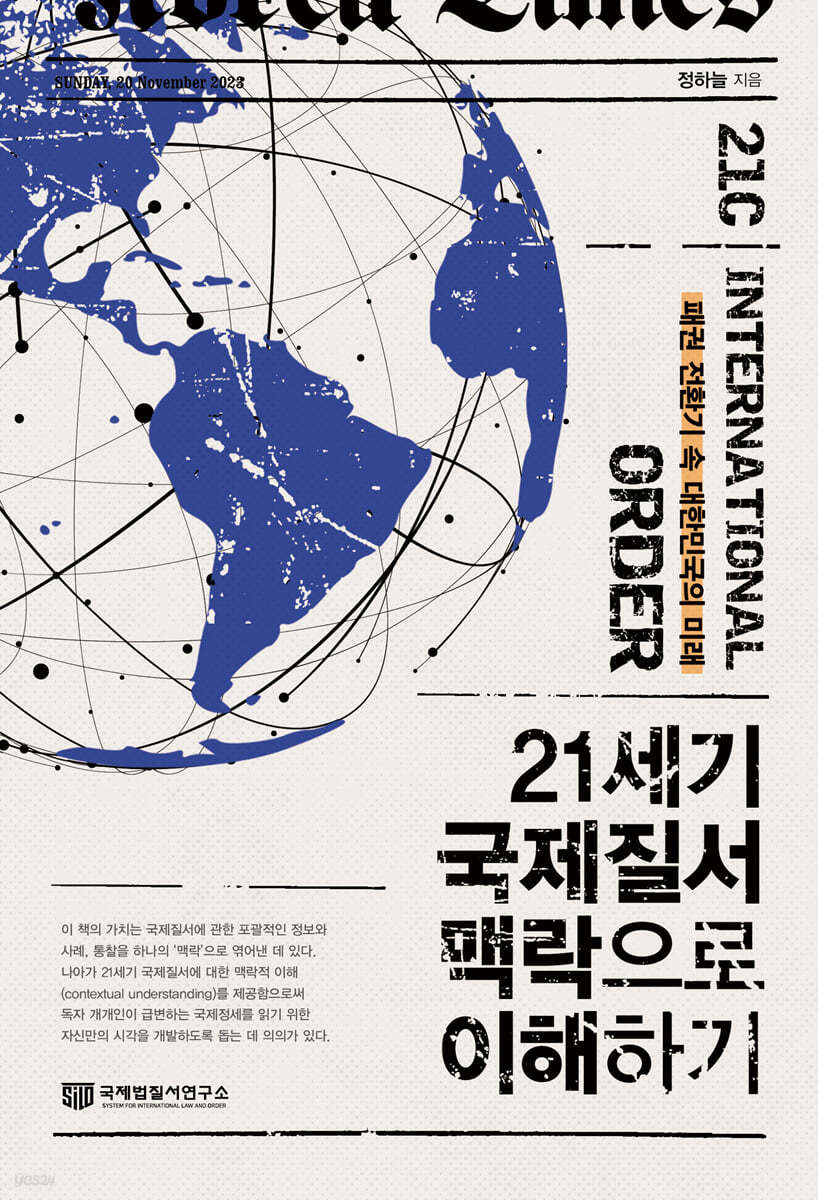
Understanding in the context of the 21st century international order
 |
Description
Book Introduction
In today's world, where urgent international news is pouring in, literacy in reading international affairs has become an essential skill for everyone.
However, in order to accurately interpret the complex international situation and develop one's own response strategy, one must first understand the underlying international order.
However, the international order, which has been formed through the accumulation of human history, politics, economics, ideology, and technological development over thousands of years, can only be understood through its context.
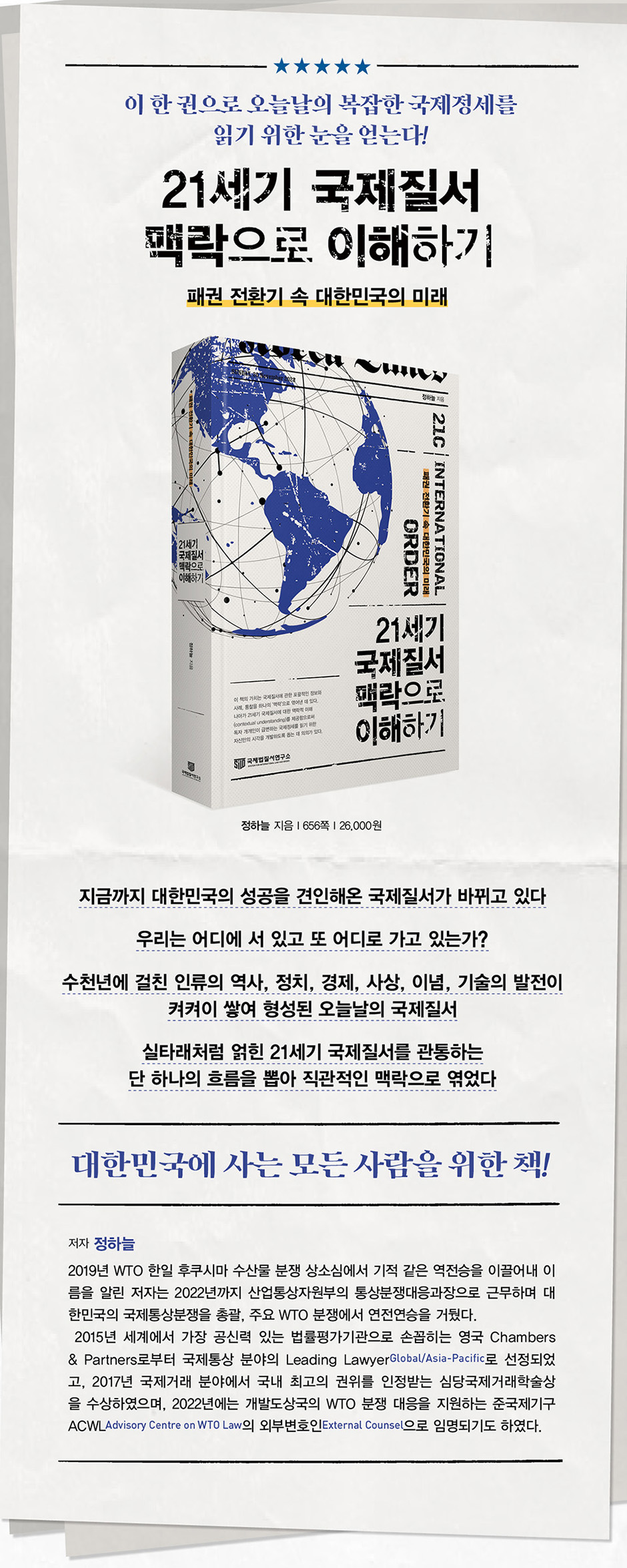
“Understanding the 21st Century International Order in the Context of Hegemony Transition: The Future of the Republic of Korea” is a book that unravels the complexly intertwined international order into a single flow for readers.
By tracing the evolution of the international order in accordance with human history and the evolution of thought, this book shows the path the current international order has taken to reach the present day and the changes it has brought about in human history.
It also provides an easy and in-depth explanation of what exactly the US-centric "liberal international order" was that emerged after the Cold War and persisted until recently, and what changes China's rise as a superpower in the 21st century has brought to the current international order.
Furthermore, we analyze the impact of the recently changing international order on our lives, the individual plans of major countries within this changing international order, and suggest the stance that South Korea should take.
The more complex the issue, the more important it is to see the forest, not the trees.
In today's world, where the international situation is so dire that it's difficult to foresee even an inch ahead, if you can gain insight into the international order through this book, it will undoubtedly be of great help to everyone in South Korea.
However, in order to accurately interpret the complex international situation and develop one's own response strategy, one must first understand the underlying international order.
However, the international order, which has been formed through the accumulation of human history, politics, economics, ideology, and technological development over thousands of years, can only be understood through its context.
“Understanding the 21st Century International Order in the Context of Hegemony Transition: The Future of the Republic of Korea” is a book that unravels the complexly intertwined international order into a single flow for readers.
By tracing the evolution of the international order in accordance with human history and the evolution of thought, this book shows the path the current international order has taken to reach the present day and the changes it has brought about in human history.
It also provides an easy and in-depth explanation of what exactly the US-centric "liberal international order" was that emerged after the Cold War and persisted until recently, and what changes China's rise as a superpower in the 21st century has brought to the current international order.
Furthermore, we analyze the impact of the recently changing international order on our lives, the individual plans of major countries within this changing international order, and suggest the stance that South Korea should take.
The more complex the issue, the more important it is to see the forest, not the trees.
In today's world, where the international situation is so dire that it's difficult to foresee even an inch ahead, if you can gain insight into the international order through this book, it will undoubtedly be of great help to everyone in South Korea.
- You can preview some of the book's contents.
Preview
index
Chapter 1: Why You Should Read This Book
01.
A rapidly changing world
Seoul in the 1980s | Seoul in 2018 | and now
02.
The world is divided
The Changing International Order | South Korea at a Crossroads in Transition
Chapter 2: The History of Hegemony and the Evolution of Order
01.
introduction
02.
Human nature and human ideals
Hegemony and Liberalism | The Essence of Liberal Thought | Liberalism and the Ideal of International Society | The Theoretical Foundations of the Liberal International Order | The Difference Between Ideal and Reality
03.
Order and peace built on the balance of power, and its collapse
Britain and Russia's 'Great Game' | Bismarck and the Rise of a Unified German Empire | The Seeds of Ruin
04.
World War I and the Attempts and Failures of a Liberal International Order
The Course of the War | The End of the War and the Collapse of the Old Order | Attempts to Realize Liberal Ideals | The Failure of the League of Nations and the Limits of Liberal Ideals
05.
World War II and the End of the Old World
Background of the War | Origins of the War | Course of the War | End of the War and the Rise of a New Hegemonic Order
06.
The era of the Cold War
Polarized Hegemony | Nuclear Arms Race | Ideological Competition | Economic Competition | The International Order of the Cold War | The Course and End of the Cold War
Chapter 3: Pax Americana and the Liberal International Order
01.
American global hegemony and the liberal international order
Understanding Pax Americana | The Liberal International Order Finally Realized | The Nature of the Liberal International Order | Globalization and an Integrated World
02.
The forces that sustain the liberal international order
America's Hegemonic Power | An International Community United by Multilateralism
03.
The Light and Shadow of the Liberal International Order
The Most Peaceful Time in History | American Unilateralism and the Hegemony of the Liberal International Order | The Most Prosperous Time in History | The Shadow of Globalization and Neoliberalism
04.
The Twilight of Pax Americana
9/11 and the War on Terror | The 2008 Financial Crisis | The Rise of Donald Trump and America First | Political Polarization and the Crisis of Democracy | The 2021 Afghanistan Withdrawal
Chapter 4: The Era of US-China Hegemony Competition
01.
A Correct Understanding of the US-China Hegemony Competition
02.
The rise of China
China's accession to the WTO: A turning point for a century | A giant begins to stretch its legs | A declaration of war for hegemony
03.
US-China trade dispute
Background to the Dispute | Limitations of the WTO System | The Trump Administration's Trade Dispute with China | The US-China Trade Dispute Continuing the Biden Administration | Disruption of the Global Value Chain and Segmentation of the Global Supply Chain | The Era of Economic Sanctions and the End of the Free Trade Order
04.
US-China technology competition
China's Technological Rise | The Fourth Industrial Revolution and the Technological Paradigm Shift | US Export Controls Target China's Semiconductor Industry
05.
US-China security and military competition
The Absolute Gap Still | The US-China Nuclear Arms Race | Geopolitical Competition in the Indo-Pacific
06.
The results of the US-China hegemony competition
Can China Become a Global Hegemon? | | Can China Form a Bipolar System with the United States? | | Can China Overtake the United States and Become the World's Most Powerful Power in the 21st Century? | | Can China Dismantle America's Global Hegemony? |
07.
The disintegration of American global hegemony
The Weakening of Institutional Hegemony | Anti-American Coalition and the Rise of the Global South | The Weakening of the Dollar Hegemony
08.
Variables that threaten peace in the transition period
Chapter 5 Ukraine and the Taiwan Strait
01.
ominous variables
02.
The Ukrainian War and the Domino Effect
Background of the War | Course of the War | Implications of the Ukrainian War | Future of the Ukrainian War | The Ukrainian War and the Taiwan Strait
03.
The Taiwan Strait: A Potential Battleground in the US-China Hegemony Competition
The US-China Military Standoff in the Taiwan Strait | US Strategy | Taiwan's Response | Possibility and Timing of Invasion | Efforts to Avoid War
04.
Ukraine, Taiwan, and the Korean Peninsula
Short-term impact | Medium- to long-term impact
Chapter 6: A World Without Hegemons
01.
An unstable world
The Rise of Potential Regional Hegemons | Efforts to Balance Power | The Intensifying Arms Race | Industrial Policy: A Keyword in the New Era
02.
America's Choice and Future
The Rise of Isolationism | The Decline of Hegemony and the Return of the Most Powerful Power | America's External Balancing Strategy and Deterrence
03.
America's Allies Against China
America's Closest Allies: The Five Eyes/Anglo-American Alliance | The Philippines Awakens from a Dream | Japan, the Western Pacific's Counterpart
04.
The Last Idealist: Europe's Challenge
From Division to Integration | Europe's Limits | Europe Uniting Against a Common External Enemy | Europe's Strategic Autonomy | Europe's Idealistic Efforts in a Multipolar International Order
05.
Anti-American coalition united by vested interests
Three Countries Share a History of Conflict | Anti-American Solidarity for Mutual Complement | Two Superpowers Join Forces to Defeat the Most Powerful | The Achilles' Heel of the Anti-American Solidarity
06.
The trend of the times is towards the 'Global South'
Opportunities in the Global South | Not Anti-Americanism, but De-Americanism | Challenges and Resource Nationalism in the Global South
07.
Every man for himself in the Global South
Central and South America | Southeast Asia | Middle East | Africa
08.
A past empire dreaming of hegemony
India, destined to become the hegemon of the Indian Ocean | Turkey, seeking to succeed the Ottoman Empire | Balanced diplomacy aimed at hegemony
Chapter 7: The International Order of the Remaining 21st Century
01.
Phenomenon diagnosis
The End of the Liberal International Order | The Transition of the Hegemonic Order
02.
What will the international order be like in the remaining 21st century?
Rules-Based International Order, Multipolar International Order, and Global Order|The Only Alternative to the Liberal International Order
03.
The Future of Multilateralism
Multilateralism in a Multipolar World | The Limits of 21st-Century Multilateralism | Multilateralism That Cannot Be Abandoned
Chapter 8: South Korea at a Crossroads
01.
Korean Peninsula History and Northeast Asia's International Order
Two thousand years of living under the gravity of China | The end of Pax Sinica and the price of lost time | The Japanese colonial period and the rise of anti-Japanese identity | The tragedy of a nation divided in half | The Republic of Korea in the free world during the Cold War | The Republic of Korea in the liberal international order
02.
South Korea in a Changing International Order
The Geopolitical Environment of the Korean Peninsula Today | The Dilemma South Korea Faces in the US-China Hegemony Rivalry | South Korea's Future Will Be Determined in the Next Five, or at Most, Ten Years
03.
South Korea's grand strategy
South Korea's Short-Term Strategy | South Korea's Mid- to Long-Term Strategy | The Intertwined North Korea Problem
04.
South Korea's homework
Chapter 9 Conclusion
01.
A rapidly changing world
Seoul in the 1980s | Seoul in 2018 | and now
02.
The world is divided
The Changing International Order | South Korea at a Crossroads in Transition
Chapter 2: The History of Hegemony and the Evolution of Order
01.
introduction
02.
Human nature and human ideals
Hegemony and Liberalism | The Essence of Liberal Thought | Liberalism and the Ideal of International Society | The Theoretical Foundations of the Liberal International Order | The Difference Between Ideal and Reality
03.
Order and peace built on the balance of power, and its collapse
Britain and Russia's 'Great Game' | Bismarck and the Rise of a Unified German Empire | The Seeds of Ruin
04.
World War I and the Attempts and Failures of a Liberal International Order
The Course of the War | The End of the War and the Collapse of the Old Order | Attempts to Realize Liberal Ideals | The Failure of the League of Nations and the Limits of Liberal Ideals
05.
World War II and the End of the Old World
Background of the War | Origins of the War | Course of the War | End of the War and the Rise of a New Hegemonic Order
06.
The era of the Cold War
Polarized Hegemony | Nuclear Arms Race | Ideological Competition | Economic Competition | The International Order of the Cold War | The Course and End of the Cold War
Chapter 3: Pax Americana and the Liberal International Order
01.
American global hegemony and the liberal international order
Understanding Pax Americana | The Liberal International Order Finally Realized | The Nature of the Liberal International Order | Globalization and an Integrated World
02.
The forces that sustain the liberal international order
America's Hegemonic Power | An International Community United by Multilateralism
03.
The Light and Shadow of the Liberal International Order
The Most Peaceful Time in History | American Unilateralism and the Hegemony of the Liberal International Order | The Most Prosperous Time in History | The Shadow of Globalization and Neoliberalism
04.
The Twilight of Pax Americana
9/11 and the War on Terror | The 2008 Financial Crisis | The Rise of Donald Trump and America First | Political Polarization and the Crisis of Democracy | The 2021 Afghanistan Withdrawal
Chapter 4: The Era of US-China Hegemony Competition
01.
A Correct Understanding of the US-China Hegemony Competition
02.
The rise of China
China's accession to the WTO: A turning point for a century | A giant begins to stretch its legs | A declaration of war for hegemony
03.
US-China trade dispute
Background to the Dispute | Limitations of the WTO System | The Trump Administration's Trade Dispute with China | The US-China Trade Dispute Continuing the Biden Administration | Disruption of the Global Value Chain and Segmentation of the Global Supply Chain | The Era of Economic Sanctions and the End of the Free Trade Order
04.
US-China technology competition
China's Technological Rise | The Fourth Industrial Revolution and the Technological Paradigm Shift | US Export Controls Target China's Semiconductor Industry
05.
US-China security and military competition
The Absolute Gap Still | The US-China Nuclear Arms Race | Geopolitical Competition in the Indo-Pacific
06.
The results of the US-China hegemony competition
Can China Become a Global Hegemon? | | Can China Form a Bipolar System with the United States? | | Can China Overtake the United States and Become the World's Most Powerful Power in the 21st Century? | | Can China Dismantle America's Global Hegemony? |
07.
The disintegration of American global hegemony
The Weakening of Institutional Hegemony | Anti-American Coalition and the Rise of the Global South | The Weakening of the Dollar Hegemony
08.
Variables that threaten peace in the transition period
Chapter 5 Ukraine and the Taiwan Strait
01.
ominous variables
02.
The Ukrainian War and the Domino Effect
Background of the War | Course of the War | Implications of the Ukrainian War | Future of the Ukrainian War | The Ukrainian War and the Taiwan Strait
03.
The Taiwan Strait: A Potential Battleground in the US-China Hegemony Competition
The US-China Military Standoff in the Taiwan Strait | US Strategy | Taiwan's Response | Possibility and Timing of Invasion | Efforts to Avoid War
04.
Ukraine, Taiwan, and the Korean Peninsula
Short-term impact | Medium- to long-term impact
Chapter 6: A World Without Hegemons
01.
An unstable world
The Rise of Potential Regional Hegemons | Efforts to Balance Power | The Intensifying Arms Race | Industrial Policy: A Keyword in the New Era
02.
America's Choice and Future
The Rise of Isolationism | The Decline of Hegemony and the Return of the Most Powerful Power | America's External Balancing Strategy and Deterrence
03.
America's Allies Against China
America's Closest Allies: The Five Eyes/Anglo-American Alliance | The Philippines Awakens from a Dream | Japan, the Western Pacific's Counterpart
04.
The Last Idealist: Europe's Challenge
From Division to Integration | Europe's Limits | Europe Uniting Against a Common External Enemy | Europe's Strategic Autonomy | Europe's Idealistic Efforts in a Multipolar International Order
05.
Anti-American coalition united by vested interests
Three Countries Share a History of Conflict | Anti-American Solidarity for Mutual Complement | Two Superpowers Join Forces to Defeat the Most Powerful | The Achilles' Heel of the Anti-American Solidarity
06.
The trend of the times is towards the 'Global South'
Opportunities in the Global South | Not Anti-Americanism, but De-Americanism | Challenges and Resource Nationalism in the Global South
07.
Every man for himself in the Global South
Central and South America | Southeast Asia | Middle East | Africa
08.
A past empire dreaming of hegemony
India, destined to become the hegemon of the Indian Ocean | Turkey, seeking to succeed the Ottoman Empire | Balanced diplomacy aimed at hegemony
Chapter 7: The International Order of the Remaining 21st Century
01.
Phenomenon diagnosis
The End of the Liberal International Order | The Transition of the Hegemonic Order
02.
What will the international order be like in the remaining 21st century?
Rules-Based International Order, Multipolar International Order, and Global Order|The Only Alternative to the Liberal International Order
03.
The Future of Multilateralism
Multilateralism in a Multipolar World | The Limits of 21st-Century Multilateralism | Multilateralism That Cannot Be Abandoned
Chapter 8: South Korea at a Crossroads
01.
Korean Peninsula History and Northeast Asia's International Order
Two thousand years of living under the gravity of China | The end of Pax Sinica and the price of lost time | The Japanese colonial period and the rise of anti-Japanese identity | The tragedy of a nation divided in half | The Republic of Korea in the free world during the Cold War | The Republic of Korea in the liberal international order
02.
South Korea in a Changing International Order
The Geopolitical Environment of the Korean Peninsula Today | The Dilemma South Korea Faces in the US-China Hegemony Rivalry | South Korea's Future Will Be Determined in the Next Five, or at Most, Ten Years
03.
South Korea's grand strategy
South Korea's Short-Term Strategy | South Korea's Mid- to Long-Term Strategy | The Intertwined North Korea Problem
04.
South Korea's homework
Chapter 9 Conclusion
Detailed image
Into the book
We live each day struggling in a complex world.
In a world where even the biggest news stories that rank first on portals can't last more than a few hours and are replaced breathlessly,
Just as humans who live on the ground cannot sense the rotation and revolution of the Earth, it is not easy for us, who live in an ever-changing world, to sense and understand the great currents that move the world.
But I believe that at least one thing is secretly felt by everyone who reads this book.
This means that events outside the country are increasingly having an impact on our lives.
In modern society, where all countries are directly or indirectly connected, events occurring outside the country are bound to have a direct or indirect impact on our lives.
Even in the past, the unrest that broke out in the distant Middle East immediately raised our heating and cooling bills and the cost of gas for our cars.
When the United States across the Pacific raises interest rates, dollars flow out of our country, and the won-dollar exchange rate rises, affecting our financial market as well.
However, the direction of the various events that have occurred recently will bring about results of a different dimension from the flat influences of the past.
This is because the series of changes currently being observed globally are not independent events, but rather the product of a massive trend resulting from the process of changing the order of the international community itself.
These transitional changes will continue until a new international order emerges.
At the end of this transformation, when a new international order arrives, it is highly likely that we will all be living in a world completely different from the one we have today.
It is important to realize that what we are currently experiencing is a kind of transitional change.
Only when we realize this will we begin to seriously explore what futures lie before our eyes and what futures we can choose among them.
And only by starting such efforts as soon as possible can we quickly determine what direction we should take and what efforts we should make from now on.
--- p.37-38
In order to anticipate the direction the paths before us will lead us in a rapidly changing international situation, we must first reflect on the path we took to get here.
In the same vein, to objectively understand the reality we face, we must first understand the history of hegemony that created today's international order and the evolution of international society.
As historian David McCullough puts it, “history is a compass for navigating dangerous times.”
Since the end of the Cold War, the world has been under an international order led by the United States.
The United States, the victor of the Cold War, is also called the global hegemon.
Today's international order is sometimes called a unipolar international order because it is led by the United States, the only world hegemon in human history.
The recent turmoil is a phenomenon that has arisen as China and Russia challenge American hegemony.
Powers that change the status quo, such as China and Russia, argue that the US-led unipolar system must be transformed into a multipolar system.
Here, 'unipolar' or 'multipolar' is determined by how many countries dominate the international community.
It is in the same context that the world led by the United States and the Soviet Union, which divided the world in two during the Cold War, was called bipolar.
In short, the declaration to transform the international community from a unipolar system to a multipolar system means ending the era led by the sole hegemonic power, the United States, and implementing an international order led by multiple or many great powers.
The realistic international order is thus determined by the number of 'powers' that lead the international community.
However, the current international order also has names that have nothing to do with the number of powers that lead the international community.
The name for this is the 'liberal international order'.
This 'liberal international order' still remains the prevailing order in the international community.
However, as America's unipolar hegemony declines, the liberal international order is also being undermined.
The liberal international order is an artificial order.
Since before the dawn of civilization, mankind has lived within the shackles of reality called the 'state of nature.'
The state of nature is the survival of the fittest.
In a world where the law of the jungle prevails, we have no choice but to live a life of self-preservation.
To overcome this cruel reality, humanity formed tribes, and these tribes came together to form nations.
In the society built by humans, who are social animals, a hierarchical ruling system was naturally established.
In short, all human societies are created for one fundamental function.
It's about protecting the lives and property of our members.
Long before the establishment of liberal democratic ideas in modern Western societies, all social systems of governance have had a duty to protect their members.
Although the logic justifying the legitimacy of domination may have been different for each person, a ruling system that fails to fulfill its duty to protect its members has never been recognized as legitimate, regardless of time or place.
Needless to say, this is not the case these days.
Modern civilized nations maintain law and order in society through a ruling system called the "government," which provides public power, and ensure that its members can escape the fate of the survival of the fittest.
This is also the reason why a country that fails to fulfill its duty to protect its members is defined as a 'failed state.'
Protecting the lives and property of the people is the fundamental role of the government.
However, in the international community formed by sovereign states, there is no superior ruling system, or 'world government', that governs the states.
This is where all the trouble begins.
In an international society in a state of primitive anarchy, all nations must survive according to the law of the survival of the fittest, just as individuals in a state of nature without a ruling system must.
The liberal international order is an artificially created order to overcome this fate of anarchy.
The current liberal international order is the final product of humanity's long history of war, imperialist colonial rule, World War I and II, and the Cold War, which exposed all of humanity to the threat of nuclear war.
Because the liberal international order was properly implemented and began to exert global influence only after the establishment of American global hegemony, the liberal international order maintained by American unipolar hegemony is sometimes equated with the American hegemonic order.
--- p.43-45
The Soviet Union, a great empire that had divided the world with the United States for half a century, was dissolved in 1991.
For the next 30 years or so, the United States was called the only global hegemon in human history.
To properly understand the past 30 years and the current hegemonic transition, we must first understand what America's "global hegemony" was specifically.
There is no doubt that the United States is not only the world's most powerful nation, but also the most powerful nation in human history.
However, a superpower and a hegemonic power are different.
A hegemon must be the strongest power, but a strongest power is not necessarily a hegemon.
To become a hegemon, one needs the power to suppress all competing powers in the region almost simultaneously.
The existence of hegemony is usually determined by military power and hard power elements of national power (economic power, population, etc.) that can be converted into military power.
No matter how strong a country's soft power influence is, it cannot become a hegemon by itself.
However, according to these standards, it is almost impossible for a world hegemon to emerge.
Regional hegemons, whose scope of hegemony is limited to a specific region, have appeared frequently throughout history.
However, a world hegemon is required to directly overwhelm all its competitors around the world.
Establishing regional hegemony within a certain sphere of influence centered on one's own country and establishing hegemony over the entire world are two entirely different matters.
Even the most powerful nation in the world is limited in its ability to project its power beyond its own borders to distant foreign countries due to numerous geopolitical and geoeconomic factors.
This is because not only physical factors such as distance and geography, but also all conceivable factors such as cultural, social, and racial differences act as constraints.
It is virtually impossible to overcome all these constraints and project overwhelming national power anytime, anywhere, and under any circumstances.
Even the United States immediately after World War II, which overwhelmed all its competitors on Earth in most indicators of national power, and the United States in the 1990s, which achieved global hegemony, did not possess that level of national power.
Even the United States at its peak was not always able to subdue China and Russia on all issues, and its influence over countries within China's or Russia's sphere of influence was limited.
But can we truly conclude that soft power influence is unrelated to hegemony? Even if it can't coerce all other nations into completely submitting to its will, wouldn't establishing, controlling, and maintaining the "rules of the game" followed by all countries in the region constitute hegemony in a soft sense? If so, until very recently, the United States was worthy of the title of global hegemon.
In the post-Cold War era, the United States exerted an overwhelming influence over the world that no other hegemonic power in history had ever enjoyed, and through that influence, it formed, maintained, and controlled the international order.
This is also why many liberal international relations scholars have defined America's global hegemony as 'hegemonic leadership' or 'hegemonic order.'
--- p.139-140
America's global hegemony is shaking.
It is often said that the rise of China is the cause, and indeed, it is the most direct cause.
However, it will still take a long time for China to acquire comprehensive national power comparable to that of the United States.
For China to overtake the United States during this century, two conditions will probably have to be met simultaneously: China's continued success and America's continued failure.
This means that the United States is likely to maintain its position as the world's most powerful nation for the remainder of the 21st century.
So why is everyone talking about China as a threat to the United States? Is it some kind of hysteria, a reaction to the rise of the only country with the potential to challenge America's status as a global superpower? Not really.
China is a real threat to the United States.
However, what China threatens is not America's status as the world's most powerful nation, but its status as a global hegemon.
China does not need to surpass or replace the United States to threaten American global hegemony.
It is enough to simply become a regional hegemon, establishing an independent sphere of influence.
As the old proverb goes, “Two tigers cannot live on the same mountain,” it is impossible for two hegemonies to coexist in the same region.
This is why regional hegemonies cannot exist in a world where there is a global hegemon that considers the entire world its territory.
Conversely, a world hegemon cannot exist in a world where regional hegemons exist.
When a sufficiently large area of the globe is created beyond the reach of American hegemonic influence, unipolar global hegemony will disintegrate at some point, and the United States will be relegated to the position of the largest regional hegemon.
The United States identified China as its greatest geopolitical challenge in its 2021 National Security Strategy report.
The National Security Strategy Report, published the following year in 2022, identified China as the only competitor with the ability and will to reshape the current international order to serve its own interests.
China poses a genuine threat to American global hegemony and, more broadly, to the liberal international order built on that hegemony.
--- p.209-210
In February 2022, Russia invaded Ukraine.
This raises the possibility of a direct armed conflict between the United States and Russia, or between the United States and China.
The direction of the ongoing war in Ukraine could affect the possibility of war not only in the Taiwan Strait but also on the Korean Peninsula.
If an all-out war breaks out between the United States and China or the anti-American coalition, petty competition for hegemony will no longer be an issue.
Because a third world war could break out, putting the fate of humanity at stake.
Even if we are fortunate enough to successfully prevent an all-out war, an armed conflict between the two sides would completely change the duration and nature of the ongoing hegemonic competition.
Armed conflict between great powers brings disastrous consequences.
There is no need to mention war between superpowers.
It is clear that armed conflict must be avoided as much as possible.
However, as the old adage “If you want peace, prepare for war” suggests, the most effective way to prevent war is to deter the possibility of war from occurring by having a strong military.
The problem is that efforts to secure a strong military force can foster anxiety and misunderstanding among rivals, increasing the likelihood of war.
Whether it's due to China and Russia's ambitions, America's containment strategy, mutual distrust and misunderstanding, or self-fulfilling prophecies on both sides, the ongoing US-China hegemony competition could escalate from a cold war to a hot one.
--- p.313-314
The comprehensive free trade of the post-Cold War era is over. The enforcement power of WTO agreements, once guaranteed by the WTO dispute settlement process, has been paralyzed.
Global value chains (GVCs) and supply chains that once encompassed the entire world are becoming fragmented.
However, unless it escalates to a catastrophe like war, decoupling between the camps is likely to be limited to the core technological areas of the Fourth Industrial Revolution.
While decoupling of trade and investment is already underway for high-tech or technology-intensive products, imports and exports of non-sensitive technologies and products are still conducted in accordance with the general principles of the WTO agreement.
Because free trade benefits everyone.
Therefore, even in the period of hegemonic transition that has begun to be called 'de-globalization,' the WTO multilateral trading system will continue to exist, albeit in a loose form.
This is also the reason why we cannot say that a 'new Cold War' has begun yet.
However, as long as the hegemonic transition period continues, uncertainty remains in the international community.
Uncertainty breeds instability, and instability creates costs and risks.
How long will this unstable hegemonic transition last, and what will it look like? And what will the world look like after the hegemonic transition?
--- p.371
What path can South Korea take to secure prosperity in the remaining 21st century? This topic is being debated daily among experts from all walks of life.
Since each expert has a different diagnosis of the situation, the solutions also vary.
But there is one point on which everyone agrees.
The Republic of Korea is a country that cannot help but be decisively influenced by the international order.
Yes, that's right.
The future of the Republic of Korea depends on the international order.
South Korea's security is dependent on the situation in Northeast Asia, and the situation in Northeast Asia is directly linked to the larger international order.
The same goes for the economy.
If you are reading this book somewhere in South Korea right now, take a moment to look around you.
No matter where you are, many of the goods, equipment, and materials you see are likely imported.
Even if you happen to be in a place filled with 'Made in Korea' signs, most of the raw materials for the items you see are probably imported.
South Korea, which has limited natural resources, cannot sustain its industry for even a moment without importing resources.
Domestic demand must of course be increased, but it is physically impossible to abandon export-oriented industries.
This is because exports are necessary to earn foreign currency, and foreign currency must be earned to import consumer goods and essential goods.
That's why international trade is necessary.
However, the environment for international trade is influenced by the international order.
During the 30 years since the end of the Cold War, South Korea was able to go beyond eating "rice with meat soup" to its heart's content for the first time in Korean history and leap forward to become one of the world's top 10 advanced countries within the liberal international order.
The liberal international order that has driven South Korea's success to date will disintegrate, and the new international order that will emerge in the future, whatever it may be, will also effectively determine South Korea's future.
The current all-out US-China hegemony competition is accelerating the geopolitical fragmentation of the international community.
In the era of the Fourth Industrial Revolution, which is rapidly approaching, the United States, seeking to maintain the economic and technological gap with China, is attempting to abandon the free trade order it has fostered and protected.
As nations increasingly seek to survive on their own, the Global South is seeking to rise by using its resources as a weapon, and in the midst of this competition for hegemony, regional powers are increasingly asserting their power, seeking future hegemony.
If South Korea had maintained its current national power and remained attached to Africa, Southeast Asia, the Middle East, and other places, it might have been more advantageous for the world to transition to a fully multipolar system.
But South Korea, nestled in the heart of Northeast Asia, is surrounded by four of the world's most powerful superpowers and an existential threat: North Korea.
In reality, it is difficult for the Republic of Korea to become a regional power, let alone one of the multipolar powers.
No, even if the UK, France, or Germany, which are more than twice the size of the territory and economy, were placed in South Korea's geopolitical position, it would still be unable to avoid the fate of being a weak country in the region.
The reality that South Korea must adapt to in this period of hegemonic transition is not easy.
--- p.631-632
Now is a critical moment when every choice we make can determine the future and fate of the Republic of Korea.
It is clear what we must do.
It is about strategically establishing the geopolitical value and role of the Republic of Korea to safely and proactively navigate the turbulent times of the international order.
This is not just the responsibility of government and corporations.
In the Republic of Korea, a liberal democratic republic, all citizens directly or indirectly influence the direction and efforts of the nation.
The purpose of this book is to contribute, even if only in a small way, to the international understanding we all need in these difficult and critical times.
In a world where even the biggest news stories that rank first on portals can't last more than a few hours and are replaced breathlessly,
Just as humans who live on the ground cannot sense the rotation and revolution of the Earth, it is not easy for us, who live in an ever-changing world, to sense and understand the great currents that move the world.
But I believe that at least one thing is secretly felt by everyone who reads this book.
This means that events outside the country are increasingly having an impact on our lives.
In modern society, where all countries are directly or indirectly connected, events occurring outside the country are bound to have a direct or indirect impact on our lives.
Even in the past, the unrest that broke out in the distant Middle East immediately raised our heating and cooling bills and the cost of gas for our cars.
When the United States across the Pacific raises interest rates, dollars flow out of our country, and the won-dollar exchange rate rises, affecting our financial market as well.
However, the direction of the various events that have occurred recently will bring about results of a different dimension from the flat influences of the past.
This is because the series of changes currently being observed globally are not independent events, but rather the product of a massive trend resulting from the process of changing the order of the international community itself.
These transitional changes will continue until a new international order emerges.
At the end of this transformation, when a new international order arrives, it is highly likely that we will all be living in a world completely different from the one we have today.
It is important to realize that what we are currently experiencing is a kind of transitional change.
Only when we realize this will we begin to seriously explore what futures lie before our eyes and what futures we can choose among them.
And only by starting such efforts as soon as possible can we quickly determine what direction we should take and what efforts we should make from now on.
--- p.37-38
In order to anticipate the direction the paths before us will lead us in a rapidly changing international situation, we must first reflect on the path we took to get here.
In the same vein, to objectively understand the reality we face, we must first understand the history of hegemony that created today's international order and the evolution of international society.
As historian David McCullough puts it, “history is a compass for navigating dangerous times.”
Since the end of the Cold War, the world has been under an international order led by the United States.
The United States, the victor of the Cold War, is also called the global hegemon.
Today's international order is sometimes called a unipolar international order because it is led by the United States, the only world hegemon in human history.
The recent turmoil is a phenomenon that has arisen as China and Russia challenge American hegemony.
Powers that change the status quo, such as China and Russia, argue that the US-led unipolar system must be transformed into a multipolar system.
Here, 'unipolar' or 'multipolar' is determined by how many countries dominate the international community.
It is in the same context that the world led by the United States and the Soviet Union, which divided the world in two during the Cold War, was called bipolar.
In short, the declaration to transform the international community from a unipolar system to a multipolar system means ending the era led by the sole hegemonic power, the United States, and implementing an international order led by multiple or many great powers.
The realistic international order is thus determined by the number of 'powers' that lead the international community.
However, the current international order also has names that have nothing to do with the number of powers that lead the international community.
The name for this is the 'liberal international order'.
This 'liberal international order' still remains the prevailing order in the international community.
However, as America's unipolar hegemony declines, the liberal international order is also being undermined.
The liberal international order is an artificial order.
Since before the dawn of civilization, mankind has lived within the shackles of reality called the 'state of nature.'
The state of nature is the survival of the fittest.
In a world where the law of the jungle prevails, we have no choice but to live a life of self-preservation.
To overcome this cruel reality, humanity formed tribes, and these tribes came together to form nations.
In the society built by humans, who are social animals, a hierarchical ruling system was naturally established.
In short, all human societies are created for one fundamental function.
It's about protecting the lives and property of our members.
Long before the establishment of liberal democratic ideas in modern Western societies, all social systems of governance have had a duty to protect their members.
Although the logic justifying the legitimacy of domination may have been different for each person, a ruling system that fails to fulfill its duty to protect its members has never been recognized as legitimate, regardless of time or place.
Needless to say, this is not the case these days.
Modern civilized nations maintain law and order in society through a ruling system called the "government," which provides public power, and ensure that its members can escape the fate of the survival of the fittest.
This is also the reason why a country that fails to fulfill its duty to protect its members is defined as a 'failed state.'
Protecting the lives and property of the people is the fundamental role of the government.
However, in the international community formed by sovereign states, there is no superior ruling system, or 'world government', that governs the states.
This is where all the trouble begins.
In an international society in a state of primitive anarchy, all nations must survive according to the law of the survival of the fittest, just as individuals in a state of nature without a ruling system must.
The liberal international order is an artificially created order to overcome this fate of anarchy.
The current liberal international order is the final product of humanity's long history of war, imperialist colonial rule, World War I and II, and the Cold War, which exposed all of humanity to the threat of nuclear war.
Because the liberal international order was properly implemented and began to exert global influence only after the establishment of American global hegemony, the liberal international order maintained by American unipolar hegemony is sometimes equated with the American hegemonic order.
--- p.43-45
The Soviet Union, a great empire that had divided the world with the United States for half a century, was dissolved in 1991.
For the next 30 years or so, the United States was called the only global hegemon in human history.
To properly understand the past 30 years and the current hegemonic transition, we must first understand what America's "global hegemony" was specifically.
There is no doubt that the United States is not only the world's most powerful nation, but also the most powerful nation in human history.
However, a superpower and a hegemonic power are different.
A hegemon must be the strongest power, but a strongest power is not necessarily a hegemon.
To become a hegemon, one needs the power to suppress all competing powers in the region almost simultaneously.
The existence of hegemony is usually determined by military power and hard power elements of national power (economic power, population, etc.) that can be converted into military power.
No matter how strong a country's soft power influence is, it cannot become a hegemon by itself.
However, according to these standards, it is almost impossible for a world hegemon to emerge.
Regional hegemons, whose scope of hegemony is limited to a specific region, have appeared frequently throughout history.
However, a world hegemon is required to directly overwhelm all its competitors around the world.
Establishing regional hegemony within a certain sphere of influence centered on one's own country and establishing hegemony over the entire world are two entirely different matters.
Even the most powerful nation in the world is limited in its ability to project its power beyond its own borders to distant foreign countries due to numerous geopolitical and geoeconomic factors.
This is because not only physical factors such as distance and geography, but also all conceivable factors such as cultural, social, and racial differences act as constraints.
It is virtually impossible to overcome all these constraints and project overwhelming national power anytime, anywhere, and under any circumstances.
Even the United States immediately after World War II, which overwhelmed all its competitors on Earth in most indicators of national power, and the United States in the 1990s, which achieved global hegemony, did not possess that level of national power.
Even the United States at its peak was not always able to subdue China and Russia on all issues, and its influence over countries within China's or Russia's sphere of influence was limited.
But can we truly conclude that soft power influence is unrelated to hegemony? Even if it can't coerce all other nations into completely submitting to its will, wouldn't establishing, controlling, and maintaining the "rules of the game" followed by all countries in the region constitute hegemony in a soft sense? If so, until very recently, the United States was worthy of the title of global hegemon.
In the post-Cold War era, the United States exerted an overwhelming influence over the world that no other hegemonic power in history had ever enjoyed, and through that influence, it formed, maintained, and controlled the international order.
This is also why many liberal international relations scholars have defined America's global hegemony as 'hegemonic leadership' or 'hegemonic order.'
--- p.139-140
America's global hegemony is shaking.
It is often said that the rise of China is the cause, and indeed, it is the most direct cause.
However, it will still take a long time for China to acquire comprehensive national power comparable to that of the United States.
For China to overtake the United States during this century, two conditions will probably have to be met simultaneously: China's continued success and America's continued failure.
This means that the United States is likely to maintain its position as the world's most powerful nation for the remainder of the 21st century.
So why is everyone talking about China as a threat to the United States? Is it some kind of hysteria, a reaction to the rise of the only country with the potential to challenge America's status as a global superpower? Not really.
China is a real threat to the United States.
However, what China threatens is not America's status as the world's most powerful nation, but its status as a global hegemon.
China does not need to surpass or replace the United States to threaten American global hegemony.
It is enough to simply become a regional hegemon, establishing an independent sphere of influence.
As the old proverb goes, “Two tigers cannot live on the same mountain,” it is impossible for two hegemonies to coexist in the same region.
This is why regional hegemonies cannot exist in a world where there is a global hegemon that considers the entire world its territory.
Conversely, a world hegemon cannot exist in a world where regional hegemons exist.
When a sufficiently large area of the globe is created beyond the reach of American hegemonic influence, unipolar global hegemony will disintegrate at some point, and the United States will be relegated to the position of the largest regional hegemon.
The United States identified China as its greatest geopolitical challenge in its 2021 National Security Strategy report.
The National Security Strategy Report, published the following year in 2022, identified China as the only competitor with the ability and will to reshape the current international order to serve its own interests.
China poses a genuine threat to American global hegemony and, more broadly, to the liberal international order built on that hegemony.
--- p.209-210
In February 2022, Russia invaded Ukraine.
This raises the possibility of a direct armed conflict between the United States and Russia, or between the United States and China.
The direction of the ongoing war in Ukraine could affect the possibility of war not only in the Taiwan Strait but also on the Korean Peninsula.
If an all-out war breaks out between the United States and China or the anti-American coalition, petty competition for hegemony will no longer be an issue.
Because a third world war could break out, putting the fate of humanity at stake.
Even if we are fortunate enough to successfully prevent an all-out war, an armed conflict between the two sides would completely change the duration and nature of the ongoing hegemonic competition.
Armed conflict between great powers brings disastrous consequences.
There is no need to mention war between superpowers.
It is clear that armed conflict must be avoided as much as possible.
However, as the old adage “If you want peace, prepare for war” suggests, the most effective way to prevent war is to deter the possibility of war from occurring by having a strong military.
The problem is that efforts to secure a strong military force can foster anxiety and misunderstanding among rivals, increasing the likelihood of war.
Whether it's due to China and Russia's ambitions, America's containment strategy, mutual distrust and misunderstanding, or self-fulfilling prophecies on both sides, the ongoing US-China hegemony competition could escalate from a cold war to a hot one.
--- p.313-314
The comprehensive free trade of the post-Cold War era is over. The enforcement power of WTO agreements, once guaranteed by the WTO dispute settlement process, has been paralyzed.
Global value chains (GVCs) and supply chains that once encompassed the entire world are becoming fragmented.
However, unless it escalates to a catastrophe like war, decoupling between the camps is likely to be limited to the core technological areas of the Fourth Industrial Revolution.
While decoupling of trade and investment is already underway for high-tech or technology-intensive products, imports and exports of non-sensitive technologies and products are still conducted in accordance with the general principles of the WTO agreement.
Because free trade benefits everyone.
Therefore, even in the period of hegemonic transition that has begun to be called 'de-globalization,' the WTO multilateral trading system will continue to exist, albeit in a loose form.
This is also the reason why we cannot say that a 'new Cold War' has begun yet.
However, as long as the hegemonic transition period continues, uncertainty remains in the international community.
Uncertainty breeds instability, and instability creates costs and risks.
How long will this unstable hegemonic transition last, and what will it look like? And what will the world look like after the hegemonic transition?
--- p.371
What path can South Korea take to secure prosperity in the remaining 21st century? This topic is being debated daily among experts from all walks of life.
Since each expert has a different diagnosis of the situation, the solutions also vary.
But there is one point on which everyone agrees.
The Republic of Korea is a country that cannot help but be decisively influenced by the international order.
Yes, that's right.
The future of the Republic of Korea depends on the international order.
South Korea's security is dependent on the situation in Northeast Asia, and the situation in Northeast Asia is directly linked to the larger international order.
The same goes for the economy.
If you are reading this book somewhere in South Korea right now, take a moment to look around you.
No matter where you are, many of the goods, equipment, and materials you see are likely imported.
Even if you happen to be in a place filled with 'Made in Korea' signs, most of the raw materials for the items you see are probably imported.
South Korea, which has limited natural resources, cannot sustain its industry for even a moment without importing resources.
Domestic demand must of course be increased, but it is physically impossible to abandon export-oriented industries.
This is because exports are necessary to earn foreign currency, and foreign currency must be earned to import consumer goods and essential goods.
That's why international trade is necessary.
However, the environment for international trade is influenced by the international order.
During the 30 years since the end of the Cold War, South Korea was able to go beyond eating "rice with meat soup" to its heart's content for the first time in Korean history and leap forward to become one of the world's top 10 advanced countries within the liberal international order.
The liberal international order that has driven South Korea's success to date will disintegrate, and the new international order that will emerge in the future, whatever it may be, will also effectively determine South Korea's future.
The current all-out US-China hegemony competition is accelerating the geopolitical fragmentation of the international community.
In the era of the Fourth Industrial Revolution, which is rapidly approaching, the United States, seeking to maintain the economic and technological gap with China, is attempting to abandon the free trade order it has fostered and protected.
As nations increasingly seek to survive on their own, the Global South is seeking to rise by using its resources as a weapon, and in the midst of this competition for hegemony, regional powers are increasingly asserting their power, seeking future hegemony.
If South Korea had maintained its current national power and remained attached to Africa, Southeast Asia, the Middle East, and other places, it might have been more advantageous for the world to transition to a fully multipolar system.
But South Korea, nestled in the heart of Northeast Asia, is surrounded by four of the world's most powerful superpowers and an existential threat: North Korea.
In reality, it is difficult for the Republic of Korea to become a regional power, let alone one of the multipolar powers.
No, even if the UK, France, or Germany, which are more than twice the size of the territory and economy, were placed in South Korea's geopolitical position, it would still be unable to avoid the fate of being a weak country in the region.
The reality that South Korea must adapt to in this period of hegemonic transition is not easy.
--- p.631-632
Now is a critical moment when every choice we make can determine the future and fate of the Republic of Korea.
It is clear what we must do.
It is about strategically establishing the geopolitical value and role of the Republic of Korea to safely and proactively navigate the turbulent times of the international order.
This is not just the responsibility of government and corporations.
In the Republic of Korea, a liberal democratic republic, all citizens directly or indirectly influence the direction and efforts of the nation.
The purpose of this book is to contribute, even if only in a small way, to the international understanding we all need in these difficult and critical times.
--- p.634-635
Publisher's Review
In April 2019, the good news arrived that South Korea had achieved a miraculous comeback victory in the WTO appeals court over the Fukushima seafood dispute between Korea and Japan, a dispute that had gripped the entire nation.
At the center of the comeback was Jeong Ha-neul, former director of the Trade Dispute Response Division at the Ministry of Trade, Industry and Energy.
In addition to the Korea-Japan fisheries dispute, he has consistently won victories representing South Korea in major WTO disputes.
In 2022, after winning the Korea-US washing machine safeguard dispute, which put an end to the decade-long WTO dispute with the US, former Director Jeong left the government.
He returned with a book about a year after leaving office.
Understanding the 21st-Century International Order: The Future of South Korea in a Hegemonic Shift
As the title suggests, this book is about today's complex international order, the hot US-China hegemony war, and the future of South Korea.
But what about “understanding in context”?
In today's world, where urgent international news is constantly pouring in, literacy to understand international affairs has become an essential skill for everyone.
However, in order to properly understand the complex international situation and develop one's own response strategy, one must first understand the underlying international order.
However, the international order, formed through the accumulation of historical, political, economic, ideological, and technological developments over thousands of years, can only be understood through its context.
“Understanding the 21st Century International Order in the Context of Hegemonic Transition: The Future of the Republic of Korea” is a valuable book that unravels the complexly intertwined international order into a single flow for readers.
This book sheds light on the changes brought about by the recently evolving international order in our lives, and traces the evolution of the international order in accordance with human history and the evolution of thought.
It also provides an easy and in-depth explanation of what exactly the US-centric "liberal international order" was that emerged after the Cold War and persisted until recently, and what changes China's rise as a superpower in the 21st century has brought to the current international order.
At the same time, it analyzes the individual plans of major countries in the rapidly changing international order and does not leave out advice on the attitude that South Korea should have.
The author stated, “I have strived to write the most accessible, intuitive, and profound book on the 21st-century international order,” and expressed his hope that “my goal is to help all readers develop the perspective necessary to formulate their own strategies in the rapidly changing international situation.”
It is a 'storybook' that explains a difficult but essential topic in the easiest and most interesting way possible.
The more complex the issue, the more important it is to see the forest, not the trees.
In today's world, where the international situation is so dire that it's difficult to foresee even an inch ahead, if this book can help you gain insight into the international order from your own perspective, it will undoubtedly be of great help to everyone in South Korea.
These days, urgent international news is pouring in every day.
Even those who are not interested in international affairs will feel that the laws of the world are changing right now.
Concerns are growing across all sectors that the international situation is increasingly unfavorable to South Korea.
The reality is that individual lives are determined by the future of a nation, and the future of a nation is determined by the international order.
This is an era in which strategies for proactively responding to changes in the international situation are essential.
Literacy to understand international affairs has become an essential skill for everyone, regardless of whether they are an individual, a company, or a nation.
However, it is not easy to understand today's complex international situation.
In order to properly interpret the complex international situation and develop one's own response strategy, one must first understand the underlying international order.
However, the international order, formed through the accumulation of historical, political, economic, ideological, and technological developments over thousands of years, can only be understood through its context.
“Understanding the 21st Century International Order: The Future of South Korea in the Age of Hegemonic Transition” is a book written to be helpful to everyone living in South Korea in that very context.
This book presents the international order, as intricately intertwined as a thread, as a single flow to the reader.
By tracing the evolution of the international order in accordance with human history and the evolution of thought, the author shows the path the current international order has taken to reach the present day and the changes it has brought about in human history.
It also provides an easy and in-depth explanation of what exactly the US-centric "liberal international order" was that emerged after the Cold War and persisted until recently, and what changes China's rise as a superpower in the 21st century has brought to the current international order.
Furthermore, we analyze the impact of the recently changing international order on our lives, the individual plans of major countries within this changing international order, and suggest the stance that South Korea should take.
The true value of “Understanding the 21st Century International Order: The Future of South Korea in a Hegemonic Shift” lies in helping readers cultivate “eyes that can see the forest, not the trees” amidst the deluge of international news.
In today's world, where the international situation is so dire that it's difficult to even foresee the next moment, if you can gain insight into the international order through this book, it will be of great help to everyone in South Korea.
At the center of the comeback was Jeong Ha-neul, former director of the Trade Dispute Response Division at the Ministry of Trade, Industry and Energy.
In addition to the Korea-Japan fisheries dispute, he has consistently won victories representing South Korea in major WTO disputes.
In 2022, after winning the Korea-US washing machine safeguard dispute, which put an end to the decade-long WTO dispute with the US, former Director Jeong left the government.
He returned with a book about a year after leaving office.
Understanding the 21st-Century International Order: The Future of South Korea in a Hegemonic Shift
As the title suggests, this book is about today's complex international order, the hot US-China hegemony war, and the future of South Korea.
But what about “understanding in context”?
In today's world, where urgent international news is constantly pouring in, literacy to understand international affairs has become an essential skill for everyone.
However, in order to properly understand the complex international situation and develop one's own response strategy, one must first understand the underlying international order.
However, the international order, formed through the accumulation of historical, political, economic, ideological, and technological developments over thousands of years, can only be understood through its context.
“Understanding the 21st Century International Order in the Context of Hegemonic Transition: The Future of the Republic of Korea” is a valuable book that unravels the complexly intertwined international order into a single flow for readers.
This book sheds light on the changes brought about by the recently evolving international order in our lives, and traces the evolution of the international order in accordance with human history and the evolution of thought.
It also provides an easy and in-depth explanation of what exactly the US-centric "liberal international order" was that emerged after the Cold War and persisted until recently, and what changes China's rise as a superpower in the 21st century has brought to the current international order.
At the same time, it analyzes the individual plans of major countries in the rapidly changing international order and does not leave out advice on the attitude that South Korea should have.
The author stated, “I have strived to write the most accessible, intuitive, and profound book on the 21st-century international order,” and expressed his hope that “my goal is to help all readers develop the perspective necessary to formulate their own strategies in the rapidly changing international situation.”
It is a 'storybook' that explains a difficult but essential topic in the easiest and most interesting way possible.
The more complex the issue, the more important it is to see the forest, not the trees.
In today's world, where the international situation is so dire that it's difficult to foresee even an inch ahead, if this book can help you gain insight into the international order from your own perspective, it will undoubtedly be of great help to everyone in South Korea.
These days, urgent international news is pouring in every day.
Even those who are not interested in international affairs will feel that the laws of the world are changing right now.
Concerns are growing across all sectors that the international situation is increasingly unfavorable to South Korea.
The reality is that individual lives are determined by the future of a nation, and the future of a nation is determined by the international order.
This is an era in which strategies for proactively responding to changes in the international situation are essential.
Literacy to understand international affairs has become an essential skill for everyone, regardless of whether they are an individual, a company, or a nation.
However, it is not easy to understand today's complex international situation.
In order to properly interpret the complex international situation and develop one's own response strategy, one must first understand the underlying international order.
However, the international order, formed through the accumulation of historical, political, economic, ideological, and technological developments over thousands of years, can only be understood through its context.
“Understanding the 21st Century International Order: The Future of South Korea in the Age of Hegemonic Transition” is a book written to be helpful to everyone living in South Korea in that very context.
This book presents the international order, as intricately intertwined as a thread, as a single flow to the reader.
By tracing the evolution of the international order in accordance with human history and the evolution of thought, the author shows the path the current international order has taken to reach the present day and the changes it has brought about in human history.
It also provides an easy and in-depth explanation of what exactly the US-centric "liberal international order" was that emerged after the Cold War and persisted until recently, and what changes China's rise as a superpower in the 21st century has brought to the current international order.
Furthermore, we analyze the impact of the recently changing international order on our lives, the individual plans of major countries within this changing international order, and suggest the stance that South Korea should take.
The true value of “Understanding the 21st Century International Order: The Future of South Korea in a Hegemonic Shift” lies in helping readers cultivate “eyes that can see the forest, not the trees” amidst the deluge of international news.
In today's world, where the international situation is so dire that it's difficult to even foresee the next moment, if you can gain insight into the international order through this book, it will be of great help to everyone in South Korea.
GOODS SPECIFICS
- Date of issue: November 20, 2023
- Page count, weight, size: 656 pages | 886g | 150*220*32mm
- ISBN13: 9791198411907
- ISBN10: 1198411902
You may also like
카테고리
korean


korean

![GQ KOREA Mark (Monthly): December [2025]](http://librairie.coreenne.fr/cdn/shop/files/8ef265dbbfbf186523ed75ba7319009d.jpg?v=1765340328&width=3840)


