

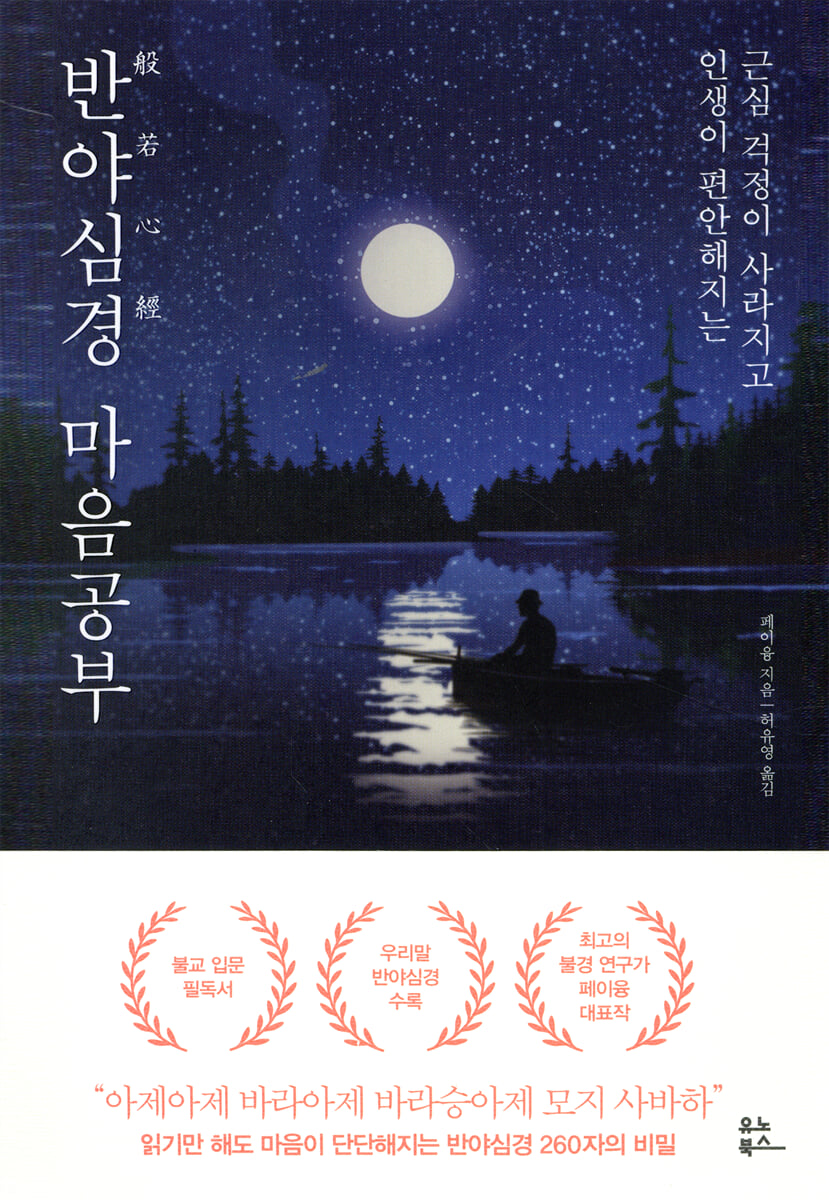
Heart Sutra Mind Study
 |
Description
Book Introduction
“Ajeaj baraaj barasangaj moji sabaha”
The secret of the 260 characters of the Heart Sutra that will make your worries disappear just by reading them!
Essential Reading for Beginners to Buddhism
Korean version of the Heart Sutra included
The masterpiece of the greatest Buddhist scholar, Fei Yong
Living is very difficult.
The desire to get a good job, meet a great spouse, have and raise children well, earn a lot of money, and live a long and healthy life all become the suffering of life.
We seek answers from religion, psychology, medicine, and economics to escape suffering, but it is not easy.
What should we do? The answer offered by the Heart Sutra is, "There is no answer."
So, instead of suffering to find answers that don't exist, change your thinking.
He tells us to calm our minds by focusing only on ourselves.
When we look at the true nature of existence, we can resolve the root causes of our problems and find peace in our lives and minds.
In this book, Professor Fei Yong, a leading Buddhist scripture researcher who has been introducing Buddhist thought to the public for over 30 years, tells the story of the Heart Sutra, the most widely known and widely read Buddhist scripture.
The Heart Sutra is a sutra that condenses the essence of the 600-volume Prajna Paramita Sutra into just 260 characters. It is the shortest sutra, yet contains the profound wisdom of the Buddha, and has been loved by many.
After “practicing Prajna Paramita deeply [行深般波羅蜜多]”, “reflecting [照見]”, and “having neither wisdom nor attainment [無智無得]”, it ends with the recitation of the mantra “揭帝揭帝, 波羅揭帝, 波羅僧揭帝]”.
This is how you can escape suffering and find joy.
In just 260 characters, it not only answers all of life's problems, but also opens up a completely new path of thought and teaches specific methods of practice.
Even if you are not a Buddhist, you should read the Heart Sutra to gain wisdom in life, to train your mind, to understand Buddhist thought, and to understand the meaning of the sutra.
The secret of the 260 characters of the Heart Sutra that will make your worries disappear just by reading them!
Essential Reading for Beginners to Buddhism
Korean version of the Heart Sutra included
The masterpiece of the greatest Buddhist scholar, Fei Yong
Living is very difficult.
The desire to get a good job, meet a great spouse, have and raise children well, earn a lot of money, and live a long and healthy life all become the suffering of life.
We seek answers from religion, psychology, medicine, and economics to escape suffering, but it is not easy.
What should we do? The answer offered by the Heart Sutra is, "There is no answer."
So, instead of suffering to find answers that don't exist, change your thinking.
He tells us to calm our minds by focusing only on ourselves.
When we look at the true nature of existence, we can resolve the root causes of our problems and find peace in our lives and minds.
In this book, Professor Fei Yong, a leading Buddhist scripture researcher who has been introducing Buddhist thought to the public for over 30 years, tells the story of the Heart Sutra, the most widely known and widely read Buddhist scripture.
The Heart Sutra is a sutra that condenses the essence of the 600-volume Prajna Paramita Sutra into just 260 characters. It is the shortest sutra, yet contains the profound wisdom of the Buddha, and has been loved by many.
After “practicing Prajna Paramita deeply [行深般波羅蜜多]”, “reflecting [照見]”, and “having neither wisdom nor attainment [無智無得]”, it ends with the recitation of the mantra “揭帝揭帝, 波羅揭帝, 波羅僧揭帝]”.
This is how you can escape suffering and find joy.
In just 260 characters, it not only answers all of life's problems, but also opens up a completely new path of thought and teaches specific methods of practice.
Even if you are not a Buddhist, you should read the Heart Sutra to gain wisdom in life, to train your mind, to understand Buddhist thought, and to understand the meaning of the sutra.
- You can preview some of the book's contents.
Preview
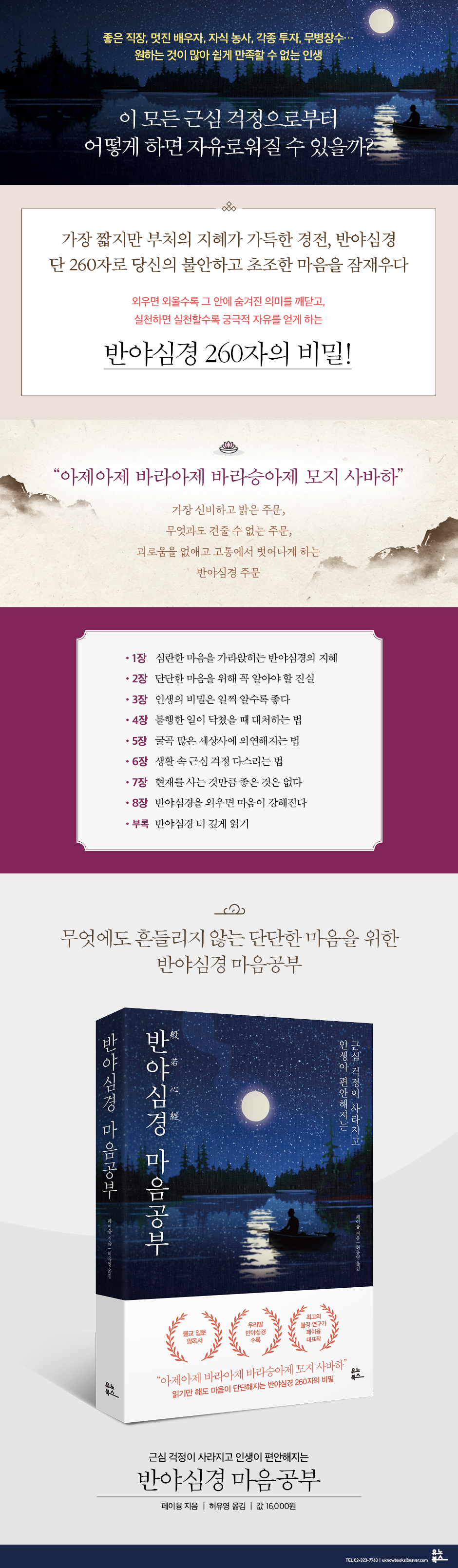
index
Introduction | The Heart Sutra: A Simple Reading That Will Make Your Worries Disappear
Full text of the Heart Sutra in Korean
Chapter 1: The Wisdom of the Heart Sutra to Calm the Troubled Mind
6 Ways to Eliminate Worries and Make Life Easier
The sorrow of others as seen through 'Boshi'
The 'precepts' to do good and not bad things
The attitude of 'inyok' that does not get angry at any moment
'Jeongjin', the guide to becoming a better me
'Seonjeong', which controls the mind and achieves the Way
Prajna, the fundamental wisdom that frees us from suffering
Chapter 2: The Truth You Must Know for a Strong Mind
5 Clues to Know Who You Are
Realize that what you see is not everything.
Pain and pleasure change from moment to moment.
Question and doubt every concept
Let go of your obsession and control your desires.
Beware of the mind that wants to discriminate
Encountering Your True Self Through the Awakening of 'Oon'
Chapter 3: The Secret of Life: The Earlier You Know It, the Better
Perceiving the infinite world with a finite body
The vast world of 'nothingness' beyond what is visible
The Secret of Life or the Universe
How to Live Fully Across Differences
There is no such thing as 'it has to be done'
Free yourself from the 'justifications' that bind your life.
We must break down and overcome the barrier of 'comparison'.
Chapter 4: How to Cope When Misfortune Befalls You
Can my fate be changed?
The secret of fate that flows along the 12 lines of fate
When you are at the mercy of fate, focus on yourself.
Chapter 5: How to Be Resilient in the Twisted World
Why is my heart tired and in pain?
The power to remain centered and not be shaken by anything
Both joy and sorrow are part of my life.
You must continue without losing your composure.
Look at praise and criticism as if you were looking at a lakeside scenery.
Chapter 6: How to Manage Worries and Anxiety in Life
7 Ways to Eliminate Fear in Your Mind
“I can think,” therefore there are no obstacles.
“I can see and hear,” therefore there are no obstacles.
“I can transcend the ego,” therefore there are no obstacles.
“I don’t believe in secrets,” so there are no obstacles.
“I have my own world,” therefore there are no obstacles.
“I know my habits well,” so there are no obstacles.
“I know the pitfalls of common sense,” so there are no obstacles.
Chapter 7: There's nothing better than living in the present.
Live in this quiet moment
Do what you want with all your heart
Learn to coexist with an imperfect world.
Chapter 8: Reciting the Heart Sutra Strengthens the Mind
A spell to bring peace to your life and mind
Appendix: A Deeper Reading of the Heart Sutra
Why did the field wizard go west?
Who wrote the Heart Sutra?
Who is the true protagonist of the Heart Sutra?
What does the word 'heart' in the Heart Sutra mean?
Full text of the Heart Sutra in Korean
Chapter 1: The Wisdom of the Heart Sutra to Calm the Troubled Mind
6 Ways to Eliminate Worries and Make Life Easier
The sorrow of others as seen through 'Boshi'
The 'precepts' to do good and not bad things
The attitude of 'inyok' that does not get angry at any moment
'Jeongjin', the guide to becoming a better me
'Seonjeong', which controls the mind and achieves the Way
Prajna, the fundamental wisdom that frees us from suffering
Chapter 2: The Truth You Must Know for a Strong Mind
5 Clues to Know Who You Are
Realize that what you see is not everything.
Pain and pleasure change from moment to moment.
Question and doubt every concept
Let go of your obsession and control your desires.
Beware of the mind that wants to discriminate
Encountering Your True Self Through the Awakening of 'Oon'
Chapter 3: The Secret of Life: The Earlier You Know It, the Better
Perceiving the infinite world with a finite body
The vast world of 'nothingness' beyond what is visible
The Secret of Life or the Universe
How to Live Fully Across Differences
There is no such thing as 'it has to be done'
Free yourself from the 'justifications' that bind your life.
We must break down and overcome the barrier of 'comparison'.
Chapter 4: How to Cope When Misfortune Befalls You
Can my fate be changed?
The secret of fate that flows along the 12 lines of fate
When you are at the mercy of fate, focus on yourself.
Chapter 5: How to Be Resilient in the Twisted World
Why is my heart tired and in pain?
The power to remain centered and not be shaken by anything
Both joy and sorrow are part of my life.
You must continue without losing your composure.
Look at praise and criticism as if you were looking at a lakeside scenery.
Chapter 6: How to Manage Worries and Anxiety in Life
7 Ways to Eliminate Fear in Your Mind
“I can think,” therefore there are no obstacles.
“I can see and hear,” therefore there are no obstacles.
“I can transcend the ego,” therefore there are no obstacles.
“I don’t believe in secrets,” so there are no obstacles.
“I have my own world,” therefore there are no obstacles.
“I know my habits well,” so there are no obstacles.
“I know the pitfalls of common sense,” so there are no obstacles.
Chapter 7: There's nothing better than living in the present.
Live in this quiet moment
Do what you want with all your heart
Learn to coexist with an imperfect world.
Chapter 8: Reciting the Heart Sutra Strengthens the Mind
A spell to bring peace to your life and mind
Appendix: A Deeper Reading of the Heart Sutra
Why did the field wizard go west?
Who wrote the Heart Sutra?
Who is the true protagonist of the Heart Sutra?
What does the word 'heart' in the Heart Sutra mean?
Detailed image
Into the book
The reason why the Heart Sutra is so great is that it answers all the problems that living beings face in just 260 characters.
Moreover, this answer not only opens up a completely new way of thinking for sentient beings, but also provides very specific methods of practice.
Just like the secrets of martial arts, the method of practice is hidden in each and every letter.
---From the opening text, “The Heart Sutra, which will make your worries disappear just by reading it”
From now on, let's practice not causing discord.
It means not badmouthing others or gossiping about them.
What would happen if a month, three months, a year, two years piled up? Wouldn't the problems in our relationships be resolved? Wouldn't the reality we face become peaceful and warm?
---From Chapter 1, “The Precepts of Doing Good and Not Bad Things”
The concept that “all of the five aggregates are emptiness” is not nihilism.
To say that all five skandhas are empty means that there is no master, nothing is determined by fate, and nothing is decided by God.
Everything is determined by fate.
Therefore, enlightenment is knowing about causes and conditions.
---From Chapter 2, “Meeting the True Self through the Enlightenment of ‘O-on’”
The concept of causality simply means that everything has a cause and a relationship.
We must know our own destiny, and if we want to change it, we must know the causes and relationships hidden within it.
How can we know? The twelve links of dependent origination, as taught by the Buddha, open a vast door to understanding the causal relationships of life.
It might be helpful to look into the reasoning behind this.
---From Chapter 4, "Can My Destiny Change?"
Suffering is the result of the world, suffering is the cause of the world's suffering, extinction is the result of transcending the world, and the Way is the cause of transcending the world.
This corpse represents the most fundamental Buddhist law, the Buddhist worldview, and presents a solution to the question of how to live in this world as a human being.
---From Chapter 5, “Why is the heart tired and in pain?”
Of course, transcending this world does not mean leaving this world.
On the contrary, it means that we must continue to live in this world, and further, we must live better.
How can we live better? "Without hindrances in our minds, without hindrances, without fear, far removed from distorted, vain thoughts, we enter complete nirvana."
---From Chapter 6, “7 Ways to Eliminate Fear in Your Heart”
In Buddhism, mantras are the Buddha's mind, a secret language known only to the Buddha and the Buddha alone.
The order is a call from the depths of space.
That sound is calling us back to some place.
Therefore, if you translate the incantation of the Heart Sutra, the meaning will be vague.
Moreover, this answer not only opens up a completely new way of thinking for sentient beings, but also provides very specific methods of practice.
Just like the secrets of martial arts, the method of practice is hidden in each and every letter.
---From the opening text, “The Heart Sutra, which will make your worries disappear just by reading it”
From now on, let's practice not causing discord.
It means not badmouthing others or gossiping about them.
What would happen if a month, three months, a year, two years piled up? Wouldn't the problems in our relationships be resolved? Wouldn't the reality we face become peaceful and warm?
---From Chapter 1, “The Precepts of Doing Good and Not Bad Things”
The concept that “all of the five aggregates are emptiness” is not nihilism.
To say that all five skandhas are empty means that there is no master, nothing is determined by fate, and nothing is decided by God.
Everything is determined by fate.
Therefore, enlightenment is knowing about causes and conditions.
---From Chapter 2, “Meeting the True Self through the Enlightenment of ‘O-on’”
The concept of causality simply means that everything has a cause and a relationship.
We must know our own destiny, and if we want to change it, we must know the causes and relationships hidden within it.
How can we know? The twelve links of dependent origination, as taught by the Buddha, open a vast door to understanding the causal relationships of life.
It might be helpful to look into the reasoning behind this.
---From Chapter 4, "Can My Destiny Change?"
Suffering is the result of the world, suffering is the cause of the world's suffering, extinction is the result of transcending the world, and the Way is the cause of transcending the world.
This corpse represents the most fundamental Buddhist law, the Buddhist worldview, and presents a solution to the question of how to live in this world as a human being.
---From Chapter 5, “Why is the heart tired and in pain?”
Of course, transcending this world does not mean leaving this world.
On the contrary, it means that we must continue to live in this world, and further, we must live better.
How can we live better? "Without hindrances in our minds, without hindrances, without fear, far removed from distorted, vain thoughts, we enter complete nirvana."
---From Chapter 6, “7 Ways to Eliminate Fear in Your Heart”
In Buddhism, mantras are the Buddha's mind, a secret language known only to the Buddha and the Buddha alone.
The order is a call from the depths of space.
That sound is calling us back to some place.
Therefore, if you translate the incantation of the Heart Sutra, the meaning will be vague.
---From Chapter 8, “A Spell to Comfort Your Life and Mind”
Publisher's Review
Many people turn to the Heart Sutra when they feel tired and distressed.
It is the most mysterious and bright spell, an incomparable spell, and a spell that eliminates suffering and frees you from pain. The more you recite it, the more you realize the hidden meaning within it, and the more you practice it, the more it helps you achieve ultimate freedom.
It's about changing into the type of person you want and desire.
I hope that you too will gain a firm mind that is unshaken by anything within the Heart Sutra.
The path to peace of mind and escape from the pain of life
From the moment we are born into this world, we age continuously, fight against various illnesses, and eventually die.
We cannot spend long periods of time with people and things we like, and people and things we do not like are always by our side.
Because they want so much, they are never satisfied, and they experience ups and downs due to being entangled in complex thoughts and emotions.
Sometimes we encounter unexpected disasters such as traffic accidents and disasters.
We are never at peace from these things.
How can I escape the pain of life? How can I become free?
Fei Yong, a leading Chinese Buddhist scripture scholar, found the answer in the Heart Sutra.
The Heart Sutra, the shortest sutra yet full of Buddha's wisdom
Answering all the questions of life in 260 characters
“There is no answer.” The answer to all the world’s problems is “There is no answer.”
The Heart Sutra tells us not to rely on anything else, but to rely only on ourselves.
Live in the present moment, calm your mind, and look at yourself properly.
Only then can we fundamentally solve the problem and find true peace of mind.
The Heart Sutra provides concise and clear answers to all questions, and the wisdom contained in words such as the Four Noble Truths, the Eightfold Path, the Five Aggregates, the Twelve Foundations, the Eighteen Realms, the Six Perfections, the Twelve Causes and Conditions, Emptiness, and Nothingness.
The Heart Sutra, consisting of only 260 characters, is the shortest of all Buddhist scriptures, but it is the most widely read and widely known because it richly condenses the profound wisdom of the Buddha.
Furthermore, it has played a major role in solving life's problems that cause people suffering and in helping them find wisdom in life.
How to Live Fully Across Differences
If we were to find another reason that makes life difficult, it would be excessive discrimination.
Countless boundaries surround our lives, including nationality, ethnicity, gender, good and evil, love and hate, etc.
Value judgments are made along those boundaries, and we are forced to distinguish between good and bad.
Ultimately, it leads to the formation of stereotypical thinking and makes us jump to conclusions and judge everything we see.
Because we are trapped within this framework, we always feel in trouble and unfree.
This book says there is no such thing as trouble.
It is our prejudices and stubbornness that create the difficulties.
Because we are obsessed with all kinds of differences and want to have what we think is good, the world is becoming increasingly narrow.
Buddha says that we should see the difference, but also that we should not see the difference.
Live in the world, but transcend the world.
That is, do not live in fragments, but live in a complete being, and live greatly within the whole.
The Buddha's teachings are the wisdom that brings together separate things and connects contradictory things into one whole.
《Heart Sutra Mind Study》 goes beyond enlightenment and presents specific practical methods for applying the Buddha's teachings to our lives. It also broadens the scope of meditation by utilizing analogies and quotations to help us understand the Buddha's wisdom contained in the Heart Sutra more deeply and more easily.
Heart Sutra Mantra for Peaceful Life and Mind
“Ajeaje baraje bara seung aje moji sabaha.”
This mantra in the Heart Sutra is the enlightenment that the Buddha gives us and the true words that eliminate all suffering.
Translations and interpretations may vary, but the message is clear: it is telling us to 'leave.'
How can a command to leave solve our suffering and unhappiness? The answer, says Fei Yong, isn't easy to find.
Nevertheless, Feiyong hopes that many people will read the Heart Sutra and become people filled with inner joy and strength, and that they will all gain the wisdom of life left behind by the Buddha and live their lives in the way they like best.
This book will guide you to a life free from worries and concerns and a comfortable life.
It is the most mysterious and bright spell, an incomparable spell, and a spell that eliminates suffering and frees you from pain. The more you recite it, the more you realize the hidden meaning within it, and the more you practice it, the more it helps you achieve ultimate freedom.
It's about changing into the type of person you want and desire.
I hope that you too will gain a firm mind that is unshaken by anything within the Heart Sutra.
The path to peace of mind and escape from the pain of life
From the moment we are born into this world, we age continuously, fight against various illnesses, and eventually die.
We cannot spend long periods of time with people and things we like, and people and things we do not like are always by our side.
Because they want so much, they are never satisfied, and they experience ups and downs due to being entangled in complex thoughts and emotions.
Sometimes we encounter unexpected disasters such as traffic accidents and disasters.
We are never at peace from these things.
How can I escape the pain of life? How can I become free?
Fei Yong, a leading Chinese Buddhist scripture scholar, found the answer in the Heart Sutra.
The Heart Sutra, the shortest sutra yet full of Buddha's wisdom
Answering all the questions of life in 260 characters
“There is no answer.” The answer to all the world’s problems is “There is no answer.”
The Heart Sutra tells us not to rely on anything else, but to rely only on ourselves.
Live in the present moment, calm your mind, and look at yourself properly.
Only then can we fundamentally solve the problem and find true peace of mind.
The Heart Sutra provides concise and clear answers to all questions, and the wisdom contained in words such as the Four Noble Truths, the Eightfold Path, the Five Aggregates, the Twelve Foundations, the Eighteen Realms, the Six Perfections, the Twelve Causes and Conditions, Emptiness, and Nothingness.
The Heart Sutra, consisting of only 260 characters, is the shortest of all Buddhist scriptures, but it is the most widely read and widely known because it richly condenses the profound wisdom of the Buddha.
Furthermore, it has played a major role in solving life's problems that cause people suffering and in helping them find wisdom in life.
How to Live Fully Across Differences
If we were to find another reason that makes life difficult, it would be excessive discrimination.
Countless boundaries surround our lives, including nationality, ethnicity, gender, good and evil, love and hate, etc.
Value judgments are made along those boundaries, and we are forced to distinguish between good and bad.
Ultimately, it leads to the formation of stereotypical thinking and makes us jump to conclusions and judge everything we see.
Because we are trapped within this framework, we always feel in trouble and unfree.
This book says there is no such thing as trouble.
It is our prejudices and stubbornness that create the difficulties.
Because we are obsessed with all kinds of differences and want to have what we think is good, the world is becoming increasingly narrow.
Buddha says that we should see the difference, but also that we should not see the difference.
Live in the world, but transcend the world.
That is, do not live in fragments, but live in a complete being, and live greatly within the whole.
The Buddha's teachings are the wisdom that brings together separate things and connects contradictory things into one whole.
《Heart Sutra Mind Study》 goes beyond enlightenment and presents specific practical methods for applying the Buddha's teachings to our lives. It also broadens the scope of meditation by utilizing analogies and quotations to help us understand the Buddha's wisdom contained in the Heart Sutra more deeply and more easily.
Heart Sutra Mantra for Peaceful Life and Mind
“Ajeaje baraje bara seung aje moji sabaha.”
This mantra in the Heart Sutra is the enlightenment that the Buddha gives us and the true words that eliminate all suffering.
Translations and interpretations may vary, but the message is clear: it is telling us to 'leave.'
How can a command to leave solve our suffering and unhappiness? The answer, says Fei Yong, isn't easy to find.
Nevertheless, Feiyong hopes that many people will read the Heart Sutra and become people filled with inner joy and strength, and that they will all gain the wisdom of life left behind by the Buddha and live their lives in the way they like best.
This book will guide you to a life free from worries and concerns and a comfortable life.
GOODS SPECIFICS
- Date of issue: May 7, 2021
- Page count, weight, size: 300 pages | 408g | 142*210*18mm
- ISBN13: 9791190826556
- ISBN10: 1190826550
You may also like
카테고리
korean


korean

![GQ KOREA Mark (Monthly): December [2025]](http://librairie.coreenne.fr/cdn/shop/files/8ef265dbbfbf186523ed75ba7319009d.jpg?v=1765340328&width=3840)


