

Critique of Pure Reason 2
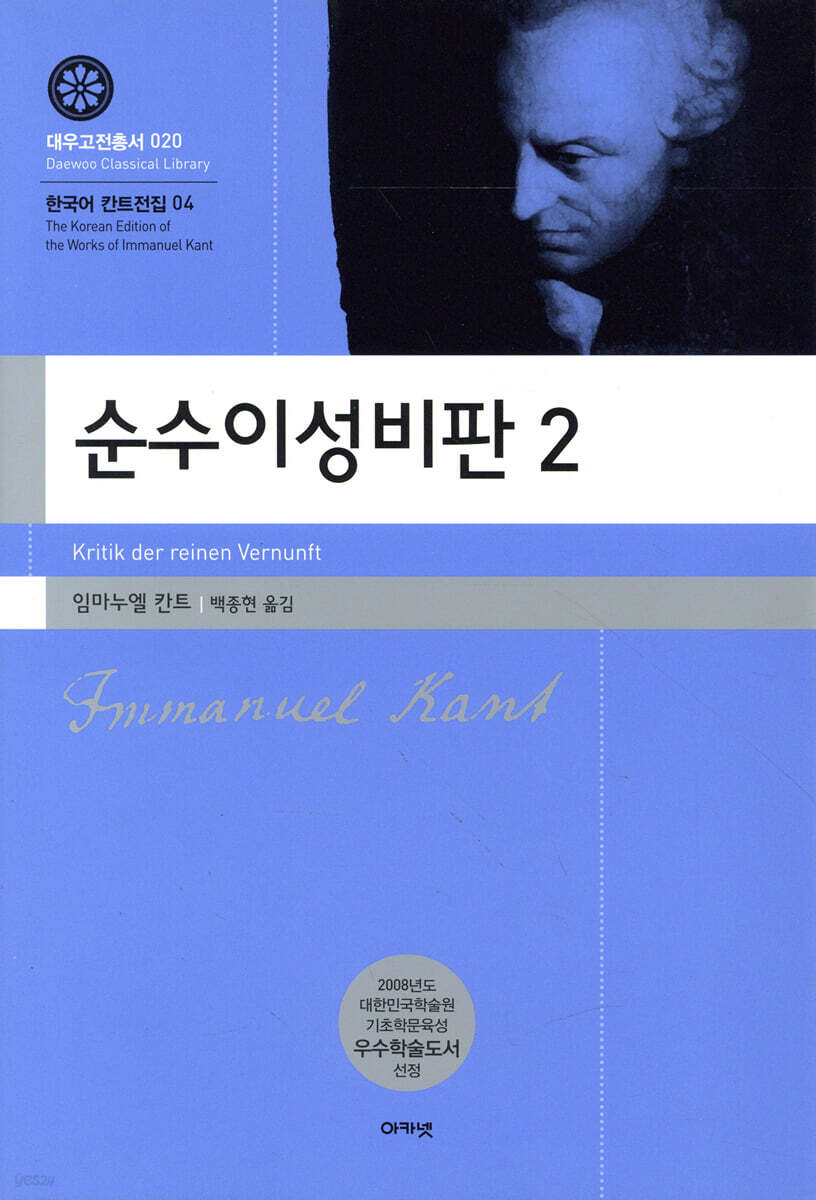 |
Description
Book Introduction
The Critique of Pure Reason, a great classic of Western philosophy that portrays the Enlightenment image of humanity that dreamed of greatness within the limits of finite cognition.
The newly published volumes 1 and 2 of the Critique of Pure Reason, translated by Professor Baek Jong-hyeon of the Department of Philosophy at Seoul National University, are a massive "research translation" based on recent research on Kant. They consist of a translation of the original text of approximately 800 pages, along with a voluminous commentary and index of approximately 130 pages each.
The newly published volumes 1 and 2 of the Critique of Pure Reason, translated by Professor Baek Jong-hyeon of the Department of Philosophy at Seoul National University, are a massive "research translation" based on recent research on Kant. They consist of a translation of the original text of approximately 800 pages, along with a voluminous commentary and index of approximately 130 pages each.
- You can preview some of the book's contents.
Preview
index
When publishing a book
Part 1: Introduction to the Critique of Pure Reason
I.
Kant's philosophical task
II.
The system of the Critique of Pure Reason
III.
Critique of Pure Reason and its Results
IV.
Kant's System of Transcendental Philosophy
1.
Transcendental Emotions
1) Space and time as pure intuition
2) Subjectivity of space and time representation
3) Objective reality as an empirical intuitional form of subjective representations of space and time.
(1) The function of emotional overview and its form
(2) Empirical reality and transcendental ideality of space and time
(3) Conclusions from the ‘form’ and ‘material’ of the phenomenon
2.
Transcendental logic
1) Deduction of pure intellectual concepts
(1) Metaphysical deduction of pure intellectual concepts
(2) Transcendental deduction of pure intellectual concepts
2) Comprehensive principles of pure intelligence
(1) Principle of objective use of the concept of quantity
(2) Principle of objective use of the concept of quality
(3) Principles of objective use of the concept of relationship
① First principle of analogy - the principle of objective use of the concept of substance
② Second principle of analogy - the principle of objective use of causal concepts
③ Third Principle of Analogy - Principle of Objective Use of Interaction Concepts
(4) Principles of objective use of the concept of modality
V.
Critique of Rational Metaphysics: Transcendental Dialectics
1.
Transcendental virtual systems
2.
Criticism of the fallacy of pure reasoning
3.
Explanation of the paradox of pure reason
1) First, the betrayal of interest
2) Second, the betrayal of interest
3) Third, the betrayal of interest
4) Fourth, the betrayal of interest
4.
Explanation of the ideal of pure reason
1) The impossibility of ontological proof of God's existence
2) The impossibility of cosmological proof of God's existence.
3) The impossibility of physical-theological proof of God's existence.
VI.
Final Reflections on the Conditions for a Perfect System of Pure Reason: Transcendental Methodology
1.
Training in pure reason
2.
The standard of pure reason
3.
The architecture of pure reason
4.
The History of Pure Reason
VII.
Author of the Critique of Pure Reason
Key Literature Related to the Critique of Pure Reason
I.
The main edition of the original Kritik der reinen Vernunft
1.
Major editions
2.
Criticism of the original and major editions
II.
Dictionary
III.
academic journals
IV.
commentary
V.
Foreign research papers
1.
Overview Research Paper
2.
Comprehensive research paper
3.
Dissertations on 'Transcendental Emotions'
4.
Related papers on 'Transcendental Logic I: The Analytics of Concepts'
5.
Related papers on 'Transcendental Logic II: The Analysis of Principles'
6.
Related papers on 'Transcendental Logic III: Dialectics'
7.
Research papers related to influence
VI.
Domestic research papers
Translator's Notes for Part 2 of the Critique of Pure Reason
Principle of translator
Table of translations of similar and related words
Translation and annotation of the Critique of Pure Reason
Search
Note
Find a person
Finding the concept
Part 1: Introduction to the Critique of Pure Reason
I.
Kant's philosophical task
II.
The system of the Critique of Pure Reason
III.
Critique of Pure Reason and its Results
IV.
Kant's System of Transcendental Philosophy
1.
Transcendental Emotions
1) Space and time as pure intuition
2) Subjectivity of space and time representation
3) Objective reality as an empirical intuitional form of subjective representations of space and time.
(1) The function of emotional overview and its form
(2) Empirical reality and transcendental ideality of space and time
(3) Conclusions from the ‘form’ and ‘material’ of the phenomenon
2.
Transcendental logic
1) Deduction of pure intellectual concepts
(1) Metaphysical deduction of pure intellectual concepts
(2) Transcendental deduction of pure intellectual concepts
2) Comprehensive principles of pure intelligence
(1) Principle of objective use of the concept of quantity
(2) Principle of objective use of the concept of quality
(3) Principles of objective use of the concept of relationship
① First principle of analogy - the principle of objective use of the concept of substance
② Second principle of analogy - the principle of objective use of causal concepts
③ Third Principle of Analogy - Principle of Objective Use of Interaction Concepts
(4) Principles of objective use of the concept of modality
V.
Critique of Rational Metaphysics: Transcendental Dialectics
1.
Transcendental virtual systems
2.
Criticism of the fallacy of pure reasoning
3.
Explanation of the paradox of pure reason
1) First, the betrayal of interest
2) Second, the betrayal of interest
3) Third, the betrayal of interest
4) Fourth, the betrayal of interest
4.
Explanation of the ideal of pure reason
1) The impossibility of ontological proof of God's existence
2) The impossibility of cosmological proof of God's existence.
3) The impossibility of physical-theological proof of God's existence.
VI.
Final Reflections on the Conditions for a Perfect System of Pure Reason: Transcendental Methodology
1.
Training in pure reason
2.
The standard of pure reason
3.
The architecture of pure reason
4.
The History of Pure Reason
VII.
Author of the Critique of Pure Reason
Key Literature Related to the Critique of Pure Reason
I.
The main edition of the original Kritik der reinen Vernunft
1.
Major editions
2.
Criticism of the original and major editions
II.
Dictionary
III.
academic journals
IV.
commentary
V.
Foreign research papers
1.
Overview Research Paper
2.
Comprehensive research paper
3.
Dissertations on 'Transcendental Emotions'
4.
Related papers on 'Transcendental Logic I: The Analytics of Concepts'
5.
Related papers on 'Transcendental Logic II: The Analysis of Principles'
6.
Related papers on 'Transcendental Logic III: Dialectics'
7.
Research papers related to influence
VI.
Domestic research papers
Translator's Notes for Part 2 of the Critique of Pure Reason
Principle of translator
Table of translations of similar and related words
Translation and annotation of the Critique of Pure Reason
Search
Note
Find a person
Finding the concept
Publisher's Review
Overcoming the Identity Crisis of Philosophy in a New Way
As is well known, this book contains a critical exploration of human rational capacity.
Based on the spirit of the Enlightenment that “the age of enlightenment is the age of true criticism, and everything must be submitted to criticism,” Kant placed metaphysics, which had reigned as the essence of philosophy until then, on the judgment seat of reason.
What Kant focused on in the zeitgeist of his time was the identity crisis of metaphysics-centered philosophy, which provided the basis for ethics and religion.
“There was a time when metaphysics was called the queen of all sciences.
(......) But now it has become the fashion of the times to show all kinds of contempt for metaphysics.” In the face of the persuasive explanation of nature presented in Newton’s Mathematical Principles of Natural Philosophy (1781), metaphysics has fallen into the shabby dogmatism of an old age, and now it has come to a desperate point where it must find a new way.
Kant re-establishes philosophy on the basis of recognizing the superiority of Newtonian mechanics over traditional speculative metaphysics.
Self-Criticism of Reason: How Are Synthetic A priori Judgments Possible?
“How are synthetic a priori judgments possible?” Kant believed that the answer to this question would provide a solution to philosophy’s identity crisis.
What he called synthetic a priori judgments were propositions of mathematics and natural science (Newtonian mechanics).
What he was questioning here was the structure of that universality and necessity, and that this was possible through the critical work of reason.
Reason is the sum total of human intellectual abilities.
The critique of reason is the work of dissecting how such intellectual abilities come to be.
However, since the subject of this dissection is also human reason, this criticism is a self-criticism that reason imposes on itself.
The Critique of Pure Reason is a self-anatomy of reason undertaken to reveal this structure.
He assumes that human knowledge begins with experience and attempts to explain the possible basis of experience, that is, the conditions that make experience possible.
The Critique of Pure Reason can be broadly divided into three parts: the theory of sensibility reveals the sensuous conditions that make experience possible, and the analysis elucidates the intellectual conditions that make experience possible.
And dialectics exposes the errors that arise from the improper activity of reason.
The Copernican Revolution: Humans as Nature's Legislators
Another point to note in the Critique of Pure Reason is the revolution in thinking that can be likened to the Copernican revolution.
He emphasizes that our human cognition should not be based on the 'object as a thing in itself', but rather on the 'object as a phenomenon given to us by the thing itself', which is the basis of our a priori cognition.
Kant's revolution in thinking did not mean abandoning anthropocentrism, but rather a shift in thinking that sought to break away from the medieval Christian world and portray the world through human eyes through finite human reason.
In this sense, what is noteworthy about Kantian humans is the greatness that finite humans can pursue within the limits of reason.
On the one hand, humans are emotional beings, so although they cannot limit the content of nature, on the other hand, as intellectual beings, they become the legislators of nature, limiting only the form of nature.
Man as the legislator of nature is the archetype of the enlightened man that Kant dreamed of.
A New Path in Metaphysics: Exploring the Coexistence of Science and Religion (Morality)
Through his Critique of Pure Reason, Kant attempted to reconcile rationalism and empiricism by providing an alternative to Hume's skepticism.
Equally important was the task of establishing a new foundation for morality and religion.
As stated in the preface to the second edition, “I found it necessary to deny knowledge in order to make room for faith.” This statement contains Kant’s intention to secure the realm of morality and religion by distinguishing them on a dimensional level from realms of knowledge such as mathematics and natural science.
By saying that the problem of fact is a problem of knowledge in which a priori synthetic judgments are established, while the problem of religion and morality is a problem of duty, which is a problem of practical reason, the aim is to seek the coexistence of the dual order of fact and duty.
This book systematically introduces the core of Kant's critical philosophy through faithful translations and annotations of the original text, systematic and detailed commentary to aid understanding of difficult original texts, and an extensive index and bibliography. It will serve as an important cornerstone for Kant studies in Korea.
As is well known, this book contains a critical exploration of human rational capacity.
Based on the spirit of the Enlightenment that “the age of enlightenment is the age of true criticism, and everything must be submitted to criticism,” Kant placed metaphysics, which had reigned as the essence of philosophy until then, on the judgment seat of reason.
What Kant focused on in the zeitgeist of his time was the identity crisis of metaphysics-centered philosophy, which provided the basis for ethics and religion.
“There was a time when metaphysics was called the queen of all sciences.
(......) But now it has become the fashion of the times to show all kinds of contempt for metaphysics.” In the face of the persuasive explanation of nature presented in Newton’s Mathematical Principles of Natural Philosophy (1781), metaphysics has fallen into the shabby dogmatism of an old age, and now it has come to a desperate point where it must find a new way.
Kant re-establishes philosophy on the basis of recognizing the superiority of Newtonian mechanics over traditional speculative metaphysics.
Self-Criticism of Reason: How Are Synthetic A priori Judgments Possible?
“How are synthetic a priori judgments possible?” Kant believed that the answer to this question would provide a solution to philosophy’s identity crisis.
What he called synthetic a priori judgments were propositions of mathematics and natural science (Newtonian mechanics).
What he was questioning here was the structure of that universality and necessity, and that this was possible through the critical work of reason.
Reason is the sum total of human intellectual abilities.
The critique of reason is the work of dissecting how such intellectual abilities come to be.
However, since the subject of this dissection is also human reason, this criticism is a self-criticism that reason imposes on itself.
The Critique of Pure Reason is a self-anatomy of reason undertaken to reveal this structure.
He assumes that human knowledge begins with experience and attempts to explain the possible basis of experience, that is, the conditions that make experience possible.
The Critique of Pure Reason can be broadly divided into three parts: the theory of sensibility reveals the sensuous conditions that make experience possible, and the analysis elucidates the intellectual conditions that make experience possible.
And dialectics exposes the errors that arise from the improper activity of reason.
The Copernican Revolution: Humans as Nature's Legislators
Another point to note in the Critique of Pure Reason is the revolution in thinking that can be likened to the Copernican revolution.
He emphasizes that our human cognition should not be based on the 'object as a thing in itself', but rather on the 'object as a phenomenon given to us by the thing itself', which is the basis of our a priori cognition.
Kant's revolution in thinking did not mean abandoning anthropocentrism, but rather a shift in thinking that sought to break away from the medieval Christian world and portray the world through human eyes through finite human reason.
In this sense, what is noteworthy about Kantian humans is the greatness that finite humans can pursue within the limits of reason.
On the one hand, humans are emotional beings, so although they cannot limit the content of nature, on the other hand, as intellectual beings, they become the legislators of nature, limiting only the form of nature.
Man as the legislator of nature is the archetype of the enlightened man that Kant dreamed of.
A New Path in Metaphysics: Exploring the Coexistence of Science and Religion (Morality)
Through his Critique of Pure Reason, Kant attempted to reconcile rationalism and empiricism by providing an alternative to Hume's skepticism.
Equally important was the task of establishing a new foundation for morality and religion.
As stated in the preface to the second edition, “I found it necessary to deny knowledge in order to make room for faith.” This statement contains Kant’s intention to secure the realm of morality and religion by distinguishing them on a dimensional level from realms of knowledge such as mathematics and natural science.
By saying that the problem of fact is a problem of knowledge in which a priori synthetic judgments are established, while the problem of religion and morality is a problem of duty, which is a problem of practical reason, the aim is to seek the coexistence of the dual order of fact and duty.
This book systematically introduces the core of Kant's critical philosophy through faithful translations and annotations of the original text, systematic and detailed commentary to aid understanding of difficult original texts, and an extensive index and bibliography. It will serve as an important cornerstone for Kant studies in Korea.
GOODS SPECIFICS
- Date of issue: June 25, 2006
- Format: Hardcover book binding method guide
- Page count, weight, size: 587 pages | 1,056g | 188*257*35mm
- ISBN13: 9788957330845
- ISBN10: 8957330844
You may also like
카테고리
korean


korean

![GQ KOREA Mark (Monthly): December [2025]](http://librairie.coreenne.fr/cdn/shop/files/8ef265dbbfbf186523ed75ba7319009d.jpg?v=1765340328&width=3840)


