

Romantic Generation
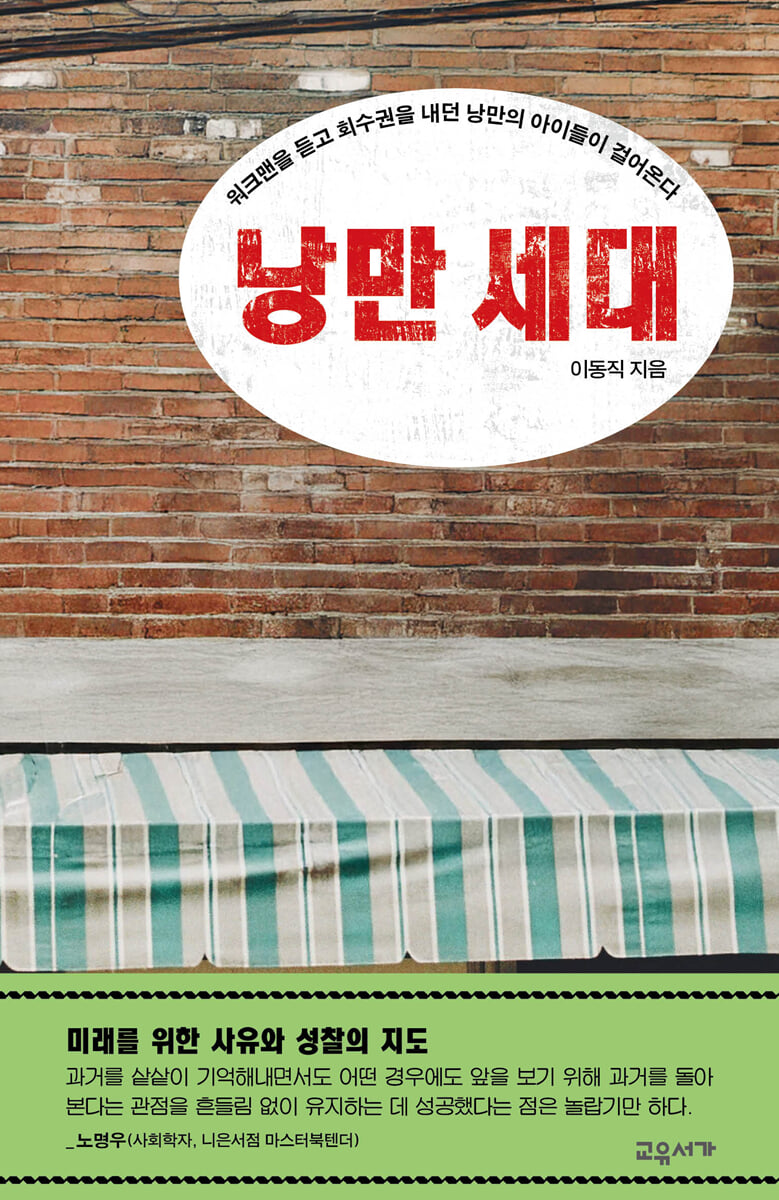 |
Description
Book Introduction
People who were born in the 60s and 70s and lived through the romantic era
A small milestone showing the way forward
“The romantic generation has always been the last of the past,
It was the beginning of something new.
The last and the first meet in the present.
Because the present is the end of the past and the beginning of the future.
“It is remarkable that he has succeeded in maintaining a steadfast perspective of looking back to the past in order to look ahead, even while thoroughly remembering the past.
This book is a guide to thinking and reflecting on the future.
“I spread out that map and think about where the ‘Land of the Elderly’ will go.”
Noh Myung-woo (sociologist, master booktender at Nien Bookstore)
“This book is an autobiography of a generation and a self-portrait of Korean society.
(…) In an age of generational conflict and disconnection, the author finds new hope in the lives of the Romantic generation.
“The Romantic Generation” can be called a romantic chronicle of Korean society’s pursuit of intergenerational empathy.”
_Yoon Je-kyun (director of the film "Ode to My Father")
A time when society began to emerge after thousands of years of poverty.
There was a time when the growth graphs all stood up at the same time.
People who were born in a time when all the numbers were exploding like fireworks, and who learned to walk, talk, and read.
The time when most children were born.
Looking back on their lives is another way to look at Korean society.
_From "Entering"
A small milestone showing the way forward
“The romantic generation has always been the last of the past,
It was the beginning of something new.
The last and the first meet in the present.
Because the present is the end of the past and the beginning of the future.
“It is remarkable that he has succeeded in maintaining a steadfast perspective of looking back to the past in order to look ahead, even while thoroughly remembering the past.
This book is a guide to thinking and reflecting on the future.
“I spread out that map and think about where the ‘Land of the Elderly’ will go.”
Noh Myung-woo (sociologist, master booktender at Nien Bookstore)
“This book is an autobiography of a generation and a self-portrait of Korean society.
(…) In an age of generational conflict and disconnection, the author finds new hope in the lives of the Romantic generation.
“The Romantic Generation” can be called a romantic chronicle of Korean society’s pursuit of intergenerational empathy.”
_Yoon Je-kyun (director of the film "Ode to My Father")
A time when society began to emerge after thousands of years of poverty.
There was a time when the growth graphs all stood up at the same time.
People who were born in a time when all the numbers were exploding like fireworks, and who learned to walk, talk, and read.
The time when most children were born.
Looking back on their lives is another way to look at Korean society.
_From "Entering"
index
Entering
1.
The Birth of Romance_Children Born on Friday
The Age of Addition, the Adolescence of Subtraction
When I was reading Demian
The Starry Night
Compatibility, something scarier than Mama
The story we left behind in those days
2.
An explosion of romance: fin-de-siècle anxiety, the confusion of youth
Y2K?
Leslie Cheung is dead
The end has come early
We unified our desires
A democratic fighter in a drill uniform
Thirty Years Old, A Story of Youth
3.
For Romance_Imagination of Empathy
Sad End Generation
If you can do it, you can do it - Honest and capable person
If it works, I'll do it - a fair discriminationist
Community of Empathy
The story of the romantic generation
1.
The Birth of Romance_Children Born on Friday
The Age of Addition, the Adolescence of Subtraction
When I was reading Demian
The Starry Night
Compatibility, something scarier than Mama
The story we left behind in those days
2.
An explosion of romance: fin-de-siècle anxiety, the confusion of youth
Y2K?
Leslie Cheung is dead
The end has come early
We unified our desires
A democratic fighter in a drill uniform
Thirty Years Old, A Story of Youth
3.
For Romance_Imagination of Empathy
Sad End Generation
If you can do it, you can do it - Honest and capable person
If it works, I'll do it - a fair discriminationist
Community of Empathy
The story of the romantic generation
Into the book
The Romantic generation has always been the last of the past and the first of the new.
The last and the first meet in the present.
Because the present is the end of the past and the beginning of the future.
In that way, the romantic generation has endured countless ‘presents’.
--- From "Entering"
Not everyone has entered an age of abundance.
Some people are still poor, while others have experienced overwhelming wealth.
However, everyone was looking forward to better days.
That spirit of hope is the background of the romantic generation.
--- p.22
The dictatorship used TV as an effective means of governance.
It instilled the need for dictatorship and advertised nationalism.
However, the children were learning different things in the video.
(…) the first video generation.
The Romantic Generation spent their childhood and adolescence watching TV, naturally immersing themselves in the grammar of visuals. They grew up alongside TV.
--- p.54
The days of everyone sitting together in front of the TV are over.
The ticket booth in front of the theater where I used to wait for my friend is no longer there.
Select a video with your finger and it will be played on your palm.
Put on your earphones and enter into some alone time.
As the medium changes, the way we communicate changes.
Compatibility, what is more frightening than Mama may be the way relationships change as time passes.
When the way we communicate changes, everything changes.
Everything has changed.
The world is sometimes unfamiliar to the romantic generation.
--- p.61~62
The modern class structure of gold spoons, silver spoons, and dirt spoons has created hereditary capitalism, and Korean society is likened to hell (Hell Joseon).
As those who achieved wealth boasted of their abilities and passed their wealth on to their children, those outside the castle found ways to adapt in a world without ladders.
Not getting married, not having children.
--- p.125
Humans live with others, and one generation lives with another generation.
Generations, which are human beings and groups of humans, realize 'who I am' in the process.
Start looking for the meaning of life.
Adults don't dream of a vague happy ending.
The romantic generation is adults.
I draw beauty in relationships with other generations.
All relationships begin with listening to each other and talking.
--- p.159~160
The slogan, 'If you do it, you can do it' was the ethic of that time.
It's a fairy tale for adults, but the times made fairy tales the zeitgeist.
No logic can overcome reality.
If you really do it, it will work.
By the time they were born, learned to speak, and went to elementary school, South Korea was doing and becoming everything.
Roads were opened, buildings were built, and exports increased.
People were carving the slogans posted here and there into their hearts.
'You can do it'.
--- p.162~163
In the near future, the class war will be redefined not as a battle between rich and poor, but as a fight between young and old.
--- p.189
Children who grew up in groups during those times.
The children didn't worry about what was fun.
We ran through the vacant lot together, and ran through the alley together.
I was happy because I didn't have time to think about what happiness was.
(…) The children grew up.
We ran to overcome the economic crisis and ran on the streets of democracy.
In 2002, they called for a 'Great Republic of Korea'.
Every seat was followed by the word 'together'.
Empathy was instinctive.
--- p.208
The way to overcome generational conflict is intergenerational empathy.
For the romantic generation, it may be a duty and an ethics.
Intergenerational empathy is about listening to the narratives of each generation and allowing those narratives to flow.
Their parents' generation overcame the scars of war by fleeing in droves.
The empathetic language of 'togetherness' was a life wisdom passed down from our parents' generation.
The culture of playing kimchi was an ethics of empathy learned from watching parents, and a romance that touched the essence of life.
It's time to pass it on to the next generation.
The last and the first meet in the present.
Because the present is the end of the past and the beginning of the future.
In that way, the romantic generation has endured countless ‘presents’.
--- From "Entering"
Not everyone has entered an age of abundance.
Some people are still poor, while others have experienced overwhelming wealth.
However, everyone was looking forward to better days.
That spirit of hope is the background of the romantic generation.
--- p.22
The dictatorship used TV as an effective means of governance.
It instilled the need for dictatorship and advertised nationalism.
However, the children were learning different things in the video.
(…) the first video generation.
The Romantic Generation spent their childhood and adolescence watching TV, naturally immersing themselves in the grammar of visuals. They grew up alongside TV.
--- p.54
The days of everyone sitting together in front of the TV are over.
The ticket booth in front of the theater where I used to wait for my friend is no longer there.
Select a video with your finger and it will be played on your palm.
Put on your earphones and enter into some alone time.
As the medium changes, the way we communicate changes.
Compatibility, what is more frightening than Mama may be the way relationships change as time passes.
When the way we communicate changes, everything changes.
Everything has changed.
The world is sometimes unfamiliar to the romantic generation.
--- p.61~62
The modern class structure of gold spoons, silver spoons, and dirt spoons has created hereditary capitalism, and Korean society is likened to hell (Hell Joseon).
As those who achieved wealth boasted of their abilities and passed their wealth on to their children, those outside the castle found ways to adapt in a world without ladders.
Not getting married, not having children.
--- p.125
Humans live with others, and one generation lives with another generation.
Generations, which are human beings and groups of humans, realize 'who I am' in the process.
Start looking for the meaning of life.
Adults don't dream of a vague happy ending.
The romantic generation is adults.
I draw beauty in relationships with other generations.
All relationships begin with listening to each other and talking.
--- p.159~160
The slogan, 'If you do it, you can do it' was the ethic of that time.
It's a fairy tale for adults, but the times made fairy tales the zeitgeist.
No logic can overcome reality.
If you really do it, it will work.
By the time they were born, learned to speak, and went to elementary school, South Korea was doing and becoming everything.
Roads were opened, buildings were built, and exports increased.
People were carving the slogans posted here and there into their hearts.
'You can do it'.
--- p.162~163
In the near future, the class war will be redefined not as a battle between rich and poor, but as a fight between young and old.
--- p.189
Children who grew up in groups during those times.
The children didn't worry about what was fun.
We ran through the vacant lot together, and ran through the alley together.
I was happy because I didn't have time to think about what happiness was.
(…) The children grew up.
We ran to overcome the economic crisis and ran on the streets of democracy.
In 2002, they called for a 'Great Republic of Korea'.
Every seat was followed by the word 'together'.
Empathy was instinctive.
--- p.208
The way to overcome generational conflict is intergenerational empathy.
For the romantic generation, it may be a duty and an ethics.
Intergenerational empathy is about listening to the narratives of each generation and allowing those narratives to flow.
Their parents' generation overcame the scars of war by fleeing in droves.
The empathetic language of 'togetherness' was a life wisdom passed down from our parents' generation.
The culture of playing kimchi was an ethics of empathy learned from watching parents, and a romance that touched the essence of life.
It's time to pass it on to the next generation.
--- p.210
Publisher's Review
A New Generational Theory Dissecting Korean Society: The Romantic Generation Chronicles
Those born in the 60s and 70s, who lived through a period of rapid economic growth, the romantic 90s, and the end of the century and the new century, now face the present filled with conflict and hatred.
The author defines these people as the “Romantic Generation,” who were born as children in the poorest countries and grew up in middle age in wealthy countries, whose growth curves coincided with those of society, and who grew up with society and prepared for decline along with it.
Romance is born
It was a time when the war had ended and everyone was just over the threshold of hunger, not everyone was prosperous, but everyone held onto the hope that better days would come.
During the period of economic growth that was literally miraculous, known as the 'Miracle on the Han River,' those born in the 60s and 70s were a blessed generation that was able to directly enjoy the fruits of the miracle.
Thanks to the generation of parents who used to sing, “Let’s live well too,” we have experienced relatively fair economic freedom, and since we are not yet forced into fierce competition, we have the luxury of being able to “look out for” each other through games like rubber band games, tag games, and tag-a-thon games.
Experiencing the agonizing pain of adolescence was not a luxury, and I could encounter and personally experience the ambiguity of personal life and social inequality through reading books.
Everyone could have memorized a few poems and grown up experiencing pure confusion, like in Demian.
As the master of life, I could realize the social injustice that was far from my will, and I could roll around all night crying in emptiness and frustration, or I could even curse.
But why do we call that time when someone's song became resistance and life, that time when youth cried out for democracy with bloodshed, that time when it was actually more uncomfortable and difficult than now, the "era of romance" and miss it?
The author says that due to a kind of memory distortion, he may only recall the good memories from that time.
He also confesses that he may be looking back on the past and seeking solace in the current economic turmoil.
People who lived in an era that was romantic, but in reality was by no means romantic.
People who experienced firsthand the anxiety of the turn of the century and the confusion of youth.
People who grew up in the analog era and now enjoy, or rather, have to tolerate, digital.
The romance they seek may not be simply warm memories, but a path to finding themselves in this chaotic present, amidst economic turmoil and intensifying generational conflict.
“They are time travelers.
Experience two completely different times.
I learned the abacus when I was young, and now I use AI.
I have experienced everything from traditional toilets to bidets.
It skipped two time zones without a hitch.
Their parents have a hard time with digital.
Their child doesn't know analog.
They are the only ones who can interpret analog emotions into digital language.” _From “Introduction”
Romance exploded
The Western 'Belle Époque' period of peace and prosperity in the late 19th and early 20th centuries gave way to a period of slaughter and destruction in the early 20th century.
Our society, intoxicated by the fruits of rapid growth, was swept away by the collapsed department stores and the IMF, the bubble economy, and the seemingly distant tide of democracy, struggling in the chaos of the end of the century.
I sold all my assets and waited for the end of the world and the rapture, and I was also anxious about how the Y2K crisis, which has now become a word that evokes emotions from the past, would come.
The belief that hard work alone would lead to a good life has collapsed, and the economic turmoil that seemed to have been overcome continues to this day.
It has become an era where running does not lead to progress, but rather one where running is the only way to stay in place.
There have been people who have struck it rich thanks to the venture and KOSDAQ craze, and there have also been reports of people who dreamed of striking it rich in real estate actually striking it rich.
On the other hand, people who originally did not have the capacity to invest fell into a sense of inferiority.
It was a time when, as wealth reached its peak on one side, poverty sank even faster on the other side.
Like the advertisement that said, “Get rich,” the desires of this society have become unified.
“Becoming rich.” Instead of working hard to achieve something, my dream became to seize the opportunity and achieve wealth that others would envy.
As the Romantic generation crossed the fin-de-siècle boundary, they experienced a clash of two times.
In my childhood memories, analog culture, Confucian community, and military culture remain.
The new culture they had to adapt to as they grew up was full of digital, individualism, and urban anonymity.
The Romantic generation was bound to be confused between the two cultures that clashed and mixed in their lives.
A new generation has been born that must provide new standards of living to the generation that cannot apply the example of their parents that they have seen and learned in their lives.
The generation that used to express themselves through country, family, school, and workplace has now faced globalization, digitalization, and, above all, individualization.
“It is an honest cultural critique of his generation written by a baby boomer.
While reading 『Romantic Generation』, I thought about the role of a ‘disappearing mediator’
“I am quietly chewing on something.” _Go Young-jik (literary critic)
To become a romantic legacy, not a remnant_The Empathy Generation
The youth who could not tolerate injustice, the young men who ran out into the streets shouting for justice and freedom and equality, have now become adults.
The activists of that time who came forward to share the suffering of the people became decision makers in each field.
What kind of world do they create? The tradition of children supporting their parents is disappearing.
Unlike the past when parents could pour everything into their children, we now live in an era where parents must prepare their own paths.
The idea that "if you try hard, you can succeed," will now be treated as old-fashioned, and we need to prepare for an era where "if you can, you can do it," because if you fail once, it's over.
The era has arrived where one must become a discriminator who dreams of fairness in order to survive.
It is a society of conflict.
People get angry easily and everyday life is filled with hatred.
The parent generation was a generation of survivalists who lived in poverty, and the children's generation is a generation of survivalists who live in poverty and lack hope.
The Romantic generation, which lies between the two surviving generations, owes a debt to the two surviving generations.
If we do not want to be left as hypocritical elders who monopolize all the social resources acquired through the sacrifices of previous generations and then leave, we must remember and pass them on.
The Romantic generation played the guitar and discussed democracy under the shade of the trees planted by their parents.
Now it's the romantic generation's turn to become trees.
For the romantic generation, where there was no bullying but there was kimchi, there is the power of “togetherness.”
First, you have the potential to reach out, approach, apologize, be grateful, and be proud.
The romantic generation that enjoyed life must now become the empathetic generation.
No, we must become a generation that paves the way for a generation of empathy and takes the lead.
Don't call me sir.
I'm not an adult.
What's the big deal about that age?
Yes, I do.
I have nothing to say to kids these days.
I'm sorry.
I was taught that if you work hard, you will be fine.
This world isn't like that.
_From the drama “Navillera”
Those born in the 60s and 70s, who lived through a period of rapid economic growth, the romantic 90s, and the end of the century and the new century, now face the present filled with conflict and hatred.
The author defines these people as the “Romantic Generation,” who were born as children in the poorest countries and grew up in middle age in wealthy countries, whose growth curves coincided with those of society, and who grew up with society and prepared for decline along with it.
Romance is born
It was a time when the war had ended and everyone was just over the threshold of hunger, not everyone was prosperous, but everyone held onto the hope that better days would come.
During the period of economic growth that was literally miraculous, known as the 'Miracle on the Han River,' those born in the 60s and 70s were a blessed generation that was able to directly enjoy the fruits of the miracle.
Thanks to the generation of parents who used to sing, “Let’s live well too,” we have experienced relatively fair economic freedom, and since we are not yet forced into fierce competition, we have the luxury of being able to “look out for” each other through games like rubber band games, tag games, and tag-a-thon games.
Experiencing the agonizing pain of adolescence was not a luxury, and I could encounter and personally experience the ambiguity of personal life and social inequality through reading books.
Everyone could have memorized a few poems and grown up experiencing pure confusion, like in Demian.
As the master of life, I could realize the social injustice that was far from my will, and I could roll around all night crying in emptiness and frustration, or I could even curse.
But why do we call that time when someone's song became resistance and life, that time when youth cried out for democracy with bloodshed, that time when it was actually more uncomfortable and difficult than now, the "era of romance" and miss it?
The author says that due to a kind of memory distortion, he may only recall the good memories from that time.
He also confesses that he may be looking back on the past and seeking solace in the current economic turmoil.
People who lived in an era that was romantic, but in reality was by no means romantic.
People who experienced firsthand the anxiety of the turn of the century and the confusion of youth.
People who grew up in the analog era and now enjoy, or rather, have to tolerate, digital.
The romance they seek may not be simply warm memories, but a path to finding themselves in this chaotic present, amidst economic turmoil and intensifying generational conflict.
“They are time travelers.
Experience two completely different times.
I learned the abacus when I was young, and now I use AI.
I have experienced everything from traditional toilets to bidets.
It skipped two time zones without a hitch.
Their parents have a hard time with digital.
Their child doesn't know analog.
They are the only ones who can interpret analog emotions into digital language.” _From “Introduction”
Romance exploded
The Western 'Belle Époque' period of peace and prosperity in the late 19th and early 20th centuries gave way to a period of slaughter and destruction in the early 20th century.
Our society, intoxicated by the fruits of rapid growth, was swept away by the collapsed department stores and the IMF, the bubble economy, and the seemingly distant tide of democracy, struggling in the chaos of the end of the century.
I sold all my assets and waited for the end of the world and the rapture, and I was also anxious about how the Y2K crisis, which has now become a word that evokes emotions from the past, would come.
The belief that hard work alone would lead to a good life has collapsed, and the economic turmoil that seemed to have been overcome continues to this day.
It has become an era where running does not lead to progress, but rather one where running is the only way to stay in place.
There have been people who have struck it rich thanks to the venture and KOSDAQ craze, and there have also been reports of people who dreamed of striking it rich in real estate actually striking it rich.
On the other hand, people who originally did not have the capacity to invest fell into a sense of inferiority.
It was a time when, as wealth reached its peak on one side, poverty sank even faster on the other side.
Like the advertisement that said, “Get rich,” the desires of this society have become unified.
“Becoming rich.” Instead of working hard to achieve something, my dream became to seize the opportunity and achieve wealth that others would envy.
As the Romantic generation crossed the fin-de-siècle boundary, they experienced a clash of two times.
In my childhood memories, analog culture, Confucian community, and military culture remain.
The new culture they had to adapt to as they grew up was full of digital, individualism, and urban anonymity.
The Romantic generation was bound to be confused between the two cultures that clashed and mixed in their lives.
A new generation has been born that must provide new standards of living to the generation that cannot apply the example of their parents that they have seen and learned in their lives.
The generation that used to express themselves through country, family, school, and workplace has now faced globalization, digitalization, and, above all, individualization.
“It is an honest cultural critique of his generation written by a baby boomer.
While reading 『Romantic Generation』, I thought about the role of a ‘disappearing mediator’
“I am quietly chewing on something.” _Go Young-jik (literary critic)
To become a romantic legacy, not a remnant_The Empathy Generation
The youth who could not tolerate injustice, the young men who ran out into the streets shouting for justice and freedom and equality, have now become adults.
The activists of that time who came forward to share the suffering of the people became decision makers in each field.
What kind of world do they create? The tradition of children supporting their parents is disappearing.
Unlike the past when parents could pour everything into their children, we now live in an era where parents must prepare their own paths.
The idea that "if you try hard, you can succeed," will now be treated as old-fashioned, and we need to prepare for an era where "if you can, you can do it," because if you fail once, it's over.
The era has arrived where one must become a discriminator who dreams of fairness in order to survive.
It is a society of conflict.
People get angry easily and everyday life is filled with hatred.
The parent generation was a generation of survivalists who lived in poverty, and the children's generation is a generation of survivalists who live in poverty and lack hope.
The Romantic generation, which lies between the two surviving generations, owes a debt to the two surviving generations.
If we do not want to be left as hypocritical elders who monopolize all the social resources acquired through the sacrifices of previous generations and then leave, we must remember and pass them on.
The Romantic generation played the guitar and discussed democracy under the shade of the trees planted by their parents.
Now it's the romantic generation's turn to become trees.
For the romantic generation, where there was no bullying but there was kimchi, there is the power of “togetherness.”
First, you have the potential to reach out, approach, apologize, be grateful, and be proud.
The romantic generation that enjoyed life must now become the empathetic generation.
No, we must become a generation that paves the way for a generation of empathy and takes the lead.
Don't call me sir.
I'm not an adult.
What's the big deal about that age?
Yes, I do.
I have nothing to say to kids these days.
I'm sorry.
I was taught that if you work hard, you will be fine.
This world isn't like that.
_From the drama “Navillera”
GOODS SPECIFICS
- Date of issue: October 1, 2025
- Pages, weight, size: 212 pages | 292g | 130*202*14mm
- ISBN13: 9791194523888
- ISBN10: 1194523889
You may also like
카테고리
korean


korean

![GQ KOREA Mark (Monthly): December [2025]](http://librairie.coreenne.fr/cdn/shop/files/8ef265dbbfbf186523ed75ba7319009d.jpg?v=1765340328&width=3840)


