

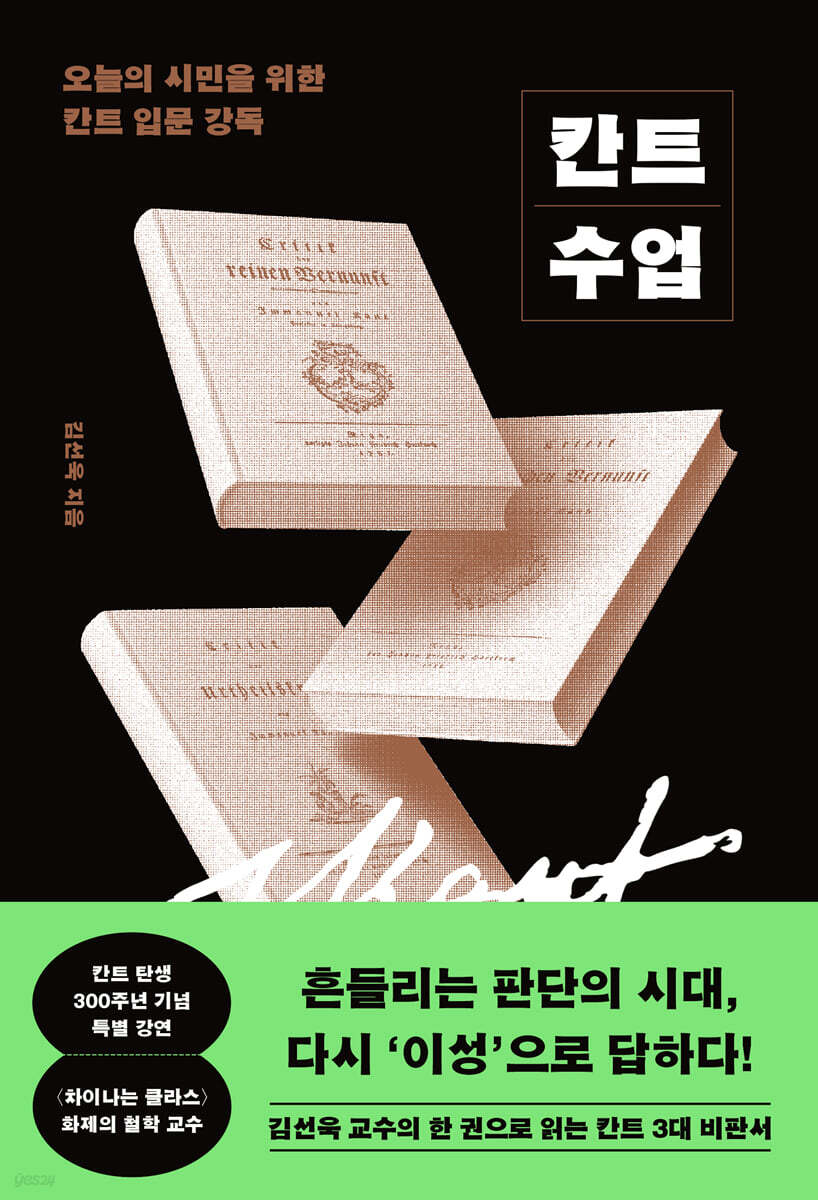
Kant class
 |
Description
Book Introduction
The 'Life Lessons' series, a time to add wisdom to your life.
Again, as a thinking human being
Kant's 300th Anniversary Lectures Now Available in Book Format
All the essential knowledge you need for life is gathered together! The thirty-sixth book in the "Life Lectures" series, a fascinating knowledge experience presented by Korea's leading professors, has been published.
The Life Lectures series, which transcribes the lectures of the best professors in various fields from universities across the country, including history, philosophy, science, medicine, and art, into books, provides readers with useful knowledge to live today and insight to look forward to tomorrow.
It is a knowledge and culture brand that allows you to encounter the best knowledge content in everyday life through not only books but also online lectures, YouTube, and podcasts.
"Kant Class" was planned based on four online lectures given by Professor Kim Seon-wook of the Department of Philosophy at Soongsil University to commemorate the 300th anniversary of Kant's birth in 2024.
In this book, Professor Kim Seon-wook concisely organizes the structure of Kant's philosophy by examining Kant's critical works, such as 『Critique of Pure Reason』, 『Critique of Practical Reason』, and 『Critique of Judgment』, and connects Kant's philosophy to the subjective consciousness of today's global citizens.
Through this book, readers can clearly understand the concepts of reason and judgment and explore a philosophical path back to being a conversational human being.
Again, as a thinking human being
Kant's 300th Anniversary Lectures Now Available in Book Format
All the essential knowledge you need for life is gathered together! The thirty-sixth book in the "Life Lectures" series, a fascinating knowledge experience presented by Korea's leading professors, has been published.
The Life Lectures series, which transcribes the lectures of the best professors in various fields from universities across the country, including history, philosophy, science, medicine, and art, into books, provides readers with useful knowledge to live today and insight to look forward to tomorrow.
It is a knowledge and culture brand that allows you to encounter the best knowledge content in everyday life through not only books but also online lectures, YouTube, and podcasts.
"Kant Class" was planned based on four online lectures given by Professor Kim Seon-wook of the Department of Philosophy at Soongsil University to commemorate the 300th anniversary of Kant's birth in 2024.
In this book, Professor Kim Seon-wook concisely organizes the structure of Kant's philosophy by examining Kant's critical works, such as 『Critique of Pure Reason』, 『Critique of Practical Reason』, and 『Critique of Judgment』, and connects Kant's philosophy to the subjective consciousness of today's global citizens.
Through this book, readers can clearly understand the concepts of reason and judgment and explore a philosophical path back to being a conversational human being.
- You can preview some of the book's contents.
Preview
index
time
Prologue - Invitation to Kant's Class
Part 1: How Knowledge Is Created - Kant's Epistemology
Chapter 1: Who is Kant?
Chapter 2: What is Criticism?
Chapter 3: Do We Know 'As It Is'?
Chapter 4: Can the Existence of God Be Proven?
Part 2: How We Should Live - Kant's Moral Philosophy
Chapter 1: Why Are Humans Dignified?
Chapter 2: A Happy Life and a Right Life
Chapter 3: How are moral laws discovered?
Chapter 4: How Can Humans Be Moral?
Part 3: From Enlightenment to Global Citizenship - The Philosophy of Humanism
Chapter 1: Courageous Questions About Humanity
Chapter 2: The Courage to Use Intelligence
Chapter 3: Are We Living in an Enlightened Age?
Chapter 4: The Failure or Incompleteness of Enlightenment
Part 4: Aesthetics and Politics - Aesthetics and Political Philosophy
Chapter 1: Where is the Fate of Universalism Headed?
Chapter 2: How Judgments Are Made
Chapter 3: How Political Is Aesthetics?
Chapter 4: Is it possible to expand into global citizenship?
Part 5 Addendum
Thinking as a Global Citizen - Nation, Citizens, and Global Citizenship
Chapter 1: What is a Global Citizen?
Chapter 2: Nation, Tribe, and Citizen
Chapter 3: Global Citizenship and Solidarity
Chapter 4: Education and Practice for Growth
Epilogue - Beyond Monologue to Dialogue
Main keywords
annotation
Prologue - Invitation to Kant's Class
Part 1: How Knowledge Is Created - Kant's Epistemology
Chapter 1: Who is Kant?
Chapter 2: What is Criticism?
Chapter 3: Do We Know 'As It Is'?
Chapter 4: Can the Existence of God Be Proven?
Part 2: How We Should Live - Kant's Moral Philosophy
Chapter 1: Why Are Humans Dignified?
Chapter 2: A Happy Life and a Right Life
Chapter 3: How are moral laws discovered?
Chapter 4: How Can Humans Be Moral?
Part 3: From Enlightenment to Global Citizenship - The Philosophy of Humanism
Chapter 1: Courageous Questions About Humanity
Chapter 2: The Courage to Use Intelligence
Chapter 3: Are We Living in an Enlightened Age?
Chapter 4: The Failure or Incompleteness of Enlightenment
Part 4: Aesthetics and Politics - Aesthetics and Political Philosophy
Chapter 1: Where is the Fate of Universalism Headed?
Chapter 2: How Judgments Are Made
Chapter 3: How Political Is Aesthetics?
Chapter 4: Is it possible to expand into global citizenship?
Part 5 Addendum
Thinking as a Global Citizen - Nation, Citizens, and Global Citizenship
Chapter 1: What is a Global Citizen?
Chapter 2: Nation, Tribe, and Citizen
Chapter 3: Global Citizenship and Solidarity
Chapter 4: Education and Practice for Growth
Epilogue - Beyond Monologue to Dialogue
Main keywords
annotation
Detailed image

Into the book
I sincerely hope that through this book, readers will encounter Kant as a meaningful friend in their lives and thoughts.
To me, Kant is that kind of person.
The stars that shine in the sky, the moral law that shines in my heart… There are two things that fill my heart with wonder and awe that grows ever new and greater the more I ponder them.
It is the starry sky above me and the moral law within me…
--- From the "Prologue"
In order for the five senses to make judgments through categories, they need data that will become the content of that judgment, and that actual data is supplied by the emotions.
That is, the concept of reason must be applied to intuitive data to form a judgment.
Kant explains this in the following sentence:
“Concepts without intuition are empty, and intuition without concepts is blind.”
--- From "Do We Know 'As It Is'?"
Freedom is not about ignoring causality.
Freedom is the first starting point for creating new causes.
Therefore, a free act is an act that creates a new cause, and freedom is an act that opens up the first cause.
Even if the subsequent flow is again formed within a causal order, there is freedom in its beginning.
Moral action is not something you do simply because you do it, but because you have to do it.
In other words, it is an act that responds to the request of goodness itself.
That is why Kant used the expression ‘unconditional good.’
--- From "Why Are Humans Dignified?"
But Kant's claims about the immortality of the soul and the existence of God feel like a cry to me.
In this world, a moral life based on good intentions may not lead to a good life and may be betrayed.
However, as long as reason demands such a life, the outcome of that life must ultimately lead to happiness, which is a cry.
The belief that the immortality of the soul and the existence of God are as necessary as the logicality of reason is considered the basis of Kant's argument in the realm of practical reason.
As if concrete life in reality is impossible without such belief.
--- From "How Can Humans Be Moral?"
When we see a work of art and feel beauty and are deeply moved, it means that our aesthetic judgment is at work at that very moment.
There is something about that work that moves people, and that is why I feel that way.
Here, the element of possibility of subjective experience, which is the emotion of 'me', is open to the possibility of moving 'everyone', and the element of that emotion is none other than something that already exists within us.
--- From "How Judgments Are Made"
Good will, guided by reason, goes beyond natural nature and judges whether it conforms to the principles of universal legislation, and the standard is presented in the form of a categorical imperative that everyone must follow.
--- From "What is a Global Citizen"
This kind of solidarity comes from a sense of shame as a human being.
The shame we feel when confronted with the realities of suffering and abuse arises from the recognition that those who suffer and those who recognize it are fundamentally the same human beings.
This empathy transcends any particular group and leads to an inclusive solidarity that applies to all of humanity.
To me, Kant is that kind of person.
The stars that shine in the sky, the moral law that shines in my heart… There are two things that fill my heart with wonder and awe that grows ever new and greater the more I ponder them.
It is the starry sky above me and the moral law within me…
--- From the "Prologue"
In order for the five senses to make judgments through categories, they need data that will become the content of that judgment, and that actual data is supplied by the emotions.
That is, the concept of reason must be applied to intuitive data to form a judgment.
Kant explains this in the following sentence:
“Concepts without intuition are empty, and intuition without concepts is blind.”
--- From "Do We Know 'As It Is'?"
Freedom is not about ignoring causality.
Freedom is the first starting point for creating new causes.
Therefore, a free act is an act that creates a new cause, and freedom is an act that opens up the first cause.
Even if the subsequent flow is again formed within a causal order, there is freedom in its beginning.
Moral action is not something you do simply because you do it, but because you have to do it.
In other words, it is an act that responds to the request of goodness itself.
That is why Kant used the expression ‘unconditional good.’
--- From "Why Are Humans Dignified?"
But Kant's claims about the immortality of the soul and the existence of God feel like a cry to me.
In this world, a moral life based on good intentions may not lead to a good life and may be betrayed.
However, as long as reason demands such a life, the outcome of that life must ultimately lead to happiness, which is a cry.
The belief that the immortality of the soul and the existence of God are as necessary as the logicality of reason is considered the basis of Kant's argument in the realm of practical reason.
As if concrete life in reality is impossible without such belief.
--- From "How Can Humans Be Moral?"
When we see a work of art and feel beauty and are deeply moved, it means that our aesthetic judgment is at work at that very moment.
There is something about that work that moves people, and that is why I feel that way.
Here, the element of possibility of subjective experience, which is the emotion of 'me', is open to the possibility of moving 'everyone', and the element of that emotion is none other than something that already exists within us.
--- From "How Judgments Are Made"
Good will, guided by reason, goes beyond natural nature and judges whether it conforms to the principles of universal legislation, and the standard is presented in the form of a categorical imperative that everyone must follow.
--- From "What is a Global Citizen"
This kind of solidarity comes from a sense of shame as a human being.
The shame we feel when confronted with the realities of suffering and abuse arises from the recognition that those who suffer and those who recognize it are fundamentally the same human beings.
This empathy transcends any particular group and leads to an inclusive solidarity that applies to all of humanity.
--- From "Global Citizenship and Solidarity"
Publisher's Review
Has the moral law within me stopped working?
The Judgment of a Global Citizen, Questioned by Kant
We live in an age where anyone can pour out information and make judgments. Whether on social media, YouTube, or in public settings, it's easy to find people willing to go to any lengths to prove their "righteousness."
Some people take the number of “likes” as truth, while others paralyze public discourse by proving the superiority of morality through anger.
In this age of endless judgment and reaction, can we really say that we are 'thinking'?
"Kant's Lessons" is a book that deeply reflects on human judgment and moral autonomy in this situation that can be called a crisis of reason.
It was planned based on a lecture by Professor Kim Seon-wook, an authority on Hannah Arendt studies in Korea, to commemorate the 300th anniversary of Kant's birth in 2024.
This book revisits the fundamental structure of Kant's philosophy, which has influenced numerous modern philosophers, including Hannah Arendt and Michael Sandel.
In particular, it organizes Kant's three major critiques, 『Critique of Pure Reason』, 『Critique of Practical Reason』, and 『Critique of Judgment』, into the structure of cognition-morality-judgment.
Through this, we connect Kant's philosophy to today's life and answer the question of the future called 'cosmopolitanism' by connecting the challenges left by his philosophy.
Is it possible to make the right judgment for everyone?
In the movie “The Matrix,” Morpheus speaks to the main character, Neo.
“The world we see is not the ultimate reality.” He then shows Neo the blue pill and the red pill.
Neo must now choose whether to take the red pill and face reality, or take the blue pill and maintain a comfortable life in fantasy.
In "Kant's Class," the author says that encountering Kant's philosophy is like facing the world after taking the red pill.
In this way, Kant's Copernican revolution was a revolution that overturned the existing world view.
It is a transformation of the world from an objective reality as it is to a result constructed within the cognitive structure of humans.
If the world is reconstructed within each person's perception, can there be universal moral laws that apply to everyone?
Kant believed that there was a universal cognitive structure shared by all humans, and attempted to prove this through the Critique of Pure Reason.
He believed that it was possible to make judgments that were always true, without going through any experience, that is, 'innate synthetic judgments'.
By virtue of their innate synthetic judgment, humans can always discern true and correct knowledge without relying solely on their own experience.
In other words, humans become able to discern not only science but also “fictional belief structures.”
Through this process of critically examining the limits of reason, humans become aware of “what they are doing” and take the first step toward morality.
The courage to use one's intellect, from pure reason to moral law.
“Moral action is not something you do simply because you have to do it, but something you do because you have to do it.”
In other words, it is an act that responds to the request of goodness itself.”
- 108p, "How We Should Live - Kant's Moral Philosophy"
Any discussion of reason leads to the question, 'What is to be done?'
Kant calls the moral law discovered through reason the 'categorical imperative.'
The categorical imperative examines whether a law can be applied universally and serves as a criterion for determining whether it is moral or not.
For example, the law that “everyone always makes false promises, no matter what the circumstances” cannot be universalized.
Since the very concept of a 'false promise' is a contradiction, if this law were to be universalized, the concept of a promise would not exist in the world.
The categorical imperative shows the unique characteristic of Kant's moral philosophy in that it emphasizes 'self-contradiction' rather than 'social benefit', which is the utilitarian viewpoint.
The author evaluates Kant as having established moral philosophy “more thoroughly than Socrates.”
Kant derives moral laws based solely on fierce logic and reason, not on someone's interests or right and wrong.
But the law doesn't tell us what to do.
It just makes you judge exactly what you are doing.
The categorical imperative ultimately relies on human autonomy, and Kant leaves morality to the will.
Thus, for Kant, dignity is not simply a given right, but rather a matter of practice.
In other words, “humans are inherently dignified, but they are only worthy of being treated with dignity when they practice the will to uphold that dignity.”
This sentence raises a question:
In an age where legitimacy is often based on instinct and anger, do we truly have the will to impose our own moral laws and follow them? "Kant's Lessons" leads readers to these questions, laying the foundation for judgment.
Beyond monologue to dialogue
Imagining coexistence and solidarity based on Kant's philosophy
What is most interesting about this book is that it gradually expands Kant's philosophy to include morality, humanism, and the practice of global citizenship.
In particular, after Part 4, which deals with the Critique of Judgment, Part 5, an addition that was not included in the original lecture, was added, and the discussion expanded to questions about ‘cosmopolitanism.’
“If I were to define Kant in one word, he would be a philosopher who opened up the possibility of universalism based on transcendental philosophy and reflective philosophy.”
But through the world wars and the Holocaust of the 19th century, we witnessed how 'universalism' could degenerate into violence.
For us living in the 21st century, the concept of ‘world’ is no longer confined to a single concept.
The world is constantly evolving and changing within the interconnected world of the Internet, within the fusion of individual experiences and cultural activities.
This is why Kant's philosophy seems unable to accommodate modern diversity.
However, the author finds a clue to solidarity in ‘universality.’
As Kant argued in his Critique of the Power of Judgment, we do not use moral laws to judge whether our appreciation or feelings about a work of art are valid or not.
Aesthetic judgments gain artistic validity only by sharing and communicating with others.
This is the very nature of aesthetics, and ultimately we come to realize that the problem of sharing and accepting some common sense is a “problem of communication.”
Although Kant developed his philosophical thought through his monologues, the author argues that “transforming it into a philosophy of dialogue is a crucial task that makes his universalism meaningful today.”
Today we face the cracks brought about by globalization.
In the book, the author calls for a ‘global citizenship’ that goes beyond ‘world citizenship.’
Global citizenship, while encompassed within the framework of cosmopolitanism, demands concrete reflection and practical effort on real-world issues such as politics, ethics, and culture.
Such efforts are possible when we reflect on the sense of reason, autonomy, and responsibility presented by Kant.
Kant's philosophy asks us again:
"Will we possess such enlightenment and courage?" The author suggests that each person's answer to this question will ultimately determine coexistence and peace in our time, thereby enabling Kant's philosophy to move beyond abstract theory to practical ethics.
The Judgment of a Global Citizen, Questioned by Kant
We live in an age where anyone can pour out information and make judgments. Whether on social media, YouTube, or in public settings, it's easy to find people willing to go to any lengths to prove their "righteousness."
Some people take the number of “likes” as truth, while others paralyze public discourse by proving the superiority of morality through anger.
In this age of endless judgment and reaction, can we really say that we are 'thinking'?
"Kant's Lessons" is a book that deeply reflects on human judgment and moral autonomy in this situation that can be called a crisis of reason.
It was planned based on a lecture by Professor Kim Seon-wook, an authority on Hannah Arendt studies in Korea, to commemorate the 300th anniversary of Kant's birth in 2024.
This book revisits the fundamental structure of Kant's philosophy, which has influenced numerous modern philosophers, including Hannah Arendt and Michael Sandel.
In particular, it organizes Kant's three major critiques, 『Critique of Pure Reason』, 『Critique of Practical Reason』, and 『Critique of Judgment』, into the structure of cognition-morality-judgment.
Through this, we connect Kant's philosophy to today's life and answer the question of the future called 'cosmopolitanism' by connecting the challenges left by his philosophy.
Is it possible to make the right judgment for everyone?
In the movie “The Matrix,” Morpheus speaks to the main character, Neo.
“The world we see is not the ultimate reality.” He then shows Neo the blue pill and the red pill.
Neo must now choose whether to take the red pill and face reality, or take the blue pill and maintain a comfortable life in fantasy.
In "Kant's Class," the author says that encountering Kant's philosophy is like facing the world after taking the red pill.
In this way, Kant's Copernican revolution was a revolution that overturned the existing world view.
It is a transformation of the world from an objective reality as it is to a result constructed within the cognitive structure of humans.
If the world is reconstructed within each person's perception, can there be universal moral laws that apply to everyone?
Kant believed that there was a universal cognitive structure shared by all humans, and attempted to prove this through the Critique of Pure Reason.
He believed that it was possible to make judgments that were always true, without going through any experience, that is, 'innate synthetic judgments'.
By virtue of their innate synthetic judgment, humans can always discern true and correct knowledge without relying solely on their own experience.
In other words, humans become able to discern not only science but also “fictional belief structures.”
Through this process of critically examining the limits of reason, humans become aware of “what they are doing” and take the first step toward morality.
The courage to use one's intellect, from pure reason to moral law.
“Moral action is not something you do simply because you have to do it, but something you do because you have to do it.”
In other words, it is an act that responds to the request of goodness itself.”
- 108p, "How We Should Live - Kant's Moral Philosophy"
Any discussion of reason leads to the question, 'What is to be done?'
Kant calls the moral law discovered through reason the 'categorical imperative.'
The categorical imperative examines whether a law can be applied universally and serves as a criterion for determining whether it is moral or not.
For example, the law that “everyone always makes false promises, no matter what the circumstances” cannot be universalized.
Since the very concept of a 'false promise' is a contradiction, if this law were to be universalized, the concept of a promise would not exist in the world.
The categorical imperative shows the unique characteristic of Kant's moral philosophy in that it emphasizes 'self-contradiction' rather than 'social benefit', which is the utilitarian viewpoint.
The author evaluates Kant as having established moral philosophy “more thoroughly than Socrates.”
Kant derives moral laws based solely on fierce logic and reason, not on someone's interests or right and wrong.
But the law doesn't tell us what to do.
It just makes you judge exactly what you are doing.
The categorical imperative ultimately relies on human autonomy, and Kant leaves morality to the will.
Thus, for Kant, dignity is not simply a given right, but rather a matter of practice.
In other words, “humans are inherently dignified, but they are only worthy of being treated with dignity when they practice the will to uphold that dignity.”
This sentence raises a question:
In an age where legitimacy is often based on instinct and anger, do we truly have the will to impose our own moral laws and follow them? "Kant's Lessons" leads readers to these questions, laying the foundation for judgment.
Beyond monologue to dialogue
Imagining coexistence and solidarity based on Kant's philosophy
What is most interesting about this book is that it gradually expands Kant's philosophy to include morality, humanism, and the practice of global citizenship.
In particular, after Part 4, which deals with the Critique of Judgment, Part 5, an addition that was not included in the original lecture, was added, and the discussion expanded to questions about ‘cosmopolitanism.’
“If I were to define Kant in one word, he would be a philosopher who opened up the possibility of universalism based on transcendental philosophy and reflective philosophy.”
But through the world wars and the Holocaust of the 19th century, we witnessed how 'universalism' could degenerate into violence.
For us living in the 21st century, the concept of ‘world’ is no longer confined to a single concept.
The world is constantly evolving and changing within the interconnected world of the Internet, within the fusion of individual experiences and cultural activities.
This is why Kant's philosophy seems unable to accommodate modern diversity.
However, the author finds a clue to solidarity in ‘universality.’
As Kant argued in his Critique of the Power of Judgment, we do not use moral laws to judge whether our appreciation or feelings about a work of art are valid or not.
Aesthetic judgments gain artistic validity only by sharing and communicating with others.
This is the very nature of aesthetics, and ultimately we come to realize that the problem of sharing and accepting some common sense is a “problem of communication.”
Although Kant developed his philosophical thought through his monologues, the author argues that “transforming it into a philosophy of dialogue is a crucial task that makes his universalism meaningful today.”
Today we face the cracks brought about by globalization.
In the book, the author calls for a ‘global citizenship’ that goes beyond ‘world citizenship.’
Global citizenship, while encompassed within the framework of cosmopolitanism, demands concrete reflection and practical effort on real-world issues such as politics, ethics, and culture.
Such efforts are possible when we reflect on the sense of reason, autonomy, and responsibility presented by Kant.
Kant's philosophy asks us again:
"Will we possess such enlightenment and courage?" The author suggests that each person's answer to this question will ultimately determine coexistence and peace in our time, thereby enabling Kant's philosophy to move beyond abstract theory to practical ethics.
GOODS SPECIFICS
- Date of issue: October 29, 2025
- Page count, weight, size: 276 pages | 128*188*20mm
- ISBN13: 9791173575662
- ISBN10: 1173575669
You may also like
카테고리
korean


korean

![GQ KOREA Mark (Monthly): December [2025]](http://librairie.coreenne.fr/cdn/shop/files/8ef265dbbfbf186523ed75ba7319009d.jpg?v=1765340328&width=3840)


