

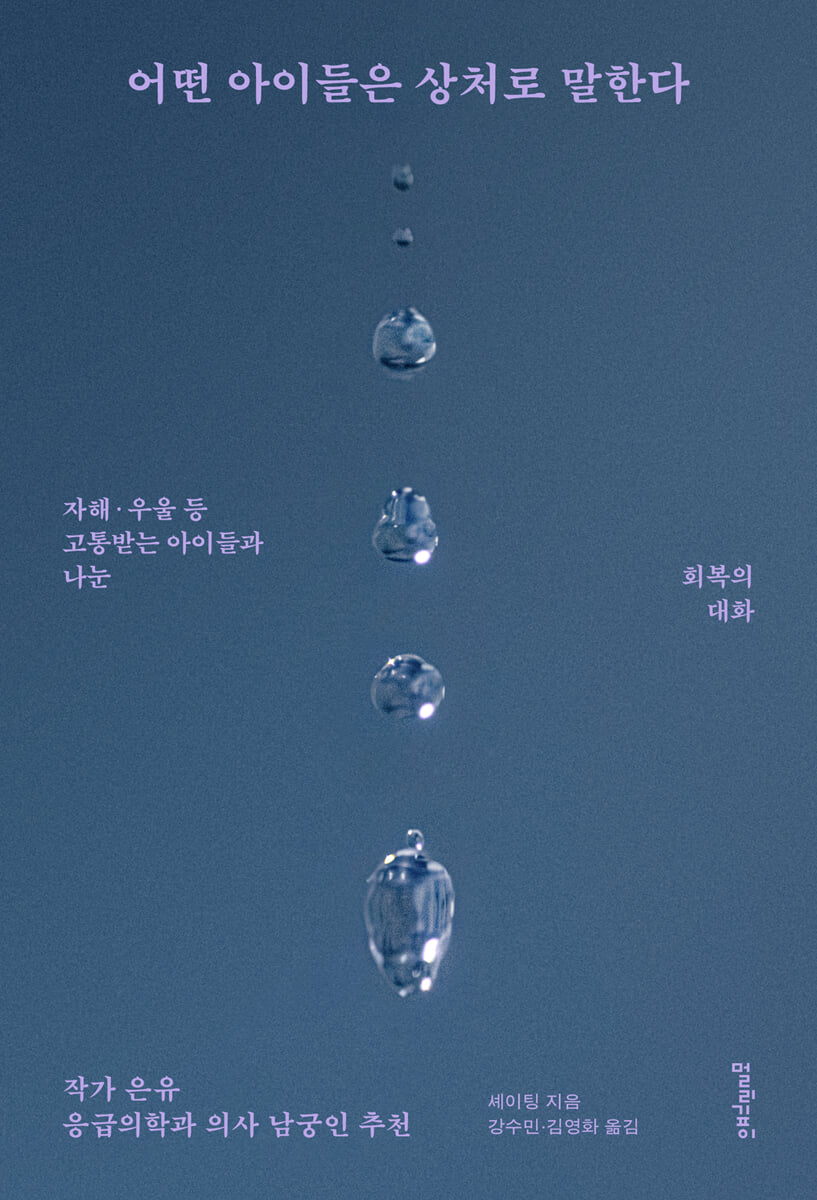
Some children speak with hurt
 |
Description
Book Introduction
Eunyu, Namgung In highly recommended!
A report on adolescent psychology that views self-harm and depression as a "sign to live."
Taiwanese child and adolescent psychiatrist Xie Ying-ting recorded the stories of 24 children, ranging in age from four to twenty, who experienced self-harm, depression, and mutism.
The 26 vivid cases contain the desperate hearts of children who are hurting and the worries of the adults who try to protect them.
This book confronts head-on the issues of youth self-harm and depression, which Korean society still ignores, and poses honest questions to a society that pretends there are no problems other than studying.
A report on adolescent psychology that views self-harm and depression as a "sign to live."
Taiwanese child and adolescent psychiatrist Xie Ying-ting recorded the stories of 24 children, ranging in age from four to twenty, who experienced self-harm, depression, and mutism.
The 26 vivid cases contain the desperate hearts of children who are hurting and the worries of the adults who try to protect them.
This book confronts head-on the issues of youth self-harm and depression, which Korean society still ignores, and poses honest questions to a society that pretends there are no problems other than studying.
- You can preview some of the book's contents.
Preview
index
[Recommendation] Why Did the Sunshine Child Hang Himself?
[Parents' Recommendation] Children who gain strength from our positivity.
1.
None of them saw the boy being sexually assaulted.
The Tropical Fish Boy Who Wrote a Fatigue Diary
2.
If I do this, I'll die, right?
Four-year-old Xiaoqi smashed a clay doll
3.
I want to disappear completely from this world
Xiaoju, a high school student who was afraid of independence
4.
I'm afraid that I'll do something stupid and hurt the people around me.
Baek Moon-jo, a high school student who was bullied by a group
5.
How can I stop thinking useless thoughts?
A girl with short hair who came to the clinic alone
6.
I feel like my mom only loves a part of me
A child who is not recognized as homosexual
7.
If I had taken him to the hospital right then, he might have lived.
Xiaomeng couldn't shed a single tear at her best friend's death.
8.
Actually, I know I shouldn't be a hindrance to my father's happiness.
A girl with a ponytail who pulled out her hair so that her scalp was visible
9.
Sometimes I feel terrible about myself
Xiaomai, a middle school student who harms herself because of her mother's lovers
10.
Everything feels like a lie
Xiaoyu, a middle school student who discovers her father's affair
11.
Okay, I enjoy playing alone.
Xiaozi's expression darkens whenever he talks about his friends.
12.
Teacher, I miss my grandmother so much.
Xiaoguang, an ADHD child who lost his grandmother who raised him
13.
The teacher said our family was a problem family.
Xiaolong wandered before finding what he loved.
14.
Teacher, how can I improve my concentration?
Ah-ha-o, a boy studying in military uniform
15.
What am I wrong about? It was clearly written that way in the book.
A boy who becomes obsessed with medical knowledge to cure his mother's cancer.
16.
I'm never going to school again
Xiaoba, the loner who poured drinks on the children in his class
17.
You can study hard at home too.
The classic Chinese girl who refused to go to school
18.
Mom, why is there fluid coming out of your eyes?
A boy with Asperger's who suffered from obsessive compulsive disorder
19.
I'm sorry I was born
Mo Yan, the girl who kept her mouth shut
20.
There's no way my child has autism!
Ran, an autistic boy who has to go to a special class
21.
For me, math was a subject of memorization.
The Math Girl Who Makes Us Rethink the Meaning of Disability
22.
I was born for my sick brother
A five-year-old child who has never received proper attention
23.
Is it all my fault that my child ended up like this?
Xiaoten, a child sitting alone next to a trash can
24.
I want to become smart, make a lot of money, and have a big house.
Ahan, a boy who was criticized all day long
25.
I used to be a kindergarten teacher, but I can't teach my own children.
A two-year-old child who was thought to have autism
26.
I tried to ignore the child's feelings.
A father and child who have closed their hearts after their mother's death
[Epilogue] I'll hold your hand
[Parents' Recommendation] Children who gain strength from our positivity.
1.
None of them saw the boy being sexually assaulted.
The Tropical Fish Boy Who Wrote a Fatigue Diary
2.
If I do this, I'll die, right?
Four-year-old Xiaoqi smashed a clay doll
3.
I want to disappear completely from this world
Xiaoju, a high school student who was afraid of independence
4.
I'm afraid that I'll do something stupid and hurt the people around me.
Baek Moon-jo, a high school student who was bullied by a group
5.
How can I stop thinking useless thoughts?
A girl with short hair who came to the clinic alone
6.
I feel like my mom only loves a part of me
A child who is not recognized as homosexual
7.
If I had taken him to the hospital right then, he might have lived.
Xiaomeng couldn't shed a single tear at her best friend's death.
8.
Actually, I know I shouldn't be a hindrance to my father's happiness.
A girl with a ponytail who pulled out her hair so that her scalp was visible
9.
Sometimes I feel terrible about myself
Xiaomai, a middle school student who harms herself because of her mother's lovers
10.
Everything feels like a lie
Xiaoyu, a middle school student who discovers her father's affair
11.
Okay, I enjoy playing alone.
Xiaozi's expression darkens whenever he talks about his friends.
12.
Teacher, I miss my grandmother so much.
Xiaoguang, an ADHD child who lost his grandmother who raised him
13.
The teacher said our family was a problem family.
Xiaolong wandered before finding what he loved.
14.
Teacher, how can I improve my concentration?
Ah-ha-o, a boy studying in military uniform
15.
What am I wrong about? It was clearly written that way in the book.
A boy who becomes obsessed with medical knowledge to cure his mother's cancer.
16.
I'm never going to school again
Xiaoba, the loner who poured drinks on the children in his class
17.
You can study hard at home too.
The classic Chinese girl who refused to go to school
18.
Mom, why is there fluid coming out of your eyes?
A boy with Asperger's who suffered from obsessive compulsive disorder
19.
I'm sorry I was born
Mo Yan, the girl who kept her mouth shut
20.
There's no way my child has autism!
Ran, an autistic boy who has to go to a special class
21.
For me, math was a subject of memorization.
The Math Girl Who Makes Us Rethink the Meaning of Disability
22.
I was born for my sick brother
A five-year-old child who has never received proper attention
23.
Is it all my fault that my child ended up like this?
Xiaoten, a child sitting alone next to a trash can
24.
I want to become smart, make a lot of money, and have a big house.
Ahan, a boy who was criticized all day long
25.
I used to be a kindergarten teacher, but I can't teach my own children.
A two-year-old child who was thought to have autism
26.
I tried to ignore the child's feelings.
A father and child who have closed their hearts after their mother's death
[Epilogue] I'll hold your hand
Detailed image
Into the book
“What do you want to do with Mr. Knight?” asked the clinical psychologist.
Xiaochi raised his sword and slashed it at the clay doll.
His grip grew stronger and stronger, and soon he was swinging a knife and a fork in each hand.
In an instant, the clay doll was shattered into pieces.
“I can’t bother you now that the knight is broken,” the clinical psychologist said calmly next to the child.
Xiaochi collected the clay pieces into a pot and placed it on the gas stove.
“I can’t do anything to you because it’s bubbling in the pot, right?”
“If I do this, I’ll die, right?” Xiaochi blurted out in a clear voice.
--- p.35~36
“Actually, I felt strange because I kept feeling down since last March.
But my mom wouldn't let me go to the hospital because it was dangerous due to the coronavirus.
When April came, I couldn't stand it any longer.
When I told my family, they said I wasn't mentally ill, so why would I go there?
People say things like, "I'm depressed because I'm not satisfied with reality," or, "How can I get a job if I have a psychiatric treatment record?"
But I couldn't sleep, I couldn't study, and I felt like my classmates would betray me... I really thought I was going crazy."
The emergency room doctor on duty recommended hospitalization for fear that Baek Moon-jo might attempt suicide again.
But before I knew it, my mother came into the examination room and stopped me.
“Think carefully and answer.
“If you get hospitalized, your life is over.” --- p.57
However, during counseling sessions, a tense standoff often occurs between the youth harboring the secret and the person willing to reveal it.
“If you tell your parents, you’ll go straight to the hospital and die!” I’ve heard these words so many times that it chills my heart just hearing them.
How else can we explain this seemingly endless dilemma other than calling it the original sin of child psychiatrists?
--- p.64
"Professor, wasn't homosexuality removed from the mental illness category in 1973? Then why did you just recommend a psychological evaluation for that child's parents?" The professor in charge looked a little surprised and blank.
But soon he answered with a smile that showed his experience.
“If I tell the truth, those parents will take their child to another hospital.
Until they find a doctor who will correct their child's sexual orientation as they wish.
"Wouldn't it be better to have him receive treatment here and take his time to persuade him? I decided that was the best option for the child."
Even after hearing the professor's answer, I still wasn't sure if this was the best option.
Ten years later, Taiwan legalized same-sex marriage.
However, unfortunately, there are still parents who consider homosexuality as 'misguided sexual attraction', 'abnormal sexual desire', or 'abnormal love' and seek psychiatric treatment.
These parents were broadly divided into two categories.
The cases that came because they were worried that their children would have a difficult life in the future were relatively better.
Most of the time, they asked to be fixed so that they could become 'normal'.
When it got worse, they would swear at their children, saying things like, “You’re a pervert,” or “You must be crazy!”
If such verbal abuse could actually cause harm, the clinic would probably be a sea of blood.
--- p.73~74
“I thought about it for a long time.
Maybe he wanted to communicate with me through this game.
I didn't even know that and was lost in my own depression.
That day, I had no choice but to leave because that kid kept calling me.
I've been blaming myself all along.
Why didn't I notice my friend was sick from the beginning?
If they had taken him to the hospital right then, he might have lived.
I was upset on the train because the kid vomited and soiled my coat.
Afterwards, I couldn't even think about remembering this and couldn't even log into my game account.
I wish I had played the game faster….
“It still feels like that kid is alive.”
Having said this, Xiaomeng began to cry quietly.
Xiaochi raised his sword and slashed it at the clay doll.
His grip grew stronger and stronger, and soon he was swinging a knife and a fork in each hand.
In an instant, the clay doll was shattered into pieces.
“I can’t bother you now that the knight is broken,” the clinical psychologist said calmly next to the child.
Xiaochi collected the clay pieces into a pot and placed it on the gas stove.
“I can’t do anything to you because it’s bubbling in the pot, right?”
“If I do this, I’ll die, right?” Xiaochi blurted out in a clear voice.
--- p.35~36
“Actually, I felt strange because I kept feeling down since last March.
But my mom wouldn't let me go to the hospital because it was dangerous due to the coronavirus.
When April came, I couldn't stand it any longer.
When I told my family, they said I wasn't mentally ill, so why would I go there?
People say things like, "I'm depressed because I'm not satisfied with reality," or, "How can I get a job if I have a psychiatric treatment record?"
But I couldn't sleep, I couldn't study, and I felt like my classmates would betray me... I really thought I was going crazy."
The emergency room doctor on duty recommended hospitalization for fear that Baek Moon-jo might attempt suicide again.
But before I knew it, my mother came into the examination room and stopped me.
“Think carefully and answer.
“If you get hospitalized, your life is over.” --- p.57
However, during counseling sessions, a tense standoff often occurs between the youth harboring the secret and the person willing to reveal it.
“If you tell your parents, you’ll go straight to the hospital and die!” I’ve heard these words so many times that it chills my heart just hearing them.
How else can we explain this seemingly endless dilemma other than calling it the original sin of child psychiatrists?
--- p.64
"Professor, wasn't homosexuality removed from the mental illness category in 1973? Then why did you just recommend a psychological evaluation for that child's parents?" The professor in charge looked a little surprised and blank.
But soon he answered with a smile that showed his experience.
“If I tell the truth, those parents will take their child to another hospital.
Until they find a doctor who will correct their child's sexual orientation as they wish.
"Wouldn't it be better to have him receive treatment here and take his time to persuade him? I decided that was the best option for the child."
Even after hearing the professor's answer, I still wasn't sure if this was the best option.
Ten years later, Taiwan legalized same-sex marriage.
However, unfortunately, there are still parents who consider homosexuality as 'misguided sexual attraction', 'abnormal sexual desire', or 'abnormal love' and seek psychiatric treatment.
These parents were broadly divided into two categories.
The cases that came because they were worried that their children would have a difficult life in the future were relatively better.
Most of the time, they asked to be fixed so that they could become 'normal'.
When it got worse, they would swear at their children, saying things like, “You’re a pervert,” or “You must be crazy!”
If such verbal abuse could actually cause harm, the clinic would probably be a sea of blood.
--- p.73~74
“I thought about it for a long time.
Maybe he wanted to communicate with me through this game.
I didn't even know that and was lost in my own depression.
That day, I had no choice but to leave because that kid kept calling me.
I've been blaming myself all along.
Why didn't I notice my friend was sick from the beginning?
If they had taken him to the hospital right then, he might have lived.
I was upset on the train because the kid vomited and soiled my coat.
Afterwards, I couldn't even think about remembering this and couldn't even log into my game account.
I wish I had played the game faster….
“It still feels like that kid is alive.”
Having said this, Xiaomeng began to cry quietly.
--- p.89~90
Publisher's Review
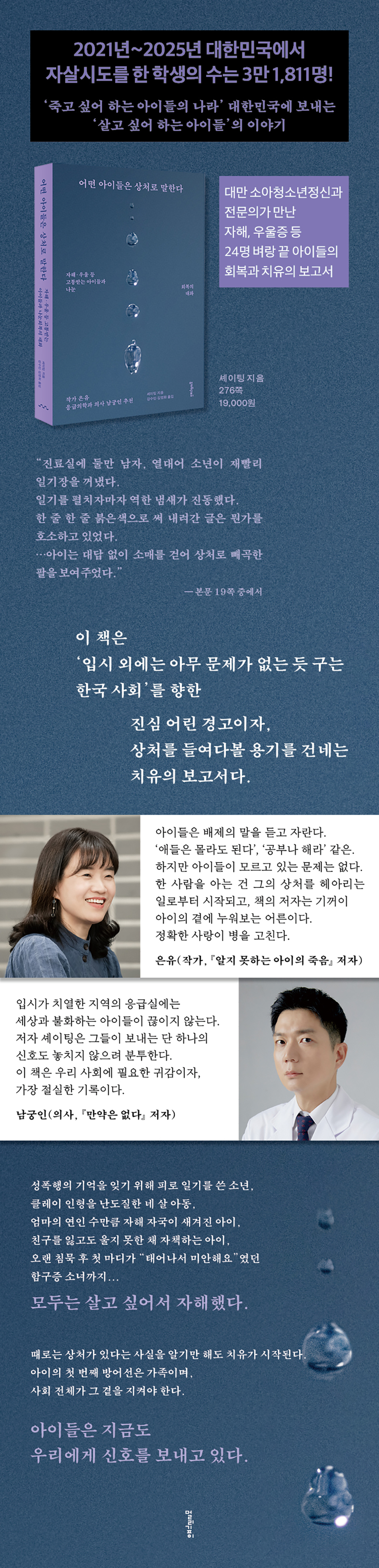
The number of suicide cases among Korean youth over the past five years has reached 31,811!
The story of "children who want to live" sent to South Korea, "the land of children who want to die."
A Taiwanese child and adolescent psychiatrist shares 26 "reasonable pains" from 24 children.
“There were only two men in the clinic, and the tropical fish boy quickly took out his diary.
As soon as I opened the diary, a strong smell hit me.
The text written in red, line by line, was appealing to something.
…The child rolled up his sleeves without answering, showing his arms covered in wounds.
“I could tell what the diary was written in without even having to say anything.”
- From page 21 of the text
According to data released by 17 provincial and metropolitan offices of education in October 2025, the total number of students who attempted suicide or committed self-harm in schools nationwide from 2021 to June 2025 was 31,811.
The fact that so many children 'wanted to die' is surprising in itself, but what is more troubling is the steep increase.
The number of students who attempted suicide or self-harmed increased from 522 in 2022 to 844 in 2023 and 968 in 2024, with 589 children attempting suicide in the first half of 2025 alone.
Although the government announced a 'National Suicide Prevention Strategy' last September to reduce the suicide rate by 40% within 10 years, the reality is that it has not even properly identified the causes.
《Some Children Speak with Their Wounds》(2025, published by Mulli-Gip-Yi) is a clinical report on adolescent self-harm and problem behavior written by Taiwanese child and adolescent psychiatrist Shaiting.
Scheiting is one of only 300 child and adolescent psychiatrists in Taiwan, and his book reveals the various psychological distress and self-harm behaviors experienced by children and adolescents of all ages, from babbling infants to teenagers in their twenties.
What does it mean for this book, published in 2020 and supported by various experts and parents in Taiwan, to be published in Korea in 2025?
The book contains stories so painful and desperate that it is almost embarrassing to read them.
A boy who wrote a diary in his own blood to forget the memories of sexual assault, a four-year-old sexually assaulted child who stabbed a clay doll with a toy knife in the counseling room, a child with self-harm scars equal to the number of lovers his mother had repeatedly, a child who couldn't shed a single tear and blamed himself after suddenly losing a friend, a child who refused to go to school after being bullied, and a mute child whose first words after two years of counseling were "I'm sorry I was born" - all of them hurt their bodies and minds because they "wanted to live."
All of these problems faced by children and adolescents in Taiwan are something that children living in South Korea cannot avoid.
In the recommendation of “The Death of an Unknown Child,” Eunyu says, “Knowing a person begins with understanding their wounds.”
The meaning of this book is revealed at this very point.
"Some Children Speak Through Their Wounds" is a book that does not ignore the uncomfortable reality of youth self-harm and depression, which has been denied behind the huge veil of "entrance exams," but sincerely listens to the loneliness and distress signals hidden within it.
Above all, to those who breathe with youth in counseling rooms, schools, and homes.
It offers deep empathy and practical insight.
This book, which has received praise in Taiwan as "a tear-jerking clinical report" and "a must-read for parents and teachers," isn't limited to "problem children." It also offers solutions to common concerns in Korean families, such as ADHD and loneliness stemming from a lack of parental attention.
Sometimes just knowing you have a wound can heal you.
A warning to Korean society, which pretends that nothing matters except studying.
Dr. Namgung In, an emergency medicine physician who wrote the book's recommendation, said, "I've been working in an area with fiercely competitive college entrance exams for a long time, and the children around me spend their school years believing that grades are directly connected to life."
'Because of this, hospitals are overflowing with children who are at odds with the world, and sometimes we hear heartbreaking stories.'
The purpose of “Some Children Speak with Their Wounds” is clear.
There is a problem, so let's not cover it up.
In Korea's educational environment, many parents respond to the numerous difficulties their children face by saying, "Just study."
The widespread problem of sexual violence is treated as if it were invisible, and the gender identity crisis that affects approximately 10% of young people is also ignored by society as a whole as if it were a 'non-existent shame'.
This book proposes breaking that silence and listening to children's signals head-on.
“Children who lack the strength to resolve their inner turmoil often
Acting neurotically and hurting others and yourself.
If at this time
If you ignore the child's distress signals and only push them,
“You may miss the opportunity to help forever.”
- From page 8 of the text
Mental illnesses like depression are not like colds that can be cured by simply taking medicine.
To get your life back on track, you must understand and accept your emotions and try to adapt to the world.
Only then can we move forward without being held back by the sadness and hurt within us.
The first line of defense for a child mired in emotional turmoil is the family.
And the entire society has a responsibility to ensure that the child emerges safely from the dense fog.
Only then will we finally meet the ‘children who love me.’
The story of "children who want to live" sent to South Korea, "the land of children who want to die."
A Taiwanese child and adolescent psychiatrist shares 26 "reasonable pains" from 24 children.
“There were only two men in the clinic, and the tropical fish boy quickly took out his diary.
As soon as I opened the diary, a strong smell hit me.
The text written in red, line by line, was appealing to something.
…The child rolled up his sleeves without answering, showing his arms covered in wounds.
“I could tell what the diary was written in without even having to say anything.”
- From page 21 of the text
According to data released by 17 provincial and metropolitan offices of education in October 2025, the total number of students who attempted suicide or committed self-harm in schools nationwide from 2021 to June 2025 was 31,811.
The fact that so many children 'wanted to die' is surprising in itself, but what is more troubling is the steep increase.
The number of students who attempted suicide or self-harmed increased from 522 in 2022 to 844 in 2023 and 968 in 2024, with 589 children attempting suicide in the first half of 2025 alone.
Although the government announced a 'National Suicide Prevention Strategy' last September to reduce the suicide rate by 40% within 10 years, the reality is that it has not even properly identified the causes.
《Some Children Speak with Their Wounds》(2025, published by Mulli-Gip-Yi) is a clinical report on adolescent self-harm and problem behavior written by Taiwanese child and adolescent psychiatrist Shaiting.
Scheiting is one of only 300 child and adolescent psychiatrists in Taiwan, and his book reveals the various psychological distress and self-harm behaviors experienced by children and adolescents of all ages, from babbling infants to teenagers in their twenties.
What does it mean for this book, published in 2020 and supported by various experts and parents in Taiwan, to be published in Korea in 2025?
The book contains stories so painful and desperate that it is almost embarrassing to read them.
A boy who wrote a diary in his own blood to forget the memories of sexual assault, a four-year-old sexually assaulted child who stabbed a clay doll with a toy knife in the counseling room, a child with self-harm scars equal to the number of lovers his mother had repeatedly, a child who couldn't shed a single tear and blamed himself after suddenly losing a friend, a child who refused to go to school after being bullied, and a mute child whose first words after two years of counseling were "I'm sorry I was born" - all of them hurt their bodies and minds because they "wanted to live."
All of these problems faced by children and adolescents in Taiwan are something that children living in South Korea cannot avoid.
In the recommendation of “The Death of an Unknown Child,” Eunyu says, “Knowing a person begins with understanding their wounds.”
The meaning of this book is revealed at this very point.
"Some Children Speak Through Their Wounds" is a book that does not ignore the uncomfortable reality of youth self-harm and depression, which has been denied behind the huge veil of "entrance exams," but sincerely listens to the loneliness and distress signals hidden within it.
Above all, to those who breathe with youth in counseling rooms, schools, and homes.
It offers deep empathy and practical insight.
This book, which has received praise in Taiwan as "a tear-jerking clinical report" and "a must-read for parents and teachers," isn't limited to "problem children." It also offers solutions to common concerns in Korean families, such as ADHD and loneliness stemming from a lack of parental attention.
Sometimes just knowing you have a wound can heal you.
A warning to Korean society, which pretends that nothing matters except studying.
Dr. Namgung In, an emergency medicine physician who wrote the book's recommendation, said, "I've been working in an area with fiercely competitive college entrance exams for a long time, and the children around me spend their school years believing that grades are directly connected to life."
'Because of this, hospitals are overflowing with children who are at odds with the world, and sometimes we hear heartbreaking stories.'
The purpose of “Some Children Speak with Their Wounds” is clear.
There is a problem, so let's not cover it up.
In Korea's educational environment, many parents respond to the numerous difficulties their children face by saying, "Just study."
The widespread problem of sexual violence is treated as if it were invisible, and the gender identity crisis that affects approximately 10% of young people is also ignored by society as a whole as if it were a 'non-existent shame'.
This book proposes breaking that silence and listening to children's signals head-on.
“Children who lack the strength to resolve their inner turmoil often
Acting neurotically and hurting others and yourself.
If at this time
If you ignore the child's distress signals and only push them,
“You may miss the opportunity to help forever.”
- From page 8 of the text
Mental illnesses like depression are not like colds that can be cured by simply taking medicine.
To get your life back on track, you must understand and accept your emotions and try to adapt to the world.
Only then can we move forward without being held back by the sadness and hurt within us.
The first line of defense for a child mired in emotional turmoil is the family.
And the entire society has a responsibility to ensure that the child emerges safely from the dense fog.
Only then will we finally meet the ‘children who love me.’
GOODS SPECIFICS
- Date of issue: November 5, 2025
- Page count, weight, size: 276 pages | 360g | 128*188*17mm
- ISBN13: 9791191439717
- ISBN10: 1191439712
You may also like
카테고리
korean


korean

![GQ KOREA Mark (Monthly): December [2025]](http://librairie.coreenne.fr/cdn/shop/files/8ef265dbbfbf186523ed75ba7319009d.jpg?v=1765340328&width=3840)


