

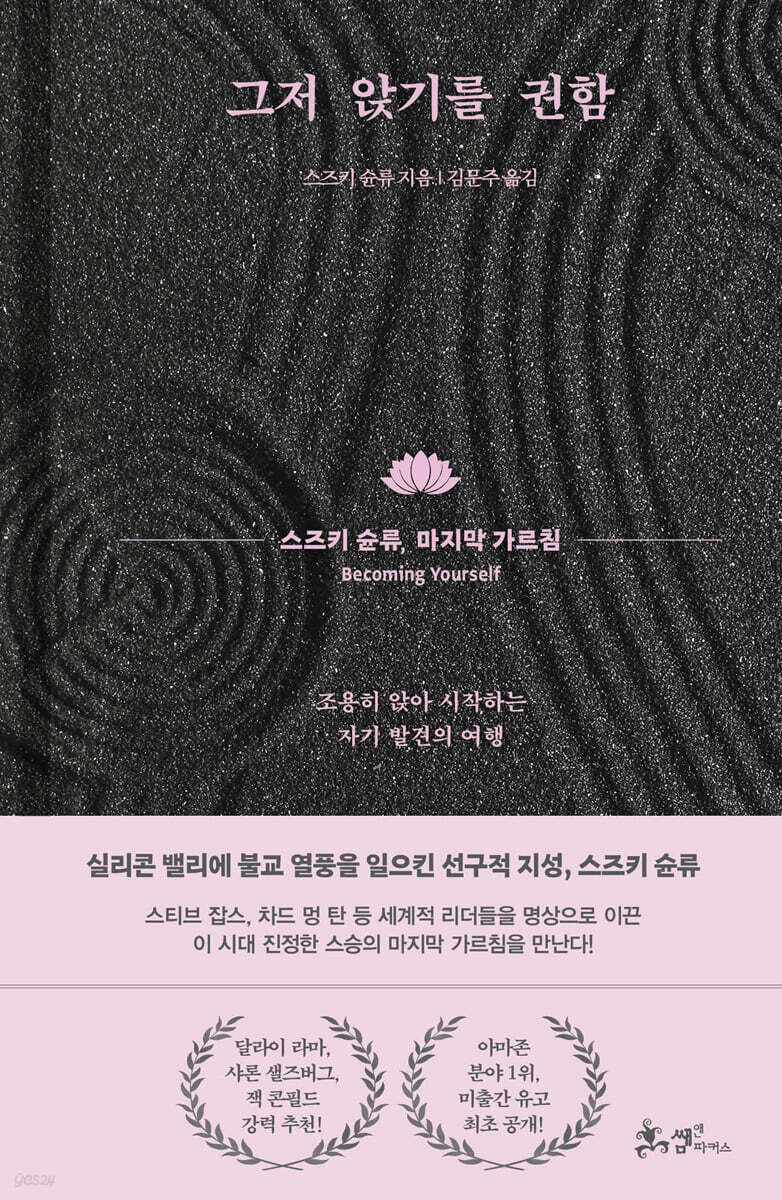
I suggest you just sit down
 |
Description
Book Introduction
Saying 'just sit down'
This is a request that I hope you live as yourself.
The unpublished posthumous works of Shunryu Suzuki, who sparked a Buddhist craze in Silicon Valley.
Great teachings that brought out the creativity of world leaders like Steve Jobs and Chade-Meng Tan.
Meet the final teachings of Shunryu Suzuki, the great teacher who succeeded the Dalai Lama and Thich Nhat Hanh.
An unpublished manuscript that was not included in the world-wide bestseller 『Seonsimchosim』, which sold over a million copies, has been discovered and edited for the first time in 50 years.
Shunryu Suzuki, a monk who moved to the United States in 1959 and introduced Zen Buddhism and zazen meditation, caused a social sensation by influencing the 'Beat Generation' and 'hippie culture' led by young American intellectuals and social activists at the time.
As college students in the San Francisco area where he worked grew into leaders in Silicon Valley, Buddhism and meditation culture naturally permeated the IT industry.
Apple founder Steve Jobs also mentioned that he was greatly influenced by Shunryu Suzuki's books in his youth.
The new work, “Just Sit,” suggests a way to become reborn as your “true self” through sitting meditation, a representative practice of Zen Buddhism.
It speaks in simple, refined language about growth achieved in everyday life, appropriate attitudes toward society and others, and the wisdom to endure life's hardships.
In a time of confusion and lack of teachers, this is a precious teaching that will truly serve as a light in the darkness.
This is a request that I hope you live as yourself.
The unpublished posthumous works of Shunryu Suzuki, who sparked a Buddhist craze in Silicon Valley.
Great teachings that brought out the creativity of world leaders like Steve Jobs and Chade-Meng Tan.
Meet the final teachings of Shunryu Suzuki, the great teacher who succeeded the Dalai Lama and Thich Nhat Hanh.
An unpublished manuscript that was not included in the world-wide bestseller 『Seonsimchosim』, which sold over a million copies, has been discovered and edited for the first time in 50 years.
Shunryu Suzuki, a monk who moved to the United States in 1959 and introduced Zen Buddhism and zazen meditation, caused a social sensation by influencing the 'Beat Generation' and 'hippie culture' led by young American intellectuals and social activists at the time.
As college students in the San Francisco area where he worked grew into leaders in Silicon Valley, Buddhism and meditation culture naturally permeated the IT industry.
Apple founder Steve Jobs also mentioned that he was greatly influenced by Shunryu Suzuki's books in his youth.
The new work, “Just Sit,” suggests a way to become reborn as your “true self” through sitting meditation, a representative practice of Zen Buddhism.
It speaks in simple, refined language about growth achieved in everyday life, appropriate attitudes toward society and others, and the wisdom to endure life's hardships.
In a time of confusion and lack of teachers, this is a precious teaching that will truly serve as a light in the darkness.
- You can preview some of the book's contents.
Preview
index
Chapter 1: Just Sit Down and Meet Your True Self
Share your feelings first
Focus your attention on your whole body
Embracing all things
Just sitting down and being my true self
Don't try to figure out who you are
Considering your heart
Finding yourself
Don't be swayed by other people's thoughts
Original mind
The great sage is you yourself.
About wearing monk's robes
Take care of yourself
As is
Questions and Answers About Anger
Questions and Answers about Sitting Meditation
Chapter 2: Lines Encountered in Everyday Life
Living together
Don't make trouble
A life of respect
Always cheerful
A desire that is not selfish
Respecting money
Naturalness
The skin will soon win
What kind of mind will you cultivate?
True discrimination
Every day is a good day
Chapter 3 Going deeper
Ethics is our nature
Becoming the real me
Beyond moral norms
“I will do that!”
There is only one way to go
Just sitting is the precept
Great effort
Ideal and Reality
There are no rules after all
Appendix 1: About the Sixteen Precepts
Appendix 2: The Life of Shunryu Suzuki
Share your feelings first
Focus your attention on your whole body
Embracing all things
Just sitting down and being my true self
Don't try to figure out who you are
Considering your heart
Finding yourself
Don't be swayed by other people's thoughts
Original mind
The great sage is you yourself.
About wearing monk's robes
Take care of yourself
As is
Questions and Answers About Anger
Questions and Answers about Sitting Meditation
Chapter 2: Lines Encountered in Everyday Life
Living together
Don't make trouble
A life of respect
Always cheerful
A desire that is not selfish
Respecting money
Naturalness
The skin will soon win
What kind of mind will you cultivate?
True discrimination
Every day is a good day
Chapter 3 Going deeper
Ethics is our nature
Becoming the real me
Beyond moral norms
“I will do that!”
There is only one way to go
Just sitting is the precept
Great effort
Ideal and Reality
There are no rules after all
Appendix 1: About the Sixteen Precepts
Appendix 2: The Life of Shunryu Suzuki
Detailed image

Into the book
It can be said that all of Shunryu Suzuki's teachings point in one direction.
This is the practice of ‘living true to myself.’
--- p.7
When Suzuki Roshi first founded Sokoji Temple and Zen Center, Tassahara Zen Mountain Center, in San Francisco in the 1960s, no one could have imagined that the idealistic and vibrant community he was creating would leave such a mark on Buddhist history.
He was just one of many trying out new ways of thinking, practicing, and being, and he could have disappeared in an instant.
But as time went by, people came to know that Suzuki Nosa had quite a different teaching.
--- p.12
Our lives keep flowing and are endlessly filled with clutter.
It probably wasn't a mess from the beginning.
At one point, things were important to you, but once that moment passes, there's no need to hold on to them.
The same goes for our daily lives.
There's so much useless clutter in our minds that it's hard to share our feelings with people, things, trees, or mountains.
Even if you are in the middle of a forest, it is difficult to fully perceive the feeling of the bushes.
When we can truly sense the feeling of the bush, that is Zen.
--- p.22
Your existence here means that one day you will disappear.
Everything that exists will eventually pass away, and you cannot hold on to what you have forever.
The only thing that will ever exist is that which existed before anything else came into being.
No matter how hard you try to find something, you can only reach a faint shadow, not reality itself.
You can only discover it when you do not crave for anything, and you can only attain enlightenment when you do not struggle to attain it.
You miss out because you're trying to get something.
--- p.37
The greatest purpose of our practice is to truly realize who we are and what things are.
The way you sit on that cushion is the way things exist in their respective places.
If you live your life based on this meditation practice, you will always achieve wonderful harmony with your family, neighbors, and all things you encounter.
You won't overwork yourself or become lazy.
You will do exactly what is needed.
That's what sitting meditation feels like.
--- p.76
Whatever you do can be accomplished.
Drinking tea, eating, sleeping, walking or sitting are all like that.
But how we understand these things is very important.
This is the practice of ‘living true to myself.’
--- p.7
When Suzuki Roshi first founded Sokoji Temple and Zen Center, Tassahara Zen Mountain Center, in San Francisco in the 1960s, no one could have imagined that the idealistic and vibrant community he was creating would leave such a mark on Buddhist history.
He was just one of many trying out new ways of thinking, practicing, and being, and he could have disappeared in an instant.
But as time went by, people came to know that Suzuki Nosa had quite a different teaching.
--- p.12
Our lives keep flowing and are endlessly filled with clutter.
It probably wasn't a mess from the beginning.
At one point, things were important to you, but once that moment passes, there's no need to hold on to them.
The same goes for our daily lives.
There's so much useless clutter in our minds that it's hard to share our feelings with people, things, trees, or mountains.
Even if you are in the middle of a forest, it is difficult to fully perceive the feeling of the bushes.
When we can truly sense the feeling of the bush, that is Zen.
--- p.22
Your existence here means that one day you will disappear.
Everything that exists will eventually pass away, and you cannot hold on to what you have forever.
The only thing that will ever exist is that which existed before anything else came into being.
No matter how hard you try to find something, you can only reach a faint shadow, not reality itself.
You can only discover it when you do not crave for anything, and you can only attain enlightenment when you do not struggle to attain it.
You miss out because you're trying to get something.
--- p.37
The greatest purpose of our practice is to truly realize who we are and what things are.
The way you sit on that cushion is the way things exist in their respective places.
If you live your life based on this meditation practice, you will always achieve wonderful harmony with your family, neighbors, and all things you encounter.
You won't overwork yourself or become lazy.
You will do exactly what is needed.
That's what sitting meditation feels like.
--- p.76
Whatever you do can be accomplished.
Drinking tea, eating, sleeping, walking or sitting are all like that.
But how we understand these things is very important.
--- p.128
Publisher's Review
#1 on Amazon immediately after release!
Highly recommended by the Dalai Lama, Sharon Salzberg, and Jack Kornfield!
The final book of the great master, Zen Master Shunryu Suzuki
“A book that encourages simple, profound wisdom and a life free from attachment to anything.” _Dalai Lama
“Affectionate and difficult.
“It comforts us and enlightens us” _Jack Kornfield
“A book that helps you live as your true self through clear teachings.” _Sharon Salzberg
In 1959, in San Francisco, USA, a monk with a shaved head just arrived at the airport.
It was a time when Buddhism was not yet well known in the United States and Western society.
World-renowned figures like the Dalai Lama and Thich Nhat Hanh, as well as concepts like mindfulness, Zen, and meditation, were unfamiliar.
Shunryu Suzuki, a monk nicknamed the "squashed cucumber" for his small stature, became an immortal teacher who left a huge mark on the cultural landscape of the West within a decade.
The Buddhist teachings of Shunryu Suzuki had a great impact on the university community in San Francisco.
Buddhism, which pursues inner growth and self-sufficient perfection, attracted young people who were tired of Christian ethics and capitalist society.
In particular, it directly and indirectly influenced the 'Beat Generation' and 'Hippie culture', which rebelled against the order of the established society and pursued individuality, and it also led Steve Jobs to go to India to become absorbed in meditation and Buddhism.
This is also why Buddhist culture has been prevalent among Silicon Valley IT companies centered around San Francisco.
After Shunryu Suzuki's only book during his lifetime, "Seonsimchosim," which sold over a million copies and became a worldwide bestseller, it was difficult to encounter his teachings again.
But now we have a new, unpublished manuscript that will allow us to hear his vivid voice again.
The new book, "Becoming Yourself," reveals for the first time stories from Shunryu Suzuki's life, including recordings and voices that have never been presented to the public in books.
His closest disciples compiled the essence of his teachings by editing extensive recordings of his lectures and serialized articles.
It conveys a clear and strong message that enlightenment can be found in everyday life, as emphasized by Shunryu Suzuki, and that true self-discovery and fulfillment of life can be achieved through 'just sitting' meditation, as the title suggests.
In these increasingly chaotic times, these are the teachings of the 'Great Teacher' that will resonate with our hearts and help us find the center of our lives.
There is no teaching more direct than simply sitting.
This is a truth you must discover for yourself.
And it's the only way to let go without causing hardship to yourself or anyone else.
That's what 'just sitting' means.
_In the book
A powerful truth contained in simple content
A journey of self-discovery that begins with how to sit and how to breathe.
Shunryu Suzuki's teachings are not difficult.
The moment when I can fully concentrate on the task in front of me while living my daily life is ‘practice’ and ‘meditation.’
Every moment of life is a practice, and above all, it is important not to forget that purpose.
It is about becoming ‘my true self’.
In the Soto sect that Suzuki Shunryu was a part of, and in Zen Buddhism, it is said that all beings in the world, including humans, have Buddha nature, that is, the potential to become Buddha.
It is not true that you can attain enlightenment and reach a certain state only by continuously studying and practicing.
All we have to do is to know that every being can become better at any time and to accept that as it is.
"Just Sit" distills Shunryu Suzuki's wisdom into everyday, concise language.
It explains the core concepts of Buddhism, such as ‘anatta (no-self),’ ‘emptiness (emptiness),’ and ‘enlightenment,’ in an easy-to-understand manner, and also presents fascinating anecdotes about the lives and practices of various practitioners.
The wit and humor interspersed between the profound words of wisdom vividly bring Shunryu Suzuki's sermons to life.
Above all, the 'just sitting' he suggests is essential for relieving the pressure and worries that weigh down modern people.
Each person sits comfortably, takes a deep breath, gathers their mind, and ultimately focuses solely on that moment and place.
Shunryu Suzuki says that it is only then that we can face our true selves.
I recommend this book as a starting point to change your life.
The greatest purpose of our practice is to truly realize who we are and what things are.
The way you sit on that cushion is the way things exist in their respective places.
If you live your life based on this meditation practice, you will always achieve wonderful harmony with your family, neighbors, and all things you encounter.
You won't overwork yourself or become lazy.
You will do exactly what is needed.
That's what sitting meditation feels like.
_In the book
Highly recommended by the Dalai Lama, Sharon Salzberg, and Jack Kornfield!
The final book of the great master, Zen Master Shunryu Suzuki
“A book that encourages simple, profound wisdom and a life free from attachment to anything.” _Dalai Lama
“Affectionate and difficult.
“It comforts us and enlightens us” _Jack Kornfield
“A book that helps you live as your true self through clear teachings.” _Sharon Salzberg
In 1959, in San Francisco, USA, a monk with a shaved head just arrived at the airport.
It was a time when Buddhism was not yet well known in the United States and Western society.
World-renowned figures like the Dalai Lama and Thich Nhat Hanh, as well as concepts like mindfulness, Zen, and meditation, were unfamiliar.
Shunryu Suzuki, a monk nicknamed the "squashed cucumber" for his small stature, became an immortal teacher who left a huge mark on the cultural landscape of the West within a decade.
The Buddhist teachings of Shunryu Suzuki had a great impact on the university community in San Francisco.
Buddhism, which pursues inner growth and self-sufficient perfection, attracted young people who were tired of Christian ethics and capitalist society.
In particular, it directly and indirectly influenced the 'Beat Generation' and 'Hippie culture', which rebelled against the order of the established society and pursued individuality, and it also led Steve Jobs to go to India to become absorbed in meditation and Buddhism.
This is also why Buddhist culture has been prevalent among Silicon Valley IT companies centered around San Francisco.
After Shunryu Suzuki's only book during his lifetime, "Seonsimchosim," which sold over a million copies and became a worldwide bestseller, it was difficult to encounter his teachings again.
But now we have a new, unpublished manuscript that will allow us to hear his vivid voice again.
The new book, "Becoming Yourself," reveals for the first time stories from Shunryu Suzuki's life, including recordings and voices that have never been presented to the public in books.
His closest disciples compiled the essence of his teachings by editing extensive recordings of his lectures and serialized articles.
It conveys a clear and strong message that enlightenment can be found in everyday life, as emphasized by Shunryu Suzuki, and that true self-discovery and fulfillment of life can be achieved through 'just sitting' meditation, as the title suggests.
In these increasingly chaotic times, these are the teachings of the 'Great Teacher' that will resonate with our hearts and help us find the center of our lives.
There is no teaching more direct than simply sitting.
This is a truth you must discover for yourself.
And it's the only way to let go without causing hardship to yourself or anyone else.
That's what 'just sitting' means.
_In the book
A powerful truth contained in simple content
A journey of self-discovery that begins with how to sit and how to breathe.
Shunryu Suzuki's teachings are not difficult.
The moment when I can fully concentrate on the task in front of me while living my daily life is ‘practice’ and ‘meditation.’
Every moment of life is a practice, and above all, it is important not to forget that purpose.
It is about becoming ‘my true self’.
In the Soto sect that Suzuki Shunryu was a part of, and in Zen Buddhism, it is said that all beings in the world, including humans, have Buddha nature, that is, the potential to become Buddha.
It is not true that you can attain enlightenment and reach a certain state only by continuously studying and practicing.
All we have to do is to know that every being can become better at any time and to accept that as it is.
"Just Sit" distills Shunryu Suzuki's wisdom into everyday, concise language.
It explains the core concepts of Buddhism, such as ‘anatta (no-self),’ ‘emptiness (emptiness),’ and ‘enlightenment,’ in an easy-to-understand manner, and also presents fascinating anecdotes about the lives and practices of various practitioners.
The wit and humor interspersed between the profound words of wisdom vividly bring Shunryu Suzuki's sermons to life.
Above all, the 'just sitting' he suggests is essential for relieving the pressure and worries that weigh down modern people.
Each person sits comfortably, takes a deep breath, gathers their mind, and ultimately focuses solely on that moment and place.
Shunryu Suzuki says that it is only then that we can face our true selves.
I recommend this book as a starting point to change your life.
The greatest purpose of our practice is to truly realize who we are and what things are.
The way you sit on that cushion is the way things exist in their respective places.
If you live your life based on this meditation practice, you will always achieve wonderful harmony with your family, neighbors, and all things you encounter.
You won't overwork yourself or become lazy.
You will do exactly what is needed.
That's what sitting meditation feels like.
_In the book
GOODS SPECIFICS
- Date of issue: September 1, 2025
- Format: Hardcover book binding method guide
- Page count, weight, size: 264 pages | 356g | 115*180*20mm
- ISBN13: 9791194755630
- ISBN10: 1194755631
You may also like
카테고리
korean


korean

![GQ KOREA Mark (Monthly): December [2025]](http://librairie.coreenne.fr/cdn/shop/files/8ef265dbbfbf186523ed75ba7319009d.jpg?v=1765340328&width=3840)


