

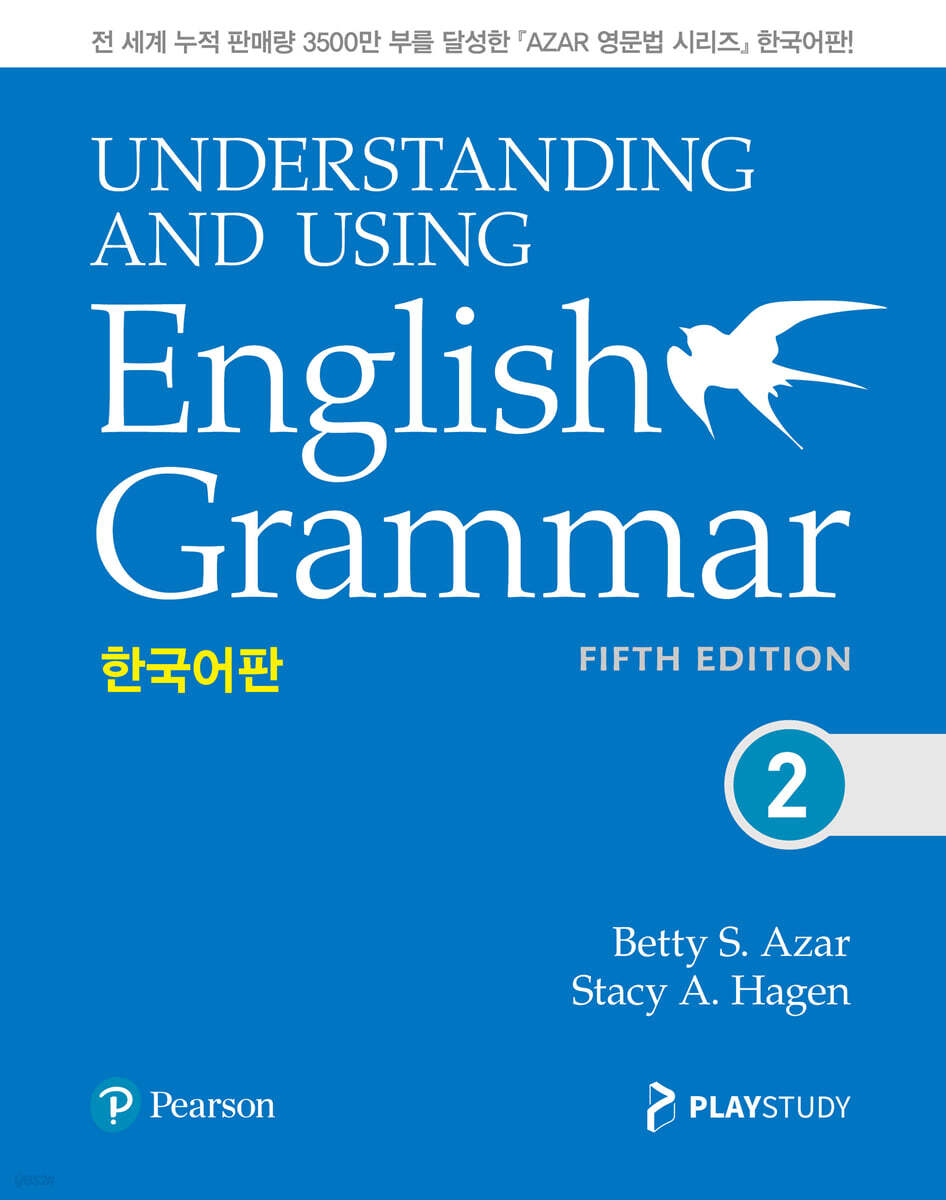
Understanding and Using English Grammar, Korean Edition, Volume 2
 |
Description
Book Introduction
The AZAR English Grammar series was created by Betty S., who studied at Stanford University and the University of Washington and has conducted extensive research and experiments on language education, emphasizing that grammar is the foundation for improving all language skills such as listening, speaking, reading, and writing.
Based on her extensive experience teaching English with Azar, Stacy A. developed a method for understanding and applying grammar rules within the context of sentences, emphasizing the clarity and practicality of English grammar.
This is an English grammar textbook co-written by Hagen and published by Pearson, a global educational publishing group. It is a bestseller and steady seller with cumulative sales of 35 million copies worldwide.
Based on her extensive experience teaching English with Azar, Stacy A. developed a method for understanding and applying grammar rules within the context of sentences, emphasizing the clarity and practicality of English grammar.
This is an English grammar textbook co-written by Hagen and published by Pearson, a global educational publishing group. It is a bestseller and steady seller with cumulative sales of 35 million copies worldwide.
- You can preview some of the book's contents.
Preview
index
CHAPTER 11 Passive Voice
11-1 Active vs.
passive
11-2 Passive tense forms
11-3 Using the passive voice
11-4 Passive form of auxiliary verbs (phrases)
11-5 State (non-progressive) passive voice
11-6 Commonly used passive form (non-progressive) 「Verb + Preposition」
11-7 Passive voice used with get
11-8 -ed/-ing adjectives
CHAPTER 12 NOUN CLAUSES
12-1 Overview
12-2 Noun clauses with interrogative pronouns
12-3 Noun clauses beginning with whether or if
12-4 "Interrogative Word + To-Infinitive"
12-5 That noun clause
12-6 Direct speech
12-7 Indirect speech
12-8 Indirect Speech: Auxiliary Verbs in Noun Clauses
12-9 Subjunctive Verbs in Noun Clauses
CHAPTER 13 ADJECTIVE CLAUSES
13-1 Adjective clause pronouns used as subjects [nominative relative pronouns]
13-2 Adjective clause pronouns used as objects of verbs [objective relative pronouns]
13-3 Adjective clause pronouns used as objects of prepositions [objective relative pronouns]
13-4 Usage of Whose
13-5 Use of the relative adverb Where in adjective clauses
13-6 Use of the relative adverb When in adjective clauses
13-7 Use of adjective clauses modifying pronouns
13-8 Using punctuation in adjective clauses
13-9 Use of quantity expressions in adjective clauses
13-10 Use of Which to Modify Entire Sentences
13-11 Reduce adjective clauses to adjective phrases
CHAPTER 14 Gerunds and Infinitives 1
14-1 Gerunds and To-Infinitives: Overview
14-2 Verbs that take gerunds as objects
14-3 Verbs that take an infinitive as their object
14-4 To-infinitive following the object of a verb
14-5 Verbs that take both an infinitive and a gerund as their object
14-6 Use of gerunds as objects of prepositions
14-7 "Go + gerund"
14-8 Idiomatic expressions followed by -ing
14-9 "It + To-Infinitive": Use of Gerunds and To-Infinitives as Subjects
14-10 Reference List of Verbs that Take the Infinitive as an Object
14-11 Reference list of verbs that take gerunds as objects
14-12 Reference List of Prepositional Phrases Followed by Gerunds
CHAPTER 15 Gerunds and Infinitives 2
15-1 To-infinitive indicating purpose: In Order To
15-2 "Adjective + To-Infinitive"
15-3 "Too ~ To-infinitive..." and "~ Enough + To-infinitive..."
15-4 Passive To-Infinitive and Passive Gerund: Present Tense
15-5 Past Forms of Infinitives and Gerunds: Active and Passive Voice
15-6 Usage of "Need + gerund" or "Need + passive to-infinitive"
15-7 Use of verbs of perception
15-8 "Let / Help + Infinitive"
15-9 Uses of causative verbs: Make, Have, Get
15-10 Use of possessives to modify gerunds
CHAPTER 16 Coordinating Conjunctions
16-1 Parallel Structure
16-2 Parallel Structure: Use of Commas (,)
16-3 Punctuation for Independent Clauses: Connecting Independent Clauses with And and But
16-4 Correlative conjunctions: 「Both ~ And ...」, 「Not Only ~ But Also ...」, 「Either ~ Or ...」, 「Neither ~ Nor ...」
CHAPTER 17 Adverbial Clauses
17-1 Overview
17-2 Adverbial clauses expressing time relationships
17-3 Adverbial clauses expressing causal relationships
17-4 Showing Contrast (Unexpected Results): Even Though
17-5 Expressing Direct Contrast: While
17-6 Expressing Conditions in Adverbial Clauses: If Clauses
17-7 Abbreviation of If clause
17-8 Conditional Adverbial Clauses: Whether Or Not and Even If
17-9 Conditional Adverbial Clause: In Case
17-10 Conditional Adverbial Clause: Unless
17-11 Conditional Adverbial Clause: Only If
CHAPTER 18 Participle Phrases
18-1 Overview
18-2 Changing the adverbial clause of the hour into a participle phrase
18-3 Expressing simultaneous actions in participle phrases
18-4 Expressing cause and effect in participle phrases
18-5 Use of "Upon + -ing" in participial phrases
CHAPTER 19 Connective Words Expressing Cause and Effect, Contrast, and Condition
19-1 Overview
19-2 Use of Because Of and Due To
19-3 Cause and Effect: Use of Therefore, Consequently, and So
19-4 Punctuation according to sentence structure
19-5 Other ways to express cause and effect: 「Such ~ That ...」 and 「So ~ That ...」
19-6 Expressing Purpose: Using So That
19-7 Showing Contrasting Facts [Unexpected Results]
19-8 Showing direct contrast facts
19-9 Expressing Conditions: Otherwise and Or [Else]
CHAPTER 20 CONDITIONAL MOVEMENTS AND EXPRESSION OF WISHES
20-1 Basic verb forms used in the conditional mood
20-2 Expressing realistic conditions in the present or future [Present Subjunctive
20-3 Expressing unrealistic conditions that are contrary to facts in the present or future [Past Subjunctive]
20-4 Expressing unrealistic conditions that contradict past facts [Past Perfect Subjunctive]
20-5 Use of progressive verb forms in conditional sentences
20-6 Use of mixed tenses in conditional sentences [Mixed conditional]
Omission of 20-7 If
20-8 Implied subjunctive mood
20-9 Expressing Wishes for the Present and Past: "Wish + Subjunctive"
20-10 Expressing Your Wishes for the Future: "Wish + Would"
supplement
UNIT A: Basic Grammar Terms
UNIT B: QUESTIONS
UNIT C: CONTRACTION
UNIT D: Negative Sentences
UNIT E: VERBS
Answers and explanations (in the book)
11-1 Active vs.
passive
11-2 Passive tense forms
11-3 Using the passive voice
11-4 Passive form of auxiliary verbs (phrases)
11-5 State (non-progressive) passive voice
11-6 Commonly used passive form (non-progressive) 「Verb + Preposition」
11-7 Passive voice used with get
11-8 -ed/-ing adjectives
CHAPTER 12 NOUN CLAUSES
12-1 Overview
12-2 Noun clauses with interrogative pronouns
12-3 Noun clauses beginning with whether or if
12-4 "Interrogative Word + To-Infinitive"
12-5 That noun clause
12-6 Direct speech
12-7 Indirect speech
12-8 Indirect Speech: Auxiliary Verbs in Noun Clauses
12-9 Subjunctive Verbs in Noun Clauses
CHAPTER 13 ADJECTIVE CLAUSES
13-1 Adjective clause pronouns used as subjects [nominative relative pronouns]
13-2 Adjective clause pronouns used as objects of verbs [objective relative pronouns]
13-3 Adjective clause pronouns used as objects of prepositions [objective relative pronouns]
13-4 Usage of Whose
13-5 Use of the relative adverb Where in adjective clauses
13-6 Use of the relative adverb When in adjective clauses
13-7 Use of adjective clauses modifying pronouns
13-8 Using punctuation in adjective clauses
13-9 Use of quantity expressions in adjective clauses
13-10 Use of Which to Modify Entire Sentences
13-11 Reduce adjective clauses to adjective phrases
CHAPTER 14 Gerunds and Infinitives 1
14-1 Gerunds and To-Infinitives: Overview
14-2 Verbs that take gerunds as objects
14-3 Verbs that take an infinitive as their object
14-4 To-infinitive following the object of a verb
14-5 Verbs that take both an infinitive and a gerund as their object
14-6 Use of gerunds as objects of prepositions
14-7 "Go + gerund"
14-8 Idiomatic expressions followed by -ing
14-9 "It + To-Infinitive": Use of Gerunds and To-Infinitives as Subjects
14-10 Reference List of Verbs that Take the Infinitive as an Object
14-11 Reference list of verbs that take gerunds as objects
14-12 Reference List of Prepositional Phrases Followed by Gerunds
CHAPTER 15 Gerunds and Infinitives 2
15-1 To-infinitive indicating purpose: In Order To
15-2 "Adjective + To-Infinitive"
15-3 "Too ~ To-infinitive..." and "~ Enough + To-infinitive..."
15-4 Passive To-Infinitive and Passive Gerund: Present Tense
15-5 Past Forms of Infinitives and Gerunds: Active and Passive Voice
15-6 Usage of "Need + gerund" or "Need + passive to-infinitive"
15-7 Use of verbs of perception
15-8 "Let / Help + Infinitive"
15-9 Uses of causative verbs: Make, Have, Get
15-10 Use of possessives to modify gerunds
CHAPTER 16 Coordinating Conjunctions
16-1 Parallel Structure
16-2 Parallel Structure: Use of Commas (,)
16-3 Punctuation for Independent Clauses: Connecting Independent Clauses with And and But
16-4 Correlative conjunctions: 「Both ~ And ...」, 「Not Only ~ But Also ...」, 「Either ~ Or ...」, 「Neither ~ Nor ...」
CHAPTER 17 Adverbial Clauses
17-1 Overview
17-2 Adverbial clauses expressing time relationships
17-3 Adverbial clauses expressing causal relationships
17-4 Showing Contrast (Unexpected Results): Even Though
17-5 Expressing Direct Contrast: While
17-6 Expressing Conditions in Adverbial Clauses: If Clauses
17-7 Abbreviation of If clause
17-8 Conditional Adverbial Clauses: Whether Or Not and Even If
17-9 Conditional Adverbial Clause: In Case
17-10 Conditional Adverbial Clause: Unless
17-11 Conditional Adverbial Clause: Only If
CHAPTER 18 Participle Phrases
18-1 Overview
18-2 Changing the adverbial clause of the hour into a participle phrase
18-3 Expressing simultaneous actions in participle phrases
18-4 Expressing cause and effect in participle phrases
18-5 Use of "Upon + -ing" in participial phrases
CHAPTER 19 Connective Words Expressing Cause and Effect, Contrast, and Condition
19-1 Overview
19-2 Use of Because Of and Due To
19-3 Cause and Effect: Use of Therefore, Consequently, and So
19-4 Punctuation according to sentence structure
19-5 Other ways to express cause and effect: 「Such ~ That ...」 and 「So ~ That ...」
19-6 Expressing Purpose: Using So That
19-7 Showing Contrasting Facts [Unexpected Results]
19-8 Showing direct contrast facts
19-9 Expressing Conditions: Otherwise and Or [Else]
CHAPTER 20 CONDITIONAL MOVEMENTS AND EXPRESSION OF WISHES
20-1 Basic verb forms used in the conditional mood
20-2 Expressing realistic conditions in the present or future [Present Subjunctive
20-3 Expressing unrealistic conditions that are contrary to facts in the present or future [Past Subjunctive]
20-4 Expressing unrealistic conditions that contradict past facts [Past Perfect Subjunctive]
20-5 Use of progressive verb forms in conditional sentences
20-6 Use of mixed tenses in conditional sentences [Mixed conditional]
Omission of 20-7 If
20-8 Implied subjunctive mood
20-9 Expressing Wishes for the Present and Past: "Wish + Subjunctive"
20-10 Expressing Your Wishes for the Future: "Wish + Would"
supplement
UNIT A: Basic Grammar Terms
UNIT B: QUESTIONS
UNIT C: CONTRACTION
UNIT D: Negative Sentences
UNIT E: VERBS
Answers and explanations (in the book)
Detailed image
Publisher's Review
〈Special Features of the Korean Version Series〉
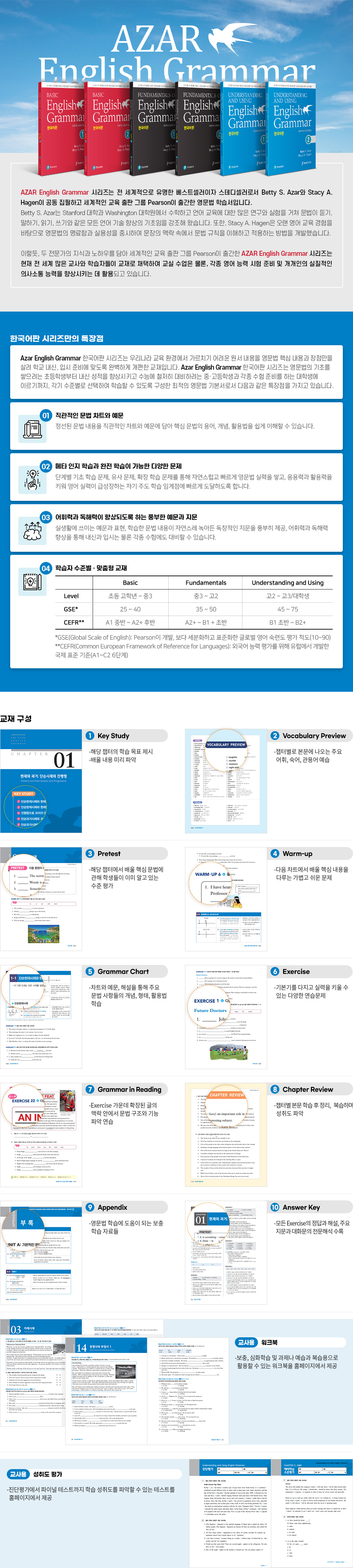
The Azar English Grammar Korean edition series is a textbook that has been completely revised to fit school grades and entrance exam preparation by taking only the core contents and strengths of English grammar from the original Azar English Grammar book, which is difficult to teach in the Korean educational environment.
The Azar English Grammar Korean edition series is the optimal English grammar textbook for all levels, from elementary school students building a foundation in English grammar, to middle and high school students seeking to improve their grades and thoroughly prepare for the CSAT, to college students preparing for various exams. It is organized so that students can choose and study according to their level. It has the following special features.
Intuitive grammar charts and examples
Selected grammar content is presented in intuitive charts and examples, making it easy to understand key grammar terms, concepts, and usage.
A variety of problems that enable metacognitive learning and mastery learning
Through step-by-step basic learning problems, similar problems, and extended learning problems, you will naturally and quickly build your English grammar skills. You will also develop your application and utilization skills, allowing you to quickly reach the critical point of self-directed learning where your English skills will rapidly improve.
Rich examples and texts to improve vocabulary and reading comprehension
We provide a wealth of original examples that naturally integrate the grammar you've learned, along with real-life examples and expressions. This will help you improve your vocabulary and reading comprehension, helping you prepare for school and college entrance exams, as well as solidify your English skills.
Stop learning English grammar by just guessing the correct answer!
A new learning method that naturally acquires core English grammar concepts and their usage!
· The Korean version of the must-read English grammar study guide chosen by millions of students worldwide!
· Partnership with Pearson, a global education and publishing group, to revise and improve the program to suit the Korean educational environment.
· Implementing practical learning effects based on cognitive science teaching and learning theories
· Simultaneously improve English grammar skills (Grammar Based Learning) and communication skills (Content Based Learning)
· Naturally understand core grammar and achieve rapid learning results through practical grammar explanations, examples, and abundant practice problems.
· Prepare for school grades and entrance exams by solving frequently tested questions and studying reading comprehension.
· Includes textbook-level essential vocabulary, key expressions, and a variety of examples and texts to pique students' interest.
※ Characteristics of each textbook composition
1 Key Study
- Present the learning objectives for the chapter
- Understand what you will learn in advance
2 Vocabulary Review
- Preview key vocabulary, idioms, and phrases that appear in each chapter
- Helps understand the text during class
3 Pretest
- Assess the level of students' knowledge of the core grammar they will learn in the chapter.
4 Warm-up
- Light and easy problems covering the key topics you will learn in the following chart.
5 Grammar Chart
- Learn the concepts, forms, and usage of key grammar points through charts, examples, and explanations.
Exercise 6
- Various practice problems to build fundamentals and improve skills
7 Grammar in Reading
- Practice understanding grammatical structure and function within the context of an extended text in the middle of the exercise.
Chapter 8 Review
- After studying the text for each chapter, organize and review to determine your achievements.
9 Appendix
- Supplementary learning materials and appendices to help you learn English grammar.
10 Answer Key
- Includes answers and explanations for all exercises, as well as expert interpretations of key passages and dialogues.
Specialty
Providing online workbook and achievement assessment test download service for teachers (www.playstudy.co.kr)
· Online Workbook [For Teachers]
Provides online workbooks for each volume that can be used for supplementary and in-depth study, assignments, or review purposes.
· Online Achievement Assessment Test [For Teachers]
Online tests are provided for each volume and chapter to assess understanding and achievement of the learning content.
The Azar English Grammar Korean edition series is a textbook that has been completely revised to fit school grades and entrance exam preparation by taking only the core contents and strengths of English grammar from the original Azar English Grammar book, which is difficult to teach in the Korean educational environment.
The Azar English Grammar Korean edition series is the optimal English grammar textbook for all levels, from elementary school students building a foundation in English grammar, to middle and high school students seeking to improve their grades and thoroughly prepare for the CSAT, to college students preparing for various exams. It is organized so that students can choose and study according to their level. It has the following special features.
Intuitive grammar charts and examples
Selected grammar content is presented in intuitive charts and examples, making it easy to understand key grammar terms, concepts, and usage.
A variety of problems that enable metacognitive learning and mastery learning
Through step-by-step basic learning problems, similar problems, and extended learning problems, you will naturally and quickly build your English grammar skills. You will also develop your application and utilization skills, allowing you to quickly reach the critical point of self-directed learning where your English skills will rapidly improve.
Rich examples and texts to improve vocabulary and reading comprehension
We provide a wealth of original examples that naturally integrate the grammar you've learned, along with real-life examples and expressions. This will help you improve your vocabulary and reading comprehension, helping you prepare for school and college entrance exams, as well as solidify your English skills.
Stop learning English grammar by just guessing the correct answer!
A new learning method that naturally acquires core English grammar concepts and their usage!
· The Korean version of the must-read English grammar study guide chosen by millions of students worldwide!
· Partnership with Pearson, a global education and publishing group, to revise and improve the program to suit the Korean educational environment.
· Implementing practical learning effects based on cognitive science teaching and learning theories
· Simultaneously improve English grammar skills (Grammar Based Learning) and communication skills (Content Based Learning)
· Naturally understand core grammar and achieve rapid learning results through practical grammar explanations, examples, and abundant practice problems.
· Prepare for school grades and entrance exams by solving frequently tested questions and studying reading comprehension.
· Includes textbook-level essential vocabulary, key expressions, and a variety of examples and texts to pique students' interest.
※ Characteristics of each textbook composition
1 Key Study
- Present the learning objectives for the chapter
- Understand what you will learn in advance
2 Vocabulary Review
- Preview key vocabulary, idioms, and phrases that appear in each chapter
- Helps understand the text during class
3 Pretest
- Assess the level of students' knowledge of the core grammar they will learn in the chapter.
4 Warm-up
- Light and easy problems covering the key topics you will learn in the following chart.
5 Grammar Chart
- Learn the concepts, forms, and usage of key grammar points through charts, examples, and explanations.
Exercise 6
- Various practice problems to build fundamentals and improve skills
7 Grammar in Reading
- Practice understanding grammatical structure and function within the context of an extended text in the middle of the exercise.
Chapter 8 Review
- After studying the text for each chapter, organize and review to determine your achievements.
9 Appendix
- Supplementary learning materials and appendices to help you learn English grammar.
10 Answer Key
- Includes answers and explanations for all exercises, as well as expert interpretations of key passages and dialogues.
Specialty
Providing online workbook and achievement assessment test download service for teachers (www.playstudy.co.kr)
· Online Workbook [For Teachers]
Provides online workbooks for each volume that can be used for supplementary and in-depth study, assignments, or review purposes.
· Online Achievement Assessment Test [For Teachers]
Online tests are provided for each volume and chapter to assess understanding and achievement of the learning content.
GOODS SPECIFICS
- Date of issue: April 28, 2025
- Page count, weight, size: 380 pages | 205*260*40mm
- ISBN13: 9791165971342
- ISBN10: 1165971348
- Reference book for use in: 2nd and 3rd year high school students
- Reference book usage semester: Common semester
- Reference book difficulty: Normal, Hard Reference book difficulty guide
You may also like
카테고리
korean


korean

![GQ KOREA Mark (Monthly): December [2025]](http://librairie.coreenne.fr/cdn/shop/files/8ef265dbbfbf186523ed75ba7319009d.jpg?v=1765340328&width=3840)


