

Dalgomhan Literacy Elementary Reading Level 4 A (Grades 3 and 4)
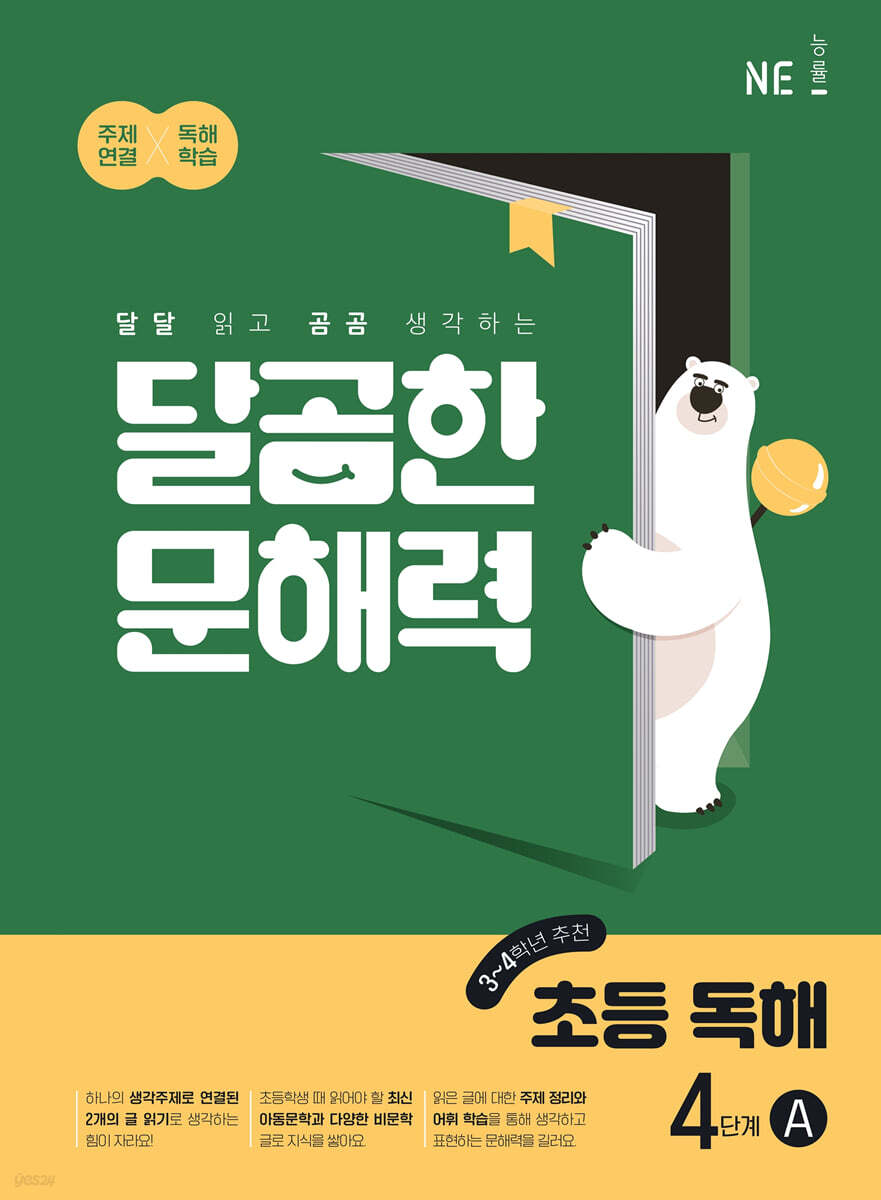 |
Description
Book Introduction
Sweet literacy elementary reading comprehension that reads and thinks deeply The literacy workbook that 2,500 elementary school parents discovered first! The first elementary school literacy textbook to introduce topic-linked reading. Jointly developed by elementary school textbook planning committee members and elementary school teachers. For the first time in elementary school reading, we've introduced the "topic-linked reading method," which involves reading two passages connected by a single topic. 2,500 elementary school parents reviewed the survey! Satisfaction rate: 98.7%. Includes textbook-linked, best-selling children's literature books. Let's improve integrated literacy through integrated learning by topic, vocabulary, and writing. |
- You can preview some of the book's contents.
Preview
index
"Read two articles connected by one topic of thought together!"
Chapter 1
Topic of Thought 01.
Why is a pen called a pen?
Please give me a friend | Language is a social contract
Topic of Thought 02.
Why do people celebrate anniversaries?
The Little Prince | Various Anniversaries
Topic of Thought 03.
Where is the heart?
The Wizard of Oz | The Brain That Controls Human Emotions
Topic of Thought 04.
What impact has sanitation had on humanity?
A World Stained with Shit | The Evolution of Sanitation
Topic 05.
Why do we need music?
A Musical Journey with Aunt Dorandoran | The Power of Music
Chapter 2
Topic 06.
Why does stopping something make you want to do it more?
Romeo and Juliet | The Caligula Effect
Topic 07.
Should children pay taxes too?
Adam Smith's Economics Stationery Store | Types and Uses of Taxes
Topic 08.
What causes pubertal changes?
My voice is strange | Hormones that regulate our bodies
Topic 09.
How did the three kingdoms become one?
Silla Overthrows Baekje and Goguryeo! | The Process of Unifying the Three Kingdoms
Topic 10: How should we view advertising?
Advertising Strategies to Drive Consumption | How to Avoid Getting Lost in the Land of Advertising
Chapter 3
Topic 11.
Why follow others?
The Emperor's New Clothes | Sympathy Phenomenon
Topic 12.
Why did money come into existence?
Good Money, Bad Money, and Weird Money | The Origins and Development of Money
Topic 13.
Why imitate nature?
Amoeba-Like Robots | Why They Mimic Nature
Topic 14.
Why did Goryeo create the Tripitaka Koreana?
Tripitaka Koreana and the Burning Lion | Tripitaka Koreana and the Janggyeong Panjeon
Topic 15.
How to save the city?
The Galactic Village Garrison's Dreaming City Research Lab | How to Save the City
Chapter 4
Topic 16.
How are literature and history different?
Lady Park, Joseon's Heroine | Literature and History
Topic 17.
What is a stock company?
Should we create a stock company too? | Stocks and Stock Companies
Topic 18.
How to prevent disease?
Do I really need to wash my hands with soap? | Disease-Causing Bacteria and Viruses
Topic 19.
What language do computers speak?
Decimal system for representing numbers | Computer language, binary system
Topic 20.
Is the food we eat okay?
Happy Meal Day | The Food We Eat
Chapter 1
Topic of Thought 01.
Why is a pen called a pen?
Please give me a friend | Language is a social contract
Topic of Thought 02.
Why do people celebrate anniversaries?
The Little Prince | Various Anniversaries
Topic of Thought 03.
Where is the heart?
The Wizard of Oz | The Brain That Controls Human Emotions
Topic of Thought 04.
What impact has sanitation had on humanity?
A World Stained with Shit | The Evolution of Sanitation
Topic 05.
Why do we need music?
A Musical Journey with Aunt Dorandoran | The Power of Music
Chapter 2
Topic 06.
Why does stopping something make you want to do it more?
Romeo and Juliet | The Caligula Effect
Topic 07.
Should children pay taxes too?
Adam Smith's Economics Stationery Store | Types and Uses of Taxes
Topic 08.
What causes pubertal changes?
My voice is strange | Hormones that regulate our bodies
Topic 09.
How did the three kingdoms become one?
Silla Overthrows Baekje and Goguryeo! | The Process of Unifying the Three Kingdoms
Topic 10: How should we view advertising?
Advertising Strategies to Drive Consumption | How to Avoid Getting Lost in the Land of Advertising
Chapter 3
Topic 11.
Why follow others?
The Emperor's New Clothes | Sympathy Phenomenon
Topic 12.
Why did money come into existence?
Good Money, Bad Money, and Weird Money | The Origins and Development of Money
Topic 13.
Why imitate nature?
Amoeba-Like Robots | Why They Mimic Nature
Topic 14.
Why did Goryeo create the Tripitaka Koreana?
Tripitaka Koreana and the Burning Lion | Tripitaka Koreana and the Janggyeong Panjeon
Topic 15.
How to save the city?
The Galactic Village Garrison's Dreaming City Research Lab | How to Save the City
Chapter 4
Topic 16.
How are literature and history different?
Lady Park, Joseon's Heroine | Literature and History
Topic 17.
What is a stock company?
Should we create a stock company too? | Stocks and Stock Companies
Topic 18.
How to prevent disease?
Do I really need to wash my hands with soap? | Disease-Causing Bacteria and Viruses
Topic 19.
What language do computers speak?
Decimal system for representing numbers | Computer language, binary system
Topic 20.
Is the food we eat okay?
Happy Meal Day | The Food We Eat
Detailed image

Publisher's Review
Growing literacy means growing thinking!
Elementary reading that helps develop thinking, elementary reading that helps develop literacy
Q.
What is "Theme-Linked Reading," developed by textbook planning committee members and elementary school teachers?
This is a reading comprehension study method that involves reading two connected texts and solving problems based on the main topics of the elementary school curriculum.
If you consistently practice 'topic-related reading', your thinking skills will be developed, and through this, you can develop true literacy skills.
Q.
Why did you include both literature and non-literature together?
In elementary school, it is necessary to practice building knowledge by reading various texts such as literature, phenomena, and concepts.
In particular, after building background knowledge through interesting literary texts, you can easily understand non-literary texts and develop three-dimensional knowledge and a balanced perspective on the subject.
Q.
What kind of text can you read?
The textbook planning committee professors and elementary school teachers, who are most familiar with the elementary school curriculum and educational field, personally selected the materials.
It contains a large number of textbook-related texts essential for children, serving as a foundation for school studies. It also includes the latest children's literature bestsellers, such as Nine-Year-Old's Mind Dictionary, Momo, and Monster Child, enabling interesting reading comprehension learning.
Elementary reading that helps develop thinking, elementary reading that helps develop literacy
Q.
What is "Theme-Linked Reading," developed by textbook planning committee members and elementary school teachers?
This is a reading comprehension study method that involves reading two connected texts and solving problems based on the main topics of the elementary school curriculum.
If you consistently practice 'topic-related reading', your thinking skills will be developed, and through this, you can develop true literacy skills.
Q.
Why did you include both literature and non-literature together?
In elementary school, it is necessary to practice building knowledge by reading various texts such as literature, phenomena, and concepts.
In particular, after building background knowledge through interesting literary texts, you can easily understand non-literary texts and develop three-dimensional knowledge and a balanced perspective on the subject.
Q.
What kind of text can you read?
The textbook planning committee professors and elementary school teachers, who are most familiar with the elementary school curriculum and educational field, personally selected the materials.
It contains a large number of textbook-related texts essential for children, serving as a foundation for school studies. It also includes the latest children's literature bestsellers, such as Nine-Year-Old's Mind Dictionary, Momo, and Monster Child, enabling interesting reading comprehension learning.
GOODS SPECIFICS
- Date of issue: November 20, 2023
- Page count, weight, size: 168 pages | 524g | 220*300*10mm
- ISBN13: 9791125343479
- ISBN10: 1125343478
- Reference book for use in grades: 4th grade elementary school
- Reference book usage semester: Common semester
- Reference book difficulty: Medium Reference book difficulty guide
- KC Certification: Certification Type: Conformity Confirmation
You may also like
카테고리
korean


korean

![GQ KOREA Mark (Monthly): December [2025]](http://librairie.coreenne.fr/cdn/shop/files/8ef265dbbfbf186523ed75ba7319009d.jpg?v=1765340328&width=3840)


