

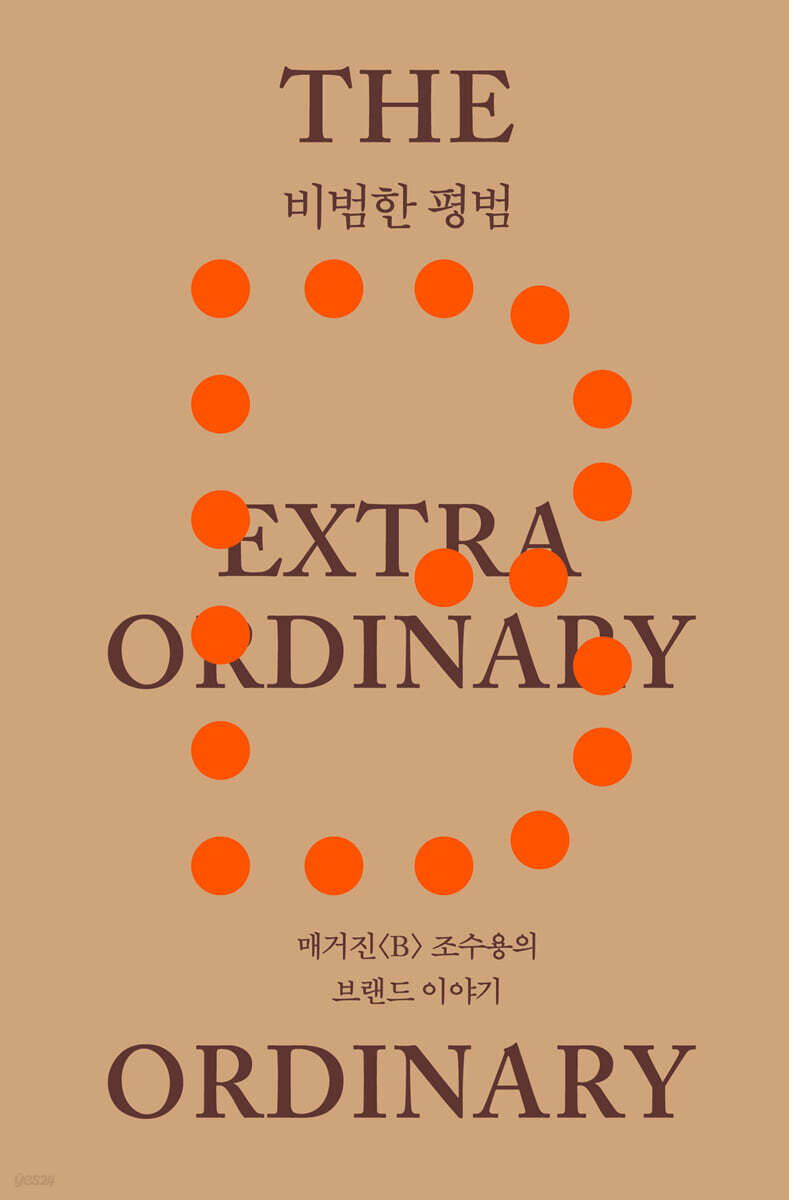
Extraordinary ordinary
 |
Description
Book Introduction
'A brand is an ordinary idea
It is the result of an extraordinary process of making it into a concrete reality.'
The true brand story of B magazine publisher Jo Su-yong.
The new book “Extraordinary Ordinary” by Jo Su-yong, publisher of magazine “B”, has been published.
In his first solo essay, 《The Sense of Work》, published last year, he talked about his method of exploring 'sense' as a design and creative professional. In this book, 《The Extraordinary Ordinary》, he more candidly reveals which brands he views as the publisher of the magazine 《B》 and which moments within those brands moved him.
In an era where brands are overflowing and the importance of brands is emphasized, Jo Soo-yong founded the magazine "B" in 2011, providing a platform to illuminate the appeal and essence of brands from various angles, and in the process, he also refined his own perspective on brands.
In this book, you can read that accumulation in one volume.
The table of contents contains 51 brands that magazine B has been focusing on, from perfume brand 'Le Labo' to bag brand 'Freitag'.
What makes brands that remain beloved over time different, and what messages still resonate with us today—a journey to find the answers unfolds naturally.
To write this book, Jo Su-yong took out the 'Publisher's Note' that had been published in the magazine 'B' and comprehensively revised and supplemented it with his current perspective and experience.
Additionally, by writing several new pieces, an organic flow is completed.
The message that we must focus on the 'essence' emphasized in "The Sense of Work" continues in "The Extraordinary Ordinary."
This book reveals the extraordinary moments in which ordinary ideas become extraordinary, and how brands establish themselves in people's hearts and establish a firm foothold.
It is the result of an extraordinary process of making it into a concrete reality.'
The true brand story of B magazine publisher Jo Su-yong.
The new book “Extraordinary Ordinary” by Jo Su-yong, publisher of magazine “B”, has been published.
In his first solo essay, 《The Sense of Work》, published last year, he talked about his method of exploring 'sense' as a design and creative professional. In this book, 《The Extraordinary Ordinary》, he more candidly reveals which brands he views as the publisher of the magazine 《B》 and which moments within those brands moved him.
In an era where brands are overflowing and the importance of brands is emphasized, Jo Soo-yong founded the magazine "B" in 2011, providing a platform to illuminate the appeal and essence of brands from various angles, and in the process, he also refined his own perspective on brands.
In this book, you can read that accumulation in one volume.
The table of contents contains 51 brands that magazine B has been focusing on, from perfume brand 'Le Labo' to bag brand 'Freitag'.
What makes brands that remain beloved over time different, and what messages still resonate with us today—a journey to find the answers unfolds naturally.
To write this book, Jo Su-yong took out the 'Publisher's Note' that had been published in the magazine 'B' and comprehensively revised and supplemented it with his current perspective and experience.
Additionally, by writing several new pieces, an organic flow is completed.
The message that we must focus on the 'essence' emphasized in "The Sense of Work" continues in "The Extraordinary Ordinary."
This book reveals the extraordinary moments in which ordinary ideas become extraordinary, and how brands establish themselves in people's hearts and establish a firm foothold.
- You can preview some of the book's contents.
Preview
index
Introduction
An Ordinary Idea─Le Labo
The Public's Perspective - Blue Bottle Coffee
The Beauty of Imperfection - Astier de Villatte
Swedish Pink─Acne Studios
Design is a way of thinking—Balmuda
A Minor Problem - Joseph Joseph
Sincere Media─Instagram Instagram
Psychological Premium─APC
Things you use without thinking─Big Bic
A classic that has endured two eras—G-Shock
Good person - Thule
One picture─ %Arabica %Arabica
Planned Naturalness─Lemaire
Elegance on the Table─San Pellegrino
Fantasy Storytelling─L'occitane
A Spoonful of Wit - Hey Hay
Humor and Leisure─Maison Kitsune
The Blank Page Story─Moleskine
Becoming a Media Person - The Michelin Guide
Honest People─YouTube
The End is Local - Airbnb
Style without style─Vans
Color is temperature─Pantone
The Power of Modules - USM
The Beauty of Function─Arc'teryx
Exquisite Balance─Moscot
Distribution is the brand - Haagen-Dazs
Casual Classic─Lamy
Commercial Outsider─Maison Margiela
Unfamiliar Familiarity─Hoshinoya
The Fundamentals of Cooking─Staub
The envy of the few─Rapha
Stylish Wellness─Lululemon
A Connection of Tastes - Soho House
A slightly different path - Apple Music
Collaboration with old-fashionedness─Barbour
Old Happiness─Danner
The Role of Bookstores - Tsutaya
The brand's role model: Muji
Waiting for the Waves─Patagonia
The Role of the Director - Chanel
A private and precious experience─Spotify
Conscious Capital - Ikea
Self-Awareness - DJI
Adult Attachment Machine - Mini
Important Clients - Mr. Porter
Emotional Real Estate─WeWork
The Ultimate Asset - Disney
People are Opportunities - Netflix
The Ordinary: Specialness─Asics
Perfect Balance─Freitag
Going out words
An Ordinary Idea─Le Labo
The Public's Perspective - Blue Bottle Coffee
The Beauty of Imperfection - Astier de Villatte
Swedish Pink─Acne Studios
Design is a way of thinking—Balmuda
A Minor Problem - Joseph Joseph
Sincere Media─Instagram Instagram
Psychological Premium─APC
Things you use without thinking─Big Bic
A classic that has endured two eras—G-Shock
Good person - Thule
One picture─ %Arabica %Arabica
Planned Naturalness─Lemaire
Elegance on the Table─San Pellegrino
Fantasy Storytelling─L'occitane
A Spoonful of Wit - Hey Hay
Humor and Leisure─Maison Kitsune
The Blank Page Story─Moleskine
Becoming a Media Person - The Michelin Guide
Honest People─YouTube
The End is Local - Airbnb
Style without style─Vans
Color is temperature─Pantone
The Power of Modules - USM
The Beauty of Function─Arc'teryx
Exquisite Balance─Moscot
Distribution is the brand - Haagen-Dazs
Casual Classic─Lamy
Commercial Outsider─Maison Margiela
Unfamiliar Familiarity─Hoshinoya
The Fundamentals of Cooking─Staub
The envy of the few─Rapha
Stylish Wellness─Lululemon
A Connection of Tastes - Soho House
A slightly different path - Apple Music
Collaboration with old-fashionedness─Barbour
Old Happiness─Danner
The Role of Bookstores - Tsutaya
The brand's role model: Muji
Waiting for the Waves─Patagonia
The Role of the Director - Chanel
A private and precious experience─Spotify
Conscious Capital - Ikea
Self-Awareness - DJI
Adult Attachment Machine - Mini
Important Clients - Mr. Porter
Emotional Real Estate─WeWork
The Ultimate Asset - Disney
People are Opportunities - Netflix
The Ordinary: Specialness─Asics
Perfect Balance─Freitag
Going out words
Detailed image

Into the book
“What criteria do you use to select brands?”
This is the question I've been asked most often since I started Magazine B.
This question isn't simply asking for criteria; it actually asks a fundamental question: "What makes a good brand?" or "What should we look for when looking at a brand?"
I always use a tetrahedron, which has four vertices, as an example.
It's practicality, beauty, price, and philosophy.
If it's practical, beautiful, and reasonably priced, it's already competitive in the market.
However, it becomes a brand only when the brand's thoughts and consciousness, or 'philosophy', are added.
When people connect with that philosophy, they love that brand even if it's a little impractical, not very pretty, or even expensive.
Ultimately, when looking at a brand, what we should pay attention to is whether it has a philosophy and mindset that reads the times, and that philosophy comes from the person who creates the brand.
--- p.6-7, from “Introductory Remarks”
A brand is more than just a logo or a product.
It is a symbol, a story, a certain attitude toward life that people share.
Apple suggests creativity and freedom, Patagonia suggests the environment and social responsibility, and Tsutaya suggests a third space in the city.
Ultimately, examining a brand is about reading what people want and how they want to live.
--- p.7, from “Introductory Remarks”
Steve Jobs said, “Apple is at the intersection of the liberal arts and technology.”
Technology only becomes meaningful when it incorporates a human perspective.
The same goes for brands.
Beyond product performance or marketing techniques, how a brand views and interprets people and life determines its future.
--- p.7-8, from “Introductory Remarks”
The strategy adopted by Balmuda is different from that of other home appliance brands.
While other companies segment consumer segments and release various models, Balmuda offers the 'final answer' within a single category.
The end of the fan, the end of the toaster, the end of the air purifier.
A brand that can answer the question, “Do we need a better product?” without hesitation, “We already have enough.”
(…) Ultimately, what Balmuda shows is that regardless of scale, the completeness of the experience determines the size of the brand.
Even a small brand can look like a big brand through deep thinking and persistent perfection.
--- p.36-37, from “Design is a way of thinking - Balmuda”
In the end, the important thing is not to let minor issues slip away.
We must seriously consider the trite question, “Can’t we make it more beautiful and more convenient?”
Joseph Joseph Joseph Joseph Joseph started out like that and transformed the ordinary stage called the kitchen into something new.
--- p.41, from “Minor Matters - Joseph Joseph”
A brand may be born from a long history and tradition, but that alone does not make it beloved.
A brand begins only when you accurately read the code of what people want and like.
--- p.107, from "Blank Page Story - Moleskine"
When evaluating a brand, it's not enough to just think of it as a "well-made product" or a "successful business."
While it may seem like a niche interest and nerd culture on the surface, it holds hidden power that moves markets and creates long-term value.
If we overlook this context, which is not easily defined, we only read half of the brand.
--- p.201-202, from "Old Happiness - Danner"
A brand is not simply a product or a marketing product.
It is a new field of humanities that most clearly reflects human desires, values, and the zeitgeist of today.
This is the question I've been asked most often since I started Magazine B.
This question isn't simply asking for criteria; it actually asks a fundamental question: "What makes a good brand?" or "What should we look for when looking at a brand?"
I always use a tetrahedron, which has four vertices, as an example.
It's practicality, beauty, price, and philosophy.
If it's practical, beautiful, and reasonably priced, it's already competitive in the market.
However, it becomes a brand only when the brand's thoughts and consciousness, or 'philosophy', are added.
When people connect with that philosophy, they love that brand even if it's a little impractical, not very pretty, or even expensive.
Ultimately, when looking at a brand, what we should pay attention to is whether it has a philosophy and mindset that reads the times, and that philosophy comes from the person who creates the brand.
--- p.6-7, from “Introductory Remarks”
A brand is more than just a logo or a product.
It is a symbol, a story, a certain attitude toward life that people share.
Apple suggests creativity and freedom, Patagonia suggests the environment and social responsibility, and Tsutaya suggests a third space in the city.
Ultimately, examining a brand is about reading what people want and how they want to live.
--- p.7, from “Introductory Remarks”
Steve Jobs said, “Apple is at the intersection of the liberal arts and technology.”
Technology only becomes meaningful when it incorporates a human perspective.
The same goes for brands.
Beyond product performance or marketing techniques, how a brand views and interprets people and life determines its future.
--- p.7-8, from “Introductory Remarks”
The strategy adopted by Balmuda is different from that of other home appliance brands.
While other companies segment consumer segments and release various models, Balmuda offers the 'final answer' within a single category.
The end of the fan, the end of the toaster, the end of the air purifier.
A brand that can answer the question, “Do we need a better product?” without hesitation, “We already have enough.”
(…) Ultimately, what Balmuda shows is that regardless of scale, the completeness of the experience determines the size of the brand.
Even a small brand can look like a big brand through deep thinking and persistent perfection.
--- p.36-37, from “Design is a way of thinking - Balmuda”
In the end, the important thing is not to let minor issues slip away.
We must seriously consider the trite question, “Can’t we make it more beautiful and more convenient?”
Joseph Joseph Joseph Joseph Joseph started out like that and transformed the ordinary stage called the kitchen into something new.
--- p.41, from “Minor Matters - Joseph Joseph”
A brand may be born from a long history and tradition, but that alone does not make it beloved.
A brand begins only when you accurately read the code of what people want and like.
--- p.107, from "Blank Page Story - Moleskine"
When evaluating a brand, it's not enough to just think of it as a "well-made product" or a "successful business."
While it may seem like a niche interest and nerd culture on the surface, it holds hidden power that moves markets and creates long-term value.
If we overlook this context, which is not easily defined, we only read half of the brand.
--- p.201-202, from "Old Happiness - Danner"
A brand is not simply a product or a marketing product.
It is a new field of humanities that most clearly reflects human desires, values, and the zeitgeist of today.
--- p.273, from “Perfect Balance - Freitag”
Publisher's Review
What to Look for When Looking at a Brand
Practicality, beauty, price, and philosophy
Jo Soo-yong's perspective on brands is extremely delicate.
He doesn't just focus on the flashy success story, but also pays close attention to the founding background, history, and the people who make up the brand.
It is about valuing the time that a brand has accumulated through consideration, selection, and keeping in tune with the times.
Jo Soo-yong lists practicality, beauty, price, and philosophy as the four criteria for a good brand.
The first three are the requirements for competitiveness in the market.
However, he says that to become a 'brand', you must have a philosophy.
“What criteria do you use to select brands?”
This is the question I've been asked most often since I started Magazine B.
This question isn't simply asking for criteria; it actually asks a fundamental question: "What makes a good brand?" or "What should we look for when looking at a brand?"
I always use a tetrahedron, which has four vertices, as an example.
It's practicality, beauty, price, and philosophy.
If it's practical, beautiful, and reasonably priced, it's already competitive in the market.
However, it becomes a brand only when the brand's thoughts and consciousness, or 'philosophy', are added.
When people connect with that philosophy, they love that brand even if it's a little impractical, not very pretty, or even expensive.
Ultimately, when looking at a brand, what we should pay attention to is whether it has a philosophy and mindset that reads the times, and that philosophy comes from the person who creates the brand.
_From "Introductory Remarks"
The brands he focuses on also have a philosophy of moving people's hearts and creating long-term value.
Specific examples include Muji, which penetrates the essence of modern consumer society with its 'simplicity'; A.P.C., which reveals its charm by focusing on 'how to live' rather than outwardly displaying beauty; Le Labo, which brings out the aesthetics of one's own perfume with 'intentional imperfection'; and Balmuda, which reveals 'completeness' with a design that reconstructs the user experience.
People who purchase products from these brands not only feel satisfied with the product, but also feel that they are part of its philosophy.
A brand with a solid philosophy is often willing to be chosen by consumers even if it means sacrificing beauty, practicality, or price.
Ultimately, a brand is about more than just emotion and concept; it's also about history, context, and the people who create it. When all of these come together to create a single story, it can truly captivate consumers.
A brand with a solid philosophy can confidently expand into any field.
Muji is expanding its reach beyond furniture and household goods to include homes, hotels, cafes, and restaurants, creating its own world.
People choose products made by Muji with confidence and even have high expectations.
That's the most ideal a brand can achieve.
_From "Brand Role Model - Muji"
"An effort to turn ordinary ideas into sustainable business models."
Ultimately, the essence of a brand is important.
If we apply the 'essence' that Jo Su-yong emphasized in 'The Sense of Work' to a brand, it can be said to be 'ordinariness'.
When we notice this ordinariness in life and develop it into a real-world business model, the 'extraordinary' begins.
Those who create brands must first be able to examine what people want, how they want to live, and their attitudes and desires.
In other words, how we view and interpret people and life is important.
This is the 'essence' that goes beyond the product's performance or marketing techniques, and it is also a perspective that determines the brand's future.
Jo Soo-yong chooses 'Freitag' as the 'perfect brand' he thinks of.
Freitag, which makes bags by recycling discarded tarpaulins, was selected as a brand in the inaugural issue of the magazine B and is also the last brand on the table of contents of this book.
Cho Soo-yong says that while the idea of recycling is common, the practicality and beauty of the product, as well as the meticulously organized production and distribution system that has enabled the business to expand globally, are exceptional achievements that cannot be achieved through ideas alone.
Looking back at Friday, the theme of the inaugural issue, Jo Su-yong also revisits the issues he discussed when starting the magazine B.
A brand cannot be simply explained as a product or a marketing result; it has become a field of humanities that most clearly reflects human desire and the zeitgeist of today.
People are drawn to the recycling concept and the cool looks, but I'm most impressed by how Freitag runs its business.
The perfect function and practicality of a bag, the beauty of fashion, and the business development achieved through a meticulous production and distribution system go far beyond the level of an environmental activist simply recommending a recycled shopping bag.
Building factories to reliably produce ideal products, organizing business operations, and distributing them globally are tasks that can never be achieved with mere ideas.
_From "Perfect Balance - Freitag"
Launched in November 2011, Magazine B has attracted the attention of not only brand professionals but also readers from various fields for over 10 years.
The selected brands also achieved promotional effects in their own right.
Jo Soo-yong says that while the idea behind magazine B isn't particularly impressive in the book and media market, it's the brand's essence: publishing it with beautiful design and physical properties, evoking empathy, expanding the brand story, and striving to build a sustainable business model with a system in place.
I recommend this book, "Extraordinary Ordinary," to people who work in branding, those who want to create their own brand, and readers who are curious about the perspective on modern society, where we live and consume brands.
Through brand stories, you may gain insight into how work should be done and what mindset the workers should have.
Practicality, beauty, price, and philosophy
Jo Soo-yong's perspective on brands is extremely delicate.
He doesn't just focus on the flashy success story, but also pays close attention to the founding background, history, and the people who make up the brand.
It is about valuing the time that a brand has accumulated through consideration, selection, and keeping in tune with the times.
Jo Soo-yong lists practicality, beauty, price, and philosophy as the four criteria for a good brand.
The first three are the requirements for competitiveness in the market.
However, he says that to become a 'brand', you must have a philosophy.
“What criteria do you use to select brands?”
This is the question I've been asked most often since I started Magazine B.
This question isn't simply asking for criteria; it actually asks a fundamental question: "What makes a good brand?" or "What should we look for when looking at a brand?"
I always use a tetrahedron, which has four vertices, as an example.
It's practicality, beauty, price, and philosophy.
If it's practical, beautiful, and reasonably priced, it's already competitive in the market.
However, it becomes a brand only when the brand's thoughts and consciousness, or 'philosophy', are added.
When people connect with that philosophy, they love that brand even if it's a little impractical, not very pretty, or even expensive.
Ultimately, when looking at a brand, what we should pay attention to is whether it has a philosophy and mindset that reads the times, and that philosophy comes from the person who creates the brand.
_From "Introductory Remarks"
The brands he focuses on also have a philosophy of moving people's hearts and creating long-term value.
Specific examples include Muji, which penetrates the essence of modern consumer society with its 'simplicity'; A.P.C., which reveals its charm by focusing on 'how to live' rather than outwardly displaying beauty; Le Labo, which brings out the aesthetics of one's own perfume with 'intentional imperfection'; and Balmuda, which reveals 'completeness' with a design that reconstructs the user experience.
People who purchase products from these brands not only feel satisfied with the product, but also feel that they are part of its philosophy.
A brand with a solid philosophy is often willing to be chosen by consumers even if it means sacrificing beauty, practicality, or price.
Ultimately, a brand is about more than just emotion and concept; it's also about history, context, and the people who create it. When all of these come together to create a single story, it can truly captivate consumers.
A brand with a solid philosophy can confidently expand into any field.
Muji is expanding its reach beyond furniture and household goods to include homes, hotels, cafes, and restaurants, creating its own world.
People choose products made by Muji with confidence and even have high expectations.
That's the most ideal a brand can achieve.
_From "Brand Role Model - Muji"
"An effort to turn ordinary ideas into sustainable business models."
Ultimately, the essence of a brand is important.
If we apply the 'essence' that Jo Su-yong emphasized in 'The Sense of Work' to a brand, it can be said to be 'ordinariness'.
When we notice this ordinariness in life and develop it into a real-world business model, the 'extraordinary' begins.
Those who create brands must first be able to examine what people want, how they want to live, and their attitudes and desires.
In other words, how we view and interpret people and life is important.
This is the 'essence' that goes beyond the product's performance or marketing techniques, and it is also a perspective that determines the brand's future.
Jo Soo-yong chooses 'Freitag' as the 'perfect brand' he thinks of.
Freitag, which makes bags by recycling discarded tarpaulins, was selected as a brand in the inaugural issue of the magazine B and is also the last brand on the table of contents of this book.
Cho Soo-yong says that while the idea of recycling is common, the practicality and beauty of the product, as well as the meticulously organized production and distribution system that has enabled the business to expand globally, are exceptional achievements that cannot be achieved through ideas alone.
Looking back at Friday, the theme of the inaugural issue, Jo Su-yong also revisits the issues he discussed when starting the magazine B.
A brand cannot be simply explained as a product or a marketing result; it has become a field of humanities that most clearly reflects human desire and the zeitgeist of today.
People are drawn to the recycling concept and the cool looks, but I'm most impressed by how Freitag runs its business.
The perfect function and practicality of a bag, the beauty of fashion, and the business development achieved through a meticulous production and distribution system go far beyond the level of an environmental activist simply recommending a recycled shopping bag.
Building factories to reliably produce ideal products, organizing business operations, and distributing them globally are tasks that can never be achieved with mere ideas.
_From "Perfect Balance - Freitag"
Launched in November 2011, Magazine B has attracted the attention of not only brand professionals but also readers from various fields for over 10 years.
The selected brands also achieved promotional effects in their own right.
Jo Soo-yong says that while the idea behind magazine B isn't particularly impressive in the book and media market, it's the brand's essence: publishing it with beautiful design and physical properties, evoking empathy, expanding the brand story, and striving to build a sustainable business model with a system in place.
I recommend this book, "Extraordinary Ordinary," to people who work in branding, those who want to create their own brand, and readers who are curious about the perspective on modern society, where we live and consume brands.
Through brand stories, you may gain insight into how work should be done and what mindset the workers should have.
GOODS SPECIFICS
- Date of issue: November 25, 2025
- Page count, weight, size: 296 pages | 125*190*20mm
- ISBN13: 9791193383285
- ISBN10: 1193383285
You may also like
카테고리
korean


korean

![ELLE 엘르 스페셜 에디션 A형 : 12월 [2025]](http://librairie.coreenne.fr/cdn/shop/files/b8e27a3de6c9538896439686c6b0e8fb.jpg?v=1766436872&width=3840)


