

Adult conversation skills
 |
Description
Book Introduction
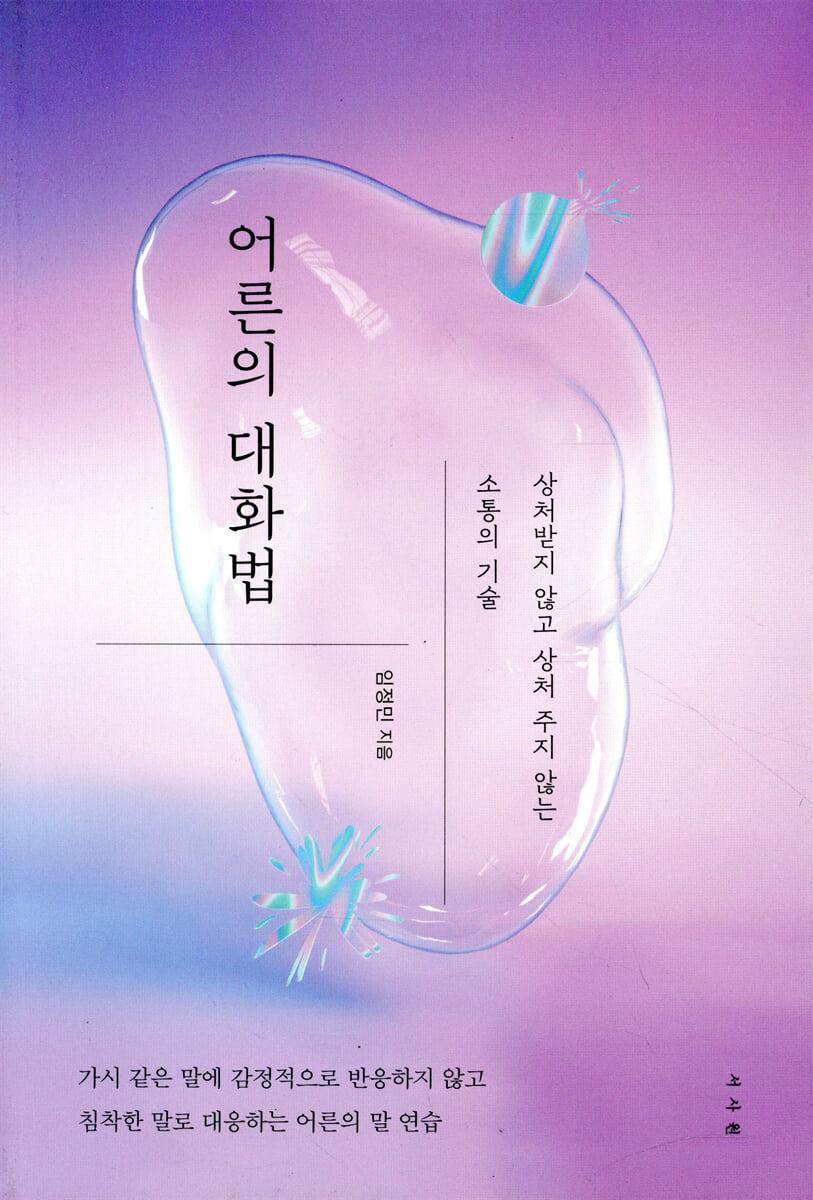
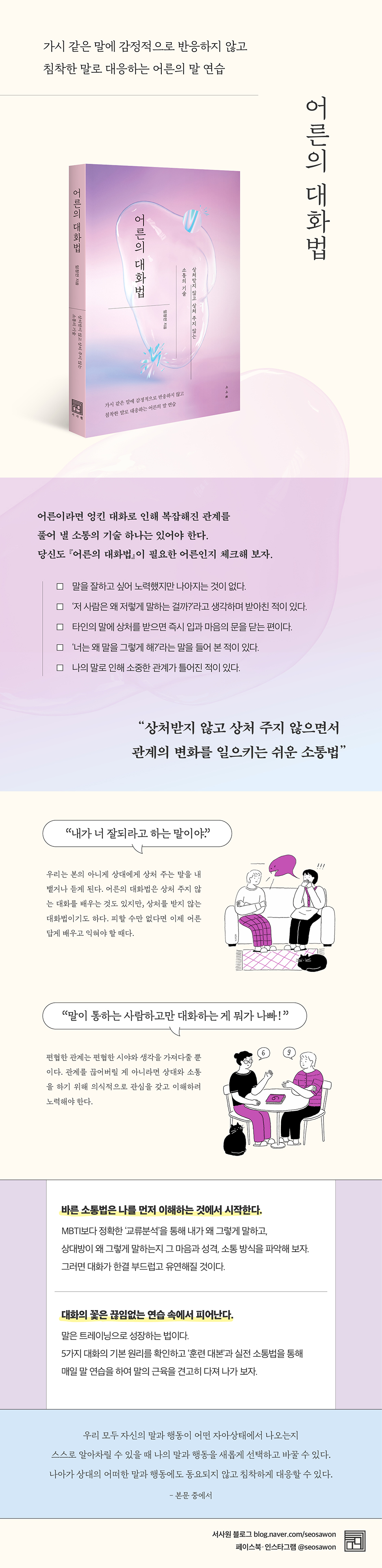
“Do you really have to say that?” “Did I really have to say that?” Don't react emotionally to thorny words Practice speaking to adults who respond calmly This book doesn't teach you the 'skill of saying everything you want to say in an organized manner.' It doesn't stop you from giving someone a hard time or kicking the covers before bed, saying, "I should have said that!" Instead, it gives you the strength to let go of those who hurt you with words and the tolerance to understand and accept the situation. You may be puzzled when I say 'understanding'. You may express your dissatisfaction by asking why you are the only one who has to understand. But as you know, things don't change. There are people everywhere who hurt me, and conversely, there are always people who are hurt by my words. The purpose of this book is to acknowledge that we cannot change people or situations, and to train ourselves to process them in a way that is more beneficial to us. The basic framework for understanding is a psychological theory called 'transactional analysis'. Transactional analysis was developed by American psychiatrist Eric Berne, and explains that people are made up of three selves: 'parent', 'adult', and 'child', and that words and actions come out through these selves. Transactional analysis was used to understand the basic framework of the conversation, but it did not convey difficult content. A speech communication expert who has coached hundreds of people and lectured thousands using transactional analysis explains the core concepts using easy-to-understand examples so that even the general public can easily understand them. The example is about a common communication failure that occurs around us. Let's look at the examples in the text and compare them to situations I've experienced. Then, I can immediately understand why that person, why I said and did that at that time. If you have the power to rationally read the other person's words and behavior patterns, you can lead all conversations calmly and without reacting emotionally. Since conversation skills require practice and training, the appendix includes a 'training script' that will help you develop your ego. Even just reading a book out loud to yourself, without having to talk to someone to get used to the sensations or having to film a monodrama for a specific situation, can restore balance to an unbalanced ego state. Let's try to walk the path of true adult communication that does not hurt or cause harm with this book. |
- You can preview some of the book's contents.
Preview
index
Prologue.
First, be aware of your communication style.
PART 1.
Why are our words at a standstill?
Difference is not the problem
Bias blocks communication
Non-face-to-face interactions lead to misunderstandings and mistakes.
Emotional words come with a harsh price.
●One Step to Communication: Speaking Differently Changes Relationships
PART 2.
Understanding Me: Why Do I Say That?
Examining the Structure of the Mind
A Look Inside My Three Minds
Words and actions that change according to one's heart
Discover your main personality and communication style
Five Personalities That Understand You and Me
Duality of personality (OK, Not-OK)
●Two Steps to Communication: Diagnosing the Egogram
PART 3.
Basic Principles of Conversation: How to Speak
Don't react, respond
Remember the purpose of the conversation
Understanding the Three Conversation Types
Speaking in Five Patterns
Speaking with recognition and stimulation
●Three Steps to Communication: Diagnosing Stroke
PART 4.
Practical Communication Skills That Create Change in Relationships
Communicate frequently in daily life and work
Make the same words sound good
Apologize sincerely
Please don't be offended
Acknowledging generational differences and speaking differently
Waiting for and embracing puberty
●The Four Steps to Communication: Confirming Your Sincerity toward the Other Person
supplement
Speaking Training Script by Personality Type
epilogue.
One step of ten people is better than ten steps of one person.
References
First, be aware of your communication style.
PART 1.
Why are our words at a standstill?
Difference is not the problem
Bias blocks communication
Non-face-to-face interactions lead to misunderstandings and mistakes.
Emotional words come with a harsh price.
●One Step to Communication: Speaking Differently Changes Relationships
PART 2.
Understanding Me: Why Do I Say That?
Examining the Structure of the Mind
A Look Inside My Three Minds
Words and actions that change according to one's heart
Discover your main personality and communication style
Five Personalities That Understand You and Me
Duality of personality (OK, Not-OK)
●Two Steps to Communication: Diagnosing the Egogram
PART 3.
Basic Principles of Conversation: How to Speak
Don't react, respond
Remember the purpose of the conversation
Understanding the Three Conversation Types
Speaking in Five Patterns
Speaking with recognition and stimulation
●Three Steps to Communication: Diagnosing Stroke
PART 4.
Practical Communication Skills That Create Change in Relationships
Communicate frequently in daily life and work
Make the same words sound good
Apologize sincerely
Please don't be offended
Acknowledging generational differences and speaking differently
Waiting for and embracing puberty
●The Four Steps to Communication: Confirming Your Sincerity toward the Other Person
supplement
Speaking Training Script by Personality Type
epilogue.
One step of ten people is better than ten steps of one person.
References
Detailed image
Into the book
Our lives cannot always be filled with only good and happy things.
Moreover, if you stumble over a rock while walking along the road, you can't blame the rock every time.
Even if you get annoyed by the situation and say something harsh in the moment, you can't go back to the situation before you fell over the rock.
I may fall on a rock, get hurt, feel bad, and say bad things, but don't let that happen to me.
Let's not let our feelings become our attitude.
The bad words that come out of my mouth are the first thing I hear and flow into my body through my ears.
In our lives, we encounter countless instances of stumbling over obstacles in our relationships. Instead of blaming the situation or blaming the other person, let's encourage and care for ourselves and communicate in a healthy way that doesn't hurt others.
--- p.42~43
‘Relationships’ are formed through ‘meetings’, ‘communication’ is formed through ‘words’, and ‘words’ originate from the ‘heart’.
Language is more than just exchanging messages.
This is because 'language' is the total result of the cultural and socialization process that a person has experienced.
So we can find the thread of true communication in words and actions.
Because words and actions reflect the mind, if we correctly understand the state of mind of ourselves and others by observing their outward words and actions, we can build harmonious relationships with them.
--- p.46
British philosopher Thomas Hobbes said, “It is generally impossible to understand another person deeply.
But by looking deeply into yourself, you can come to know many people deeply.
Because humans have fundamentally common characteristics.
“Trying to know others without being able to see yourself well is like trying to decipher a code without a clue,” he said.
He pointed out that trying to know others without knowing oneself is a very contradictory act, and emphasized that 'self-understanding' comes first.
--- p.49
The impulsive emotions and words that came like uninvited guests ultimately left me with regrets.
If you want to preserve your precious relationships, you must look into your own state of mind and consciously notice the changes in your mind from moment to moment.
--- p.70
As we live, we face various conflict situations, such as friction with our boss, differences of opinion with colleagues in other departments, discord between lovers or spouses, and clashes with our children.
If you first recognize your own ego state in such situations and 'respond' with a character that can handle the situation you are in and the ego state of the other person well, you will be able to communicate more flexibly.
--- p.98~99
The purpose of conversation is to communicate effectively with others and maintain good relationships regardless of the situation.
No one gets pleasure from making others feel bad.
I will not speak with the purpose of subduing the opponent and showing off my superiority.
Moreover, don't countries try to form alliances and maintain friendly relations to prevent national conflicts?
If so, we must prioritize ‘relationships’.
From home to work and various organizations, in situations of conflict, even a momentary, immature slip of the tongue can ruin work and relationships, so we must make even more effort.
Moreover, if you stumble over a rock while walking along the road, you can't blame the rock every time.
Even if you get annoyed by the situation and say something harsh in the moment, you can't go back to the situation before you fell over the rock.
I may fall on a rock, get hurt, feel bad, and say bad things, but don't let that happen to me.
Let's not let our feelings become our attitude.
The bad words that come out of my mouth are the first thing I hear and flow into my body through my ears.
In our lives, we encounter countless instances of stumbling over obstacles in our relationships. Instead of blaming the situation or blaming the other person, let's encourage and care for ourselves and communicate in a healthy way that doesn't hurt others.
--- p.42~43
‘Relationships’ are formed through ‘meetings’, ‘communication’ is formed through ‘words’, and ‘words’ originate from the ‘heart’.
Language is more than just exchanging messages.
This is because 'language' is the total result of the cultural and socialization process that a person has experienced.
So we can find the thread of true communication in words and actions.
Because words and actions reflect the mind, if we correctly understand the state of mind of ourselves and others by observing their outward words and actions, we can build harmonious relationships with them.
--- p.46
British philosopher Thomas Hobbes said, “It is generally impossible to understand another person deeply.
But by looking deeply into yourself, you can come to know many people deeply.
Because humans have fundamentally common characteristics.
“Trying to know others without being able to see yourself well is like trying to decipher a code without a clue,” he said.
He pointed out that trying to know others without knowing oneself is a very contradictory act, and emphasized that 'self-understanding' comes first.
--- p.49
The impulsive emotions and words that came like uninvited guests ultimately left me with regrets.
If you want to preserve your precious relationships, you must look into your own state of mind and consciously notice the changes in your mind from moment to moment.
--- p.70
As we live, we face various conflict situations, such as friction with our boss, differences of opinion with colleagues in other departments, discord between lovers or spouses, and clashes with our children.
If you first recognize your own ego state in such situations and 'respond' with a character that can handle the situation you are in and the ego state of the other person well, you will be able to communicate more flexibly.
--- p.98~99
The purpose of conversation is to communicate effectively with others and maintain good relationships regardless of the situation.
No one gets pleasure from making others feel bad.
I will not speak with the purpose of subduing the opponent and showing off my superiority.
Moreover, don't countries try to form alliances and maintain friendly relations to prevent national conflicts?
If so, we must prioritize ‘relationships’.
From home to work and various organizations, in situations of conflict, even a momentary, immature slip of the tongue can ruin work and relationships, so we must make even more effort.
--- p.124
Publisher's Review
With this book, sharp communication becomes blunt!
Making the relationship between you and me flexible
How to talk like a real adult
Why do we need to communicate constantly?
Modern people, who cry out, “24 hours in a day is not enough” and “We’re so busy in this modern society,” do not want to put much effort into interpersonal relationships and communication.
I just want to wash away the day's fatigue by communicating with someone who I get along with and can communicate well with.
However, he says that this kind of thinking narrows people's thinking, does not recognize differences, and further causes discord in communication.
Some people choose 'communication breakdown' or 'one-sided communication' to reduce the hurt and stress they feel during conversation.
Disconnection may be a last resort to avoid being hurt, but it cannot be the way to make human relationships and my life comfortable.
This is an attitude that is not accepted, especially in an adult society where communication is essential.
Like it or not, as members of society, we are surrounded by family, friends, and work, and we must constantly communicate within that society.
At least as adults, we should learn how to communicate for ourselves and others.
There is a saying that if you can't avoid it, enjoy it, but there are limits to enjoyment.
In order to have an adult conversation without getting hurt or causing harm, understanding and respect for the other person must come first.
This way, we can effectively communicate our opinions, avoid unnecessary conflict, and ultimately, relieve the stress of the conversation we want.
If you've ever been unable to control your emotions in the moment and said hurtful things to someone else, or if you've ever caused a relationship to go wrong because of you, you need to understand why you're feeling emotional and how to communicate your feelings.
Everything I say comes back to me.
Therefore, the 'adult conversation' we should pursue should be the kind of words I want to hear and that respects all of us.
Adult conversation begins with understanding oneself and the other person.
Communication begins with understanding and respect.
As the old saying goes, “Know yourself and know your enemy, and you will never be defeated,” understanding and respect must begin with “me” and “you.”
In "How to Talk to Adults," it is said that we can understand ourselves and other people's words and actions through "transactional analysis," a field of psychology.
Transactional analysis explains that the human mind is made up of three selves: 'parent', 'adult', and 'child', and that people speak and act based on the ego state that stands out among these three selves.
Eric Berne, the founder of the theory, says that we can understand the other person's ego state through verbal and nonverbal cues (behavior, facial expressions, etc.) and that we can continue a flexible conversation by choosing words that do not clash with a specific ego.
Transactional analysis is a personality theory and psychological technique used for counseling, therapy, and educational purposes.
Let's check what kind of person I am through the principles of mental structure, five personality traits, and egogram diagnostic chart provided in this book.
If you come to the realization that 'Ah, that's why I said this' or 'That's why that person said and did this', you will be able to control your words and actions in the future and understand the other person's words and actions with your head, not your emotions.
Conversation is not a skill, but a product of practice.
Author Lim Jeong-min says that speaking is not just about 'skill' and that it becomes completely yours only through repeated practice.
Therefore, this book provides 'Five Basic Principles of Conversation' with various examples and 'Practical Communication Methods that Create Change in Relationships'.
The examples are so common that the term 'life-related' naturally comes to mind.
Just reading this will give you a sense of how to have a conversation in certain situations.
It also provides a 'scriptbook' to help improve my unbalanced ego state.
In fact, in speech classes based on transactional analysis, each person is given a script that matches their ego state and is trained to read it out loud.
I am confident that there is no more certain way than this, and I hope that every reader of this book will find peace of mind by reading the script at least once a day.
Making the relationship between you and me flexible
How to talk like a real adult
Why do we need to communicate constantly?
Modern people, who cry out, “24 hours in a day is not enough” and “We’re so busy in this modern society,” do not want to put much effort into interpersonal relationships and communication.
I just want to wash away the day's fatigue by communicating with someone who I get along with and can communicate well with.
However, he says that this kind of thinking narrows people's thinking, does not recognize differences, and further causes discord in communication.
Some people choose 'communication breakdown' or 'one-sided communication' to reduce the hurt and stress they feel during conversation.
Disconnection may be a last resort to avoid being hurt, but it cannot be the way to make human relationships and my life comfortable.
This is an attitude that is not accepted, especially in an adult society where communication is essential.
Like it or not, as members of society, we are surrounded by family, friends, and work, and we must constantly communicate within that society.
At least as adults, we should learn how to communicate for ourselves and others.
There is a saying that if you can't avoid it, enjoy it, but there are limits to enjoyment.
In order to have an adult conversation without getting hurt or causing harm, understanding and respect for the other person must come first.
This way, we can effectively communicate our opinions, avoid unnecessary conflict, and ultimately, relieve the stress of the conversation we want.
If you've ever been unable to control your emotions in the moment and said hurtful things to someone else, or if you've ever caused a relationship to go wrong because of you, you need to understand why you're feeling emotional and how to communicate your feelings.
Everything I say comes back to me.
Therefore, the 'adult conversation' we should pursue should be the kind of words I want to hear and that respects all of us.
Adult conversation begins with understanding oneself and the other person.
Communication begins with understanding and respect.
As the old saying goes, “Know yourself and know your enemy, and you will never be defeated,” understanding and respect must begin with “me” and “you.”
In "How to Talk to Adults," it is said that we can understand ourselves and other people's words and actions through "transactional analysis," a field of psychology.
Transactional analysis explains that the human mind is made up of three selves: 'parent', 'adult', and 'child', and that people speak and act based on the ego state that stands out among these three selves.
Eric Berne, the founder of the theory, says that we can understand the other person's ego state through verbal and nonverbal cues (behavior, facial expressions, etc.) and that we can continue a flexible conversation by choosing words that do not clash with a specific ego.
Transactional analysis is a personality theory and psychological technique used for counseling, therapy, and educational purposes.
Let's check what kind of person I am through the principles of mental structure, five personality traits, and egogram diagnostic chart provided in this book.
If you come to the realization that 'Ah, that's why I said this' or 'That's why that person said and did this', you will be able to control your words and actions in the future and understand the other person's words and actions with your head, not your emotions.
Conversation is not a skill, but a product of practice.
Author Lim Jeong-min says that speaking is not just about 'skill' and that it becomes completely yours only through repeated practice.
Therefore, this book provides 'Five Basic Principles of Conversation' with various examples and 'Practical Communication Methods that Create Change in Relationships'.
The examples are so common that the term 'life-related' naturally comes to mind.
Just reading this will give you a sense of how to have a conversation in certain situations.
It also provides a 'scriptbook' to help improve my unbalanced ego state.
In fact, in speech classes based on transactional analysis, each person is given a script that matches their ego state and is trained to read it out loud.
I am confident that there is no more certain way than this, and I hope that every reader of this book will find peace of mind by reading the script at least once a day.
GOODS SPECIFICS
- Date of issue: January 10, 2022
- Page count, weight, size: 256 pages | 370g | 140*205*20mm
- ISBN13: 9791168220348
- ISBN10: 1168220343
You may also like
카테고리
korean


korean

![ELLE 엘르 스페셜 에디션 A형 : 12월 [2025]](http://librairie.coreenne.fr/cdn/shop/files/b8e27a3de6c9538896439686c6b0e8fb.jpg?v=1766436872&width=3840)


