

Thought-Organizing Speech
 |
Description
Book Introduction
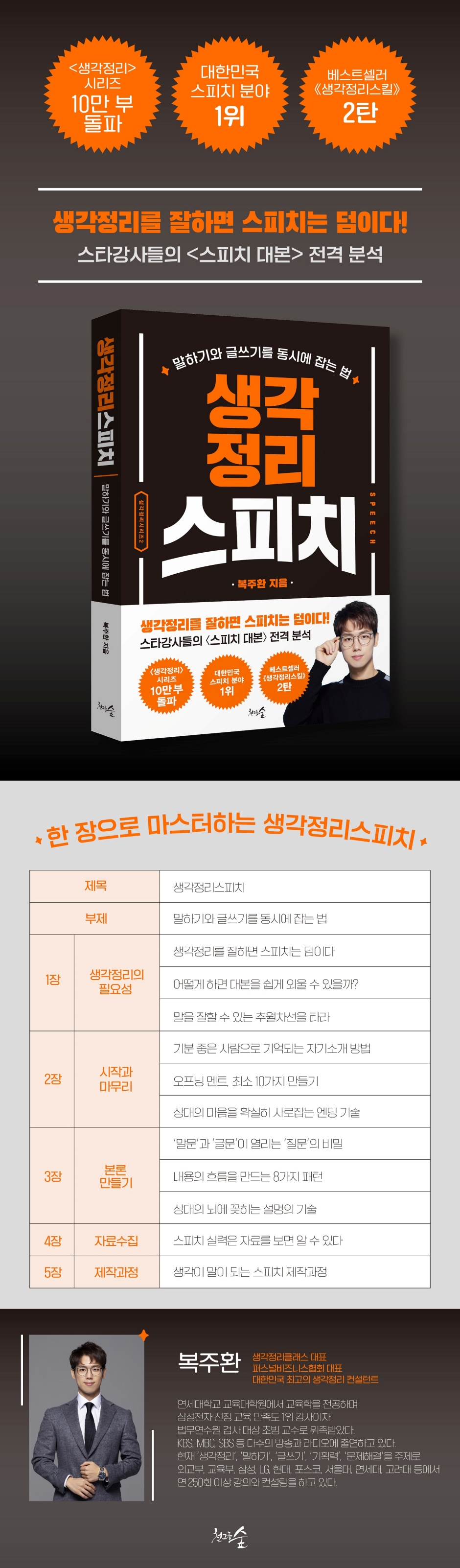
[Thought Organization] Revised Edition Published to Celebrate 100,000 Copies of the Series! “If you organize your thoughts well, speaking is a bonus!” A Comprehensive Analysis of Speech Scripts from Korea's Star Instructors Our misconception about speech is that if we train ourselves to express ourselves, we will be able to speak well. If you practice pronunciation hard, your pronunciation will improve, and if you train your voice hard, your voice will improve. Pronunciation, vocalization, and voice are necessary, but not sufficient, conditions for speech. A good voice is an important factor in increasing trust and likability, but a good voice does not necessarily mean that you will speak well. Let's think of broadcaster Kim Je-dong, writer Yoo Si-min, and former President Roh Moo-hyun. They don't have good voices like announcers and they even use dialects. Nevertheless, people listen to them. Why is that? Because it's something worth hearing. To give a good speech, you must first organize your thoughts. If you organize your thoughts well, speaking skills will come as a bonus. So, this book introduces how to create a speech script 'properly'. This is because the process of creating a script improves your ‘writing skills’ and the process of speaking strengthens your ‘speech skills’. In other words, if you can create a good speech script, you can master both 'speaking' and 'writing' at the same time. Before writing a speech script, you must first create and expand a logical structure using question maps, mind maps, mandalas, etc. Expand and concretize the content by asking questions through the question map. After structuring your thoughts through a mind map, you can expand your ideas through a mandala. This book introduces how to properly create a speech script that consists of an introduction, body, and conclusion. First, in Creating an Introduction, we explain 10 ways to create a self-introduction and opening statement. And in the main part of creating a speech blueprint, we introduce methods to concretize the content and reconstruct the logic, such as eight patterns that create the flow of the content and how to make the speech more refined with connecting comments. The conclusion section introduces how to find the one word you really want to say and ending techniques that will definitely capture the other person's heart. 『Thought-Organizing Speech』 is a book for those of you who want to become good at giving speeches. If you just read a book, it ends at understanding, but if you put it into practice, it becomes yours. You can only improve your skills by doing it yourself. Practice speaking out loud and create your own speech script using the examples. Remember, the completion of this book is up to you! |
- You can preview some of the book's contents.
Preview
index
Prologue / To give a good speech, start by organizing your thoughts!
Chapter 1: If you organize your thoughts well, you'll get a speech as a bonus!
01 Fake Talkers vs. Real Talkers
02 Disorganized speech torments the other person's mind!
03 There's a separate reason why star instructors write books.
04 How can I easily memorize the script?
05 Get in the fast lane where you can speak well.
06 5 Steps to Stealing Speeches from Star Instructors
〈1-Page Summary〉 How to Become a Truly Good Speaker
Chapter 2: Just by starting and ending well, people look different!
01 If you say this at the beginning, you will definitely lose.
02 How to introduce yourself so that you are remembered as a pleasant person
03 If you brag, you'll get cursed, but if you tell a story, you'll get noticed.
04 Opening Statement, Create at Least 10
05 Habit of starting with the conclusion
06 Ending technique that will definitely capture your opponent's heart
〈1-Page Summary〉 The Beginning and Ending of a Speech
Chapter 3: Creating the Main Thesis: If you don't do it today, you won't be able to do it tomorrow!
01 Why is it so difficult to write a main text?
02 The Secret of 'Questions' That Open 'Speech' and 'Writing'
03 This is how instructor Seol Min-seok creates a script!
04 How to Think Like Anchor Son Seok-hee
05 Two Ways to Create a Speech Style
06 8 Patterns to Create Content Flow
07 Speech, just by connecting well, it becomes sophisticated!
08 7 Explanation Techniques That Will Stick in Your Opponent's Brain
09 Secrets Hidden in the Scripts of Star Instructors
〈1-Page Summary〉 Creating the Main Body of Your Speech
Chapter 4: You can tell your speech skills by looking at the data!
01 Where to Find Speech Materials
02 Ideas/Notes
03 Diary Writing (Experience/Feeling/Imagination)
04 Reading
05 SNS/Internet/Video
06 Academic Information
07 News/Newspaper Articles
08 Movies/Dramas
09 Lecture/Expert
10 Things to keep in mind when collecting data
〈1-Page Summary〉Speech Material Management
Chapter 5: The entire process of preparing a speech is 'organizing thoughts'!
01 The process of creating a speech
02 Everyone gets scared when they are asked to give a speech!
03 [Step 1] Organize your plan first.
04 [Step 2] Thoroughly Analyze Your Audience
05 [Step 3] Select a key message
06 [Step 4] Collect data until the end.
07 [Step 5] Create a speech script
08 [Step 6] Make your PPT concise.
09 [Step 7] Prepare for rehearsal as if it were the real thing.
10 On the day of the speech, thoughts finally become words!
〈1-Page Summary〉 The Process of Creating a Speech
Chapter 1: If you organize your thoughts well, you'll get a speech as a bonus!
01 Fake Talkers vs. Real Talkers
02 Disorganized speech torments the other person's mind!
03 There's a separate reason why star instructors write books.
04 How can I easily memorize the script?
05 Get in the fast lane where you can speak well.
06 5 Steps to Stealing Speeches from Star Instructors
〈1-Page Summary〉 How to Become a Truly Good Speaker
Chapter 2: Just by starting and ending well, people look different!
01 If you say this at the beginning, you will definitely lose.
02 How to introduce yourself so that you are remembered as a pleasant person
03 If you brag, you'll get cursed, but if you tell a story, you'll get noticed.
04 Opening Statement, Create at Least 10
05 Habit of starting with the conclusion
06 Ending technique that will definitely capture your opponent's heart
〈1-Page Summary〉 The Beginning and Ending of a Speech
Chapter 3: Creating the Main Thesis: If you don't do it today, you won't be able to do it tomorrow!
01 Why is it so difficult to write a main text?
02 The Secret of 'Questions' That Open 'Speech' and 'Writing'
03 This is how instructor Seol Min-seok creates a script!
04 How to Think Like Anchor Son Seok-hee
05 Two Ways to Create a Speech Style
06 8 Patterns to Create Content Flow
07 Speech, just by connecting well, it becomes sophisticated!
08 7 Explanation Techniques That Will Stick in Your Opponent's Brain
09 Secrets Hidden in the Scripts of Star Instructors
〈1-Page Summary〉 Creating the Main Body of Your Speech
Chapter 4: You can tell your speech skills by looking at the data!
01 Where to Find Speech Materials
02 Ideas/Notes
03 Diary Writing (Experience/Feeling/Imagination)
04 Reading
05 SNS/Internet/Video
06 Academic Information
07 News/Newspaper Articles
08 Movies/Dramas
09 Lecture/Expert
10 Things to keep in mind when collecting data
〈1-Page Summary〉Speech Material Management
Chapter 5: The entire process of preparing a speech is 'organizing thoughts'!
01 The process of creating a speech
02 Everyone gets scared when they are asked to give a speech!
03 [Step 1] Organize your plan first.
04 [Step 2] Thoroughly Analyze Your Audience
05 [Step 3] Select a key message
06 [Step 4] Collect data until the end.
07 [Step 5] Create a speech script
08 [Step 6] Make your PPT concise.
09 [Step 7] Prepare for rehearsal as if it were the real thing.
10 On the day of the speech, thoughts finally become words!
〈1-Page Summary〉 The Process of Creating a Speech
Detailed image
Into the book
Ironically, it was not through speech books that I discovered the principles and methods for speaking well, but through studying writing and planning.
Yes! Thoughts, writing, and speech were all connected.
Why didn't I think of that? It's because I had this fixed idea that speaking and writing had to be learned separately.
--- p.16
A person who has organized thoughts can convey his message clearly even when speaking concisely.
Even though the voice is small, it comes across with a strong resonance.
Even if you use a dialect, it is expressed accurately.
Because what you want to say is clear.
--- p.30
Star instructors diligently write books even with their busy schedules.
Why do people write books, even though they take a long time and are not easy to complete? Because they know that writing is the best way to become a good public speaker.
Writing is a process of refining thoughts.
--- p.34
Let's make the logic of the star instructor we analyzed our own.
Leave the skeleton and only change the content.
Let's change the word so that it doesn't get dirty.
Surprisingly, when I speak at a time when the star lecturer is moved, the audience is moved, and when I speak at a time when the star lecturer receives applause, I receive applause.
Because that was the logic from the beginning.
--- p.59
It is very important to put your audience in a positive mood when you begin your speech.
Emotions are divided into positive emotions (happiness, satisfaction, joy, etc.) and negative emotions (annoyance, depression, anger, etc.). It is natural that learning becomes difficult if you have a lot of negative emotions.
--- p.66
The role of the speech beginning is to arouse curiosity and focus attention on the topic.
Therefore, speakers must come up with creative ideas that can captivate the audience.
Creativity comes from generating numerous ideas from different perspectives.
--- p.93
Humor not only creates a sense of likability, it also focuses attention and helps relieve tension.
Showing humor when you begin your speech will increase your likeability and build anticipation for the speaker.
One thing to be careful of is to avoid awkward humor.
If you are not careful, the speaker may appear frivolous and lose credibility.
--- p.98~99
If you want your audience to remember your speech, you need to summarize the main points.
If you want to get good at summarizing, it would be a good idea to create a script in the form of a 'logical structure' and practice summarizing only the key points.
--- p.123
A good speaker knows how to create a table of contents by anticipating questions people might ask.
People who speak logically do not organize their thoughts as they come to mind, but rather list questions and rearrange them in an order that is easy for the audience to understand or in an order that is likely to intrigue them.
And just add content here and you have a speech script.
--- p.147
Good speakers introduce their speeches with titles and topics to help the audience visualize the big picture.
Because I know very well that if I don't tell the title first, the other person will get confused.
--- p.189
If you want to be a good speaker, you need to take notes with a purpose, not just take notes.
No matter how many thoughts you write down, if you write them down without a purpose, it won't be very effective when giving a speech.
--- p.214
When creating a speech script, I recommend using a digital mind map.
The program helps you organize and design large amounts of content in a structured manner.
It would be a good idea to create a table of contents to outline the outline of your speech.
You can see the flow of logic on one page and prevent 'duplication' and 'omission' of content.
Yes! Thoughts, writing, and speech were all connected.
Why didn't I think of that? It's because I had this fixed idea that speaking and writing had to be learned separately.
--- p.16
A person who has organized thoughts can convey his message clearly even when speaking concisely.
Even though the voice is small, it comes across with a strong resonance.
Even if you use a dialect, it is expressed accurately.
Because what you want to say is clear.
--- p.30
Star instructors diligently write books even with their busy schedules.
Why do people write books, even though they take a long time and are not easy to complete? Because they know that writing is the best way to become a good public speaker.
Writing is a process of refining thoughts.
--- p.34
Let's make the logic of the star instructor we analyzed our own.
Leave the skeleton and only change the content.
Let's change the word so that it doesn't get dirty.
Surprisingly, when I speak at a time when the star lecturer is moved, the audience is moved, and when I speak at a time when the star lecturer receives applause, I receive applause.
Because that was the logic from the beginning.
--- p.59
It is very important to put your audience in a positive mood when you begin your speech.
Emotions are divided into positive emotions (happiness, satisfaction, joy, etc.) and negative emotions (annoyance, depression, anger, etc.). It is natural that learning becomes difficult if you have a lot of negative emotions.
--- p.66
The role of the speech beginning is to arouse curiosity and focus attention on the topic.
Therefore, speakers must come up with creative ideas that can captivate the audience.
Creativity comes from generating numerous ideas from different perspectives.
--- p.93
Humor not only creates a sense of likability, it also focuses attention and helps relieve tension.
Showing humor when you begin your speech will increase your likeability and build anticipation for the speaker.
One thing to be careful of is to avoid awkward humor.
If you are not careful, the speaker may appear frivolous and lose credibility.
--- p.98~99
If you want your audience to remember your speech, you need to summarize the main points.
If you want to get good at summarizing, it would be a good idea to create a script in the form of a 'logical structure' and practice summarizing only the key points.
--- p.123
A good speaker knows how to create a table of contents by anticipating questions people might ask.
People who speak logically do not organize their thoughts as they come to mind, but rather list questions and rearrange them in an order that is easy for the audience to understand or in an order that is likely to intrigue them.
And just add content here and you have a speech script.
--- p.147
Good speakers introduce their speeches with titles and topics to help the audience visualize the big picture.
Because I know very well that if I don't tell the title first, the other person will get confused.
--- p.189
If you want to be a good speaker, you need to take notes with a purpose, not just take notes.
No matter how many thoughts you write down, if you write them down without a purpose, it won't be very effective when giving a speech.
--- p.214
When creating a speech script, I recommend using a digital mind map.
The program helps you organize and design large amounts of content in a structured manner.
It would be a good idea to create a table of contents to outline the outline of your speech.
You can see the flow of logic on one page and prevent 'duplication' and 'omission' of content.
--- p.259~260
Publisher's Review
The second installment of the best-selling "Thinking Organization Skills," chosen by 100,000 learners!
To give a good speech, start by organizing your thoughts!
“Disorganized words torment the other person’s mind!”
In relationships with people, thoughts are conveyed through words.
Office workers give presentations for business, and college students present assignments for grades.
Job seekers prepare speeches for interviews, and speakers prepare what they will say on stage.
So many people live their lives speaking for various purposes.
But 'speaking' is not an easy thing.
I always get nervous when I stand in front of people, and I worry because I can't explain things clearly or logically.
How can we solve this problem?
If you want to be good at speaking, you should use people who are good at speaking as your textbooks.
This book contains the case studies of star instructors such as Kim Mi-kyung, Kim Chang-ok, and Seol Min-seok, as well as the case study of anchor Son Seok-hee, who was chosen by journalists as the most eloquent person.
Why are they so good at speaking? What secrets lie hidden in their speech scripts? We need to analyze the thoughts behind their words, not simply imitate them.
Let's analyze their speech logic and patterns and make them our own.
The theme of 『Thought Organizing Speech』 is 'If you organize your thoughts well, speaking is a bonus.'
The goal is to provide a way to 'capture speaking and writing simultaneously'.
This book, consisting of five chapters, contains 'secrets to organizing your thoughts and speaking well right now.'
Chapter 1 introduces why organizing your thoughts is necessary when preparing a speech.
Explains how to create scripts that you can memorize on your own, how to get on the fast lane to speak well, and how to analyze the scripts of star instructors and make them your own.
Chapter 2 introduces how to begin and end a speech.
We explain how to create a self-introduction that will make you remember someone as a pleasant person, how to create 10 different versions of an opening statement, and ending techniques that will definitely capture the other person's heart.
Chapter 3 is about how to create the main body.
It explains how to make your speech content specific through questions, 7 techniques for explaining things that will stick in the other person's mind, and the secrets hidden in the scripts of star lecturers.
Chapter 4 is about data collection methods.
You can tell your speech skills by looking at the data.
Where to find materials? How to use them in your speech? This book generously shares all of the author's expertise in collecting and managing materials.
Chapter 5 reveals the process of creating a lecture (speech) based on the author's actual case.
Everyone gets scared when they are asked to give a speech.
I've outlined the process of how to overcome it and how to make sense of the thoughts.
The entire process of preparing a speech is 'organizing your thoughts'!
To give a good speech, start by organizing your thoughts!
“Disorganized words torment the other person’s mind!”
In relationships with people, thoughts are conveyed through words.
Office workers give presentations for business, and college students present assignments for grades.
Job seekers prepare speeches for interviews, and speakers prepare what they will say on stage.
So many people live their lives speaking for various purposes.
But 'speaking' is not an easy thing.
I always get nervous when I stand in front of people, and I worry because I can't explain things clearly or logically.
How can we solve this problem?
If you want to be good at speaking, you should use people who are good at speaking as your textbooks.
This book contains the case studies of star instructors such as Kim Mi-kyung, Kim Chang-ok, and Seol Min-seok, as well as the case study of anchor Son Seok-hee, who was chosen by journalists as the most eloquent person.
Why are they so good at speaking? What secrets lie hidden in their speech scripts? We need to analyze the thoughts behind their words, not simply imitate them.
Let's analyze their speech logic and patterns and make them our own.
The theme of 『Thought Organizing Speech』 is 'If you organize your thoughts well, speaking is a bonus.'
The goal is to provide a way to 'capture speaking and writing simultaneously'.
This book, consisting of five chapters, contains 'secrets to organizing your thoughts and speaking well right now.'
Chapter 1 introduces why organizing your thoughts is necessary when preparing a speech.
Explains how to create scripts that you can memorize on your own, how to get on the fast lane to speak well, and how to analyze the scripts of star instructors and make them your own.
Chapter 2 introduces how to begin and end a speech.
We explain how to create a self-introduction that will make you remember someone as a pleasant person, how to create 10 different versions of an opening statement, and ending techniques that will definitely capture the other person's heart.
Chapter 3 is about how to create the main body.
It explains how to make your speech content specific through questions, 7 techniques for explaining things that will stick in the other person's mind, and the secrets hidden in the scripts of star lecturers.
Chapter 4 is about data collection methods.
You can tell your speech skills by looking at the data.
Where to find materials? How to use them in your speech? This book generously shares all of the author's expertise in collecting and managing materials.
Chapter 5 reveals the process of creating a lecture (speech) based on the author's actual case.
Everyone gets scared when they are asked to give a speech.
I've outlined the process of how to overcome it and how to make sense of the thoughts.
The entire process of preparing a speech is 'organizing your thoughts'!
GOODS SPECIFICS
- Date of issue: May 20, 2023
- Page count, weight, size: 280 pages | 436g | 152*225*17mm
- ISBN13: 9791193000090
You may also like
카테고리
korean


korean

![ELLE 엘르 스페셜 에디션 A형 : 12월 [2025]](http://librairie.coreenne.fr/cdn/shop/files/b8e27a3de6c9538896439686c6b0e8fb.jpg?v=1766436872&width=3840)


