

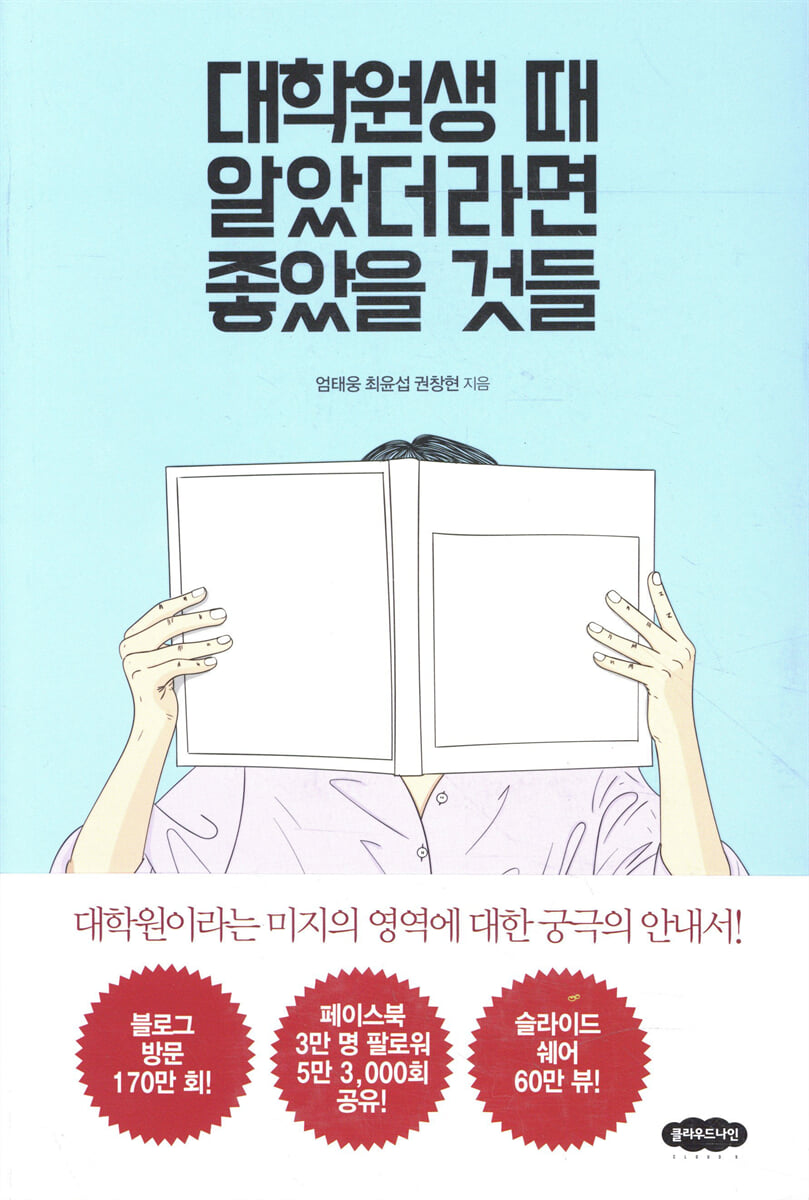
Things I Wish I Knew When I Was a Graduate Student
 |
Description
Book Introduction
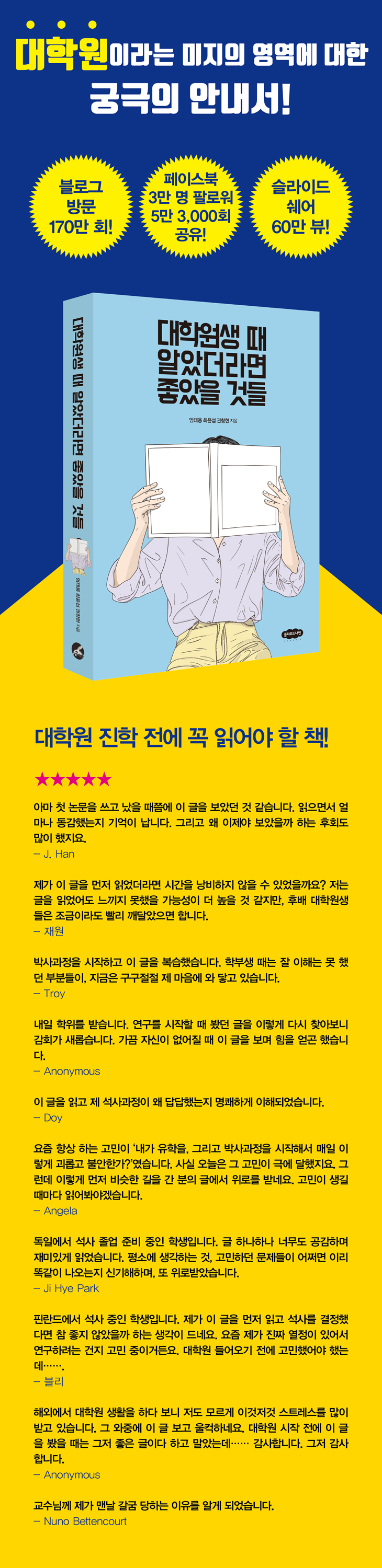
1.7 million blog visits! / 600,000 SlideShare views! / 30,000 Facebook followers, 53,000 shares!
The ultimate guide to the uncharted territory of graduate school!
Korea's first full-fledged graduate school life user manual!
Going to college and going to graduate school are just a few letters apart, but the roles you take on, the environment you'll be in, the intensity of your studies, and your social standing are worlds apart.
However, many people enter graduate school without proper knowledge of the program and only have vague imaginations and superficial information, which leads to great difficulties.
This is especially true in Korea.
This book is the ultimate guide to the uncharted territory of graduate school, written by authors who have experienced real-life trial and error.
This is because three senior researchers with diverse research experiences are each sharing their perspectives on 'things I wish I had known as a graduate student' based on their graduate school life and research experiences.
It provides detailed and realistic information on what graduate school is like, how to decide where to go, how to choose an advisor, what research is, how to write a thesis, what it means to obtain a doctorate, and how to resolve the various concerns that arise during the process.
The background of this book's creation is also interesting.
This book originally started as a topic of conversation when one of the authors, Choi Yun-seop, casually uploaded "Research Know-How I Wish I Knew When I Entered Graduate School" to a slide sharing site in 2012.
This sparked a multinational project where three authors, originally unacquainted with each other and living in Korea, the United States, and Canada, would collaborate and write on a single topic in turns over three years, publishing it online.
Authors from different countries and time zones shared their opinions online and encouraged each other when writing wasn't possible, working on the project for a long time.
The ultimate guide to the uncharted territory of graduate school!
Korea's first full-fledged graduate school life user manual!
Going to college and going to graduate school are just a few letters apart, but the roles you take on, the environment you'll be in, the intensity of your studies, and your social standing are worlds apart.
However, many people enter graduate school without proper knowledge of the program and only have vague imaginations and superficial information, which leads to great difficulties.
This is especially true in Korea.
This book is the ultimate guide to the uncharted territory of graduate school, written by authors who have experienced real-life trial and error.
This is because three senior researchers with diverse research experiences are each sharing their perspectives on 'things I wish I had known as a graduate student' based on their graduate school life and research experiences.
It provides detailed and realistic information on what graduate school is like, how to decide where to go, how to choose an advisor, what research is, how to write a thesis, what it means to obtain a doctorate, and how to resolve the various concerns that arise during the process.
The background of this book's creation is also interesting.
This book originally started as a topic of conversation when one of the authors, Choi Yun-seop, casually uploaded "Research Know-How I Wish I Knew When I Entered Graduate School" to a slide sharing site in 2012.
This sparked a multinational project where three authors, originally unacquainted with each other and living in Korea, the United States, and Canada, would collaborate and write on a single topic in turns over three years, publishing it online.
Authors from different countries and time zones shared their opinions online and encouraged each other when writing wasn't possible, working on the project for a long time.
- You can preview some of the book's contents.
Preview
index
Introduction This book is a guide to the unknown territory of graduate school.
Part 1: Stories from PhD Students (PhD Student Taewoong Eom)
Prologue: The Beginning of a Grand Story
1 Can I dream of becoming a doctor?
2. To Get a Job or to Go to College, That is the Question (Part 1)
3. To Get a Job or to Go to College, That is the Question (Part 2)
4 I want to change my major and go to graduate school.
5 My Study Abroad Failure Story
6 My Study Abroad Challenge Success Story
7 How to Choose a Good Advisor
8 How to Read English Papers Well Even If You Can't Speak English
9 How to write a good English paper even if you can't speak English
10 Self-management is everything in graduate school.
11 Surprising Virtues Graduate Students Should Possess
12 Allow me the happiness that can lag behind.
Epilogue: There's no such thing as a stable life.
Part 2: The Story of a Researcher Who Graduated from Graduate School (Dr. Choi Yun-seop)
Prologue: Starting my research story
1 Should I really go to graduate school?
2 What does a PhD mean?
3 How to Choose a Supervisor
4 I got into graduate school… … What do I do now?
5 How to choose and approach your first research topic
6 Write your first paper as quickly as possible.
7 Time Management for Graduate Students
8 Think, think, think
9 Never work alone
10 Help your juniors grow
Epilogue: What Makes a Good Researcher (+ Some Minor Tips)
Part 3: A Professor's Story of Guiding Graduate Students
(Professor Kwon Chang-hyun)
Prologue The frog to the tadpole
1 Good students, bad students, and weird students
2 Do my research
3 Research Secrets: The Feynman Algorithm
4 Is what you are doing now research or not?
5 Research and Equipment
6. Email Communication among Graduate Students
7. A person who thinks and acts like a professor becomes a professor.
8 Research Practice
9 What should I do when I go to the conference?
10. The wave of mental breakdown that comes with graduate school.
Epilogue: I feel anxious no matter what I do
source
Part 1: Stories from PhD Students (PhD Student Taewoong Eom)
Prologue: The Beginning of a Grand Story
1 Can I dream of becoming a doctor?
2. To Get a Job or to Go to College, That is the Question (Part 1)
3. To Get a Job or to Go to College, That is the Question (Part 2)
4 I want to change my major and go to graduate school.
5 My Study Abroad Failure Story
6 My Study Abroad Challenge Success Story
7 How to Choose a Good Advisor
8 How to Read English Papers Well Even If You Can't Speak English
9 How to write a good English paper even if you can't speak English
10 Self-management is everything in graduate school.
11 Surprising Virtues Graduate Students Should Possess
12 Allow me the happiness that can lag behind.
Epilogue: There's no such thing as a stable life.
Part 2: The Story of a Researcher Who Graduated from Graduate School (Dr. Choi Yun-seop)
Prologue: Starting my research story
1 Should I really go to graduate school?
2 What does a PhD mean?
3 How to Choose a Supervisor
4 I got into graduate school… … What do I do now?
5 How to choose and approach your first research topic
6 Write your first paper as quickly as possible.
7 Time Management for Graduate Students
8 Think, think, think
9 Never work alone
10 Help your juniors grow
Epilogue: What Makes a Good Researcher (+ Some Minor Tips)
Part 3: A Professor's Story of Guiding Graduate Students
(Professor Kwon Chang-hyun)
Prologue The frog to the tadpole
1 Good students, bad students, and weird students
2 Do my research
3 Research Secrets: The Feynman Algorithm
4 Is what you are doing now research or not?
5 Research and Equipment
6. Email Communication among Graduate Students
7. A person who thinks and acts like a professor becomes a professor.
8 Research Practice
9 What should I do when I go to the conference?
10. The wave of mental breakdown that comes with graduate school.
Epilogue: I feel anxious no matter what I do
source
Detailed image
Into the book
The reason I started writing this book was not simply to provide people with tips for getting into a good graduate school or getting a good master's or doctorate degree.
Of course, after reading all of these articles, you may have gained tips on how to get into a good graduate school or obtain a master's or doctoral degree with ease.
However, I would like to make it clear that this is merely a byproduct that the reader may have gained while reading this article and that it is not the purpose of this article.
I want to talk about the learning we need to gain in graduate school to become adults, independent individuals who can take responsibility for their own lives.
Of course, talking about such a grand topic as life is not an easy task.
But if we never confront the weight of grand questions as we navigate life, our lives may end up struggling with the 'rites of passage' set by others.
After high school, you go to college, after college, you go to graduate school, after graduate school, you go to work, after getting a job, you get married, have children, buy a house, raise children… … .
If you're just struggling to resolve the rites of passage right in front of you, you'll start to feel regret and wonder, "Was I ever the master of my own life?"
And I feel like my life has been so busy being pushed around by the pressure of rites of passage.
In the places we were pushed to, there was always fierce competition with other people who were pushed to the same places as us, and we had no chance to look back on our lives while trying to survive that competition.
--- pp.13~14
What's the most important factor to consider when applying to graduate school? The school? The major? The scholarship? The field of study? There are many factors to consider, but I believe none are as important as the advisor.
If I had to choose between doing research I wanted to do under the worst advisor and doing research on a topic I didn't like under the best advisor, I would definitely recommend the latter.
For a graduate student, the presence of an advisor is like the parents of a newborn baby.
Just as a child learns about the world through his or her parents, the academic world can look like a blue ocean or a dirty swamp depending on the kind of professor you meet.
If you want to experience the blue sea of graduate school life, finding a good advisor is essential.
If you remember that graduate school isn't about acquiring knowledge, but about growing yourself, you'll understand the importance of a good advisor.
However, many people cannot let go of their attachment to the school name and seem to think that the priority of choice, which should be 'advisor 〉 research field 〉 scholarship 〉 school', is the opposite, 'school 〉 scholarship 〉 research field 〉 advisor.'
It's like when I was in high school and had to choose between 'Do I want to go to a bad department at a prestigious university, or a good department at a less prestigious university?'
But we must finally say goodbye to such shallow worries that determine our future, especially with the college entrance exam.
Going to graduate school is like planning my future life.
So, rather than simply worrying about which university to put on your resume, it would be better to think about how you can invest your precious years to change your life.
And the power to make those years heaven or hell lies with the advisor.
--- pp.58~59
Graduate school is the flower of education that transforms students from objects of knowledge injection into subjects of independent research.
In that sense, if your graduate school life is filled with all sorts of other things, you need to look back on your graduate school life.
For example, if you feel like you're a slave to a project or like you're being used as a mere puppet by a shooter who has nothing to teach you, you need to make some changes to your graduate school life right away.
Because we came to graduate school to become the masters of our own lives, not to become someone else's puppets.*
Asking, “Professor, what kind of research should I do?” is like asking, “Professor, what am I curious about?”, a question with no answer.
Also, asking for a solution by saying, “Professor, how should I solve this problem?” and criticizing the advisor by saying, “I did everything you told me to do, but it didn’t work,” can be considered an immature attitude that forgets that the subject of the research should be oneself.
The advisor is sometimes called a supervisor in English, but is also called an advisor.
--- p.89
As a graduate student, research was my everything, my life itself.
Those were the days when I was running full speed ahead, risking everything I had to research.
I lived a frantic life, constantly pressed by endless deadlines, crying and laughing over the results of a single experiment, and staying up all night worrying about the uncertain future and my future path.
It was so hard when experiments kept failing, but it was so joyful when my hypothesis turned out to be correct.
I still remember the moment I opened my mailbox one dawn and saw the acceptance email for my first paper.
This was after going through multiple rejections and three revisions over a period of over a year.
I met many brilliant people along the way.
Some of them were truly geniuses who took humanity a step further.
However, many people had an unhappy time during graduate school, and some people could not endure the process and quietly went their separate ways.
I was relatively lucky, but if I had to pick the most difficult time in my life, I would have to say graduate school.
My graduate school years were filled with many paradoxes and complex emotions of love and hate.
It was perhaps the purest and most difficult time of my life, the most inefficient, but also the time when I learned the most.
If I were to go through that whole process again, I don't think I could ever do it again, but if I were to go back in time and face that choice, I think I would probably make the same decision.
--- pp.117~118
It was as if an explorer had been working hard to navigate the jungle, looking at a map, but even though he had reached the edge of the map, there was still an endless jungle stretching out before him.
Now, the place I am going is an unknown world that neither the person who drew this map nor anyone else has ever been to.
From now on, I, none other than myself, must carefully take each step, checking whether there is a cliff or a river ahead, and drawing my own map.
Doing research is like exploring the unknown world beyond the boundaries of human knowledge, little by little.
Now the answer to my question is something I must create myself.
I don't know if there is a "correct answer" to my question, but if I can logically conclude the problem through hypothesis and experimentation, and if this is accepted by the academic community, it will become a thesis and ultimately become new knowledge for humanity.
--- p.144
One more thing I would like to emphasize is that I may even be able to utilize my subconscious in my dreams.
Readers might get tired of it or scoff and say, “Is it unconscious now?”
But I was just as desperate and serious during my graduate school days.
I wanted to utilize all of my conscious and unconscious selves and use 120% of my potential.
After work, I would return to my dorm and lie down before falling asleep, thinking deeply about data analysis methods, logical development, and the design of figures for my thesis.
If you do that, problems may actually appear in your dreams and things may become clearer.
--- p.225
In this book, which is intended to be helpful to graduate students, I believe my role is, paradoxically, to convey the perspective of an advisor.
For example, when I was talking to the other two about how to choose an advisor, the professors talked about what kind of students they wanted to mentor.
The relationship between a student and his or her advisor is so profound that it is often likened to marriage.
In a relationship that can be complex if it's complicated or simple if it's simple, the dissatisfaction that students accumulate toward their professors can take many forms.
To help with some of that, I'd like to talk about topics like what professors' lives are like and what concerns they have.
So, I hope that students can understand the professor's position and thoughts a little better and use the professor better.
Yes, that's right.
Graduate school is actually a place where students use professors.
No, that's where you have to use it.
It is a place where you can borrow the experience and knowledge you lack from professors for the research you want to do, and train within a safe fence.
I hope my writing will help students in that regard.
--- pp.274~275
Once you've entered the doctoral program and are two or three years in, you should have a good sense of what research is all about. At that stage, the professor should not be the owner of the thesis.
Students must become their own masters.
But if the student is reluctant to be the master, the professor has no choice but to start saying things and ordering the student around.
If a student seems to be struggling to get a feel for the direction of their research or to decide on a research method, the advisor will naturally try various things to help them.
And then, waiting for the student to declare himself the master one day.
But this attempt is just an attempt.
As I said before, even the professor doesn't know what it is.
So I'm going to try a few things that I think seem most promising.
But of course, there is a high possibility that it won't work.
That's why I'm researching it.
--- pp.293~294
Even if they are all candidates for a PhD, the way they present themselves varies greatly.
When you look at some candidates, the word 'student' just comes to mind.
On the other hand, when you talk to some candidates, it feels like you're talking to a fellow professor rather than a student.
Ultimately, a person who has thought about his or her future as a professor can speak and act like a professor and become a professor.
People who enjoy and like the various things that professors do, such as research, lectures, student guidance, and interactions with other professors, tend to think about them.
In a sense, thinking and acting like a professor also falls under the category of what it means to 'act naturally.'
In the end, it may not be possible to prepare it separately.
There are people for whom becoming a professor comes naturally.
There are probably some students who have naturally thought a lot about the profession of a professor because it fits so well with what they like.
However, not all professors speak and act like professors before being hired.
There are definitely people somewhere in the middle.
Just like I did.
For those of you who are struggling like me, I'd like to offer some advice on preparing for a professor interview.
Of course, after reading all of these articles, you may have gained tips on how to get into a good graduate school or obtain a master's or doctoral degree with ease.
However, I would like to make it clear that this is merely a byproduct that the reader may have gained while reading this article and that it is not the purpose of this article.
I want to talk about the learning we need to gain in graduate school to become adults, independent individuals who can take responsibility for their own lives.
Of course, talking about such a grand topic as life is not an easy task.
But if we never confront the weight of grand questions as we navigate life, our lives may end up struggling with the 'rites of passage' set by others.
After high school, you go to college, after college, you go to graduate school, after graduate school, you go to work, after getting a job, you get married, have children, buy a house, raise children… … .
If you're just struggling to resolve the rites of passage right in front of you, you'll start to feel regret and wonder, "Was I ever the master of my own life?"
And I feel like my life has been so busy being pushed around by the pressure of rites of passage.
In the places we were pushed to, there was always fierce competition with other people who were pushed to the same places as us, and we had no chance to look back on our lives while trying to survive that competition.
--- pp.13~14
What's the most important factor to consider when applying to graduate school? The school? The major? The scholarship? The field of study? There are many factors to consider, but I believe none are as important as the advisor.
If I had to choose between doing research I wanted to do under the worst advisor and doing research on a topic I didn't like under the best advisor, I would definitely recommend the latter.
For a graduate student, the presence of an advisor is like the parents of a newborn baby.
Just as a child learns about the world through his or her parents, the academic world can look like a blue ocean or a dirty swamp depending on the kind of professor you meet.
If you want to experience the blue sea of graduate school life, finding a good advisor is essential.
If you remember that graduate school isn't about acquiring knowledge, but about growing yourself, you'll understand the importance of a good advisor.
However, many people cannot let go of their attachment to the school name and seem to think that the priority of choice, which should be 'advisor 〉 research field 〉 scholarship 〉 school', is the opposite, 'school 〉 scholarship 〉 research field 〉 advisor.'
It's like when I was in high school and had to choose between 'Do I want to go to a bad department at a prestigious university, or a good department at a less prestigious university?'
But we must finally say goodbye to such shallow worries that determine our future, especially with the college entrance exam.
Going to graduate school is like planning my future life.
So, rather than simply worrying about which university to put on your resume, it would be better to think about how you can invest your precious years to change your life.
And the power to make those years heaven or hell lies with the advisor.
--- pp.58~59
Graduate school is the flower of education that transforms students from objects of knowledge injection into subjects of independent research.
In that sense, if your graduate school life is filled with all sorts of other things, you need to look back on your graduate school life.
For example, if you feel like you're a slave to a project or like you're being used as a mere puppet by a shooter who has nothing to teach you, you need to make some changes to your graduate school life right away.
Because we came to graduate school to become the masters of our own lives, not to become someone else's puppets.*
Asking, “Professor, what kind of research should I do?” is like asking, “Professor, what am I curious about?”, a question with no answer.
Also, asking for a solution by saying, “Professor, how should I solve this problem?” and criticizing the advisor by saying, “I did everything you told me to do, but it didn’t work,” can be considered an immature attitude that forgets that the subject of the research should be oneself.
The advisor is sometimes called a supervisor in English, but is also called an advisor.
--- p.89
As a graduate student, research was my everything, my life itself.
Those were the days when I was running full speed ahead, risking everything I had to research.
I lived a frantic life, constantly pressed by endless deadlines, crying and laughing over the results of a single experiment, and staying up all night worrying about the uncertain future and my future path.
It was so hard when experiments kept failing, but it was so joyful when my hypothesis turned out to be correct.
I still remember the moment I opened my mailbox one dawn and saw the acceptance email for my first paper.
This was after going through multiple rejections and three revisions over a period of over a year.
I met many brilliant people along the way.
Some of them were truly geniuses who took humanity a step further.
However, many people had an unhappy time during graduate school, and some people could not endure the process and quietly went their separate ways.
I was relatively lucky, but if I had to pick the most difficult time in my life, I would have to say graduate school.
My graduate school years were filled with many paradoxes and complex emotions of love and hate.
It was perhaps the purest and most difficult time of my life, the most inefficient, but also the time when I learned the most.
If I were to go through that whole process again, I don't think I could ever do it again, but if I were to go back in time and face that choice, I think I would probably make the same decision.
--- pp.117~118
It was as if an explorer had been working hard to navigate the jungle, looking at a map, but even though he had reached the edge of the map, there was still an endless jungle stretching out before him.
Now, the place I am going is an unknown world that neither the person who drew this map nor anyone else has ever been to.
From now on, I, none other than myself, must carefully take each step, checking whether there is a cliff or a river ahead, and drawing my own map.
Doing research is like exploring the unknown world beyond the boundaries of human knowledge, little by little.
Now the answer to my question is something I must create myself.
I don't know if there is a "correct answer" to my question, but if I can logically conclude the problem through hypothesis and experimentation, and if this is accepted by the academic community, it will become a thesis and ultimately become new knowledge for humanity.
--- p.144
One more thing I would like to emphasize is that I may even be able to utilize my subconscious in my dreams.
Readers might get tired of it or scoff and say, “Is it unconscious now?”
But I was just as desperate and serious during my graduate school days.
I wanted to utilize all of my conscious and unconscious selves and use 120% of my potential.
After work, I would return to my dorm and lie down before falling asleep, thinking deeply about data analysis methods, logical development, and the design of figures for my thesis.
If you do that, problems may actually appear in your dreams and things may become clearer.
--- p.225
In this book, which is intended to be helpful to graduate students, I believe my role is, paradoxically, to convey the perspective of an advisor.
For example, when I was talking to the other two about how to choose an advisor, the professors talked about what kind of students they wanted to mentor.
The relationship between a student and his or her advisor is so profound that it is often likened to marriage.
In a relationship that can be complex if it's complicated or simple if it's simple, the dissatisfaction that students accumulate toward their professors can take many forms.
To help with some of that, I'd like to talk about topics like what professors' lives are like and what concerns they have.
So, I hope that students can understand the professor's position and thoughts a little better and use the professor better.
Yes, that's right.
Graduate school is actually a place where students use professors.
No, that's where you have to use it.
It is a place where you can borrow the experience and knowledge you lack from professors for the research you want to do, and train within a safe fence.
I hope my writing will help students in that regard.
--- pp.274~275
Once you've entered the doctoral program and are two or three years in, you should have a good sense of what research is all about. At that stage, the professor should not be the owner of the thesis.
Students must become their own masters.
But if the student is reluctant to be the master, the professor has no choice but to start saying things and ordering the student around.
If a student seems to be struggling to get a feel for the direction of their research or to decide on a research method, the advisor will naturally try various things to help them.
And then, waiting for the student to declare himself the master one day.
But this attempt is just an attempt.
As I said before, even the professor doesn't know what it is.
So I'm going to try a few things that I think seem most promising.
But of course, there is a high possibility that it won't work.
That's why I'm researching it.
--- pp.293~294
Even if they are all candidates for a PhD, the way they present themselves varies greatly.
When you look at some candidates, the word 'student' just comes to mind.
On the other hand, when you talk to some candidates, it feels like you're talking to a fellow professor rather than a student.
Ultimately, a person who has thought about his or her future as a professor can speak and act like a professor and become a professor.
People who enjoy and like the various things that professors do, such as research, lectures, student guidance, and interactions with other professors, tend to think about them.
In a sense, thinking and acting like a professor also falls under the category of what it means to 'act naturally.'
In the end, it may not be possible to prepare it separately.
There are people for whom becoming a professor comes naturally.
There are probably some students who have naturally thought a lot about the profession of a professor because it fits so well with what they like.
However, not all professors speak and act like professors before being hired.
There are definitely people somewhere in the middle.
Just like I did.
For those of you who are struggling like me, I'd like to offer some advice on preparing for a professor interview.
--- pp.334~335
Publisher's Review
Detailed and practical advice from three senior graduate researchers!
This book is written by three senior researchers with different backgrounds and experiences, each sharing their experiences and perspectives on various aspects of graduate school and research.
The story of a PhD student in Part 1 was written by PhD student Taewoong Eom.
Taewoong Eom is currently a final-year doctoral student studying artificial intelligence in Canada.
He is a lively and energetic person who enjoys communicating through Facebook and YouTube based on his research.
In this book, I tell my story as a current graduate student.
The story of a researcher who graduated from a second-level graduate school was written by Dr. Choi Yun-seop.
After receiving his Ph.D. in life sciences in Korea, Choi Yun-seop conducted research at university hospitals and research institutes of large corporations. He is now an independent professional working in the industrial sector.
The story is based on research experiences at domestic and overseas graduate schools, as well as research experiences in various organizations such as hospitals, companies, and research institutes.
The story of a professor who mentors graduate students in the third division was written by Professor Kwon Chang-hyun.
Kwon Chang-hyun is a professor who holds a Ph.D. in industrial engineering and runs his own laboratory at a university in the United States.
I will talk about my experiences as a graduate student, as a professor who currently advises graduate students, and as I build my career as a professor in academia after receiving my doctorate.
If you read Parts 1, 2, and 3 in order, you will be able to find answers to questions you had as a graduate student and future career paths.
This book will help junior researchers reduce the trial and error they experience in graduate school and successfully grow as independent researchers.
Recommendation
I think I saw this article around the time I wrote my first paper.
I remember how much I sympathized with it while reading it.
And I had a lot of regrets about why I only saw it now.
-J.
Han
If I had read this article first, would I have been able to avoid wasting time? I think I likely wouldn't have realized it even if I had read it, but I hope my junior graduate students will realize it sooner.
-financial resources
I started my PhD and reviewed this article.
There are parts that I didn't quite understand when I was an undergraduate, but now they really resonate with me.
-Troy
I'm getting my degree tomorrow.
It brings back new memories to look back at the article I read when I first started my research.
Sometimes when I feel unsure, I read this article and gain strength.
-Anonymous
After reading this article, I clearly understood why my master's program was so frustrating.
-Doy
These days, I've been constantly wondering, "Am I really this miserable and anxious every day since I started studying abroad and my PhD program?"
Actually, today, my worries reached their peak.
But I find comfort in reading the writings of someone who has gone down a similar path before me.
I should read it whenever I have any concerns.
-Angela
I am a student preparing for my master's degree in Germany.
I really enjoyed reading every single post and I really empathized with it.
I was amazed and comforted by how the things I usually think about and worry about could come out so similarly.
-Ji Hye Park
I am a master's student in Finland.
I wonder if it wouldn't have been better if I had read this article first and then decided to pursue a master's degree.
These days, I'm wondering if I really have the passion to do research.
I should have thought about it before entering graduate school… … .
-Bly
As I live in graduate school abroad, I find myself getting stressed out from all sorts of things without even realizing it.
In the meantime, I'm crying after reading this article.
When I first saw this article before starting graduate school, I just thought it was a good article... ... Thank you.
Just thank you.
-Anonymous
I found out why I was always being scolded by the professor.
-Nuno Bettencourt
This book is written by three senior researchers with different backgrounds and experiences, each sharing their experiences and perspectives on various aspects of graduate school and research.
The story of a PhD student in Part 1 was written by PhD student Taewoong Eom.
Taewoong Eom is currently a final-year doctoral student studying artificial intelligence in Canada.
He is a lively and energetic person who enjoys communicating through Facebook and YouTube based on his research.
In this book, I tell my story as a current graduate student.
The story of a researcher who graduated from a second-level graduate school was written by Dr. Choi Yun-seop.
After receiving his Ph.D. in life sciences in Korea, Choi Yun-seop conducted research at university hospitals and research institutes of large corporations. He is now an independent professional working in the industrial sector.
The story is based on research experiences at domestic and overseas graduate schools, as well as research experiences in various organizations such as hospitals, companies, and research institutes.
The story of a professor who mentors graduate students in the third division was written by Professor Kwon Chang-hyun.
Kwon Chang-hyun is a professor who holds a Ph.D. in industrial engineering and runs his own laboratory at a university in the United States.
I will talk about my experiences as a graduate student, as a professor who currently advises graduate students, and as I build my career as a professor in academia after receiving my doctorate.
If you read Parts 1, 2, and 3 in order, you will be able to find answers to questions you had as a graduate student and future career paths.
This book will help junior researchers reduce the trial and error they experience in graduate school and successfully grow as independent researchers.
Recommendation
I think I saw this article around the time I wrote my first paper.
I remember how much I sympathized with it while reading it.
And I had a lot of regrets about why I only saw it now.
-J.
Han
If I had read this article first, would I have been able to avoid wasting time? I think I likely wouldn't have realized it even if I had read it, but I hope my junior graduate students will realize it sooner.
-financial resources
I started my PhD and reviewed this article.
There are parts that I didn't quite understand when I was an undergraduate, but now they really resonate with me.
-Troy
I'm getting my degree tomorrow.
It brings back new memories to look back at the article I read when I first started my research.
Sometimes when I feel unsure, I read this article and gain strength.
-Anonymous
After reading this article, I clearly understood why my master's program was so frustrating.
-Doy
These days, I've been constantly wondering, "Am I really this miserable and anxious every day since I started studying abroad and my PhD program?"
Actually, today, my worries reached their peak.
But I find comfort in reading the writings of someone who has gone down a similar path before me.
I should read it whenever I have any concerns.
-Angela
I am a student preparing for my master's degree in Germany.
I really enjoyed reading every single post and I really empathized with it.
I was amazed and comforted by how the things I usually think about and worry about could come out so similarly.
-Ji Hye Park
I am a master's student in Finland.
I wonder if it wouldn't have been better if I had read this article first and then decided to pursue a master's degree.
These days, I'm wondering if I really have the passion to do research.
I should have thought about it before entering graduate school… … .
-Bly
As I live in graduate school abroad, I find myself getting stressed out from all sorts of things without even realizing it.
In the meantime, I'm crying after reading this article.
When I first saw this article before starting graduate school, I just thought it was a good article... ... Thank you.
Just thank you.
-Anonymous
I found out why I was always being scolded by the professor.
-Nuno Bettencourt
GOODS SPECIFICS
- Date of issue: April 18, 2019
- Page count, weight, size: 384 pages | 701g | 152*225*24mm
- ISBN13: 9791189430207
- ISBN10: 1189430207
You may also like
카테고리
korean


korean

![ELLE 엘르 스페셜 에디션 A형 : 12월 [2025]](http://librairie.coreenne.fr/cdn/shop/files/b8e27a3de6c9538896439686c6b0e8fb.jpg?v=1766436872&width=3840)


