

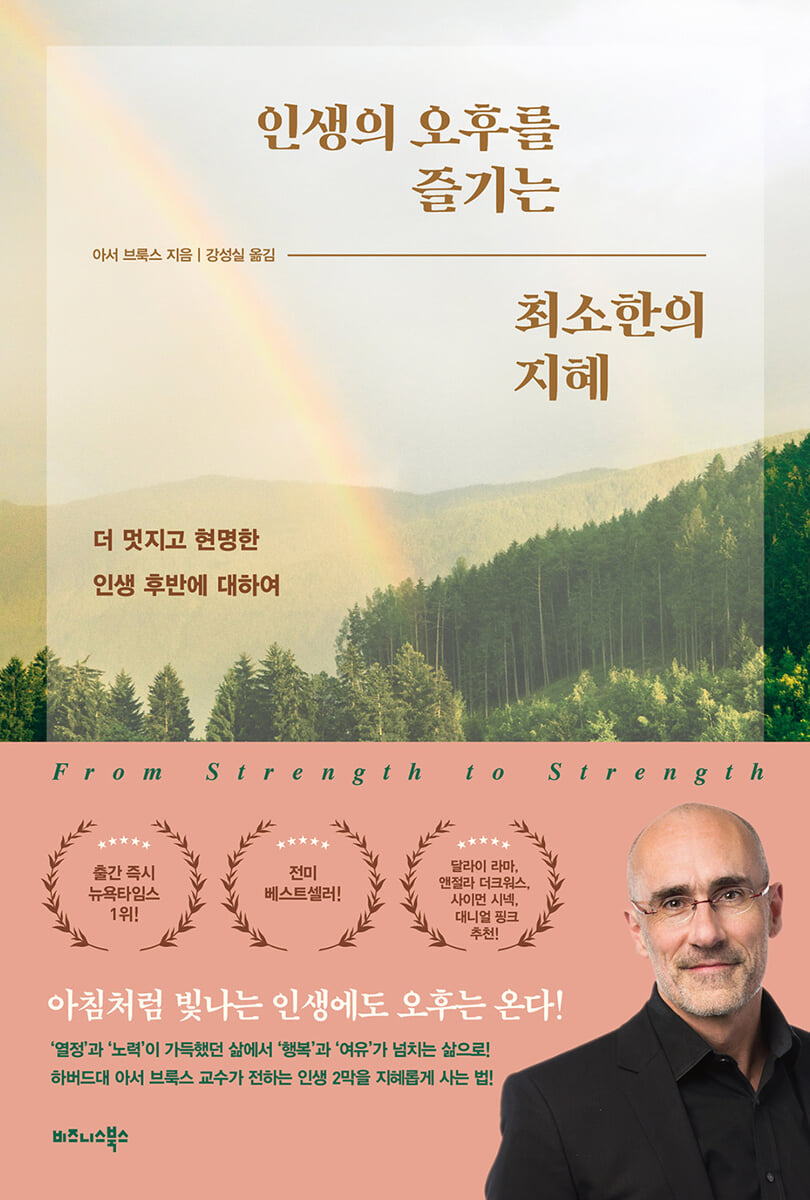
The minimum wisdom to enjoy the afternoon of life
 |
Description
Book Introduction
#1 New York Times bestseller, and a long-term bestseller worldwide.
It gave hope and empathy to readers in their 40s and 50s.
How a Harvard professor can make the most of the latter half of his life.
This book began on a late-night plane ride.
The author hears a man of great worldly accomplishments confess to his wife, "I would rather be dead."
His abilities had declined, life had become frustrating and dissatisfying, and he felt as if no one cared about him the way they used to.
The author began to research whether a period of decline like that of the man on the plane might be his future, and what he could do to prevent that fate.
He delved deeply into diverse fields, from his own specialty, social science, to adjacent disciplines like brain science, philosophy, theology, and history. He also delved into the study of people striving to become the best, interviewing hundreds of leaders.
As a result, those who strive to be the best inevitably face a period of decline, and they come to realize that the success they have achieved is becoming increasingly dissatisfying and they feel a lack in their interpersonal relationships.
Studies have shown that people who pursue power and achievement at work are more unhappy in retirement than those who don't.
The more attached we are to the success and talents of our youth, the sooner we notice our own decline and the more painful it is.
Professional skills peak around the 20th year of employment and then decline steeply.
Happiness gradually decreases and reaches its lowest point in one's 50s.
Those who were once successful feel the fall more acutely and choose to work harder to not lose sight of their achievements.
But the author says that this behavior ultimately only leaves behind anger and frustration.
The author achieved great success, leading a world-class think tank. At the age of 51, he made a major change in his career and attitude toward life to achieve success in the second half of his life, and is now living a fulfilling and happy life.
The author says in this book that because strengths before and after 50 are different, we need to discover new strengths as we age and get on a new second life curve.
It also deals with how to accept death naturally and become friendly with our inevitable fate, and it reveals that the secret to enduring and enjoying loneliness and falling is to connect our roots to others, just as the roots of the trees in a grove of aspen trees are connected to each other.
This book teaches people how to transform professional and social decline into opportunities for growth and transcendence, rather than regret and anger. It helps people in the second half of life find new purpose and meaning in life and make the remaining years a time of happiness and success.
It gave hope and empathy to readers in their 40s and 50s.
How a Harvard professor can make the most of the latter half of his life.
This book began on a late-night plane ride.
The author hears a man of great worldly accomplishments confess to his wife, "I would rather be dead."
His abilities had declined, life had become frustrating and dissatisfying, and he felt as if no one cared about him the way they used to.
The author began to research whether a period of decline like that of the man on the plane might be his future, and what he could do to prevent that fate.
He delved deeply into diverse fields, from his own specialty, social science, to adjacent disciplines like brain science, philosophy, theology, and history. He also delved into the study of people striving to become the best, interviewing hundreds of leaders.
As a result, those who strive to be the best inevitably face a period of decline, and they come to realize that the success they have achieved is becoming increasingly dissatisfying and they feel a lack in their interpersonal relationships.
Studies have shown that people who pursue power and achievement at work are more unhappy in retirement than those who don't.
The more attached we are to the success and talents of our youth, the sooner we notice our own decline and the more painful it is.
Professional skills peak around the 20th year of employment and then decline steeply.
Happiness gradually decreases and reaches its lowest point in one's 50s.
Those who were once successful feel the fall more acutely and choose to work harder to not lose sight of their achievements.
But the author says that this behavior ultimately only leaves behind anger and frustration.
The author achieved great success, leading a world-class think tank. At the age of 51, he made a major change in his career and attitude toward life to achieve success in the second half of his life, and is now living a fulfilling and happy life.
The author says in this book that because strengths before and after 50 are different, we need to discover new strengths as we age and get on a new second life curve.
It also deals with how to accept death naturally and become friendly with our inevitable fate, and it reveals that the secret to enduring and enjoying loneliness and falling is to connect our roots to others, just as the roots of the trees in a grove of aspen trees are connected to each other.
This book teaches people how to transform professional and social decline into opportunities for growth and transcendence, rather than regret and anger. It helps people in the second half of life find new purpose and meaning in life and make the remaining years a time of happiness and success.
- You can preview some of the book's contents.
Preview
index
Entering_A man I met on a night flight
Chapter 1: The Party of Life Doesn't Go On
The 'aging curve' comes to everyone.
How I, a Classical Musician, Became a Social Scientist
Why Effort Betrays You As You Age
The poison called great achievement
Accept the decline and move on to something new.
Chapter 2: How to Overcome Aging
Two functions that make up a human being
Don't fight against time, go with the flow.
If you live your life like Bach
How to work smarter, not harder
Chapter 3: Breaking Free from the Success Addiction That Leads to Unhappiness
People who chose specialness over happiness
There is no such thing as success enough for a success addict.
Why do you love my 'image' and not myself?
Pride, fear, comparison, and withdrawal symptoms
Save yourself from the fear of being forgotten
Throw away everything that creates a fake image.
Chapter 4: The Relationship Between Bucket Lists and Happiness
What Bucket Lists Don't Tell Us
When money, power, and fame become the goal
Why are we stuck in the pleasure hamster wheel?
The fear of failure is stronger than desire
The less you want, the closer you get to happiness.
Ask 'why' you should throw away rather than 'what' you should throw away.
Write your bucket list backwards
How to Find Happiness in Little Things
How much time do you have left?
Chapter 5: Thinking Concretely About Death
Understanding the Fear of Death
We are all just forgotten beings
Practice existing in the 'present moment'
Face the decline and think concretely.
If there is someone next to you who can help you out
Chapter 6: Grow Your Own Forest of Ash Trees
The essence of happiness, studied at Harvard University
A disease called loneliness
Why Leaders Feel More Isolated
It's easy to fall in love, but it's very difficult to stay in love.
Do you have real friends or contract friends?
Six Principles for Healthy Relationships
If tomorrow is the last day
Worldly goals do not bring happiness.
Moving to a higher level of love
Chapter 7: A Time of Seclusion for the Second Leap
How to fully embrace life's imperfections
The Story of My Religion and My Guru
Nicodemus, who served Jesus in the darkness
Three Obstacles to the Spiritual Path
Insights gained from walking the Camino de Santiago
The power to leap to the second curve
Chapter 8: Turn Your Weaknesses into Strengths
Who defines weakness as weakness?
There is no growth without loss and pain.
How to Find Greatness Hidden in Weakness
When you let go of your pretense of strength, you gain the strength to rise above.
Chapter 9: Cast Your Rod When the Water Ebbs
The gift that painful transitions give us
Does middle age necessarily have to be a crisis?
It's never too late to reset your life.
Four Tips for Navigating the Time of Crisis
The courage to take one more step
Going Out_Three Sentences to Remember for Change
The present of the man I met on the plane
Acknowledgements
main
Chapter 1: The Party of Life Doesn't Go On
The 'aging curve' comes to everyone.
How I, a Classical Musician, Became a Social Scientist
Why Effort Betrays You As You Age
The poison called great achievement
Accept the decline and move on to something new.
Chapter 2: How to Overcome Aging
Two functions that make up a human being
Don't fight against time, go with the flow.
If you live your life like Bach
How to work smarter, not harder
Chapter 3: Breaking Free from the Success Addiction That Leads to Unhappiness
People who chose specialness over happiness
There is no such thing as success enough for a success addict.
Why do you love my 'image' and not myself?
Pride, fear, comparison, and withdrawal symptoms
Save yourself from the fear of being forgotten
Throw away everything that creates a fake image.
Chapter 4: The Relationship Between Bucket Lists and Happiness
What Bucket Lists Don't Tell Us
When money, power, and fame become the goal
Why are we stuck in the pleasure hamster wheel?
The fear of failure is stronger than desire
The less you want, the closer you get to happiness.
Ask 'why' you should throw away rather than 'what' you should throw away.
Write your bucket list backwards
How to Find Happiness in Little Things
How much time do you have left?
Chapter 5: Thinking Concretely About Death
Understanding the Fear of Death
We are all just forgotten beings
Practice existing in the 'present moment'
Face the decline and think concretely.
If there is someone next to you who can help you out
Chapter 6: Grow Your Own Forest of Ash Trees
The essence of happiness, studied at Harvard University
A disease called loneliness
Why Leaders Feel More Isolated
It's easy to fall in love, but it's very difficult to stay in love.
Do you have real friends or contract friends?
Six Principles for Healthy Relationships
If tomorrow is the last day
Worldly goals do not bring happiness.
Moving to a higher level of love
Chapter 7: A Time of Seclusion for the Second Leap
How to fully embrace life's imperfections
The Story of My Religion and My Guru
Nicodemus, who served Jesus in the darkness
Three Obstacles to the Spiritual Path
Insights gained from walking the Camino de Santiago
The power to leap to the second curve
Chapter 8: Turn Your Weaknesses into Strengths
Who defines weakness as weakness?
There is no growth without loss and pain.
How to Find Greatness Hidden in Weakness
When you let go of your pretense of strength, you gain the strength to rise above.
Chapter 9: Cast Your Rod When the Water Ebbs
The gift that painful transitions give us
Does middle age necessarily have to be a crisis?
It's never too late to reset your life.
Four Tips for Navigating the Time of Crisis
The courage to take one more step
Going Out_Three Sentences to Remember for Change
The present of the man I met on the plane
Acknowledgements
main
Detailed image

Into the book
“There is no place that wants you anymore.
“That’s a ridiculous idea.”
That day, I was sitting on a plane departing from Los Angeles late at night.
The plane landed in Washington D.C.
As I was flying towards C, I heard an angry voice from an older woman in the seat behind me.
The cabin was dark and quiet.
Most of the passengers were sleeping or watching movies.
A man, presumed to be the woman's husband, muttered something unintelligible, and then his wife said:
“Oh, please stop saying you’d rather be dead.” Before I knew it, I was completely absorbed in their conversation.
I didn't intend to eavesdrop on it, but it happened without me knowing.
I listened to their conversation half out of interest as a human being and half out of professional interest as a social scientist.
I pictured my husband sitting in the backseat.
I imagined that he might be a person who worked hard all his life without a name.
---From "Entering_A Man I Met on a Night Plane"
Most people think that the day will come when they are too old to perform as well as they used to, and that will come much later.
A look at some interesting survey results provides a glimpse into this thinking.
For example, in a 2009 survey, when asked "At what age do you consider old age?" the largest number of American respondents answered 85.
In other words, the "average American" who lives to age 79 will die six years before reaching old age.
---From "Chapter 1: The Party of Life Doesn't Go On"
The biggest difference between the two was how they managed their own lives.
That is, there was a difference in how they accepted the decline that came in middle age as innovators.
Darwin was depressed and discouraged when he hit the wall.
His life ended in sorrow.
Like most people, he either found or failed to find the second curve.
In other words, in his later years he experienced only decline.
Meanwhile, when Bach realized that his fluid intelligence curve was tilting, he jumped on the crystallized intelligence curve with all his might and didn't look back.
As an innovator, he chose to become a leader when he was left behind.
According to reports, he died loved and respected, feeling fulfilled and happy.
Even though it wasn't as famous as it was in its prime.
---From Chapter 2: How to Overcome Aging
Like most strivers, you have probably been striving for decades to achieve success in the worldly sense.
And now I'm asking you to go against that instinct.
But once you embark on this journey, you will realize that much of your life has been about building an 'image' of yourself and others that shows you how successful and special you are.
And some of these are material spoils, 'positional goods' that show you are very important in the world.
It could be a house, a car, or a boat.
But don't feel bad if these things don't matter to you or if your success doesn't depend on money.
Your loot might be social media followers, famous friends, or living in a popular neighborhood.
What I'm trying to say is that the symbols of specialness surround you like so many barnacles, with a hard outer shell.
Not only do these things not bring you true satisfaction, they also weigh you down so much that it's difficult to jump to the next curve.
A lot of them need to be stripped down.
But what should we take away?
---From Chapter 3, “Escape from the Addiction to Success That Leads to Unhappiness”
Satisfaction is what you have divided by what you want.
Do you see the difference between this and the equations we've seen before? All evolutionary and biological equations focus us on the molecule—what you "have."
If you are dissatisfied with your life, chances are you have been for a long time.
This is because the denominator of the satisfaction equation, ‘what you want,’ was not taken into consideration.
If you simply increase your possessions without properly understanding what you want, your demands will increase rapidly and run wild.
The higher you climb the ladder of success, the more likely it is that your satisfaction will diminish.
Because what you want always surpasses what you have.
And when that happens, your satisfaction level drops.
---From Chapter 4, The Relationship Between Bucket Lists and Happiness
A few years ago, I had lunch with an old friend of mine, who was about my age and now works as a CEO at a company.
I told him about the research studies in this book.
I talked about the inevitable decline of fluid intelligence and how difficult that is for many successful people to deal with.
Then he said, “I don’t worry about that.”
“How could I not?” I asked.
“I will not decline.
“You just keep running harder and harder until the wheels fall off.”
In other words, it means that you will work, work, work, and work until you collapse.
So what I was saying was that there was no need for a second curve or anything like that.
---From Chapter 5: Thinking Concretely About Death
As I later learned, the ash tree was not as solitary a creature as I had thought.
According to a friend who knows much more about trees than I do, each 'individual' tree is part of a huge root system.
In fact, the fir tree is arguably the largest living organism on Earth.
A grove of aspen trees called "Pando" in Utah covers approximately 430,000 square meters and has a root system that weighs up to 6 million kilograms.
The single ash tree I was looking at was actually not all that there was, but one of the trees that grew out of a huge root system.
That is, it was one of countless trees that emerged from one identical living organism.
---From Chapter 6, "Grow Your Own Forest of Zelkova"
It is a mistake to view weaknesses only in a negative light.
Any human being can have weaknesses, and these weaknesses can cause inconvenience and loss.
But it is also an opportunity.
An opportunity to connect more deeply with others, discover divinity in suffering, and pioneer new realms of growth and success.
Don't try to hide your weaknesses, nor resist them.
“That’s a ridiculous idea.”
That day, I was sitting on a plane departing from Los Angeles late at night.
The plane landed in Washington D.C.
As I was flying towards C, I heard an angry voice from an older woman in the seat behind me.
The cabin was dark and quiet.
Most of the passengers were sleeping or watching movies.
A man, presumed to be the woman's husband, muttered something unintelligible, and then his wife said:
“Oh, please stop saying you’d rather be dead.” Before I knew it, I was completely absorbed in their conversation.
I didn't intend to eavesdrop on it, but it happened without me knowing.
I listened to their conversation half out of interest as a human being and half out of professional interest as a social scientist.
I pictured my husband sitting in the backseat.
I imagined that he might be a person who worked hard all his life without a name.
---From "Entering_A Man I Met on a Night Plane"
Most people think that the day will come when they are too old to perform as well as they used to, and that will come much later.
A look at some interesting survey results provides a glimpse into this thinking.
For example, in a 2009 survey, when asked "At what age do you consider old age?" the largest number of American respondents answered 85.
In other words, the "average American" who lives to age 79 will die six years before reaching old age.
---From "Chapter 1: The Party of Life Doesn't Go On"
The biggest difference between the two was how they managed their own lives.
That is, there was a difference in how they accepted the decline that came in middle age as innovators.
Darwin was depressed and discouraged when he hit the wall.
His life ended in sorrow.
Like most people, he either found or failed to find the second curve.
In other words, in his later years he experienced only decline.
Meanwhile, when Bach realized that his fluid intelligence curve was tilting, he jumped on the crystallized intelligence curve with all his might and didn't look back.
As an innovator, he chose to become a leader when he was left behind.
According to reports, he died loved and respected, feeling fulfilled and happy.
Even though it wasn't as famous as it was in its prime.
---From Chapter 2: How to Overcome Aging
Like most strivers, you have probably been striving for decades to achieve success in the worldly sense.
And now I'm asking you to go against that instinct.
But once you embark on this journey, you will realize that much of your life has been about building an 'image' of yourself and others that shows you how successful and special you are.
And some of these are material spoils, 'positional goods' that show you are very important in the world.
It could be a house, a car, or a boat.
But don't feel bad if these things don't matter to you or if your success doesn't depend on money.
Your loot might be social media followers, famous friends, or living in a popular neighborhood.
What I'm trying to say is that the symbols of specialness surround you like so many barnacles, with a hard outer shell.
Not only do these things not bring you true satisfaction, they also weigh you down so much that it's difficult to jump to the next curve.
A lot of them need to be stripped down.
But what should we take away?
---From Chapter 3, “Escape from the Addiction to Success That Leads to Unhappiness”
Satisfaction is what you have divided by what you want.
Do you see the difference between this and the equations we've seen before? All evolutionary and biological equations focus us on the molecule—what you "have."
If you are dissatisfied with your life, chances are you have been for a long time.
This is because the denominator of the satisfaction equation, ‘what you want,’ was not taken into consideration.
If you simply increase your possessions without properly understanding what you want, your demands will increase rapidly and run wild.
The higher you climb the ladder of success, the more likely it is that your satisfaction will diminish.
Because what you want always surpasses what you have.
And when that happens, your satisfaction level drops.
---From Chapter 4, The Relationship Between Bucket Lists and Happiness
A few years ago, I had lunch with an old friend of mine, who was about my age and now works as a CEO at a company.
I told him about the research studies in this book.
I talked about the inevitable decline of fluid intelligence and how difficult that is for many successful people to deal with.
Then he said, “I don’t worry about that.”
“How could I not?” I asked.
“I will not decline.
“You just keep running harder and harder until the wheels fall off.”
In other words, it means that you will work, work, work, and work until you collapse.
So what I was saying was that there was no need for a second curve or anything like that.
---From Chapter 5: Thinking Concretely About Death
As I later learned, the ash tree was not as solitary a creature as I had thought.
According to a friend who knows much more about trees than I do, each 'individual' tree is part of a huge root system.
In fact, the fir tree is arguably the largest living organism on Earth.
A grove of aspen trees called "Pando" in Utah covers approximately 430,000 square meters and has a root system that weighs up to 6 million kilograms.
The single ash tree I was looking at was actually not all that there was, but one of the trees that grew out of a huge root system.
That is, it was one of countless trees that emerged from one identical living organism.
---From Chapter 6, "Grow Your Own Forest of Zelkova"
It is a mistake to view weaknesses only in a negative light.
Any human being can have weaknesses, and these weaknesses can cause inconvenience and loss.
But it is also an opportunity.
An opportunity to connect more deeply with others, discover divinity in suffering, and pioneer new realms of growth and success.
Don't try to hide your weaknesses, nor resist them.
---From Chapter 8, “Turn Your Weaknesses into Strengths”
Publisher's Review
In a life full of ‘passion’ and ‘effort’
To a life overflowing with ‘happiness’ and ‘leisure’!
Harvard University's Arthur Brooks on Happiness in the Second Half of Life
Ranked #1 on the New York Times immediately after publication!
National bestseller!
Highly recommended by the Dalai Lama, Angela Duckworth, Simon Sinek, and Daniel Pink!
The professional, mental and physical decline that comes with age
Turn regret and anger into opportunities for growth and change!
Most people think that the day will come when they are old and can no longer perform as well as they used to.
But in almost all high-skilled occupations, the decline period comes between the late 30s and early 50s.
And the more painful truth is that the more professionally accomplished and accomplished a person is, the more clearly he or she feels the decline when it comes.
As your abilities decline, you may feel alienated from others.
What should we do when we feel ourselves aging professionally, mentally, and physically? Should we deny the approach of decline and become enraged by the frustration and disappointment it brings? Should we accept decline as an inevitable tragedy? Many people embrace aging as a tragedy and become enraged.
But the author argues that aging isn't always bad, and that understanding and developing new strengths can transform life's decline into new and exciting successes.
In 1971, Cattell argued that humans possess two types of intelligence: the first, "fluid intelligence," is the ability to make logical judgments, think flexibly, and solve novel problems.
Fluid intelligence is relatively highest in early adulthood and declines sharply in the 30s and 40s.
The second intelligence is called 'crystallized intelligence', which is the ability to utilize knowledge accumulated from the past to the present.
That is, we have innate intelligence as children, but wisdom develops as we age.
When you're young, you can generate a lot of ideas, but as you get older, you learn what those ideas mean and how to use them.
This intelligence tends to increase with age and does not decline until quite late in life.
When the fluid intelligence curve naturally draws a downward curve, the crystallized intelligence curve draws an upward curve.
Arthur Brooks says this is a very significant discovery for his readers and himself.
Because I discovered that there is a second curve that leads older people to success.
If you're experiencing a decline in your fluid intelligence, it doesn't mean you're past your prime; it means it's time to shift to the crystallized intelligence curve.
Those who fight against the flow of time try to change the flow of the existing curve rather than trying to get on a new curve.
However, it is almost impossible to change the flow of the liquid intelligence curve.
But those who succeed in breaking free from their old ways and jumping to another curve almost always reap great rewards.
Are we going to live like Darwin, a depressed old age, a lagging innovator?
Will you live like Bach, who ended his life revered for his second leap?
An example of someone who successfully jumped onto a new life curve is Johann Sebastian Bach.
Bach was known as a genius musician from a young age.
But his fame and glory did not last.
Because Bach's son pushed him off center stage.
Instead of lamenting his son's falling behind, Bach was proud of his son's originality and redesigned his life from that of an innovative musician to that of a music teacher.
On the other hand, Charles Darwin, although considered one of the greatest scientists in history, died feeling inadequate about his professional achievements.
Although he wrote numerous works in the latter part of his life, his research did not receive much attention, and Darwin ultimately failed to overcome the decline and frustration that came with his later years.
Darwin's life and Bach's life are equally great, if we judge only by the records they leave behind.
Both men were born with exceptional talent and achieved fame at a young age.
However, there was a difference in how they accepted the decline that came in middle age.
Darwin became depressed and discouraged, and his life ended in sorrow.
Meanwhile, Bach realized that his fluid intelligence curve was tilting and jumped onto the crystallized intelligence curve.
The author shows how middle-aged people entering a period of decline can make a new leap forward, and how to eliminate three things that block a new leap forward: addiction to work and success, obsession with worldly rewards, and fear of decline.
The author also provides wisdom from a variety of fields, including scientific evidence, social science, philosophy, biography, theology, and classics, on how to naturally accept professional and physical decline and death, how to endure the loneliness that comes in the latter half of life, and how to maintain healthy interpersonal relationships.
This book rose to the top of the New York Times bestseller list as soon as it was published, and has been a long-term bestseller across the United States, showing its popularity among readers in their 40s and 50s in the latter half of their lives.
Let's take a look at Arthur Brooks's popular work, which is called a must-read for those who have passed the morning and entered the afternoon of life.
To a life overflowing with ‘happiness’ and ‘leisure’!
Harvard University's Arthur Brooks on Happiness in the Second Half of Life
Ranked #1 on the New York Times immediately after publication!
National bestseller!
Highly recommended by the Dalai Lama, Angela Duckworth, Simon Sinek, and Daniel Pink!
The professional, mental and physical decline that comes with age
Turn regret and anger into opportunities for growth and change!
Most people think that the day will come when they are old and can no longer perform as well as they used to.
But in almost all high-skilled occupations, the decline period comes between the late 30s and early 50s.
And the more painful truth is that the more professionally accomplished and accomplished a person is, the more clearly he or she feels the decline when it comes.
As your abilities decline, you may feel alienated from others.
What should we do when we feel ourselves aging professionally, mentally, and physically? Should we deny the approach of decline and become enraged by the frustration and disappointment it brings? Should we accept decline as an inevitable tragedy? Many people embrace aging as a tragedy and become enraged.
But the author argues that aging isn't always bad, and that understanding and developing new strengths can transform life's decline into new and exciting successes.
In 1971, Cattell argued that humans possess two types of intelligence: the first, "fluid intelligence," is the ability to make logical judgments, think flexibly, and solve novel problems.
Fluid intelligence is relatively highest in early adulthood and declines sharply in the 30s and 40s.
The second intelligence is called 'crystallized intelligence', which is the ability to utilize knowledge accumulated from the past to the present.
That is, we have innate intelligence as children, but wisdom develops as we age.
When you're young, you can generate a lot of ideas, but as you get older, you learn what those ideas mean and how to use them.
This intelligence tends to increase with age and does not decline until quite late in life.
When the fluid intelligence curve naturally draws a downward curve, the crystallized intelligence curve draws an upward curve.
Arthur Brooks says this is a very significant discovery for his readers and himself.
Because I discovered that there is a second curve that leads older people to success.
If you're experiencing a decline in your fluid intelligence, it doesn't mean you're past your prime; it means it's time to shift to the crystallized intelligence curve.
Those who fight against the flow of time try to change the flow of the existing curve rather than trying to get on a new curve.
However, it is almost impossible to change the flow of the liquid intelligence curve.
But those who succeed in breaking free from their old ways and jumping to another curve almost always reap great rewards.
Are we going to live like Darwin, a depressed old age, a lagging innovator?
Will you live like Bach, who ended his life revered for his second leap?
An example of someone who successfully jumped onto a new life curve is Johann Sebastian Bach.
Bach was known as a genius musician from a young age.
But his fame and glory did not last.
Because Bach's son pushed him off center stage.
Instead of lamenting his son's falling behind, Bach was proud of his son's originality and redesigned his life from that of an innovative musician to that of a music teacher.
On the other hand, Charles Darwin, although considered one of the greatest scientists in history, died feeling inadequate about his professional achievements.
Although he wrote numerous works in the latter part of his life, his research did not receive much attention, and Darwin ultimately failed to overcome the decline and frustration that came with his later years.
Darwin's life and Bach's life are equally great, if we judge only by the records they leave behind.
Both men were born with exceptional talent and achieved fame at a young age.
However, there was a difference in how they accepted the decline that came in middle age.
Darwin became depressed and discouraged, and his life ended in sorrow.
Meanwhile, Bach realized that his fluid intelligence curve was tilting and jumped onto the crystallized intelligence curve.
The author shows how middle-aged people entering a period of decline can make a new leap forward, and how to eliminate three things that block a new leap forward: addiction to work and success, obsession with worldly rewards, and fear of decline.
The author also provides wisdom from a variety of fields, including scientific evidence, social science, philosophy, biography, theology, and classics, on how to naturally accept professional and physical decline and death, how to endure the loneliness that comes in the latter half of life, and how to maintain healthy interpersonal relationships.
This book rose to the top of the New York Times bestseller list as soon as it was published, and has been a long-term bestseller across the United States, showing its popularity among readers in their 40s and 50s in the latter half of their lives.
Let's take a look at Arthur Brooks's popular work, which is called a must-read for those who have passed the morning and entered the afternoon of life.
GOODS SPECIFICS
- Date of issue: February 23, 2024
- Page count, weight, size: 340 pages | 152*225*30mm
- ISBN13: 9791162543641
- ISBN10: 1162543647
You may also like
카테고리
korean


korean

![ELLE 엘르 스페셜 에디션 A형 : 12월 [2025]](http://librairie.coreenne.fr/cdn/shop/files/b8e27a3de6c9538896439686c6b0e8fb.jpg?v=1766436872&width=3840)


