

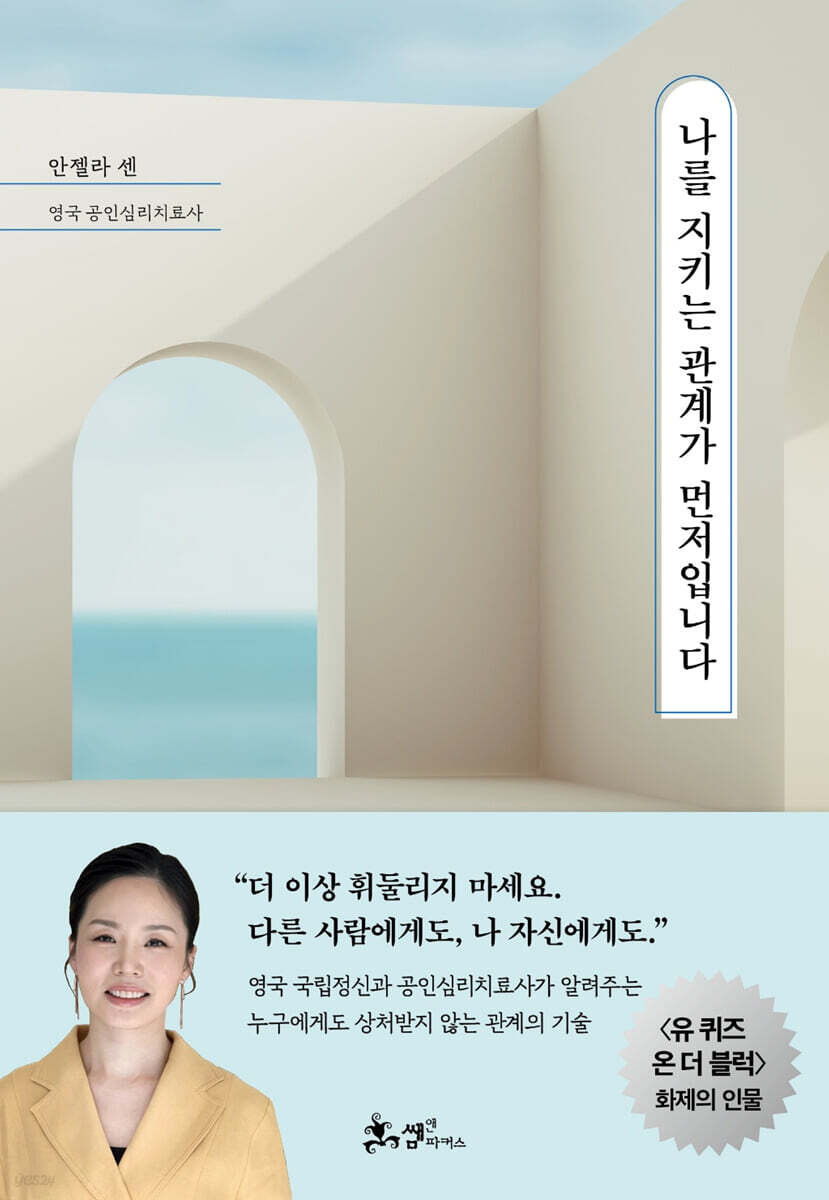
The relationships that protect me come first
 |
Description
Book Introduction
“Don’t be swayed by anyone anymore.
“To others, and to yourself.”
A licensed psychotherapist from the UK's 'National Counselling Service', visited by 1.6 million people, provides advice.
Healthy Communication Skills to Protect You in Difficult Relationships
***** British National Psychiatry 'iAPT' Certified Psychotherapist
***** British Chief Inspector General's Psychiatry Department, 'Good Neighbors' Psychological and Emotional Advisory Committee
***** Includes 10 weeks of practical self-care techniques
A veteran psychotherapist who has comforted and healed people's hearts every day at the UK's National Advice Center, which receives 1.6 million visits annually, offers practical and systematic solutions to the most frequently asked question: "Why am I so swayed?"
People who are tossed around and struggle in various relationships such as with friends, family, lovers, and colleagues, people who are exhausted from struggling to refuse unreasonable demands, people who are unable to say anything and suffer alone when they actually need help, people who lose sleep at night because they cannot say what they want to say, etc. What these people who are tired of human relationships that only bring them harm are really in need of is not 'how to cut off a relationship in one fell swoop' or 'how to get revenge with soda', but 'how to create relationships that protect me'.
A 10-week self-care class that teaches you the communication and relationship skills to protect yourself warmly yet firmly, flexibly yet firmly, through practical and systematic techniques such as the characteristics of the four communication styles, four magic spells to read the mind, and four arms that hold relationships together.
“To others, and to yourself.”
A licensed psychotherapist from the UK's 'National Counselling Service', visited by 1.6 million people, provides advice.
Healthy Communication Skills to Protect You in Difficult Relationships
***** British National Psychiatry 'iAPT' Certified Psychotherapist
***** British Chief Inspector General's Psychiatry Department, 'Good Neighbors' Psychological and Emotional Advisory Committee
***** Includes 10 weeks of practical self-care techniques
A veteran psychotherapist who has comforted and healed people's hearts every day at the UK's National Advice Center, which receives 1.6 million visits annually, offers practical and systematic solutions to the most frequently asked question: "Why am I so swayed?"
People who are tossed around and struggle in various relationships such as with friends, family, lovers, and colleagues, people who are exhausted from struggling to refuse unreasonable demands, people who are unable to say anything and suffer alone when they actually need help, people who lose sleep at night because they cannot say what they want to say, etc. What these people who are tired of human relationships that only bring them harm are really in need of is not 'how to cut off a relationship in one fell swoop' or 'how to get revenge with soda', but 'how to create relationships that protect me'.
A 10-week self-care class that teaches you the communication and relationship skills to protect yourself warmly yet firmly, flexibly yet firmly, through practical and systematic techniques such as the characteristics of the four communication styles, four magic spells to read the mind, and four arms that hold relationships together.
- You can preview some of the book's contents.
Preview
index
Prologue_For the 'me' who is not swayed by anyone
Chapter 1: Why am I being swayed like this?
The reason I can't say what I want to say while being swayed
Communication is not a battle you win or lose.
Misconceptions about healthy communication
Chapter 2: What kind of person is unswayed?
There are different types of communication methods.
'Passive tofu type' who endures and endures
The 'aggressive bulldozer type', always ready to fight
The passive-aggressive, backstabbing type, with a different exterior and interior
A warm but unwavering 'healthy pumpkin type'
Chapter 3: Why We Grow Up into Swaying Adults
Where did it all start to get swayed?
No one deserves a wound
The Roots of the Mind: The Values We View Ourselves, People, and the World
Pillars of the Mind: Beliefs and Rules That Establish the Standards of Life
It's different now than it was then
Chapter 4: Know My Heart: Communicating with Myself
A magic spell that reads my mind
First Order: Understanding the Crisis 'Situation'
Second Order: Read 'Emotions'
Third Order: Read 'Thoughts'
Examining the Fourth Order: "Action"
Chapter 5: Tell Me What's on Your Mind: Speaking and Listening
Pumpkin-type speaking technique
Things to keep in mind when speaking in a pumpkin-like tone
Pumpkin-type listening technique
Things to watch out for when listening to the pumpkin type
Chapter 6: How to Make Rejection Easier
Rejection is difficult for everyone.
A New Perspective on Rejection
The Art of Refusal: Starting Today
Chapter 7: How to Not Break Down in the Face of Disappointment and Frustration
Life is not a path of flowers
Disappointment is not reacting, it's responding
So that it can become our expectations, not just my own.
Chapter 8: How to Protect Myself from Criticism and Blame
Why are we swayed by criticism?
Criticism and condemnation are different.
A New Perspective on Criticism
Responding to constructive criticism
Responding to aggressive criticism
Chapter 9: How to Avoid Praise and Gratitude
Compliments that start and continue a relationship
Why is it difficult to give praise?
How to make a compliment sound like a compliment
How to take a compliment as a compliment
Chapter 10: A Brief Overview and Enhancement of Communication Skills
One step back, two steps forward, and then step back
If you find it difficult to take the first step, try a little trial
When you have a problem, go to the error notebook
Chapter 1: Why am I being swayed like this?
The reason I can't say what I want to say while being swayed
Communication is not a battle you win or lose.
Misconceptions about healthy communication
Chapter 2: What kind of person is unswayed?
There are different types of communication methods.
'Passive tofu type' who endures and endures
The 'aggressive bulldozer type', always ready to fight
The passive-aggressive, backstabbing type, with a different exterior and interior
A warm but unwavering 'healthy pumpkin type'
Chapter 3: Why We Grow Up into Swaying Adults
Where did it all start to get swayed?
No one deserves a wound
The Roots of the Mind: The Values We View Ourselves, People, and the World
Pillars of the Mind: Beliefs and Rules That Establish the Standards of Life
It's different now than it was then
Chapter 4: Know My Heart: Communicating with Myself
A magic spell that reads my mind
First Order: Understanding the Crisis 'Situation'
Second Order: Read 'Emotions'
Third Order: Read 'Thoughts'
Examining the Fourth Order: "Action"
Chapter 5: Tell Me What's on Your Mind: Speaking and Listening
Pumpkin-type speaking technique
Things to keep in mind when speaking in a pumpkin-like tone
Pumpkin-type listening technique
Things to watch out for when listening to the pumpkin type
Chapter 6: How to Make Rejection Easier
Rejection is difficult for everyone.
A New Perspective on Rejection
The Art of Refusal: Starting Today
Chapter 7: How to Not Break Down in the Face of Disappointment and Frustration
Life is not a path of flowers
Disappointment is not reacting, it's responding
So that it can become our expectations, not just my own.
Chapter 8: How to Protect Myself from Criticism and Blame
Why are we swayed by criticism?
Criticism and condemnation are different.
A New Perspective on Criticism
Responding to constructive criticism
Responding to aggressive criticism
Chapter 9: How to Avoid Praise and Gratitude
Compliments that start and continue a relationship
Why is it difficult to give praise?
How to make a compliment sound like a compliment
How to take a compliment as a compliment
Chapter 10: A Brief Overview and Enhancement of Communication Skills
One step back, two steps forward, and then step back
If you find it difficult to take the first step, try a little trial
When you have a problem, go to the error notebook
Detailed image

Into the book
As we live, we get hurt by relationships, communication problems, and more.
Many people I met in my London consulting room were like that.
The clients came from over 50 countries and ranged in age from 18 to 92, but they shared similar concerns regardless of age, nationality, or gender.
“Why am I being swayed like this?”
--- p.8, from "Prologue"
Many people blame their personality for their relationships and communication.
Because of my innate personality, I can't say anything and am constantly being swayed.
However, communication skills are not an innate trait but rather a skill that can be acquired later in life.
Even a white-haired gentleman in his 80s comes to the counseling room, saying he is tired of a relationship that only brings him losses.
It's never too late to start now.
There is clearly a healthy alternative to being 'warm but firm, friendly but not pushy' and maintaining one's center while neither swaying nor being swayed.
--- p.9, from "Prologue"
Healthy communication creates healthy relationships.
But we still have difficulties communicating.
There are three main reasons for this.
The first reason is that we do not know the specifics of what it means to speak up without being swayed and how to do it.
In such cases, confidence in communication decreases.
The second reason is that even though we understand the 'what' and the 'how,' worries and fears still bind us and prevent us from communicating.
The third reason is the inertia of the mind that 'responds immediately' as in the old habit even though we have kicked out the thoughts that bind us.
--- p.24, from “Chapter 1: Why Am I Being Swayed Like This?”
The problem is not the conflict itself, but how we react to it.
In any relationship, it is impossible to prevent or eliminate even the slightest discomfort.
Healthy communication keeps the door open for communication, focusing on understanding and resolving issues together rather than blaming each other, based on basic respect, even in difficult conflict situations.
Therefore, the field of communication is not a battlefield where one wins or loses, but a field of cooperation.
Many people struggle with how to speak warmly yet firmly, friendly yet challenging.
Healthy communication, where you can speak your mind assertively while maintaining warmth and consideration, is a delicate balance between these two seemingly opposing directions.
Healthy communication provides an alternative to being swayed or manipulated, and to supporting each other.
--- p.29, from “Chapter 1: Why Am I Being Swayed Like This?”
The first line of a relationship resume is the first relationship you have with your parents and the first social group you have with your family.
Relationships with parents and family members are important to examine as they form the basis for current communication patterns and interpersonal relationships.
In the process of communicating with parents, children constantly observe feedback on how their parents reward and punish them for certain behaviors.
If you have siblings, you learn the 'rules' of relationships and communication within a polygonal structure where more complex interactions occur.
The ‘first time’ is intense for everyone.
The intense emotions of happy, scared, and hurtful moments in our early life, when many things were 'firsts', are layered into special memory data.
Initial data, such as 'default values', accumulate to form a perspective on oneself, others, and the world, and create a basic framework for communication in response to this.
This will soon become the 'basic program' of communication.
'This is what the world is like.
People are like this.
'This is the kind of person I am, living among people in this world.'
--- p.82, from “Chapter 3: Why We Grow Up to Be Swayed Adults”
When our minds are swayed, we tend to react hastily rather than respond leisurely.
At this time, I unconsciously think, feel, and act as I always have, unable to say what I want to say, and as this vicious cycle repeats, it becomes a mental inertia that is difficult to reverse.
Therefore, to understand the vicious cycle of communication and reverse the inertia of the mind, we will first learn how to communicate with ourselves.
It is called a 'mind diary'.
The mind diary is an effective technique for organizing a confused mind using four magical spells that read your mind.
We want to know the hearts of others even though we don't know our own hearts.
I expect others to understand me when I don't even understand myself.
And while my own heart is not at peace, I try to move other people's hearts.
If I don't even know what I'm thinking, feeling, or wanting, how can others possibly understand my heart? This is how we struggle to communicate with others before we can even connect with ourselves.
--- p.115, from “Chapter 4 Know My Heart: Communicating with Myself”
A snare is a trap made by tying a knot with a rope to catch an animal.
When an animal gets caught in a snare, it becomes startled and panics, struggling to escape.
But the more you do that, the more tangled you become and the more you reach a point where you can't move.
The same goes for the trap of the mind.
At this time, instead of reacting immediately, we need a tool that can first hold up a mirror to our mind and read it.
That's a 'mind diary'.
A mind diary is a technique that allows you to recognize and read your own thoughts, feelings, and actions so that you can effectively 'respond' to everyday crisis situations without reflexively 'reacting' when you are unaware of your own mind.
The mind diary that reads my mind is not about finding someone who knows me better than I do, but rather about developing the inner strength to recognize my own problems and reach solutions so that I can become the expert who knows myself best.
--- p.122, from “Chapter 4 Know My Heart: Communicating with Myself”
The reason why the process of organizing and recording in a mental diary is important is especially for maintaining a healthy distance and establishing a healthy relationship with myself.
When I organize the things that are tangled in my head and put them out into print, I create a physical distance between myself and my thoughts.
We often confuse and equate ‘my thoughts’ with ‘me’.
There are things that pass by without any particular meaning, like the scenery passing by outside the window, but there are also scenes that we hold on to and cannot let go of.
Just because I hold onto this scene doesn't mean that this scene becomes my very existence.
Thoughts are similar to this scenery.
Most of the thoughts that pass by without a break are like the scenery outside the window, passing through the stream of consciousness, but sometimes there are thoughts that we do not miss and catch.
That doesn't mean my thoughts become me.
--- p.140~141, from “Chapter 4 Know My Heart: Communicating with Myself”
When you decline someone's request, you are rejecting that one request, not the person who made the request.
Also, it is not the rejection itself that is rude, but the wrong attitude when rejecting that is rude.
If I have the right to refuse, so does the other person. If I say no when I don't want to, and no when I can't, then the other person will be more honest when they have to refuse my request next time.
Then the next request and rejection will be lighter.
Relationships become easier when rejection becomes easier.
--- p.193, from “Chapter 6: How to Make Rejection Easier”
We think that the closer the relationship, the better, but ironically, we express relationships as 'in-between'.
Healthy relationships, such as between friends and lovers, have a space between them.
As we can see from the example of Amanda, an icon of sacrifice, maintaining a healthy 'relationship' within family relationships requires maintaining an appropriate line through rejection.
Even if rejection is a bit frustrating and unpleasant, it is about keeping an appropriate distance and giving each person responsibility.
--- p.197, from “Chapter 6: How to Make Rejection Easier”
Change is a scary, awkward, and slow process.
When you work hard but don't see any noticeable results, you may fall into a slump.
“I don’t know where or how to start,” “I’m afraid to start,” “No matter how much I practice, I don’t get better.” … Many people express these concerns during the process of self-care and change.
Nevertheless, if you do not lose faith in yourself and courage, and silently water your heart, there will come a day when the once hard bud will burst into soft petals, filled with the fullness of spring.
However, the beautiful words to just have hope and keep working hard feel like a mirage when it comes to enduring the winter that seems to never end.
They tell me to be brave and try to hit it, but if I just hit it without thinking, it seems like it will just break.
I feel even more despair at myself for losing courage and hiding.
So, isn't there a concrete way to encourage myself and move forward steadily? We need more than just hope and courage.
Many people I met in my London consulting room were like that.
The clients came from over 50 countries and ranged in age from 18 to 92, but they shared similar concerns regardless of age, nationality, or gender.
“Why am I being swayed like this?”
--- p.8, from "Prologue"
Many people blame their personality for their relationships and communication.
Because of my innate personality, I can't say anything and am constantly being swayed.
However, communication skills are not an innate trait but rather a skill that can be acquired later in life.
Even a white-haired gentleman in his 80s comes to the counseling room, saying he is tired of a relationship that only brings him losses.
It's never too late to start now.
There is clearly a healthy alternative to being 'warm but firm, friendly but not pushy' and maintaining one's center while neither swaying nor being swayed.
--- p.9, from "Prologue"
Healthy communication creates healthy relationships.
But we still have difficulties communicating.
There are three main reasons for this.
The first reason is that we do not know the specifics of what it means to speak up without being swayed and how to do it.
In such cases, confidence in communication decreases.
The second reason is that even though we understand the 'what' and the 'how,' worries and fears still bind us and prevent us from communicating.
The third reason is the inertia of the mind that 'responds immediately' as in the old habit even though we have kicked out the thoughts that bind us.
--- p.24, from “Chapter 1: Why Am I Being Swayed Like This?”
The problem is not the conflict itself, but how we react to it.
In any relationship, it is impossible to prevent or eliminate even the slightest discomfort.
Healthy communication keeps the door open for communication, focusing on understanding and resolving issues together rather than blaming each other, based on basic respect, even in difficult conflict situations.
Therefore, the field of communication is not a battlefield where one wins or loses, but a field of cooperation.
Many people struggle with how to speak warmly yet firmly, friendly yet challenging.
Healthy communication, where you can speak your mind assertively while maintaining warmth and consideration, is a delicate balance between these two seemingly opposing directions.
Healthy communication provides an alternative to being swayed or manipulated, and to supporting each other.
--- p.29, from “Chapter 1: Why Am I Being Swayed Like This?”
The first line of a relationship resume is the first relationship you have with your parents and the first social group you have with your family.
Relationships with parents and family members are important to examine as they form the basis for current communication patterns and interpersonal relationships.
In the process of communicating with parents, children constantly observe feedback on how their parents reward and punish them for certain behaviors.
If you have siblings, you learn the 'rules' of relationships and communication within a polygonal structure where more complex interactions occur.
The ‘first time’ is intense for everyone.
The intense emotions of happy, scared, and hurtful moments in our early life, when many things were 'firsts', are layered into special memory data.
Initial data, such as 'default values', accumulate to form a perspective on oneself, others, and the world, and create a basic framework for communication in response to this.
This will soon become the 'basic program' of communication.
'This is what the world is like.
People are like this.
'This is the kind of person I am, living among people in this world.'
--- p.82, from “Chapter 3: Why We Grow Up to Be Swayed Adults”
When our minds are swayed, we tend to react hastily rather than respond leisurely.
At this time, I unconsciously think, feel, and act as I always have, unable to say what I want to say, and as this vicious cycle repeats, it becomes a mental inertia that is difficult to reverse.
Therefore, to understand the vicious cycle of communication and reverse the inertia of the mind, we will first learn how to communicate with ourselves.
It is called a 'mind diary'.
The mind diary is an effective technique for organizing a confused mind using four magical spells that read your mind.
We want to know the hearts of others even though we don't know our own hearts.
I expect others to understand me when I don't even understand myself.
And while my own heart is not at peace, I try to move other people's hearts.
If I don't even know what I'm thinking, feeling, or wanting, how can others possibly understand my heart? This is how we struggle to communicate with others before we can even connect with ourselves.
--- p.115, from “Chapter 4 Know My Heart: Communicating with Myself”
A snare is a trap made by tying a knot with a rope to catch an animal.
When an animal gets caught in a snare, it becomes startled and panics, struggling to escape.
But the more you do that, the more tangled you become and the more you reach a point where you can't move.
The same goes for the trap of the mind.
At this time, instead of reacting immediately, we need a tool that can first hold up a mirror to our mind and read it.
That's a 'mind diary'.
A mind diary is a technique that allows you to recognize and read your own thoughts, feelings, and actions so that you can effectively 'respond' to everyday crisis situations without reflexively 'reacting' when you are unaware of your own mind.
The mind diary that reads my mind is not about finding someone who knows me better than I do, but rather about developing the inner strength to recognize my own problems and reach solutions so that I can become the expert who knows myself best.
--- p.122, from “Chapter 4 Know My Heart: Communicating with Myself”
The reason why the process of organizing and recording in a mental diary is important is especially for maintaining a healthy distance and establishing a healthy relationship with myself.
When I organize the things that are tangled in my head and put them out into print, I create a physical distance between myself and my thoughts.
We often confuse and equate ‘my thoughts’ with ‘me’.
There are things that pass by without any particular meaning, like the scenery passing by outside the window, but there are also scenes that we hold on to and cannot let go of.
Just because I hold onto this scene doesn't mean that this scene becomes my very existence.
Thoughts are similar to this scenery.
Most of the thoughts that pass by without a break are like the scenery outside the window, passing through the stream of consciousness, but sometimes there are thoughts that we do not miss and catch.
That doesn't mean my thoughts become me.
--- p.140~141, from “Chapter 4 Know My Heart: Communicating with Myself”
When you decline someone's request, you are rejecting that one request, not the person who made the request.
Also, it is not the rejection itself that is rude, but the wrong attitude when rejecting that is rude.
If I have the right to refuse, so does the other person. If I say no when I don't want to, and no when I can't, then the other person will be more honest when they have to refuse my request next time.
Then the next request and rejection will be lighter.
Relationships become easier when rejection becomes easier.
--- p.193, from “Chapter 6: How to Make Rejection Easier”
We think that the closer the relationship, the better, but ironically, we express relationships as 'in-between'.
Healthy relationships, such as between friends and lovers, have a space between them.
As we can see from the example of Amanda, an icon of sacrifice, maintaining a healthy 'relationship' within family relationships requires maintaining an appropriate line through rejection.
Even if rejection is a bit frustrating and unpleasant, it is about keeping an appropriate distance and giving each person responsibility.
--- p.197, from “Chapter 6: How to Make Rejection Easier”
Change is a scary, awkward, and slow process.
When you work hard but don't see any noticeable results, you may fall into a slump.
“I don’t know where or how to start,” “I’m afraid to start,” “No matter how much I practice, I don’t get better.” … Many people express these concerns during the process of self-care and change.
Nevertheless, if you do not lose faith in yourself and courage, and silently water your heart, there will come a day when the once hard bud will burst into soft petals, filled with the fullness of spring.
However, the beautiful words to just have hope and keep working hard feel like a mirage when it comes to enduring the winter that seems to never end.
They tell me to be brave and try to hit it, but if I just hit it without thinking, it seems like it will just break.
I feel even more despair at myself for losing courage and hiding.
So, isn't there a concrete way to encourage myself and move forward steadily? We need more than just hope and courage.
--- p.303, from “Chapter 10: Briefing and Strengthening Communication Skills”
Publisher's Review
“Why am I so tired and in pain?”
You are so kind that you are in trouble. You need this.
Relationship classes that protect me from being hurt by anyone
For modern people living in a complex society, human relationships are always a difficult task.
People who hear people around them call them 'good people' or 'kind people' often experience more stress due to interpersonal relationships.
In particular, if you are not good at saying 'no' and you repeatedly give in to unreasonable requests or tolerate the other person's rudeness, you may fall into a vicious cycle of being increasingly manipulated and hurt by others.
At this point, the saying, "If you continue to be kind, you think it's a right" feels like a truth about human relationships.
Is there any reason to continue this hurtful relationship? Should I cut all ties with the person who's causing me pain?
Angela Sen, a registered psychotherapist in the UK who has counseled many people for a long time, says about this, 'Relationships are not about breaking up, but about protecting each other.'
Whether we like it or not, we have no choice but to always be in a relationship with someone in our lives. If we cut off relationships whenever things get tough, it is not only not good for us, but it is also not possible in the first place.
The problem is that the relationship continues with me enduring, sacrificing, and tolerating it alone.
This book is a self-care guide that offers practical and real-world methods for people who are constantly being swayed and hurt because they are "too nice" to stop being hurt by relationships.
Not ‘momentary comfort’ but ‘fundamental change’
Special psychotherapy from iApt, the UK's "National Counseling Center"
IAPT, the UK's national psychological treatment center, which receives 1.6 million visits a year, is a special measure established by the UK government to address the mental health issues of its citizens. Under strict management, verified professional therapists provide only scientific and systematic treatment.
As the number of people complaining of mental distress, such as depression and anxiety, is rapidly increasing in Korea, the OECD recommended that Korea adopt the British psychotherapy model.
As such, the UK's iAPT is a world-leading psychotherapy system.
Angela Sen, one of the few Korean licensed psychotherapists working at the UK's 'National Counseling Center' iAPT, has comforted and healed the hearts of over 1,500 people for 15 years. She discovered that so many people are hurt and struggling because they are manipulated by others, and felt the need to share communication methods that protect themselves.
I also realized that communication and relationship skills apply to everyone, regardless of nationality or culture.
This book, which is filled with the rich experience and knowledge of a clinical psychologist and professional therapist, teaches step-by-step how to build strong and healthy relationships based on the practical skills that iApt boasts, ‘specific and easy-to-practice techniques.’
In particular, it brings about 'fundamental change' rather than 'temporary comfort' through psychological techniques that are easy to follow and apply, such as the four types of communication, four magic spells to read minds, and four arms to hold relationships.
From ‘verbal treatment’ to ‘action treatment’
The art of true communication that protects both me and my relationships
Angela Sen emphasizes that communication is a “skill,” not a “personality.”
In other words, the reason we are constantly swayed and hurt is not because of our innate personality, but because we have not learned what true communication is and how to do it. Even if we learn the method, it takes time to break free from the inertia that has become ingrained due to long-standing habits.
Therefore, in order to learn a relationship that protects us and prevents us from getting hurt anymore, ‘learning’ and ‘practice’ must go together.
Just like when you first learn to play the piano or ride a bicycle, you need to learn communication skills and practice them consistently.
This book, which provides scientific and practical solutions in cognitive behavioral psychology, is closer to 'action therapy' than 'talk therapy' in that sense.
From the basic principles of healthy communication to applied techniques for real-life situations like rejection, disappointment, criticism, and praise, follow the step-by-step relationship lessons and you'll soon become a strong person who can't be swayed by anyone.
In particular, through the 'Self-Care' page for each course, where you can ask questions, think, and write down your own answers, you can develop the inner strength to recognize problems and reach solutions on your own.
Rather than looking for someone who knows me better than I do, it's about becoming the expert who knows me best.
If I bring the center of gravity of the relationship to myself like this, I will be able to build good relationships no matter when, where, or with whom I meet.
You are so kind that you are in trouble. You need this.
Relationship classes that protect me from being hurt by anyone
For modern people living in a complex society, human relationships are always a difficult task.
People who hear people around them call them 'good people' or 'kind people' often experience more stress due to interpersonal relationships.
In particular, if you are not good at saying 'no' and you repeatedly give in to unreasonable requests or tolerate the other person's rudeness, you may fall into a vicious cycle of being increasingly manipulated and hurt by others.
At this point, the saying, "If you continue to be kind, you think it's a right" feels like a truth about human relationships.
Is there any reason to continue this hurtful relationship? Should I cut all ties with the person who's causing me pain?
Angela Sen, a registered psychotherapist in the UK who has counseled many people for a long time, says about this, 'Relationships are not about breaking up, but about protecting each other.'
Whether we like it or not, we have no choice but to always be in a relationship with someone in our lives. If we cut off relationships whenever things get tough, it is not only not good for us, but it is also not possible in the first place.
The problem is that the relationship continues with me enduring, sacrificing, and tolerating it alone.
This book is a self-care guide that offers practical and real-world methods for people who are constantly being swayed and hurt because they are "too nice" to stop being hurt by relationships.
Not ‘momentary comfort’ but ‘fundamental change’
Special psychotherapy from iApt, the UK's "National Counseling Center"
IAPT, the UK's national psychological treatment center, which receives 1.6 million visits a year, is a special measure established by the UK government to address the mental health issues of its citizens. Under strict management, verified professional therapists provide only scientific and systematic treatment.
As the number of people complaining of mental distress, such as depression and anxiety, is rapidly increasing in Korea, the OECD recommended that Korea adopt the British psychotherapy model.
As such, the UK's iAPT is a world-leading psychotherapy system.
Angela Sen, one of the few Korean licensed psychotherapists working at the UK's 'National Counseling Center' iAPT, has comforted and healed the hearts of over 1,500 people for 15 years. She discovered that so many people are hurt and struggling because they are manipulated by others, and felt the need to share communication methods that protect themselves.
I also realized that communication and relationship skills apply to everyone, regardless of nationality or culture.
This book, which is filled with the rich experience and knowledge of a clinical psychologist and professional therapist, teaches step-by-step how to build strong and healthy relationships based on the practical skills that iApt boasts, ‘specific and easy-to-practice techniques.’
In particular, it brings about 'fundamental change' rather than 'temporary comfort' through psychological techniques that are easy to follow and apply, such as the four types of communication, four magic spells to read minds, and four arms to hold relationships.
From ‘verbal treatment’ to ‘action treatment’
The art of true communication that protects both me and my relationships
Angela Sen emphasizes that communication is a “skill,” not a “personality.”
In other words, the reason we are constantly swayed and hurt is not because of our innate personality, but because we have not learned what true communication is and how to do it. Even if we learn the method, it takes time to break free from the inertia that has become ingrained due to long-standing habits.
Therefore, in order to learn a relationship that protects us and prevents us from getting hurt anymore, ‘learning’ and ‘practice’ must go together.
Just like when you first learn to play the piano or ride a bicycle, you need to learn communication skills and practice them consistently.
This book, which provides scientific and practical solutions in cognitive behavioral psychology, is closer to 'action therapy' than 'talk therapy' in that sense.
From the basic principles of healthy communication to applied techniques for real-life situations like rejection, disappointment, criticism, and praise, follow the step-by-step relationship lessons and you'll soon become a strong person who can't be swayed by anyone.
In particular, through the 'Self-Care' page for each course, where you can ask questions, think, and write down your own answers, you can develop the inner strength to recognize problems and reach solutions on your own.
Rather than looking for someone who knows me better than I do, it's about becoming the expert who knows me best.
If I bring the center of gravity of the relationship to myself like this, I will be able to build good relationships no matter when, where, or with whom I meet.
GOODS SPECIFICS
- Date of issue: July 20, 2023
- Page count, weight, size: 344 pages | 542g | 145*210*20mm
- ISBN13: 9791165347727
- ISBN10: 1165347725
You may also like
카테고리
korean


korean

![ELLE 엘르 스페셜 에디션 A형 : 12월 [2025]](http://librairie.coreenne.fr/cdn/shop/files/b8e27a3de6c9538896439686c6b0e8fb.jpg?v=1766436872&width=3840)


