

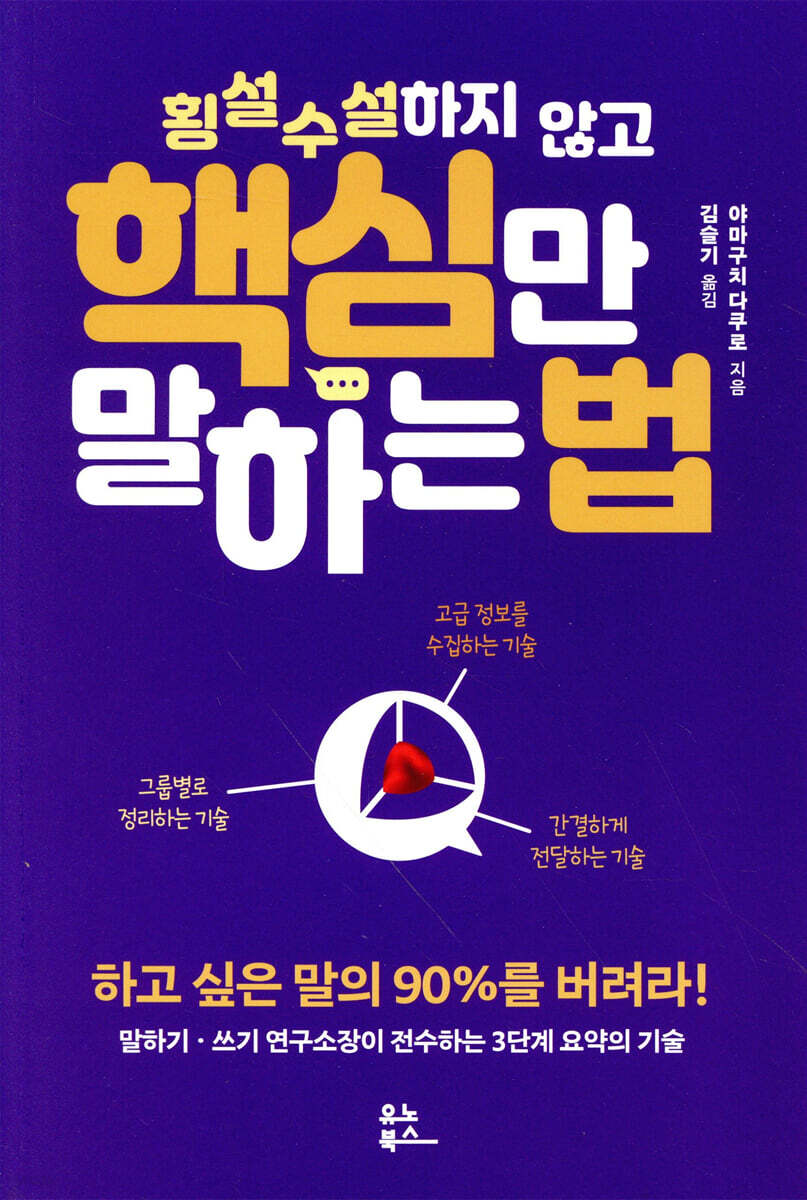
How to get to the point without rambling
 |
Description
Book Introduction
Throw away 90% of what you want to say!
The 3-Step Summary Technique Taught by the Director of the Speaking/Writing Institute
From rambling to clear words
From a lack of confidence to speaking with confidence
What's the crucial difference between those who speak well and those who don't? It comes down to their ability to summarize, to get to the core of the message.
When you're talking to a friend, reporting your work progress to your boss, or giving directions to a stranger, do you find yourself rambled on, following a stream of consciousness? If you frequently hear things like, "So, what's the bottom line?" or "Can you be more specific?", you're missing the point.
In order for my words and writing to be well-communicated to the other person, I must discard 90% of what I want to say and leave only the core message.
The power of summary is the power to find something that you think, "I must say this even if I die!"
In an age of information overload and rapid changes in work methods, values, and lifestyles, explaining everything from start to finish is a selfish act that wastes the other person's time.
Moreover, if you can't properly communicate what you know, you're likely to miss out on good opportunities every time they come your way.
On the other hand, if you learn to speak only the essential points, communication becomes smoother and work efficiency increases.
Even if you are suddenly asked a question, you can give an accurate answer, so you are recognized as someone who can do anything well and become an indispensable person anywhere.
Especially today, with non-face-to-face communication such as online meetings, emails, and video chats becoming essential, the ability to speak only to the point has become even more important.
If you can just get to the point, good people, information, and opportunities will naturally gather around you.
The ability to summarize becomes a tool for success in life.
The author, who is the director of the Speaking/Writing Research Institute, has accumulated high-quality delivery know-how through 25 years of experience covering over 3,300 reporting cases and continues to actively write.
"How to Get to the Point Without Rambling" is a book filled with the author's know-how, and guides you through the "3-step summary technique" to achieve maximum results through quick and accurate communication without missing the main points in speech or writing.
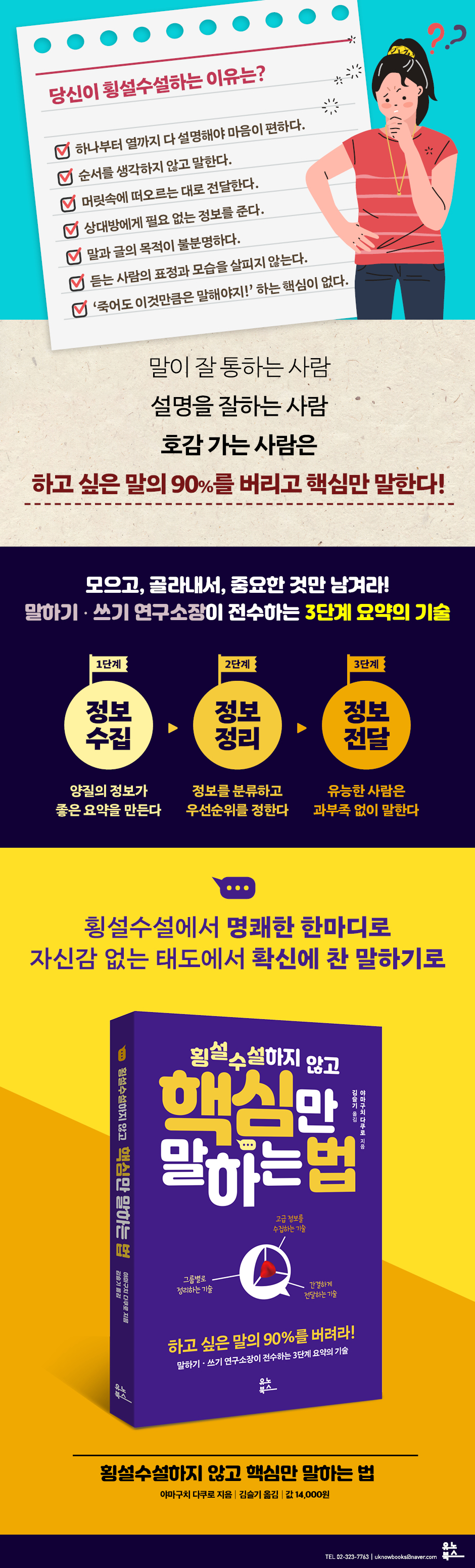
Step 1, ‘Information Gathering,’ introduces how to obtain quality information, Step 2, ‘Information Organization,’ introduces how to classify and prioritize information, and Step 3, ‘Information Delivery,’ introduces how to convey information concisely to the other person.
Anyone who goes through these three steps will be able to grasp the essence of information and effectively communicate their argument.
If you want to stop rambling and become a clear and quick communicator, master the art of summarizing! Mastering quick and concise conversations will transform you into a likeable and opportunity-seeking individual in both work and daily life.
The 3-Step Summary Technique Taught by the Director of the Speaking/Writing Institute
From rambling to clear words
From a lack of confidence to speaking with confidence
What's the crucial difference between those who speak well and those who don't? It comes down to their ability to summarize, to get to the core of the message.
When you're talking to a friend, reporting your work progress to your boss, or giving directions to a stranger, do you find yourself rambled on, following a stream of consciousness? If you frequently hear things like, "So, what's the bottom line?" or "Can you be more specific?", you're missing the point.
In order for my words and writing to be well-communicated to the other person, I must discard 90% of what I want to say and leave only the core message.
The power of summary is the power to find something that you think, "I must say this even if I die!"
In an age of information overload and rapid changes in work methods, values, and lifestyles, explaining everything from start to finish is a selfish act that wastes the other person's time.
Moreover, if you can't properly communicate what you know, you're likely to miss out on good opportunities every time they come your way.
On the other hand, if you learn to speak only the essential points, communication becomes smoother and work efficiency increases.
Even if you are suddenly asked a question, you can give an accurate answer, so you are recognized as someone who can do anything well and become an indispensable person anywhere.
Especially today, with non-face-to-face communication such as online meetings, emails, and video chats becoming essential, the ability to speak only to the point has become even more important.
If you can just get to the point, good people, information, and opportunities will naturally gather around you.
The ability to summarize becomes a tool for success in life.
The author, who is the director of the Speaking/Writing Research Institute, has accumulated high-quality delivery know-how through 25 years of experience covering over 3,300 reporting cases and continues to actively write.
"How to Get to the Point Without Rambling" is a book filled with the author's know-how, and guides you through the "3-step summary technique" to achieve maximum results through quick and accurate communication without missing the main points in speech or writing.
Step 1, ‘Information Gathering,’ introduces how to obtain quality information, Step 2, ‘Information Organization,’ introduces how to classify and prioritize information, and Step 3, ‘Information Delivery,’ introduces how to convey information concisely to the other person.
Anyone who goes through these three steps will be able to grasp the essence of information and effectively communicate their argument.
If you want to stop rambling and become a clear and quick communicator, master the art of summarizing! Mastering quick and concise conversations will transform you into a likeable and opportunity-seeking individual in both work and daily life.
- You can preview some of the book's contents.
Preview
index
Introduction│The difference in your ability to summarize makes a difference in your life.
Preparation: To whom, what, and how will you communicate?
We live in an age where you have to be good at summarizing to survive.
People who talk nonsense VS People who just say the main point
If there's one thing I want to say even if I die
The art of three-step summarization that conveys only the essential points
Words that attract people have a purpose.
Instead of saying what you want to say, say what you want to hear
Reactions are not guessed, they are elicited.
Check the amount to summarize
It's accurate to summarize facial expressions and actions.
Tips for getting to the core! A quick look at the 3-step summary technique.
Step 1: Gather Information
Gather quality information
Good summaries require good quality information.
Setting up an antenna to receive information
Be proactive and question.
3 Questions to Gain Trust: Why, How, and What if
Confirmation is a closed question, ideas are open questions
An attitude of blind faith is poison.
Understand the essence of information
If you organize a person's personality, you can see their relationships.
How to Strengthen the Information Network in Your Head
Tips for summarizing a book: How do you summarize it?
Step 2: Organize Information
Divide the information into groups
Start with your goal and work backwards.
'Group thinking': labeling information
I'll always say this before I die: "Prioritize your thinking."
You talk nonsense because you don't know the priorities.
How to organize information so you never miss the key points
Just the essentials! Information also needs to be updated.
Step 3: Information Transmission
Communicate concisely to the other person
The more capable a person is, the more he speaks without exaggeration.
Ditch the boring introduction.
Say it in the order of 'stem → branch → leaf'
How to answer any question in just one word
The All-Purpose Conversational Method: "Getting to the Point + Conclusion First"
'Enumeration', where you can have a lot to say without any problems
Leave out vague expressions and use specific keywords.
Make sure the other person understands.
Two conditions for grasping the main point in one second
How to summarize a newspaper article?
How to organize diagrams so you don't have to read them twice
Become a master of explanations that are understood immediately after hearing them.
Increase the 'abstraction' by grouping similar things together.
People who are good communicators are also good at using metaphors.
Look for phrasing errors that distort information.
How to objectively understand my speech
Practice writing 140 characters on social media.
Tip: Get straight to the point! Infuse your message with affection and passion.
Leaving behind only the essentials in life
Preparation: To whom, what, and how will you communicate?
We live in an age where you have to be good at summarizing to survive.
People who talk nonsense VS People who just say the main point
If there's one thing I want to say even if I die
The art of three-step summarization that conveys only the essential points
Words that attract people have a purpose.
Instead of saying what you want to say, say what you want to hear
Reactions are not guessed, they are elicited.
Check the amount to summarize
It's accurate to summarize facial expressions and actions.
Tips for getting to the core! A quick look at the 3-step summary technique.
Step 1: Gather Information
Gather quality information
Good summaries require good quality information.
Setting up an antenna to receive information
Be proactive and question.
3 Questions to Gain Trust: Why, How, and What if
Confirmation is a closed question, ideas are open questions
An attitude of blind faith is poison.
Understand the essence of information
If you organize a person's personality, you can see their relationships.
How to Strengthen the Information Network in Your Head
Tips for summarizing a book: How do you summarize it?
Step 2: Organize Information
Divide the information into groups
Start with your goal and work backwards.
'Group thinking': labeling information
I'll always say this before I die: "Prioritize your thinking."
You talk nonsense because you don't know the priorities.
How to organize information so you never miss the key points
Just the essentials! Information also needs to be updated.
Step 3: Information Transmission
Communicate concisely to the other person
The more capable a person is, the more he speaks without exaggeration.
Ditch the boring introduction.
Say it in the order of 'stem → branch → leaf'
How to answer any question in just one word
The All-Purpose Conversational Method: "Getting to the Point + Conclusion First"
'Enumeration', where you can have a lot to say without any problems
Leave out vague expressions and use specific keywords.
Make sure the other person understands.
Two conditions for grasping the main point in one second
How to summarize a newspaper article?
How to organize diagrams so you don't have to read them twice
Become a master of explanations that are understood immediately after hearing them.
Increase the 'abstraction' by grouping similar things together.
People who are good communicators are also good at using metaphors.
Look for phrasing errors that distort information.
How to objectively understand my speech
Practice writing 140 characters on social media.
Tip: Get straight to the point! Infuse your message with affection and passion.
Leaving behind only the essentials in life
Detailed image
Into the book
Summarizing is the ability to grasp the core of information and convey it concisely and logically, appropriately for the time and place.
The amount of information you can get from a film that's about two hours long is enormous.
If you don't summarize the main points, the story will most likely become boring.
On the other hand, people who can extract the core information from a vast amount of information attract the other person's interest.
The former is a person who is 'bad at summarizing', and the latter is a person who is 'good at summarizing'.
--- From page 8, 'The difference in summary ability makes a difference in life'
In today's world, the flow of work and market trends are dramatically faster than they were 10 years ago.
Not only that, but common sense, values, and ways of working and living are also changing at an incredible pace.
Even if we look at the business world alone, work and meeting times are gradually shortening.
In other words, the ability to summarize information quickly and accurately is becoming increasingly important.
--- From page 22, 'The era has come where you have to be good at summarizing to survive'
The most important thing in the information delivery stage is to convey it 'concisely'.
To do this, ideally, you should discard 90 percent of the information.
When it comes to communication, deciding what not to communicate is just as important as deciding what to communicate.
People who are unable to convey information will say everything from beginning to end or will ramble on without thinking about the order.
As a result, it puts a burden on the other person.
--- From page 37, 'The 3-step summary technique that conveys only the key points'
Whether it's sports, gaming, or travel, whatever topic you're passionate about, you can comfortably talk for an hour or two.
Because you have a lot of information.
But if someone were to ask you today, "Please explain the economic situation in Ethiopia," would you be able to give a good answer? You probably wouldn't be able to speak comfortably.
If it's not a topic you're interested in, you don't have enough information.
--- From page 61, ‘Good information quality is essential for a good summary’
To grasp the essence, ‘observation’ and ‘insight’ are required.
As mentioned earlier, ‘observation’ refers to the ability to carefully observe ‘visible information’ such as the situation or appearance of something.
'Insight' refers to the power to see into the 'invisible essence' based on visible information.
To use a tree analogy, the trunk and leaves can be seen with observation, and the roots below ground can be seen with insight.
--- From page 84, 'Understand the essence of information'
Information stored in the brain must be constantly updated.
Especially in today's rapidly changing society, information quickly becomes outdated and its shelf life becomes increasingly shorter.
Information is a living thing.
It changes and evolves every moment.
When you pass on outdated information, it's easy to be perceived as "anachronistic" or "unsubstantiated."
--- From page 126, ‘Information also needs to be updated’
There are people who suddenly start talking about parts of an incident or minor episodes.
It may be something you want to convey to them right away, but it may be difficult for the listener to understand because it comes out of nowhere.
If you don't have any basic knowledge on the topic, you will have a hard time following the story.
The listener wants to know the whole story.
--- From page 137, “Say in the order of ‘stem → branch → leaf’”
People who are not good at communicating what they want to say mistakenly believe that the other person knows what they know.
However, in practical conversations, you should actively supplement your speech and consciously use specific numbers and proper nouns.
No matter how well you summarize, it is meaningless if the other person doesn't understand it.
The important thing is not to overestimate your opponent's abilities (level of knowledge, understanding, imagination, etc.).
Rather, 'approaching with a little bit of suspicion' is 'just right'.
--- From page 159, ‘Exclude vague expressions and insert specific keywords’
People who have a peculiar habit of ending their words need to reflect on themselves.
People who are too quick to make assumptions may lack observational or analytical skills.
They may want to be evaluated as 'good workers' even if it means using definitive expressions.
Conversely, people who only use euphemisms may have a hidden desire to 'not take responsibility for things.'
Words, especially endings, can easily reflect a person's attitude.
To use mothers appropriately, you must first organize your own mind.
--- From page 191, 'Find the speech habits that distort information'
The important thing is to realize for yourself the 'state of being summarized'.
You must not become a slave to the information, environment, or anyone else around you.
We need to always be proactive in facing information and have the discernment to select only what we need.
Ultimately, the phrase 'let's strengthen our ability to summarize' has the hidden meaning of 'let's live independently.'
The amount of information you can get from a film that's about two hours long is enormous.
If you don't summarize the main points, the story will most likely become boring.
On the other hand, people who can extract the core information from a vast amount of information attract the other person's interest.
The former is a person who is 'bad at summarizing', and the latter is a person who is 'good at summarizing'.
--- From page 8, 'The difference in summary ability makes a difference in life'
In today's world, the flow of work and market trends are dramatically faster than they were 10 years ago.
Not only that, but common sense, values, and ways of working and living are also changing at an incredible pace.
Even if we look at the business world alone, work and meeting times are gradually shortening.
In other words, the ability to summarize information quickly and accurately is becoming increasingly important.
--- From page 22, 'The era has come where you have to be good at summarizing to survive'
The most important thing in the information delivery stage is to convey it 'concisely'.
To do this, ideally, you should discard 90 percent of the information.
When it comes to communication, deciding what not to communicate is just as important as deciding what to communicate.
People who are unable to convey information will say everything from beginning to end or will ramble on without thinking about the order.
As a result, it puts a burden on the other person.
--- From page 37, 'The 3-step summary technique that conveys only the key points'
Whether it's sports, gaming, or travel, whatever topic you're passionate about, you can comfortably talk for an hour or two.
Because you have a lot of information.
But if someone were to ask you today, "Please explain the economic situation in Ethiopia," would you be able to give a good answer? You probably wouldn't be able to speak comfortably.
If it's not a topic you're interested in, you don't have enough information.
--- From page 61, ‘Good information quality is essential for a good summary’
To grasp the essence, ‘observation’ and ‘insight’ are required.
As mentioned earlier, ‘observation’ refers to the ability to carefully observe ‘visible information’ such as the situation or appearance of something.
'Insight' refers to the power to see into the 'invisible essence' based on visible information.
To use a tree analogy, the trunk and leaves can be seen with observation, and the roots below ground can be seen with insight.
--- From page 84, 'Understand the essence of information'
Information stored in the brain must be constantly updated.
Especially in today's rapidly changing society, information quickly becomes outdated and its shelf life becomes increasingly shorter.
Information is a living thing.
It changes and evolves every moment.
When you pass on outdated information, it's easy to be perceived as "anachronistic" or "unsubstantiated."
--- From page 126, ‘Information also needs to be updated’
There are people who suddenly start talking about parts of an incident or minor episodes.
It may be something you want to convey to them right away, but it may be difficult for the listener to understand because it comes out of nowhere.
If you don't have any basic knowledge on the topic, you will have a hard time following the story.
The listener wants to know the whole story.
--- From page 137, “Say in the order of ‘stem → branch → leaf’”
People who are not good at communicating what they want to say mistakenly believe that the other person knows what they know.
However, in practical conversations, you should actively supplement your speech and consciously use specific numbers and proper nouns.
No matter how well you summarize, it is meaningless if the other person doesn't understand it.
The important thing is not to overestimate your opponent's abilities (level of knowledge, understanding, imagination, etc.).
Rather, 'approaching with a little bit of suspicion' is 'just right'.
--- From page 159, ‘Exclude vague expressions and insert specific keywords’
People who have a peculiar habit of ending their words need to reflect on themselves.
People who are too quick to make assumptions may lack observational or analytical skills.
They may want to be evaluated as 'good workers' even if it means using definitive expressions.
Conversely, people who only use euphemisms may have a hidden desire to 'not take responsibility for things.'
Words, especially endings, can easily reflect a person's attitude.
To use mothers appropriately, you must first organize your own mind.
--- From page 191, 'Find the speech habits that distort information'
The important thing is to realize for yourself the 'state of being summarized'.
You must not become a slave to the information, environment, or anyone else around you.
We need to always be proactive in facing information and have the discernment to select only what we need.
Ultimately, the phrase 'let's strengthen our ability to summarize' has the hidden meaning of 'let's live independently.'
--- From page 203, 'To keep only what is absolutely necessary in my life'
Publisher's Review
“What on earth are you trying to say?”
People who talk nonsense VS People who just say the main point
People who ramble about their day's work when their boss asks about their work, people who suddenly start talking about things they know only about, and people who explain every single thing about any topic from start to finish have something in common.
The point is that there is 'no core' in the words.
They either don't understand the intent of the question in the first place or don't know how to effectively organize and convey the information in their heads, so they just talk nonsense.
This type of communication habit doesn't build trust with the other person, so it's easy to get a reputation as someone who "can't do their job" at work or someone who "doesn't want to talk" in interpersonal relationships.
On the other hand, people who only talk about the main points gain a positive reputation as 'people people want to work with' and 'people people want to talk to.'
They convey information concisely and accurately.
What if customer service representatives simply forwarded complaints to repair technicians without organizing them? This would be a waste of time, with unnecessary back-and-forth.
If you can convey only the information that the other person needs, not only will your work efficiency increase, but all communication in your daily life will become much smoother.
Collect, select, and leave only the important things
The art of three-step summarization
If you want to convey your message accurately the first time, discard 90 percent of what you want to say! Anyone can develop the habit of getting to the core of their message by simply developing their "summarizing skills."
The power of summary is the power to find something that you think, "I must say this even if I die!"
The reason you ramble is not because you lack the wherewithal to speak, but because you don't know how to get to the heart of the information and convey it concisely.
Even without flowery rhetoric, if you hone your summarizing skills, you can become a competent person who speaks only to the point.
Step 1: Gather Information
Good information makes a good summary.
Communication with others, such as company superiors, subordinates, colleagues, business partners, or friends and family, is all a place for information gathering.
The quality of the summary varies depending on what information is obtained at this time.
The information gathering stage introduces specific methods for collecting quality information in everyday life.
‘Setting up information antennas in the brain’, ‘asking questions to resolve doubts’, and ‘raising metacognition to prevent bias’ are practical methods that can be easily applied in real life to obtain good information.
Step 2: Organize Information
You talk nonsense because you don't know the priorities.
In the information organization stage, we introduce methods to effectively organize information, such as classifying and prioritizing the information obtained in stage 1.
If you practice labeling and grouping information and speaking in order of importance, you will be able to retrieve the most optimal information in any situation.
If you want to meet the needs of the other person, you must go through the information organization process.
Step 3: 'Information Transmission'
A competent person speaks without excess or deficiency.
In the information transmission stage, we introduce how to convert the information collected and selected so far into the form of ‘speaking’ and ‘writing’.
The most important thing in communication is ‘simplicity.’
You will learn various conversation techniques and delivery know-how to present situations frequently encountered in business settings and daily life, such as work reports, directions, and persuasion, and to get to the point.
If you examine your speaking habits and identify the elements that hinder your communication and improve them, your communication skills will noticeably improve.
From a lack of confidence to speaking with confidence
The power of summarizing, leaving only what's necessary for my life.
If you can just get to the point, your daily life will be much more satisfying.
When reporting work to your boss, persuading someone in an important meeting, or chatting with a friend in everyday life, if you speak confidently and without rambling, you will not only be liked but also get the results you want.
When you hone your summarizing skills, you will be able to convey only the main points.
The key is the number one thing that needs to be said first.
Do you want to become a competent and effective worker? Do you want to learn how to speak in a way that earns trust and likeability? If so, cultivate the ability to summarize without missing the main point.
If you've often heard the question, "What are you trying to say?", if you've struggled to express your many thoughts, if you've lost your mind and rambling on and on every time you report, think about the "words you absolutely must say, even if it means dying."
By actively utilizing the three-step summary technique of 'collecting, selecting, and leaving only the important things,' you will gain the power to keep only the essential things in life.
With this ability, your reputation will be upgraded and resources such as money, people, and information will naturally follow.
People who talk nonsense VS People who just say the main point
People who ramble about their day's work when their boss asks about their work, people who suddenly start talking about things they know only about, and people who explain every single thing about any topic from start to finish have something in common.
The point is that there is 'no core' in the words.
They either don't understand the intent of the question in the first place or don't know how to effectively organize and convey the information in their heads, so they just talk nonsense.
This type of communication habit doesn't build trust with the other person, so it's easy to get a reputation as someone who "can't do their job" at work or someone who "doesn't want to talk" in interpersonal relationships.
On the other hand, people who only talk about the main points gain a positive reputation as 'people people want to work with' and 'people people want to talk to.'
They convey information concisely and accurately.
What if customer service representatives simply forwarded complaints to repair technicians without organizing them? This would be a waste of time, with unnecessary back-and-forth.
If you can convey only the information that the other person needs, not only will your work efficiency increase, but all communication in your daily life will become much smoother.
Collect, select, and leave only the important things
The art of three-step summarization
If you want to convey your message accurately the first time, discard 90 percent of what you want to say! Anyone can develop the habit of getting to the core of their message by simply developing their "summarizing skills."
The power of summary is the power to find something that you think, "I must say this even if I die!"
The reason you ramble is not because you lack the wherewithal to speak, but because you don't know how to get to the heart of the information and convey it concisely.
Even without flowery rhetoric, if you hone your summarizing skills, you can become a competent person who speaks only to the point.
Step 1: Gather Information
Good information makes a good summary.
Communication with others, such as company superiors, subordinates, colleagues, business partners, or friends and family, is all a place for information gathering.
The quality of the summary varies depending on what information is obtained at this time.
The information gathering stage introduces specific methods for collecting quality information in everyday life.
‘Setting up information antennas in the brain’, ‘asking questions to resolve doubts’, and ‘raising metacognition to prevent bias’ are practical methods that can be easily applied in real life to obtain good information.
Step 2: Organize Information
You talk nonsense because you don't know the priorities.
In the information organization stage, we introduce methods to effectively organize information, such as classifying and prioritizing the information obtained in stage 1.
If you practice labeling and grouping information and speaking in order of importance, you will be able to retrieve the most optimal information in any situation.
If you want to meet the needs of the other person, you must go through the information organization process.
Step 3: 'Information Transmission'
A competent person speaks without excess or deficiency.
In the information transmission stage, we introduce how to convert the information collected and selected so far into the form of ‘speaking’ and ‘writing’.
The most important thing in communication is ‘simplicity.’
You will learn various conversation techniques and delivery know-how to present situations frequently encountered in business settings and daily life, such as work reports, directions, and persuasion, and to get to the point.
If you examine your speaking habits and identify the elements that hinder your communication and improve them, your communication skills will noticeably improve.
From a lack of confidence to speaking with confidence
The power of summarizing, leaving only what's necessary for my life.
If you can just get to the point, your daily life will be much more satisfying.
When reporting work to your boss, persuading someone in an important meeting, or chatting with a friend in everyday life, if you speak confidently and without rambling, you will not only be liked but also get the results you want.
When you hone your summarizing skills, you will be able to convey only the main points.
The key is the number one thing that needs to be said first.
Do you want to become a competent and effective worker? Do you want to learn how to speak in a way that earns trust and likeability? If so, cultivate the ability to summarize without missing the main point.
If you've often heard the question, "What are you trying to say?", if you've struggled to express your many thoughts, if you've lost your mind and rambling on and on every time you report, think about the "words you absolutely must say, even if it means dying."
By actively utilizing the three-step summary technique of 'collecting, selecting, and leaving only the important things,' you will gain the power to keep only the essential things in life.
With this ability, your reputation will be upgraded and resources such as money, people, and information will naturally follow.
GOODS SPECIFICS
- Publication date: March 9, 2021
- Page count, weight, size: 204 pages | 290g | 142*210*13mm
- ISBN13: 9791190826433
- ISBN10: 1190826437
You may also like
카테고리
korean


korean

![ELLE 엘르 스페셜 에디션 A형 : 12월 [2025]](http://librairie.coreenne.fr/cdn/shop/files/b8e27a3de6c9538896439686c6b0e8fb.jpg?v=1766436872&width=3840)


