

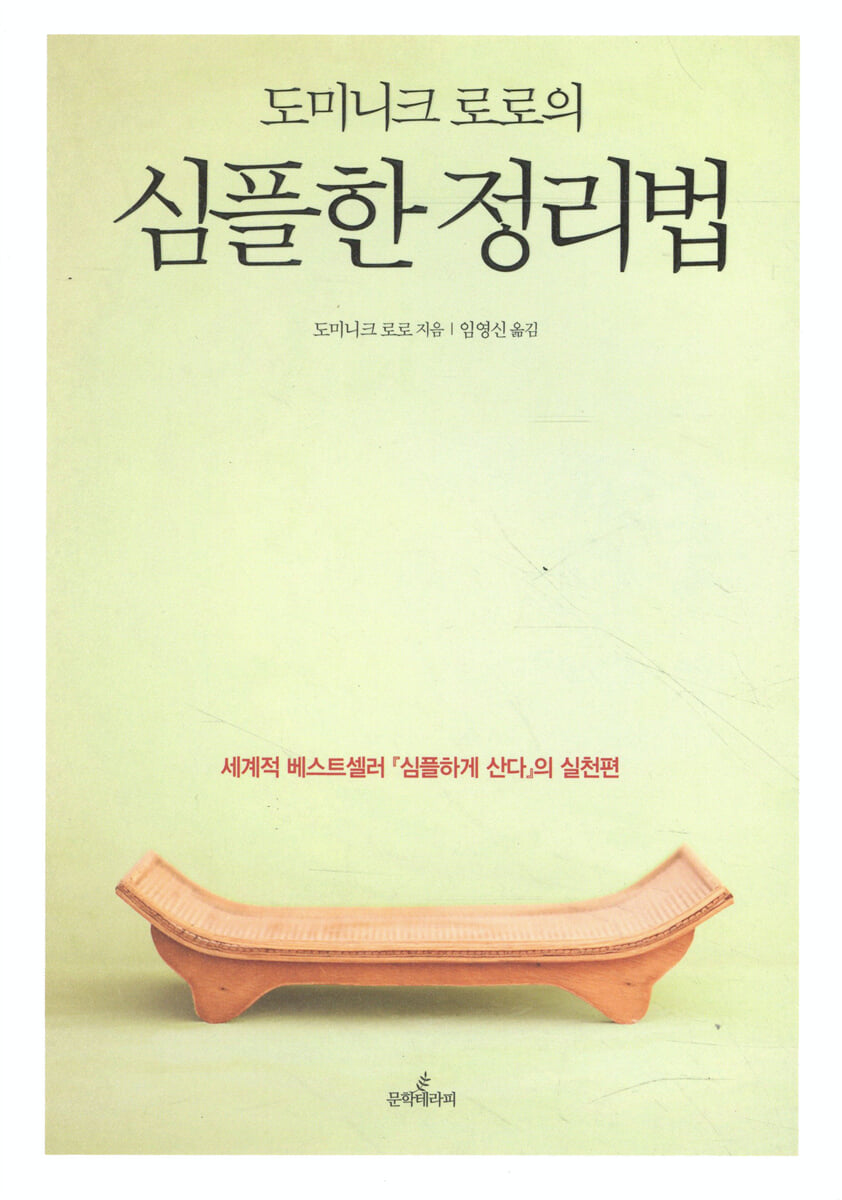
Dominique Loreau's Simple Organizing Method
 |
Description
Book Introduction
The Essential Rule for Happiness: Decluttering Life's Clutter
This is the practical version of ‘Living Simply’.
It contains methods to neatly and simply organize all the unnecessary things in life, including the space, time, relationships, choices, and even the organization of the mind, that drain our energy and make us tired.
It also emphasizes that a tidy interior, amazing peace, better choices, and better relationships are essential for happiness, and that a simple life and simple organization are key to achieving this.
The book delves into everything from organizing your kitchen or refrigerator, to the criteria for choosing essential items, the pursuit of a simple life, and how the laws of organization impact our daily lives, lives, and minds.
And it explains from various angles the causes of the principles that block our simple life.
It most persuasively demonstrates that through organization, we can encounter the essential things in life that we so desperately desire: freedom, peace, and the wonders of life.
Simplicity is the decision not to own anything that might clutter us.
It is also a comfortable room where you can relax after a day's work, and a clean apartment where you don't have to do anything.
It also involves avoiding the countless choices we face every day, without being confined to rigid frameworks.
Owning only what you need gives you greater mental freedom and allows you to use your imagination to explore things.
Let's simplify our surroundings by removing everything else, leaving only what allows us to relax our body and mind.
True simplicity begins with owning only the things you absolutely need and cherish.
This is the practical version of ‘Living Simply’.
It contains methods to neatly and simply organize all the unnecessary things in life, including the space, time, relationships, choices, and even the organization of the mind, that drain our energy and make us tired.
It also emphasizes that a tidy interior, amazing peace, better choices, and better relationships are essential for happiness, and that a simple life and simple organization are key to achieving this.
The book delves into everything from organizing your kitchen or refrigerator, to the criteria for choosing essential items, the pursuit of a simple life, and how the laws of organization impact our daily lives, lives, and minds.
And it explains from various angles the causes of the principles that block our simple life.
It most persuasively demonstrates that through organization, we can encounter the essential things in life that we so desperately desire: freedom, peace, and the wonders of life.
Simplicity is the decision not to own anything that might clutter us.
It is also a comfortable room where you can relax after a day's work, and a clean apartment where you don't have to do anything.
It also involves avoiding the countless choices we face every day, without being confined to rigid frameworks.
Owning only what you need gives you greater mental freedom and allows you to use your imagination to explore things.
Let's simplify our surroundings by removing everything else, leaving only what allows us to relax our body and mind.
True simplicity begins with owning only the things you absolutely need and cherish.
- You can preview some of the book's contents.
Preview
index
Entering
Emptiness is the true cure for a better life, greater leisure, and newfound freedom.
Part 1: Clearing Out the Unnecessary Things in Your Life
1.
If you clean it, it will change
tidy interior
More neatly, more stylishly, more simply, more comfortably
Amazing peace
Increasing time, decreasing worries, and surging energy
A better choice
Choice Fatigue│The Value of What You Have in Your Hands│The Simpler Your Choices, the Greater Your Happiness
better relationships
New relationships come from breaking free from the past. The more you own, the more easily you get hurt. The source of greed, envy, and jealousy. Greater freedom and independence.
2.
Tidying up, that peace of mind
Clutter that clutters the mind
Peace of mind│Inner order│A society that encourages hoarding
For a more vibrant future
As we age, we accumulate more things. If we can't get them back, let them go. Happy moderation.
3.
Things you see after throwing it away
The peace that comes from giving up
Happiness and Possession│Obsession and Freedom│Life Like a Vacation
Removing excess
A Light and Graceful Life│Happiness and Peace Are Separate│Excessive Ego│Let Go of Your Firm Beliefs
When I throw it away, I see my true self
A Simple Life, Not a Better Life│The Price of the Mask We Wear│Time to Care for My Inner Self│Intellect and Daily Life
Part 2: The simpler the future, the safer it is.
1.
What to discard and what to keep
Knowing myself properly comes first
Once you have your destination set, you can pack only what you need. │To discard and keep, you must first know yourself. │Organizing for the sake of organizing.
Me and the things that reflect me
Style, Showing My Inner Self│Keep Only What Matters│How to Become a True Stylist
The power to discern what I really need
The True Meaning of Need│The Age of Dreams and Desires│The Livelihoods of the Ancients│The Monk's Bag
Characteristics of a good product
Objects that bring joy even if kept for a long time│One wonderful object is better than many ordinary objects│Objects that contain the beauty of simplicity and restraint│Objects that give good energy│Objects that serve as a protective shield│Old objects
2.
Why can't I throw it away?
Fear and show-off
Fear of losing money│Fear of looking poor│Fear of losing what you have│Poverty is not about not having money, but about lacking it│Fear of regretting things later│There are things you will regret throwing away
The simpler you live, the safer your future will be.
In reality, we need very little. Change, the unknown, and things that hold back a new life. Fear of loneliness and boredom. Fear of the passage of time. Fear of death. Letting go raises questions about one's own life.
The more unhappy a person is, the more he or she tries to hoard.
External factors that cause excessive hoarding of things │ People who had unstable housing during their childhood │ People who lived an unhappy life or are obsessed with short-term happiness │ People who were abandoned │ People who suffered from parental interference │ People who were sexually abused during their childhood │ People with irresponsible drug-addicted parents │ People who were born through unwanted childbirth │ People who experienced a lack of affection or the death of a loved one │ People with genetic problems
Inner fear and anxiety
Fear of being criticized for being wasteful│Fear of being abandoned│The pressure to be useful to others│People who are afraid to think about what kind of person they are│People who are afraid of war or disaster│People who are afraid of empty space│People who want to leave behind mementos for their descendants│The desire to prove one's existence with things
A disease called hoarding disorder
People with Depression│Animals and Hoarding│Diogenes Syndrome│The Patrice Moore Story│Richard's Story: The Man Who Got an Eviction Notice from His Apartment│How to Deal with Your Hoarding Spouse's Symptoms
Examples of happy people
People who share the joy of living with less │ The story of Grandma Emma Gatewood │ Japanese elderly women living in their children's homes │ The act of discarding and keeping reflects life.
Part 3: Simple Organization
1.
If you look inside the refrigerator, you can see that person.
The Kitchen Tramps
Why do we keep so many ingredients in our cupboards? │ Keep only the essentials │ Jewish food storage methods │ Fill your refrigerator with only fresh food │ Your freezer is not a time-stopping machine │ Dishes │ Kitchen essentials │ Thousands of recipes and cookbooks you'll never try │ Ingenious kitchen gadgets │ You don't need machines to make healthy food │ Are cooking utensils really helpful │ Kitchen clutter │ Eat, drink, serve │ Serving guests with ease │ Drinks │ Eco-friendly living
Household essentials
Home appliances, laundry, cleaning products, telecommunications products, video and audio equipment
Decorations and furniture
Interior decorations | Indoor plants | Paintings and other wall decorations | Furniture | Furniture for organizing
A place for organizing
Warehouse, attic, closet, storage room│round table, chest of drawers, table top│closet
personal items
Clothing, jewelry and perfume, beauty products and cosmetics, medicine, first aid kits, sporting goods, tools and toys, collectibles
Documents, certificates, photos, books
Administrative documents│Storage period for each item│Documents│Books
2.
Organizing Skills for the Shy
The first step to organizing
Where to start│Tackle one drawer, one box first│Cleaning has its own order│Get rid of big items first│The art of organizing boxes and bags│Have only one drawer for clutter│Organizing bags to put clutter in│If you're still hesitant, take out all the items│Limit to a specific color│Set an upper limit on the quantity│Combine duplicates into one│Group items│Ask for help if you want to throw things away│Go on a long trip│Move to a smaller house
The best timing for practice
Moments when you must act without delay│Throw away according to the season│Make decisions in the morning│The best time to clean is when you are angry│Let your thoughts follow your actions│Decisions require time to think carefully│Don't invest time in spending│Use travel as an opportunity to throw away
Donate, recycle, throw away, or resell.
Is Donating Really Charity? │ Let's Give Unused Items a Chance
What to do when you find yourself in a dilemma
What does it mean to sort? │ When you can't decide │ Things that others have accumulated │ Things that you received as gifts │ Wanting to own the meaning of things │ If it's something you're reluctant to throw away, just keep it │ Things you bought wrong │ When you hesitate between two things │ If you have several things with the same purpose │ Things that are ambiguous whether to use them or not │ The best thing at least │ Your own reasons for emptying out │ The art of improvisation │ Things with sentimental value │ Things that bring back memories │ Old letters │ Photos
3.
After cleaning up, don't let your guard down.
Nature fears empty spaces
To avoid piling up again│The temptation of new products│Let those around you know that you have decided not to give or receive gifts
Traps that encourage wasteful spending
Beware of Freebies│Sales│The Cheap Comfort of Consumption
The 30-Day Rule to Stop Impulse Buying
To overcome temptation│If you wait 30 days, most of the things you buy will become unnecessary│Have the courage to return them│So that we can feel it together
The joys of a simple life
Simplicity, an aesthetic and wonderful way of life│Changing consumption habits│Sufficiency is having only what you need
For a life like a vacation
If we stand before death│Life is like a journey│Reducing consumption is the first thing to do
In closing
Simple, it's not about eliminating desires, it's about learning not to be ruled by them.
Emptiness is the true cure for a better life, greater leisure, and newfound freedom.
Part 1: Clearing Out the Unnecessary Things in Your Life
1.
If you clean it, it will change
tidy interior
More neatly, more stylishly, more simply, more comfortably
Amazing peace
Increasing time, decreasing worries, and surging energy
A better choice
Choice Fatigue│The Value of What You Have in Your Hands│The Simpler Your Choices, the Greater Your Happiness
better relationships
New relationships come from breaking free from the past. The more you own, the more easily you get hurt. The source of greed, envy, and jealousy. Greater freedom and independence.
2.
Tidying up, that peace of mind
Clutter that clutters the mind
Peace of mind│Inner order│A society that encourages hoarding
For a more vibrant future
As we age, we accumulate more things. If we can't get them back, let them go. Happy moderation.
3.
Things you see after throwing it away
The peace that comes from giving up
Happiness and Possession│Obsession and Freedom│Life Like a Vacation
Removing excess
A Light and Graceful Life│Happiness and Peace Are Separate│Excessive Ego│Let Go of Your Firm Beliefs
When I throw it away, I see my true self
A Simple Life, Not a Better Life│The Price of the Mask We Wear│Time to Care for My Inner Self│Intellect and Daily Life
Part 2: The simpler the future, the safer it is.
1.
What to discard and what to keep
Knowing myself properly comes first
Once you have your destination set, you can pack only what you need. │To discard and keep, you must first know yourself. │Organizing for the sake of organizing.
Me and the things that reflect me
Style, Showing My Inner Self│Keep Only What Matters│How to Become a True Stylist
The power to discern what I really need
The True Meaning of Need│The Age of Dreams and Desires│The Livelihoods of the Ancients│The Monk's Bag
Characteristics of a good product
Objects that bring joy even if kept for a long time│One wonderful object is better than many ordinary objects│Objects that contain the beauty of simplicity and restraint│Objects that give good energy│Objects that serve as a protective shield│Old objects
2.
Why can't I throw it away?
Fear and show-off
Fear of losing money│Fear of looking poor│Fear of losing what you have│Poverty is not about not having money, but about lacking it│Fear of regretting things later│There are things you will regret throwing away
The simpler you live, the safer your future will be.
In reality, we need very little. Change, the unknown, and things that hold back a new life. Fear of loneliness and boredom. Fear of the passage of time. Fear of death. Letting go raises questions about one's own life.
The more unhappy a person is, the more he or she tries to hoard.
External factors that cause excessive hoarding of things │ People who had unstable housing during their childhood │ People who lived an unhappy life or are obsessed with short-term happiness │ People who were abandoned │ People who suffered from parental interference │ People who were sexually abused during their childhood │ People with irresponsible drug-addicted parents │ People who were born through unwanted childbirth │ People who experienced a lack of affection or the death of a loved one │ People with genetic problems
Inner fear and anxiety
Fear of being criticized for being wasteful│Fear of being abandoned│The pressure to be useful to others│People who are afraid to think about what kind of person they are│People who are afraid of war or disaster│People who are afraid of empty space│People who want to leave behind mementos for their descendants│The desire to prove one's existence with things
A disease called hoarding disorder
People with Depression│Animals and Hoarding│Diogenes Syndrome│The Patrice Moore Story│Richard's Story: The Man Who Got an Eviction Notice from His Apartment│How to Deal with Your Hoarding Spouse's Symptoms
Examples of happy people
People who share the joy of living with less │ The story of Grandma Emma Gatewood │ Japanese elderly women living in their children's homes │ The act of discarding and keeping reflects life.
Part 3: Simple Organization
1.
If you look inside the refrigerator, you can see that person.
The Kitchen Tramps
Why do we keep so many ingredients in our cupboards? │ Keep only the essentials │ Jewish food storage methods │ Fill your refrigerator with only fresh food │ Your freezer is not a time-stopping machine │ Dishes │ Kitchen essentials │ Thousands of recipes and cookbooks you'll never try │ Ingenious kitchen gadgets │ You don't need machines to make healthy food │ Are cooking utensils really helpful │ Kitchen clutter │ Eat, drink, serve │ Serving guests with ease │ Drinks │ Eco-friendly living
Household essentials
Home appliances, laundry, cleaning products, telecommunications products, video and audio equipment
Decorations and furniture
Interior decorations | Indoor plants | Paintings and other wall decorations | Furniture | Furniture for organizing
A place for organizing
Warehouse, attic, closet, storage room│round table, chest of drawers, table top│closet
personal items
Clothing, jewelry and perfume, beauty products and cosmetics, medicine, first aid kits, sporting goods, tools and toys, collectibles
Documents, certificates, photos, books
Administrative documents│Storage period for each item│Documents│Books
2.
Organizing Skills for the Shy
The first step to organizing
Where to start│Tackle one drawer, one box first│Cleaning has its own order│Get rid of big items first│The art of organizing boxes and bags│Have only one drawer for clutter│Organizing bags to put clutter in│If you're still hesitant, take out all the items│Limit to a specific color│Set an upper limit on the quantity│Combine duplicates into one│Group items│Ask for help if you want to throw things away│Go on a long trip│Move to a smaller house
The best timing for practice
Moments when you must act without delay│Throw away according to the season│Make decisions in the morning│The best time to clean is when you are angry│Let your thoughts follow your actions│Decisions require time to think carefully│Don't invest time in spending│Use travel as an opportunity to throw away
Donate, recycle, throw away, or resell.
Is Donating Really Charity? │ Let's Give Unused Items a Chance
What to do when you find yourself in a dilemma
What does it mean to sort? │ When you can't decide │ Things that others have accumulated │ Things that you received as gifts │ Wanting to own the meaning of things │ If it's something you're reluctant to throw away, just keep it │ Things you bought wrong │ When you hesitate between two things │ If you have several things with the same purpose │ Things that are ambiguous whether to use them or not │ The best thing at least │ Your own reasons for emptying out │ The art of improvisation │ Things with sentimental value │ Things that bring back memories │ Old letters │ Photos
3.
After cleaning up, don't let your guard down.
Nature fears empty spaces
To avoid piling up again│The temptation of new products│Let those around you know that you have decided not to give or receive gifts
Traps that encourage wasteful spending
Beware of Freebies│Sales│The Cheap Comfort of Consumption
The 30-Day Rule to Stop Impulse Buying
To overcome temptation│If you wait 30 days, most of the things you buy will become unnecessary│Have the courage to return them│So that we can feel it together
The joys of a simple life
Simplicity, an aesthetic and wonderful way of life│Changing consumption habits│Sufficiency is having only what you need
For a life like a vacation
If we stand before death│Life is like a journey│Reducing consumption is the first thing to do
In closing
Simple, it's not about eliminating desires, it's about learning not to be ruled by them.
Into the book
Let's get to the heart of the matter.
Let us get rid of everything that is deemed non-essential, meaningless, or useless.
Once this excess disappears, you can get closer to your true self.
Throwing things away may seem easy at first, but not many people actually do it.
To eliminate the clutter in your life, you must first understand yourself! You must know who you are, what you like, what you need, and what you don't.
This applies to both our material, mental, and spiritual lives. We must understand what truly makes us happy, mature, and helps us grow, and what power within us enables us to protect ourselves and those around us from being deceived by the world's lies.
---p.11
Simplicity doesn't just refer to an interior with a modern design on white walls.
A truly simple life is one where you have time to spare, don't waste it, choose the good things, and cherish and respect yourself.
To achieve this, we must first and foremost avoid things that cause us stress and resolve not to own anything that disturbs us.
A comfortable room where you can relax after a day's work and a clean house that needs no further maintenance also fall into this category.
It also involves avoiding being confined to monotonous and rigid frameworks and reducing the number of choices required of us every day.
Owning only what you need gives you greater mental freedom and allows you to use your imagination to explore things.
In other words, simplicity enriches things related to dreams and imagination. ---p.20
The more we own, the more easily we get hurt.
On the other hand, as we progress spiritually, our desires for possessions and people decrease.
Becoming detached from material things allows us to be free from all spheres, including the relationships that surround it.
“I’m really happy with this person right now.
But I don't own him.
"I am not a prison guard, and he is free whether he is with me or away from me." If you can say this, you will worry less about losing that person, and you will be able to distance yourself from him, which will allow you to become more free. ---p.33
The more you clear out clutter, the more clearly you become aware of what is unnecessary.
Let's start with material things first, and then gradually expand the scope to eliminate unnecessary activities, pointless chatter, and meaningless relationships.
Cleaning your head is similar to spring cleaning or the Japanese New Year's cleaning.
Every time we let go of old attitudes and habits, and every time we discard unnecessary items around us, we create more space in our hearts.
Additionally, as you gain more room to see and act on situations from different angles, you will feel more relaxed and free.
If we clear our minds and banish the strange thoughts that have been nesting in our minds (most of the time we are not even aware of them), we will be free to enjoy all kinds of wonderful things that belong not only to the material world but also to the immaterial world.
---p.42
Actually, it is very easy to concentrate.
Just looking at children or animals provides good examples of concentration.
The common misconception that focusing requires hard work is that people often find it difficult.
Concentration is not something to be stressed about, but rather something to be relaxed about.
Hold in your mind a joyful and precious image, as if what you imagine is right before your eyes.
Then you will naturally focus. ---p.79
Another way of saying that having your own style and unique way of life means knowing who you are and living according to your own desires.
Paradoxically, if we truly know ourselves, we can create our own style with fewer possessions.
In fact, stylish people have a very clear style system and they know what suits them perfectly.
They buy only clothes that suit their personality and body type, live within their capabilities, and are in harmony with who they are, not with an alter ego they wish to become. ---p.82
If you decide to practice minimal ownership, choosing only the essentials, then choose the best quality.
A well-made, beautiful object provides lasting pleasure.
It is better to have one beautiful ring than three mediocre rings.
When something is perfect like this, we forget about it and stop caring about it.
It becomes like a part of oneself, and the desire to change it into something else disappears.
Having nice things, like a pair of pretty shoes that fit well, makes you feel good. ---p.91
Antiques and objects imbued with simplicity stand in opposition to today's culture of excess.
I also reject the flashy designs on cereal bags, CD cases, knick-knacks, magazines, and cheap knick-knacks.
Old things are thrown away at the beginning of autumn,
A hazy rural horizon landscape with brown birds foraging for food in the fields.
Also, like a handcrafted wooden armchair, it is simple, neat, unadorned, functional, yet sophisticated.
So, over time, it takes on a warmer and deeper color, giving you pleasure every time you look at it, touch it, or sit on it.
A string of yarn, a needle, a wooden teaspoon, a bar of soap, a broom, a pair of jeans, a pencil… .
These timeless objects, created hundreds of years ago, still bring us the greatest joy today.
In other words, the beauty of old things is that they seem indifferent to the passage of time.
Old floors and stairs, leather goods, ceramics, jewels, patinaed metal, worn carpets, moss-covered rocks, yellowed sheets of paper, darkened tea sets, cast-iron pots blackened by long use, and white candles dripping with wax create this beauty.
These objects bear the marks of time and are not tainted by uniformity.
So, it shows uniqueness, and that is history.
It goes without saying that the aesthetics of old things do not include overuse.
Some objects become very interesting because of the history they contain.
This is precisely what we want to preserve. ---pp.96~97
Living eco-friendly doesn't mean forcing yourself to live a frugal life, making sacrifices, or living an uncomfortable life.
Rather, it is about living a richer, more interesting, more fulfilling, more sustainable, and healthier life.
All it takes is a little diligence. ---p.171
When you're very angry, you tend to place less importance on things than usual, which reduces the emotional value you place on them.
So, you can easily throw away even things you couldn't even think about until then.
The act of letting go also calms the mind, provides a fresh perspective, and clears emotional blocks by discarding materially unnecessary items. ---p.223
We live in the 'information age'.
To protect yourself and live a rich and enjoyable life amidst the deluge of new products, information, messages, and desires, you must be able to choose wisely.
Selecting refers to the skill of comparing and selecting or discarding by weighing the pros and cons.
Let's start by taking out the six kitchen knives and ten umbrellas we have at home, and choose the ones we like the most from each type and throw away the rest.
Let's throw away all the things that have become useless and out of function, like the indoor exercise bike that has become a clothes drying rack, the faded painting, the worn-out Moroccan cushion chair, and the rusty scissors, and keep only the useful things like 'faithful servants'.
As you battle this accumulated clutter, new items you may not have even known existed and never used will pop up here and there.
By accumulating things like this, we subtly gain a sense of security that we own something.
And we find excuses to keep unnecessary items that clutter up our space.
in result
Expending mental energy in a dizzying space takes a financial and emotional toll.
If this state persists for a long time, you will become even more lost, not knowing what to do even if you want to deal with it. ---pp.232~233
One of the important things in 'emptiness' is the skill of 'improvising' to handle all situations.
For example, it's useful to prepare a meal using leftover ingredients from the refrigerator, or to organize clothes by tying the four corners of a scarf when you don't have a bag or place to put them.
It's also common wisdom to wear two sweaters in layers instead of running to the store to buy a warmer one as soon as the temperature drops.
In other words, the improvisation discussed here is the skill of minimizing waste by making the most of what one has through one's imagination to achieve a certain goal rather than possessing something else. ---p.245
The problem is not what we own, but how and why we own it.
Of course, some of our desires are essential for a happy life.
But unfortunately, most desires are produced and created by consumer society.
This is what hinders our happiness.
Simplicity, it is not about eliminating all desires, but learning to suppress them so that they do not amplify and do not become dominated by them.
Let us get rid of everything that is deemed non-essential, meaningless, or useless.
Once this excess disappears, you can get closer to your true self.
Throwing things away may seem easy at first, but not many people actually do it.
To eliminate the clutter in your life, you must first understand yourself! You must know who you are, what you like, what you need, and what you don't.
This applies to both our material, mental, and spiritual lives. We must understand what truly makes us happy, mature, and helps us grow, and what power within us enables us to protect ourselves and those around us from being deceived by the world's lies.
---p.11
Simplicity doesn't just refer to an interior with a modern design on white walls.
A truly simple life is one where you have time to spare, don't waste it, choose the good things, and cherish and respect yourself.
To achieve this, we must first and foremost avoid things that cause us stress and resolve not to own anything that disturbs us.
A comfortable room where you can relax after a day's work and a clean house that needs no further maintenance also fall into this category.
It also involves avoiding being confined to monotonous and rigid frameworks and reducing the number of choices required of us every day.
Owning only what you need gives you greater mental freedom and allows you to use your imagination to explore things.
In other words, simplicity enriches things related to dreams and imagination. ---p.20
The more we own, the more easily we get hurt.
On the other hand, as we progress spiritually, our desires for possessions and people decrease.
Becoming detached from material things allows us to be free from all spheres, including the relationships that surround it.
“I’m really happy with this person right now.
But I don't own him.
"I am not a prison guard, and he is free whether he is with me or away from me." If you can say this, you will worry less about losing that person, and you will be able to distance yourself from him, which will allow you to become more free. ---p.33
The more you clear out clutter, the more clearly you become aware of what is unnecessary.
Let's start with material things first, and then gradually expand the scope to eliminate unnecessary activities, pointless chatter, and meaningless relationships.
Cleaning your head is similar to spring cleaning or the Japanese New Year's cleaning.
Every time we let go of old attitudes and habits, and every time we discard unnecessary items around us, we create more space in our hearts.
Additionally, as you gain more room to see and act on situations from different angles, you will feel more relaxed and free.
If we clear our minds and banish the strange thoughts that have been nesting in our minds (most of the time we are not even aware of them), we will be free to enjoy all kinds of wonderful things that belong not only to the material world but also to the immaterial world.
---p.42
Actually, it is very easy to concentrate.
Just looking at children or animals provides good examples of concentration.
The common misconception that focusing requires hard work is that people often find it difficult.
Concentration is not something to be stressed about, but rather something to be relaxed about.
Hold in your mind a joyful and precious image, as if what you imagine is right before your eyes.
Then you will naturally focus. ---p.79
Another way of saying that having your own style and unique way of life means knowing who you are and living according to your own desires.
Paradoxically, if we truly know ourselves, we can create our own style with fewer possessions.
In fact, stylish people have a very clear style system and they know what suits them perfectly.
They buy only clothes that suit their personality and body type, live within their capabilities, and are in harmony with who they are, not with an alter ego they wish to become. ---p.82
If you decide to practice minimal ownership, choosing only the essentials, then choose the best quality.
A well-made, beautiful object provides lasting pleasure.
It is better to have one beautiful ring than three mediocre rings.
When something is perfect like this, we forget about it and stop caring about it.
It becomes like a part of oneself, and the desire to change it into something else disappears.
Having nice things, like a pair of pretty shoes that fit well, makes you feel good. ---p.91
Antiques and objects imbued with simplicity stand in opposition to today's culture of excess.
I also reject the flashy designs on cereal bags, CD cases, knick-knacks, magazines, and cheap knick-knacks.
Old things are thrown away at the beginning of autumn,
A hazy rural horizon landscape with brown birds foraging for food in the fields.
Also, like a handcrafted wooden armchair, it is simple, neat, unadorned, functional, yet sophisticated.
So, over time, it takes on a warmer and deeper color, giving you pleasure every time you look at it, touch it, or sit on it.
A string of yarn, a needle, a wooden teaspoon, a bar of soap, a broom, a pair of jeans, a pencil… .
These timeless objects, created hundreds of years ago, still bring us the greatest joy today.
In other words, the beauty of old things is that they seem indifferent to the passage of time.
Old floors and stairs, leather goods, ceramics, jewels, patinaed metal, worn carpets, moss-covered rocks, yellowed sheets of paper, darkened tea sets, cast-iron pots blackened by long use, and white candles dripping with wax create this beauty.
These objects bear the marks of time and are not tainted by uniformity.
So, it shows uniqueness, and that is history.
It goes without saying that the aesthetics of old things do not include overuse.
Some objects become very interesting because of the history they contain.
This is precisely what we want to preserve. ---pp.96~97
Living eco-friendly doesn't mean forcing yourself to live a frugal life, making sacrifices, or living an uncomfortable life.
Rather, it is about living a richer, more interesting, more fulfilling, more sustainable, and healthier life.
All it takes is a little diligence. ---p.171
When you're very angry, you tend to place less importance on things than usual, which reduces the emotional value you place on them.
So, you can easily throw away even things you couldn't even think about until then.
The act of letting go also calms the mind, provides a fresh perspective, and clears emotional blocks by discarding materially unnecessary items. ---p.223
We live in the 'information age'.
To protect yourself and live a rich and enjoyable life amidst the deluge of new products, information, messages, and desires, you must be able to choose wisely.
Selecting refers to the skill of comparing and selecting or discarding by weighing the pros and cons.
Let's start by taking out the six kitchen knives and ten umbrellas we have at home, and choose the ones we like the most from each type and throw away the rest.
Let's throw away all the things that have become useless and out of function, like the indoor exercise bike that has become a clothes drying rack, the faded painting, the worn-out Moroccan cushion chair, and the rusty scissors, and keep only the useful things like 'faithful servants'.
As you battle this accumulated clutter, new items you may not have even known existed and never used will pop up here and there.
By accumulating things like this, we subtly gain a sense of security that we own something.
And we find excuses to keep unnecessary items that clutter up our space.
in result
Expending mental energy in a dizzying space takes a financial and emotional toll.
If this state persists for a long time, you will become even more lost, not knowing what to do even if you want to deal with it. ---pp.232~233
One of the important things in 'emptiness' is the skill of 'improvising' to handle all situations.
For example, it's useful to prepare a meal using leftover ingredients from the refrigerator, or to organize clothes by tying the four corners of a scarf when you don't have a bag or place to put them.
It's also common wisdom to wear two sweaters in layers instead of running to the store to buy a warmer one as soon as the temperature drops.
In other words, the improvisation discussed here is the skill of minimizing waste by making the most of what one has through one's imagination to achieve a certain goal rather than possessing something else. ---p.245
The problem is not what we own, but how and why we own it.
Of course, some of our desires are essential for a happy life.
But unfortunately, most desires are produced and created by consumer society.
This is what hinders our happiness.
Simplicity, it is not about eliminating all desires, but learning to suppress them so that they do not amplify and do not become dominated by them.
---p.274
Publisher's Review
1.
The Practice of "Living Simply," Chosen by a Million Readers
The Essential Rule for Happiness: Decluttering Life's Unnecessary Things
The author of this book, Dominique Loreau, was born in France, but was attracted to the restrained beauty of the Orient and began living in Japan.
The author's first book, "Living Simply," was published in 36 countries, including Europe, North America, China, Japan, and Arab countries, and sold over 1 million copies, creating a global consensus.
The keyword 'simple', which has been able to garner sympathy worldwide, has now become a necessity rather than a choice for happiness.
"Dominique Loreau's Simple Tidying Up" is a practical version of "Living Simply." It contains methods for organizing all the unnecessary things in life, including space, time, relationships, choices, and even organizing the mind, that drain our energy and tire us out.
In this book, the author explains that a well-organized interior, incredible peace, better choices, and better relationships are essential to happiness, and that a simple life and simple organization are the key solutions to achieving this.
2.
The Law of Tidying Up: Living the Best Life with What You Have
Living without a home, food, clothing, or even basic medical care is not considered a simple life.
It is not a simplicity that one can choose, but a poverty that one must endure.
Living simply doesn't mean giving up all material comforts, but rather living a lighter and more profound life.
True simplicity is a life of leisure, of choosing good things without waste, of cherishing and respecting oneself.
But above all, simplicity means deciding to avoid things that stress us out and to not own anything that might clutter us.
It is also a comfortable room where you can relax after a day's work, and a clean apartment where you don't have to do anything.
And it also involves avoiding the countless choices we face every day, without being trapped in gloomy, rigid frameworks.
Owning only what you need gives you greater mental freedom and allows you to use your imagination to explore things.
In other words, simplicity actually enriches things related to dreams and imagination.
All of this, like real things, real stories, and real people, nourishes our souls.
Why do people want to travel so much, sleeping in hotels, eating in restaurants, and strolling along vast, deserted beaches? It's because there are no extra tasks or worries to worry about, and no need to worry about "protecting your property."
But you can do that at home too.
Simplify your surroundings by removing everything else, leaving only what allows you to relax your body and mind.
If you want an object to appear to be the center of the room, leave some empty space around it.
True simplicity begins with having only the things you absolutely need and cherish, without being distracted or diminished by anything.
3.
The simpler we live, the safer our future will be.
The more unhappy a person is, the more he or she tries to hoard.
Because our nature is to fear emptiness.
But when you overcome your fear and let it go, you will see your true self.
Because simplicity means knowing myself well and being able to choose what's right for me.
In this way, simplicity is not about eliminating desires, but learning not to be ruled by them.
“When we strive for more, our inner energy becomes focused on accumulation, acquisition, rewards, spoils, recognition, money, etc.
Moreover, if they fail to meet these requirements, they feel guilty and ashamed, thinking that they are lazy or irresponsible.
But what you need to be free is not more material things.
Instead, we must cultivate a different kind of energy, an energy that can bring peace, not war, to our hearts.
Instead of always trying to get ahead, let's spend time with loved ones, read a book, or go for a walk.
Freedom is not about accumulating things, it is about choosing to enjoy freedom.”
-Page 64 of the text
This book thoroughly explains everything from the skills to organize your kitchen or refrigerator, to the criteria for selecting essential items, the pursuit of a simple life, and how the laws of organization affect our daily lives, lives, and minds.
And it explains from various angles the causes of the principles that block our simple life.
It also shows most compellingly that when we choose a simple life, despite our inner fears and social circumstances, the essential things we long for in life—freedom, peace, and the wonders of life—await us.
The Practice of "Living Simply," Chosen by a Million Readers
The Essential Rule for Happiness: Decluttering Life's Unnecessary Things
The author of this book, Dominique Loreau, was born in France, but was attracted to the restrained beauty of the Orient and began living in Japan.
The author's first book, "Living Simply," was published in 36 countries, including Europe, North America, China, Japan, and Arab countries, and sold over 1 million copies, creating a global consensus.
The keyword 'simple', which has been able to garner sympathy worldwide, has now become a necessity rather than a choice for happiness.
"Dominique Loreau's Simple Tidying Up" is a practical version of "Living Simply." It contains methods for organizing all the unnecessary things in life, including space, time, relationships, choices, and even organizing the mind, that drain our energy and tire us out.
In this book, the author explains that a well-organized interior, incredible peace, better choices, and better relationships are essential to happiness, and that a simple life and simple organization are the key solutions to achieving this.
2.
The Law of Tidying Up: Living the Best Life with What You Have
Living without a home, food, clothing, or even basic medical care is not considered a simple life.
It is not a simplicity that one can choose, but a poverty that one must endure.
Living simply doesn't mean giving up all material comforts, but rather living a lighter and more profound life.
True simplicity is a life of leisure, of choosing good things without waste, of cherishing and respecting oneself.
But above all, simplicity means deciding to avoid things that stress us out and to not own anything that might clutter us.
It is also a comfortable room where you can relax after a day's work, and a clean apartment where you don't have to do anything.
And it also involves avoiding the countless choices we face every day, without being trapped in gloomy, rigid frameworks.
Owning only what you need gives you greater mental freedom and allows you to use your imagination to explore things.
In other words, simplicity actually enriches things related to dreams and imagination.
All of this, like real things, real stories, and real people, nourishes our souls.
Why do people want to travel so much, sleeping in hotels, eating in restaurants, and strolling along vast, deserted beaches? It's because there are no extra tasks or worries to worry about, and no need to worry about "protecting your property."
But you can do that at home too.
Simplify your surroundings by removing everything else, leaving only what allows you to relax your body and mind.
If you want an object to appear to be the center of the room, leave some empty space around it.
True simplicity begins with having only the things you absolutely need and cherish, without being distracted or diminished by anything.
3.
The simpler we live, the safer our future will be.
The more unhappy a person is, the more he or she tries to hoard.
Because our nature is to fear emptiness.
But when you overcome your fear and let it go, you will see your true self.
Because simplicity means knowing myself well and being able to choose what's right for me.
In this way, simplicity is not about eliminating desires, but learning not to be ruled by them.
“When we strive for more, our inner energy becomes focused on accumulation, acquisition, rewards, spoils, recognition, money, etc.
Moreover, if they fail to meet these requirements, they feel guilty and ashamed, thinking that they are lazy or irresponsible.
But what you need to be free is not more material things.
Instead, we must cultivate a different kind of energy, an energy that can bring peace, not war, to our hearts.
Instead of always trying to get ahead, let's spend time with loved ones, read a book, or go for a walk.
Freedom is not about accumulating things, it is about choosing to enjoy freedom.”
-Page 64 of the text
This book thoroughly explains everything from the skills to organize your kitchen or refrigerator, to the criteria for selecting essential items, the pursuit of a simple life, and how the laws of organization affect our daily lives, lives, and minds.
And it explains from various angles the causes of the principles that block our simple life.
It also shows most compellingly that when we choose a simple life, despite our inner fears and social circumstances, the essential things we long for in life—freedom, peace, and the wonders of life—await us.
GOODS SPECIFICS
- Publication date: November 15, 2013
- Page count, weight, size: 276 pages | 464g | 150*215*20mm
- ISBN13: 9788965132554
- ISBN10: 896513255X
You may also like
카테고리
korean


korean

![ELLE 엘르 스페셜 에디션 A형 : 12월 [2025]](http://librairie.coreenne.fr/cdn/shop/files/b8e27a3de6c9538896439686c6b0e8fb.jpg?v=1766436872&width=3840)


