

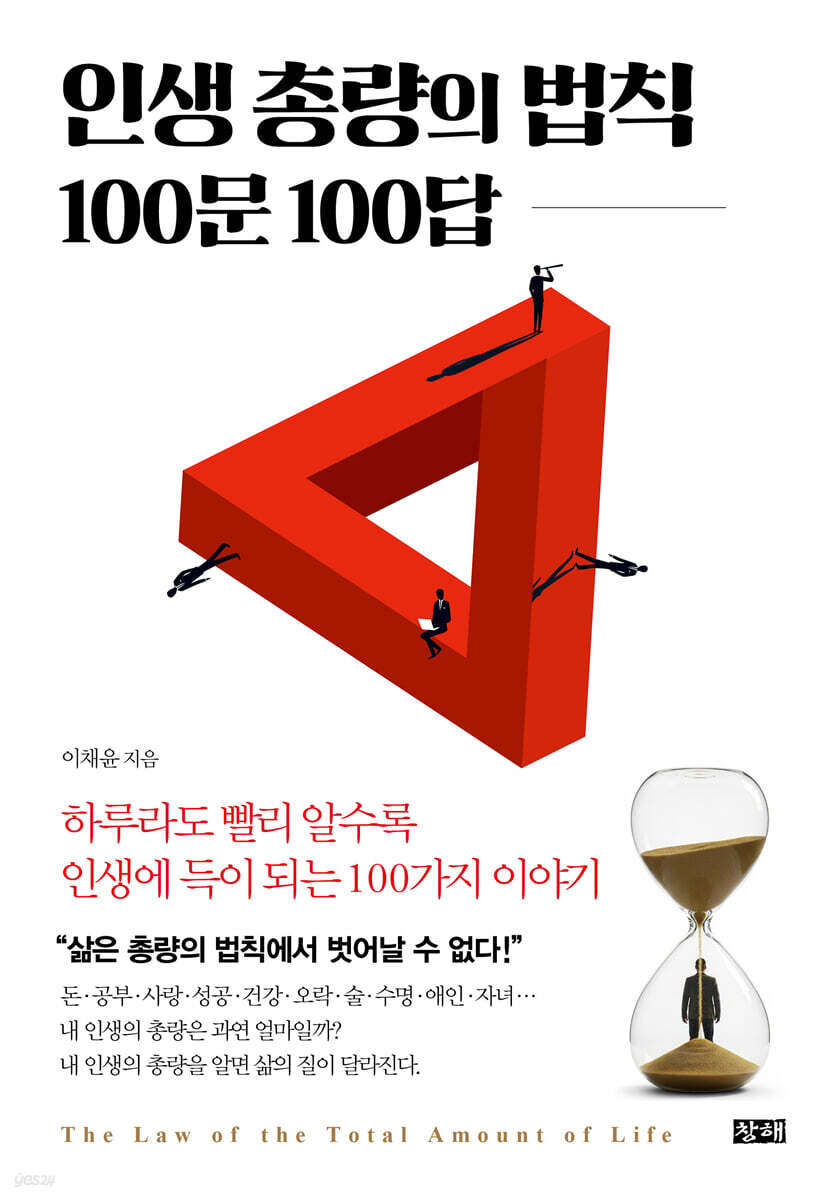
The Law of Total Life: 100 Questions and 100 Answers
 |
Description
Book Introduction
In the invisible order that permeates our unpredictable lives,
A book that delves into 100 topics about the sum total of my life!
If only I had known the total sum of my life even a day earlier, my life would have changed much faster! "Understanding the law of total sum and living accordingly will transform the quality of your life." This book explores how all aspects of life—money, study, love, success, health, entertainment, alcohol, family—are balanced in a total sum through 100 questions and answers.
Life is unfair? You're right.
But even unfair methods try to achieve a certain total.
If you're lucky, the next turn won't be yours.
If you are unlucky now, your chance will come soon.
Life is ultimately a dance in the total.
It is important to understand the flow and adapt your own steps.
Now, it's time to explore the 'Law of Total Life'.
From now on, let's recalculate your life.
From now on, let's live by setting the total amount of life!
A book that delves into 100 topics about the sum total of my life!
If only I had known the total sum of my life even a day earlier, my life would have changed much faster! "Understanding the law of total sum and living accordingly will transform the quality of your life." This book explores how all aspects of life—money, study, love, success, health, entertainment, alcohol, family—are balanced in a total sum through 100 questions and answers.
Life is unfair? You're right.
But even unfair methods try to achieve a certain total.
If you're lucky, the next turn won't be yours.
If you are unlucky now, your chance will come soon.
Life is ultimately a dance in the total.
It is important to understand the flow and adapt your own steps.
Now, it's time to explore the 'Law of Total Life'.
From now on, let's recalculate your life.
From now on, let's live by setting the total amount of life!
- You can preview some of the book's contents.
Preview
index
Prologue: Life is ultimately a dance within the total.
Chapter 1.
The philosophy of total life
-Everything is in balance
001.
What is the law of total life?
002.
Why do we need to know the law of total life?
003.
Every joy must bring about a corresponding sorrow.
004.
Do unhappy people become happier later?
005.
Success and failure come back like a merry-go-round.
006.
Your life is already in balance
007.
Why doesn't a perfect life exist?
008.
The Truth Behind "Life is Plus and Minus Zero"
009.
If you don't know the value of a quiet day
010.
After a lucky day, a bill always comes - "Lucky Day" and the law of total life.
Chapter 2.
Psychodynamics
-Emotions also have a total amount.
011.
Human emotions eventually return to their original place - hedonic adaptation theory
012.
Why Happiness Doesn't Last
013.
How to ride the emotional roller coaster?
014.
When something bad happens, think, “It’s time to move on.”
015.
Look at emotions statistically
016.
The more you dwell on misfortune, the less the total amount decreases.
017.
Even with a smiling face, there are days when you want to cry.
018.
Past pain arms you
019.
Emotional Inertia There's no need to continue feeling sad
020.
Happiness is ultimately the art of “interpretation.”
Chapter 3.
The rhythm of life
-Harmony of the total amount of life
021.
Total balance of happiness and unhappiness
022.
The Law of Money and Total Life
023.
Total amount of study and knowledge
024.
The Totality of Love and Human Relationships - What is the utility of love?
025.
The Total of Work and Success - Work-Life Balance
026.
Total amount in health and body balance
027.
Total amount of entertainment and leisure
028.
Total amount in alcohol and food
029.
Total amount in family and human relationships
030.
Life wisdom gained from a holistic perspective
Chapter 4.
Self-development and the sum total of life
-The Law of Growth and Recovery
031.
The more failures a person has, the greater the opportunity.
032.
Answer the question, “Why am I going through this?”
033.
Adversity is an asset later on - Viktor Frankl's theory of finding meaning
034.
Accepting the fullness of life boosts self-esteem.
035.
Instead of giving up, define it as "low times."
036.
Growth that explodes after a string of misfortunes ends
037.
Don't accumulate happiness, disperse it.
038.
Building Muscles to Withstand Life's Ups and Downs
039.
Even if there are many failures, the total amount is similar - the process rather than the result.
040.
After great pain comes great presence.
Chapter 5.
Fate and the Logic of the Universe
- The total amount of thought from East to West, past and present
041.
The Book of Changes: Change Always Balances
042.
Buddhist Karma: The Law of the Totality of Life and Death
043.
The Book of the Dead and the Continuity of Past Lives
044.
Hindu karma is a "total storage."
045.
Tarot card combinations and reversals of fate
046.
The Golden Rule of the East, the Golden Rule of the West
047.
Aristotle's Moderation and Harmony of Emotions
048.
Reincarnation in Tibetan Buddhism is a system for balance.
049.
Human suffering acts as a transformational mechanism in the universe.
050.
The belief that “present suffering is the sum total of the past”
Chapter 6.
Modern science and the sum total of life
-The reward system of the body, mind, and brain
051.
When the body senses pain, it prepares for recovery.
052.
Hormones Try to Balance Them Too - Cortisol vs. Serotonin
053.
Stress always comes back with a vengeance.
054.
Positive psychology can be trained—but the total quantity remains constant.
055.
The brain's pleasure circuits are easily depleted.
056.
Managing pain also regulates overall volume.
057.
Resilience is 'total recovery capacity'
058.
Medically, life is cyclical.
059.
Compensatory function: the built-in ability to restore life
060.
The brain tries to truncate happiness at a certain level - the basal happiness hypothesis
Chapter 7.
Total economic and social
-The Interplay of Achievement and Loss
061.
The economy also seeks balance - market equilibrium theory
062.
Consumption brings joy, but ultimately reduces satisfaction.
063.
Why Worries Increase as Wealth Grows
064.
If unemployment is bad luck, starting a business is an opportunity.
065.
The difference between a jackpot and a failure is a sheet of paper
066.
Does economic failure compensate for human suffering?
067.
Society always distributes losses and gains.
068.
Making money can also lead to losing relationships.
069.
The rich are those who have more to lose
070.
Unbalanced wealth is the result of ignoring the total amount.
Chapter 8.
Total Story in Literature and Film
-Truth in fiction
071.
Tolstoy: Every unhappy family has its own sum.
072.
Dostoevsky: Salvation through suffering is total restoration.
073.
Hemingway: The Pain Beneath the 'Iceberg' Fuels Success
074.
Oscar Wilde: Behind every pleasure lies the shadow of pain.
075.
Inside Out: The sum total of emotions shines in harmony.
076.
The Shawshank Redemption: The depth of despair is equal to the depth of hope.
077.
Joker: Suffering ends only when one becomes mad.
078.
A classic folktale's lesson: After every trial, there's always a reward.
079.
Fantasy compensates for the totality of reality with fantasy.
080.
Love Drama: Laughter and Tears Always Come Together - Love and Emotion
Chapter 9.
Total amount of life that can be used in real life
-Attitude, habits, strategies
081.
Keep an emotional diary - quantify the flow of your emotions.
082.
Today's misfortune fills tomorrow's total.
083.
Gratitude training reduces the overall perceived amount of pain.
084.
During a stagnation period, think of it as "storing up total reserves."
085.
In moments of despair, say, "I'm in the red right now."
086.
Don't be too stingy with joy - the total quantity is circulating.
087.
Everyone is born with their own share of sorrow.
088.
Pain is not suffering, it is interpretation.
089.
When I sympathize with the misfortune of others, my total also decreases.
090.
Life's weight becomes lighter when shared.
Chapter 10.
Your total amount completed with questions
-10 Self-Reflections
091.
Am I consuming the full amount of pain right now?
092.
Will today's joys be balanced by tomorrow's sorrows?
093.
What joy compensated for the greatest pain I have ever endured?
094.
What total amount of failure is being accumulated now?
095.
What patterns does my emotional rhythm show?
096.
Am I living my life conscious of the totality of my life?
097.
Where does this feeling fit into the total?
098.
How do you deal with the pain of the past?
099.
What moment became the turning point for the total?
100.
Am I interpreting the law of total life in my own way?
Epilogue: Life is settled, and the total circulates.
Chapter 1.
The philosophy of total life
-Everything is in balance
001.
What is the law of total life?
002.
Why do we need to know the law of total life?
003.
Every joy must bring about a corresponding sorrow.
004.
Do unhappy people become happier later?
005.
Success and failure come back like a merry-go-round.
006.
Your life is already in balance
007.
Why doesn't a perfect life exist?
008.
The Truth Behind "Life is Plus and Minus Zero"
009.
If you don't know the value of a quiet day
010.
After a lucky day, a bill always comes - "Lucky Day" and the law of total life.
Chapter 2.
Psychodynamics
-Emotions also have a total amount.
011.
Human emotions eventually return to their original place - hedonic adaptation theory
012.
Why Happiness Doesn't Last
013.
How to ride the emotional roller coaster?
014.
When something bad happens, think, “It’s time to move on.”
015.
Look at emotions statistically
016.
The more you dwell on misfortune, the less the total amount decreases.
017.
Even with a smiling face, there are days when you want to cry.
018.
Past pain arms you
019.
Emotional Inertia There's no need to continue feeling sad
020.
Happiness is ultimately the art of “interpretation.”
Chapter 3.
The rhythm of life
-Harmony of the total amount of life
021.
Total balance of happiness and unhappiness
022.
The Law of Money and Total Life
023.
Total amount of study and knowledge
024.
The Totality of Love and Human Relationships - What is the utility of love?
025.
The Total of Work and Success - Work-Life Balance
026.
Total amount in health and body balance
027.
Total amount of entertainment and leisure
028.
Total amount in alcohol and food
029.
Total amount in family and human relationships
030.
Life wisdom gained from a holistic perspective
Chapter 4.
Self-development and the sum total of life
-The Law of Growth and Recovery
031.
The more failures a person has, the greater the opportunity.
032.
Answer the question, “Why am I going through this?”
033.
Adversity is an asset later on - Viktor Frankl's theory of finding meaning
034.
Accepting the fullness of life boosts self-esteem.
035.
Instead of giving up, define it as "low times."
036.
Growth that explodes after a string of misfortunes ends
037.
Don't accumulate happiness, disperse it.
038.
Building Muscles to Withstand Life's Ups and Downs
039.
Even if there are many failures, the total amount is similar - the process rather than the result.
040.
After great pain comes great presence.
Chapter 5.
Fate and the Logic of the Universe
- The total amount of thought from East to West, past and present
041.
The Book of Changes: Change Always Balances
042.
Buddhist Karma: The Law of the Totality of Life and Death
043.
The Book of the Dead and the Continuity of Past Lives
044.
Hindu karma is a "total storage."
045.
Tarot card combinations and reversals of fate
046.
The Golden Rule of the East, the Golden Rule of the West
047.
Aristotle's Moderation and Harmony of Emotions
048.
Reincarnation in Tibetan Buddhism is a system for balance.
049.
Human suffering acts as a transformational mechanism in the universe.
050.
The belief that “present suffering is the sum total of the past”
Chapter 6.
Modern science and the sum total of life
-The reward system of the body, mind, and brain
051.
When the body senses pain, it prepares for recovery.
052.
Hormones Try to Balance Them Too - Cortisol vs. Serotonin
053.
Stress always comes back with a vengeance.
054.
Positive psychology can be trained—but the total quantity remains constant.
055.
The brain's pleasure circuits are easily depleted.
056.
Managing pain also regulates overall volume.
057.
Resilience is 'total recovery capacity'
058.
Medically, life is cyclical.
059.
Compensatory function: the built-in ability to restore life
060.
The brain tries to truncate happiness at a certain level - the basal happiness hypothesis
Chapter 7.
Total economic and social
-The Interplay of Achievement and Loss
061.
The economy also seeks balance - market equilibrium theory
062.
Consumption brings joy, but ultimately reduces satisfaction.
063.
Why Worries Increase as Wealth Grows
064.
If unemployment is bad luck, starting a business is an opportunity.
065.
The difference between a jackpot and a failure is a sheet of paper
066.
Does economic failure compensate for human suffering?
067.
Society always distributes losses and gains.
068.
Making money can also lead to losing relationships.
069.
The rich are those who have more to lose
070.
Unbalanced wealth is the result of ignoring the total amount.
Chapter 8.
Total Story in Literature and Film
-Truth in fiction
071.
Tolstoy: Every unhappy family has its own sum.
072.
Dostoevsky: Salvation through suffering is total restoration.
073.
Hemingway: The Pain Beneath the 'Iceberg' Fuels Success
074.
Oscar Wilde: Behind every pleasure lies the shadow of pain.
075.
Inside Out: The sum total of emotions shines in harmony.
076.
The Shawshank Redemption: The depth of despair is equal to the depth of hope.
077.
Joker: Suffering ends only when one becomes mad.
078.
A classic folktale's lesson: After every trial, there's always a reward.
079.
Fantasy compensates for the totality of reality with fantasy.
080.
Love Drama: Laughter and Tears Always Come Together - Love and Emotion
Chapter 9.
Total amount of life that can be used in real life
-Attitude, habits, strategies
081.
Keep an emotional diary - quantify the flow of your emotions.
082.
Today's misfortune fills tomorrow's total.
083.
Gratitude training reduces the overall perceived amount of pain.
084.
During a stagnation period, think of it as "storing up total reserves."
085.
In moments of despair, say, "I'm in the red right now."
086.
Don't be too stingy with joy - the total quantity is circulating.
087.
Everyone is born with their own share of sorrow.
088.
Pain is not suffering, it is interpretation.
089.
When I sympathize with the misfortune of others, my total also decreases.
090.
Life's weight becomes lighter when shared.
Chapter 10.
Your total amount completed with questions
-10 Self-Reflections
091.
Am I consuming the full amount of pain right now?
092.
Will today's joys be balanced by tomorrow's sorrows?
093.
What joy compensated for the greatest pain I have ever endured?
094.
What total amount of failure is being accumulated now?
095.
What patterns does my emotional rhythm show?
096.
Am I living my life conscious of the totality of my life?
097.
Where does this feeling fit into the total?
098.
How do you deal with the pain of the past?
099.
What moment became the turning point for the total?
100.
Am I interpreting the law of total life in my own way?
Epilogue: Life is settled, and the total circulates.
Detailed image

Into the book
It is human nature to dream of a perfect life.
A stable job, a loving partner, a healthy body, a certain amount of wealth, and even recognition in relationships.
We imagine a picture of everything, believing that this is what happiness is all about. The seemingly perfect daily lives of others on social media only make the holes in our own lives stand out even more.
The question, “Why don’t I have a life like this?” easily leads to self-blame.
But the truth is simple.
There is no such thing as a perfect life.
It is not a question of deficiency, but rather the very structure of existence rejects perfection.
*
Too often, a lucky day is a precursor to a bad day.
Life is settled precisely.
Heaven doesn't give anything for free.
When luck comes like a storm, there's already a bill included.
In the final scene of the novel “A Lucky Day,” when Kim Cheom-ji collapses before his wife’s body, we realize this again.
As lucky as he was that day, the world did not forget his sorrow.
The law of totality in life, so cruelly yet honestly, puts its final stamp on the paper.
*
It is not a curse that happiness does not last long, it is a blessing.
When emotions stagnate, life stops.
The moment happiness fades, we learn to live again.
As the saying goes, “Happiness is not a guest who stays long; we can only do our best to welcome it while it is there.” The more you try to hold on to happiness, the sooner it leaves.
But if you let it go, it comes back to you.
The question is not how long happiness lasts, but whether you can still love life after it's gone.
The law of total life says:
As one plate rises, another comes down, and as happiness leaves, new joy prepares its place.
The reason happiness doesn't last long is because it leaves room for the next happiness.
*
We all live along a curve of total quantity.
When happiness reaches its peak, there will be a downturn, and when suffering hits rock bottom, there will be a rebound.
But there is one thing we must not forget.
Pain is never wasted.
It becomes your life's bulletproof vest.
Instead of breaking you down, the pain you've endured fortifies you.
Today's wounds are tomorrow's resilience, and today's tears are tomorrow's language.
So now let us not fear pain.
Pain isn't there to break you.
I am coming to rebuild you.
“It’s okay if the wound doesn’t heal.
“If light seeps into that place.”
-An anonymous poet
*
The law of totality is not about eliminating suffering, but about recognizing that suffering is part of balance.
Ultimately, misfortune becomes the door to a new path, and failure becomes the seed of the next success.
One day, joy and pain will sit at the same table and clink glasses.
On that day we can say this:
“Yes, I have finally lived up to my share.
And misfortune always returns as happiness under another name.”
*
Success and work are only a part of life's total sum.
If only one instrument sounds loud, the other instruments are buried, and the symphony becomes unbalanced.
Just as an orchestra must be in harmony to achieve emotion, success shines when it is coordinated with health, relationships, and meaning.
As the saying goes, 'work-life balance,' the law of totality in life always demands balance.
Success is not a race in one direction, but a symphony in which many instruments play in harmony until the very end.
*
There are many cases in Korean society where the sum total of failures created great opportunities.
Chung Ju-yung, the founder of Hyundai, who worked as a rice deliveryman, was recognized for his sincerity and took over the store from the owner. However, his first business failed due to the control of rice distribution by the Japanese government's rice rationing system.
After that, he took out a loan and started an auto repair business called Ado Service, but lost all his assets in a factory fire.
Chung Ju-young, who was in debt due to the fire, borrowed money from a private loan shark and tried again, but failed again when Japan started the Pacific War and confiscated all vehicles as war materials.
After going through several setbacks, he changed his career path to the construction industry and eventually became the protagonist who led the 'Miracle on the Han River'.
He later said, “There are trials, but no failures,” which was not simply optimism, but an attitude that understood the totality of life.
He did not hesitate to take on huge challenges because he believed that opportunities would be prepared as failures piled up.
*
The Law of Total Life says that suffering never goes away.
It leaves a trace and a weight, and that weight makes people unshakable.
Stephen Hawking, Nick Vujicic, Napoleon Hill, Joel Austin, Rollo May—their presence comes from the traces of suffering they endured.
So if you are experiencing great pain right now, it is a sign that your being is growing.
Even if it's not visible yet, the pain will soon be absorbed into your eyes, your speech, and your attitude, persuading the world.
And someone will look at you and say to themselves:
“There’s something different about that person.”
Yes, that's right.
That is the presence that pain leaves behind.
*
Life is always in balance.
Too much is worse than too little, and too much restraint can make you lose your vitality.
When joy overflows, anxiety creeps in, and when sadness deepens, life becomes heavy and heavy.
Those who are intoxicated by success are destroyed by arrogance, and those who are immersed in failure destroy themselves in despair.
Ultimately, life is a philosophy of balance, a force that does not lean to one side.
The Eastern Doctrine of the Mean and the Western Golden Rule have different languages and cultures, but at their roots flow the same insight.
“Everything is maintained in harmony with the total.”
*
A wise person does not see present suffering as simply present tense.
He reads it as a past tense bill.
This perspective allows us to understand suffering not as a mere swamp of emotions, but as a structural event.
Beethoven used the pain of hearing loss as a source of musical experimentation, Miyamoto Musashi transformed solitude into wisdom, and dynasties throughout history paid for the sums of their luxuries with the blood of revolution.
The law of total quantity is unwavering.
The accumulation of the past will inevitably return to the present claim.
*
In Buddhism, the cause of suffering is said to be 'attachment'.
This obsession is the desire to control emotions, that is, to suppress them.
The Dhammapada says:
“The mind is not an object of control, but an object of observation.”
This is also the 'fundamental principle of stress relief'.
If you suppress your emotions, they remain as poison inside you, but if you look at them as they are, they disappear into the flow.
This is why meditation and breathing exercises are effective in treating stress.
When we adopt an attitude of observation rather than suppression, the totality of our emotions finds balance.
Revenge stops then.
*
Today's society has structures that most threaten resilience.
Smartphone notifications, endless streaming, and social media likes constantly stimulate the brain's reward circuitry.
Small pleasures are repeated every day, and the brain quickly tires out, as if drinking champagne every day.
Add to that drinking, overeating, and sexual stimulation, and you can find yourself feeling the emotional fatigue of a 60-year-old in your mid-30s.
As one mentor put it in Timothy Ferriss's book, Mentor Tribe, "We're working our brains harder than our bodies." If we can't manage pain, pleasure will wear off prematurely.
*
Unemployment is not just a loss of income, it is a collapse of identity.
The road I took to work every morning disappeared, and my business card disappeared.
At this time, a person feels like he or she is 'nothing'.
As Confucius said in the Analects, “A gentleman is not a tool.” In other words, he is not a functional tool tied to a single job.
But the moment they lose their jobs, most of them feel like 'abandoned machines'.
At this point, unemployment seems like bad luck.
But paradoxically, the law of total life returns this misfortune to a new equilibrium.
*
Financial failure isn't simply about losing money.
It is a powerful force that rearranges the human sum.
Although it is a deficit on the income statement, a new asset is recorded on the balance sheet.
It's about gaining time instead of money, truth instead of fame, and relationships instead of power.
In King Lear, Shakespeare shows the king regaining his true humanity only after losing all his power and becoming mad.
Failure is not destruction, but the beginning of reorganization.
So, don't assume you're "finished" in the face of financial failure.
The space that has collapsed now may be a space preparing to be filled with another amount.
The moment you gain people instead of losing money, and regain yourself instead of losing your job, financial failure is no longer failure.
It is rather another name for human success.
*
Hemingway tells us:
Pain is not a part of life, it is the fabric of life.
It is a weight that is hidden, but does not disappear.
Thanks to that weight, humans can remain strong even when they fall, and can become stronger even when they are broken.
His sentences ask us:
“What pain are you hiding now, and how is it supporting you?”
The pain beneath the iceberg is always the fuel for success.
That's how the law of sum total works in Hemingway's literature.
Hemingway wrote in The Old Man and the Sea:
“Man can be destroyed, but he cannot be defeated.”
This sentence cuts to the heart of suffering.
He actually went through countless wars, accidents, heartbreaks, and injuries, but he kept the pain hidden beneath the iceberg.
This is the 'iceberg theory' he spoke of.
The visible sentences are only 1/8, the remaining 7/8 are in the abyss of invisible pain.
That pain created the density of the work.
A writer who avoids pain has no depth, and a writer who endures pain can write the whole world.
Hemingway's sentences were restrained, but restraint was the very opposite of hurt.
*
Love is an explosion and annihilation of emotions, and at the same time a pendulum that constantly oscillates toward balance.
If you tilt to one side, you will inevitably swing to the other side.
Applying the theory of total emotional capacity to the drama of love can explain why we laugh and cry, and why we are so happy and then fall into despair.
That is because love is not sustained by absolute joy or absolute pain alone.
There is always a tendency to have opposing emotions, and these emotions tend to be balanced.
As The Law of Total Life says, balance in love is intertwined with other balances in life.
Excessive dependence erases the ego, and excessive independence pushes others away.
Ideal love does not harm oneself and does not seek to possess others.
Ultimately, love is a discipline to understand and manage the swings of the pendulum between oneself and others.
*
The total quantity circulates.
Postponing laughter doesn't lessen tomorrow's pain.
Rather, the joy of not smiling today will disappear forever.
So, don't be stingy with joy, but rather enjoy it boldly.
As Andrew Ross-Sorkin said, the world is never as good or as bad as it seems.
If you can laugh now, it's part of the total.
And someday that smile will protect you again.
Now the conclusion is simple.
“It’s okay, this is just part of the total.
“You deserve to be happy.”
And the moment you smile like that, life begins to cycle again.
*
Pain becomes lighter when shared.
It is easy for any human being to become absorbed in their own suffering.
When my life is falling apart, the misfortunes of others feel trivial, or sometimes even annoying.
But ironically, the more I approach and empathize with the pain of others, the less my own suffering is.
Neuroscientific research supports this.
In moments of empathy and solidarity, the stress hormone cortisol is lowered and oxytocin, which provides a sense of stability, is secreted.
That is, the moment I comfort someone's wounds, my nervous system is also healed.
The ancient Stoic philosopher Marcus Aurelius wrote in his Meditations:
“Helping others is not just a good deed, it’s a fundamental part of being human.”
Although he was the emperor of an empire, he knew better than anyone that humans cannot stand alone.
Solidarity is not a choice, it is nature.
*
According to the law of totality, suffering does not disappear.
But it is necessarily reduced to another form.
Some people find new relationships through failure, while others find greater meaning in life through illness.
What matters is how we interpret it.
Pain is not a meaningless burden.
It is a crossroads to joy, a turning point to meaning.
Life is like this, always keeping an accounting book.
Now let's ask a question.
“What joy compensated for the greatest suffering I have ever endured?”
The answer will vary for each person, but there is a common truth.
Life's ledger may not be fair, but it strives for balance.
The weight you endured that day is already being prepared to be compensated for by the lightness of tomorrow.
So remember.
Pain is not just a negative.
It is a prelude to a new joy.
In the place where you fell, the greatest joy will bloom someday.
*
What did you spend your entire day on? Did you waste it on annoying conversations, or did you invest it in the gaze of a loved one? After spending it, did you feel lighter, or more exhausted? Life is ultimately a summation of totals, a cumulative record.
Today's choices create tomorrow's balance.
A person who is conscious of the total quantity no longer imitates the lives of others.
He asks.
“Is this worth spending my entire budget on?”
Only in the face of that question does life become one's own.
And at that moment, we begin to live according to our own total scorecard, not according to anyone else's.
A stable job, a loving partner, a healthy body, a certain amount of wealth, and even recognition in relationships.
We imagine a picture of everything, believing that this is what happiness is all about. The seemingly perfect daily lives of others on social media only make the holes in our own lives stand out even more.
The question, “Why don’t I have a life like this?” easily leads to self-blame.
But the truth is simple.
There is no such thing as a perfect life.
It is not a question of deficiency, but rather the very structure of existence rejects perfection.
*
Too often, a lucky day is a precursor to a bad day.
Life is settled precisely.
Heaven doesn't give anything for free.
When luck comes like a storm, there's already a bill included.
In the final scene of the novel “A Lucky Day,” when Kim Cheom-ji collapses before his wife’s body, we realize this again.
As lucky as he was that day, the world did not forget his sorrow.
The law of totality in life, so cruelly yet honestly, puts its final stamp on the paper.
*
It is not a curse that happiness does not last long, it is a blessing.
When emotions stagnate, life stops.
The moment happiness fades, we learn to live again.
As the saying goes, “Happiness is not a guest who stays long; we can only do our best to welcome it while it is there.” The more you try to hold on to happiness, the sooner it leaves.
But if you let it go, it comes back to you.
The question is not how long happiness lasts, but whether you can still love life after it's gone.
The law of total life says:
As one plate rises, another comes down, and as happiness leaves, new joy prepares its place.
The reason happiness doesn't last long is because it leaves room for the next happiness.
*
We all live along a curve of total quantity.
When happiness reaches its peak, there will be a downturn, and when suffering hits rock bottom, there will be a rebound.
But there is one thing we must not forget.
Pain is never wasted.
It becomes your life's bulletproof vest.
Instead of breaking you down, the pain you've endured fortifies you.
Today's wounds are tomorrow's resilience, and today's tears are tomorrow's language.
So now let us not fear pain.
Pain isn't there to break you.
I am coming to rebuild you.
“It’s okay if the wound doesn’t heal.
“If light seeps into that place.”
-An anonymous poet
*
The law of totality is not about eliminating suffering, but about recognizing that suffering is part of balance.
Ultimately, misfortune becomes the door to a new path, and failure becomes the seed of the next success.
One day, joy and pain will sit at the same table and clink glasses.
On that day we can say this:
“Yes, I have finally lived up to my share.
And misfortune always returns as happiness under another name.”
*
Success and work are only a part of life's total sum.
If only one instrument sounds loud, the other instruments are buried, and the symphony becomes unbalanced.
Just as an orchestra must be in harmony to achieve emotion, success shines when it is coordinated with health, relationships, and meaning.
As the saying goes, 'work-life balance,' the law of totality in life always demands balance.
Success is not a race in one direction, but a symphony in which many instruments play in harmony until the very end.
*
There are many cases in Korean society where the sum total of failures created great opportunities.
Chung Ju-yung, the founder of Hyundai, who worked as a rice deliveryman, was recognized for his sincerity and took over the store from the owner. However, his first business failed due to the control of rice distribution by the Japanese government's rice rationing system.
After that, he took out a loan and started an auto repair business called Ado Service, but lost all his assets in a factory fire.
Chung Ju-young, who was in debt due to the fire, borrowed money from a private loan shark and tried again, but failed again when Japan started the Pacific War and confiscated all vehicles as war materials.
After going through several setbacks, he changed his career path to the construction industry and eventually became the protagonist who led the 'Miracle on the Han River'.
He later said, “There are trials, but no failures,” which was not simply optimism, but an attitude that understood the totality of life.
He did not hesitate to take on huge challenges because he believed that opportunities would be prepared as failures piled up.
*
The Law of Total Life says that suffering never goes away.
It leaves a trace and a weight, and that weight makes people unshakable.
Stephen Hawking, Nick Vujicic, Napoleon Hill, Joel Austin, Rollo May—their presence comes from the traces of suffering they endured.
So if you are experiencing great pain right now, it is a sign that your being is growing.
Even if it's not visible yet, the pain will soon be absorbed into your eyes, your speech, and your attitude, persuading the world.
And someone will look at you and say to themselves:
“There’s something different about that person.”
Yes, that's right.
That is the presence that pain leaves behind.
*
Life is always in balance.
Too much is worse than too little, and too much restraint can make you lose your vitality.
When joy overflows, anxiety creeps in, and when sadness deepens, life becomes heavy and heavy.
Those who are intoxicated by success are destroyed by arrogance, and those who are immersed in failure destroy themselves in despair.
Ultimately, life is a philosophy of balance, a force that does not lean to one side.
The Eastern Doctrine of the Mean and the Western Golden Rule have different languages and cultures, but at their roots flow the same insight.
“Everything is maintained in harmony with the total.”
*
A wise person does not see present suffering as simply present tense.
He reads it as a past tense bill.
This perspective allows us to understand suffering not as a mere swamp of emotions, but as a structural event.
Beethoven used the pain of hearing loss as a source of musical experimentation, Miyamoto Musashi transformed solitude into wisdom, and dynasties throughout history paid for the sums of their luxuries with the blood of revolution.
The law of total quantity is unwavering.
The accumulation of the past will inevitably return to the present claim.
*
In Buddhism, the cause of suffering is said to be 'attachment'.
This obsession is the desire to control emotions, that is, to suppress them.
The Dhammapada says:
“The mind is not an object of control, but an object of observation.”
This is also the 'fundamental principle of stress relief'.
If you suppress your emotions, they remain as poison inside you, but if you look at them as they are, they disappear into the flow.
This is why meditation and breathing exercises are effective in treating stress.
When we adopt an attitude of observation rather than suppression, the totality of our emotions finds balance.
Revenge stops then.
*
Today's society has structures that most threaten resilience.
Smartphone notifications, endless streaming, and social media likes constantly stimulate the brain's reward circuitry.
Small pleasures are repeated every day, and the brain quickly tires out, as if drinking champagne every day.
Add to that drinking, overeating, and sexual stimulation, and you can find yourself feeling the emotional fatigue of a 60-year-old in your mid-30s.
As one mentor put it in Timothy Ferriss's book, Mentor Tribe, "We're working our brains harder than our bodies." If we can't manage pain, pleasure will wear off prematurely.
*
Unemployment is not just a loss of income, it is a collapse of identity.
The road I took to work every morning disappeared, and my business card disappeared.
At this time, a person feels like he or she is 'nothing'.
As Confucius said in the Analects, “A gentleman is not a tool.” In other words, he is not a functional tool tied to a single job.
But the moment they lose their jobs, most of them feel like 'abandoned machines'.
At this point, unemployment seems like bad luck.
But paradoxically, the law of total life returns this misfortune to a new equilibrium.
*
Financial failure isn't simply about losing money.
It is a powerful force that rearranges the human sum.
Although it is a deficit on the income statement, a new asset is recorded on the balance sheet.
It's about gaining time instead of money, truth instead of fame, and relationships instead of power.
In King Lear, Shakespeare shows the king regaining his true humanity only after losing all his power and becoming mad.
Failure is not destruction, but the beginning of reorganization.
So, don't assume you're "finished" in the face of financial failure.
The space that has collapsed now may be a space preparing to be filled with another amount.
The moment you gain people instead of losing money, and regain yourself instead of losing your job, financial failure is no longer failure.
It is rather another name for human success.
*
Hemingway tells us:
Pain is not a part of life, it is the fabric of life.
It is a weight that is hidden, but does not disappear.
Thanks to that weight, humans can remain strong even when they fall, and can become stronger even when they are broken.
His sentences ask us:
“What pain are you hiding now, and how is it supporting you?”
The pain beneath the iceberg is always the fuel for success.
That's how the law of sum total works in Hemingway's literature.
Hemingway wrote in The Old Man and the Sea:
“Man can be destroyed, but he cannot be defeated.”
This sentence cuts to the heart of suffering.
He actually went through countless wars, accidents, heartbreaks, and injuries, but he kept the pain hidden beneath the iceberg.
This is the 'iceberg theory' he spoke of.
The visible sentences are only 1/8, the remaining 7/8 are in the abyss of invisible pain.
That pain created the density of the work.
A writer who avoids pain has no depth, and a writer who endures pain can write the whole world.
Hemingway's sentences were restrained, but restraint was the very opposite of hurt.
*
Love is an explosion and annihilation of emotions, and at the same time a pendulum that constantly oscillates toward balance.
If you tilt to one side, you will inevitably swing to the other side.
Applying the theory of total emotional capacity to the drama of love can explain why we laugh and cry, and why we are so happy and then fall into despair.
That is because love is not sustained by absolute joy or absolute pain alone.
There is always a tendency to have opposing emotions, and these emotions tend to be balanced.
As The Law of Total Life says, balance in love is intertwined with other balances in life.
Excessive dependence erases the ego, and excessive independence pushes others away.
Ideal love does not harm oneself and does not seek to possess others.
Ultimately, love is a discipline to understand and manage the swings of the pendulum between oneself and others.
*
The total quantity circulates.
Postponing laughter doesn't lessen tomorrow's pain.
Rather, the joy of not smiling today will disappear forever.
So, don't be stingy with joy, but rather enjoy it boldly.
As Andrew Ross-Sorkin said, the world is never as good or as bad as it seems.
If you can laugh now, it's part of the total.
And someday that smile will protect you again.
Now the conclusion is simple.
“It’s okay, this is just part of the total.
“You deserve to be happy.”
And the moment you smile like that, life begins to cycle again.
*
Pain becomes lighter when shared.
It is easy for any human being to become absorbed in their own suffering.
When my life is falling apart, the misfortunes of others feel trivial, or sometimes even annoying.
But ironically, the more I approach and empathize with the pain of others, the less my own suffering is.
Neuroscientific research supports this.
In moments of empathy and solidarity, the stress hormone cortisol is lowered and oxytocin, which provides a sense of stability, is secreted.
That is, the moment I comfort someone's wounds, my nervous system is also healed.
The ancient Stoic philosopher Marcus Aurelius wrote in his Meditations:
“Helping others is not just a good deed, it’s a fundamental part of being human.”
Although he was the emperor of an empire, he knew better than anyone that humans cannot stand alone.
Solidarity is not a choice, it is nature.
*
According to the law of totality, suffering does not disappear.
But it is necessarily reduced to another form.
Some people find new relationships through failure, while others find greater meaning in life through illness.
What matters is how we interpret it.
Pain is not a meaningless burden.
It is a crossroads to joy, a turning point to meaning.
Life is like this, always keeping an accounting book.
Now let's ask a question.
“What joy compensated for the greatest suffering I have ever endured?”
The answer will vary for each person, but there is a common truth.
Life's ledger may not be fair, but it strives for balance.
The weight you endured that day is already being prepared to be compensated for by the lightness of tomorrow.
So remember.
Pain is not just a negative.
It is a prelude to a new joy.
In the place where you fell, the greatest joy will bloom someday.
*
What did you spend your entire day on? Did you waste it on annoying conversations, or did you invest it in the gaze of a loved one? After spending it, did you feel lighter, or more exhausted? Life is ultimately a summation of totals, a cumulative record.
Today's choices create tomorrow's balance.
A person who is conscious of the total quantity no longer imitates the lives of others.
He asks.
“Is this worth spending my entire budget on?”
Only in the face of that question does life become one's own.
And at that moment, we begin to live according to our own total scorecard, not according to anyone else's.
--- From the text
Publisher's Review
■ “Life cannot escape the law of total quantity!?”
Money, study, love, success, health, entertainment, alcohol, longevity, lover, children…
What is the total amount of my life?
Knowing the totality of my life changes the quality of my life.
In the invisible order that permeates our unpredictable lives,
Life may seem like a series of random events, but there are certain laws.
Unexpected successes and frustrations, sudden joys and deep sorrows mix to throw people into confusion.
However, author Lee Chae-yoon's new book, "100 Questions and 100 Answers on the Law of Total Life," says that even in this chaos, there is a clear flow and balance.
Emotions and events, successes and failures all circulate in a single, total harmony.
The author explains this law not as a simple metaphor, but as a principle that both ancient human wisdom and modern science share.
The Eastern yin-yang theory, Buddhist reincarnation, Stoic philosophy, and Christian providence all viewed human joys and sorrows as being regulated within a grand balance.
Modern science also reveals that extreme experiences are inevitably counteracted by opposing forces, through the body's homeostasis, psychological resilience, and reward systems like dopamine and serotonin.
Based on these insights, "100 Questions and 100 Answers on the Law of Total Life" vividly explains "Why happiness doesn't last long?", "Why do we become stronger after failure?", and "Why fatigue sets in after extreme luck."
Joy and sorrow do not come separately, but are a hyperbolic rhythm that calls each other, and the waves of life move in a flow of harmony, not disorder.
《100 Questions and 100 Answers on the Law of Total Life》 is not a simple self-help book.
It is a philosophical perspective that views life as a checklist, and at the same time, a record of experimental thinking that translates emotions and fate into the language of science.
The author says:
“When joy is excessive, the heart cracks, and when sorrow is deep, the soul grows again.
“The total quantity always seeks equilibrium.”
These words are not consolation, but a sobering diagnosis that penetrates the very fabric of reality.
But in that coolness, humans are liberated.
Because unhappiness is not something 'wrong', but rather part of the process of restoring balance.
The book leads the reader into the forest of philosophy, but never remains in the realm of ideas.
The laws of total gaming, total suffering, total studying, total food, total love, and total happiness—every chapter is connected by a single rhythm: the brain's dopamine system, the psychology of resilience, the shadow of economic growth, and even the downfall and rise of a character in a movie.
To readers living in unpredictable times
This book will be a compass that provides you with solid observation skills and a sense of balance.
It also presents a new perspective on self-development.
The argument is that self-development should not be viewed as a tool for achievement, but rather as a skill for managing and recovering the totality of life.
Habits stabilize the total, reflection checks the flow, and strategy maintains balance over the long term.
The author says, “The moment you understand the law of total life, suffering turns into optimism, and success turns into humility.”
The part that reads the waves of life in literature and film also stands out.
From The Great Gatsby, Les Misérables, and The Death of Ivan Ilyich to the films Parasite and The Shawshank Redemption, the rise and fall of characters in works are analyzed from a holistic perspective, revealing the universality of human life.
The book's appeal lies in the appropriate tension between comfort and a sense of reality.
The law of summation does not give us the illusion that life is always fair.
Instead, it shows that suffering and fortune are not random but rather in flux, and that those who understand that flow are less shaken by life.
For readers living in unpredictable times, this book will serve as a compass that provides solid observation and a sense of balance.
Who are the intended readers and intended audience for the publication?
Today's era demands endless achievement.
But the peak of achievement is soon the beginning of exhaustion.
《100 Questions and 100 Answers on the Law of Total Life》 presents a new philosophy of balance to break that vicious cycle.
· A person who pushes himself endlessly
· People who feel that misfortune is 'their own failure'
· A person who has lost his way on an emotional roller coaster
· Or, someone who wants to reset the rhythm of life
This book teaches them “how to remain unshaken by the waves of life.”
It shows that only those who read the rhythm even in the moments of life's collapse can reach true peace.
The new book, “100 Questions and 100 Answers on the Law of Total Life,” was also selected for the Ministry of Culture, Sports and Tourism’s 2025 “Small and Medium Publishers’ Leap Forward Production Support” project.
Money, study, love, success, health, entertainment, alcohol, longevity, lover, children…
What is the total amount of my life?
Knowing the totality of my life changes the quality of my life.
In the invisible order that permeates our unpredictable lives,
Life may seem like a series of random events, but there are certain laws.
Unexpected successes and frustrations, sudden joys and deep sorrows mix to throw people into confusion.
However, author Lee Chae-yoon's new book, "100 Questions and 100 Answers on the Law of Total Life," says that even in this chaos, there is a clear flow and balance.
Emotions and events, successes and failures all circulate in a single, total harmony.
The author explains this law not as a simple metaphor, but as a principle that both ancient human wisdom and modern science share.
The Eastern yin-yang theory, Buddhist reincarnation, Stoic philosophy, and Christian providence all viewed human joys and sorrows as being regulated within a grand balance.
Modern science also reveals that extreme experiences are inevitably counteracted by opposing forces, through the body's homeostasis, psychological resilience, and reward systems like dopamine and serotonin.
Based on these insights, "100 Questions and 100 Answers on the Law of Total Life" vividly explains "Why happiness doesn't last long?", "Why do we become stronger after failure?", and "Why fatigue sets in after extreme luck."
Joy and sorrow do not come separately, but are a hyperbolic rhythm that calls each other, and the waves of life move in a flow of harmony, not disorder.
《100 Questions and 100 Answers on the Law of Total Life》 is not a simple self-help book.
It is a philosophical perspective that views life as a checklist, and at the same time, a record of experimental thinking that translates emotions and fate into the language of science.
The author says:
“When joy is excessive, the heart cracks, and when sorrow is deep, the soul grows again.
“The total quantity always seeks equilibrium.”
These words are not consolation, but a sobering diagnosis that penetrates the very fabric of reality.
But in that coolness, humans are liberated.
Because unhappiness is not something 'wrong', but rather part of the process of restoring balance.
The book leads the reader into the forest of philosophy, but never remains in the realm of ideas.
The laws of total gaming, total suffering, total studying, total food, total love, and total happiness—every chapter is connected by a single rhythm: the brain's dopamine system, the psychology of resilience, the shadow of economic growth, and even the downfall and rise of a character in a movie.
To readers living in unpredictable times
This book will be a compass that provides you with solid observation skills and a sense of balance.
It also presents a new perspective on self-development.
The argument is that self-development should not be viewed as a tool for achievement, but rather as a skill for managing and recovering the totality of life.
Habits stabilize the total, reflection checks the flow, and strategy maintains balance over the long term.
The author says, “The moment you understand the law of total life, suffering turns into optimism, and success turns into humility.”
The part that reads the waves of life in literature and film also stands out.
From The Great Gatsby, Les Misérables, and The Death of Ivan Ilyich to the films Parasite and The Shawshank Redemption, the rise and fall of characters in works are analyzed from a holistic perspective, revealing the universality of human life.
The book's appeal lies in the appropriate tension between comfort and a sense of reality.
The law of summation does not give us the illusion that life is always fair.
Instead, it shows that suffering and fortune are not random but rather in flux, and that those who understand that flow are less shaken by life.
For readers living in unpredictable times, this book will serve as a compass that provides solid observation and a sense of balance.
Who are the intended readers and intended audience for the publication?
Today's era demands endless achievement.
But the peak of achievement is soon the beginning of exhaustion.
《100 Questions and 100 Answers on the Law of Total Life》 presents a new philosophy of balance to break that vicious cycle.
· A person who pushes himself endlessly
· People who feel that misfortune is 'their own failure'
· A person who has lost his way on an emotional roller coaster
· Or, someone who wants to reset the rhythm of life
This book teaches them “how to remain unshaken by the waves of life.”
It shows that only those who read the rhythm even in the moments of life's collapse can reach true peace.
The new book, “100 Questions and 100 Answers on the Law of Total Life,” was also selected for the Ministry of Culture, Sports and Tourism’s 2025 “Small and Medium Publishers’ Leap Forward Production Support” project.
GOODS SPECIFICS
- Date of issue: December 19, 2025
- Page count, weight, size: 528 pages | 762g | 153*224*25mm
- ISBN13: 9791171740635
- ISBN10: 1171740638
You may also like
카테고리
korean


korean

![GQ KOREA Mark (Monthly): December [2025]](http://librairie.coreenne.fr/cdn/shop/files/8ef265dbbfbf186523ed75ba7319009d.jpg?v=1765340328&width=3840)


