

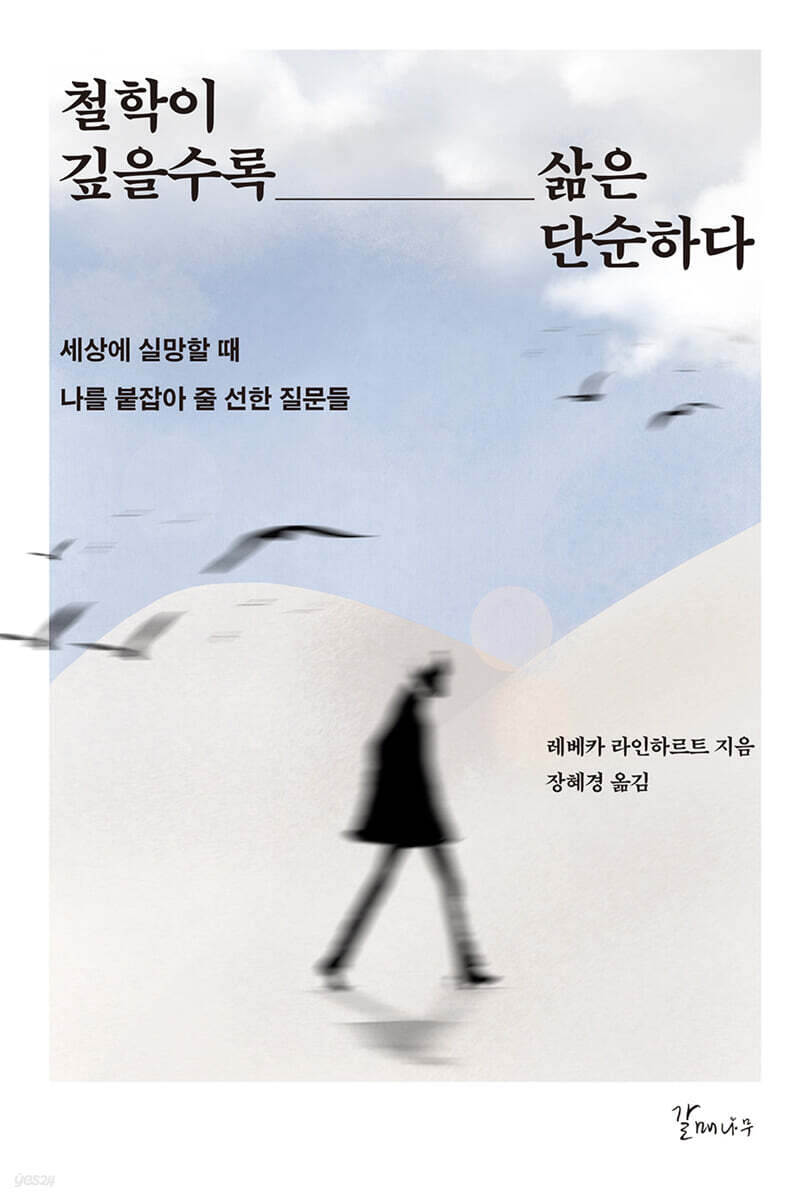
The deeper the philosophy, the simpler life becomes.
 |
Description
Book Introduction
“This book brightly illuminates the belief that this society is sustained by the connection between loving hearts.”
_Kim Min-seop, the protagonist of the 'Find Kim Min-seop Project' introduced on 'You Quiz on the Block'
There are many 'good' people
Why is the world so 'bad'?
Even when life is in crisis, you will definitely find meaning.
Philosophical Insights on the 'Banality of Good'
Have there ever been days when I so desperately wished not to have to hate anyone, not to be worn down by impatience, not to fall into helplessness?
It is because these are times when it is difficult to be optimistic through willpower alone, as hatred runs deep, communication is widespread, and hope is vague.
Of course, we cannot be unaware that humanity has also gone through more chaotic times.
But now, here, a compass is desperately needed.
"The Deeper Your Philosophy, the Simpler Your Life" is a book that awakens the wisdom and inner strength to endure these difficult times, based on the insights of humanity that have matured over the years since Greek philosophy.
Rebecca Reinhardt, a German clinical philosopher and bestselling author, has actively engaged with the public as a self-proclaimed philosophical counselor, with the conviction that she wants to “take philosophy out of the ivory tower and return it to the real world where it belongs.”
This book, which claims to be "an inner compass that will help you find happiness even when life is in crisis," also aims to "ask the right questions and find direction in the chaotic daily lives of modern people."
Especially today, as conflict and confrontation due to economic and political polarization deepen worldwide, and political philosopher Hannah Arendt's concept of the "banality of evil" is receiving attention from various angles, the author proposes a philosophy of affection, warmth, style, and reflection that will realize the "banality of good" in response.
We will be able to find simple yet profound comfort and inspiration in the philosophy of 'the banality of goodness', which will be realized through the names of Eudaimonia (slow happiness), Mesotes (moderate moderation), Sprezzatura (taste and attitude), and Metanoia (self-reflection).
“Our decisions about right and wrong depend on the choices we make about the people we choose to spend our lives with,” Hannah Arendt said in On Evil.
…the ‘banality of evil’ begins with the most mundane indifference, expediency, and principledness, and gradually grows into a disaster.
But I believe that the 'banality of good' can counter this.
Every day, in the small, personal realm.
Of course, it may seem weak or it may be an illusion.
But in this moment, when another person is standing before you, it can be more powerful than any violence.
-In the text
_Kim Min-seop, the protagonist of the 'Find Kim Min-seop Project' introduced on 'You Quiz on the Block'
There are many 'good' people
Why is the world so 'bad'?
Even when life is in crisis, you will definitely find meaning.
Philosophical Insights on the 'Banality of Good'
Have there ever been days when I so desperately wished not to have to hate anyone, not to be worn down by impatience, not to fall into helplessness?
It is because these are times when it is difficult to be optimistic through willpower alone, as hatred runs deep, communication is widespread, and hope is vague.
Of course, we cannot be unaware that humanity has also gone through more chaotic times.
But now, here, a compass is desperately needed.
"The Deeper Your Philosophy, the Simpler Your Life" is a book that awakens the wisdom and inner strength to endure these difficult times, based on the insights of humanity that have matured over the years since Greek philosophy.
Rebecca Reinhardt, a German clinical philosopher and bestselling author, has actively engaged with the public as a self-proclaimed philosophical counselor, with the conviction that she wants to “take philosophy out of the ivory tower and return it to the real world where it belongs.”
This book, which claims to be "an inner compass that will help you find happiness even when life is in crisis," also aims to "ask the right questions and find direction in the chaotic daily lives of modern people."
Especially today, as conflict and confrontation due to economic and political polarization deepen worldwide, and political philosopher Hannah Arendt's concept of the "banality of evil" is receiving attention from various angles, the author proposes a philosophy of affection, warmth, style, and reflection that will realize the "banality of good" in response.
We will be able to find simple yet profound comfort and inspiration in the philosophy of 'the banality of goodness', which will be realized through the names of Eudaimonia (slow happiness), Mesotes (moderate moderation), Sprezzatura (taste and attitude), and Metanoia (self-reflection).
“Our decisions about right and wrong depend on the choices we make about the people we choose to spend our lives with,” Hannah Arendt said in On Evil.
…the ‘banality of evil’ begins with the most mundane indifference, expediency, and principledness, and gradually grows into a disaster.
But I believe that the 'banality of good' can counter this.
Every day, in the small, personal realm.
Of course, it may seem weak or it may be an illusion.
But in this moment, when another person is standing before you, it can be more powerful than any violence.
-In the text
- You can preview some of the book's contents.
Preview
index
Part 1┃If you are anxious, from old wisdom
1.
On Quick Happiness, Slow Happiness, and the Ordinariness of Good
There are so many 'good' people, so why is the world so 'bad'?
How good does one have to be to be called 'good'?
2.
About the addiction to endless thoughts and common sense
Is it okay to have a child in such an uncertain world?
The fact is that we don't actually know much.
3.
Words that ask which side you are on, about right and wrong
There are so many words, but why is there no conversation?
If one side is the 'victim', is the other side the 'perpetrator'?
4.
About three perspectives and values regarding relationships
Are Instagram friends not real relationships?
The moment we become accustomed to the fake and forget the real
Eudaimonia: 'Affection' is about revealing each other's imperfections.
Part 2┃The illusion of the world lies in the details.
5.
Between Desire and Need: On Good Influence
How much can we trust in the power of power influencers?
Have you ever truly experienced the freedom of being 'together'?
6.
Surviving in the Age of Narcissism: On Dignity
Is there a secret to spotting fake gaslighting?
If you embrace fantasy while ignoring reality,
7.
About more, higher, faster, newer and more satisfying
How long can we continue to move forward?
In search of the middle ground that has never been reached before
ㆍMesotes: The virtue of 'warmth' that is not biased towards cold or heat.
Part 3┃Even though we are helpless, we are braver than we think.
8.
To Have or to Be: On Minimalism
Can life be summarized in a balance sheet?
Living a Stoic Lifestyle
9.
Language is the House of Being: On Etiquette
Do you have to like someone to respect them?
We could use a little more kindness
10.
How to Make Your Life a Work of ArtㆍAbout Beauty
Will my life change just by looking at the setting sun?
The magic of experiencing transcendence in everyday life
11.
We have the right to love life. On participation.
What does belonging mean to me?
Thinking Like Simone Weil, Hannah Arendt, and Susan Sontag
ㆍSprezzatura: My own 'style' with flexibility and nonchalance
Part 4┃For the Unbearable Lightness of Being
12.
From Existence to Non-existence, On Meaning
What would a life achieved through ‘self-determination’ look like?
Finding meaning is meaningless, but believing is meaningful.
13.
Death is just a semi-final. About love.
Life is hard enough, so why should we delve into the meaning of death?
What remains when one's life comes to an end
14.
A Dialogue Between an Optimist and a Pessimist: On Time
Can we expect the worst and hope for the best?
Living as Schopenhauer or Oprah Winfrey
15.
On moving forward and taking risks, and on trust.
Who decides what is important and what is trivial?
Affirmation towards a lighter life
ㆍMetanoia: 'Reflection' means looking at the world from a different perspective.
1.
On Quick Happiness, Slow Happiness, and the Ordinariness of Good
There are so many 'good' people, so why is the world so 'bad'?
How good does one have to be to be called 'good'?
2.
About the addiction to endless thoughts and common sense
Is it okay to have a child in such an uncertain world?
The fact is that we don't actually know much.
3.
Words that ask which side you are on, about right and wrong
There are so many words, but why is there no conversation?
If one side is the 'victim', is the other side the 'perpetrator'?
4.
About three perspectives and values regarding relationships
Are Instagram friends not real relationships?
The moment we become accustomed to the fake and forget the real
Eudaimonia: 'Affection' is about revealing each other's imperfections.
Part 2┃The illusion of the world lies in the details.
5.
Between Desire and Need: On Good Influence
How much can we trust in the power of power influencers?
Have you ever truly experienced the freedom of being 'together'?
6.
Surviving in the Age of Narcissism: On Dignity
Is there a secret to spotting fake gaslighting?
If you embrace fantasy while ignoring reality,
7.
About more, higher, faster, newer and more satisfying
How long can we continue to move forward?
In search of the middle ground that has never been reached before
ㆍMesotes: The virtue of 'warmth' that is not biased towards cold or heat.
Part 3┃Even though we are helpless, we are braver than we think.
8.
To Have or to Be: On Minimalism
Can life be summarized in a balance sheet?
Living a Stoic Lifestyle
9.
Language is the House of Being: On Etiquette
Do you have to like someone to respect them?
We could use a little more kindness
10.
How to Make Your Life a Work of ArtㆍAbout Beauty
Will my life change just by looking at the setting sun?
The magic of experiencing transcendence in everyday life
11.
We have the right to love life. On participation.
What does belonging mean to me?
Thinking Like Simone Weil, Hannah Arendt, and Susan Sontag
ㆍSprezzatura: My own 'style' with flexibility and nonchalance
Part 4┃For the Unbearable Lightness of Being
12.
From Existence to Non-existence, On Meaning
What would a life achieved through ‘self-determination’ look like?
Finding meaning is meaningless, but believing is meaningful.
13.
Death is just a semi-final. About love.
Life is hard enough, so why should we delve into the meaning of death?
What remains when one's life comes to an end
14.
A Dialogue Between an Optimist and a Pessimist: On Time
Can we expect the worst and hope for the best?
Living as Schopenhauer or Oprah Winfrey
15.
On moving forward and taking risks, and on trust.
Who decides what is important and what is trivial?
Affirmation towards a lighter life
ㆍMetanoia: 'Reflection' means looking at the world from a different perspective.
Detailed image

Into the book
Efficient thinking is completely different from philosophical thinking.
Efficient thinking must be fast and not allow for doubt.
While it is possible to think about ethical issues 'effectively,' such answers are likely to be somewhat superficial.
But if you think about good in a philosophical way, the pressure of 'I have to' will disappear.
You will have an inner space that will allow you to move into a state of admiration.
--- From "On Common Sense"
An acquaintance of mine who is in the intensive care unit posts a live feed from his hospital bed on Facebook every day, and his friends respond with likes and tears.
… … Comments and emoticons posted to express sympathy are meaningless if they are part of an automated action-reaction mechanism.
But if it's a crucial path to a patient's survival, this Facebook activity isn't an empty interaction.
There, what Buber called “true life” will take place in the form of free, vibrant, and original encounters.
--- From "On Value"
Manners are not only ethically meaningful, but are also a skill that can liven up the atmosphere.
As the French philosopher Henri Bergson said, “Courtesy creates a nimble and lively sympathy among souls” and shows us “an ideal other world.”
--- From "On Etiquette"
A sure proof that you are on the right path is the forgetting of 'I'.
You can do creative activities or just look at beautiful objects with eyes of admiration.
When you focus on beauty, your ego becomes as small as a grain of sand.
Immerse yourself in a mystical experience of transcendence.
… … A rose placed on the bedside of a dying patient can be the greatest comfort in the world.
Just as watching the setting sun can change your life.
--- From "On Beauty"
As sociologist Niklas Luhmann says, trust reduces complexity.
It allows you to take action here and now without wasting time worrying.
But on the other hand, there are always risks to be taken.
Because the other party may use the trust you have given them in advance for their own purposes.
… … Even if the ability to soar with confidence takes you to more dangerous places, what kind of life would it be without it? It would be a narrow and dull life, governed by the laws of rational choice.
Efficient thinking must be fast and not allow for doubt.
While it is possible to think about ethical issues 'effectively,' such answers are likely to be somewhat superficial.
But if you think about good in a philosophical way, the pressure of 'I have to' will disappear.
You will have an inner space that will allow you to move into a state of admiration.
--- From "On Common Sense"
An acquaintance of mine who is in the intensive care unit posts a live feed from his hospital bed on Facebook every day, and his friends respond with likes and tears.
… … Comments and emoticons posted to express sympathy are meaningless if they are part of an automated action-reaction mechanism.
But if it's a crucial path to a patient's survival, this Facebook activity isn't an empty interaction.
There, what Buber called “true life” will take place in the form of free, vibrant, and original encounters.
--- From "On Value"
Manners are not only ethically meaningful, but are also a skill that can liven up the atmosphere.
As the French philosopher Henri Bergson said, “Courtesy creates a nimble and lively sympathy among souls” and shows us “an ideal other world.”
--- From "On Etiquette"
A sure proof that you are on the right path is the forgetting of 'I'.
You can do creative activities or just look at beautiful objects with eyes of admiration.
When you focus on beauty, your ego becomes as small as a grain of sand.
Immerse yourself in a mystical experience of transcendence.
… … A rose placed on the bedside of a dying patient can be the greatest comfort in the world.
Just as watching the setting sun can change your life.
--- From "On Beauty"
As sociologist Niklas Luhmann says, trust reduces complexity.
It allows you to take action here and now without wasting time worrying.
But on the other hand, there are always risks to be taken.
Because the other party may use the trust you have given them in advance for their own purposes.
… … Even if the ability to soar with confidence takes you to more dangerous places, what kind of life would it be without it? It would be a narrow and dull life, governed by the laws of rational choice.
--- From "On Trust"
Publisher's Review
Why is the world so absurd and yet so beautiful?
About attitudes and decisions that bring happiness in any situation
I came home feeling elated after hearing the news of my promotion, but the water pipe burst and the house was a mess.
Why does the world not work the way I want it to? As a philosopher grounded in reality, the author begins his story by questioning the factors that hinder happiness in ordinary daily life.
Human happiness is actually influenced by the good mood that hormones bring, and happiness that gives a quick mood tends to disappear as quickly as it comes.
On the other hand, there is a slow happiness that is quiet, gentle, and unassuming, but does not break easily.
Aristotle and other Greek philosophers recognized early on that this 'slow happiness' was connected to an ethical attitude, and they called it 'eudaimonia' (p. 18) and have been practicing it for a long time.
Starting from Hinduism and Buddhism, its spiritual teachings and philosophy have continued through the 'voluntary self-denial' practiced by Diogenes, the 'arete' pursued by the Stoics, and the 'art of being' proposed by Erich Fromm.
“If all people pursued eudaimonia rather than quick happiness, there would be less jealousy, less strife, less hatred, less lethal weapons, and less unhappiness.
Slow happiness will steadily increase and bring peace to the world.
It's a very attractive future, but it's also a difficult prospect to embrace.
“Because humans are quite foolish and impatient creatures.”
This slow happiness grows whenever we combine ethics and action, that is, whenever we practice goodness.
Our sense of need is reduced, and our feelings of anxiety and loss are also reduced.
It is on a different level from the quick happiness that comes from comparing yourself to others and pursuing pleasure while shouting, “More, higher, faster, newer.”
This is why the author suggests that it is a challenge worth taking on, or perhaps even an unavoidable one.
“We believe that if we don’t constantly think, we won’t survive, we won’t succeed, we won’t be happy.
…thinking addiction pressures us to anticipate everything and be right in everything.
As a result, selfishness and self-righteousness are seen everywhere.
“Anxiety and lack of freedom remain, and the dictator who distracted you secretly smiles in satisfaction.”
Zen is the art of taking action even if you don't understand the situation rationally.
We do not know why life punishes those who have done nothing wrong, or why humanity has not yet been able to eradicate evil.
I just know that darkness is a part of the world.
If we are stuck in a state of thought addiction—what the author calls "cognitive streaming" (p. 33)—where we try to rationally control our situations while remaining trapped in unanswerable worries, we will not be able to open our eyes to the diversity of the world and the richness of life.
There is only one important question.
What good can I do right now? The answer is simple.
You can do what you want and put it into action here and now.
You don't have to be Mother Teresa or Gandhi.
There is no need to sacrifice yourself.
All it takes is a kind smile to someone who looks tired, a phone call to a friend and a dedicated ear, or giving up the line to someone anxious about a crying child.
Without compulsion, without obligation, freely.
Do you want to be a good person?
Thinking Like Simone Weil, Hannah Arendt, and Susan Sontag
We don't want to be bad people.
I don't even understand why there is injustice, hatred, violence and war.
In fact, we all want the same thing.
More slow happiness, more humanity, more ordinary kindness.
But the pace of the world is always ahead of our pace, and terrible things we don't want to believe and narcissists we don't want to see are constantly appearing.
In this context, it is also questionable whether the 'ordinariness of good' can truly be effective and whether it will benefit the bad.
But there have always been those who have overcome the 'banality of evil' with a spirit of resistance to the empty crowd that easily falls into evil and a determination not to be swayed by chance and fate.
The author calls this attitude and momentum 'style' and introduces three philosophers in particular.
Simone Weil, Hannah Arendt, and Susan Sontag, who respected the dignity of others and themselves and confronted painful realities, are examples. (p. 206)
“The times in which they lived and worked were different from today, but conformity, indifference, and cowardice are constants of daily life in human society, just like injustice, violence, and war.
But this also applies to ordinary good, which can shatter the banality of evil.
“Like a yellow dandelion poking through the ground next to gray cement.”
However, this does not mean that we should live a heavy life so as not to compromise with the world.
They loved their lives more than anyone else and pursued happiness and beauty.
When you break the chains of obligation and rules with a cool, nonchalant attitude like them, you can live your daily life in style with sprezzatura, making even the most difficult tasks seem easy.
I can let go of my strength and be honest, human, and a good person in my own way.
“All human beings are in a process of eternal change.
Life shapes a person in the way he or she makes himself by what he or she does or does not do.
It is only at the end of his life that we can know what kind of person he became.
A person you haven't seen for a long time and suddenly meet one day is like a novel.
The title of the novel is either 'Nothing Has Changed' or 'I Almost Didn't Recognize You'.
So how good the novel you write will be depends on the way you change.”
Can we still believe in human goodness?
Living like Schopenhauer or Oprah Winfrey
Why is there so much talk, yet so little dialogue? How can we endure this age of narcissism? How long can we continue to move forward? Can we expect the worst and hope for the best? "The Deeper Your Philosophy, the Simpler Your Life" invites a diverse group of philosophers, sociologists, and writers to offer insightful insights into the questions we face as we navigate modern society.
In particular, the composition stands out by presenting the complex and subtle situations of daily life in detail in each chapter and helping us look at them from a different perspective.
“You were at a recent gathering where everyone was criticizing a certain politician, and you said, ‘I thought he was okay, didn’t I?’ and then you looked for an opportunity to back up that opinion.
But it was too late.
All that comes back are confused looks, bewildered silence, and sarcastic retorts.”
In this case that questions 'correctness,' the author cites the words of British philosopher Mary Midgley, who said, "Everyone has a negative," reminding us that no one is only 'cool' or 'pathetic.' (p. 60) Like a negative film, the parts that appear dark may actually be the brightest parts.
Furthermore, borrowing the concept of "moral panic" from South African sociologist Stanley Cohen, he warns that the more social anxiety fuels a "moral panic" that fuels fear, the more likely it is that hasty diagnoses and ideologies will be applied. (p. 56) Partisanship and schematic answers only exacerbate the confusion.
In this way, through reflections that intersect and permeate each other, thoughts deepen, and tangled concerns gradually become simple and clear.
“What will be left if we give up kindness and conversation? There is only one thing left to fear.
“Life passes by without a single smile, that is the only thing that is scary.”
“Oprah, the optimist, is busy sending positive messages to her viewers, while Arthur, the pessimist, is obsessed with pessimism.
No one really listens to each other or responds properly.
“One side wants to see only the good, and the other side cannot see anything good, so both of them miss out on precious moments.”
The philosophy on 'time' left by the virtual conversation (page 270) between optimist Oprah Winfrey and pessimist Arthur Schopenhauer is also impressive.
Those two, who only stay in utopia and dystopia respectively, can never live in the present.
On the other hand, realists, who expect the worst while simultaneously hoping for the best, do their utmost to cultivate meaning and happiness while not ignoring the meaninglessness of life on earth.
We live with and for our parents, spouse, children, friends, and colleagues, and we create the reality of that life.
From the banality of good to the power of good influence, along with common sense, righteousness, dignity, contentment, courtesy, beauty, participation, meaning, love, time, and trust, this book addresses philosophical values we should all contemplate at least once in our lives, along with practical questions.
If we use the advice of these thinkers who have dedicated their lives to finding the answer as a compass, we will be able to walk hand in hand with those who share warmth and comfort, and even if we sometimes wander, at least we will not lose our direction.
About attitudes and decisions that bring happiness in any situation
I came home feeling elated after hearing the news of my promotion, but the water pipe burst and the house was a mess.
Why does the world not work the way I want it to? As a philosopher grounded in reality, the author begins his story by questioning the factors that hinder happiness in ordinary daily life.
Human happiness is actually influenced by the good mood that hormones bring, and happiness that gives a quick mood tends to disappear as quickly as it comes.
On the other hand, there is a slow happiness that is quiet, gentle, and unassuming, but does not break easily.
Aristotle and other Greek philosophers recognized early on that this 'slow happiness' was connected to an ethical attitude, and they called it 'eudaimonia' (p. 18) and have been practicing it for a long time.
Starting from Hinduism and Buddhism, its spiritual teachings and philosophy have continued through the 'voluntary self-denial' practiced by Diogenes, the 'arete' pursued by the Stoics, and the 'art of being' proposed by Erich Fromm.
“If all people pursued eudaimonia rather than quick happiness, there would be less jealousy, less strife, less hatred, less lethal weapons, and less unhappiness.
Slow happiness will steadily increase and bring peace to the world.
It's a very attractive future, but it's also a difficult prospect to embrace.
“Because humans are quite foolish and impatient creatures.”
This slow happiness grows whenever we combine ethics and action, that is, whenever we practice goodness.
Our sense of need is reduced, and our feelings of anxiety and loss are also reduced.
It is on a different level from the quick happiness that comes from comparing yourself to others and pursuing pleasure while shouting, “More, higher, faster, newer.”
This is why the author suggests that it is a challenge worth taking on, or perhaps even an unavoidable one.
“We believe that if we don’t constantly think, we won’t survive, we won’t succeed, we won’t be happy.
…thinking addiction pressures us to anticipate everything and be right in everything.
As a result, selfishness and self-righteousness are seen everywhere.
“Anxiety and lack of freedom remain, and the dictator who distracted you secretly smiles in satisfaction.”
Zen is the art of taking action even if you don't understand the situation rationally.
We do not know why life punishes those who have done nothing wrong, or why humanity has not yet been able to eradicate evil.
I just know that darkness is a part of the world.
If we are stuck in a state of thought addiction—what the author calls "cognitive streaming" (p. 33)—where we try to rationally control our situations while remaining trapped in unanswerable worries, we will not be able to open our eyes to the diversity of the world and the richness of life.
There is only one important question.
What good can I do right now? The answer is simple.
You can do what you want and put it into action here and now.
You don't have to be Mother Teresa or Gandhi.
There is no need to sacrifice yourself.
All it takes is a kind smile to someone who looks tired, a phone call to a friend and a dedicated ear, or giving up the line to someone anxious about a crying child.
Without compulsion, without obligation, freely.
Do you want to be a good person?
Thinking Like Simone Weil, Hannah Arendt, and Susan Sontag
We don't want to be bad people.
I don't even understand why there is injustice, hatred, violence and war.
In fact, we all want the same thing.
More slow happiness, more humanity, more ordinary kindness.
But the pace of the world is always ahead of our pace, and terrible things we don't want to believe and narcissists we don't want to see are constantly appearing.
In this context, it is also questionable whether the 'ordinariness of good' can truly be effective and whether it will benefit the bad.
But there have always been those who have overcome the 'banality of evil' with a spirit of resistance to the empty crowd that easily falls into evil and a determination not to be swayed by chance and fate.
The author calls this attitude and momentum 'style' and introduces three philosophers in particular.
Simone Weil, Hannah Arendt, and Susan Sontag, who respected the dignity of others and themselves and confronted painful realities, are examples. (p. 206)
“The times in which they lived and worked were different from today, but conformity, indifference, and cowardice are constants of daily life in human society, just like injustice, violence, and war.
But this also applies to ordinary good, which can shatter the banality of evil.
“Like a yellow dandelion poking through the ground next to gray cement.”
However, this does not mean that we should live a heavy life so as not to compromise with the world.
They loved their lives more than anyone else and pursued happiness and beauty.
When you break the chains of obligation and rules with a cool, nonchalant attitude like them, you can live your daily life in style with sprezzatura, making even the most difficult tasks seem easy.
I can let go of my strength and be honest, human, and a good person in my own way.
“All human beings are in a process of eternal change.
Life shapes a person in the way he or she makes himself by what he or she does or does not do.
It is only at the end of his life that we can know what kind of person he became.
A person you haven't seen for a long time and suddenly meet one day is like a novel.
The title of the novel is either 'Nothing Has Changed' or 'I Almost Didn't Recognize You'.
So how good the novel you write will be depends on the way you change.”
Can we still believe in human goodness?
Living like Schopenhauer or Oprah Winfrey
Why is there so much talk, yet so little dialogue? How can we endure this age of narcissism? How long can we continue to move forward? Can we expect the worst and hope for the best? "The Deeper Your Philosophy, the Simpler Your Life" invites a diverse group of philosophers, sociologists, and writers to offer insightful insights into the questions we face as we navigate modern society.
In particular, the composition stands out by presenting the complex and subtle situations of daily life in detail in each chapter and helping us look at them from a different perspective.
“You were at a recent gathering where everyone was criticizing a certain politician, and you said, ‘I thought he was okay, didn’t I?’ and then you looked for an opportunity to back up that opinion.
But it was too late.
All that comes back are confused looks, bewildered silence, and sarcastic retorts.”
In this case that questions 'correctness,' the author cites the words of British philosopher Mary Midgley, who said, "Everyone has a negative," reminding us that no one is only 'cool' or 'pathetic.' (p. 60) Like a negative film, the parts that appear dark may actually be the brightest parts.
Furthermore, borrowing the concept of "moral panic" from South African sociologist Stanley Cohen, he warns that the more social anxiety fuels a "moral panic" that fuels fear, the more likely it is that hasty diagnoses and ideologies will be applied. (p. 56) Partisanship and schematic answers only exacerbate the confusion.
In this way, through reflections that intersect and permeate each other, thoughts deepen, and tangled concerns gradually become simple and clear.
“What will be left if we give up kindness and conversation? There is only one thing left to fear.
“Life passes by without a single smile, that is the only thing that is scary.”
“Oprah, the optimist, is busy sending positive messages to her viewers, while Arthur, the pessimist, is obsessed with pessimism.
No one really listens to each other or responds properly.
“One side wants to see only the good, and the other side cannot see anything good, so both of them miss out on precious moments.”
The philosophy on 'time' left by the virtual conversation (page 270) between optimist Oprah Winfrey and pessimist Arthur Schopenhauer is also impressive.
Those two, who only stay in utopia and dystopia respectively, can never live in the present.
On the other hand, realists, who expect the worst while simultaneously hoping for the best, do their utmost to cultivate meaning and happiness while not ignoring the meaninglessness of life on earth.
We live with and for our parents, spouse, children, friends, and colleagues, and we create the reality of that life.
From the banality of good to the power of good influence, along with common sense, righteousness, dignity, contentment, courtesy, beauty, participation, meaning, love, time, and trust, this book addresses philosophical values we should all contemplate at least once in our lives, along with practical questions.
If we use the advice of these thinkers who have dedicated their lives to finding the answer as a compass, we will be able to walk hand in hand with those who share warmth and comfort, and even if we sometimes wander, at least we will not lose our direction.
GOODS SPECIFICS
- Date of issue: April 30, 2025
- Page count, weight, size: 316 pages | 382g | 135*200*20mm
- ISBN13: 9791191842869
- ISBN10: 119184286X
You may also like
카테고리
korean


korean

![ELLE 엘르 스페셜 에디션 A형 : 12월 [2025]](http://librairie.coreenne.fr/cdn/shop/files/b8e27a3de6c9538896439686c6b0e8fb.jpg?v=1766436872&width=3840)


