

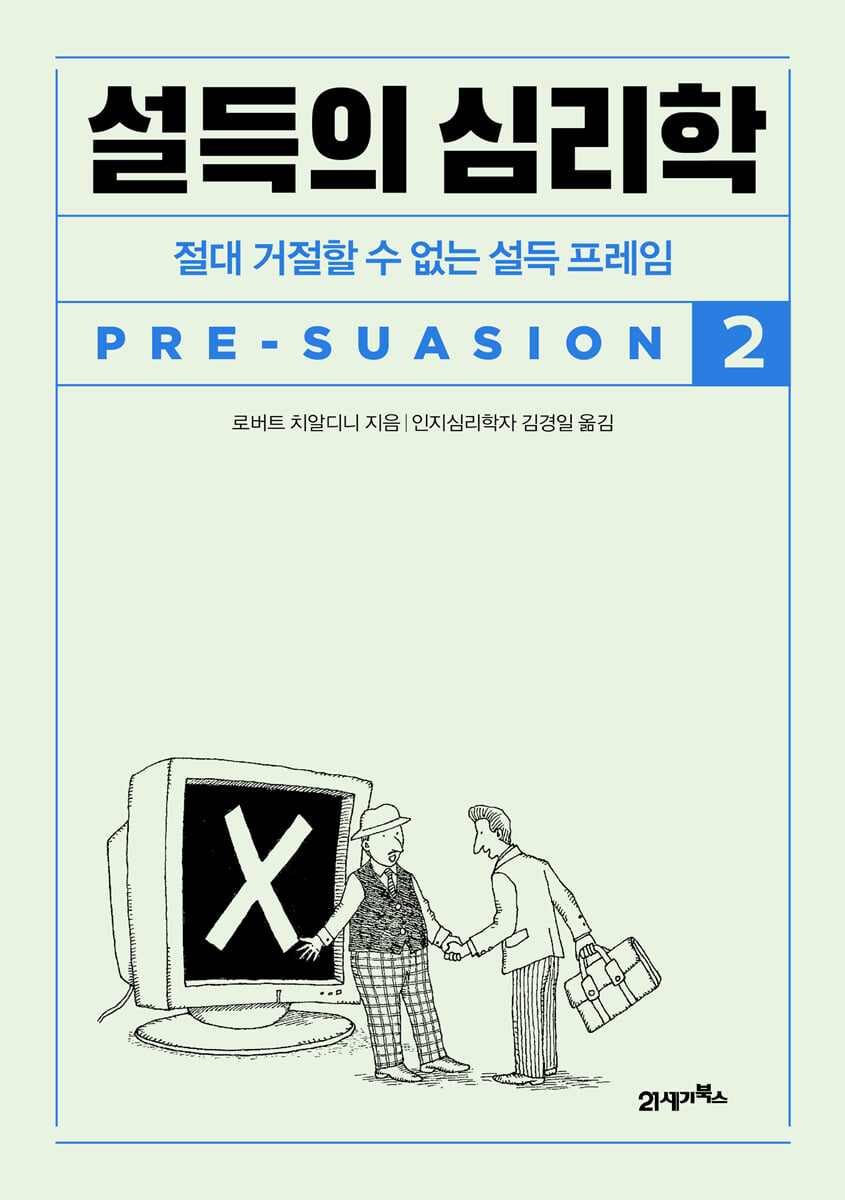
The Psychology of Persuasion 2
 |
Description
Book Introduction
Amazon's #1 in Public Speaking and Negotiation!
A New York Times and Wall Street Journal bestseller!
Financial Times' Best Business Book of the Year!
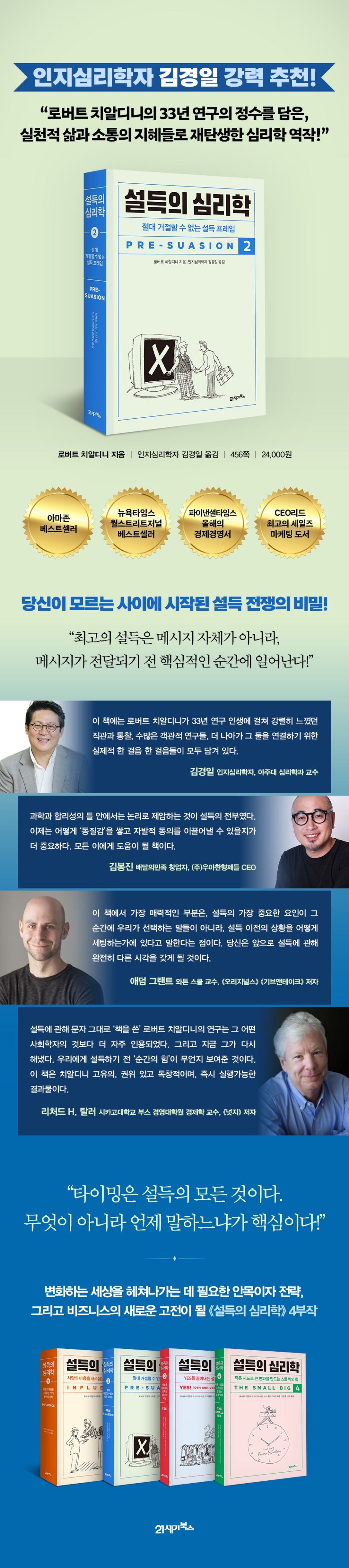
Highly recommended by cognitive psychologist Kim Kyung-il!
“A masterpiece of psychology, reborn with the wisdom of practical life and communication, containing the essence of Cialdini’s 33 years of research!”
The secret to the war of persuasion that started without you knowing!
The best persuasion happens not in the message itself, but in the key moments before the message is delivered!
This book contains the essence of the results of 33 years of direct research since the publication of the best-selling book 『Influence』 by Robert Cialdini, who is known worldwide as the 'godfather of persuasion.'
『Pre-Persuasion』, which became a bestseller immediately after its publication, was revised and republished as 『Psychology of Persuasion 2』 to add strength to the 'Psychology of Persuasion Series'.
In this revised edition, we have revamped the text by organizing it in language that is easy for readers to understand.
We are exposed to dozens of advertisements and promotional materials every day, including newspapers, TV, and other media channels, as well as information on social media via mobile devices, and even on store signs on the street.
They try to win our hearts with captivating phrases and images, and they really do.
So how do marketers make us receptive to their ads? A closer look reveals a pre-programmed mechanism designed to induce people to buy the product.
What is that?
According to Dr. Robert Cialdini, a guru to salespeople and marketers around the world, the success of persuasion lies not in the message itself.
More important than successfully persuading people by exploiting their psychology and behavioral patterns is designing a situation that makes them say "yes."
This book introduces how to create that very appropriate 'context'.
In particular, the author strengthens the validity of the book by combining scientific research with case studies from various situations and fields, while explaining it in an easy-to-understand way so that anyone can apply it in real life.
It will open up new horizons in the business world by presenting new principles of persuasion that overturn conventional wisdom about persuasion techniques.
A New York Times and Wall Street Journal bestseller!
Financial Times' Best Business Book of the Year!
Highly recommended by cognitive psychologist Kim Kyung-il!
“A masterpiece of psychology, reborn with the wisdom of practical life and communication, containing the essence of Cialdini’s 33 years of research!”
The secret to the war of persuasion that started without you knowing!
The best persuasion happens not in the message itself, but in the key moments before the message is delivered!
This book contains the essence of the results of 33 years of direct research since the publication of the best-selling book 『Influence』 by Robert Cialdini, who is known worldwide as the 'godfather of persuasion.'
『Pre-Persuasion』, which became a bestseller immediately after its publication, was revised and republished as 『Psychology of Persuasion 2』 to add strength to the 'Psychology of Persuasion Series'.
In this revised edition, we have revamped the text by organizing it in language that is easy for readers to understand.
We are exposed to dozens of advertisements and promotional materials every day, including newspapers, TV, and other media channels, as well as information on social media via mobile devices, and even on store signs on the street.
They try to win our hearts with captivating phrases and images, and they really do.
So how do marketers make us receptive to their ads? A closer look reveals a pre-programmed mechanism designed to induce people to buy the product.
What is that?
According to Dr. Robert Cialdini, a guru to salespeople and marketers around the world, the success of persuasion lies not in the message itself.
More important than successfully persuading people by exploiting their psychology and behavioral patterns is designing a situation that makes them say "yes."
This book introduces how to create that very appropriate 'context'.
In particular, the author strengthens the validity of the book by combining scientific research with case studies from various situations and fields, while explaining it in an easy-to-understand way so that anyone can apply it in real life.
It will open up new horizons in the business world by presenting new principles of persuasion that overturn conventional wisdom about persuasion techniques.
- You can preview some of the book's contents.
Preview
index
Advance Book Review Group Recommendation
Praise for this book
Translator's Note: Psychology Reborn Through the Wisdom of Practical Life and Communication
Author's Note: How Irresistible Persuasion Begins
PART 1: Designing a Moment of Persuasion
Chapter 1: Persuade Before You Send a Message
The moment of attention determines the other person's response | Six principles of effective persuasion |
A Scientific Approach to Persuasion | Persuasion is All About Timing
Chapter 2: Seize the Moment to Your Advantage
It's not a scam or a trick, it's the focus | A moment of unfairly designed privilege |
Guided Attention | The Masters of Focused Attention
Chapter 3: The moment you pay attention, it becomes important.
The Focus Illusion: The Limits of Limited Attention | Ways to Shift Attention
Chapter 4: When Importance Changes, Causality Changes
The Strange Influence of the Tylenol Case | How to Avoid the Trap of False Confessions
Chapter 5: How to Attract Attention
Sexual | Violent | Attention-seeking vs.
Highly persuasive
Chapter 6 How to Stay Attention
Information related to me | The effect of unfinished tasks | Use mystery
PART 2: Create the optimal situation for persuasion.
Chapter 7: The Power of Association: It's All Connected
Thoughts are connections | The word 'achievement' brings achievement |
The surprising persuasive power of metaphorical expressions
Chapter 8: The Geography of Persuasion: How Physical and Psychological Spaces Shape Emotions
The Contagiousness of Our Embedded Experiences | The Real Cause Hidden in Stereotypes
Chapter 9: Mechanisms of Persuasion: Causes, Limitations, and Alternatives
Prepare and wait | Free yourself from undesirable influences |
Why Choose Shortcuts in Decision Making
PART 3: Choose the Best Method for Persuasion
Chapter 10: Six Paths to Change That Produce the Best Results
The Six Principles of Persuasion | How to Apply the Principles of Persuasion
Chapter 11: Solidarity 1: Being Together
Solidarity: We Are a Shared Self | Existing Together
Chapter 12: Solidarity 2: Acting Together
From Similarity to Liking | The Self-Sacrifice of Sympathetic Behavior | Music Struggling for Persuasion |
Our Mind System | Continuous Interaction | Co-creation | Coming Together
Chapter 13: Ethical Persuasion
Three Characteristics of a Dishonest Organization
Chapter 14: How to Make Persuasion Last
A Powerful Commitment to Lasting Change | Creating Lasting Change Through Clues |
Where we are determines our choices
annotation
References
Praise for this book
Translator's Note: Psychology Reborn Through the Wisdom of Practical Life and Communication
Author's Note: How Irresistible Persuasion Begins
PART 1: Designing a Moment of Persuasion
Chapter 1: Persuade Before You Send a Message
The moment of attention determines the other person's response | Six principles of effective persuasion |
A Scientific Approach to Persuasion | Persuasion is All About Timing
Chapter 2: Seize the Moment to Your Advantage
It's not a scam or a trick, it's the focus | A moment of unfairly designed privilege |
Guided Attention | The Masters of Focused Attention
Chapter 3: The moment you pay attention, it becomes important.
The Focus Illusion: The Limits of Limited Attention | Ways to Shift Attention
Chapter 4: When Importance Changes, Causality Changes
The Strange Influence of the Tylenol Case | How to Avoid the Trap of False Confessions
Chapter 5: How to Attract Attention
Sexual | Violent | Attention-seeking vs.
Highly persuasive
Chapter 6 How to Stay Attention
Information related to me | The effect of unfinished tasks | Use mystery
PART 2: Create the optimal situation for persuasion.
Chapter 7: The Power of Association: It's All Connected
Thoughts are connections | The word 'achievement' brings achievement |
The surprising persuasive power of metaphorical expressions
Chapter 8: The Geography of Persuasion: How Physical and Psychological Spaces Shape Emotions
The Contagiousness of Our Embedded Experiences | The Real Cause Hidden in Stereotypes
Chapter 9: Mechanisms of Persuasion: Causes, Limitations, and Alternatives
Prepare and wait | Free yourself from undesirable influences |
Why Choose Shortcuts in Decision Making
PART 3: Choose the Best Method for Persuasion
Chapter 10: Six Paths to Change That Produce the Best Results
The Six Principles of Persuasion | How to Apply the Principles of Persuasion
Chapter 11: Solidarity 1: Being Together
Solidarity: We Are a Shared Self | Existing Together
Chapter 12: Solidarity 2: Acting Together
From Similarity to Liking | The Self-Sacrifice of Sympathetic Behavior | Music Struggling for Persuasion |
Our Mind System | Continuous Interaction | Co-creation | Coming Together
Chapter 13: Ethical Persuasion
Three Characteristics of a Dishonest Organization
Chapter 14: How to Make Persuasion Last
A Powerful Commitment to Lasting Change | Creating Lasting Change Through Clues |
Where we are determines our choices
annotation
References
Detailed image
Into the book
The value of advance planning can be clearly seen in the words of Sun Tzu, the ancient Chinese military strategist, who said, “The outcome of every battle is decided before it is fought.”
Consultants are taught to first establish themselves as "trusted advisors" before accepting work from clients.
Dale Carnegie was convinced that “You make more friends by being genuinely interested in people for two months than by trying to get them to be interested in you for two years.”
All of this is undoubtedly wise advice.
But there is something missing here too.
This is because prior activities on a daily, weekly or monthly basis are also required.
This book fills that void.
--- p.20 From “Author’s Note, How Irresistible Persuasion Begins”
What's even more surprising is that the "power of first appearance" isn't limited to cases where large numbers appear first.
In one study, college students were divided into two groups and asked to draw long and short lines on a piece of paper.
Then, when asked to estimate the length of the Mississippi River, students who drew a long line estimated the river to be much longer than those who drew a short line.
Moreover, the 'power of first appearance' applies even in situations that have nothing to do with numbers.
When German music played in a wine shop while customers were choosing wine, they were more likely to buy German vintage wines, and when French music played, they were more likely to buy French vintage wines.
As such, it is not just one specific experience that influences what happens later.
It could be a number, the length of a line, or a type of background music.
As we will see in more detail later, the phenomenon of momentary attention altering people's responses can occur in any psychological subject.
--- p.33~34, from “Chapter 1: Designing the Moment of Persuasion”
In short, because what stands out is considered important and the object of focus is often seen as the cause, there is an advantage in communication in that drawing people's attention to a particular aspect of the message can already create a significant level of receptivity in them.
In fact, this kind of directed attention breaks down the listener's guard during the initial persuasion stage.
Before you even process that message, you've already opened the lock on your heart.
This is every persuader's dream.
Because the hardest part of persuasion isn't communicating the merits of your message, but getting people to dedicate their time and energy to it.
--- p.116~117, from “Chapter 4: When Importance Changes, Causality Changes”
What kind of presence, what kind of perceived relationship, maximizes coworker favorability? The answer requires a subtle but important distinction.
The relationships that lead people to do the most practical favors are not the ones that say, “Oh, that person is like us,” but the ones that say, “Oh, that person is of us.”
Let's take an example.
I have more in common with my coworkers than with my siblings in terms of tastes and preferences, but I know which of them I consider "of me" and which I consider "like me," and which I'm more likely to help when asked.
The experience of solidarity is not simply about similarity.
(Similarity may also play a role, but only to a lesser extent, due to the principle of liking.) What matters is shared identity.
--- p.262~264, from “Chapter 11 Solidarity 1: Existing Together”
Indeed, archaeological and anthropological records clearly show that all human societies have developed ways of responding together or simultaneously, in the form of song, march, ritual, chant, prayer, and dance.
Moreover, these things have been done since prehistoric times.
For example, scenes of group dancing are quite often depicted in paintings, petroglyphs, and cave paintings from the Neolithic Age and the Chalcolithic Age (the transitional period from the Stone Age to the Bronze Age - translator's note).
Behavioral science research clearly reveals the reason.
Because people actually become more united when they act in a unified way.
As a result, group solidarity serves the interests of society by enabling a degree of loyalty and self-sacrifice usually seen only in much smaller family units.
Thus, human societies, even in ancient times, appear to have discovered a group cohesion 'technology' that involves coordinated responses.
The effect is similar to that seen only in blood relations - we-ness, merger, blurred boundaries between self and other.
--- p.287~288, from “Chapter 12 Solidarity 2: Acting Together”
Patients who don't show up for hospital or dental appointments cause more than just inconvenience.
They cause significant cost losses in the health and welfare sector.
Hospitals commonly call patients the day before their appointments to remind them of their appointments as a way to reduce no-shows.
In a study conducted by my colleague Steve Martin at a medical school in the UK, these efforts reduced the so-called no-show rate by 3.5 percent.
However, phone notification services not only require time and money, but they also do not always reach the expected goals.
Let's compare this method with a wise way of using the appointment procedure.
When it comes to making a follow-up appointment after a hospital visit, we all know what the process is like.
The reception desk writes the next appointment date and time on a card and gives it to the patient.
Instead of doing this, ask patients to fill out a card, and this action step will make them more likely to keep their appointment.
When this cost-free procedure was tried at a British medical school, no-show rates were reduced by 18 percent.
Consultants are taught to first establish themselves as "trusted advisors" before accepting work from clients.
Dale Carnegie was convinced that “You make more friends by being genuinely interested in people for two months than by trying to get them to be interested in you for two years.”
All of this is undoubtedly wise advice.
But there is something missing here too.
This is because prior activities on a daily, weekly or monthly basis are also required.
This book fills that void.
--- p.20 From “Author’s Note, How Irresistible Persuasion Begins”
What's even more surprising is that the "power of first appearance" isn't limited to cases where large numbers appear first.
In one study, college students were divided into two groups and asked to draw long and short lines on a piece of paper.
Then, when asked to estimate the length of the Mississippi River, students who drew a long line estimated the river to be much longer than those who drew a short line.
Moreover, the 'power of first appearance' applies even in situations that have nothing to do with numbers.
When German music played in a wine shop while customers were choosing wine, they were more likely to buy German vintage wines, and when French music played, they were more likely to buy French vintage wines.
As such, it is not just one specific experience that influences what happens later.
It could be a number, the length of a line, or a type of background music.
As we will see in more detail later, the phenomenon of momentary attention altering people's responses can occur in any psychological subject.
--- p.33~34, from “Chapter 1: Designing the Moment of Persuasion”
In short, because what stands out is considered important and the object of focus is often seen as the cause, there is an advantage in communication in that drawing people's attention to a particular aspect of the message can already create a significant level of receptivity in them.
In fact, this kind of directed attention breaks down the listener's guard during the initial persuasion stage.
Before you even process that message, you've already opened the lock on your heart.
This is every persuader's dream.
Because the hardest part of persuasion isn't communicating the merits of your message, but getting people to dedicate their time and energy to it.
--- p.116~117, from “Chapter 4: When Importance Changes, Causality Changes”
What kind of presence, what kind of perceived relationship, maximizes coworker favorability? The answer requires a subtle but important distinction.
The relationships that lead people to do the most practical favors are not the ones that say, “Oh, that person is like us,” but the ones that say, “Oh, that person is of us.”
Let's take an example.
I have more in common with my coworkers than with my siblings in terms of tastes and preferences, but I know which of them I consider "of me" and which I consider "like me," and which I'm more likely to help when asked.
The experience of solidarity is not simply about similarity.
(Similarity may also play a role, but only to a lesser extent, due to the principle of liking.) What matters is shared identity.
--- p.262~264, from “Chapter 11 Solidarity 1: Existing Together”
Indeed, archaeological and anthropological records clearly show that all human societies have developed ways of responding together or simultaneously, in the form of song, march, ritual, chant, prayer, and dance.
Moreover, these things have been done since prehistoric times.
For example, scenes of group dancing are quite often depicted in paintings, petroglyphs, and cave paintings from the Neolithic Age and the Chalcolithic Age (the transitional period from the Stone Age to the Bronze Age - translator's note).
Behavioral science research clearly reveals the reason.
Because people actually become more united when they act in a unified way.
As a result, group solidarity serves the interests of society by enabling a degree of loyalty and self-sacrifice usually seen only in much smaller family units.
Thus, human societies, even in ancient times, appear to have discovered a group cohesion 'technology' that involves coordinated responses.
The effect is similar to that seen only in blood relations - we-ness, merger, blurred boundaries between self and other.
--- p.287~288, from “Chapter 12 Solidarity 2: Acting Together”
Patients who don't show up for hospital or dental appointments cause more than just inconvenience.
They cause significant cost losses in the health and welfare sector.
Hospitals commonly call patients the day before their appointments to remind them of their appointments as a way to reduce no-shows.
In a study conducted by my colleague Steve Martin at a medical school in the UK, these efforts reduced the so-called no-show rate by 3.5 percent.
However, phone notification services not only require time and money, but they also do not always reach the expected goals.
Let's compare this method with a wise way of using the appointment procedure.
When it comes to making a follow-up appointment after a hospital visit, we all know what the process is like.
The reception desk writes the next appointment date and time on a card and gives it to the patient.
Instead of doing this, ask patients to fill out a card, and this action step will make them more likely to keep their appointment.
When this cost-free procedure was tried at a British medical school, no-show rates were reduced by 18 percent.
--- p.319, from “Chapter 14: How to Maintain the Effect of Persuasion”
Publisher's Review
Dr. Robert Cialdini, the world's leading authority on persuasive psychology,
A masterpiece that follows the success of "The Psychology of Persuasion 1," chosen by 5 million readers!
How Irresistible Persuasion Begins
Can you move someone's heart without being eloquent? Or is there a way to clearly convey your message to a stranger and ensure it resonates as intended?
Dr. Robert Cialdini, the master of persuasion whose book, "The Psychology of Persuasion 1," has become a business classic, selling over 5 million copies and being translated into over 30 languages over the past 33 years since its first publication, introduces the concept of "pre-suasion" in his new book, "The Psychology of Persuasion 2."
He says people spend too much time worrying about the message itself, not considering what happens right before they deliver it.
And the best persuaders emphasize that before delivering the message they want to convey, they need to design the moment of persuasion, create the optimal situation, and choose the best method for persuasion so that the other person can accept the message.
Psychological design strategies to capture the other person's heart!
“The best persuasion happens at a crucial moment, before the message is delivered!”
We are exposed to dozens of advertisements and promotional materials every day, including newspapers, TV, and other media channels, as well as information on social media via mobile devices, and even on store signs on the street.
They try to win our hearts with captivating phrases and images, and they really do.
So how do marketers make us receptive to their ads? A closer look reveals a pre-programmed mechanism designed to induce people to buy the product.
Let's look at some examples from the book.
·People were willing to pay more for food when the restaurant was called 'Studio 97' than when it was called 'Studio 17'.
·If you ask people how adventurous they consider themselves to be when trying out a prototype, their response rate will be higher than if you don't ask them first.
·If you listened to 'German music' while choosing wine in a wine shop, you were more likely to buy 'German wine', and if you listened to 'French music', you were more likely to buy 'French wine'.
These are the psychological findings that demonstrate the "power of first impressions," which show that various types of prior experiences influence what happens later.
This can be seen as a kind of 'opener' concept in the persuasion process, and is in line with concepts called frame, anchor, primes, mindset, and first impression in psychology.
These forms strongly influence the persuasion process in two ways.
First, these forms allow us to take the first steps in thinking.
That is, it makes you start thinking about building trust.
The essential function of the persuasion process corresponds to the second method.
Trust removes the psychological barriers that exist between the persuader and the other party and makes the persuasion process clear.
Thus, it serves to unlock the protective wall of people's tightly closed hearts.
How to attract and keep someone's attention,
Causality of Focus Created by 'Guided Attention'
If you want to persuade someone or get your point across, the key is not just to make a strong appeal to what you're trying to persuade, but to make sure your listener's attention is focused in the right direction just before you make your appeal.
This is what Dr. Cialdini calls the 'causal relationship created by concentration.'
If you are attending an important meeting, a VIP (Very Important Person) may be present with you.
So where is the best place to exert your influence in a conference room? If everyone takes turns sharing their opinions in order of seating, you might want to sit next to the VIP and try to explain your ideas in detail so they can best hear your point.
But according to what Dr. Cialdini calls the "next-in-line effect," that's a mistake that breaks the context of focus.
If you speak before the VIP, he will be replaying what he is going to say while you are speaking.
Then you are more likely to miss most of the opinions you are saying.
Conversely, if you speak immediately after a VIP has spoken, the VIP will likely be mulling over what he or she just said, and thus there is a greater risk of missing a significant portion of what you are saying.
That's why Dr. Cialdini recommends sitting across from the person you want to persuade.
By sitting across from you, the VIP will have an easier time focusing on what you're saying, and because you're visually visible, they'll think you have a good idea for solving the problem.
This preemptive strategy of focusing on 'me' acts like a kind of glue that can strongly attract and hold people's attention.
The vision and strategy needed to navigate the changing world.
And 『The Psychology of Persuasion 2』, which will become a new business classic.
Modern life is increasingly fast-paced, turbulent, and full of stimulation.
As a result, we have become increasingly less able to think critically and think about the best course of action in most situations.
So even people who think very carefully are increasingly likely to automatically react to cues about behavior in the complexities of their environment.
Given today's fast-paced and attention-sapping world, how should we respond? Dr. Cialdini suggests that rather than rejecting automatic reactions, it's better to accept them and even manage them.
In other words, we must become interior designers of our own everyday spaces and have the ability to direct ourselves in the direction we most desire to go in that space.
Accepting and utilizing pre-emptive persuasion can ultimately be seen as giving us the perspective to live in a multi-layered era.
To borrow Dr. Cialdini's expression, it is to become a 'moment monitor' and a 'moment maker'.
In that sense, this book is a tool for filtering out the negative pre-persuasion of 'Svengali' (a person with the power to control the minds of others to do bad things) that we may encounter at any time in our daily lives, and it is an essential strategy for those who want to seriously think about business strategies based on science. For readers who remember 'The Psychology of Persuasion 1', it will be a business classic that lives up to the fervent expectations as it has been long awaited.
A masterpiece that follows the success of "The Psychology of Persuasion 1," chosen by 5 million readers!
How Irresistible Persuasion Begins
Can you move someone's heart without being eloquent? Or is there a way to clearly convey your message to a stranger and ensure it resonates as intended?
Dr. Robert Cialdini, the master of persuasion whose book, "The Psychology of Persuasion 1," has become a business classic, selling over 5 million copies and being translated into over 30 languages over the past 33 years since its first publication, introduces the concept of "pre-suasion" in his new book, "The Psychology of Persuasion 2."
He says people spend too much time worrying about the message itself, not considering what happens right before they deliver it.
And the best persuaders emphasize that before delivering the message they want to convey, they need to design the moment of persuasion, create the optimal situation, and choose the best method for persuasion so that the other person can accept the message.
Psychological design strategies to capture the other person's heart!
“The best persuasion happens at a crucial moment, before the message is delivered!”
We are exposed to dozens of advertisements and promotional materials every day, including newspapers, TV, and other media channels, as well as information on social media via mobile devices, and even on store signs on the street.
They try to win our hearts with captivating phrases and images, and they really do.
So how do marketers make us receptive to their ads? A closer look reveals a pre-programmed mechanism designed to induce people to buy the product.
Let's look at some examples from the book.
·People were willing to pay more for food when the restaurant was called 'Studio 97' than when it was called 'Studio 17'.
·If you ask people how adventurous they consider themselves to be when trying out a prototype, their response rate will be higher than if you don't ask them first.
·If you listened to 'German music' while choosing wine in a wine shop, you were more likely to buy 'German wine', and if you listened to 'French music', you were more likely to buy 'French wine'.
These are the psychological findings that demonstrate the "power of first impressions," which show that various types of prior experiences influence what happens later.
This can be seen as a kind of 'opener' concept in the persuasion process, and is in line with concepts called frame, anchor, primes, mindset, and first impression in psychology.
These forms strongly influence the persuasion process in two ways.
First, these forms allow us to take the first steps in thinking.
That is, it makes you start thinking about building trust.
The essential function of the persuasion process corresponds to the second method.
Trust removes the psychological barriers that exist between the persuader and the other party and makes the persuasion process clear.
Thus, it serves to unlock the protective wall of people's tightly closed hearts.
How to attract and keep someone's attention,
Causality of Focus Created by 'Guided Attention'
If you want to persuade someone or get your point across, the key is not just to make a strong appeal to what you're trying to persuade, but to make sure your listener's attention is focused in the right direction just before you make your appeal.
This is what Dr. Cialdini calls the 'causal relationship created by concentration.'
If you are attending an important meeting, a VIP (Very Important Person) may be present with you.
So where is the best place to exert your influence in a conference room? If everyone takes turns sharing their opinions in order of seating, you might want to sit next to the VIP and try to explain your ideas in detail so they can best hear your point.
But according to what Dr. Cialdini calls the "next-in-line effect," that's a mistake that breaks the context of focus.
If you speak before the VIP, he will be replaying what he is going to say while you are speaking.
Then you are more likely to miss most of the opinions you are saying.
Conversely, if you speak immediately after a VIP has spoken, the VIP will likely be mulling over what he or she just said, and thus there is a greater risk of missing a significant portion of what you are saying.
That's why Dr. Cialdini recommends sitting across from the person you want to persuade.
By sitting across from you, the VIP will have an easier time focusing on what you're saying, and because you're visually visible, they'll think you have a good idea for solving the problem.
This preemptive strategy of focusing on 'me' acts like a kind of glue that can strongly attract and hold people's attention.
The vision and strategy needed to navigate the changing world.
And 『The Psychology of Persuasion 2』, which will become a new business classic.
Modern life is increasingly fast-paced, turbulent, and full of stimulation.
As a result, we have become increasingly less able to think critically and think about the best course of action in most situations.
So even people who think very carefully are increasingly likely to automatically react to cues about behavior in the complexities of their environment.
Given today's fast-paced and attention-sapping world, how should we respond? Dr. Cialdini suggests that rather than rejecting automatic reactions, it's better to accept them and even manage them.
In other words, we must become interior designers of our own everyday spaces and have the ability to direct ourselves in the direction we most desire to go in that space.
Accepting and utilizing pre-emptive persuasion can ultimately be seen as giving us the perspective to live in a multi-layered era.
To borrow Dr. Cialdini's expression, it is to become a 'moment monitor' and a 'moment maker'.
In that sense, this book is a tool for filtering out the negative pre-persuasion of 'Svengali' (a person with the power to control the minds of others to do bad things) that we may encounter at any time in our daily lives, and it is an essential strategy for those who want to seriously think about business strategies based on science. For readers who remember 'The Psychology of Persuasion 1', it will be a business classic that lives up to the fervent expectations as it has been long awaited.
GOODS SPECIFICS
- Date of issue: June 28, 2023
- Page count, weight, size: 456 pages | 658g | 148*210*28mm
- ISBN13: 9788950952341
- ISBN10: 8950952343
You may also like
카테고리
korean


korean

![ELLE 엘르 스페셜 에디션 A형 : 12월 [2025]](http://librairie.coreenne.fr/cdn/shop/files/b8e27a3de6c9538896439686c6b0e8fb.jpg?v=1766436872&width=3840)


