

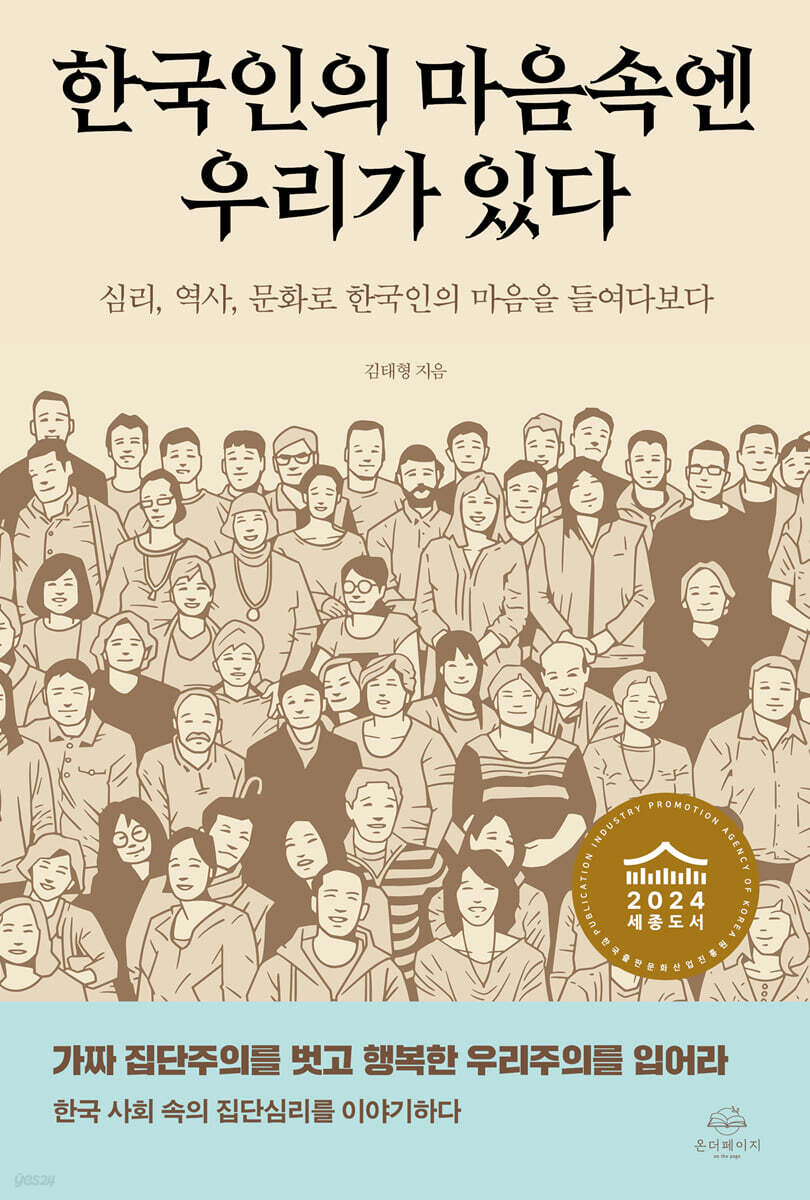
We are in the hearts of Koreans
 |
Description
Book Introduction
- A word from MD
- Modern people live more homogeneous lives than ever before, despite differences in nationality, race, and country.
However, there are unique characteristics unique to Koreans.
A society that encourages false self-esteem.
Kim Tae-hyung, author of “Affluence Addicted Society,” summarized its characteristics into five points in this book.
We are human-centered, non-religious, moral, and optimistic.
- Son Min-gyu, Humanities PD
Rediscovering history and culture to understand the psychology of Koreans.
To Koreans who dream of an ideal society where people can live like human beings
Spreading the message of "Ourism" that will foster humanity and kindness
Expressions used to describe Korean society, such as “high suicide rate,” “extreme egoism,” and “capitalism,” are confusing the minds of Koreans.
Koreans, who love people more than anything else, have historically maintained a human-centered way of thinking.
But today's Koreans are wounded and wandering aimlessly in a society rife with suspicion and conflict.
The author, who has delved into the current state of Korea in books such as “A Society That Promotes False Self-Esteem” and “Affluence-Addicted Society,” seeks to inform readers of the happiness that Koreans should truly pursue in this book.
The author has analyzed the psychology of Koreans, using Korean history and culture as analytical tools to define true happiness for Koreans.
Through this analysis, we discover ‘our-ness,’ a unique characteristic of Koreans.
The characteristic of individuals striving to build strong relationships through trust and love is our nature, and Koreans are defined as a nation with a strong sense of our nature.
In conclusion, Koreans cherish all relationships, from the small "family" to the large "national unity," and the true happiness of Koreans lies in their relationships.
Furthermore, the author analyzes the characteristics of Koreans that support these claims: 'our nature,' 'human-centeredness,' 'non-religiousness,' 'morality,' and 'optimism,' and conveys the greatness of Koreans that cannot be found in other ethnic groups.
As the title of this book suggests, there is a desire in the hearts of Koreans to create a greater nation and people.
Through this book, the author urges Koreans, who have lost their sense of "us" due to the multi-layered hierarchy created by interpersonal competition and widening gaps, to consider what we truly should pursue.
And I expect that when these concerns are focused on a national level, true happiness for Koreans will come within reach.
To Koreans who dream of an ideal society where people can live like human beings
Spreading the message of "Ourism" that will foster humanity and kindness
Expressions used to describe Korean society, such as “high suicide rate,” “extreme egoism,” and “capitalism,” are confusing the minds of Koreans.
Koreans, who love people more than anything else, have historically maintained a human-centered way of thinking.
But today's Koreans are wounded and wandering aimlessly in a society rife with suspicion and conflict.
The author, who has delved into the current state of Korea in books such as “A Society That Promotes False Self-Esteem” and “Affluence-Addicted Society,” seeks to inform readers of the happiness that Koreans should truly pursue in this book.
The author has analyzed the psychology of Koreans, using Korean history and culture as analytical tools to define true happiness for Koreans.
Through this analysis, we discover ‘our-ness,’ a unique characteristic of Koreans.
The characteristic of individuals striving to build strong relationships through trust and love is our nature, and Koreans are defined as a nation with a strong sense of our nature.
In conclusion, Koreans cherish all relationships, from the small "family" to the large "national unity," and the true happiness of Koreans lies in their relationships.
Furthermore, the author analyzes the characteristics of Koreans that support these claims: 'our nature,' 'human-centeredness,' 'non-religiousness,' 'morality,' and 'optimism,' and conveys the greatness of Koreans that cannot be found in other ethnic groups.
As the title of this book suggests, there is a desire in the hearts of Koreans to create a greater nation and people.
Through this book, the author urges Koreans, who have lost their sense of "us" due to the multi-layered hierarchy created by interpersonal competition and widening gaps, to consider what we truly should pursue.
And I expect that when these concerns are focused on a national level, true happiness for Koreans will come within reach.
- You can preview some of the book's contents.
Preview
index
preface
Introduction - Korean Psychology
What is nationality?
Causes of national character formation and development
Koreans' unique national character
Part 1 - Us
Chapter 1: Collectivism and Us
Motivation of collectivism
fake collectivism
Fake collectivism and individualism
The group and us
Our state's emotions and our nature
Equality with us
What would be good if we became
The cause of our surname
Chapter 2 Family and Us
Family and family psychology
Familism and Us
Is it family expansion or is it our own?
hierarchy
Chapter 3 Our Relationship
Non-computational relationship
A relationship of giving and receiving hearts
Understanding the mind
There are no boundaries
The origin of skinship
Chapter 4: Desire for Us
The big picture of Korean society
Part 2 - Human-centered
Chapter 1: Human-Centeredness
The openness of Koreans
faith in humanity
harmony
Human love and affection
Big cage and kindness
Chapter 2: Human Dignity
independent Koreans
The power of the people
Human-centered parenting
Chapter 3: Koreans Who Value Emotions
Why do Koreans value emotions?
Koreans have a wide range of emotions
Excitement and excitement
Part 3 - Non-religious
Religion for Humanity
worldlyism
Causes of irreligion
Part 4 - Morality
Morality for us
moral evaluation
I will not yield to power
Koreans who live and die by loyalty
Part 5 - Optimism
A nation of satire and humor
Why are Koreans so optimistic?
Coming out - Aspirations for an ideal society
The final destination of nationality
Dream of an ideal society
Americas
Introduction - Korean Psychology
What is nationality?
Causes of national character formation and development
Koreans' unique national character
Part 1 - Us
Chapter 1: Collectivism and Us
Motivation of collectivism
fake collectivism
Fake collectivism and individualism
The group and us
Our state's emotions and our nature
Equality with us
What would be good if we became
The cause of our surname
Chapter 2 Family and Us
Family and family psychology
Familism and Us
Is it family expansion or is it our own?
hierarchy
Chapter 3 Our Relationship
Non-computational relationship
A relationship of giving and receiving hearts
Understanding the mind
There are no boundaries
The origin of skinship
Chapter 4: Desire for Us
The big picture of Korean society
Part 2 - Human-centered
Chapter 1: Human-Centeredness
The openness of Koreans
faith in humanity
harmony
Human love and affection
Big cage and kindness
Chapter 2: Human Dignity
independent Koreans
The power of the people
Human-centered parenting
Chapter 3: Koreans Who Value Emotions
Why do Koreans value emotions?
Koreans have a wide range of emotions
Excitement and excitement
Part 3 - Non-religious
Religion for Humanity
worldlyism
Causes of irreligion
Part 4 - Morality
Morality for us
moral evaluation
I will not yield to power
Koreans who live and die by loyalty
Part 5 - Optimism
A nation of satire and humor
Why are Koreans so optimistic?
Coming out - Aspirations for an ideal society
The final destination of nationality
Dream of an ideal society
Americas
Detailed image

Into the book
Although we all live in the same social system or environment called the neoliberal capitalist system, and as a result, we all have the same group psychology, Koreans are fundamentally different from Americans or Japanese.
This is because Koreans have a national character and national psychology that Americans or Japanese do not have.
Therefore, in order to fully understand today's Koreans and the collective psychology of Koreans, we must first understand the Korean national character.
--- p.14~15
It can be said that Koreans and Japanese are similar in that they share the characteristic of prioritizing the group over the individual, that is, group spirit.
However, there is a significant difference between the two in their motivations for prioritizing the group.
To conclude, while Koreans voluntarily and willingly prioritize the group, Japanese people fear the group and others and therefore have no choice but to prioritize the group.
--- p.36
Today's South Korea, a neoliberal capitalist society, is one of the most unequal societies in the world.
South Korea's suicide rate, which is among the highest in the world, began to rise sharply in the 1990s, a time when we were collapsing and disappearing from Korean society.
Koreans are happiest when they live as us, and suffer the most when they lose us.
This is precisely why, if Korean society is to lower the suicide rate among Koreans, it must first address the problem of inequality, the main culprit that prevents us from achieving our goals.
--- p.68
In the past, Koreans called their friend's mother 'mother'.
Furthermore, even if it was a woman he was meeting for the first time, if she was the same age as his mother, he would call her ‘mother’ without hesitation.
If we look at it only from a phenomenological perspective, it is true that Koreans socially expand the concept of family or family relationships and view society based on that.
What Koreans have truly desired since ancient times and still desperately desire today is a world where the entire society becomes one family, a world where "everyone becomes us."
--- p.99~101
Traditionally, the purpose of life for Koreans has been to become a good human being, or, to borrow the expression of psychologist Erich Fromm, a “complete social being.”
As can be seen from the saying, “If a nation is united, the world will be at peace,” Koreans in the past dreamed of an ideal society where everyone is united, and they believed that individuals must cultivate their character to realize that.
In other words, unlike the West, they did not consider individual individuation or self-realization as goals in themselves, but rather believed that character development and family stability were necessary to create a better world.
--- p.162
Koreans have had a human-centered worldview and outlook on life since ancient times.
That is why Koreans have been able to find answers to the questions of what a desirable life is and what the meaning of life is, even without religion.
For Koreans, the ideal life is to live a humane life, and the meaning of life is to live for ourselves.
--- p.234
In Korea, no matter how great one's achievements as a professional or expert are, if one has moral flaws, the public will shun them.
Former US President Bill Clinton apologized to the public for sexual misconduct allegations in the White House, but remained in office.
However, if it were revealed that the President of Korea had engaged in sexual misconduct in the Blue House, he would not have been able to remain in office or would have resigned of his own accord.
--- p.248~249
Koreans are often called a nation of satire and humor.
This is because satire and humor are embedded throughout Korean culture, including literature and art.
Today, Koreans continue to carry on the tradition of satire and humor.
Since the dawn of the Internet age in Korea, the Internet has been overflowing with various parodies and drips, to the point where the term "nation of drips" (short for ad-lib) has been coined.
Among these, satirical parodies that contain sharp criticism of reality are considered the best of Korean internet culture.
This is because Koreans have a national character and national psychology that Americans or Japanese do not have.
Therefore, in order to fully understand today's Koreans and the collective psychology of Koreans, we must first understand the Korean national character.
--- p.14~15
It can be said that Koreans and Japanese are similar in that they share the characteristic of prioritizing the group over the individual, that is, group spirit.
However, there is a significant difference between the two in their motivations for prioritizing the group.
To conclude, while Koreans voluntarily and willingly prioritize the group, Japanese people fear the group and others and therefore have no choice but to prioritize the group.
--- p.36
Today's South Korea, a neoliberal capitalist society, is one of the most unequal societies in the world.
South Korea's suicide rate, which is among the highest in the world, began to rise sharply in the 1990s, a time when we were collapsing and disappearing from Korean society.
Koreans are happiest when they live as us, and suffer the most when they lose us.
This is precisely why, if Korean society is to lower the suicide rate among Koreans, it must first address the problem of inequality, the main culprit that prevents us from achieving our goals.
--- p.68
In the past, Koreans called their friend's mother 'mother'.
Furthermore, even if it was a woman he was meeting for the first time, if she was the same age as his mother, he would call her ‘mother’ without hesitation.
If we look at it only from a phenomenological perspective, it is true that Koreans socially expand the concept of family or family relationships and view society based on that.
What Koreans have truly desired since ancient times and still desperately desire today is a world where the entire society becomes one family, a world where "everyone becomes us."
--- p.99~101
Traditionally, the purpose of life for Koreans has been to become a good human being, or, to borrow the expression of psychologist Erich Fromm, a “complete social being.”
As can be seen from the saying, “If a nation is united, the world will be at peace,” Koreans in the past dreamed of an ideal society where everyone is united, and they believed that individuals must cultivate their character to realize that.
In other words, unlike the West, they did not consider individual individuation or self-realization as goals in themselves, but rather believed that character development and family stability were necessary to create a better world.
--- p.162
Koreans have had a human-centered worldview and outlook on life since ancient times.
That is why Koreans have been able to find answers to the questions of what a desirable life is and what the meaning of life is, even without religion.
For Koreans, the ideal life is to live a humane life, and the meaning of life is to live for ourselves.
--- p.234
In Korea, no matter how great one's achievements as a professional or expert are, if one has moral flaws, the public will shun them.
Former US President Bill Clinton apologized to the public for sexual misconduct allegations in the White House, but remained in office.
However, if it were revealed that the President of Korea had engaged in sexual misconduct in the Blue House, he would not have been able to remain in office or would have resigned of his own accord.
--- p.248~249
Koreans are often called a nation of satire and humor.
This is because satire and humor are embedded throughout Korean culture, including literature and art.
Today, Koreans continue to carry on the tradition of satire and humor.
Since the dawn of the Internet age in Korea, the Internet has been overflowing with various parodies and drips, to the point where the term "nation of drips" (short for ad-lib) has been coined.
Among these, satirical parodies that contain sharp criticism of reality are considered the best of Korean internet culture.
--- p.260~261
Publisher's Review
With the most Korean psychological approach
Presenting the collective psychology and life direction of Koreans
The author, who analyzed the historically strong tendency of Koreans to become "us," suggests ways to live like humans in a society rife with extreme egoism.
The five unique characteristics of Koreans are ‘our-ness’, ‘human-centeredness’, ‘non-religiousness’, ‘morality’, and ‘optimism’.
Our nature is a characteristic of Koreans who want to build open relationships with others and strongly desire 'our relationships' by actively empathizing with others' thoughts and feelings.
The expression 'we' used in expressions such as 'our family' and 'our mother' can explain that Koreans are a people with a 'we' surname.
Human-centeredness is the characteristic that Koreans respect and love people more than people of other countries.
Koreans, who developed from the ideological roots of the Dangun myth of ‘Hongik Ingan’, which ‘benefits humanity,’ cannot help but be born with human-centered characteristics.
The characteristics of Koreans, who are relatively easy to convert to and have less religious influence than other nations, were explained by their non-religiousness, and their morality and optimism were explained by the fact that they set strict standards of "integrity and innocence" for the yangban class of the past and current public officials and criticize their wrongdoings with satire and humor.
The author discusses the five characteristics of Koreans that he has identified, and argues that ultimately, in order to regain the lost happiness of Koreans, all Koreans must become one in heart and mind.
I hope that by reading this book, you will understand the Korean national character and that your life will move in the right direction.
Presenting the collective psychology and life direction of Koreans
The author, who analyzed the historically strong tendency of Koreans to become "us," suggests ways to live like humans in a society rife with extreme egoism.
The five unique characteristics of Koreans are ‘our-ness’, ‘human-centeredness’, ‘non-religiousness’, ‘morality’, and ‘optimism’.
Our nature is a characteristic of Koreans who want to build open relationships with others and strongly desire 'our relationships' by actively empathizing with others' thoughts and feelings.
The expression 'we' used in expressions such as 'our family' and 'our mother' can explain that Koreans are a people with a 'we' surname.
Human-centeredness is the characteristic that Koreans respect and love people more than people of other countries.
Koreans, who developed from the ideological roots of the Dangun myth of ‘Hongik Ingan’, which ‘benefits humanity,’ cannot help but be born with human-centered characteristics.
The characteristics of Koreans, who are relatively easy to convert to and have less religious influence than other nations, were explained by their non-religiousness, and their morality and optimism were explained by the fact that they set strict standards of "integrity and innocence" for the yangban class of the past and current public officials and criticize their wrongdoings with satire and humor.
The author discusses the five characteristics of Koreans that he has identified, and argues that ultimately, in order to regain the lost happiness of Koreans, all Koreans must become one in heart and mind.
I hope that by reading this book, you will understand the Korean national character and that your life will move in the right direction.
GOODS SPECIFICS
- Date of issue: June 1, 2023
- Page count, weight, size: 288 pages | 466g | 152*225*20mm
- ISBN13: 9791192445359
- ISBN10: 119244535X
You may also like
카테고리
korean


korean

![GQ KOREA Mark (Monthly): December [2025]](http://librairie.coreenne.fr/cdn/shop/files/8ef265dbbfbf186523ed75ba7319009d.jpg?v=1765340328&width=3840)


