

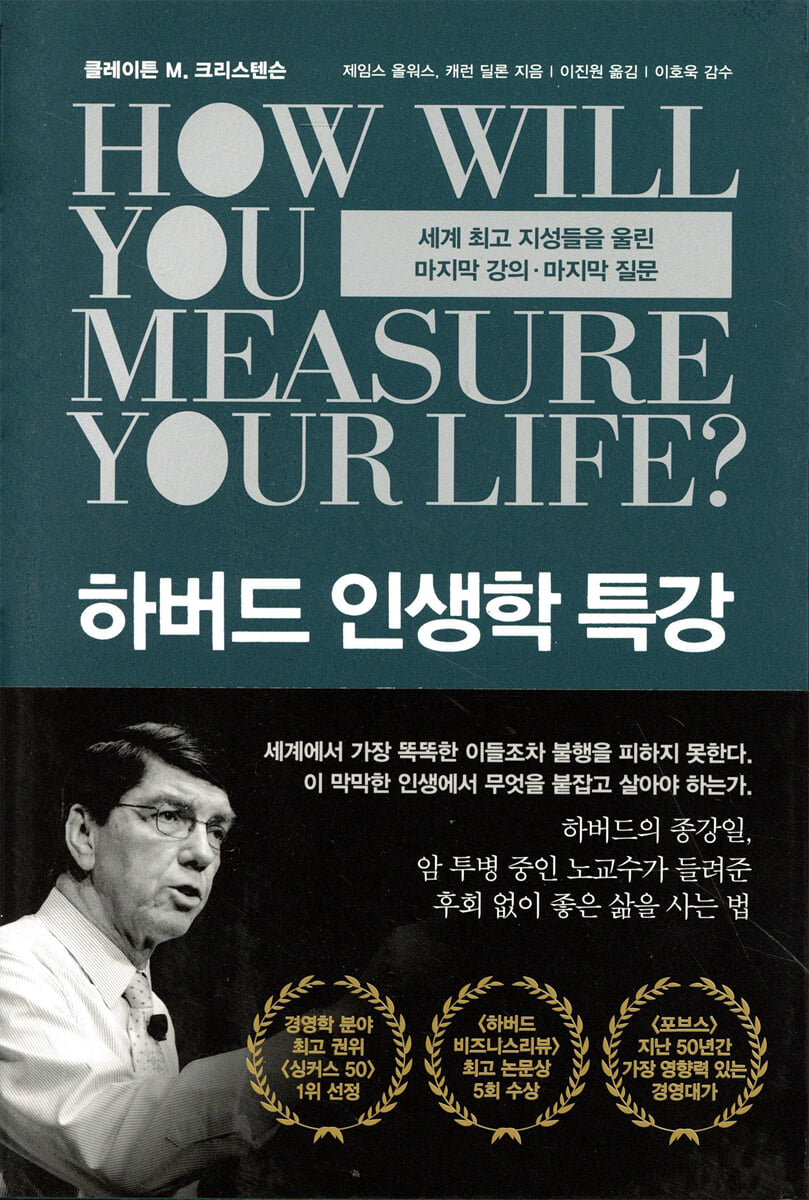
Harvard Life Studies Special Lecture
 |
Description
Book Introduction
Even the smartest people in the world cannot avoid misfortune.
What should I hold on to and live by in this vast life?
On Harvard's final day of classes, a veteran professor battling cancer shares his tips for living a good life without regrets.
On January 23, 2020, a giant in the global management world fell.
Clayton M., a distinguished professor at Harvard Business School who advocated the theory of 'disruptive innovation' and left a significant mark on the history of business administration.
Christensen passed away.
CNN reported the news, saying, "He is the man who wrote the Silicon Valley Bible. Amazon founder Jeff Bezos has cited his book as the best, and the late Apple founder Steve Jobs has also said that he was a deep inspiration to him."
Unlike other professors who are confined to their ivory towers and only do research, he is famous for having proven his theories by founding and managing several companies himself.
In the process, he revealed that he realized that a good theory can not only revive a failing company, but also a family and even an individual.
He shared this realization in the spring of 2010, when his body, weakened by his battle with cancer, gave a special lecture on life studies to Harvard Business School graduates.
This special lecture resonated with countless Harvard graduates, spread by word of mouth, and was eventually published as a book.
It is the ‘Harvard Life Studies Special Lecture’.
Although he published numerous management books during his lifetime, this is the only book that contains 'how to live a good life without regrets' by sharing personal stories as he faced death.
It's that heavy and hot.
In this chaotic age where nothing is certain, this book will offer more than just inspiration to those seeking the final insights and questions left behind by the master.
What should I hold on to and live by in this vast life?
On Harvard's final day of classes, a veteran professor battling cancer shares his tips for living a good life without regrets.
On January 23, 2020, a giant in the global management world fell.
Clayton M., a distinguished professor at Harvard Business School who advocated the theory of 'disruptive innovation' and left a significant mark on the history of business administration.
Christensen passed away.
CNN reported the news, saying, "He is the man who wrote the Silicon Valley Bible. Amazon founder Jeff Bezos has cited his book as the best, and the late Apple founder Steve Jobs has also said that he was a deep inspiration to him."
Unlike other professors who are confined to their ivory towers and only do research, he is famous for having proven his theories by founding and managing several companies himself.
In the process, he revealed that he realized that a good theory can not only revive a failing company, but also a family and even an individual.
He shared this realization in the spring of 2010, when his body, weakened by his battle with cancer, gave a special lecture on life studies to Harvard Business School graduates.
This special lecture resonated with countless Harvard graduates, spread by word of mouth, and was eventually published as a book.
It is the ‘Harvard Life Studies Special Lecture’.
Although he published numerous management books during his lifetime, this is the only book that contains 'how to live a good life without regrets' by sharing personal stories as he faced death.
It's that heavy and hot.
In this chaotic age where nothing is certain, this book will offer more than just inspiration to those seeking the final insights and questions left behind by the master.
- You can preview some of the book's contents.
Preview
index
The book has received rave reviews
Before you start
To begin with: Having feathers doesn't mean you can fly.
The Difference Between "What to Think" and "How to Think" | Good Theories Don't Be Capricious | The Power of Theory in Our Lives
Part 1: Finding Happiness in Social Life
Chapter 1: What Makes Us Dance
How Work Experiences Affect Your Home Life | Do Incentives Make the World Go Round? | The Correlation Between Incentives and Motivation | The Difference Between Dissatisfaction and Dissatisfaction | What Matters More to Us Than Money | The Process Is More Important Than the End Goal | If You're Finding a Job You Love
Chapter 2: Are you good at utilizing deliberate strategies and serendipitous opportunities?
Honda Accidentally Takes Over America | Until I Know Where I Come From | How I Became a Harvard Professor | How to Know What Will Work | What to Do Before Taking That Job
Chapter 3: Where to Focus My Resources
Why CEOs Don't Resonate with Employees | The Paradox of Resource Allocation | When Individuals Create Problems | The Dilemma of Short-Term and Long-Term Strategy | Resource Allocation in Our Lives
Part 2: Finding Happiness in Relationships
Chapter 4: Investing in Relationships Before Problems Occur
Risky Adventures, Massive Failures | Good Money VS.
Bad Money | Should You Plant a Tree When You Need Shade? | You Can't Turn Back Time | How to Prioritize Your Life Investments
Chapter 5: Understanding and Commitment to the Other Person
Hiring IKEA | Cheaper? Tastier? More? | Products That Make Parents Happy | Hiring Schools to Work for You | Why Are You Hired? | Total Sacrifice and Fierce Dedication
Chapter 6: Are you there when your child faces challenges?
The Fascinating Tragedy of Outsourcing | What Businesses Can and Can't Do | Don't Outsource Your Future | What Kids Can and Can't Do | Greek Tragedy Reenacted at Home | What My Parents Never Did for Me | Children Learn When They're Ready
Chapter 7: Did you enroll in the school of experience?
Are these really the right qualities? | 'The right qualities' are not the right qualities at all | Planning lessons to be taught in the school of experience | Courses needed for starters | What my child needs most | Parents who teach what they need to learn
Chapter 8: Creating an Invisible Culture
When the Carriage Goes Over the Hill | How Culture Is Created at Work | This Is How Our Family Acts
Part 3_ Midterm Evaluation for a Good Life
Chapter 9: Can You Resist the Temptation of "Just This Once"?
The Trap of Marginal Thinking | You'll Pay the Full Cost Anyway | The Price of the "Just Once" Excuse | It's Easier to Get 100% Than 98%
In conclusion: How would you evaluate your life?
The Importance of Purpose | The Three Parts of Purpose | Who I Want to Be | Giving It Your All | Finding the Right Criteria | The Most Important Thing to Learn Next |
Acknowledgments 1: Predicting the Future That Will Make Us Happy (Clayton M.
Christensen)
Acknowledgments 2: Those I Helped Helped Me (James Allworth)
Gratitude 3: The Encounter That Helped Me Find My Purpose (Karen Dillon)
Reviewer's Note: Meet the Life Guide of a Top Management Guru
Before you start
To begin with: Having feathers doesn't mean you can fly.
The Difference Between "What to Think" and "How to Think" | Good Theories Don't Be Capricious | The Power of Theory in Our Lives
Part 1: Finding Happiness in Social Life
Chapter 1: What Makes Us Dance
How Work Experiences Affect Your Home Life | Do Incentives Make the World Go Round? | The Correlation Between Incentives and Motivation | The Difference Between Dissatisfaction and Dissatisfaction | What Matters More to Us Than Money | The Process Is More Important Than the End Goal | If You're Finding a Job You Love
Chapter 2: Are you good at utilizing deliberate strategies and serendipitous opportunities?
Honda Accidentally Takes Over America | Until I Know Where I Come From | How I Became a Harvard Professor | How to Know What Will Work | What to Do Before Taking That Job
Chapter 3: Where to Focus My Resources
Why CEOs Don't Resonate with Employees | The Paradox of Resource Allocation | When Individuals Create Problems | The Dilemma of Short-Term and Long-Term Strategy | Resource Allocation in Our Lives
Part 2: Finding Happiness in Relationships
Chapter 4: Investing in Relationships Before Problems Occur
Risky Adventures, Massive Failures | Good Money VS.
Bad Money | Should You Plant a Tree When You Need Shade? | You Can't Turn Back Time | How to Prioritize Your Life Investments
Chapter 5: Understanding and Commitment to the Other Person
Hiring IKEA | Cheaper? Tastier? More? | Products That Make Parents Happy | Hiring Schools to Work for You | Why Are You Hired? | Total Sacrifice and Fierce Dedication
Chapter 6: Are you there when your child faces challenges?
The Fascinating Tragedy of Outsourcing | What Businesses Can and Can't Do | Don't Outsource Your Future | What Kids Can and Can't Do | Greek Tragedy Reenacted at Home | What My Parents Never Did for Me | Children Learn When They're Ready
Chapter 7: Did you enroll in the school of experience?
Are these really the right qualities? | 'The right qualities' are not the right qualities at all | Planning lessons to be taught in the school of experience | Courses needed for starters | What my child needs most | Parents who teach what they need to learn
Chapter 8: Creating an Invisible Culture
When the Carriage Goes Over the Hill | How Culture Is Created at Work | This Is How Our Family Acts
Part 3_ Midterm Evaluation for a Good Life
Chapter 9: Can You Resist the Temptation of "Just This Once"?
The Trap of Marginal Thinking | You'll Pay the Full Cost Anyway | The Price of the "Just Once" Excuse | It's Easier to Get 100% Than 98%
In conclusion: How would you evaluate your life?
The Importance of Purpose | The Three Parts of Purpose | Who I Want to Be | Giving It Your All | Finding the Right Criteria | The Most Important Thing to Learn Next |
Acknowledgments 1: Predicting the Future That Will Make Us Happy (Clayton M.
Christensen)
Acknowledgments 2: Those I Helped Helped Me (James Allworth)
Gratitude 3: The Encounter That Helped Me Find My Purpose (Karen Dillon)
Reviewer's Note: Meet the Life Guide of a Top Management Guru
Detailed image

Into the book
When the last day of class comes, we write down the theories we have studied at the top of the blackboard to create a framework for discussion.
Next to the theories, write three simple questions:
It asks each person how they can be sure of the following:
1) Will I be successful and happy in my future social life?
2) Will your relationships with your spouse, children, relatives, and friends continue to be a source of happiness?
3) Will I live an honest life and not end up in jail?
These questions may seem simple, but they are ones that many of my colleagues either never ask, or if they do, they forget what they learned.
I've been amazed every year at how the theories I cover in my courses explain issues relevant to our personal lives as well as the companies I work with.
This book summarizes the best insights from what we discussed at the end of this course.
--- From "Before You Begin"
They paid off their student loans while working.
I also paid off my mortgage.
It also enabled my family to live a comfortable life financially.
But somehow, the initial promise to return to something I was truly passionate about after a few years of earning money kept getting delayed.
They put it off by saying, “I’ll just do this for another year and then do that,” or they say, “I don’t know what else I can do besides what I’m doing now.”
In the meantime, incomes continued to rise.
Soon, several of them privately admitted that they were beginning to regret what they were doing.
Now I realize that the reasons I started doing it were wrong.
To make matters worse, he found himself in a position where he couldn't move.
Since I had already raised my standard of living to match the large salary I was receiving, it was practically difficult to lower my standard of living in the future.
At first, I chose it for hygiene reasons rather than for real motivation, but I fell into the trap it created and couldn't find a way out.
--- From "Chapter 1: What Makes Us Dance"
If you understand the concepts of emergent and deliberate strategies, you'll realize that expecting to have a clear vision of how your life will unfold is a waste of time unless you've found something truly useful in your social life.
Moreover, such expectations may actually close the door of our hearts to unexpected opportunities.
You have to keep the doors of life wide open while you figure out what's right for you.
Depending on your unique circumstances, you must be prepared to experiment with different opportunities, pivot, and adjust your strategies until you find what satisfies your hygiene factors and provides your motivators.
Only then will you realize that intentional strategy works, the moment you find the right intentional strategy.
--- From "Chapter 2: How to Make Good Use of Deliberate Strategy and Serendipitous Opportunities"
However, there are two forces that prevent us from continuing to invest interest and consideration in our relationships.
First, we are tempted to invest our resources elsewhere that will yield more immediate results.
Second, family and friends rarely shout loudly for our attention.
They love us, but they also want to help us with our social lives.
If this situation continues, we will eventually end up ignoring the people in this world that we should care about the most.
The theory of good money and bad money shows that the clock is ticking from the beginning when it comes to building relationships that bring happiness.
If we don't nurture and develop relationships, people won't be there to help us overcome major challenges in our lives or remain by our side as one of life's most important sources of happiness.
--- From "Chapter 4: Investing in Relationships Before Problems Occur"
According to ability theory, children need to experience challenges.
There are also difficult problems to solve.
Values must also be developed.
If we give children too many experiences that don't allow them to engage deeply, we're essentially denying them the processes they need for future success.
And if we outsource these experiences to others, we are missing a valuable opportunity to help our children grow and develop into respectful and caring adults.
--- From “Chapter 6: Are you there when your child faces challenges?”
The driving force behind everything the professor did was his genuine concern for the people around him.
In all the time I've known the professor, I've never seen his interest and concern waver.
During the semester, the professor was diagnosed with cancer, and as soon as he was well enough to teach again, he returned to stand with us.
It was an unforgettable and precious experience on the last day of class when the professor joined us in pondering the answers to the three questions in this book.
At the time, the professor's family also took the class with us, but no one knew that it might be the professor's last class.
At that time, the professor only helped us more resolutely.
Next to the theories, write three simple questions:
It asks each person how they can be sure of the following:
1) Will I be successful and happy in my future social life?
2) Will your relationships with your spouse, children, relatives, and friends continue to be a source of happiness?
3) Will I live an honest life and not end up in jail?
These questions may seem simple, but they are ones that many of my colleagues either never ask, or if they do, they forget what they learned.
I've been amazed every year at how the theories I cover in my courses explain issues relevant to our personal lives as well as the companies I work with.
This book summarizes the best insights from what we discussed at the end of this course.
--- From "Before You Begin"
They paid off their student loans while working.
I also paid off my mortgage.
It also enabled my family to live a comfortable life financially.
But somehow, the initial promise to return to something I was truly passionate about after a few years of earning money kept getting delayed.
They put it off by saying, “I’ll just do this for another year and then do that,” or they say, “I don’t know what else I can do besides what I’m doing now.”
In the meantime, incomes continued to rise.
Soon, several of them privately admitted that they were beginning to regret what they were doing.
Now I realize that the reasons I started doing it were wrong.
To make matters worse, he found himself in a position where he couldn't move.
Since I had already raised my standard of living to match the large salary I was receiving, it was practically difficult to lower my standard of living in the future.
At first, I chose it for hygiene reasons rather than for real motivation, but I fell into the trap it created and couldn't find a way out.
--- From "Chapter 1: What Makes Us Dance"
If you understand the concepts of emergent and deliberate strategies, you'll realize that expecting to have a clear vision of how your life will unfold is a waste of time unless you've found something truly useful in your social life.
Moreover, such expectations may actually close the door of our hearts to unexpected opportunities.
You have to keep the doors of life wide open while you figure out what's right for you.
Depending on your unique circumstances, you must be prepared to experiment with different opportunities, pivot, and adjust your strategies until you find what satisfies your hygiene factors and provides your motivators.
Only then will you realize that intentional strategy works, the moment you find the right intentional strategy.
--- From "Chapter 2: How to Make Good Use of Deliberate Strategy and Serendipitous Opportunities"
However, there are two forces that prevent us from continuing to invest interest and consideration in our relationships.
First, we are tempted to invest our resources elsewhere that will yield more immediate results.
Second, family and friends rarely shout loudly for our attention.
They love us, but they also want to help us with our social lives.
If this situation continues, we will eventually end up ignoring the people in this world that we should care about the most.
The theory of good money and bad money shows that the clock is ticking from the beginning when it comes to building relationships that bring happiness.
If we don't nurture and develop relationships, people won't be there to help us overcome major challenges in our lives or remain by our side as one of life's most important sources of happiness.
--- From "Chapter 4: Investing in Relationships Before Problems Occur"
According to ability theory, children need to experience challenges.
There are also difficult problems to solve.
Values must also be developed.
If we give children too many experiences that don't allow them to engage deeply, we're essentially denying them the processes they need for future success.
And if we outsource these experiences to others, we are missing a valuable opportunity to help our children grow and develop into respectful and caring adults.
--- From “Chapter 6: Are you there when your child faces challenges?”
The driving force behind everything the professor did was his genuine concern for the people around him.
In all the time I've known the professor, I've never seen his interest and concern waver.
During the semester, the professor was diagnosed with cancer, and as soon as he was well enough to teach again, he returned to stand with us.
It was an unforgettable and precious experience on the last day of class when the professor joined us in pondering the answers to the three questions in this book.
At the time, the professor's family also took the class with us, but no one knew that it might be the professor's last class.
At that time, the professor only helped us more resolutely.
--- From "Thanks 3 (James Allworth)"
Publisher's Review
★★★★★ Selected as #1 by Thinkers50, the most authoritative business administration publication
★★★★★ Winner of the Harvard Business Review Best Paper Award five times
★★★★★ Forbes: “The Most Influential Business Leaders of the Past 50 Years”
Why did he talk about people and not corporations?
At the beginning of the book, Professor Christensen confesses that he witnessed some interesting scenes at Harvard Business School's reunion, which is held every five years.
At their first reunion after graduation, most of them showed up in stylish attire, each of them having a great job, living a wealthy life, and having met and married beautiful spouses (of course, they were all Harvard graduates).
However, from the 10th year reunion onwards, unexpected changes began to appear.
Many people are getting divorced or living in unhappy marriages, some are having conflicts with their children, and some are even arrested for causing problems at work.
It goes without saying that there were many absentees for these reasons.
Professor Christensen is left with a question.
Why can't even the smartest people in the world avoid misfortune?
Even if your social life is going well, why does your personal life, especially your interpersonal relationships, continue to be messed up?
Why do you choose the wrong path and bring about failure?
He is troubled to discover similar scenes not only among his Harvard Business School classmates but also among his Oxford University classmates.
Then, we focus on solving the fundamental question of life: 'What should we do to live a good life and enjoy true happiness?'
Because he was at the crossroads of life and death, finding an answer to this question must have been even more urgent.
After much deliberation, he decided to use the final day of Harvard Business School as a case study to discuss the unfortunate events that frequently occurred in the lives of his classmates.
The research subjects were people, not companies.
And by examining these objects in detail through the lens of the 'theory' that he was most confident in, he identified the core of the problem, found a solution, and even predicted the outcome of the action.
“A good theory is not capricious.”
A management master who created countless businesses and people
Unwavering Life Management
Professor Christensen emphasizes the importance of 'theory' several times.
According to him, “the value of theory is that it allows us to accurately predict what will happen, and theory is the fundamental causal mechanism of human history.”
The theory, which has been studied and verified for a long time, can be applied to not only the rise and fall of a company, but also the fortunes and misfortunes of humans.
Professor Christensen skillfully applies various theories to the work, family, and relationship areas of our lives.
He says that in order to lead a successful social life, we must clearly define the purpose and meaning of work through the 'incentive theory and motivation theory', practice 'intentional strategy' while embracing the opportunity of 'creative strategy' that comes by chance, and wisely 'allocate resources' by appropriately investing 'time, money, and energy' in the strategy.
Professor Christensen then compares the risky case of "bad money," which involves making large investments to achieve short-term results, with the problem of families, which require continuous investment of resources over a long period of time, such as marital relationships or children's education, to see results, using the "good money and bad money theory."
And, based on the 'capability theory', he warns against indiscriminate 'outsourcing'.
He tells the story of how Dell Computer, once the world's most innovative PC company, gradually handed over work to Taiwan's Asus for several years, eventually outsourcing all but the brand.
Dell's filing clearly shows better numbers, but the company has become mediocre.
Even things that we can do ourselves are being done by relying on others in the name of ‘specialization’, which has ultimately weakened our future competitiveness.
Professor Christensen asks parents to consider whether they are behaving like Dell Computers at home.
“If your child gets his or her value from other people, whose child are they?”
Finally, he explores the essence of life beyond the everyday.
He warns that “the marginal thinking that permeates society and our personal lives is a trap that allows exceptions to go beyond the norm.”
In doing so, we look back at the case of Barings Bank in the UK, which boasted a long history, collapsing in an instant, as a prime example of someone who, while justifying themselves by saying, "Just this once," abandoned their conscience and ended up paying a huge total cost rather than a temporary marginal cost.
He adds that it is easier to keep something 100 percent than to keep it 98 percent.
Because once you start allowing exceptions, the chances of the same thing happening again increase.
In this way, this book exquisitely overlaps the exciting world of business and life's challenges, as seen through the creative and intuitive perspective of a management guru, helping us understand and examine life's challenges in a more three-dimensional way.
No matter where you are on the path of life, it not only helps you understand your current location more clearly, but also powerfully guides you toward future happiness.
“Change is difficult in the first place.
It's sometimes easier to just stick with what you know and what you've been doing.
But if you want to live a better life than you have now, experiment with different opportunities, pivot, and flexibly adjust your strategies.” This is Professor Christensen’s final advice.
★★★★★ Winner of the Harvard Business Review Best Paper Award five times
★★★★★ Forbes: “The Most Influential Business Leaders of the Past 50 Years”
Why did he talk about people and not corporations?
At the beginning of the book, Professor Christensen confesses that he witnessed some interesting scenes at Harvard Business School's reunion, which is held every five years.
At their first reunion after graduation, most of them showed up in stylish attire, each of them having a great job, living a wealthy life, and having met and married beautiful spouses (of course, they were all Harvard graduates).
However, from the 10th year reunion onwards, unexpected changes began to appear.
Many people are getting divorced or living in unhappy marriages, some are having conflicts with their children, and some are even arrested for causing problems at work.
It goes without saying that there were many absentees for these reasons.
Professor Christensen is left with a question.
Why can't even the smartest people in the world avoid misfortune?
Even if your social life is going well, why does your personal life, especially your interpersonal relationships, continue to be messed up?
Why do you choose the wrong path and bring about failure?
He is troubled to discover similar scenes not only among his Harvard Business School classmates but also among his Oxford University classmates.
Then, we focus on solving the fundamental question of life: 'What should we do to live a good life and enjoy true happiness?'
Because he was at the crossroads of life and death, finding an answer to this question must have been even more urgent.
After much deliberation, he decided to use the final day of Harvard Business School as a case study to discuss the unfortunate events that frequently occurred in the lives of his classmates.
The research subjects were people, not companies.
And by examining these objects in detail through the lens of the 'theory' that he was most confident in, he identified the core of the problem, found a solution, and even predicted the outcome of the action.
“A good theory is not capricious.”
A management master who created countless businesses and people
Unwavering Life Management
Professor Christensen emphasizes the importance of 'theory' several times.
According to him, “the value of theory is that it allows us to accurately predict what will happen, and theory is the fundamental causal mechanism of human history.”
The theory, which has been studied and verified for a long time, can be applied to not only the rise and fall of a company, but also the fortunes and misfortunes of humans.
Professor Christensen skillfully applies various theories to the work, family, and relationship areas of our lives.
He says that in order to lead a successful social life, we must clearly define the purpose and meaning of work through the 'incentive theory and motivation theory', practice 'intentional strategy' while embracing the opportunity of 'creative strategy' that comes by chance, and wisely 'allocate resources' by appropriately investing 'time, money, and energy' in the strategy.
Professor Christensen then compares the risky case of "bad money," which involves making large investments to achieve short-term results, with the problem of families, which require continuous investment of resources over a long period of time, such as marital relationships or children's education, to see results, using the "good money and bad money theory."
And, based on the 'capability theory', he warns against indiscriminate 'outsourcing'.
He tells the story of how Dell Computer, once the world's most innovative PC company, gradually handed over work to Taiwan's Asus for several years, eventually outsourcing all but the brand.
Dell's filing clearly shows better numbers, but the company has become mediocre.
Even things that we can do ourselves are being done by relying on others in the name of ‘specialization’, which has ultimately weakened our future competitiveness.
Professor Christensen asks parents to consider whether they are behaving like Dell Computers at home.
“If your child gets his or her value from other people, whose child are they?”
Finally, he explores the essence of life beyond the everyday.
He warns that “the marginal thinking that permeates society and our personal lives is a trap that allows exceptions to go beyond the norm.”
In doing so, we look back at the case of Barings Bank in the UK, which boasted a long history, collapsing in an instant, as a prime example of someone who, while justifying themselves by saying, "Just this once," abandoned their conscience and ended up paying a huge total cost rather than a temporary marginal cost.
He adds that it is easier to keep something 100 percent than to keep it 98 percent.
Because once you start allowing exceptions, the chances of the same thing happening again increase.
In this way, this book exquisitely overlaps the exciting world of business and life's challenges, as seen through the creative and intuitive perspective of a management guru, helping us understand and examine life's challenges in a more three-dimensional way.
No matter where you are on the path of life, it not only helps you understand your current location more clearly, but also powerfully guides you toward future happiness.
“Change is difficult in the first place.
It's sometimes easier to just stick with what you know and what you've been doing.
But if you want to live a better life than you have now, experiment with different opportunities, pivot, and flexibly adjust your strategies.” This is Professor Christensen’s final advice.
GOODS SPECIFICS
- Date of issue: February 21, 2020
- Page count, weight, size: 288 pages | 450g | 145*215*18mm
- ISBN13: 9788925568997
- ISBN10: 8925568993
You may also like
카테고리
korean


korean

![GQ KOREA Mark (Monthly): December [2025]](http://librairie.coreenne.fr/cdn/shop/files/8ef265dbbfbf186523ed75ba7319009d.jpg?v=1765340328&width=3840)


