

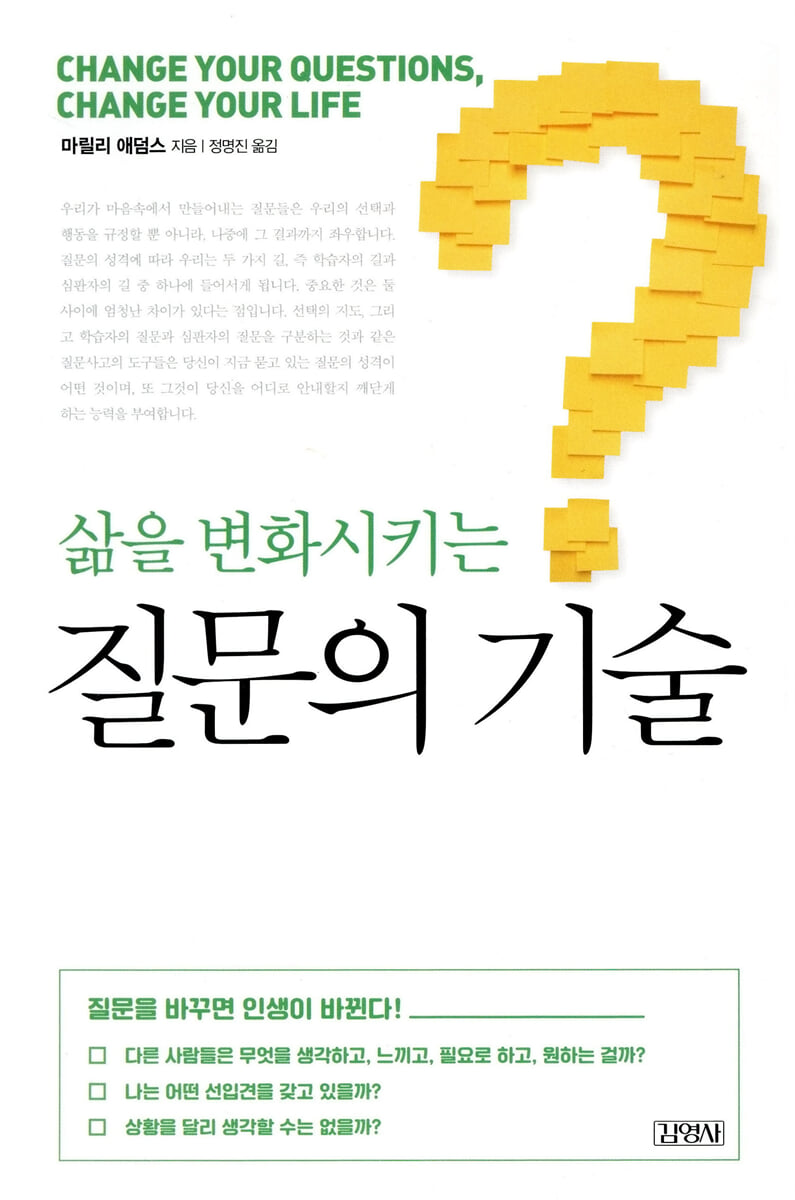
The Art of Asking Questions That Change Your Life
 |
Description
Book Introduction
The questions we ask can be divided into ‘judge’s questions’ and ‘learner’s questions.’
The judge's questions, such as "Who is to blame?" and "Why are they so foolish and disappointing?", drive us into despair, helplessness, and defeat.
On the other hand, learners' questions like "What happened?" and "What can we learn from this situation?" spark curiosity, inspire us, and lead us down the path to success.
The nature of the questions you ask can make a huge difference not only to your relationships and career, but also to your mindset, behavior, and performance.
True paradigm shift begins with the art of questioning!
"The Life-Changing Art of Questioning" is a delightful self-help book written by Marilyn Adams, the founder of "QuestionThinking™," which has brought about a revolutionary change in the way we think, in an easy-to-understand story format.
Questioning is a system of tools for changing thoughts, actions, and outcomes through skilled questioning, including questions you ask yourself as well as questions you ask others.
The author shows the power of questions in life through the story of an ordinary man, who could be considered a self-portrait of ourselves.
The judge's questions, such as "Who is to blame?" and "Why are they so foolish and disappointing?", drive us into despair, helplessness, and defeat.
On the other hand, learners' questions like "What happened?" and "What can we learn from this situation?" spark curiosity, inspire us, and lead us down the path to success.
The nature of the questions you ask can make a huge difference not only to your relationships and career, but also to your mindset, behavior, and performance.
True paradigm shift begins with the art of questioning!
"The Life-Changing Art of Questioning" is a delightful self-help book written by Marilyn Adams, the founder of "QuestionThinking™," which has brought about a revolutionary change in the way we think, in an easy-to-understand story format.
Questioning is a system of tools for changing thoughts, actions, and outcomes through skilled questioning, including questions you ask yourself as well as questions you ask others.
The author shows the power of questions in life through the story of an ordinary man, who could be considered a self-portrait of ourselves.
- You can preview some of the book's contents.
Preview
index
Recommendation
At the beginning of the book
Chapter 1: Everyone faces a crisis.
Chapter 2: Accept It As It Is
Chapter 3: The Fork in the Road and the Choice
Chapter 4: The Change Has Already Begun
Chapter 5: Discovering New Eyes and Ears Within
Chapter 6: Wherever you stumble, there is treasure.
Chapter 7: The Power of Magical Questions
Chapter 8: A Breakthrough Finally Opened
Chapter 9: Sometimes it takes courage to share your worries.
Chapter 10: Great Results Come from Great Questions
Question Thinking Workbook
In closing the book
Notes
At the beginning of the book
Chapter 1: Everyone faces a crisis.
Chapter 2: Accept It As It Is
Chapter 3: The Fork in the Road and the Choice
Chapter 4: The Change Has Already Begun
Chapter 5: Discovering New Eyes and Ears Within
Chapter 6: Wherever you stumble, there is treasure.
Chapter 7: The Power of Magical Questions
Chapter 8: A Breakthrough Finally Opened
Chapter 9: Sometimes it takes courage to share your worries.
Chapter 10: Great Results Come from Great Questions
Question Thinking Workbook
In closing the book
Notes
Into the book
“Questioning thinking is a system of tools, so to speak, that uses questions to broaden your approach to any situation you might find yourself in.
These tools empower you to refine your questions so you can achieve greater results in everything you do.
This system actually translates your thoughts into actions.
It is an action that is both focused and efficient.
“It’s a great tool that creates the foundation needed to make wiser choices.” --- p.44
“Questions not only change hypotheses, they open up new possibilities.
It can even change us physiologically.
For example, asking yourself, "What if I get fired?" can trigger a chain reaction of stress in your body.
My daughter's question, "I won't fail this time, will I?", caused me to worry, which ultimately contributed to my failure.
Of course, consciously, my daughter didn't want to fail.
But anyway, failure became reality.
Thoughts strengthen the will.
“The learner’s questions input positive intentions.” --- pp.110-111
“It’s simple.
Just go into the meeting armed with a learner's mindset.
Then, ask Alexa some questions she might have asked herself.
This question may be asked:
You might ask questions like, "What is the goal of this meeting?", "How can we all work together on one issue?", "How should we structure the meeting to achieve the best possible outcome?", "What is valuable and worth considering from each participant's perspective?", and finally, "Are we ready to digest and follow through on the course of action we've developed so far?"
You will surely understand how such questions will change the situation.
You've already answered that question yourself when you described Alexa's meeting.
Questions can help create an environment for learners.
Isn't that the key to building an effective team?" --- p.141
I remembered Joseph's suggestion.
When you feel that you have entered the path of judgment, you must stop everything right there, take a deep breath, and carefully examine the question you are asking yourself at that very moment.
The first question that came to my mind was about traffic congestion.
'How do I get out of here?' It was clear that there wasn't much choice on that matter.
There was no choice but to stay stuck until the cars started moving again.
Then Joseph's words came to mind.
'I can't choose what happens to me, but I can choose how I respond to what happens to me.' Almost immediately, a new question arose.
'How can we make the most efficient use of this time?' --- pp. 153-154
Those turning points, which were always triggered by new questions, greatly changed my perspective on things.
I realized how much time I had wasted on the Judge's path, and how much harder it was to overcome obstacles because of the misfortunes I suffered due to the Judge's mindset.
To tell you the truth, I actually lived with a judge's mindset, and that's what brought me more sorrow than I could have ever imagined.
Whenever I hear my conscience telling me I'm slipping into the realm of the judge, I always immediately look for a question of transition to return to the learner's position.
These tools empower you to refine your questions so you can achieve greater results in everything you do.
This system actually translates your thoughts into actions.
It is an action that is both focused and efficient.
“It’s a great tool that creates the foundation needed to make wiser choices.” --- p.44
“Questions not only change hypotheses, they open up new possibilities.
It can even change us physiologically.
For example, asking yourself, "What if I get fired?" can trigger a chain reaction of stress in your body.
My daughter's question, "I won't fail this time, will I?", caused me to worry, which ultimately contributed to my failure.
Of course, consciously, my daughter didn't want to fail.
But anyway, failure became reality.
Thoughts strengthen the will.
“The learner’s questions input positive intentions.” --- pp.110-111
“It’s simple.
Just go into the meeting armed with a learner's mindset.
Then, ask Alexa some questions she might have asked herself.
This question may be asked:
You might ask questions like, "What is the goal of this meeting?", "How can we all work together on one issue?", "How should we structure the meeting to achieve the best possible outcome?", "What is valuable and worth considering from each participant's perspective?", and finally, "Are we ready to digest and follow through on the course of action we've developed so far?"
You will surely understand how such questions will change the situation.
You've already answered that question yourself when you described Alexa's meeting.
Questions can help create an environment for learners.
Isn't that the key to building an effective team?" --- p.141
I remembered Joseph's suggestion.
When you feel that you have entered the path of judgment, you must stop everything right there, take a deep breath, and carefully examine the question you are asking yourself at that very moment.
The first question that came to my mind was about traffic congestion.
'How do I get out of here?' It was clear that there wasn't much choice on that matter.
There was no choice but to stay stuck until the cars started moving again.
Then Joseph's words came to mind.
'I can't choose what happens to me, but I can choose how I respond to what happens to me.' Almost immediately, a new question arose.
'How can we make the most efficient use of this time?' --- pp. 153-154
Those turning points, which were always triggered by new questions, greatly changed my perspective on things.
I realized how much time I had wasted on the Judge's path, and how much harder it was to overcome obstacles because of the misfortunes I suffered due to the Judge's mindset.
To tell you the truth, I actually lived with a judge's mindset, and that's what brought me more sorrow than I could have ever imagined.
Whenever I hear my conscience telling me I'm slipping into the realm of the judge, I always immediately look for a question of transition to return to the learner's position.
--- pp.204-205
Publisher's Review
Success at work, a vibrant and enjoyable life, comfortable relationships,
The answer to all these wishes lies within your questions!
“How did this happen?” “What do I do now?” “Where do I start?” When we find ourselves in a difficult situation or encounter a problem, countless questions flood our minds as we search for solutions.
But most of the time, rather than finding answers, they just create more obstacles by asking negative questions.
It just repeats the same old answers and does nothing to improve the situation.
《The Life-Changing Art of Questioning》 is a delightful self-help book written by Marilyn Adams, the founder of 'QuestionThinking™', which has brought about a revolutionary change in the way we think, in an easy-to-understand story format.
Questioning is a system of tools for changing thoughts, actions, and outcomes through skilled questioning, including questions you ask yourself as well as questions you ask others.
The author shows the power of questions in life through the story of an ordinary man, who could be considered a self-portrait of ourselves.
A life-changing story of a phone call and a change of scenery through the questions of an ordinary man!
A time of delightful questions that will become a turning point in your life.
Ben Knight is on the verge of being fired from his job and facing divorce at home.
Within a few months of moving to a new job, everything became a mess and a mess.
He no longer has any plan to overcome the crisis.
Then one day, he receives an unexpected offer from the CEO, who he visits with his resignation letter, to meet a man named Joseph.
Ben learns the 'question thinking' technique through a six-week meeting with Joseph, nicknamed 'the questioning coach', and his life changes completely.
Marilyn Adams, using the words of Joseph, a character in the story, tells us that questions have the power to change outcomes, and that power is much greater than we realize.
The questions we ask can be divided into ‘judge’s questions’ and ‘learner’s questions.’
The judge's questions, such as "Who's to blame?", "How did they lose?", and "Why are they so foolish and disappointing?", drive us into despair, helplessness, and defeat.
On the other hand, learners' questions like "What happened?", "What can we learn from this situation?", and "What can we do right now?" spark curiosity, inspire us, and lead us down the path to success.
The nature of the questions you ask can make a huge difference not only to your relationships and career, but also to your mindset, behavior, and performance.
Will you be someone who learns from challenging situations, or will you be a loser who always blames others? True paradigm shift begins with the art of questioning.
Before we know it, new eyes and ears within us are wide open.
Great results come from great questions.
The art of questioning that transforms the potential within me into powerful creativity and imagination!
[Focus on all questions] Understand the nature of the questions you ask yourself and others, and increase the quantity and quality of your questions.
Stick to action-inducing questions until you realize the powerful influence they have on our lives.
You can experience that the results can vary greatly depending on the nature of the question.
[Keep the Map of Choice Close] The 'Map of Choice', which visually summarizes the future led by the learner-judge mindset, allows us to recognize exactly where we stand.
A faithful guide to how to change the questions you ask to live a successful life.
[Distinguish between learner and judge questions] Everyone has both learner and judge tendencies within them.
Acknowledge this fact and practice asking learner questions that will bring about positive change.
[Strengthen your observer self] Awaken and train your inner observer self so that you can look at your thoughts, feelings, and actions more objectively.
When you become detached from your thoughts and feelings, judgments of right and wrong become less important and you become less obsessed with the outcome.
[Use Transformative Questions] “Where do I want to be?” “Can I think of the situation differently?” “What might the other person be thinking, feeling, needing, and wanting?” Transformative questions can save us from the judgment trap and help us regain a learner’s mindset.
[Question your preconceptions] Do not form preconceptions based on incorrect or incomplete information.
Preconceptions hinder our efforts to achieve our goals and desires and hinder effective communication.
Ask yourself if you have any preconceived notions about yourself, your situation, or others, and if so, what they are.
[Remember the best questions for change] “What do I want?” “What am I responsible for?” “How can I turn this situation into a win-win situation?” These questions that bring about change protect us from the various challenges we face in life and open up new choices and possibilities.
The answer to all these wishes lies within your questions!
“How did this happen?” “What do I do now?” “Where do I start?” When we find ourselves in a difficult situation or encounter a problem, countless questions flood our minds as we search for solutions.
But most of the time, rather than finding answers, they just create more obstacles by asking negative questions.
It just repeats the same old answers and does nothing to improve the situation.
《The Life-Changing Art of Questioning》 is a delightful self-help book written by Marilyn Adams, the founder of 'QuestionThinking™', which has brought about a revolutionary change in the way we think, in an easy-to-understand story format.
Questioning is a system of tools for changing thoughts, actions, and outcomes through skilled questioning, including questions you ask yourself as well as questions you ask others.
The author shows the power of questions in life through the story of an ordinary man, who could be considered a self-portrait of ourselves.
A life-changing story of a phone call and a change of scenery through the questions of an ordinary man!
A time of delightful questions that will become a turning point in your life.
Ben Knight is on the verge of being fired from his job and facing divorce at home.
Within a few months of moving to a new job, everything became a mess and a mess.
He no longer has any plan to overcome the crisis.
Then one day, he receives an unexpected offer from the CEO, who he visits with his resignation letter, to meet a man named Joseph.
Ben learns the 'question thinking' technique through a six-week meeting with Joseph, nicknamed 'the questioning coach', and his life changes completely.
Marilyn Adams, using the words of Joseph, a character in the story, tells us that questions have the power to change outcomes, and that power is much greater than we realize.
The questions we ask can be divided into ‘judge’s questions’ and ‘learner’s questions.’
The judge's questions, such as "Who's to blame?", "How did they lose?", and "Why are they so foolish and disappointing?", drive us into despair, helplessness, and defeat.
On the other hand, learners' questions like "What happened?", "What can we learn from this situation?", and "What can we do right now?" spark curiosity, inspire us, and lead us down the path to success.
The nature of the questions you ask can make a huge difference not only to your relationships and career, but also to your mindset, behavior, and performance.
Will you be someone who learns from challenging situations, or will you be a loser who always blames others? True paradigm shift begins with the art of questioning.
Before we know it, new eyes and ears within us are wide open.
Great results come from great questions.
The art of questioning that transforms the potential within me into powerful creativity and imagination!
[Focus on all questions] Understand the nature of the questions you ask yourself and others, and increase the quantity and quality of your questions.
Stick to action-inducing questions until you realize the powerful influence they have on our lives.
You can experience that the results can vary greatly depending on the nature of the question.
[Keep the Map of Choice Close] The 'Map of Choice', which visually summarizes the future led by the learner-judge mindset, allows us to recognize exactly where we stand.
A faithful guide to how to change the questions you ask to live a successful life.
[Distinguish between learner and judge questions] Everyone has both learner and judge tendencies within them.
Acknowledge this fact and practice asking learner questions that will bring about positive change.
[Strengthen your observer self] Awaken and train your inner observer self so that you can look at your thoughts, feelings, and actions more objectively.
When you become detached from your thoughts and feelings, judgments of right and wrong become less important and you become less obsessed with the outcome.
[Use Transformative Questions] “Where do I want to be?” “Can I think of the situation differently?” “What might the other person be thinking, feeling, needing, and wanting?” Transformative questions can save us from the judgment trap and help us regain a learner’s mindset.
[Question your preconceptions] Do not form preconceptions based on incorrect or incomplete information.
Preconceptions hinder our efforts to achieve our goals and desires and hinder effective communication.
Ask yourself if you have any preconceived notions about yourself, your situation, or others, and if so, what they are.
[Remember the best questions for change] “What do I want?” “What am I responsible for?” “How can I turn this situation into a win-win situation?” These questions that bring about change protect us from the various challenges we face in life and open up new choices and possibilities.
GOODS SPECIFICS
- Date of issue: July 9, 2018
- Page count, weight, size: 247 pages | 399g | 142*215*16mm
- ISBN13: 9788934982104
- ISBN10: 8934982101
You may also like
카테고리
korean


korean

![ELLE 엘르 스페셜 에디션 A형 : 12월 [2025]](http://librairie.coreenne.fr/cdn/shop/files/b8e27a3de6c9538896439686c6b0e8fb.jpg?v=1766436872&width=3840)


