

Yi Sun-sin's Anchor Leadership
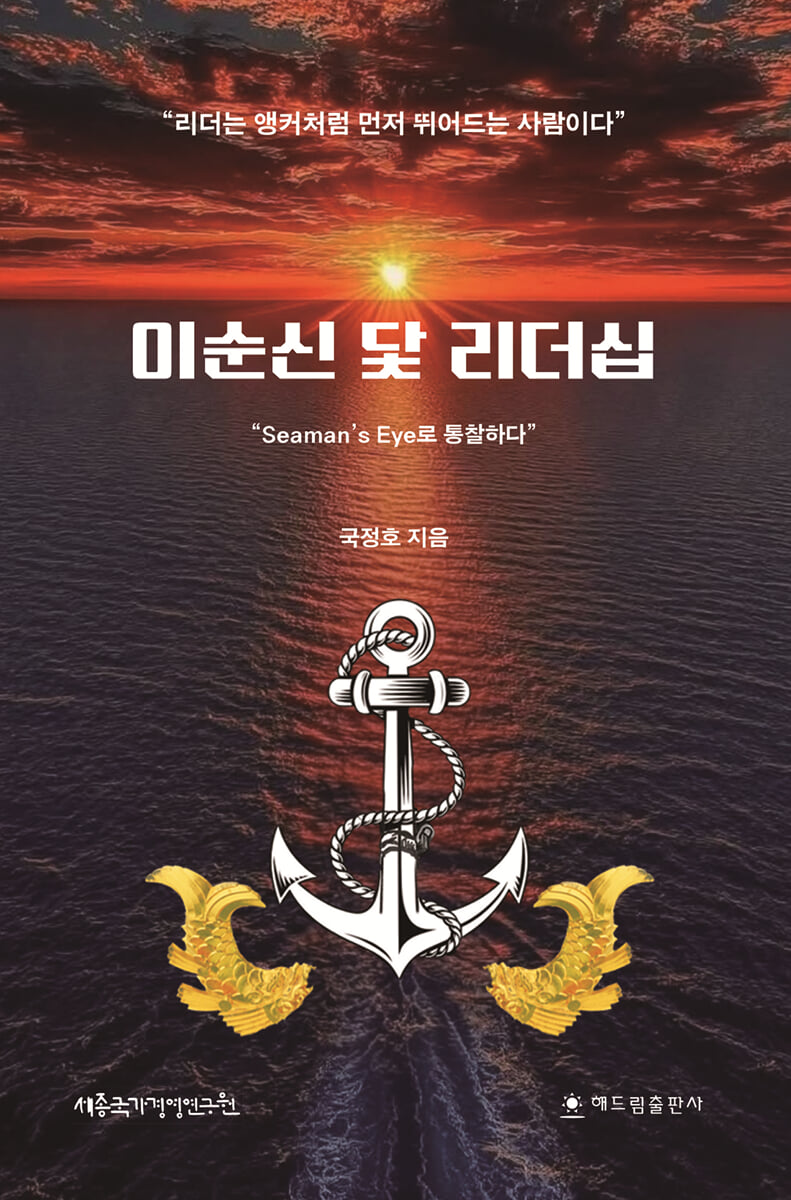 |
Description
Book Introduction
“The anchor is lowered into the sea first and secures the ship to the seabed.
“A leader is also like an anchor, the first to jump into the sea of crisis.”
When we say “Yi Sun-sin’s Anchor Leadership,” readers may be unfamiliar with the word “anchor.”
An anchor, typically used on ships, is a large, heavy device designed to secure a ship to the seabed in waters where anchorage is required.
An anchor pulled out from the bow or stern of a ship digs into the sea bed and quickly anchors the ship, thereby preventing the ship from drifting due to wind, tide, and current.
An anchor is a “symbol of seamanship”, a tool that seamen use to first anchor their ships when arriving at a new anchorage, but it also often symbolizes a leader who jumps into something first (Leader leads like an Anchor).
Also, the 'news anchor of a broadcasting station' is called an 'anchor', which probably means that he or she is the first person to deliver new information to viewers.
The anchor pattern on Popeye's arm, which we all know well, is widely used as a tattoo for masculine sea men and sailors, and is also widely used as a CI design for global shipping companies.
“A leader is also like an anchor, the first to jump into the sea of crisis.”
When we say “Yi Sun-sin’s Anchor Leadership,” readers may be unfamiliar with the word “anchor.”
An anchor, typically used on ships, is a large, heavy device designed to secure a ship to the seabed in waters where anchorage is required.
An anchor pulled out from the bow or stern of a ship digs into the sea bed and quickly anchors the ship, thereby preventing the ship from drifting due to wind, tide, and current.
An anchor is a “symbol of seamanship”, a tool that seamen use to first anchor their ships when arriving at a new anchorage, but it also often symbolizes a leader who jumps into something first (Leader leads like an Anchor).
Also, the 'news anchor of a broadcasting station' is called an 'anchor', which probably means that he or she is the first person to deliver new information to viewers.
The anchor pattern on Popeye's arm, which we all know well, is widely used as a tattoo for masculine sea men and sailors, and is also widely used as a CI design for global shipping companies.
- You can preview some of the book's contents.
Preview
index
Prologue: Let's Raise the Anchor from the Abyss 10
Reviewed by Jaehoon Park (recipient of the Order of Military Merit, Chungmu, first director of the Navy Chungmu Leadership Center) 20
Welcome Remarks by Kim Jin-hyung (Former Navy Rear Admiral, Ambassador Extraordinary and Plenipotentiary to six South Pacific countries, including Fiji) 24
Encouragement Speech 1 Son Wook (Chairman of the Sejong Institute for Management Studies, former Chairman of Nongshim, former President of Samsung Advanced Institute of Technology) 28
Encouragement Speech 2 Choi Byeong-sun (Former Professor of Leadership at the National Defense University, Former Professor Emeritus at Dongguk University Graduate School of Business) 31
Recommendation 1: Park Hyeon-mo (Director, Sejong Institute for National Management) 34
Recommendation 2: Kim Oh-hyun (Professor, Seoul Cyber University, former professor at the National Defense University and Sungshin Women's University) 36
Recommendation Letter 3 Ryu Hyo-sang (former Navy Rear Admiral, former Commander of the 2nd Fleet, Director of Advanced Force Planning, Ministry of National Defense) 40
Part 1: The Imjin War
[Column 01] Yi Sun-sin's "Original Promise" 46
[Column 02] Jeolla Left Naval Commander Yi Sun-sin's Preparations for Battle in Gyeongsang Province 53
[Column 03] The Secret to Admiral Yi Sun-sin's Victory in the Battle of Okpo: 65
[Column 04] Admiral Yi Sun-sin, 76, was hit by an enemy bullet during his second campaign.
[Column 05] The Secret of the Battle of Hansan (1) 88
[Column 06] The Secret of the Battle of Hansan (2) 96
[Column 07] The Battle of Angolpo: A Shock to the Enemy 104
[Column 08] Victory in Psychological Warfare: The Battle of Busanpo 113
[Column 09] Yi Sun-sin's Choice in the Year of Gyesa: Hansando Lee Jin 123
[Column 10] Admiral Yi Sun-sin's Wartime Life as Seen in the Nanjung Ilgi (1) 132
[Column 11] Admiral Yi Sun-sin's War Life as Seen in the Nanjung Ilgi (2) 142
[Column 12] The Unwavering Trust Between Ryu Seong-ryong and Lee Won-ik 149
▶ Yi Sun-sin's Leadership Episode (1): Yi Sun-sin before the Imjin War 157
▶ Appendix 1.
Yi Sun-sin's War Art as Seen Through the "Jeonsugi" 183
▶ Appendix 2.
Reference 215
Part 2: The Imjin War
[Column 13] Yi Sun-sin's Dismissal and Imprisonment in the Year of the Dogs, 219
[Column 14] The Battle of Chilcheollyang and Yi Sun-sin's Response 227
[Column 15] The Real Reason Yi Sun-sin Said He Had 12 Battleships
[Column 16] Yi Sun-sin's Words That Revitalized the Joseon Navy in a Moment of Despair 242
[Column 17] The Desertion of Bae Seol, Who Lost His Will to Fight 249
[Column 18] Yi Sun-sin's Immersion Before the Battle of Myeongnyang 258
[Column 19] The Battle of Myeongnyang: Those Breathtaking Moments (1) 265
[Column 20] The Battle of Myeongnyang: Those Breathtaking Moments (2) 277
[Column 21] The Death of My Beloved Son, Myeon(?) 289
[Column 22] Rebuilding the Navy Through Adversity After the Battle of Myeongnyang 295
[Column 23] Yi Sun-sin's Diary: "Doksongsa" (The Song of the Dog) - 303
[Column 24] The First Business of the Year of the Dog: The Launching Ceremony of the Panokseon 309
[Column 25] Admiral Yi Sun-sin Beating the Muan County Magistrate in 317
[Column 26] Yi Sun-sin, who didn't keep a diary for over eight months, 325
[Column 27] Jinrin's View of the Eastern Star 335
[Column 28] The Battle of Noryang: A Battle to the Death of Yi Sun-sin
[Column 29] Yi Sun-sin's Successor 352
[Column 30] Yi Sun-sin's Anchor Leadership 357
▶ Yi Sun-sin's Leadership Episode (2): 391 Generals under Yi Sun-sin
▶ Appendix 3.
A Modern Interpretation of Yi Sun-sin's Naval Battles 404
Epilogue - "Be the first to cast your anchor into your sea" 418
Book Review 423
References - Soseo (素書) 434
Reference 457
Americas 462
Reviewed by Jaehoon Park (recipient of the Order of Military Merit, Chungmu, first director of the Navy Chungmu Leadership Center) 20
Welcome Remarks by Kim Jin-hyung (Former Navy Rear Admiral, Ambassador Extraordinary and Plenipotentiary to six South Pacific countries, including Fiji) 24
Encouragement Speech 1 Son Wook (Chairman of the Sejong Institute for Management Studies, former Chairman of Nongshim, former President of Samsung Advanced Institute of Technology) 28
Encouragement Speech 2 Choi Byeong-sun (Former Professor of Leadership at the National Defense University, Former Professor Emeritus at Dongguk University Graduate School of Business) 31
Recommendation 1: Park Hyeon-mo (Director, Sejong Institute for National Management) 34
Recommendation 2: Kim Oh-hyun (Professor, Seoul Cyber University, former professor at the National Defense University and Sungshin Women's University) 36
Recommendation Letter 3 Ryu Hyo-sang (former Navy Rear Admiral, former Commander of the 2nd Fleet, Director of Advanced Force Planning, Ministry of National Defense) 40
Part 1: The Imjin War
[Column 01] Yi Sun-sin's "Original Promise" 46
[Column 02] Jeolla Left Naval Commander Yi Sun-sin's Preparations for Battle in Gyeongsang Province 53
[Column 03] The Secret to Admiral Yi Sun-sin's Victory in the Battle of Okpo: 65
[Column 04] Admiral Yi Sun-sin, 76, was hit by an enemy bullet during his second campaign.
[Column 05] The Secret of the Battle of Hansan (1) 88
[Column 06] The Secret of the Battle of Hansan (2) 96
[Column 07] The Battle of Angolpo: A Shock to the Enemy 104
[Column 08] Victory in Psychological Warfare: The Battle of Busanpo 113
[Column 09] Yi Sun-sin's Choice in the Year of Gyesa: Hansando Lee Jin 123
[Column 10] Admiral Yi Sun-sin's Wartime Life as Seen in the Nanjung Ilgi (1) 132
[Column 11] Admiral Yi Sun-sin's War Life as Seen in the Nanjung Ilgi (2) 142
[Column 12] The Unwavering Trust Between Ryu Seong-ryong and Lee Won-ik 149
▶ Yi Sun-sin's Leadership Episode (1): Yi Sun-sin before the Imjin War 157
▶ Appendix 1.
Yi Sun-sin's War Art as Seen Through the "Jeonsugi" 183
▶ Appendix 2.
Reference 215
Part 2: The Imjin War
[Column 13] Yi Sun-sin's Dismissal and Imprisonment in the Year of the Dogs, 219
[Column 14] The Battle of Chilcheollyang and Yi Sun-sin's Response 227
[Column 15] The Real Reason Yi Sun-sin Said He Had 12 Battleships
[Column 16] Yi Sun-sin's Words That Revitalized the Joseon Navy in a Moment of Despair 242
[Column 17] The Desertion of Bae Seol, Who Lost His Will to Fight 249
[Column 18] Yi Sun-sin's Immersion Before the Battle of Myeongnyang 258
[Column 19] The Battle of Myeongnyang: Those Breathtaking Moments (1) 265
[Column 20] The Battle of Myeongnyang: Those Breathtaking Moments (2) 277
[Column 21] The Death of My Beloved Son, Myeon(?) 289
[Column 22] Rebuilding the Navy Through Adversity After the Battle of Myeongnyang 295
[Column 23] Yi Sun-sin's Diary: "Doksongsa" (The Song of the Dog) - 303
[Column 24] The First Business of the Year of the Dog: The Launching Ceremony of the Panokseon 309
[Column 25] Admiral Yi Sun-sin Beating the Muan County Magistrate in 317
[Column 26] Yi Sun-sin, who didn't keep a diary for over eight months, 325
[Column 27] Jinrin's View of the Eastern Star 335
[Column 28] The Battle of Noryang: A Battle to the Death of Yi Sun-sin
[Column 29] Yi Sun-sin's Successor 352
[Column 30] Yi Sun-sin's Anchor Leadership 357
▶ Yi Sun-sin's Leadership Episode (2): 391 Generals under Yi Sun-sin
▶ Appendix 3.
A Modern Interpretation of Yi Sun-sin's Naval Battles 404
Epilogue - "Be the first to cast your anchor into your sea" 418
Book Review 423
References - Soseo (素書) 434
Reference 457
Americas 462
Into the book
The tip of the brush of Left State Councillor Yi Hang-bok, who wrote the portrait of Yi Sun-sin, trembles.
Two years after the end of the Imjin War, in the 33rd year of King Seonjo's reign (1600), Baeksa Yi Hang-bok (白沙 李恒福, 1556-1618) traveled around the three southern provinces and collected the deeds of Yi Sun-sin, wrote 'The Go Tongjesa Yi Gong Yusa', and presented it to King Seonjo.
In this analogy, it was inevitable that the parts about Yi Sun-sin's dismissal from office and his participation in the Baekuijonggun, which could only have been fatal mistakes for King Seonjo at the time, were handled with caution.
Yi Sun-sin's dismissal from office was a decision of the court, but King Seonjo forgave Yi Sun-sin and made him serve in the army in white clothing, allowing Yi Sun-sin to reflect on his sins and devote himself to his best efforts, Yi Hang-bok said indirectly.
The deep concern of the current Left State Councillor Lee Hang-bok, who could only say that it was not the fault of the leader, the king, but of us (the court), the followers, is hidden.
In January of 1597, Kato Kiyomasa crossed the sea again, and the court had Admiral Yi Sun-sin investigated for failing to meet and attack him, and appointed Won Gyun as the commander of the three provinces' naval forces in his stead.
So, on the way to Seoul, men, women, old and young blocked the road and cried out and wept.
When Gong was investigated, King Seonjo forgave him, demoted him to a white robe, and sent him to the camp of the commander-in-chief (Gwon Yul) so that he could reflect on his crimes and make an effort on his own.
Yi Sun-sin's imprisonment and Jeong Tak's new and old differences
On February 6, 1597, why did King Seonjo order Yi Sun-sin's imprisonment? Was it simply because of a false report about the Busan Japanese camp arson incident and because Yi Sun-sin disbelieved Yoshira's plot and did not go to sea to capture Kato Kiyomasa (the Regent)? And was disobeying a court order based on insufficient information really a grave crime worthy of replacing his most trusted general in the middle of a war? Or was King Seonjo swayed by the sowing of discord by those who had framed and slandered Yi Sun-sin? It was a shameful incident that made history want to be turned back.
How can the old saying not be wrong! As it is said in the Book of Songs, “Even if you strive hard and follow, you dare not speak of hardship.
“There is no sin or fault, yet the mouths of those who slander are loud.” 67) At such times, the upper class is truly ugly, and the people below are truly sad.
Yi Sun-sin, who alone maintained the righteous path and did not yield to the government's crooked judgment, worked hard in his position and upheld the affairs of the country as if they were his own, opposing the enemies' schemes. However, hatred, insults, and slander arose in the government, and the lament of Yi Sun-sin, who was dragged to Hanyang, flows out.
Yi Sun-sin was taken from Hansando Island on February 26, 1597, and imprisoned in Hanyang on March 4.
And then he was tortured once by the officials.
At the time, Yi Sun-sin's crimes were considered so serious that King Seonjo declared his intention to kill him, so Yi Sun-sin's life hung in the balance.
In particular, the opposition faction of Ryu Seong-ryong, centered around Yun Geun-su and Kim Eung-nam, were enthusiastic about killing Yi Sun-sin, and Park Seong-eun, the magistrate of Hyeonpung County, even submitted a petition demanding that Yi Sun-sin be beheaded.
During this time, there were many people who fought to save Yi Sun-sin.
Many government officials of the Dong-in faction, including the inspector general Lee Won-ik, and even people who were once under Yi Sun-sin's command, such as Jeong Gyeong-dal, stepped forward to save Yi Sun-sin.
However, Ryu Seong-ryong, who was actually Yi Sun-sin's recommender and guardian, was unable to play any role.
Because he judged that if he came forward, there was a possibility that both his followers in the Dong-in faction and Yi Sun-sin would suffer great harm.
Two years after the end of the Imjin War, in the 33rd year of King Seonjo's reign (1600), Baeksa Yi Hang-bok (白沙 李恒福, 1556-1618) traveled around the three southern provinces and collected the deeds of Yi Sun-sin, wrote 'The Go Tongjesa Yi Gong Yusa', and presented it to King Seonjo.
In this analogy, it was inevitable that the parts about Yi Sun-sin's dismissal from office and his participation in the Baekuijonggun, which could only have been fatal mistakes for King Seonjo at the time, were handled with caution.
Yi Sun-sin's dismissal from office was a decision of the court, but King Seonjo forgave Yi Sun-sin and made him serve in the army in white clothing, allowing Yi Sun-sin to reflect on his sins and devote himself to his best efforts, Yi Hang-bok said indirectly.
The deep concern of the current Left State Councillor Lee Hang-bok, who could only say that it was not the fault of the leader, the king, but of us (the court), the followers, is hidden.
In January of 1597, Kato Kiyomasa crossed the sea again, and the court had Admiral Yi Sun-sin investigated for failing to meet and attack him, and appointed Won Gyun as the commander of the three provinces' naval forces in his stead.
So, on the way to Seoul, men, women, old and young blocked the road and cried out and wept.
When Gong was investigated, King Seonjo forgave him, demoted him to a white robe, and sent him to the camp of the commander-in-chief (Gwon Yul) so that he could reflect on his crimes and make an effort on his own.
Yi Sun-sin's imprisonment and Jeong Tak's new and old differences
On February 6, 1597, why did King Seonjo order Yi Sun-sin's imprisonment? Was it simply because of a false report about the Busan Japanese camp arson incident and because Yi Sun-sin disbelieved Yoshira's plot and did not go to sea to capture Kato Kiyomasa (the Regent)? And was disobeying a court order based on insufficient information really a grave crime worthy of replacing his most trusted general in the middle of a war? Or was King Seonjo swayed by the sowing of discord by those who had framed and slandered Yi Sun-sin? It was a shameful incident that made history want to be turned back.
How can the old saying not be wrong! As it is said in the Book of Songs, “Even if you strive hard and follow, you dare not speak of hardship.
“There is no sin or fault, yet the mouths of those who slander are loud.” 67) At such times, the upper class is truly ugly, and the people below are truly sad.
Yi Sun-sin, who alone maintained the righteous path and did not yield to the government's crooked judgment, worked hard in his position and upheld the affairs of the country as if they were his own, opposing the enemies' schemes. However, hatred, insults, and slander arose in the government, and the lament of Yi Sun-sin, who was dragged to Hanyang, flows out.
Yi Sun-sin was taken from Hansando Island on February 26, 1597, and imprisoned in Hanyang on March 4.
And then he was tortured once by the officials.
At the time, Yi Sun-sin's crimes were considered so serious that King Seonjo declared his intention to kill him, so Yi Sun-sin's life hung in the balance.
In particular, the opposition faction of Ryu Seong-ryong, centered around Yun Geun-su and Kim Eung-nam, were enthusiastic about killing Yi Sun-sin, and Park Seong-eun, the magistrate of Hyeonpung County, even submitted a petition demanding that Yi Sun-sin be beheaded.
During this time, there were many people who fought to save Yi Sun-sin.
Many government officials of the Dong-in faction, including the inspector general Lee Won-ik, and even people who were once under Yi Sun-sin's command, such as Jeong Gyeong-dal, stepped forward to save Yi Sun-sin.
However, Ryu Seong-ryong, who was actually Yi Sun-sin's recommender and guardian, was unable to play any role.
Because he judged that if he came forward, there was a possibility that both his followers in the Dong-in faction and Yi Sun-sin would suffer great harm.
--- From the text
Publisher's Review
Let us raise the anchor that sleeps in the abyss
[Gap-o Diary] May 9, 1594, it rained continuously.
I sat alone in the empty pavilion all day, and all kinds of thoughts came rushing into my mind, making me feel dizzy.
How can I possibly say it all?
My mind was so confused, like I was in a dream, I felt stupid and crazy.
[Gap-o Diary] May 10, 1594, rain continued to fall.
I woke up at dawn, opened the window, looked out into the distance, and saw ships filling the entire sea.
Even if the enemy invades, we will be able to destroy them.
Late in the day, Jeonra U-suyeong Uhu Lee Jeong-chung and Chungcheong Su-sa Ipbu Yi Sun-sin (same name) came and the two competed in Subak-hee (a martial art using bare hands).
General Kwon Yul's military officer, Byeon Eung-gak, also had lunch together.
An Heung-guk, the governor of Boseong County, arrived at dusk.
The rain didn't stop all day.
I'm worried that my eldest son, Hoe(?), went out to sea.
Sobipo Kwon Kwan Lee Young-nam sent medicine.
Among Yi Sun-sin's 『Nanjung Ilgi』, the diary entries with the most striking emotional differences, "Geukhan Daebi," are from two consecutive days.
The first day, when it rained continuously, showed a confusion that could not be controlled as all kinds of emotions arose, and on the second day, the rain continued to fall, but before he knew it, Yi Sun-sin's attitude changed.
As he looks out at the sea full of ships and brims with confidence in battle, he sees the generals' banquets, eats with the staff of the higher-ranking units, and the daily routine passes by without a burden, and he sees the father, Yi Sun-sin, worrying about his son who has gone out to sea.
In this short gap, there is Yi Sun-sin as a human being and a general, as a leader who wavers but does not break, who harbors both fear and determination.
Admiral Yi Sun-sin, who was the commander of the three provinces' naval forces in 1594, was a man with emotional ups and downs like us, a true soldier who gained the fighting spirit to annihilate the enemy when he saw the sea full of ships, and a father who worried about his son who went to sea.
This is not the image of Yi Sun-sin, a hero we cannot approach, but of an ordinary leader on a battlefield.
So, we encounter Yi Sun-sin, a human being hidden behind the title of ‘great hero.’
We see the silhouette of a leader who is shaken but not broken, and who renews his resolve even in the face of fear.
But we must find the extraordinary nature of Yi Sun-sin, who won every naval battle, in that ordinary silhouette.
What secrets lie hidden in Yi Sun-sin's leadership? I will attempt to uncover them from a naval perspective.
While serving in the Navy, I was selected by the Navy Headquarters as a founding member of the newly established Naval Chungmugong Leadership Center in 2006, and postponed my position as a 3rd-class captain to go down to Jinhae in the forward fleet.
I had the opportunity to study, research, and lecture on the life of Admiral Yi Sun-sin from a leadership perspective, listening to the words of Chungmugong from Center Director Park Jae-hoon, a real-life hero who captured a spy ship, Professors Choi Du-hwan and Je Jang-myeong from within the Center, and Professor Lee Min-woong from outside (Maritime Studies).
But as time went by, these questions grew louder.
"Why am I relaying the findings of someone else's research? Shouldn't I be presenting the naval battle commander Yi Sun-sin through the eyes of a naval navigation officer—a seaman's eye?"
These concerns and awareness of the author's problems were finally published in the book "Sejong and Yi Sun-sin, K Leadership" in 2022, the 30th anniversary of his appointment, after a long period of time.
That year, at the recommendation of Professor Park Hyeon-mo of Yeoju University, the current Sejong Institute of National Management (formerly
I was fortunate enough to have my article, ‘Leadership Story of Yi Sun-sin’ published in [Sejong Column] published by the Korea Leadership Development Institute, and five Sejong Column writers and one Yi Sun-sin Column writer contributed columns in relay.
At this time, the author wrote for three years about the major naval battles of the Imjin War and the major naval battles and incidents of the Jeongyu War fought by the naval commander Yi Sun-sin, excluding his childhood and the situation before the Imjin War.
Fortunately, there were favorable reviews from Sejong Column readers.
But at that time, I had no idea to compile it into a book.
Then, the question that had been sinking like an anchor in the author's mind for a long time was brought up again.
The idea was that 'we should look at the Imjin War and various naval battles through the eyes of a seaman from the naval navigation department.'
Now I'm going to pull up that anchor and write a book.
Moreover, we will compare Yi Sun-sin's leadership to an 'anchor'.
Accordingly, I established the entire table of contents for this book, “『Yi Sun-sin Anchor Leadership』 - Subtitle: Insight with a Seaman's Eye,” and edited it in the order of contributions, changed the titles of several columns, compared the contents of the military strategy book with the actions of Yi Sun-sin, the field leader, and added several columns at the end for a logical progression.
“The anchor is lowered into the sea first and secures the ship to the seabed.
“A leader is also like an anchor, the first to jump into the sea of crisis.”
When we say “Yi Sun-sin’s Anchor Leadership,” readers may be unfamiliar with the word “anchor.”
An anchor, typically used on ships, is a large, heavy device designed to secure a ship to the seabed in waters where anchorage is required.
An anchor pulled out from the bow or stern of a ship digs into the sea bed and quickly anchors the ship, thereby preventing the ship from drifting due to wind, tide, and current.
An anchor is a “symbol of seamanship”, a tool that seamen use to first anchor their ships when arriving at a new anchorage, but it also often symbolizes a leader who jumps into something first (Leader leads like an Anchor).
Also, the 'news anchor of a broadcasting station' is called an 'anchor', which probably means that he or she is the first person to deliver new information to viewers.
The anchor pattern on Popeye's arm, which we all know well, is widely used as a tattoo for masculine sea men and sailors, and is also widely used as a CI design for global shipping companies.
“Let’s pull up the anchor sleeping in the abyss.” The idea to create this book, “『Yi Sun-sin Anchor Leadership』 - Subtitle: Insight with a Seaman’s Eye,” suddenly came to me like a spark, like gunpowder burning.
The idea of re-establishing Yi Sun-sin's leadership through the Seamanship and Seaman's Eye (the ability to understand ship control and navigation) of naval officers finally exploded internally.
I have been constantly thinking about how to realistically portray Yi Sun-sin as a strategist and naval commander skilled in military tactics. When things didn't go well, I would put the idea aside and then come back to it a few months later to think about it again.
There was a long period of immersion in the same thoughts over and over again, and the decisive awakening and insight that expanded the idea came naturally while watching an interesting MLB baseball broadcast.
“Eureka!” On this day, like a bee that has finally found good honey, I circled in place and flapped my wings in joy.
“Now, let’s raise anchor and set sail.”
Thus, 『Admiral Yi's Anchor Leadership』 was inspired by the Thought of Leading, which states that "a leader is someone who jumps in first like an anchor," and the Function of Anchor, which is "the first thing a sailor does when arriving at a new anchorage to anchor the ship." The composition of the anchor parts was taken from the most basic anchor, the 'Fisherman's Anchor.'
This signifies a ‘New Paradigm Shift in the biographies of great heroes.’
『Yi Sun-sin Anchor Leadership』 consists of 10 Leadership Key Factors.
① Desire, ② Loyalty, ③ Courage, ④ Patience, ⑤ Sincerity, ⑥ Sincerity, ⑦ Communication,
⑧ Creativity, ⑨ Immersion, ⑩ Insight.
These ten core leadership factors are the result of over 30 years of reflection on the leadership of Admiral Yi Sun-sin and the twists and turns of his life. They are also the result of my experience as a naval navigation officer, trained in our seas, on board battleships, and on land.
It was also reconstructed based on the results of the analysis of Yi Sun-sin's leadership DNA in the author's book, 『Sejong and Yi Sun-sin, K Leadership』.
Readers will approach Yi Sun-sin, a strategist and naval commander in our history, through Yi Sun-sin's 『Nanjung Ilgi』 and 『Janggye』, as well as 『Go Tongjesa Yi Gong Yusa』 and 『Seomyojeungheungji』 left by his contemporaries, and through them, they will sensually encounter ① Yi Sun-sin full of ambition, ② Yi Sun-sin the loyal, ③ Yi Sun-sin the courageous, ④ Yi Sun-sin full of patience, ⑤ Yi Sun-sin the sincere, ⑥ Yi Sun-sin the sincere, ⑦ Yi Sun-sin with communication chemistry, ⑧ Yi Sun-sin with creativity, ⑨ Yi Sun-sin soaked in immersion, and ⑩ Yi Sun-sin, the ultimate insightful champion.
The realm of leadership ultimately connects with the human mind.
A person's life is determined by the attitude he or she has as he or she goes about it.
How about walking this path of life with "Yi Sun-sin, the embodiment of positivity who never misses even the smallest possibility," as your good friend? And readers, imagine and try something new, too.
Just as I looked at Yi Sun-sin through the eyes of a seaman, look at Yi Sun-sin through your own perspective and paradigm, and try to evaluate his leadership.
And compare it to your own leadership context, and note where your leadership factors and strengths align with Yi Sun-sin's leadership.
This book will be a meaningful journey for readers to examine their "leadership anchor" through Yi Sun-sin and discover the core elements of leadership.
So I hope you gain the courage to move forward confidently even in the turbulent sea of life.
What kind of people should our young people become? This is a question that always haunts me.
I hope our young people will become “upright and proud gentlemen.”
Then, I wonder what kind of person a gentleman is.
The movie “The Gentlemen series” comes to mind, but most people think of a gentleman as a polite and well-mannered scholar or gentleman.
One day, while reading the Annals of King Sejong, I came across the etymology of the word ‘gentleman’, and I am happy to share it here.
On March 26, 1436, the 18th year of King Sejong's reign, Heo Jo (許稠), a member of the Privy Council, submitted a resignation petition. King Sejong did not approve it and instead issued a reply. In Sejong's reply, Heo Jo was described as "a model of finery."
“A model of true loyalty” refers to a model for subjects who will go before the king.
Shin (紳) is a large belt that officials in the past wore around their waists while wearing formal attire, and Jinshin (縉紳) refers to an official who has a scepter (笏) attached to a large belt.
An official with the intelligence to be considered worthy of being appointed to the royal court is called a ‘Jinshinjisa (縉紳之士)’, and the word ‘Sinsa (紳 士)’ comes from ‘Jinshinjisa (縉紳之士)’.
In the end, a gentleman is a scholar who has the ability to understand the principles of things and express his opinions with confidence and dignity even in front of the leader of a country.
However, this does not mean that I recommend that young people become civil servants in this country later in life.
I envision our young people becoming "upright and proud gentlemen," possessing "Yi Sun-sin's anchor leadership," debating global issues, including those related to the Korean Peninsula, and diligently and dynamically engaging in thought and action, exemplifying true virtue and conduct, and becoming international gentlemen. This is a hopeful future, where our young people, like BTS addressing the UN, become upright and proud gentlemen and engage in activities on the global stage.
During my time in the Navy, I often heard the saying, “Naval officers must be international gentlemen,” and I tried to become that kind of person.
Also, the Navy Founding Day is November 11th, which is written with two letters of the word ‘scholar’.
Naval officers must have the dignity of a gentleman.
Therefore, considering the above thoughts of the Jinsinjisa and the International Gentleman naval officer with international sensibility, I truly believe that a naval officer should be an upright and proud scholar (士, literary) and officer (官, military) with the intellectual ability to debate with a group of leaders from any country in the world.
Of course, as a leader equipped with the 10 core elements of Yi Sun-sin's anchor leadership.
Finally, as I prepare this book, I am at a crossroads, ending my ten-year tenure as a senior researcher at Hanwha Aerospace PGM Research Institute after my discharge from the Navy, and embarking on a new life as the head of the education team at the Sejong Institute for National Management.
The third voyage of life has now begun.
I would like to express my sincere gratitude to those around me who helped me find the courage to embark on a new journey.
And I would like to bow my head in gratitude to Chairman Son Wook and Director Park Hyeon-mo of the Sejong Institute for National Management, who supported the publication of this book in both material and spiritual ways.
Also, my hero, former author Jaehoon Park, who kindly reviewed the book.
I would also like to express my gratitude to the Director of the Naval Chungmugong Leadership Center, and to my former naval combat commander, Admiral Kim Jin-hyung, who recently returned from his post as ambassador to the Republic of Fiji and kindly gave me a welcoming speech, and to my classmate, Admiral Ryu Hyo-sang, Director of Advanced Force Planning at the Ministry of National Defense, who wrote a letter of recommendation.
I would also like to thank Professor Choi Byeong-sun and Professor Kim Oh-hyun, my mentors in the Department of Leadership at the National Defense University.
It is thanks to the leadership guidance and encouragement of these two people in the past that I am who I am today.
[Gap-o Diary] May 9, 1594, it rained continuously.
I sat alone in the empty pavilion all day, and all kinds of thoughts came rushing into my mind, making me feel dizzy.
How can I possibly say it all?
My mind was so confused, like I was in a dream, I felt stupid and crazy.
[Gap-o Diary] May 10, 1594, rain continued to fall.
I woke up at dawn, opened the window, looked out into the distance, and saw ships filling the entire sea.
Even if the enemy invades, we will be able to destroy them.
Late in the day, Jeonra U-suyeong Uhu Lee Jeong-chung and Chungcheong Su-sa Ipbu Yi Sun-sin (same name) came and the two competed in Subak-hee (a martial art using bare hands).
General Kwon Yul's military officer, Byeon Eung-gak, also had lunch together.
An Heung-guk, the governor of Boseong County, arrived at dusk.
The rain didn't stop all day.
I'm worried that my eldest son, Hoe(?), went out to sea.
Sobipo Kwon Kwan Lee Young-nam sent medicine.
Among Yi Sun-sin's 『Nanjung Ilgi』, the diary entries with the most striking emotional differences, "Geukhan Daebi," are from two consecutive days.
The first day, when it rained continuously, showed a confusion that could not be controlled as all kinds of emotions arose, and on the second day, the rain continued to fall, but before he knew it, Yi Sun-sin's attitude changed.
As he looks out at the sea full of ships and brims with confidence in battle, he sees the generals' banquets, eats with the staff of the higher-ranking units, and the daily routine passes by without a burden, and he sees the father, Yi Sun-sin, worrying about his son who has gone out to sea.
In this short gap, there is Yi Sun-sin as a human being and a general, as a leader who wavers but does not break, who harbors both fear and determination.
Admiral Yi Sun-sin, who was the commander of the three provinces' naval forces in 1594, was a man with emotional ups and downs like us, a true soldier who gained the fighting spirit to annihilate the enemy when he saw the sea full of ships, and a father who worried about his son who went to sea.
This is not the image of Yi Sun-sin, a hero we cannot approach, but of an ordinary leader on a battlefield.
So, we encounter Yi Sun-sin, a human being hidden behind the title of ‘great hero.’
We see the silhouette of a leader who is shaken but not broken, and who renews his resolve even in the face of fear.
But we must find the extraordinary nature of Yi Sun-sin, who won every naval battle, in that ordinary silhouette.
What secrets lie hidden in Yi Sun-sin's leadership? I will attempt to uncover them from a naval perspective.
While serving in the Navy, I was selected by the Navy Headquarters as a founding member of the newly established Naval Chungmugong Leadership Center in 2006, and postponed my position as a 3rd-class captain to go down to Jinhae in the forward fleet.
I had the opportunity to study, research, and lecture on the life of Admiral Yi Sun-sin from a leadership perspective, listening to the words of Chungmugong from Center Director Park Jae-hoon, a real-life hero who captured a spy ship, Professors Choi Du-hwan and Je Jang-myeong from within the Center, and Professor Lee Min-woong from outside (Maritime Studies).
But as time went by, these questions grew louder.
"Why am I relaying the findings of someone else's research? Shouldn't I be presenting the naval battle commander Yi Sun-sin through the eyes of a naval navigation officer—a seaman's eye?"
These concerns and awareness of the author's problems were finally published in the book "Sejong and Yi Sun-sin, K Leadership" in 2022, the 30th anniversary of his appointment, after a long period of time.
That year, at the recommendation of Professor Park Hyeon-mo of Yeoju University, the current Sejong Institute of National Management (formerly
I was fortunate enough to have my article, ‘Leadership Story of Yi Sun-sin’ published in [Sejong Column] published by the Korea Leadership Development Institute, and five Sejong Column writers and one Yi Sun-sin Column writer contributed columns in relay.
At this time, the author wrote for three years about the major naval battles of the Imjin War and the major naval battles and incidents of the Jeongyu War fought by the naval commander Yi Sun-sin, excluding his childhood and the situation before the Imjin War.
Fortunately, there were favorable reviews from Sejong Column readers.
But at that time, I had no idea to compile it into a book.
Then, the question that had been sinking like an anchor in the author's mind for a long time was brought up again.
The idea was that 'we should look at the Imjin War and various naval battles through the eyes of a seaman from the naval navigation department.'
Now I'm going to pull up that anchor and write a book.
Moreover, we will compare Yi Sun-sin's leadership to an 'anchor'.
Accordingly, I established the entire table of contents for this book, “『Yi Sun-sin Anchor Leadership』 - Subtitle: Insight with a Seaman's Eye,” and edited it in the order of contributions, changed the titles of several columns, compared the contents of the military strategy book with the actions of Yi Sun-sin, the field leader, and added several columns at the end for a logical progression.
“The anchor is lowered into the sea first and secures the ship to the seabed.
“A leader is also like an anchor, the first to jump into the sea of crisis.”
When we say “Yi Sun-sin’s Anchor Leadership,” readers may be unfamiliar with the word “anchor.”
An anchor, typically used on ships, is a large, heavy device designed to secure a ship to the seabed in waters where anchorage is required.
An anchor pulled out from the bow or stern of a ship digs into the sea bed and quickly anchors the ship, thereby preventing the ship from drifting due to wind, tide, and current.
An anchor is a “symbol of seamanship”, a tool that seamen use to first anchor their ships when arriving at a new anchorage, but it also often symbolizes a leader who jumps into something first (Leader leads like an Anchor).
Also, the 'news anchor of a broadcasting station' is called an 'anchor', which probably means that he or she is the first person to deliver new information to viewers.
The anchor pattern on Popeye's arm, which we all know well, is widely used as a tattoo for masculine sea men and sailors, and is also widely used as a CI design for global shipping companies.
“Let’s pull up the anchor sleeping in the abyss.” The idea to create this book, “『Yi Sun-sin Anchor Leadership』 - Subtitle: Insight with a Seaman’s Eye,” suddenly came to me like a spark, like gunpowder burning.
The idea of re-establishing Yi Sun-sin's leadership through the Seamanship and Seaman's Eye (the ability to understand ship control and navigation) of naval officers finally exploded internally.
I have been constantly thinking about how to realistically portray Yi Sun-sin as a strategist and naval commander skilled in military tactics. When things didn't go well, I would put the idea aside and then come back to it a few months later to think about it again.
There was a long period of immersion in the same thoughts over and over again, and the decisive awakening and insight that expanded the idea came naturally while watching an interesting MLB baseball broadcast.
“Eureka!” On this day, like a bee that has finally found good honey, I circled in place and flapped my wings in joy.
“Now, let’s raise anchor and set sail.”
Thus, 『Admiral Yi's Anchor Leadership』 was inspired by the Thought of Leading, which states that "a leader is someone who jumps in first like an anchor," and the Function of Anchor, which is "the first thing a sailor does when arriving at a new anchorage to anchor the ship." The composition of the anchor parts was taken from the most basic anchor, the 'Fisherman's Anchor.'
This signifies a ‘New Paradigm Shift in the biographies of great heroes.’
『Yi Sun-sin Anchor Leadership』 consists of 10 Leadership Key Factors.
① Desire, ② Loyalty, ③ Courage, ④ Patience, ⑤ Sincerity, ⑥ Sincerity, ⑦ Communication,
⑧ Creativity, ⑨ Immersion, ⑩ Insight.
These ten core leadership factors are the result of over 30 years of reflection on the leadership of Admiral Yi Sun-sin and the twists and turns of his life. They are also the result of my experience as a naval navigation officer, trained in our seas, on board battleships, and on land.
It was also reconstructed based on the results of the analysis of Yi Sun-sin's leadership DNA in the author's book, 『Sejong and Yi Sun-sin, K Leadership』.
Readers will approach Yi Sun-sin, a strategist and naval commander in our history, through Yi Sun-sin's 『Nanjung Ilgi』 and 『Janggye』, as well as 『Go Tongjesa Yi Gong Yusa』 and 『Seomyojeungheungji』 left by his contemporaries, and through them, they will sensually encounter ① Yi Sun-sin full of ambition, ② Yi Sun-sin the loyal, ③ Yi Sun-sin the courageous, ④ Yi Sun-sin full of patience, ⑤ Yi Sun-sin the sincere, ⑥ Yi Sun-sin the sincere, ⑦ Yi Sun-sin with communication chemistry, ⑧ Yi Sun-sin with creativity, ⑨ Yi Sun-sin soaked in immersion, and ⑩ Yi Sun-sin, the ultimate insightful champion.
The realm of leadership ultimately connects with the human mind.
A person's life is determined by the attitude he or she has as he or she goes about it.
How about walking this path of life with "Yi Sun-sin, the embodiment of positivity who never misses even the smallest possibility," as your good friend? And readers, imagine and try something new, too.
Just as I looked at Yi Sun-sin through the eyes of a seaman, look at Yi Sun-sin through your own perspective and paradigm, and try to evaluate his leadership.
And compare it to your own leadership context, and note where your leadership factors and strengths align with Yi Sun-sin's leadership.
This book will be a meaningful journey for readers to examine their "leadership anchor" through Yi Sun-sin and discover the core elements of leadership.
So I hope you gain the courage to move forward confidently even in the turbulent sea of life.
What kind of people should our young people become? This is a question that always haunts me.
I hope our young people will become “upright and proud gentlemen.”
Then, I wonder what kind of person a gentleman is.
The movie “The Gentlemen series” comes to mind, but most people think of a gentleman as a polite and well-mannered scholar or gentleman.
One day, while reading the Annals of King Sejong, I came across the etymology of the word ‘gentleman’, and I am happy to share it here.
On March 26, 1436, the 18th year of King Sejong's reign, Heo Jo (許稠), a member of the Privy Council, submitted a resignation petition. King Sejong did not approve it and instead issued a reply. In Sejong's reply, Heo Jo was described as "a model of finery."
“A model of true loyalty” refers to a model for subjects who will go before the king.
Shin (紳) is a large belt that officials in the past wore around their waists while wearing formal attire, and Jinshin (縉紳) refers to an official who has a scepter (笏) attached to a large belt.
An official with the intelligence to be considered worthy of being appointed to the royal court is called a ‘Jinshinjisa (縉紳之士)’, and the word ‘Sinsa (紳 士)’ comes from ‘Jinshinjisa (縉紳之士)’.
In the end, a gentleman is a scholar who has the ability to understand the principles of things and express his opinions with confidence and dignity even in front of the leader of a country.
However, this does not mean that I recommend that young people become civil servants in this country later in life.
I envision our young people becoming "upright and proud gentlemen," possessing "Yi Sun-sin's anchor leadership," debating global issues, including those related to the Korean Peninsula, and diligently and dynamically engaging in thought and action, exemplifying true virtue and conduct, and becoming international gentlemen. This is a hopeful future, where our young people, like BTS addressing the UN, become upright and proud gentlemen and engage in activities on the global stage.
During my time in the Navy, I often heard the saying, “Naval officers must be international gentlemen,” and I tried to become that kind of person.
Also, the Navy Founding Day is November 11th, which is written with two letters of the word ‘scholar’.
Naval officers must have the dignity of a gentleman.
Therefore, considering the above thoughts of the Jinsinjisa and the International Gentleman naval officer with international sensibility, I truly believe that a naval officer should be an upright and proud scholar (士, literary) and officer (官, military) with the intellectual ability to debate with a group of leaders from any country in the world.
Of course, as a leader equipped with the 10 core elements of Yi Sun-sin's anchor leadership.
Finally, as I prepare this book, I am at a crossroads, ending my ten-year tenure as a senior researcher at Hanwha Aerospace PGM Research Institute after my discharge from the Navy, and embarking on a new life as the head of the education team at the Sejong Institute for National Management.
The third voyage of life has now begun.
I would like to express my sincere gratitude to those around me who helped me find the courage to embark on a new journey.
And I would like to bow my head in gratitude to Chairman Son Wook and Director Park Hyeon-mo of the Sejong Institute for National Management, who supported the publication of this book in both material and spiritual ways.
Also, my hero, former author Jaehoon Park, who kindly reviewed the book.
I would also like to express my gratitude to the Director of the Naval Chungmugong Leadership Center, and to my former naval combat commander, Admiral Kim Jin-hyung, who recently returned from his post as ambassador to the Republic of Fiji and kindly gave me a welcoming speech, and to my classmate, Admiral Ryu Hyo-sang, Director of Advanced Force Planning at the Ministry of National Defense, who wrote a letter of recommendation.
I would also like to thank Professor Choi Byeong-sun and Professor Kim Oh-hyun, my mentors in the Department of Leadership at the National Defense University.
It is thanks to the leadership guidance and encouragement of these two people in the past that I am who I am today.
GOODS SPECIFICS
- Date of issue: November 11, 2025
- Page count, weight, size: 472 pages | 692g | 152*223*30mm
- ISBN13: 9791156346586
- ISBN10: 1156346584
You may also like
카테고리
korean


korean

![ELLE 엘르 스페셜 에디션 A형 : 12월 [2025]](http://librairie.coreenne.fr/cdn/shop/files/b8e27a3de6c9538896439686c6b0e8fb.jpg?v=1766436872&width=3840)


