

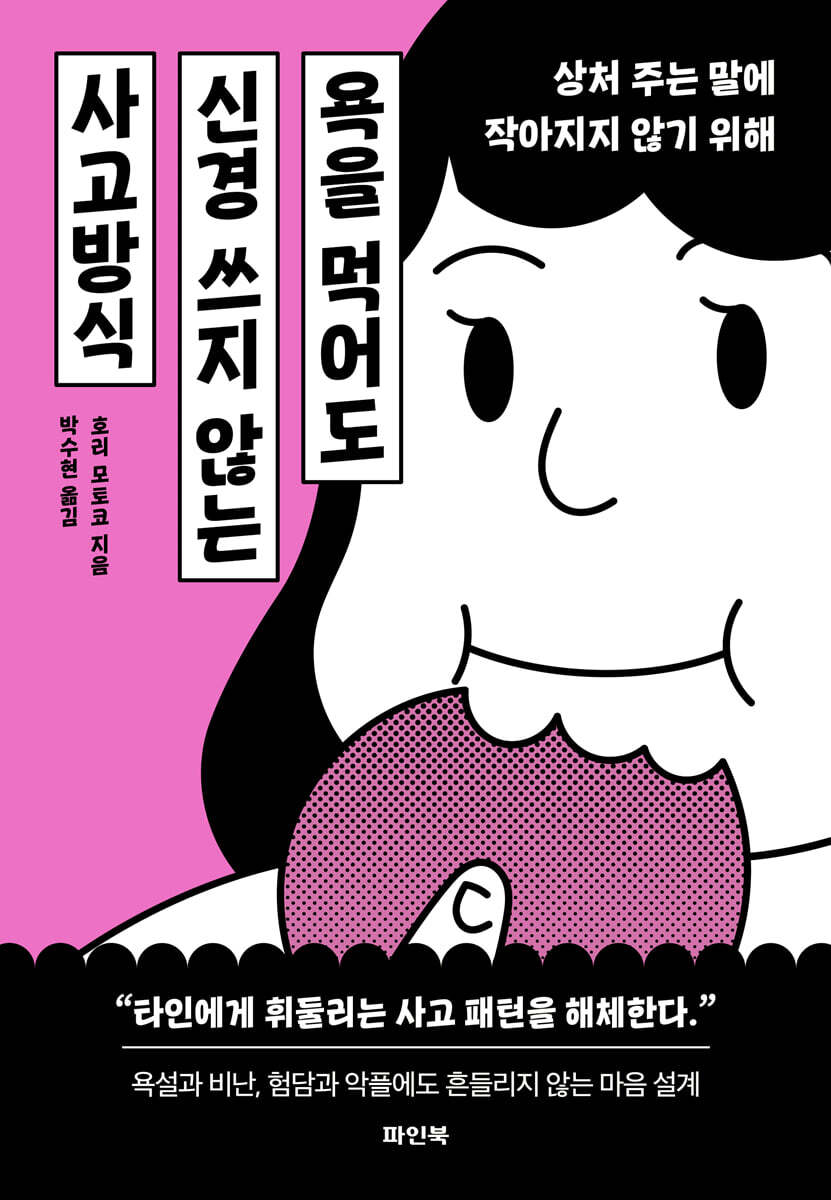
A mindset that doesn't care if you get cursed at
 |
Description
Book Introduction
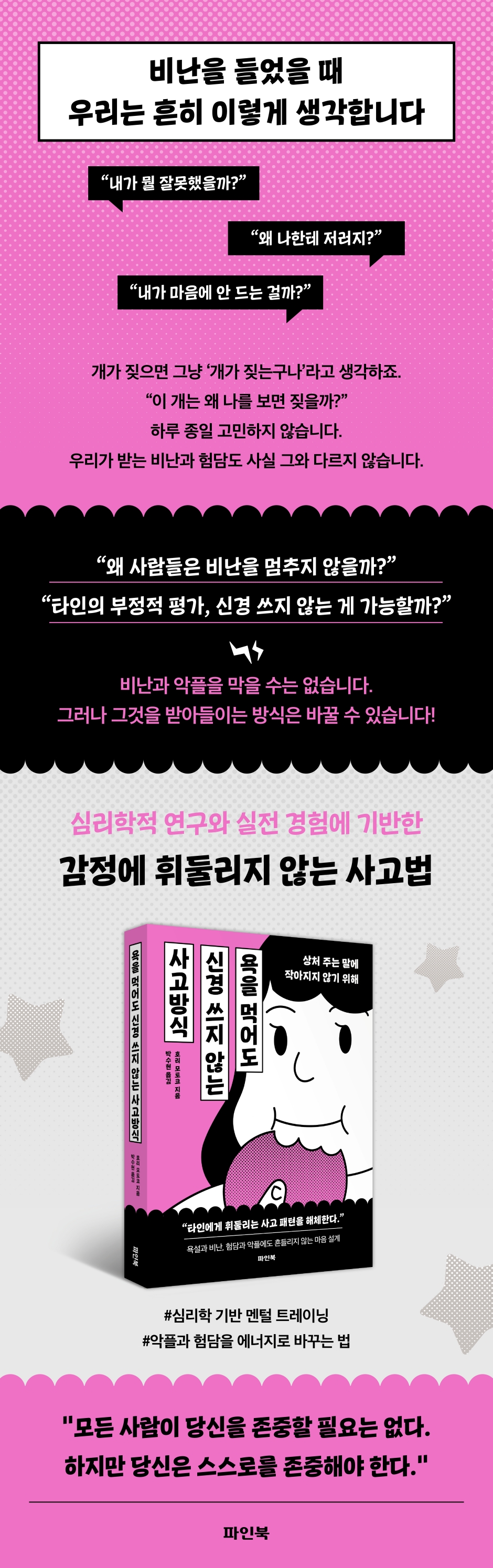
In a world where swearing, malicious comments, gossip, and criticism are rampant,
Unwavering mind immunity
In modern society, malicious comments and online bullying have a devastating impact on individuals' lives.
In the case of celebrities, we often hear of unfortunate cases where their fame is ruined due to such malicious comments.
But this reality is no longer just a problem for celebrities or public figures.
We live in an age where abusive language, hatred, criticism, and bullying run rampant, both online and offline.
As anyone can freely express their opinions through social media and online communities, groundless criticism and gossip also spread quickly.
Words that begin in the virtual world can cause extreme mental distress in the real world, and sometimes even shake up an individual's life.
When persistent malicious comments and ridicule go beyond simple differences of opinion, people gradually lose confidence and become deeply hurt.
Our society desperately needs guidance on how to respond to malicious criticism and comments and maintain composure.
This book responds precisely to these contemporary needs.
Based on the author's own experiences and psychological knowledge, he presents specific methods for walking one's own path without being swayed by the opinions of others.
The author of this book, Motoko Hori, studied juvenile delinquency at university and, in her thirties, returned to university to study psychology in depth to overcome personal difficulties.
After that, I studied the stories of various people pursuing 'a life that is true to themselves' and discovered their common way of thinking and attitude.
Based on this research and experience, the author teaches readers how to improve their quality of life through 'mindset and acceptance.'
This book specifically covers five things to consider first when faced with malicious comments and criticism, five things you should never do, and how to transform this negative energy into something positive.
It also suggests ways to live while protecting your own values, along with a way of thinking that is not swayed by criticism.
This book will serve as a useful guide for anyone who wants to protect themselves from malicious comments and criticism, including real-life abuse, and build a stronger mentality.
Unwavering mind immunity
In modern society, malicious comments and online bullying have a devastating impact on individuals' lives.
In the case of celebrities, we often hear of unfortunate cases where their fame is ruined due to such malicious comments.
But this reality is no longer just a problem for celebrities or public figures.
We live in an age where abusive language, hatred, criticism, and bullying run rampant, both online and offline.
As anyone can freely express their opinions through social media and online communities, groundless criticism and gossip also spread quickly.
Words that begin in the virtual world can cause extreme mental distress in the real world, and sometimes even shake up an individual's life.
When persistent malicious comments and ridicule go beyond simple differences of opinion, people gradually lose confidence and become deeply hurt.
Our society desperately needs guidance on how to respond to malicious criticism and comments and maintain composure.
This book responds precisely to these contemporary needs.
Based on the author's own experiences and psychological knowledge, he presents specific methods for walking one's own path without being swayed by the opinions of others.
The author of this book, Motoko Hori, studied juvenile delinquency at university and, in her thirties, returned to university to study psychology in depth to overcome personal difficulties.
After that, I studied the stories of various people pursuing 'a life that is true to themselves' and discovered their common way of thinking and attitude.
Based on this research and experience, the author teaches readers how to improve their quality of life through 'mindset and acceptance.'
This book specifically covers five things to consider first when faced with malicious comments and criticism, five things you should never do, and how to transform this negative energy into something positive.
It also suggests ways to live while protecting your own values, along with a way of thinking that is not swayed by criticism.
This book will serve as a useful guide for anyone who wants to protect themselves from malicious comments and criticism, including real-life abuse, and build a stronger mentality.
- You can preview some of the book's contents.
Preview
index
prolog
Chapter 1
Five Things to Consider When You Get a Negative Review
DON'T MIND! 01 It's all about 'accepting' anything.
DON'T MIND! 02 It might be an enemy disguised as a friend.
DON'T MIND! 03 Criticism on the Internet
DON'T MIND! 04 Being criticized doesn't diminish your worth.
DON'T MIND! 05 Rethinking Blame
Column 1 Oh, the dog is barking.
Chapter 2
Five Things You Should Never Do, Even If You Get Criticized
DON'T MIND! 01 Become emotional
DON'T MIND! 02 Blame is bound to come back.
DON'T MIND! 03 Feeling depressed because you think you're useless
DON'T MIND! 04 Escape from Reality
DON'T MIND! 05 Falling into the swamp of negativity
Column 2 No one can hurt my heart!
CHAPTER 3
Convert criticism into energy!
DON'T MIND! 01 Four Types of Energy
DON'T MIND! 02 The Psychology of a Mount Taker
DON'T MIND! 03 Why People Get Jealous
DON'T MIND! 04 How to Deal with Someone Who Wants to Gossip
Column 3: Maintaining your own values
Chapter 4
A mindset that doesn't give in to criticism
DON'T MIND! 01 If you don't refute, you'll feel like you've lost.
DON'T MIND! 02 Don't look for the cause in yourself.
DON'T MIND! 03 A friend who is tiring to be with is just an acquaintance.
DON'T MIND! 04 Why do so many difficult things keep happening to you?
DON'T MIND! 05 The Good-Kid Complex That Binds Us
DON'T MIND! 06 Your life is entirely your own decision.
Column 4 You Can't Be Loved by Everyone
Column 5: Gossip may actually be about bonding.
Chapter 1
Five Things to Consider When You Get a Negative Review
DON'T MIND! 01 It's all about 'accepting' anything.
DON'T MIND! 02 It might be an enemy disguised as a friend.
DON'T MIND! 03 Criticism on the Internet
DON'T MIND! 04 Being criticized doesn't diminish your worth.
DON'T MIND! 05 Rethinking Blame
Column 1 Oh, the dog is barking.
Chapter 2
Five Things You Should Never Do, Even If You Get Criticized
DON'T MIND! 01 Become emotional
DON'T MIND! 02 Blame is bound to come back.
DON'T MIND! 03 Feeling depressed because you think you're useless
DON'T MIND! 04 Escape from Reality
DON'T MIND! 05 Falling into the swamp of negativity
Column 2 No one can hurt my heart!
CHAPTER 3
Convert criticism into energy!
DON'T MIND! 01 Four Types of Energy
DON'T MIND! 02 The Psychology of a Mount Taker
DON'T MIND! 03 Why People Get Jealous
DON'T MIND! 04 How to Deal with Someone Who Wants to Gossip
Column 3: Maintaining your own values
Chapter 4
A mindset that doesn't give in to criticism
DON'T MIND! 01 If you don't refute, you'll feel like you've lost.
DON'T MIND! 02 Don't look for the cause in yourself.
DON'T MIND! 03 A friend who is tiring to be with is just an acquaintance.
DON'T MIND! 04 Why do so many difficult things keep happening to you?
DON'T MIND! 05 The Good-Kid Complex That Binds Us
DON'T MIND! 06 Your life is entirely your own decision.
Column 4 You Can't Be Loved by Everyone
Column 5: Gossip may actually be about bonding.
Detailed image
Into the book
Now that social media has become a part of our lives, it's impossible to see only what we want to see and the information we want to know.
Just as there are no kind posts that warn you in advance, saying, "Click carefully," there are no posts that warn you in advance, saying, "Do not read, as it contains slander against you."
Now, social media is no longer a tool that can be dismissed as, “If it hurts, just don’t look at it.”
In this era of social media, we need the skill to ‘receive what we see.’
--- p.43
A person who hears someone else say something bad about him or her might think, "That person might say that about me to someone else too."
Especially when it comes to people we aren't close to, we tend to think of them as frivolous, thinking, 'How can someone say something like that to me, even though we're not that close to them?'
It's okay to complain, but it's better not to gossip.
--- p.64
When negative thoughts arise, consciously attract new stimuli.
It's also nice to enjoy a new book or comic or watch a newly released movie.
And since negative thoughts tend to increase at night, going to bed as early as possible can help you recover your mental state more quickly.
--- p.96
The 'mammalian brain' is responsible for basic emotions such as likes and dislikes, relief and fear.
Cooperating with colleagues for group living or showing affection for vulnerable beings such as babies is also due to the mammalian brain working.
The 'human brain' controls logical thinking.
It has the ability to act with purpose or to predict the future and devise strategies.
--- p.111
I believe there is a clear difference in the level of happiness in life between those who can suppress their jealousy and those who cannot.
The proof is only in myself, but since I have been trying to get rid of my jealousy, I am much happier now than I was back then.
--- p.147
There will be many times when it is difficult to 'ignore' depending on the position or situation, so in those cases, show an 'indifferent attitude' that is close to ignoring.
Once the other person realizes that you are not interested, they will find someone else who is interested (and returns the same stroke), so you don't have to worry about it.
--- p.161
When you hear something unpleasant from someone, you want to say something back.
If you don't say anything, you'll end up feeling resentful later, thinking, "I should have said that back then," or "Why didn't I say anything back?"
If you keep having experiences like that, you'll start preparing your response in advance, thinking, 'Next time, I'll definitely hit you back.'
Moreover, the initial purpose was to refute, but at some point, the goal became to break the opponent's words and leave him speechless.
--- p.169
When school starts, parents worry about their children's interpersonal relationships, wondering, "Will my child be able to make friends?"
The teacher also emphasizes peace within the classroom, saying, “Let’s get along well with our friends.”
Growing up in this environment, we have come to believe that the number of friends we have is equivalent to our evaluation of ourselves.
A class is just a group of people of the same age who live in the same area, and if they don't get along well, they'll be seen as 'bad kids.'
--- p.187
The biggest challenge is 'acknowledging that you have a negative mindset.'
If you accept and acknowledge this, you can now always be conscious of it and think, "Oh, I was thinking of other people's solutions," and think again, "This is also my decision," and "If I have a reason, what on earth could it be?"
--- p.222
Have you ever seen someone drive a car as a child and thought, "I can't possibly drive." You can drive because you learned how to drive.
People who don't care about being cursed at simply knew the skill of 'not caring'.
The first step to changing yourself begins with learning how to do it.
Just as there are no kind posts that warn you in advance, saying, "Click carefully," there are no posts that warn you in advance, saying, "Do not read, as it contains slander against you."
Now, social media is no longer a tool that can be dismissed as, “If it hurts, just don’t look at it.”
In this era of social media, we need the skill to ‘receive what we see.’
--- p.43
A person who hears someone else say something bad about him or her might think, "That person might say that about me to someone else too."
Especially when it comes to people we aren't close to, we tend to think of them as frivolous, thinking, 'How can someone say something like that to me, even though we're not that close to them?'
It's okay to complain, but it's better not to gossip.
--- p.64
When negative thoughts arise, consciously attract new stimuli.
It's also nice to enjoy a new book or comic or watch a newly released movie.
And since negative thoughts tend to increase at night, going to bed as early as possible can help you recover your mental state more quickly.
--- p.96
The 'mammalian brain' is responsible for basic emotions such as likes and dislikes, relief and fear.
Cooperating with colleagues for group living or showing affection for vulnerable beings such as babies is also due to the mammalian brain working.
The 'human brain' controls logical thinking.
It has the ability to act with purpose or to predict the future and devise strategies.
--- p.111
I believe there is a clear difference in the level of happiness in life between those who can suppress their jealousy and those who cannot.
The proof is only in myself, but since I have been trying to get rid of my jealousy, I am much happier now than I was back then.
--- p.147
There will be many times when it is difficult to 'ignore' depending on the position or situation, so in those cases, show an 'indifferent attitude' that is close to ignoring.
Once the other person realizes that you are not interested, they will find someone else who is interested (and returns the same stroke), so you don't have to worry about it.
--- p.161
When you hear something unpleasant from someone, you want to say something back.
If you don't say anything, you'll end up feeling resentful later, thinking, "I should have said that back then," or "Why didn't I say anything back?"
If you keep having experiences like that, you'll start preparing your response in advance, thinking, 'Next time, I'll definitely hit you back.'
Moreover, the initial purpose was to refute, but at some point, the goal became to break the opponent's words and leave him speechless.
--- p.169
When school starts, parents worry about their children's interpersonal relationships, wondering, "Will my child be able to make friends?"
The teacher also emphasizes peace within the classroom, saying, “Let’s get along well with our friends.”
Growing up in this environment, we have come to believe that the number of friends we have is equivalent to our evaluation of ourselves.
A class is just a group of people of the same age who live in the same area, and if they don't get along well, they'll be seen as 'bad kids.'
--- p.187
The biggest challenge is 'acknowledging that you have a negative mindset.'
If you accept and acknowledge this, you can now always be conscious of it and think, "Oh, I was thinking of other people's solutions," and think again, "This is also my decision," and "If I have a reason, what on earth could it be?"
--- p.222
Have you ever seen someone drive a car as a child and thought, "I can't possibly drive." You can drive because you learned how to drive.
People who don't care about being cursed at simply knew the skill of 'not caring'.
The first step to changing yourself begins with learning how to do it.
--- p.223
Publisher's Review
Based on psychological research and practical experience
How to Think Emotionally and Build Mental Muscles
Practice growing instead of being hurt by workplace gossip and social media abuse.
When we find out that someone is gossiping about us, we are more shocked than we think.
Even if it's a simple joke or a malicious accusation that is completely untrue, it leaves an uneasy feeling in a corner of my heart.
Thoughts like “What did I do wrong?” and “Why did they do that to me?” keep coming back to me, making me feel depressed and eventually wasting time worrying about things I don’t need to be worrying about.
But let's think about it.
If a dog barks on the street, we don't spend the whole day wondering, "Why did that dog bark at me?"
It was just a dog barking.
The criticism and gossip we receive are actually no different.
So why do we feel hurt and distressed by words like "the sound of a dog barking"? The problem isn't the words themselves, but how we perceive them.
From a young age, we are taught that we should not say hurtful things to others, but the world runs in the exact opposite direction of that education.
There are people who criticize everywhere, and baseless gossip and malicious comments show no signs of disappearing from society.
No matter how righteously you act, there will always be someone who will dislike you, and there will always be people who dislike you for no reason.
So what should we do?
This book starts from that very question.
In a world rife with insults, criticism, malicious comments, and gossip, this book uses psychological principles and experience to explain how to protect your heart and use it as energy for growth.
Even if you get cursed at, you feel no impact!
The author confesses that he was once a person who lived overly conscious of other people's gaze.
Looking back on the past, when I used to torment myself with thoughts like, "They're definitely insulting me," or "That laughter must be mocking me," I began to explore how I could break free from such negative thoughts and live a dignified life.
He majored in psychology, devoured countless self-help books, and conducted repeated experiments to actually change his way of thinking.
And then I realized.
What matters is not genes or environment, but ‘how you accept it’.
When faced with criticism, instead of crumbling, we can take a new perspective.
Swearing also means that the other person is unable to control their emotions.
In other words, it is 'that person's problem', not 'my problem'.
People who post malicious comments are sending a signal that they are unhappy.
Rather than determining my worth based on the evaluation of others, I need to practice determining my own worth.
And above all, we must learn how to transform criticism into energy for growth.
This book doesn't simply offer comfort; it offers concrete solutions.
It's packed with practical advice, including five things to think about immediately when you hear criticism, five things you should never do, how to transform gossip into energy, and how to think without being swayed by negative words.
This book is not something you read once and put to rest. If you open it again and apply it in real-life situations, you will feel the practical effect in developing your mental muscles.
Someone will say.
“Just don’t worry about it.” But we know all too well that it’s easier said than done.
The key is not to simply ignore them, but to learn how to protect yourself and live confidently within those words.
Change won't happen overnight, but if you follow the methods in this book, you'll eventually find yourself no longer swayed by what others say.
And then you will realize.
The fact that I am ultimately the main character of my own life.
A 3-month project where you don't care what others say
Completing a psychological bulletproof system that is unshakable by the opinions of others
No need for rebuttal!
We often feel the urge to hit back when we hear unpleasant words.
But from that moment on, a 'war of words' begins with the other person, and before you know it, it becomes a matter of winning or losing.
Do we really have to fight and win against someone who has insulted us? If we don't refute them, are we truly defeated?
This book presents an interesting perspective: 'The wisest response to being cursed at is not to refute.'
When you hear hurtful words from someone, instead of being swayed by those words and wasting your emotions, you should learn the 'through skill' (the ability to let it go).
This is an episode introduced in this book.
The Buddha was severely abused by a man, but he did not say anything.
When the angry man asked why he was not saying anything, the Buddha asked back.
“If you give a gift to someone and they don’t take it, who does it belong to?” the man answered.
“Since the other person didn’t receive it, it must belong to the person who gave it to him.” At that moment, he realized.
The same goes for cursing.
If you don't respond to the words the other person is spewing, those words are ultimately just theirs.
This book helps us learn how to avoid unnecessary fights and protect our mental health through psychological principles and practical exercises.
Five ways to develop through skills, a way to think unwaveringly, and even techniques for transforming insults into energy.
If you practice this for just three months, you will find yourself much freer and stronger than you are now.
“There is no victory or defeat unless you step into the ring of battle.”
If you too want to break free from unnecessary emotional exhaustion, open this book.
How to Think Emotionally and Build Mental Muscles
Practice growing instead of being hurt by workplace gossip and social media abuse.
When we find out that someone is gossiping about us, we are more shocked than we think.
Even if it's a simple joke or a malicious accusation that is completely untrue, it leaves an uneasy feeling in a corner of my heart.
Thoughts like “What did I do wrong?” and “Why did they do that to me?” keep coming back to me, making me feel depressed and eventually wasting time worrying about things I don’t need to be worrying about.
But let's think about it.
If a dog barks on the street, we don't spend the whole day wondering, "Why did that dog bark at me?"
It was just a dog barking.
The criticism and gossip we receive are actually no different.
So why do we feel hurt and distressed by words like "the sound of a dog barking"? The problem isn't the words themselves, but how we perceive them.
From a young age, we are taught that we should not say hurtful things to others, but the world runs in the exact opposite direction of that education.
There are people who criticize everywhere, and baseless gossip and malicious comments show no signs of disappearing from society.
No matter how righteously you act, there will always be someone who will dislike you, and there will always be people who dislike you for no reason.
So what should we do?
This book starts from that very question.
In a world rife with insults, criticism, malicious comments, and gossip, this book uses psychological principles and experience to explain how to protect your heart and use it as energy for growth.
Even if you get cursed at, you feel no impact!
The author confesses that he was once a person who lived overly conscious of other people's gaze.
Looking back on the past, when I used to torment myself with thoughts like, "They're definitely insulting me," or "That laughter must be mocking me," I began to explore how I could break free from such negative thoughts and live a dignified life.
He majored in psychology, devoured countless self-help books, and conducted repeated experiments to actually change his way of thinking.
And then I realized.
What matters is not genes or environment, but ‘how you accept it’.
When faced with criticism, instead of crumbling, we can take a new perspective.
Swearing also means that the other person is unable to control their emotions.
In other words, it is 'that person's problem', not 'my problem'.
People who post malicious comments are sending a signal that they are unhappy.
Rather than determining my worth based on the evaluation of others, I need to practice determining my own worth.
And above all, we must learn how to transform criticism into energy for growth.
This book doesn't simply offer comfort; it offers concrete solutions.
It's packed with practical advice, including five things to think about immediately when you hear criticism, five things you should never do, how to transform gossip into energy, and how to think without being swayed by negative words.
This book is not something you read once and put to rest. If you open it again and apply it in real-life situations, you will feel the practical effect in developing your mental muscles.
Someone will say.
“Just don’t worry about it.” But we know all too well that it’s easier said than done.
The key is not to simply ignore them, but to learn how to protect yourself and live confidently within those words.
Change won't happen overnight, but if you follow the methods in this book, you'll eventually find yourself no longer swayed by what others say.
And then you will realize.
The fact that I am ultimately the main character of my own life.
A 3-month project where you don't care what others say
Completing a psychological bulletproof system that is unshakable by the opinions of others
No need for rebuttal!
We often feel the urge to hit back when we hear unpleasant words.
But from that moment on, a 'war of words' begins with the other person, and before you know it, it becomes a matter of winning or losing.
Do we really have to fight and win against someone who has insulted us? If we don't refute them, are we truly defeated?
This book presents an interesting perspective: 'The wisest response to being cursed at is not to refute.'
When you hear hurtful words from someone, instead of being swayed by those words and wasting your emotions, you should learn the 'through skill' (the ability to let it go).
This is an episode introduced in this book.
The Buddha was severely abused by a man, but he did not say anything.
When the angry man asked why he was not saying anything, the Buddha asked back.
“If you give a gift to someone and they don’t take it, who does it belong to?” the man answered.
“Since the other person didn’t receive it, it must belong to the person who gave it to him.” At that moment, he realized.
The same goes for cursing.
If you don't respond to the words the other person is spewing, those words are ultimately just theirs.
This book helps us learn how to avoid unnecessary fights and protect our mental health through psychological principles and practical exercises.
Five ways to develop through skills, a way to think unwaveringly, and even techniques for transforming insults into energy.
If you practice this for just three months, you will find yourself much freer and stronger than you are now.
“There is no victory or defeat unless you step into the ring of battle.”
If you too want to break free from unnecessary emotional exhaustion, open this book.
GOODS SPECIFICS
- Date of issue: July 15, 2025
- Page count, weight, size: 240 pages | 147*212*20mm
- ISBN13: 9791198632548
- ISBN10: 1198632542
You may also like
카테고리
korean


korean

![ELLE 엘르 스페셜 에디션 A형 : 12월 [2025]](http://librairie.coreenne.fr/cdn/shop/files/b8e27a3de6c9538896439686c6b0e8fb.jpg?v=1766436872&width=3840)


