

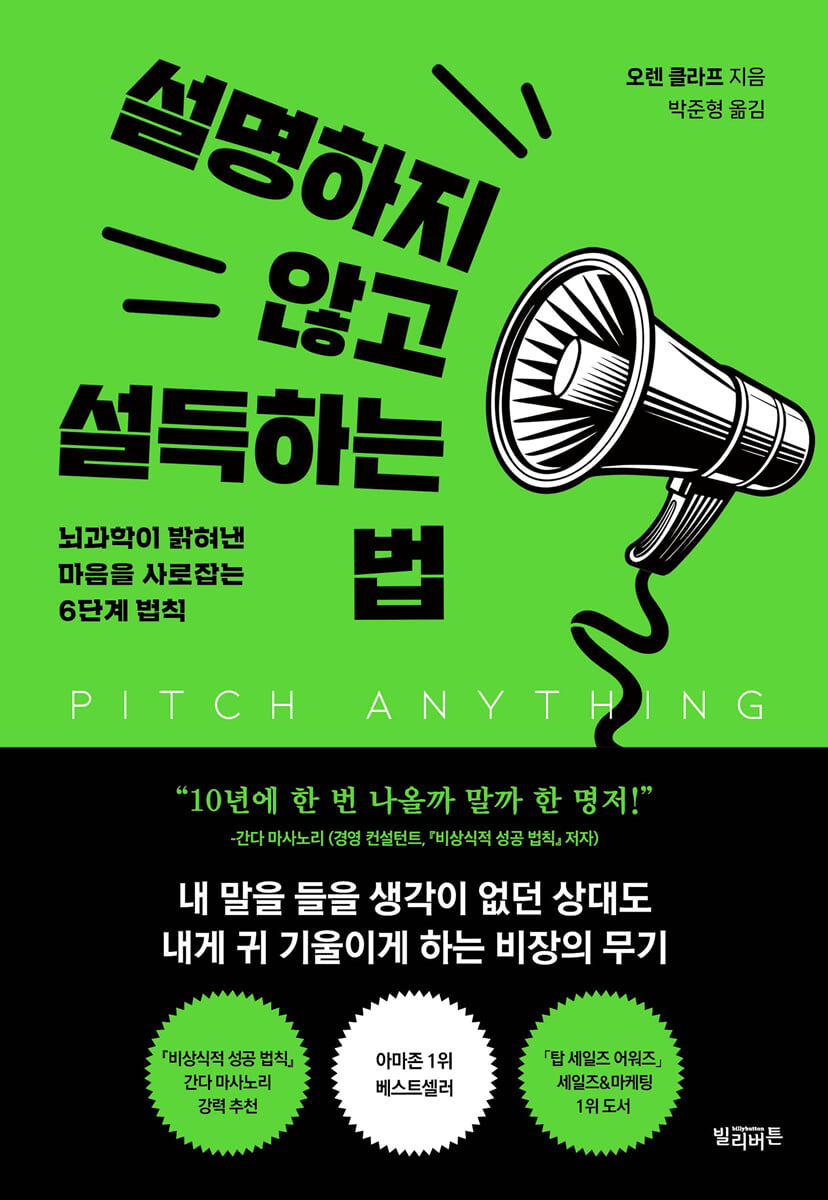
How to persuade without explaining
 |
Description
Book Introduction
***Amazon #1 Bestseller***
***The Best Business Book Praised by Masanori Kanda***
***Top Sales Awards No. 1 Sales & Marketing Book***
“The human brain does not respond to logic!”
Discovered by brain science
The most perfect art of persuasion
When you hear the word "persuasion," you probably think of silence with irrefutable facts and statistics, and change the minds of others with eloquence.
But in reality, 'real' persuasion must be much more subtle, effective, and, above all, attractive.
The author of this book, Oren Claff, is a master of persuasion who has made a living through persuasion alone in Wall Street, a place filled with high-flying and high-powered talent.
He has successfully persuaded difficult people, from big-time investors and cold-blooded analysts to arrogant businessmen and even scammers who ran off with his money. By combining the latest brain science with 10,000 hours of his own experience, he has revealed the perfect persuasion strategy.
According to him, 'cold' words like rational facts and logic bounce off the other person's ears without even reaching them.
The only thing that can capture a person's heart is 'hot' words that ignite the other person's emotions and desires.
It's about touching the subconscious, getting the other person to focus on what I'm saying, delivering the message clearly, and ultimately getting what I want.
This book contains persuasion techniques that can be used in every social situation you encounter in life.
We will also introduce how to create an engaging presentation, a means of persuading a large audience, as well as how to persuade others in one-on-one conversations.
Possessing excellent persuasion skills means having the ability to control situations as you wish.
By honing your persuasion skills with the author's guidance, you will be able to navigate any situation with confidence and without panic, anytime, anywhere.
***The Best Business Book Praised by Masanori Kanda***
***Top Sales Awards No. 1 Sales & Marketing Book***
“The human brain does not respond to logic!”
Discovered by brain science
The most perfect art of persuasion
When you hear the word "persuasion," you probably think of silence with irrefutable facts and statistics, and change the minds of others with eloquence.
But in reality, 'real' persuasion must be much more subtle, effective, and, above all, attractive.
The author of this book, Oren Claff, is a master of persuasion who has made a living through persuasion alone in Wall Street, a place filled with high-flying and high-powered talent.
He has successfully persuaded difficult people, from big-time investors and cold-blooded analysts to arrogant businessmen and even scammers who ran off with his money. By combining the latest brain science with 10,000 hours of his own experience, he has revealed the perfect persuasion strategy.
According to him, 'cold' words like rational facts and logic bounce off the other person's ears without even reaching them.
The only thing that can capture a person's heart is 'hot' words that ignite the other person's emotions and desires.
It's about touching the subconscious, getting the other person to focus on what I'm saying, delivering the message clearly, and ultimately getting what I want.
This book contains persuasion techniques that can be used in every social situation you encounter in life.
We will also introduce how to create an engaging presentation, a means of persuading a large audience, as well as how to persuade others in one-on-one conversations.
Possessing excellent persuasion skills means having the ability to control situations as you wish.
By honing your persuasion skills with the author's guidance, you will be able to navigate any situation with confidence and without panic, anytime, anywhere.
- You can preview some of the book's contents.
Preview
index
Chapter 1: The Art of Persuasion
01 Persuasion is a skill, not a talent.
02 Why Your Persuasion Fails
03 Overcome Croc Brain
04 STRONG techniques to perfect persuasion
Decide with 2 frames
01 Begging is not persuasion.
02 Key to Victory, Frame
03 Power Frame
04 Compensation Frame
05 I will receive the money that was stolen.
06 Time Frame
07 Interest Frame
08 Reward Frame: Money is common, but I am unique.
09 Leave without hesitation at any time
Chapter 3: Seize a Advantageous Position
01 French waiter sitting on top of head
02 Alpha or Beta
03 Overturn the pyramid of power
Chapter 4: The Art of Captivating Presentations
01 4 Steps of Presentation
Step 1: Introduce yourself and present your great idea.
Step 2: Reveal Your Budget and Secret Source
Step 3: Proposing a Deal
Step 4: Building a Frame for Hot Cognition
Chapter 5.
Don't show your desperation
01 Standing at a dead end
02 Never be desperate
03 Last Chance
Chapter 6.
A billion dollar bet
01 Battle of the Giants
02 Return to the battlefield
03 Emergence of a Rival
04 Strategies of Persuasion That Lead to Victory
05 Time for the Decisive Battle
06 Expected Counterattack
07 The Time of Judgment
Chapter 7.
Start now
01 Why are frames important?
02 Practice and practice again
01 Persuasion is a skill, not a talent.
02 Why Your Persuasion Fails
03 Overcome Croc Brain
04 STRONG techniques to perfect persuasion
Decide with 2 frames
01 Begging is not persuasion.
02 Key to Victory, Frame
03 Power Frame
04 Compensation Frame
05 I will receive the money that was stolen.
06 Time Frame
07 Interest Frame
08 Reward Frame: Money is common, but I am unique.
09 Leave without hesitation at any time
Chapter 3: Seize a Advantageous Position
01 French waiter sitting on top of head
02 Alpha or Beta
03 Overturn the pyramid of power
Chapter 4: The Art of Captivating Presentations
01 4 Steps of Presentation
Step 1: Introduce yourself and present your great idea.
Step 2: Reveal Your Budget and Secret Source
Step 3: Proposing a Deal
Step 4: Building a Frame for Hot Cognition
Chapter 5.
Don't show your desperation
01 Standing at a dead end
02 Never be desperate
03 Last Chance
Chapter 6.
A billion dollar bet
01 Battle of the Giants
02 Return to the battlefield
03 Emergence of a Rival
04 Strategies of Persuasion That Lead to Victory
05 Time for the Decisive Battle
06 Expected Counterattack
07 The Time of Judgment
Chapter 7.
Start now
01 Why are frames important?
02 Practice and practice again
Detailed image
.jpg)
Into the book
Perhaps readers might have similar thoughts to me 10 years ago.
At the time, I was obsessed with the idea that 'the human brain is like a computer.'
Just like on a computer, if I send an Excel file, the recipient will also have to read the file in Excel, right?
I thought this was how the human brain worked.
So I thought that if I wrote a message with my smart cerebral cortex and sent it (explained it), the other person would open the message with their own cerebral cortex.
But for the message I'm arguing to reach the logical part of the other person's brain, it must first pass through the survival filter, the croc brain.
However, because of the way humans evolved, it is very difficult for words of persuasion to pass through this filter.
--- p.27
After countless efforts, I finally developed a formula for effective persuasion.
I will now tell you the formula.
As I'll explain later, it starts with setting a frame for persuasion, putting your great idea into an easily understandable context.
Then, once the frame is established, you must secure a higher social status than the person you are trying to persuade.
Only then can we secure a solid platform for persuasion.
Next, you need to create a message that is full of interest and novelty.
--- p.37~38
For decades, there have been countless books and seminars designed to encourage and promote quick buying decisions.
Those who promote these programs realized years ago how ineffective their methods were and decided to explain them in terms of the laws of large numbers.
What they usually say is this:
“If you use our sales techniques to make 100 calls, you can make two sales.” In other words, if you work much harder than everyone else, you can achieve a 2% success rate.
But can this be called a success?
--- p.47~48
Dominating the frame gives you a position to negotiate with the buyer.
You will also gain a position to decide which trades, orders, and projects to choose, rather than just taking what you can get.
Do you think it's impossible? I do it every day.
This kind of magic is possible simply by wanting to provide better service to customers.
You can't achieve this kind of success with a sales approach that involves constantly racing to get new leads.
This book explains how to gain and maintain control of your frame instead of beating yourself up with dozens of unproductive sales calls and presentations.
Using this method, you will likely be able to close five sales, and even reject two that you don't like.
--- p.49~50
The moment your audience delves deep into the details, you lose control of the frame.
The initial excitement that started when the presentation began can naturally cool down as you listen to the presentation.
However, the cerebral cortex of the brain becomes cold when it receives information to calculate.
The way of thinking associated with problem solving, numerical computation, statistics, and all kinds of geometry is called cold cognition.
When you force your audience to look at numerical statistics and details during a presentation, their thinking cools down faster than ever.
--- p.93
In 1953, molecular biologists James Watson and Francis Crick revealed to the world the double-helix structure of DNA, widely considered the most important scientific discovery of the 20th century—the secret of life.
Watson and Crick won the Nobel Prize for this announcement.
But what's most remarkable about this achievement is that it took just five minutes for the two men to announce the entire thing out loud.
Introducing the secrets of life, explaining them in detail and showing how they work.
It took just five minutes for the perfect presentation.
Let's think about it this way.
Even the most important scientific discoveries of the 20th century could be announced in less than five minutes.
But until now, almost every presentation I see, hundreds of times a year, has been at least 45 minutes long, and usually an hour.
That's ridiculous!
--- p.166
Because push and pull are a two-way relationship, they create enough tension when they work simultaneously.
If you keep pulling the other person towards you, it becomes too much pressure and it looks like you are begging for help.
Of course, balance is necessary.
Conversely, if you keep pushing away, the other person will realize this and move away.
--- p.202
After countless attempts at persuasion, I realized that people don't do what they're told.
They must feel that they have the free will to make their own decisions.
Unless you create a primal and inescapable emotion for them to react to, they won't even know what to do.
They can't remember your words without dopamine and norepinephrine, which create two forces: desire and tension.
At the time, I was obsessed with the idea that 'the human brain is like a computer.'
Just like on a computer, if I send an Excel file, the recipient will also have to read the file in Excel, right?
I thought this was how the human brain worked.
So I thought that if I wrote a message with my smart cerebral cortex and sent it (explained it), the other person would open the message with their own cerebral cortex.
But for the message I'm arguing to reach the logical part of the other person's brain, it must first pass through the survival filter, the croc brain.
However, because of the way humans evolved, it is very difficult for words of persuasion to pass through this filter.
--- p.27
After countless efforts, I finally developed a formula for effective persuasion.
I will now tell you the formula.
As I'll explain later, it starts with setting a frame for persuasion, putting your great idea into an easily understandable context.
Then, once the frame is established, you must secure a higher social status than the person you are trying to persuade.
Only then can we secure a solid platform for persuasion.
Next, you need to create a message that is full of interest and novelty.
--- p.37~38
For decades, there have been countless books and seminars designed to encourage and promote quick buying decisions.
Those who promote these programs realized years ago how ineffective their methods were and decided to explain them in terms of the laws of large numbers.
What they usually say is this:
“If you use our sales techniques to make 100 calls, you can make two sales.” In other words, if you work much harder than everyone else, you can achieve a 2% success rate.
But can this be called a success?
--- p.47~48
Dominating the frame gives you a position to negotiate with the buyer.
You will also gain a position to decide which trades, orders, and projects to choose, rather than just taking what you can get.
Do you think it's impossible? I do it every day.
This kind of magic is possible simply by wanting to provide better service to customers.
You can't achieve this kind of success with a sales approach that involves constantly racing to get new leads.
This book explains how to gain and maintain control of your frame instead of beating yourself up with dozens of unproductive sales calls and presentations.
Using this method, you will likely be able to close five sales, and even reject two that you don't like.
--- p.49~50
The moment your audience delves deep into the details, you lose control of the frame.
The initial excitement that started when the presentation began can naturally cool down as you listen to the presentation.
However, the cerebral cortex of the brain becomes cold when it receives information to calculate.
The way of thinking associated with problem solving, numerical computation, statistics, and all kinds of geometry is called cold cognition.
When you force your audience to look at numerical statistics and details during a presentation, their thinking cools down faster than ever.
--- p.93
In 1953, molecular biologists James Watson and Francis Crick revealed to the world the double-helix structure of DNA, widely considered the most important scientific discovery of the 20th century—the secret of life.
Watson and Crick won the Nobel Prize for this announcement.
But what's most remarkable about this achievement is that it took just five minutes for the two men to announce the entire thing out loud.
Introducing the secrets of life, explaining them in detail and showing how they work.
It took just five minutes for the perfect presentation.
Let's think about it this way.
Even the most important scientific discoveries of the 20th century could be announced in less than five minutes.
But until now, almost every presentation I see, hundreds of times a year, has been at least 45 minutes long, and usually an hour.
That's ridiculous!
--- p.166
Because push and pull are a two-way relationship, they create enough tension when they work simultaneously.
If you keep pulling the other person towards you, it becomes too much pressure and it looks like you are begging for help.
Of course, balance is necessary.
Conversely, if you keep pushing away, the other person will realize this and move away.
--- p.202
After countless attempts at persuasion, I realized that people don't do what they're told.
They must feel that they have the free will to make their own decisions.
Unless you create a primal and inescapable emotion for them to react to, they won't even know what to do.
They can't remember your words without dopamine and norepinephrine, which create two forces: desire and tension.
--- p.332
Publisher's Review
The human brain is not interested in rational explanations!
The Brain Science of Persuasion: Improving Life Efficiency
Which phrase would be more appealing: "Stocks in a company with sales growing 10% monthly, expected to more than double next year, and led by a smart CEO" or "Stocks bought by Warren Buffett"? The first phrase is more "good" in terms of content.
There is a lot of useful information based on solid evidence.
But that's why it takes time to understand.
On the other hand, the phrase “stocks Warren Buffett bought” is immediately ‘stuck’ in your head without any further explanation.
Because Buffett's success story immediately stimulates our financial desires and expectations.
The reason why such 'good' explanations fail to attract our attention is because the human brain has evolved to use as little energy as possible for survival and to reach conclusions quickly with little information.
That is, humans cannot listen to others for very long.
This is why long explanations are useless in persuasion.
Therefore, if you want to persuade someone, you need to know how to design a message that will stick in their head in a short period of time.
Fortunately, this book contains a step-by-step outline of optimal persuasion strategies, designed by the author based on the latest brain science theories and verified through numerous practical applications.
Without having to dig through complex papers or study numerous cases, you can learn the best and most effective methods for persuading others in just one book.
It gives you the initiative anytime, anywhere.
The ultimate weapon, 'Frame'
Another important weapon in persuasion is ‘frame’.
A frame is a perspective from which an individual interprets a situation, and the flow of the situation changes depending on whose frame wins.
Therefore, if I use this frame well, I can turn a situation that is unfavorable to me into my favor.
Since persuasion is usually an act of targeting someone who is superior to you in some way, framing is the most important key to successful persuasion.
This book broadly categorizes people's frames into four types and presents effective methods for breaking down others' frames.
For example, I respond to someone who believes they are superior with a 'power destruction frame' that mixes humor and rebellion, and I turn the situation in my favor with a 'compensation frame' that makes the other person curious about me by not showing desperation to someone who is not interested in me.
This framing strategy is useful not only when persuading investors or clients for professional achievements, but also in everyday life, such as outwitting a rude person or even negotiating a salary with a demanding boss.
If you learn how to freely use frames through this book, you will be able to easily get what you want, anytime, anywhere, without any conflict or clash.
The Brain Science of Persuasion: Improving Life Efficiency
Which phrase would be more appealing: "Stocks in a company with sales growing 10% monthly, expected to more than double next year, and led by a smart CEO" or "Stocks bought by Warren Buffett"? The first phrase is more "good" in terms of content.
There is a lot of useful information based on solid evidence.
But that's why it takes time to understand.
On the other hand, the phrase “stocks Warren Buffett bought” is immediately ‘stuck’ in your head without any further explanation.
Because Buffett's success story immediately stimulates our financial desires and expectations.
The reason why such 'good' explanations fail to attract our attention is because the human brain has evolved to use as little energy as possible for survival and to reach conclusions quickly with little information.
That is, humans cannot listen to others for very long.
This is why long explanations are useless in persuasion.
Therefore, if you want to persuade someone, you need to know how to design a message that will stick in their head in a short period of time.
Fortunately, this book contains a step-by-step outline of optimal persuasion strategies, designed by the author based on the latest brain science theories and verified through numerous practical applications.
Without having to dig through complex papers or study numerous cases, you can learn the best and most effective methods for persuading others in just one book.
It gives you the initiative anytime, anywhere.
The ultimate weapon, 'Frame'
Another important weapon in persuasion is ‘frame’.
A frame is a perspective from which an individual interprets a situation, and the flow of the situation changes depending on whose frame wins.
Therefore, if I use this frame well, I can turn a situation that is unfavorable to me into my favor.
Since persuasion is usually an act of targeting someone who is superior to you in some way, framing is the most important key to successful persuasion.
This book broadly categorizes people's frames into four types and presents effective methods for breaking down others' frames.
For example, I respond to someone who believes they are superior with a 'power destruction frame' that mixes humor and rebellion, and I turn the situation in my favor with a 'compensation frame' that makes the other person curious about me by not showing desperation to someone who is not interested in me.
This framing strategy is useful not only when persuading investors or clients for professional achievements, but also in everyday life, such as outwitting a rude person or even negotiating a salary with a demanding boss.
If you learn how to freely use frames through this book, you will be able to easily get what you want, anytime, anywhere, without any conflict or clash.
GOODS SPECIFICS
- Date of issue: May 29, 2025
- Page count, weight, size: 360 pages | 484g | 145*210*24mm
- ISBN13: 9791192999746
- ISBN10: 1192999746
You may also like
카테고리
korean


korean

![GQ KOREA Mark (Monthly): December [2025]](http://librairie.coreenne.fr/cdn/shop/files/8ef265dbbfbf186523ed75ba7319009d.jpg?v=1765340328&width=3840)


