

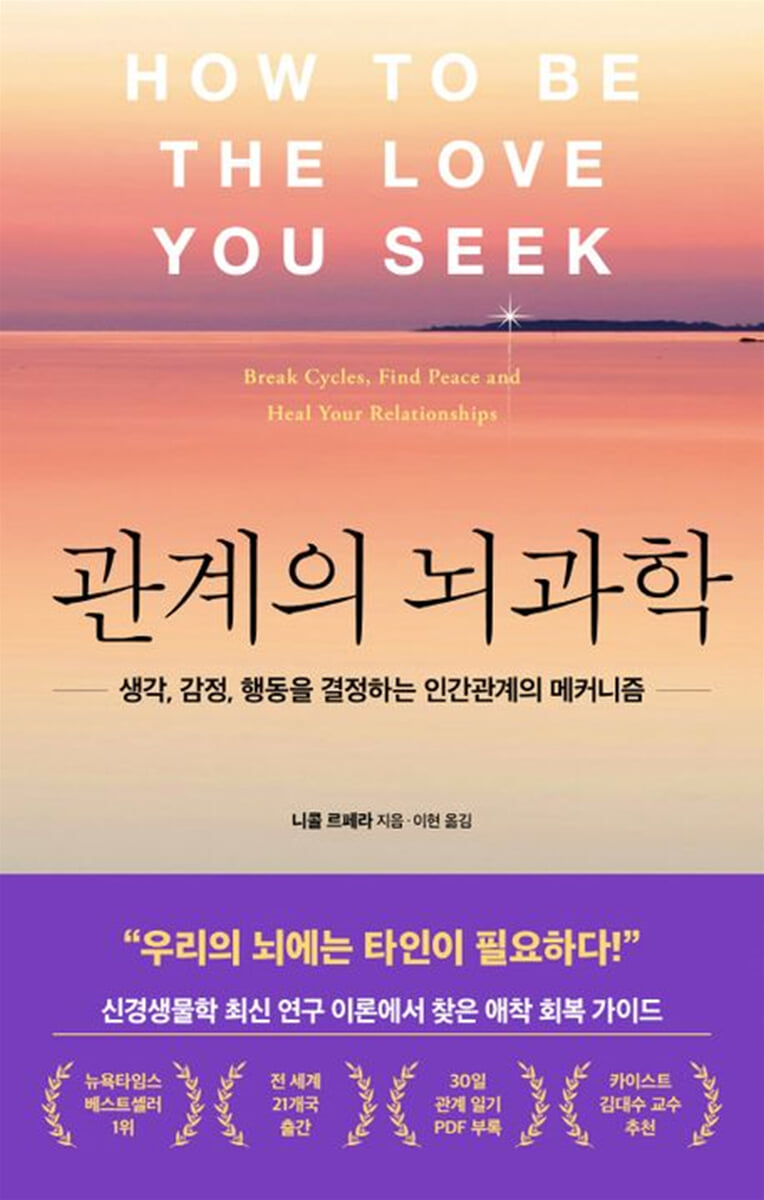
The Neuroscience of Relationships
 |
Description
Book Introduction
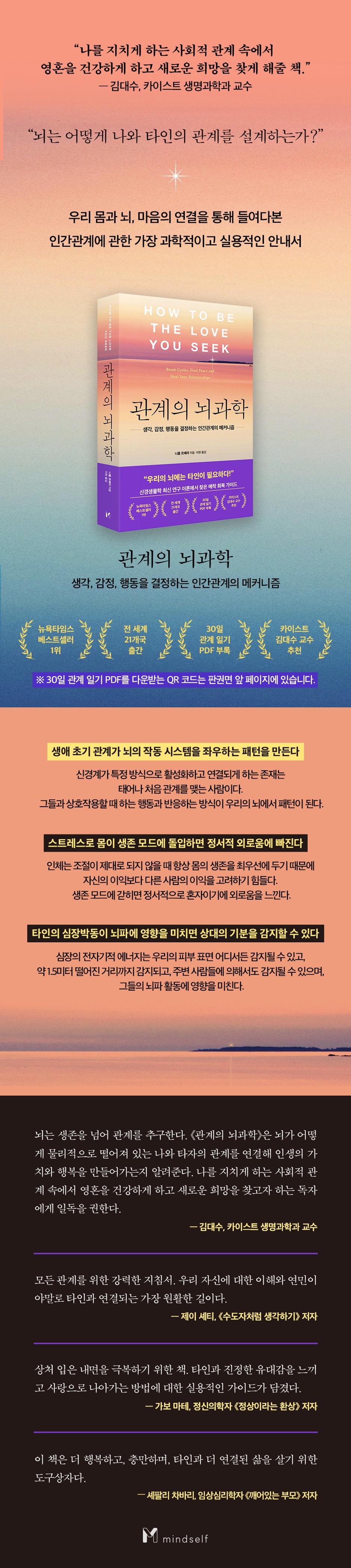
“In the social relationships that tire me out,
“A book that will heal your soul and help you find new hope.”
Kim Dae-soo, Professor of Life Sciences, KAIST
★ #1 New York Times Bestseller
★ Published in 21 countries worldwide
★ Psychology mentor to 4.4 million subscribers
★ 30-Day Relationship Diary PDF Appendix
A psychological healing book that explores the unconscious trauma and conditioned self-patterns behind interpersonal problems from a neuroscientific perspective.
In this book, Dr. Nicole LePera combines her decade of experience as a clinical psychologist with cutting-edge neuroscience research to clearly explain why we constantly crave others yet feel hurt and lonely in our relationships.
In particular, it was noted that early attachment experiences and emotional wounds affect the neural circuits and secretion of neurotransmitters in the brain, which continues to affect interpersonal relationships in adulthood.
Childhood trauma is not just a psychological experience; it leaves traces in the amygdala, frontal lobe, and autonomic nervous system of the brain, and these neurophysiological changes manifest as repetitive patterns in human relationships.
Problems in human relationships are not due to personal character flaws or lack of effort.
My current relationships are a product of the holistic systems that make us up, and if I understand the mechanisms by which my body, brain, and mind work, I can create new relationship patterns.
The constant in all relationships is 'me'.
If you listen to your inner self and follow the self-care process introduced in this book to overcome the wounds of childhood, you will be able to regain your true self, which was stuck in your childhood and curled up.
“A book that will heal your soul and help you find new hope.”
Kim Dae-soo, Professor of Life Sciences, KAIST
★ #1 New York Times Bestseller
★ Published in 21 countries worldwide
★ Psychology mentor to 4.4 million subscribers
★ 30-Day Relationship Diary PDF Appendix
A psychological healing book that explores the unconscious trauma and conditioned self-patterns behind interpersonal problems from a neuroscientific perspective.
In this book, Dr. Nicole LePera combines her decade of experience as a clinical psychologist with cutting-edge neuroscience research to clearly explain why we constantly crave others yet feel hurt and lonely in our relationships.
In particular, it was noted that early attachment experiences and emotional wounds affect the neural circuits and secretion of neurotransmitters in the brain, which continues to affect interpersonal relationships in adulthood.
Childhood trauma is not just a psychological experience; it leaves traces in the amygdala, frontal lobe, and autonomic nervous system of the brain, and these neurophysiological changes manifest as repetitive patterns in human relationships.
Problems in human relationships are not due to personal character flaws or lack of effort.
My current relationships are a product of the holistic systems that make us up, and if I understand the mechanisms by which my body, brain, and mind work, I can create new relationship patterns.
The constant in all relationships is 'me'.
If you listen to your inner self and follow the self-care process introduced in this book to overcome the wounds of childhood, you will be able to regain your true self, which was stuck in your childhood and curled up.
- You can preview some of the book's contents.
Preview
index
Introduction | A Journey Back to Myself
Chapter 1: How the Brain Designs Relationships
Relationship problems recur | The instinct to protect oneself | Early life trauma | Unmet childhood needs | Every child has an emotional inner world | Our bodies and brains need others | Conditioned stress responses | Changing the brain changes relationships | [Attachment Recovery Exercise ①] Emotional Safety and Security Checklist
Chapter 2: Understanding Myself is the Beginning of All Relationships
Understanding Your True Self | Meeting Your Body and Physical Needs | Recognizing Your Subconscious | The Place of Intuition Within You | The Journey of Inner Healing | Meeting Your True Needs | [Attachment Recovery Exercise ②] Checklist of True Needs | Healing Your Body | Body Consciousness Check | Mind Strengthening Training | Consciousness Check | The True 'Me' Lives in the Heart
Chapter 3: Relationship Problems Repeat the Same Pattern
The Traumatic Attachment Trauma | The Drive to Relive Childhood | Nervous System Basics | Staying in Social Situations | Perceptual System Errors | Nervous System Stress Responses | How to Make Your Nervous System Aware | [Attachment Recovery Exercise ③] Nervous System Checklist
Chapter 4: Understanding Your Body and Finding Stability
Our bodies and brains remember wounds | Everyone has a (wounded) inner child | Meeting your (wounded) inner child | Observing your wounded inner child | Your conditioned self | [Attachment Recovery Exercise ④] Conditioned self-evaluation
Chapter 5: The Inner Child That Determines Relationship Types
Body awareness | Emotions begin in the body | A journey to becoming conscious of your body | How to be fully present in your body | Nutrition for a sense of security | Sleep that calms the body | Movement styles | How to balance energy | Tools for regulating emotional responses | Boundaries with others
Chapter 6: Breaking Free from the Wounds Within and Living in the Present
Stories Your Subconscious Conjures | Your True Self and Who You Want to Be | Your Subconscious Creates Your Reality | Defense Mechanisms to Protect You | Meditation Training to Reconnect with Your Self | How Your Childhood Ego Affects Your Present | Giving New Meaning to Current Experiences
Chapter 7: The Power of the Heart to Lead Intuition
Physical Signals Your Heart Sends to Your Brain | Heart Coherence for Healing Relationships | The Secret Hidden in Your Heartbeat | [Attachment Recovery Exercise ⑤] Heart Rate Variability (HRV) Self-Assessment | A Journey to Reconnect with Your Heart | Training to Cultivate Heart Awareness | Listening to Your Intuition
Chapter 8: Moving Toward a Perfect Relationship
The ability to feel safe in oneself | Co-regulation experiences in childhood | Recognizing stress responses in others | How to increase relationship resilience | Feeling emotionally safe and secure in relationships
Chapter 9: How to Build Strength in Relationships
Interdependent Relationships | Honoring the Inherent Beauty of Being | For Sustainable Relationships | 5 Steps to Building Relationship Strength | When to Have Difficult Conversations | How to Recover After Conflict
Chapter 10: We Are Connected
Connecting "I" to "We" | Personal Safety Transforms Community Safety | People Who Make You Feel Safe and Comfortable | [Attachment Recovery Exercise ⑥] Social Coherence Checklist | The Ability to Perceive and Interpret the World | Schumann Resonance Menu | How to Expand Your Perception
When you listen to the signals your heart sends you
Acknowledgements
main
Search
Additional information
Chapter 1: How the Brain Designs Relationships
Relationship problems recur | The instinct to protect oneself | Early life trauma | Unmet childhood needs | Every child has an emotional inner world | Our bodies and brains need others | Conditioned stress responses | Changing the brain changes relationships | [Attachment Recovery Exercise ①] Emotional Safety and Security Checklist
Chapter 2: Understanding Myself is the Beginning of All Relationships
Understanding Your True Self | Meeting Your Body and Physical Needs | Recognizing Your Subconscious | The Place of Intuition Within You | The Journey of Inner Healing | Meeting Your True Needs | [Attachment Recovery Exercise ②] Checklist of True Needs | Healing Your Body | Body Consciousness Check | Mind Strengthening Training | Consciousness Check | The True 'Me' Lives in the Heart
Chapter 3: Relationship Problems Repeat the Same Pattern
The Traumatic Attachment Trauma | The Drive to Relive Childhood | Nervous System Basics | Staying in Social Situations | Perceptual System Errors | Nervous System Stress Responses | How to Make Your Nervous System Aware | [Attachment Recovery Exercise ③] Nervous System Checklist
Chapter 4: Understanding Your Body and Finding Stability
Our bodies and brains remember wounds | Everyone has a (wounded) inner child | Meeting your (wounded) inner child | Observing your wounded inner child | Your conditioned self | [Attachment Recovery Exercise ④] Conditioned self-evaluation
Chapter 5: The Inner Child That Determines Relationship Types
Body awareness | Emotions begin in the body | A journey to becoming conscious of your body | How to be fully present in your body | Nutrition for a sense of security | Sleep that calms the body | Movement styles | How to balance energy | Tools for regulating emotional responses | Boundaries with others
Chapter 6: Breaking Free from the Wounds Within and Living in the Present
Stories Your Subconscious Conjures | Your True Self and Who You Want to Be | Your Subconscious Creates Your Reality | Defense Mechanisms to Protect You | Meditation Training to Reconnect with Your Self | How Your Childhood Ego Affects Your Present | Giving New Meaning to Current Experiences
Chapter 7: The Power of the Heart to Lead Intuition
Physical Signals Your Heart Sends to Your Brain | Heart Coherence for Healing Relationships | The Secret Hidden in Your Heartbeat | [Attachment Recovery Exercise ⑤] Heart Rate Variability (HRV) Self-Assessment | A Journey to Reconnect with Your Heart | Training to Cultivate Heart Awareness | Listening to Your Intuition
Chapter 8: Moving Toward a Perfect Relationship
The ability to feel safe in oneself | Co-regulation experiences in childhood | Recognizing stress responses in others | How to increase relationship resilience | Feeling emotionally safe and secure in relationships
Chapter 9: How to Build Strength in Relationships
Interdependent Relationships | Honoring the Inherent Beauty of Being | For Sustainable Relationships | 5 Steps to Building Relationship Strength | When to Have Difficult Conversations | How to Recover After Conflict
Chapter 10: We Are Connected
Connecting "I" to "We" | Personal Safety Transforms Community Safety | People Who Make You Feel Safe and Comfortable | [Attachment Recovery Exercise ⑥] Social Coherence Checklist | The Ability to Perceive and Interpret the World | Schumann Resonance Menu | How to Expand Your Perception
When you listen to the signals your heart sends you
Acknowledgements
main
Search
Additional information
Detailed image
Into the book
I didn't realize the role I was playing in my own unhappiness because I kept blaming others for my relationship problems and expecting them to change for me.
I didn't even realize how disconnected I was from my own desires and needs.
I was practicing to understand myself, but I didn't really know how I approached relationships.
Like many clients, I expected others to acknowledge my feelings or make me feel better.
Without even knowing how to do it yourself.
I believed that my "soulmate" would "just know" how to soothe or eliminate my deep-seated loneliness, so I was disappointed when the other person didn't do that for me.
I couldn't be satisfied in my relationships because I expected others to fulfill my needs.
But I kept repeating the same behavior not only in my romantic relationships but in all my relationships.
--- p.11
It's difficult to recognize the active role we play in relationships.
It's also difficult to realize that we may instinctively choose certain people for certain reasons.
Often, we "fall in love" not because someone awakens a desire in our hearts, but because they fulfill an unconscious need we're not even aware of. Furthermore, we unconsciously surround ourselves with people who allow us to replicate familiar interpersonal habits and patterns from our early relationships.
We often feel powerless in relationships because we pour most of our time and energy into things we can't control: other people.
Even if you currently feel helpless or hopeless about not being able to change your relationship, realizing that you can have autonomy can be empowering.
We can all do it.
Anyone can find and create healthy, happy relationships.
It can be the love we desire, no matter what others do or what happens around us.
--- p.24
For the first time in my life, I realized that the most important relationship I had was the one I had with myself.
I realized that I could not truly connect with others if I could not be honest with myself about my deepest needs and desires.
Being honest with myself was the first step to sharing myself more authentically with others.
To break conditioned habits, I developed a new habit of pausing and observing myself whenever I noticed myself thinking about what I 'should' (or 'shouldn't') do or how I 'should' (or 'shouldn't') react.
This time gave me the opportunity to explore what else I needed or wanted to do.
--- p.72
As a child, I adapted to stressful environments by disconnecting from my body as a survival strategy, and I ignored the signals it constantly sent me.
I didn't know when my muscles were tense or when my breathing became rapid or shallow.
This condition persisted into adulthood, preventing me from noticing what I was actually feeling or what my body needed.
Our bodily senses play a vital role in our emotional lives by conveying to the brain our body's ongoing assessment of its environment.
But I was so disconnected from my body that I felt nothing, and I lived most of my life in my head, distancing myself from my physical self.
--- p.212
Humans are relationship-seeking beings.
Connecting and connecting with others is part of our evolutionary nature as humans.
We are part of a complex, collaborative ecosystem, in which we depend on each other physically, emotionally, and neurobiologically.
Our social brains rely on and are programmed by others in more ways than most people realize.
Throughout our lives, the people we surround ourselves with, especially those we spend most of our time with, influence the health of our nervous system, and vice versa.
I didn't even realize how disconnected I was from my own desires and needs.
I was practicing to understand myself, but I didn't really know how I approached relationships.
Like many clients, I expected others to acknowledge my feelings or make me feel better.
Without even knowing how to do it yourself.
I believed that my "soulmate" would "just know" how to soothe or eliminate my deep-seated loneliness, so I was disappointed when the other person didn't do that for me.
I couldn't be satisfied in my relationships because I expected others to fulfill my needs.
But I kept repeating the same behavior not only in my romantic relationships but in all my relationships.
--- p.11
It's difficult to recognize the active role we play in relationships.
It's also difficult to realize that we may instinctively choose certain people for certain reasons.
Often, we "fall in love" not because someone awakens a desire in our hearts, but because they fulfill an unconscious need we're not even aware of. Furthermore, we unconsciously surround ourselves with people who allow us to replicate familiar interpersonal habits and patterns from our early relationships.
We often feel powerless in relationships because we pour most of our time and energy into things we can't control: other people.
Even if you currently feel helpless or hopeless about not being able to change your relationship, realizing that you can have autonomy can be empowering.
We can all do it.
Anyone can find and create healthy, happy relationships.
It can be the love we desire, no matter what others do or what happens around us.
--- p.24
For the first time in my life, I realized that the most important relationship I had was the one I had with myself.
I realized that I could not truly connect with others if I could not be honest with myself about my deepest needs and desires.
Being honest with myself was the first step to sharing myself more authentically with others.
To break conditioned habits, I developed a new habit of pausing and observing myself whenever I noticed myself thinking about what I 'should' (or 'shouldn't') do or how I 'should' (or 'shouldn't') react.
This time gave me the opportunity to explore what else I needed or wanted to do.
--- p.72
As a child, I adapted to stressful environments by disconnecting from my body as a survival strategy, and I ignored the signals it constantly sent me.
I didn't know when my muscles were tense or when my breathing became rapid or shallow.
This condition persisted into adulthood, preventing me from noticing what I was actually feeling or what my body needed.
Our bodily senses play a vital role in our emotional lives by conveying to the brain our body's ongoing assessment of its environment.
But I was so disconnected from my body that I felt nothing, and I lived most of my life in my head, distancing myself from my physical self.
--- p.212
Humans are relationship-seeking beings.
Connecting and connecting with others is part of our evolutionary nature as humans.
We are part of a complex, collaborative ecosystem, in which we depend on each other physically, emotionally, and neurobiologically.
Our social brains rely on and are programmed by others in more ways than most people realize.
Throughout our lives, the people we surround ourselves with, especially those we spend most of our time with, influence the health of our nervous system, and vice versa.
--- p.342
Publisher's Review
Why do my relationships fall into the same unhappy pattern?
A Guide to Relationship Recovery Through the Connection of Body, Brain, and Mind
As we live in countless relationships, we sometimes get swayed by others' words and make unwanted choices, or we fall in love and get caught up in someone else's passion and act in ways that are not our own.
As I get older, I believe I have a better eye for people, but I still ignore my inner warnings and meet people who just don't fit in with me.
When a relationship becomes distant, people usually find the cause in the other person and repeat the cycle of blaming.
In the first place, relationships, whether at work, at school, or even with family, often feel like they were formed by chance or fate, rather than something I had planned.
It's difficult to recognize your own active role in a relationship, and it's also difficult to realize that you instinctively choose certain people for specific reasons.
But most relationships don't arise because someone awakens a desire in our hearts, but because they fulfill an unconscious need we're not even aware of.
In this book, Dr. Nicole Lepera focuses on early relationships in life, saying that all relationships are a result of the workings of our body, brain, and mind.
The first people we connect with after birth—our parents—are the ones who activate and connect our nervous systems in a specific way.
What they do (or don't do) when they interact with us and how we react to it become patterns in our brains.
These patterns dictate the brain's operating systems and activate and control instinctive thoughts, emotions, and reactions throughout life.
This causes us to unconsciously surround ourselves with people who reproduce the interpersonal habits and patterns from our early life that made us feel secure.
In this book, the author draws on over a decade of clinical psychology experience and cutting-edge neuroscience research to clearly explain how relationships work—why we crave others yet feel hurt and lonely in them.
“Understanding the connection between body, brain, and mind can change your relationship patterns!”
The Mechanism of Relationships as Examined Through the Inner Child and Nervous System Theory
The reason we easily feel helpless in relationships is because we pour our time and energy into the minds and thoughts of others, which we cannot control.
But the only constant in all relationships is me.
If we want to change the way we relate to and experience others, we must first change our relationship with ourselves.
The author recommends first delving into childhood trauma to identify the core wounds that have led to dysfunctional relationship patterns.
Excessive control, emotional neglect, and feelings of not being accepted experienced in early relationships take root in the mind as traumatic attachment, and show the aspect of a 'conditioned self' that only shows what is acceptable in interpersonal relationships.
To rewire these conditioned relationship patterns, we must first become aware of what emotions arise in what situations and what physical reactions we have when those emotions arise.
The author included various check-up sheets in the book, such as emotional stability checks and heart rate variability checks, to help readers check their own physical and mental reactions in relationships.
Additionally, it provides guidance on self-care practices such as breathing, sleep, nutrition, and meditation to increase physical stability, and teaches you how to create new neural connections from your body to your brain and regain a sense of mental security.
Humans are relationship-seeking beings.
Connecting and connecting with others is part of our evolutionary nature as humans.
We are part of a complex ecosystem of communities, in which we depend on each other physically, emotionally, and neurobiologically.
By following the guidance presented in this book, you can identify the role you play in your own unhappiness, how disconnected you are from your own desires and needs, and rebuild the connection between your body, brain, and mind through self-care. You will gain the power to break free from the patterns of anxious and conflicting relationships and maintain your own sense of stability.
A Guide to Relationship Recovery Through the Connection of Body, Brain, and Mind
As we live in countless relationships, we sometimes get swayed by others' words and make unwanted choices, or we fall in love and get caught up in someone else's passion and act in ways that are not our own.
As I get older, I believe I have a better eye for people, but I still ignore my inner warnings and meet people who just don't fit in with me.
When a relationship becomes distant, people usually find the cause in the other person and repeat the cycle of blaming.
In the first place, relationships, whether at work, at school, or even with family, often feel like they were formed by chance or fate, rather than something I had planned.
It's difficult to recognize your own active role in a relationship, and it's also difficult to realize that you instinctively choose certain people for specific reasons.
But most relationships don't arise because someone awakens a desire in our hearts, but because they fulfill an unconscious need we're not even aware of.
In this book, Dr. Nicole Lepera focuses on early relationships in life, saying that all relationships are a result of the workings of our body, brain, and mind.
The first people we connect with after birth—our parents—are the ones who activate and connect our nervous systems in a specific way.
What they do (or don't do) when they interact with us and how we react to it become patterns in our brains.
These patterns dictate the brain's operating systems and activate and control instinctive thoughts, emotions, and reactions throughout life.
This causes us to unconsciously surround ourselves with people who reproduce the interpersonal habits and patterns from our early life that made us feel secure.
In this book, the author draws on over a decade of clinical psychology experience and cutting-edge neuroscience research to clearly explain how relationships work—why we crave others yet feel hurt and lonely in them.
“Understanding the connection between body, brain, and mind can change your relationship patterns!”
The Mechanism of Relationships as Examined Through the Inner Child and Nervous System Theory
The reason we easily feel helpless in relationships is because we pour our time and energy into the minds and thoughts of others, which we cannot control.
But the only constant in all relationships is me.
If we want to change the way we relate to and experience others, we must first change our relationship with ourselves.
The author recommends first delving into childhood trauma to identify the core wounds that have led to dysfunctional relationship patterns.
Excessive control, emotional neglect, and feelings of not being accepted experienced in early relationships take root in the mind as traumatic attachment, and show the aspect of a 'conditioned self' that only shows what is acceptable in interpersonal relationships.
To rewire these conditioned relationship patterns, we must first become aware of what emotions arise in what situations and what physical reactions we have when those emotions arise.
The author included various check-up sheets in the book, such as emotional stability checks and heart rate variability checks, to help readers check their own physical and mental reactions in relationships.
Additionally, it provides guidance on self-care practices such as breathing, sleep, nutrition, and meditation to increase physical stability, and teaches you how to create new neural connections from your body to your brain and regain a sense of mental security.
Humans are relationship-seeking beings.
Connecting and connecting with others is part of our evolutionary nature as humans.
We are part of a complex ecosystem of communities, in which we depend on each other physically, emotionally, and neurobiologically.
By following the guidance presented in this book, you can identify the role you play in your own unhappiness, how disconnected you are from your own desires and needs, and rebuild the connection between your body, brain, and mind through self-care. You will gain the power to break free from the patterns of anxious and conflicting relationships and maintain your own sense of stability.
GOODS SPECIFICS
- Date of issue: March 12, 2025
- Page count, weight, size: 468 pages | 140*220*30mm
- ISBN13: 9791194293958
- ISBN10: 1194293956
You may also like
카테고리
korean


korean

![ELLE 엘르 스페셜 에디션 A형 : 12월 [2025]](http://librairie.coreenne.fr/cdn/shop/files/b8e27a3de6c9538896439686c6b0e8fb.jpg?v=1766436872&width=3840)


