

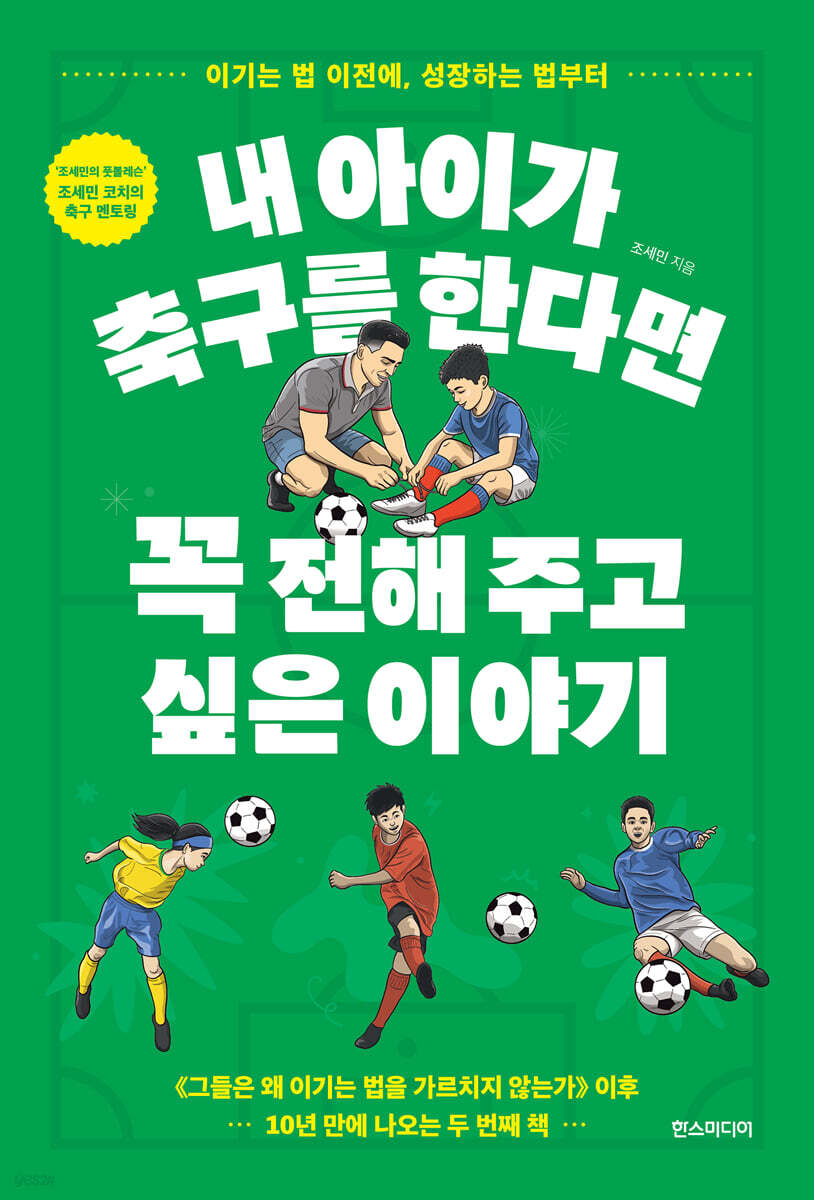
A story I'd tell my child if he played soccer.
 |
Description
Book Introduction
Before learning how to win, learn how to grow first.
Representative of 'Jo Se-min's Football Lesson'
Coach Jo Se-min's Soccer Mentoring
“This book is what I have been reading for the past 10 years.
This is a record of the enlightenment gained through seeing, hearing, and experiencing things on site.
And as a soccer coach, and as another senior in life
“This is a story I definitely want to pass on to the next generation.”
“For those who want to grow into professional players,
It requires more than just acquiring skills; it requires a thorough understanding of soccer and the right direction.
In that sense, this book is about learning soccer skills.
I think it will be an excellent guide for all young people and their families.”
- Choi Ho-young (International Committee Member, Korea Sports Council, BS89 Youth Soccer Club Representative)
Representative of 'Jo Se-min's Football Lesson'
Coach Jo Se-min's Soccer Mentoring
“This book is what I have been reading for the past 10 years.
This is a record of the enlightenment gained through seeing, hearing, and experiencing things on site.
And as a soccer coach, and as another senior in life
“This is a story I definitely want to pass on to the next generation.”
“For those who want to grow into professional players,
It requires more than just acquiring skills; it requires a thorough understanding of soccer and the right direction.
In that sense, this book is about learning soccer skills.
I think it will be an excellent guide for all young people and their families.”
- Choi Ho-young (International Committee Member, Korea Sports Council, BS89 Youth Soccer Club Representative)
- You can preview some of the book's contents.
Preview
index
Recommendation
prolog
1.
A letter to our parents and children
01 Can my child become a soccer player?
02 Parents' efforts are proportional to their children's abilities.
03 Another fundamental soccer skill that parents and children should develop together
04 Three Habits I Learned from My Father and Gained Through Soccer
05 10 Mental Rules Every Soccer Player Should Have
2.
Soccer fundamentals lecture
06 What are the fundamentals of soccer?
07 Basic Soccer Skills
08 Situation Resolution Skills
3.
The fundamental components of soccer
09 Basic Soccer Skills - Ball Sense 1
10 Fundamental Soccer Skills - Ball Sense 2
11 Basic Soccer Skills - Dribbling 1
12 Basic Soccer Skills - Dribbling 2
13 Basic Soccer Skills - Dribbling 3
14 Basic Soccer Skills - Ball Control
15 Basic Soccer Skills - Passing
16 Basic Soccer Skills - Shooting
17 Situational Solving Skills - Situational Awareness Skills
18 Situational Ability - Pressure Resistence
19 Situational Ability - Match Experience
Epilogue
prolog
1.
A letter to our parents and children
01 Can my child become a soccer player?
02 Parents' efforts are proportional to their children's abilities.
03 Another fundamental soccer skill that parents and children should develop together
04 Three Habits I Learned from My Father and Gained Through Soccer
05 10 Mental Rules Every Soccer Player Should Have
2.
Soccer fundamentals lecture
06 What are the fundamentals of soccer?
07 Basic Soccer Skills
08 Situation Resolution Skills
3.
The fundamental components of soccer
09 Basic Soccer Skills - Ball Sense 1
10 Fundamental Soccer Skills - Ball Sense 2
11 Basic Soccer Skills - Dribbling 1
12 Basic Soccer Skills - Dribbling 2
13 Basic Soccer Skills - Dribbling 3
14 Basic Soccer Skills - Ball Control
15 Basic Soccer Skills - Passing
16 Basic Soccer Skills - Shooting
17 Situational Solving Skills - Situational Awareness Skills
18 Situational Ability - Pressure Resistence
19 Situational Ability - Match Experience
Epilogue
Detailed image

Into the book
It's a heartbreaking story, but most kids don't become professional athletes.
However, the childhood experience of doing your best to pursue your dreams with the trust of your parents will be a more valuable asset than any failure.
I, too, only played professionally for a year.
But the 10 years I spent pursuing my dream with the support of my family still live and breathe within me.
Because it has become a solid pillar in my life.
Because I had that time, I was able to pioneer the rest of my life.
Parents who are reading this book, please walk that path together with your child for just one year so that your child can have that kind of time too.
That 'one year' before embarking on the path to becoming a professional soccer player can change the life of not only the child but the entire family.
--- p.22 「01.
"Can my child become a soccer player?"
The core elements that make up soccer are generally divided into four: technique, tactics, physical strength, and psychology, but I view soccer as a five-element system that includes one more element, 'Football Intelligence'.
Many people understand fundamentals as skills, but I don't see fundamentals as just the ability to perform movements.
Fundamentals are a concept that includes the 'thinking ability' to properly use skills during a match.
In other words, ‘technology (function) + thinking (understanding) = true fundamentals.’
In this way, fundamentals go beyond simple functional training and require a deep understanding of 'how to interpret and execute soccer.'
--- p.50 「06.
From "What are the fundamentals of soccer?"
Many people misunderstand that 'improving soccer skills' is the same as 'improving academic grades'.
But soccer is different from studying.
If studying is a process of continuously understanding high-level concepts and solving new problems, soccer is a process of accurately implementing the same skills in more complex and difficult situations based on basic concepts.
In other words, if studying is a process of ‘expanding knowledge,’ soccer is a process of ‘deepening the basics.’
The technique is the same, but the space is narrower, the pressure from defenders is faster, and the psychological burden is greater.
So we need to repeat the same technique, but make it faster and more accurate.
The key is ‘ball sense’.
--- p.79 「10.
From "Basic Soccer Skills - Ball Sense 2"
Ball control is not simply the skill of stopping the ball.
This skill alone reveals a lot about a player: ① Does he read the flow of the game? ② Does he have situational awareness? ③ Does he prepare for the next play? ④ Does he have ball instinct? ⑤ How well does he handle situations?
In fact, in high-level matches, there are many scenes where a single touch of the ball can break down the defensive line, create a shot timing that didn't exist before, and lead to creative play.
all.
How a player touches the ball, or 'controls the ball', is a mirror that shows his 'soccer skills'.
--- p.145 「14.
From “Basic Soccer Skills - Ball Control”
Nowadays, no matter how great your individual skills are, if you can't read the game situation, those skills become useless at crucial moments.
On the other hand, a player who can quickly decide when, where, and what to do, even without flashy skills, can lead the flow of the game and become the center of the team.
Ultimately, the starting point of these judgments is ‘situational awareness’.
In the past, 'ball handling skills' were a measure of soccer skill.
But now, players who can read the overall flow of the game, anticipate the next situation, and respond accordingly are more highly regarded.
--- pp.197-198 「17.
From “Situation Resolution Ability - Situational Awareness Ability”
I tell the players who learn soccer from me:
“It’s okay if you can’t keep a training log.
But on match days, you absolutely must keep a 'match log.' Why? Because many players let their valuable match experiences slip away.
The successes and failures, the momentary judgments and choices made on the field, disappear without being sorted out.
What problem will this cause? The same mistake will inevitably be repeated in the next game.
If you don't write it down, you can't remember it, and if you don't remember it, you can't supplement it with training.
So, a match log is not just a simple record, but a bridge that connects training and matches, and a tool for growth that turns experiences into learning that is ingrained in your body.
However, the childhood experience of doing your best to pursue your dreams with the trust of your parents will be a more valuable asset than any failure.
I, too, only played professionally for a year.
But the 10 years I spent pursuing my dream with the support of my family still live and breathe within me.
Because it has become a solid pillar in my life.
Because I had that time, I was able to pioneer the rest of my life.
Parents who are reading this book, please walk that path together with your child for just one year so that your child can have that kind of time too.
That 'one year' before embarking on the path to becoming a professional soccer player can change the life of not only the child but the entire family.
--- p.22 「01.
"Can my child become a soccer player?"
The core elements that make up soccer are generally divided into four: technique, tactics, physical strength, and psychology, but I view soccer as a five-element system that includes one more element, 'Football Intelligence'.
Many people understand fundamentals as skills, but I don't see fundamentals as just the ability to perform movements.
Fundamentals are a concept that includes the 'thinking ability' to properly use skills during a match.
In other words, ‘technology (function) + thinking (understanding) = true fundamentals.’
In this way, fundamentals go beyond simple functional training and require a deep understanding of 'how to interpret and execute soccer.'
--- p.50 「06.
From "What are the fundamentals of soccer?"
Many people misunderstand that 'improving soccer skills' is the same as 'improving academic grades'.
But soccer is different from studying.
If studying is a process of continuously understanding high-level concepts and solving new problems, soccer is a process of accurately implementing the same skills in more complex and difficult situations based on basic concepts.
In other words, if studying is a process of ‘expanding knowledge,’ soccer is a process of ‘deepening the basics.’
The technique is the same, but the space is narrower, the pressure from defenders is faster, and the psychological burden is greater.
So we need to repeat the same technique, but make it faster and more accurate.
The key is ‘ball sense’.
--- p.79 「10.
From "Basic Soccer Skills - Ball Sense 2"
Ball control is not simply the skill of stopping the ball.
This skill alone reveals a lot about a player: ① Does he read the flow of the game? ② Does he have situational awareness? ③ Does he prepare for the next play? ④ Does he have ball instinct? ⑤ How well does he handle situations?
In fact, in high-level matches, there are many scenes where a single touch of the ball can break down the defensive line, create a shot timing that didn't exist before, and lead to creative play.
all.
How a player touches the ball, or 'controls the ball', is a mirror that shows his 'soccer skills'.
--- p.145 「14.
From “Basic Soccer Skills - Ball Control”
Nowadays, no matter how great your individual skills are, if you can't read the game situation, those skills become useless at crucial moments.
On the other hand, a player who can quickly decide when, where, and what to do, even without flashy skills, can lead the flow of the game and become the center of the team.
Ultimately, the starting point of these judgments is ‘situational awareness’.
In the past, 'ball handling skills' were a measure of soccer skill.
But now, players who can read the overall flow of the game, anticipate the next situation, and respond accordingly are more highly regarded.
--- pp.197-198 「17.
From “Situation Resolution Ability - Situational Awareness Ability”
I tell the players who learn soccer from me:
“It’s okay if you can’t keep a training log.
But on match days, you absolutely must keep a 'match log.' Why? Because many players let their valuable match experiences slip away.
The successes and failures, the momentary judgments and choices made on the field, disappear without being sorted out.
What problem will this cause? The same mistake will inevitably be repeated in the next game.
If you don't write it down, you can't remember it, and if you don't remember it, you can't supplement it with training.
So, a match log is not just a simple record, but a bridge that connects training and matches, and a tool for growth that turns experiences into learning that is ingrained in your body.
--- p.225 「19.
From “Situation Resolution Ability - Match Experience”
From “Situation Resolution Ability - Match Experience”
Publisher's Review
A young player who dreams of becoming a professional soccer player
The ultimate guide for those parents
"If My Child Plays Soccer, I Definitely Want to Tell Them" is a book written by the author who obtained a UEFA B license through training with the Spanish Football Association as a coach, then worked as a coach for the Spanish 3rd division UE Cornella Juvenil D team (U16), general coach for the FC Barcelona Korean Football School, coach of the Seoul E-Land FC U12 team, research coach for the Korea Football Association's Pre-Golden Age (U6-11) TF team, general coach for Busan I'Park I-Kids, and is currently working as the representative of 'Jo Se-min's Football Lesson'. This book records the insights he gained from seeing, hearing, and experiencing in the field over the past 10 years.
The author wrote this book to show parents of children who love soccer or dream of becoming professional players a way to make their dreams come true at home, keeping pace with the changing times in which the center of youth soccer education has shifted from 'school soccer' to 'club soccer' and from 'dormitory' to 'home.'
Based on field experience
Providing guidance on the role of parents of young athletes
This book contains key insights based on the author's extensive field experience, accumulated from his trial and error as a player and his frustrations as a professional athlete, to his work as a development specialist for promising young players.
It is full of practical advice that is especially necessary for teenagers and their parents considering a career in soccer.
What makes this book special is that, based on the author's extensive field experience with Spain, the K-League youth team, and the Korea Football Association, he clearly presents how the role of parents must change in the current transition from 'school soccer' to 'club soccer.'
The author emphasizes that parents of children who dream of becoming professional soccer players and parents of non-athletes should work together to develop "football metacognition."
This refers to the process itself where parents and children communicate through the medium of soccer, understand each other's feelings, and build small growth.
To help with this, the author presents three practical methods necessary for growth through soccer, three habits of reading, exercise, and writing, and ten mental rules that soccer players should have.
Emphasizes situation-solving skills
Presenting basic soccer training methods
(QR code provided for detailed training method video)
The highlight of this book is its new perspective on 'soccer fundamentals'.
Based on his own experience, the author presents the 'fundamentals of soccer', which include not only technique but also thinking and situational judgment.
Through this, the message is conveyed that children should grow into people who progress one step at a time through each game and each training session, rather than simply being players who play to win games.
The author emphasizes that in order to develop 'soccer intelligence' that allows one to understand and interpret soccer games and make decisions, one must have 'basic soccer skills' such as ① ball sense, ② dribbling, ③ ball control, ④ passing, and ⑤ shooting, as well as 'situation-solving skills' such as ⑥ situational awareness, ⑦ pressure resistance, and ⑧ game experience.
To this end, we have compiled detailed training methods that can systematically develop eight components for developing soccer intelligence, along with QR code videos.
Before learning how to win,
From how to grow
The author says that parents of children who dream of becoming soccer players should first train with their children for a year to determine their child's sincerity.
This can be seen as providing parents with concrete implementation standards for helping their children, not just through emotional support, but through cool-headed observation and judgment.
Additionally, through this book, the author emphasizes mental rules and problem-solving skills that can lead to not only improved skills but also inner growth for children who dream of becoming soccer players.
Through this, we hope that parents will accompany their children on their journey toward their soccer career and life goals, valuing the process more than the results.
I hope this book will serve as a valuable guide not only on how to grow into a soccer player, but also on the journey of helping children grow into great adults through the tool of soccer.
The ultimate guide for those parents
"If My Child Plays Soccer, I Definitely Want to Tell Them" is a book written by the author who obtained a UEFA B license through training with the Spanish Football Association as a coach, then worked as a coach for the Spanish 3rd division UE Cornella Juvenil D team (U16), general coach for the FC Barcelona Korean Football School, coach of the Seoul E-Land FC U12 team, research coach for the Korea Football Association's Pre-Golden Age (U6-11) TF team, general coach for Busan I'Park I-Kids, and is currently working as the representative of 'Jo Se-min's Football Lesson'. This book records the insights he gained from seeing, hearing, and experiencing in the field over the past 10 years.
The author wrote this book to show parents of children who love soccer or dream of becoming professional players a way to make their dreams come true at home, keeping pace with the changing times in which the center of youth soccer education has shifted from 'school soccer' to 'club soccer' and from 'dormitory' to 'home.'
Based on field experience
Providing guidance on the role of parents of young athletes
This book contains key insights based on the author's extensive field experience, accumulated from his trial and error as a player and his frustrations as a professional athlete, to his work as a development specialist for promising young players.
It is full of practical advice that is especially necessary for teenagers and their parents considering a career in soccer.
What makes this book special is that, based on the author's extensive field experience with Spain, the K-League youth team, and the Korea Football Association, he clearly presents how the role of parents must change in the current transition from 'school soccer' to 'club soccer.'
The author emphasizes that parents of children who dream of becoming professional soccer players and parents of non-athletes should work together to develop "football metacognition."
This refers to the process itself where parents and children communicate through the medium of soccer, understand each other's feelings, and build small growth.
To help with this, the author presents three practical methods necessary for growth through soccer, three habits of reading, exercise, and writing, and ten mental rules that soccer players should have.
Emphasizes situation-solving skills
Presenting basic soccer training methods
(QR code provided for detailed training method video)
The highlight of this book is its new perspective on 'soccer fundamentals'.
Based on his own experience, the author presents the 'fundamentals of soccer', which include not only technique but also thinking and situational judgment.
Through this, the message is conveyed that children should grow into people who progress one step at a time through each game and each training session, rather than simply being players who play to win games.
The author emphasizes that in order to develop 'soccer intelligence' that allows one to understand and interpret soccer games and make decisions, one must have 'basic soccer skills' such as ① ball sense, ② dribbling, ③ ball control, ④ passing, and ⑤ shooting, as well as 'situation-solving skills' such as ⑥ situational awareness, ⑦ pressure resistance, and ⑧ game experience.
To this end, we have compiled detailed training methods that can systematically develop eight components for developing soccer intelligence, along with QR code videos.
Before learning how to win,
From how to grow
The author says that parents of children who dream of becoming soccer players should first train with their children for a year to determine their child's sincerity.
This can be seen as providing parents with concrete implementation standards for helping their children, not just through emotional support, but through cool-headed observation and judgment.
Additionally, through this book, the author emphasizes mental rules and problem-solving skills that can lead to not only improved skills but also inner growth for children who dream of becoming soccer players.
Through this, we hope that parents will accompany their children on their journey toward their soccer career and life goals, valuing the process more than the results.
I hope this book will serve as a valuable guide not only on how to grow into a soccer player, but also on the journey of helping children grow into great adults through the tool of soccer.
GOODS SPECIFICS
- Date of issue: November 28, 2025
- Page count, weight, size: 232 pages | 428g | 152*224*15mm
- ISBN13: 9791194777762
- ISBN10: 1194777767
You may also like
카테고리
korean


korean

![GQ KOREA Mark (Monthly): December [2025]](http://librairie.coreenne.fr/cdn/shop/files/8ef265dbbfbf186523ed75ba7319009d.jpg?v=1765340328&width=3840)


