

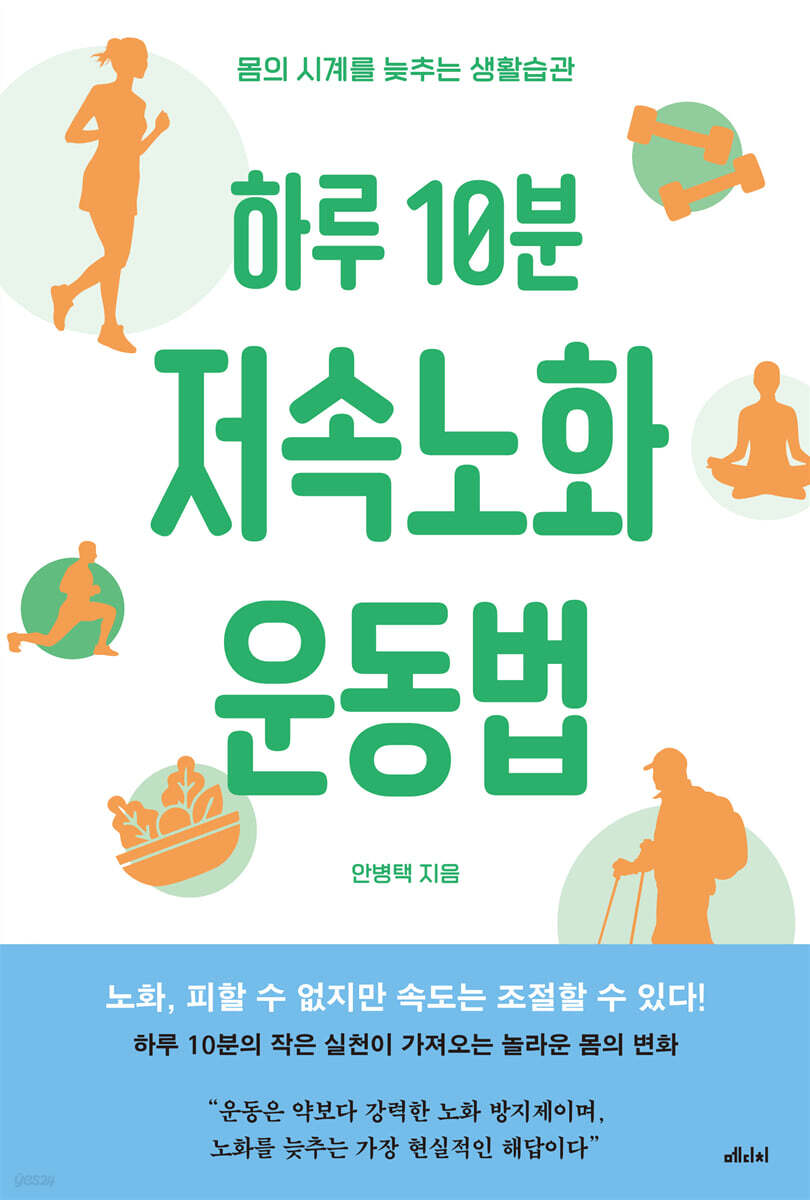
10-Minute Slow-Aging Exercise a Day
 |
Description
Book Introduction
“Aging is inevitable, but its speed can be controlled!”
Slow-aging exercise method suggested by rehabilitation experts at the Senior Research Institute!
A 10-Minute Daily Exercise Habit That Will Secure Your Future Health
The Senior Research Institute, comprised of various experts including Korean medicine doctors, physical therapists, sports medicine professors, and trainers, has compiled all the secrets and experiences of many years into one book on how to delay aging.
The most powerful and effective solution for modern people's health and anti-aging is 'exercise'.
Anyone can follow the 10-minute slow aging exercise method, which suggests the most scientific and effective exercise for modern people living busy lives.
It introduces exercises suitable for each age group and situation, and covers in detail the types, frequency, and intensity of flexibility, balance, aerobic, and strength training.
It also introduces incorrect exercise habits that cause accelerated aging and breaks down the types of muscles in detail to help us easily follow the appropriate muscle exercises.
This book goes beyond a simple list of exercise methods. It provides a comprehensive health management solution that encompasses three elements: exercise, diet, and mental health, which help you form sustainable lifestyle habits that are not bound by time or place, and turn back your body's clock.
This will ensure readers a slow-aging lifestyle.
Slow-aging exercise method suggested by rehabilitation experts at the Senior Research Institute!
A 10-Minute Daily Exercise Habit That Will Secure Your Future Health
The Senior Research Institute, comprised of various experts including Korean medicine doctors, physical therapists, sports medicine professors, and trainers, has compiled all the secrets and experiences of many years into one book on how to delay aging.
The most powerful and effective solution for modern people's health and anti-aging is 'exercise'.
Anyone can follow the 10-minute slow aging exercise method, which suggests the most scientific and effective exercise for modern people living busy lives.
It introduces exercises suitable for each age group and situation, and covers in detail the types, frequency, and intensity of flexibility, balance, aerobic, and strength training.
It also introduces incorrect exercise habits that cause accelerated aging and breaks down the types of muscles in detail to help us easily follow the appropriate muscle exercises.
This book goes beyond a simple list of exercise methods. It provides a comprehensive health management solution that encompasses three elements: exercise, diet, and mental health, which help you form sustainable lifestyle habits that are not bound by time or place, and turn back your body's clock.
This will ensure readers a slow-aging lifestyle.
- You can preview some of the book's contents.
Preview
index
Recommendation
In publishing the book
Chapter 1: Exercise Habits That Slow Down Aging
1. Why Exercise is Essential for Slow Aging
2 The Scientific Effects of Slow-Aging Exercise
3 Exercise Habits That Cause Accelerated Aging
4 Elements of Slow-Aging Exercise
5 Type 1 and 2 Muscle Exercises That Fit My Body
6 Anti-gravity muscles that correct hunched posture
7. Fall prevention alone is 80% successful.
8 Latest Exercises and Habits to Prevent Dementia
9 Exercises to Maintain Mental Health
10 Exercises for Burnout
11 Slow-Aging Exercises by Age
Chapter 2: 30 Minutes of Slow-Aging Exercise Outside the Home
1. Exercise in Nature: Nordic Walking
2 Various water exercises, aquatic gymnastics
3. Tai Chi: Exercise that trains the body and mind
4 Safe and Effective Chair Exercises: Chair Yoga
5. Continuous step-by-step exercise, low-weight strength training
Chapter 3: 10-Minute Slow-Aging Exercises You Can Do at Home
Chapter 4: Foods to Consider When Exercising
1 The Effect of Nutritional Supplements on Exercise After Age 50
2 Foods and eating habits that are toxic to slow aging
3 Proper Diet and Meals: Learn About Exercise and Fasting
4 Healthy Teas to Drink After Exercise
Acknowledgements
main
In publishing the book
Chapter 1: Exercise Habits That Slow Down Aging
1. Why Exercise is Essential for Slow Aging
2 The Scientific Effects of Slow-Aging Exercise
3 Exercise Habits That Cause Accelerated Aging
4 Elements of Slow-Aging Exercise
5 Type 1 and 2 Muscle Exercises That Fit My Body
6 Anti-gravity muscles that correct hunched posture
7. Fall prevention alone is 80% successful.
8 Latest Exercises and Habits to Prevent Dementia
9 Exercises to Maintain Mental Health
10 Exercises for Burnout
11 Slow-Aging Exercises by Age
Chapter 2: 30 Minutes of Slow-Aging Exercise Outside the Home
1. Exercise in Nature: Nordic Walking
2 Various water exercises, aquatic gymnastics
3. Tai Chi: Exercise that trains the body and mind
4 Safe and Effective Chair Exercises: Chair Yoga
5. Continuous step-by-step exercise, low-weight strength training
Chapter 3: 10-Minute Slow-Aging Exercises You Can Do at Home
Chapter 4: Foods to Consider When Exercising
1 The Effect of Nutritional Supplements on Exercise After Age 50
2 Foods and eating habits that are toxic to slow aging
3 Proper Diet and Meals: Learn About Exercise and Fasting
4 Healthy Teas to Drink After Exercise
Acknowledgements
main
Detailed image

Into the book
Aging is an unavoidable phenomenon that all humans experience.
As aging begins, the body's structures and functions weaken over time.
Many people think of aging negatively, but there is such a thing as 'successful aging'.
Successful aging refers to the qualitative aspect of aging, not simply lifespan or survival.
As society and economy developed, quality became more important than quantity.
Successful aging, which allows for a satisfying old age through individual choice and effort, involves positively accepting the aging process.
--- From "Why Exercise is Essential for Slow Aging"
Aging and aging may seem similar, but there are significant differences.
Frailty refers to 'a decline in the body's reserve capacity to cope with internal and external stresses, regardless of age.'
Aging refers to the 'gradual deterioration of body structure and functions as we age.'
Aging can occur at any age, even in young people, due to illness or accidents, and aging begins naturally from the point at which growth and development end.
However, muscle strength is particularly important in both aging and frailty.
Because muscle weakness impairs judgment.
Both physical strength and judgment are factors that contribute to decreased activity.
These changes occur almost simultaneously, creating a vicious cycle.
--- From "Why Exercise is Essential for Slow Aging"
In recent aging research, the term 'super ager' has been attracting attention.
This refers to people who are elderly but whose cognitive and physical abilities are similar to or even superior to those of younger people.
Unlike typical aging symptoms, these individuals have improved memory, concentration, and problem-solving skills.
You can also see that they are living an active life without any chronic diseases.
What's interesting is that this phenomenon stems from regular exercise habits rather than genetic factors.
Exercise has been evaluated as an effective way to slow down the body's overall aging clock.
--- From "The Four Elements of Slow Aging Exercise"
One of the most noticeable changes we experience as we age is that our bodies no longer respond the way they used to.
I get out of breath just walking, and my knees start hurting after climbing just a few flights of stairs.
The saying, 'I'm not as physically fit as I used to be' isn't just a feeling.
These are actual signals from your body as the types and functions of your muscles change.
And at the heart of that change are two types of muscle we've known little about: Type 1 and Type 2, or slow-twitch and fast-twitch.
--- From "Type 1·2 Muscle Exercises That Fit My Body"
After the age of 40 or 50, the body's alignment begins to break down, and as a result, a hunched posture, known as an 'aging body type', begins to become noticeable.
The problem is that it's not simply a question of whether it looks good or bad.
Poor posture is a sign of overall poor health, and the key to preventing this change is the 'antigravity muscles'.
--- From "Antigravity Muscles That Straighten Hunched Posture"
In Oriental medicine, burnout is often interpreted as a state of 'Qi deficiency' or 'liver depression'.
Qi deficiency is a state in which one becomes lethargic due to lack of energy, and liver weakness is a state in which suppressed emotions block circulation.
In times like these, we recommend exercises that emphasize deep breathing, such as qigong, light walks that will make you sweat, or tai chi.
For example, if you practice breathing techniques by spreading your arms and breathing slowly in sync with your breath in a park under the morning sunlight, you will feel your blood circulation become smoother and your body and mind become stable at the same time.
--- From "Exercise for Burnout"
Good carbohydrates (natural carbohydrates) are low in sugar and high in fiber.
Examples include vegetables, mushrooms, seaweed, natto, and avocado.
It is recommended to eat plenty of these foods at every meal.
Conversely, bad carbohydrates (refined carbohydrates) are high in sugar and low in fiber.
Refers to all foods made with sugar and flour.
These are also not good for your nutrition.
Therefore, excessive consumption of refined carbohydrates gradually destroys the body.
So it's best to stay away from bad carbohydrates as much as possible.
As aging begins, the body's structures and functions weaken over time.
Many people think of aging negatively, but there is such a thing as 'successful aging'.
Successful aging refers to the qualitative aspect of aging, not simply lifespan or survival.
As society and economy developed, quality became more important than quantity.
Successful aging, which allows for a satisfying old age through individual choice and effort, involves positively accepting the aging process.
--- From "Why Exercise is Essential for Slow Aging"
Aging and aging may seem similar, but there are significant differences.
Frailty refers to 'a decline in the body's reserve capacity to cope with internal and external stresses, regardless of age.'
Aging refers to the 'gradual deterioration of body structure and functions as we age.'
Aging can occur at any age, even in young people, due to illness or accidents, and aging begins naturally from the point at which growth and development end.
However, muscle strength is particularly important in both aging and frailty.
Because muscle weakness impairs judgment.
Both physical strength and judgment are factors that contribute to decreased activity.
These changes occur almost simultaneously, creating a vicious cycle.
--- From "Why Exercise is Essential for Slow Aging"
In recent aging research, the term 'super ager' has been attracting attention.
This refers to people who are elderly but whose cognitive and physical abilities are similar to or even superior to those of younger people.
Unlike typical aging symptoms, these individuals have improved memory, concentration, and problem-solving skills.
You can also see that they are living an active life without any chronic diseases.
What's interesting is that this phenomenon stems from regular exercise habits rather than genetic factors.
Exercise has been evaluated as an effective way to slow down the body's overall aging clock.
--- From "The Four Elements of Slow Aging Exercise"
One of the most noticeable changes we experience as we age is that our bodies no longer respond the way they used to.
I get out of breath just walking, and my knees start hurting after climbing just a few flights of stairs.
The saying, 'I'm not as physically fit as I used to be' isn't just a feeling.
These are actual signals from your body as the types and functions of your muscles change.
And at the heart of that change are two types of muscle we've known little about: Type 1 and Type 2, or slow-twitch and fast-twitch.
--- From "Type 1·2 Muscle Exercises That Fit My Body"
After the age of 40 or 50, the body's alignment begins to break down, and as a result, a hunched posture, known as an 'aging body type', begins to become noticeable.
The problem is that it's not simply a question of whether it looks good or bad.
Poor posture is a sign of overall poor health, and the key to preventing this change is the 'antigravity muscles'.
--- From "Antigravity Muscles That Straighten Hunched Posture"
In Oriental medicine, burnout is often interpreted as a state of 'Qi deficiency' or 'liver depression'.
Qi deficiency is a state in which one becomes lethargic due to lack of energy, and liver weakness is a state in which suppressed emotions block circulation.
In times like these, we recommend exercises that emphasize deep breathing, such as qigong, light walks that will make you sweat, or tai chi.
For example, if you practice breathing techniques by spreading your arms and breathing slowly in sync with your breath in a park under the morning sunlight, you will feel your blood circulation become smoother and your body and mind become stable at the same time.
--- From "Exercise for Burnout"
Good carbohydrates (natural carbohydrates) are low in sugar and high in fiber.
Examples include vegetables, mushrooms, seaweed, natto, and avocado.
It is recommended to eat plenty of these foods at every meal.
Conversely, bad carbohydrates (refined carbohydrates) are high in sugar and low in fiber.
Refers to all foods made with sugar and flour.
These are also not good for your nutrition.
Therefore, excessive consumption of refined carbohydrates gradually destroys the body.
So it's best to stay away from bad carbohydrates as much as possible.
--- From "Foods and Eating Habits That Are Poisonous to Slow Aging"
Publisher's Review
“Slow aging that can’t be achieved through diet alone!”
"Super Agers" who have successfully slowed aging focus on consistent daily exercise.
As attention is focused on 'slow aging', interest in the food we eat is increasing day by day.
Unfortunately, diet alone cannot achieve slow aging.
Although food has some influence, our bodies are more affected by physical activity and exercise.
'Super Agers', who have superior cognitive and physical abilities than younger people, have focused on 'exercise' to achieve slow aging.
Super Agers, who lead active lives free of chronic illnesses and have high concentration and problem-solving skills, have succeeded in slowing down their bodies' aging clocks through regular exercise habits.
Regular exercise strengthens the heart, muscles, and lungs, and circulates blood to the brain, activating nerve cells and improving memory and concentration.
Amazing body changes brought about by small actions, just 10 minutes a day!
Customized workouts for every age and situation, all in one book.
For modern people who accumulate fatigue in their busy daily lives, making exercise a habit is by no means easy.
"10 Minutes a Day Slow Aging Exercise" is an easy-to-follow, accessible exercise program that starts with small steps and gradually builds exercise habits, leading to amazing changes in our bodies.
In particular, '10-minute exercise at home' starts with stretching to relax the muscles before starting the exercise in earnest, preventing injuries.
Exercises using readily available equipment can help correct stiff muscles and posture caused by daily life and household chores.
We've explained the poses with illustrations to make them easy to follow, and added precautions and tips to help you exercise more safely and practically.
NO to excessive exercise that causes accelerated aging!
Correcting incorrect exercise habits to maintain health
No matter how beneficial exercise is, is it really that beneficial to engage in indiscriminate exercise frequently and for long periods of time? Exercising beyond your physical limits can actually be detrimental to your health.
Excessive exercise produces excessive amounts of reactive oxygen species.
An appropriate level of active oxygen is very helpful for the growth and development of muscle cells, but if it is excessive, it can cause stress on the muscles and cause problems with muscle strength.
It can also cause hormonal imbalances or put serious stress on the body.
Therefore, this book, "10 Minutes a Day Slow Aging Exercise," identifies incorrect exercise methods that can cause injuries or adverse effects, and prevents dangerous habits that are unintentionally formed during exercise.
For readers who have difficulty exercising due to their living environment or circumstances, we also include 30 minutes of slow-aging exercise per day, either at home or outside.
We also recommend Nordic walking, a natural exercise that is good for both physical and mental health, and water gymnastics for the elderly with weak joints.
Meanwhile, the external and internal factors that cause 'falls' are described in detail to provide a thoughtful introduction so that the elderly can exercise safely and consistently.
A comprehensive prescription encompassing daily life, eating habits, and even mental health.
Since mental weakness can soon lead to physical illness, we took into consideration not only physical health but also mental health.
Focusing on exercise can help you feel refreshed and achieve a sense of accomplishment.
We encourage everyone to create a happy life by recommending exercise in nature or group exercise that allows them to escape from isolated environments.
Our body clock runs the same for everyone, but we can control its speed.
This book clearly analyzes the key factors that determine the rate of aging and finds answers in scientifically evidence-based exercise.
I hope you can break the stereotype that 'I don't have time to do it' and slow down your body's clock with the 'slow aging exercise method' that makes exercise a part of your daily routine.
"Super Agers" who have successfully slowed aging focus on consistent daily exercise.
As attention is focused on 'slow aging', interest in the food we eat is increasing day by day.
Unfortunately, diet alone cannot achieve slow aging.
Although food has some influence, our bodies are more affected by physical activity and exercise.
'Super Agers', who have superior cognitive and physical abilities than younger people, have focused on 'exercise' to achieve slow aging.
Super Agers, who lead active lives free of chronic illnesses and have high concentration and problem-solving skills, have succeeded in slowing down their bodies' aging clocks through regular exercise habits.
Regular exercise strengthens the heart, muscles, and lungs, and circulates blood to the brain, activating nerve cells and improving memory and concentration.
Amazing body changes brought about by small actions, just 10 minutes a day!
Customized workouts for every age and situation, all in one book.
For modern people who accumulate fatigue in their busy daily lives, making exercise a habit is by no means easy.
"10 Minutes a Day Slow Aging Exercise" is an easy-to-follow, accessible exercise program that starts with small steps and gradually builds exercise habits, leading to amazing changes in our bodies.
In particular, '10-minute exercise at home' starts with stretching to relax the muscles before starting the exercise in earnest, preventing injuries.
Exercises using readily available equipment can help correct stiff muscles and posture caused by daily life and household chores.
We've explained the poses with illustrations to make them easy to follow, and added precautions and tips to help you exercise more safely and practically.
NO to excessive exercise that causes accelerated aging!
Correcting incorrect exercise habits to maintain health
No matter how beneficial exercise is, is it really that beneficial to engage in indiscriminate exercise frequently and for long periods of time? Exercising beyond your physical limits can actually be detrimental to your health.
Excessive exercise produces excessive amounts of reactive oxygen species.
An appropriate level of active oxygen is very helpful for the growth and development of muscle cells, but if it is excessive, it can cause stress on the muscles and cause problems with muscle strength.
It can also cause hormonal imbalances or put serious stress on the body.
Therefore, this book, "10 Minutes a Day Slow Aging Exercise," identifies incorrect exercise methods that can cause injuries or adverse effects, and prevents dangerous habits that are unintentionally formed during exercise.
For readers who have difficulty exercising due to their living environment or circumstances, we also include 30 minutes of slow-aging exercise per day, either at home or outside.
We also recommend Nordic walking, a natural exercise that is good for both physical and mental health, and water gymnastics for the elderly with weak joints.
Meanwhile, the external and internal factors that cause 'falls' are described in detail to provide a thoughtful introduction so that the elderly can exercise safely and consistently.
A comprehensive prescription encompassing daily life, eating habits, and even mental health.
Since mental weakness can soon lead to physical illness, we took into consideration not only physical health but also mental health.
Focusing on exercise can help you feel refreshed and achieve a sense of accomplishment.
We encourage everyone to create a happy life by recommending exercise in nature or group exercise that allows them to escape from isolated environments.
Our body clock runs the same for everyone, but we can control its speed.
This book clearly analyzes the key factors that determine the rate of aging and finds answers in scientifically evidence-based exercise.
I hope you can break the stereotype that 'I don't have time to do it' and slow down your body's clock with the 'slow aging exercise method' that makes exercise a part of your daily routine.
GOODS SPECIFICS
- Date of issue: November 26, 2025
- Page count, weight, size: 164 pages | 318g | 152*225*10mm
- ISBN13: 9791157064960
You may also like
카테고리
korean


korean

![GQ KOREA Mark (Monthly): December [2025]](http://librairie.coreenne.fr/cdn/shop/files/8ef265dbbfbf186523ed75ba7319009d.jpg?v=1765340328&width=3840)


