

Dasan hiking tour
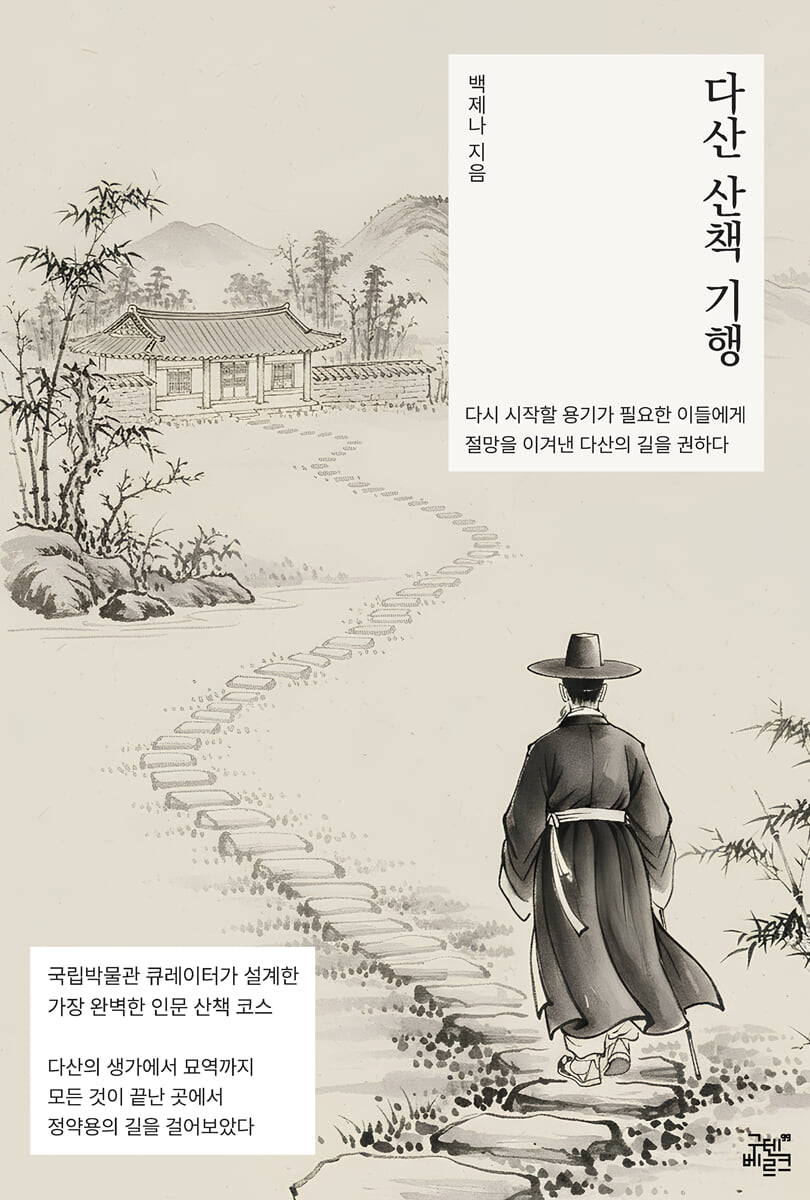 |
Description
Book Introduction
Designed by a National Museum curator
The most perfect humanities walking course
From Dasan's birthplace to his gravesite,
I walked the path of Jeong Yak-yong where everything ended.
Jeong Yak-yong, a young bureaucrat who was a genius of Joseon and favored by King Jeongjo.
When he returned to his hometown of Namyangju, branded a criminal after 18 years of exile, the world had already abandoned him, and his dreams of political revival were forever closed.
It is a time of despair that would have made an ordinary person curse the world in anger or abandon themselves to deep emptiness.
But Dasan never collapsed.
This book is a humanities travelogue, following the spaces in Namyangju where Dasan returned after enduring his most severe ordeals: his birthplace, Yeoyudang, his graveyard, and the lonely riverside paths, through the eyes of a curator with a doctorate in humanities.
The author reinterprets these spaces as battlefields of cultivation where Dasan sublimated despair into great ideas.
Over the next 18 years after his return home, Dasan systematically compiled the 500 or so volumes of writings he had roughly written in a mud room in Gangjin, completing a final prescription for the crumbling Joseon Dynasty.
Instead of being cut off from officialdom, he chose to practice self-cultivation by locking himself in a small room in the Yeoyudang, and instead of boiling with anger in front of the flowing river, he cultivated a cool intellect that observed the times.
His efforts to prove his dignity to history until the last moment of his life by writing his own epitaph (self-praise epitaph) are sublime.
The author follows the footsteps of Dasan, not a stuffed great man, but an existential human being who never put down his pen even in pain.
We read Dasan's fragmented dreams in the severed railroad tracks of Neungnae Station, and see the world of Daedong (Great Unity) that he longed for in the wind of Dasan Ecological Park.
To you who are facing the winter of life, full of failure and frustration, I convey the heavy silence of Dasan, who tells you that it is not over until it is over.
This is a record of a desperate pilgrimage to find the courage to start again.
The most perfect humanities walking course
From Dasan's birthplace to his gravesite,
I walked the path of Jeong Yak-yong where everything ended.
Jeong Yak-yong, a young bureaucrat who was a genius of Joseon and favored by King Jeongjo.
When he returned to his hometown of Namyangju, branded a criminal after 18 years of exile, the world had already abandoned him, and his dreams of political revival were forever closed.
It is a time of despair that would have made an ordinary person curse the world in anger or abandon themselves to deep emptiness.
But Dasan never collapsed.
This book is a humanities travelogue, following the spaces in Namyangju where Dasan returned after enduring his most severe ordeals: his birthplace, Yeoyudang, his graveyard, and the lonely riverside paths, through the eyes of a curator with a doctorate in humanities.
The author reinterprets these spaces as battlefields of cultivation where Dasan sublimated despair into great ideas.
Over the next 18 years after his return home, Dasan systematically compiled the 500 or so volumes of writings he had roughly written in a mud room in Gangjin, completing a final prescription for the crumbling Joseon Dynasty.
Instead of being cut off from officialdom, he chose to practice self-cultivation by locking himself in a small room in the Yeoyudang, and instead of boiling with anger in front of the flowing river, he cultivated a cool intellect that observed the times.
His efforts to prove his dignity to history until the last moment of his life by writing his own epitaph (self-praise epitaph) are sublime.
The author follows the footsteps of Dasan, not a stuffed great man, but an existential human being who never put down his pen even in pain.
We read Dasan's fragmented dreams in the severed railroad tracks of Neungnae Station, and see the world of Daedong (Great Unity) that he longed for in the wind of Dasan Ecological Park.
To you who are facing the winter of life, full of failure and frustration, I convey the heavy silence of Dasan, who tells you that it is not over until it is over.
This is a record of a desperate pilgrimage to find the courage to start again.
- You can preview some of the book's contents.
Preview
index
Dasan's life
Entry: A walking tour of Dasan
Part 1.
Dasan's birthplace, Yeoyudang
Part 2.
Dasan's study, Yuyudang Sarangchae
Part 3.
Tomb of Dasan Jeong Yak-yong
Part 4.
Evidence of a Great Heritage: Dasan Memorial Hall
Part 5.
Why is it uncomfortable, Silhak Museum
Part 6.
Towards a world of harmony, Dasan Ecological Park
Part 7.
Beginning and End, Neungnae Station Closed
Departure: A walking tour of Dasan
References
Entry: A walking tour of Dasan
Part 1.
Dasan's birthplace, Yeoyudang
Part 2.
Dasan's study, Yuyudang Sarangchae
Part 3.
Tomb of Dasan Jeong Yak-yong
Part 4.
Evidence of a Great Heritage: Dasan Memorial Hall
Part 5.
Why is it uncomfortable, Silhak Museum
Part 6.
Towards a world of harmony, Dasan Ecological Park
Part 7.
Beginning and End, Neungnae Station Closed
Departure: A walking tour of Dasan
References
Detailed image
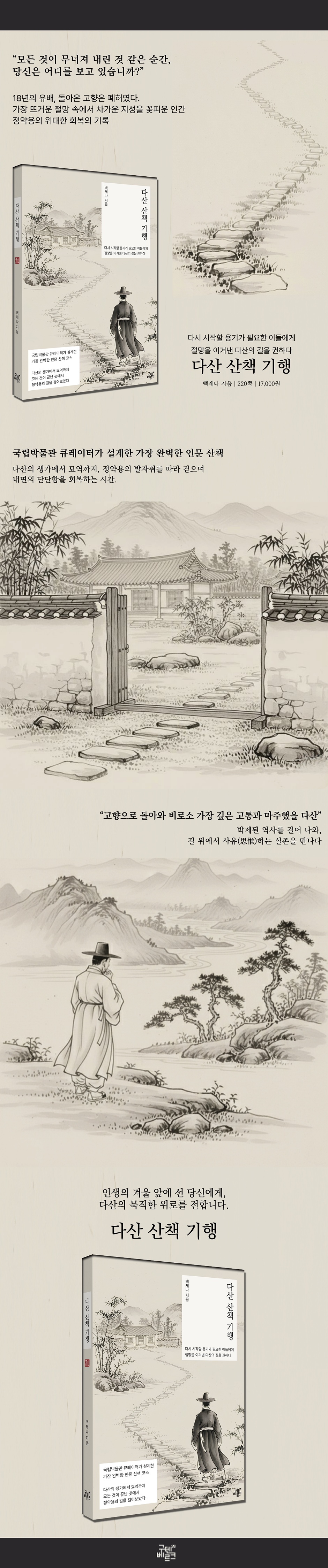
Into the book
The person we will encounter on this journey is Dasan Jeong Yak-yong.
He was a being too great for one era to fully bear, a genius full of brilliant talent but driven into deep darkness.
The short period in which he unfolded his grand ambitions of ruling the world for the people and achieving practical results under the trust of the wise monarch Jeongjo (正祖) was scattered like a spring day's dream, and most of his life was filled with the long and deep 18 years of exile.
However, the dark shadow of Joseon's old contradictions that hung over his life actually became the nutrients that made the fruits of 'Silhak' ripen brighter and more solid.
--- From "Entering the Land: A Hiking Journey in Dasan"
In 1818, Dasan, who had spent 18 long years in exile in Gangjin, finally returned to his hometown of Majae (present-day Neungnae-ri).
He is 57 years old.
It was difficult to find the image of the brilliant young official who used to travel to Hanyang with dreams of great success.
The hometown he was now standing in was like an abandoned station where everything had stopped and all roads were cut off.
The railroad tracks he was to follow were no longer visible.
18 years ago, as soon as King Jeongjo, who had cherished him, passed away, a great storm struck.
The Sinyu Persecution of 1801.
The charge of being involved in Catholicism was a superficial one, and behind it were the intentions of the opposition who feared his talent and his will to reform the world.
He was a political enemy who had to be eliminated.
--- From "Prologue: The Closure of Neungnae Station"
This is the fundamental virtue of Confucianism and the starting point of all practice: self-cultivation, that is, the attitude of cultivating oneself.
What we think of as an adult has changed over time.
Unlike modern adults, who are given responsibility based on their legal age, in pre-modern societies, people called saints were respected for their character regardless of age.
An adult is someone who knows how to take full responsibility for his or her actions, is prudent in his or her actions, has a gentle personality, but is also cold and strict with himself. In other words, he or she strives throughout his or her life to embody the ideal human being pursued in Neo-Confucianism.
--- From "Part 1: Dasan's Birthplace, Yeoyudang"
Our walk began in the study of Yeojudang, where Dasan spent his later years.
What fills that space is not only the scent of ink and the weight of the book, but also the attitude of a human being who accepted trials and blossomed them into learning.
The study of Yeoyu-dang is a symbolic place that shows us what true study is and what it means to achieve self-management through that study.
Dasan's method of study—reading, writing, teaching, and building oneself up—resonates deeply with all those who are going through difficult times in life, regardless of how big or small their struggles may be.
The knowledge management he practiced in exile became a force that held together his scattered mind and turned times of suffering into times of learning.
--- From "Part 2, Dasan's Study, Yuyudang Sarangchae"
And there is no such thing as fast or slow in correcting an individual's shortcomings.
Didn't Dasan also deeply reflect on his past mistakes only after he reached his 60th birthday and leave a record of it in his epitaph?
Of course, there is no such thing as a quick or slow way to fix a flaw, but if you think about it carefully, it is clearly a better way to try to avoid creating a flaw in the first place than to try to get rid of a flaw that has already formed.
The aforementioned quote from Oil Samsung Osin contains the wisdom to lead a life that avoids going down the wrong path and creating shortcomings as much as possible through daily self-examination.
He was a being too great for one era to fully bear, a genius full of brilliant talent but driven into deep darkness.
The short period in which he unfolded his grand ambitions of ruling the world for the people and achieving practical results under the trust of the wise monarch Jeongjo (正祖) was scattered like a spring day's dream, and most of his life was filled with the long and deep 18 years of exile.
However, the dark shadow of Joseon's old contradictions that hung over his life actually became the nutrients that made the fruits of 'Silhak' ripen brighter and more solid.
--- From "Entering the Land: A Hiking Journey in Dasan"
In 1818, Dasan, who had spent 18 long years in exile in Gangjin, finally returned to his hometown of Majae (present-day Neungnae-ri).
He is 57 years old.
It was difficult to find the image of the brilliant young official who used to travel to Hanyang with dreams of great success.
The hometown he was now standing in was like an abandoned station where everything had stopped and all roads were cut off.
The railroad tracks he was to follow were no longer visible.
18 years ago, as soon as King Jeongjo, who had cherished him, passed away, a great storm struck.
The Sinyu Persecution of 1801.
The charge of being involved in Catholicism was a superficial one, and behind it were the intentions of the opposition who feared his talent and his will to reform the world.
He was a political enemy who had to be eliminated.
--- From "Prologue: The Closure of Neungnae Station"
This is the fundamental virtue of Confucianism and the starting point of all practice: self-cultivation, that is, the attitude of cultivating oneself.
What we think of as an adult has changed over time.
Unlike modern adults, who are given responsibility based on their legal age, in pre-modern societies, people called saints were respected for their character regardless of age.
An adult is someone who knows how to take full responsibility for his or her actions, is prudent in his or her actions, has a gentle personality, but is also cold and strict with himself. In other words, he or she strives throughout his or her life to embody the ideal human being pursued in Neo-Confucianism.
--- From "Part 1: Dasan's Birthplace, Yeoyudang"
Our walk began in the study of Yeojudang, where Dasan spent his later years.
What fills that space is not only the scent of ink and the weight of the book, but also the attitude of a human being who accepted trials and blossomed them into learning.
The study of Yeoyu-dang is a symbolic place that shows us what true study is and what it means to achieve self-management through that study.
Dasan's method of study—reading, writing, teaching, and building oneself up—resonates deeply with all those who are going through difficult times in life, regardless of how big or small their struggles may be.
The knowledge management he practiced in exile became a force that held together his scattered mind and turned times of suffering into times of learning.
--- From "Part 2, Dasan's Study, Yuyudang Sarangchae"
And there is no such thing as fast or slow in correcting an individual's shortcomings.
Didn't Dasan also deeply reflect on his past mistakes only after he reached his 60th birthday and leave a record of it in his epitaph?
Of course, there is no such thing as a quick or slow way to fix a flaw, but if you think about it carefully, it is clearly a better way to try to avoid creating a flaw in the first place than to try to get rid of a flaw that has already formed.
The aforementioned quote from Oil Samsung Osin contains the wisdom to lead a life that avoids going down the wrong path and creating shortcomings as much as possible through daily self-examination.
--- From “The Tomb of Dasan Jeong Yak-yong, Part 3”
Publisher's Review
A record of life rewritten on the ruins,
Dasan hiking tour
The winter of life comes without warning and questions our dignity.
After a long exile of 18 years, Dasan Jeong Yak-yong's hometown of Namyangju could not be a comfortable place to return to.
It was another place of exile, where the stigma of a decrepit body and a political death sentence awaited him.
The world imposed utter silence and oblivion on him.
But Dasan did not waste that time of great disconnection.
He transformed isolation into solitude and disconnection into immersion.
This book traces how Dasan, during the last 18 years of his life, rebuilt his inner self by using the narrow room where his path to officialdom was blocked as his universe.
He faced the reality of Joseon's crumbling state and laid the foundation for a nation that would transcend the times through "Mokminsimseo" and "Heumheumsinseo."
By writing his own epitaph (self-praise epitaph), he determined the value of life in his own words rather than through the judgment of others.
This means more than just writing.
It was a noble struggle that proved that even in the face of a crumbling reality, the place of mastery of the heart was never damaged.
Walking out of the stuffed history,
Encounter a thinking being on the road
Within the museum's glass display case, Dasan remains a still relic.
The author, a curator at the National Museum of Korea, liberates Dasan from his ideological confinement and invites readers into the concrete space of Namyangju where he actually breathed and suffered.
This journey, which begins with the tranquility of his birthplace, Yeoyu-dang, and continues through the intellectual beauty of the Silhak Museum, the nature of Dasan Ecological Park, and the stillness of the abandoned Neungnae Station, is different from the typical walking course.
This is the path of self-cultivation that an intellectual took to control his boiling anger and pain and to refine himself.
The author keenly captures the fertile spirit behind the landscape.
For Dasan, walking was a ritual to gather his scattered mind and a philosophical practice of contemplating the times while gazing at his own reflection in the river.
It is different from the path walked by a cold scholar in front of a desk.
The existential agony of Jeong Yak-yong, a man of boiling blood who silently held onto his broken heart while climbing the rough mountain path, is vividly revived on the road.
Time has stopped,
The profound comfort conveyed by that deep immersion
If you feel a sense of emptiness, as if life has stopped like an abandoned station, I recommend that you follow the path this book guides you on.
Dasan did not escape from the abyss of failure.
Rather, he delved deep into the darkness and cultivated an inner spring that was unshaken by external conditions.
〈Dasan Hiking Journey〉 is a philosophical book on taking the lead in life, presented in the format of a humanities travel book.
Even when it seemed like everything was over, the giant's back, which never let go of himself, conveys a heavy truth to us.
True greatness lies not in flashy achievements, but in the attitude of enduring times of suffering and quietly forging one's own path.
Dasan hiking tour
The winter of life comes without warning and questions our dignity.
After a long exile of 18 years, Dasan Jeong Yak-yong's hometown of Namyangju could not be a comfortable place to return to.
It was another place of exile, where the stigma of a decrepit body and a political death sentence awaited him.
The world imposed utter silence and oblivion on him.
But Dasan did not waste that time of great disconnection.
He transformed isolation into solitude and disconnection into immersion.
This book traces how Dasan, during the last 18 years of his life, rebuilt his inner self by using the narrow room where his path to officialdom was blocked as his universe.
He faced the reality of Joseon's crumbling state and laid the foundation for a nation that would transcend the times through "Mokminsimseo" and "Heumheumsinseo."
By writing his own epitaph (self-praise epitaph), he determined the value of life in his own words rather than through the judgment of others.
This means more than just writing.
It was a noble struggle that proved that even in the face of a crumbling reality, the place of mastery of the heart was never damaged.
Walking out of the stuffed history,
Encounter a thinking being on the road
Within the museum's glass display case, Dasan remains a still relic.
The author, a curator at the National Museum of Korea, liberates Dasan from his ideological confinement and invites readers into the concrete space of Namyangju where he actually breathed and suffered.
This journey, which begins with the tranquility of his birthplace, Yeoyu-dang, and continues through the intellectual beauty of the Silhak Museum, the nature of Dasan Ecological Park, and the stillness of the abandoned Neungnae Station, is different from the typical walking course.
This is the path of self-cultivation that an intellectual took to control his boiling anger and pain and to refine himself.
The author keenly captures the fertile spirit behind the landscape.
For Dasan, walking was a ritual to gather his scattered mind and a philosophical practice of contemplating the times while gazing at his own reflection in the river.
It is different from the path walked by a cold scholar in front of a desk.
The existential agony of Jeong Yak-yong, a man of boiling blood who silently held onto his broken heart while climbing the rough mountain path, is vividly revived on the road.
Time has stopped,
The profound comfort conveyed by that deep immersion
If you feel a sense of emptiness, as if life has stopped like an abandoned station, I recommend that you follow the path this book guides you on.
Dasan did not escape from the abyss of failure.
Rather, he delved deep into the darkness and cultivated an inner spring that was unshaken by external conditions.
〈Dasan Hiking Journey〉 is a philosophical book on taking the lead in life, presented in the format of a humanities travel book.
Even when it seemed like everything was over, the giant's back, which never let go of himself, conveys a heavy truth to us.
True greatness lies not in flashy achievements, but in the attitude of enduring times of suffering and quietly forging one's own path.
GOODS SPECIFICS
- Date of issue: November 15, 2025
- Page count, weight, size: 220 pages | 135*200*20mm
- ISBN13: 9791199438460
- ISBN10: 1199438464
You may also like
카테고리
korean


korean

![ELLE 엘르 스페셜 에디션 A형 : 12월 [2025]](http://librairie.coreenne.fr/cdn/shop/files/b8e27a3de6c9538896439686c6b0e8fb.jpg?v=1766436872&width=3840)


