

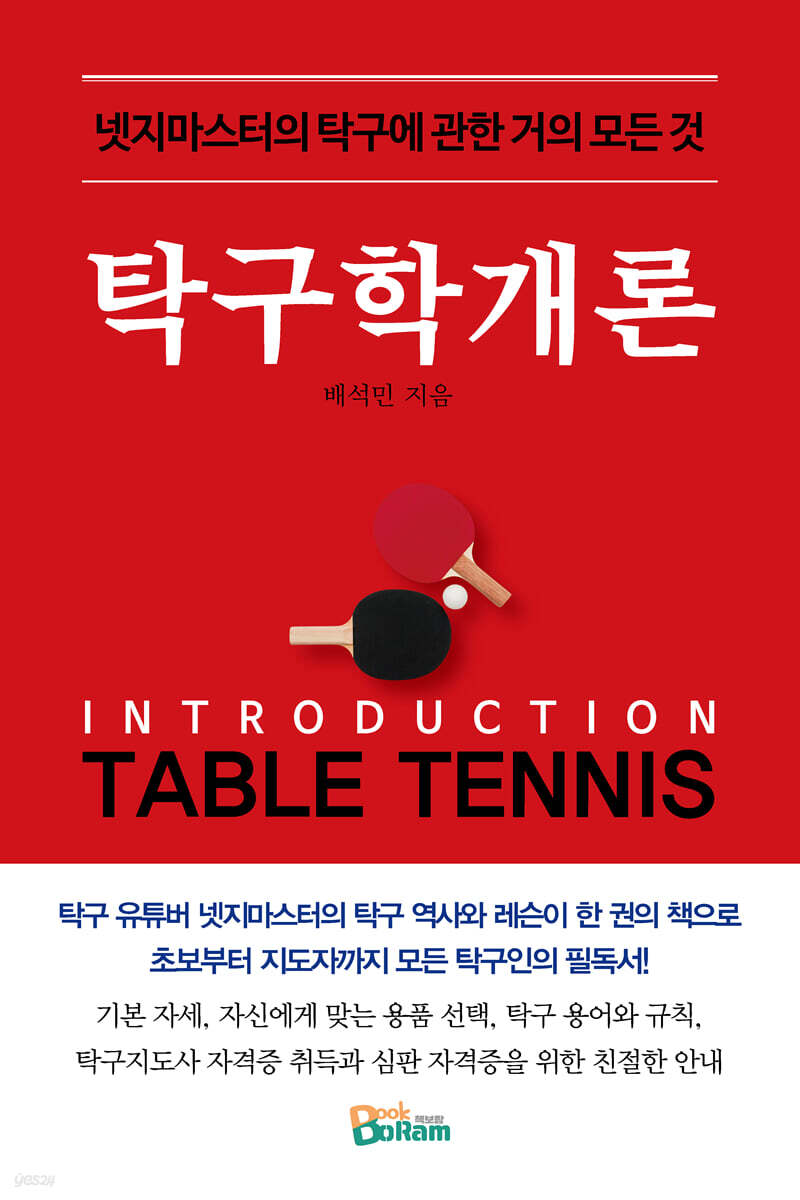
Introduction to Table Tennis
 |
Description
Book Introduction
An 'encyclopedia' for beginners… "Introduction to Table Tennis" serves as a reliable guide.
YouTube creator 'NetG Master' Bae Seok-min's must-read book on table tennis, based on 13 years of experience as a table tennis enthusiast.
Table tennis, a beloved national sport, is growing in popularity day by day.
The number of amateurs is steadily increasing as it is easy for people of all ages to enjoy due to its low risk of injury and the advantage of being an indoor sport.
However, beginners who are trying to get into table tennis are likely to get lost in the flood of information.
It can be overwhelming to know which racket to choose, what all the complicated terms mean, and where to start learning.
A book has been published that will quench the thirst of these beginners like a refreshing shower.
『Net & Edge Master's Almost Everything About Table Tennis - Introduction to Table Tennis』(Chaekboram), written by Seokmin Bae, who runs the YouTube channel 'Net & Edge Master', is expected to be the perfect compass for beginners who want to explore the vast world of table tennis.
YouTube creator 'NetG Master' Bae Seok-min's must-read book on table tennis, based on 13 years of experience as a table tennis enthusiast.
Table tennis, a beloved national sport, is growing in popularity day by day.
The number of amateurs is steadily increasing as it is easy for people of all ages to enjoy due to its low risk of injury and the advantage of being an indoor sport.
However, beginners who are trying to get into table tennis are likely to get lost in the flood of information.
It can be overwhelming to know which racket to choose, what all the complicated terms mean, and where to start learning.
A book has been published that will quench the thirst of these beginners like a refreshing shower.
『Net & Edge Master's Almost Everything About Table Tennis - Introduction to Table Tennis』(Chaekboram), written by Seokmin Bae, who runs the YouTube channel 'Net & Edge Master', is expected to be the perfect compass for beginners who want to explore the vast world of table tennis.
index
preface
Chapter 1.
What is Introduction to Table Tennis?
1.
The purpose of Introduction to Table Tennis
2.
The charm of table tennis and the direction of table tennis theory
Chapter 2.
The history of table tennis around the world
1.
Entering
2.
The origins of table tennis
3.
The cornerstone of table tennis development (1900-1926)
4.
The Hard Rubber Fashion and the Era of European Dominance (1920-1950)
5.
The Soft Rubber Fashion and the Era of Asian Dominance (1950-1970)
6.
The evolution of equipment and the resurgence of Europe (1970-1980)
7.
Modernization of Table Tennis (1980-2025)
Chapter 3.
History of Korean table tennis
1.
Entering
2.
Laying the foundation for Korean table tennis (1910-1940s)
3.
Korean table tennis's entry into the international stage (1950s-1960s)
4.
The Golden Age of Korean Table Tennis (1970s-1980s)
5.
Korea as a table tennis powerhouse (1990s)
6.
The Maturity of Korean Table Tennis (2000s)
7.
Generational Change in Korean Table Tennis (2010s)
8.
Table Tennis in Korea Today (2020s)
Chapter 4.
Table Tennis Key Terms
1.
Entering
2.
Table Tennis Rules Terminology
3.
Table tennis technical terms
3-1.
Service and Receive
3-2.
Forehand Drive Basics
3-3.
Backhand Drive
3-4.
Smash
3-5.
Top Spin
3-6.
Push
3-7.
Chop
3-8.
Drop Shot
3-9.
Flick
3-10.
Banana Flick
3-11.
Block
3-12.
Lob (Lobbing)
Chapter 5.
table tennis blade
1.
Entering
2.
Racket composition
3.
Blade material
4.
Blade structure
5.
Recommended Blade
6.
What are the alternatives to Biscaria?
Chapter 6.
table tennis rubber
1.
Entering
2.
Pimple in Lover
2-1.
Types and Structures of Pimple-in Rubber
2-2.
Structure and properties of sponges
2-3.
Structure and characteristics of the top sheet
3.
Pimple Out Rubber
3-1.
Types and Structures of Pimple Out Rubber
3-2.
Types and characteristics of short pimples
3-3.
Types and characteristics of long pimples
4.
Rubber lifespan and maintenance methods
5.
Recommended flat rubber
Chapter 7.
Table tennis and other equipment
1.
Entering
2.
ping pong table
3.
ping pong ball
4.
table tennis shoes
5.
table tennis socks
6.
table tennis uniform
7.
Table tennis bags
7-1.
racket case
7-2.
ping pong ball case
7-3.
table tennis bag
8.
Rubber protection products
8-1.
Rubber cleaner and sponge
8-2.
Rubber protective film
8-3.
Rubber protective cover
9.
Blade protection products
9-1.
side tape
9-2.
grip tape
9-3.
Surface protective coating
9-4.
Weight gain tape
10.
Rubber attachment accessories
10-1.
Mercury glue and sponge
10-2.
adhesive sheet
10-3.
Cutting knife and scissors
10-4.
Attachment roller
10-5.
Weight measuring scale
10-6.
Post-processing supplies
Chapter 8.
How to Buy Table Tennis Equipment
1.
Entering
2.
How to buy online
3.
How to purchase offline
Chapter 9.
How to attach table tennis rubber
1.
Entering
2.
Preparation
3.
Primary gluing and drying
4.
Secondary gluing and drying
5.
Rubber attachment
6.
Cutting rubber
7.
Measuring racket weight
Chapter 10.
How to Choose a Table Tennis Court and Lessons
1.
Entering
2.
Table Tennis Court Types and Their Pros and Cons
3.
Considerations When Choosing a Table Tennis Court
4.
Table tennis court etiquette
Chapter 11.
How to participate in competitions and league matches
1.
Entering
2.
Necessity of participation
3.
subsidiary and handy system
3-1.
Background information on the subsidiary system
3-2.
Provincial and national open circulation
3-3.
League match bonus
3-4.
Past regional subsidiaries
3-5.
Table tennis court demolition
4.
Features of table tennis competitions and how to participate
5.
Table Tennis League Features and How to Participate
Chapter 12.
How to collect table tennis information
1.
Entering
2.
Introducing the Table Tennis Internet Community
2-1.
Korea Table Tennis Association
2-2.
Papapa Table Tennis Club
2-3.
Tatoz Official Cafe
2-4. TTGearLab
2-5.
Table Tennis Minor Gallery
2-6.
Table Tennis Flea Market
3.
Introducing the Table Tennis YouTube Channel
3-1.
Professional Athlete Competition Channel
3-2.
Sports for All Channel
3-3.
Lesson Channel
3-4.
Comprehensive fan channel
3-5.
Overseas channels
Chapter 13.
Table tennis related qualifications
1.
Entering
2.
Physical Education Instructor Certification
2-1.
Qualification System Guide
2-2.
Written Exam Guide
2-3.
Oral and practical examination system
2-4.
How to prepare for the oral exam
2-5.
How to prepare for the practical exam
2-6.
Actual oral and practical exam reviews
2-7.
Training and Field Training Guide
2-8.
Actual reviews of training and field training
3.
Table Tennis Referee Certificate
3-1.
Purpose of acquisition and use
3-2.
How to Obtain a Level 3 Domestic Referee License
3-3.
How to Obtain a Level 2 Domestic Referee License
3-4.
How to Obtain a Level 1 Domestic Referee License
3-5.
How to obtain an international referee license
Concluding Introduction to Table Tennis
Appendix - 2025 International Table Tennis Federation Rules and Regulations
Rules of table tennis
International Competition Regulations
Table tennis terms
Search
Chapter 1.
What is Introduction to Table Tennis?
1.
The purpose of Introduction to Table Tennis
2.
The charm of table tennis and the direction of table tennis theory
Chapter 2.
The history of table tennis around the world
1.
Entering
2.
The origins of table tennis
3.
The cornerstone of table tennis development (1900-1926)
4.
The Hard Rubber Fashion and the Era of European Dominance (1920-1950)
5.
The Soft Rubber Fashion and the Era of Asian Dominance (1950-1970)
6.
The evolution of equipment and the resurgence of Europe (1970-1980)
7.
Modernization of Table Tennis (1980-2025)
Chapter 3.
History of Korean table tennis
1.
Entering
2.
Laying the foundation for Korean table tennis (1910-1940s)
3.
Korean table tennis's entry into the international stage (1950s-1960s)
4.
The Golden Age of Korean Table Tennis (1970s-1980s)
5.
Korea as a table tennis powerhouse (1990s)
6.
The Maturity of Korean Table Tennis (2000s)
7.
Generational Change in Korean Table Tennis (2010s)
8.
Table Tennis in Korea Today (2020s)
Chapter 4.
Table Tennis Key Terms
1.
Entering
2.
Table Tennis Rules Terminology
3.
Table tennis technical terms
3-1.
Service and Receive
3-2.
Forehand Drive Basics
3-3.
Backhand Drive
3-4.
Smash
3-5.
Top Spin
3-6.
Push
3-7.
Chop
3-8.
Drop Shot
3-9.
Flick
3-10.
Banana Flick
3-11.
Block
3-12.
Lob (Lobbing)
Chapter 5.
table tennis blade
1.
Entering
2.
Racket composition
3.
Blade material
4.
Blade structure
5.
Recommended Blade
6.
What are the alternatives to Biscaria?
Chapter 6.
table tennis rubber
1.
Entering
2.
Pimple in Lover
2-1.
Types and Structures of Pimple-in Rubber
2-2.
Structure and properties of sponges
2-3.
Structure and characteristics of the top sheet
3.
Pimple Out Rubber
3-1.
Types and Structures of Pimple Out Rubber
3-2.
Types and characteristics of short pimples
3-3.
Types and characteristics of long pimples
4.
Rubber lifespan and maintenance methods
5.
Recommended flat rubber
Chapter 7.
Table tennis and other equipment
1.
Entering
2.
ping pong table
3.
ping pong ball
4.
table tennis shoes
5.
table tennis socks
6.
table tennis uniform
7.
Table tennis bags
7-1.
racket case
7-2.
ping pong ball case
7-3.
table tennis bag
8.
Rubber protection products
8-1.
Rubber cleaner and sponge
8-2.
Rubber protective film
8-3.
Rubber protective cover
9.
Blade protection products
9-1.
side tape
9-2.
grip tape
9-3.
Surface protective coating
9-4.
Weight gain tape
10.
Rubber attachment accessories
10-1.
Mercury glue and sponge
10-2.
adhesive sheet
10-3.
Cutting knife and scissors
10-4.
Attachment roller
10-5.
Weight measuring scale
10-6.
Post-processing supplies
Chapter 8.
How to Buy Table Tennis Equipment
1.
Entering
2.
How to buy online
3.
How to purchase offline
Chapter 9.
How to attach table tennis rubber
1.
Entering
2.
Preparation
3.
Primary gluing and drying
4.
Secondary gluing and drying
5.
Rubber attachment
6.
Cutting rubber
7.
Measuring racket weight
Chapter 10.
How to Choose a Table Tennis Court and Lessons
1.
Entering
2.
Table Tennis Court Types and Their Pros and Cons
3.
Considerations When Choosing a Table Tennis Court
4.
Table tennis court etiquette
Chapter 11.
How to participate in competitions and league matches
1.
Entering
2.
Necessity of participation
3.
subsidiary and handy system
3-1.
Background information on the subsidiary system
3-2.
Provincial and national open circulation
3-3.
League match bonus
3-4.
Past regional subsidiaries
3-5.
Table tennis court demolition
4.
Features of table tennis competitions and how to participate
5.
Table Tennis League Features and How to Participate
Chapter 12.
How to collect table tennis information
1.
Entering
2.
Introducing the Table Tennis Internet Community
2-1.
Korea Table Tennis Association
2-2.
Papapa Table Tennis Club
2-3.
Tatoz Official Cafe
2-4. TTGearLab
2-5.
Table Tennis Minor Gallery
2-6.
Table Tennis Flea Market
3.
Introducing the Table Tennis YouTube Channel
3-1.
Professional Athlete Competition Channel
3-2.
Sports for All Channel
3-3.
Lesson Channel
3-4.
Comprehensive fan channel
3-5.
Overseas channels
Chapter 13.
Table tennis related qualifications
1.
Entering
2.
Physical Education Instructor Certification
2-1.
Qualification System Guide
2-2.
Written Exam Guide
2-3.
Oral and practical examination system
2-4.
How to prepare for the oral exam
2-5.
How to prepare for the practical exam
2-6.
Actual oral and practical exam reviews
2-7.
Training and Field Training Guide
2-8.
Actual reviews of training and field training
3.
Table Tennis Referee Certificate
3-1.
Purpose of acquisition and use
3-2.
How to Obtain a Level 3 Domestic Referee License
3-3.
How to Obtain a Level 2 Domestic Referee License
3-4.
How to Obtain a Level 1 Domestic Referee License
3-5.
How to obtain an international referee license
Concluding Introduction to Table Tennis
Appendix - 2025 International Table Tennis Federation Rules and Regulations
Rules of table tennis
International Competition Regulations
Table tennis terms
Search
Into the book
Table tennis has a lower risk of injury than other sports and requires relatively less strength and physical fitness.
Thanks to this, people of all ages and genders can enjoy it together.
It is common to see people in their 60s and 70s beating people in their 20s, or women beating men.
Additionally, by utilizing a variety of archetypes and equipment, you can employ strategies that allow you to win without relying too heavily on stamina.
Conversely, if you want to perform at a high level of intensity like professional players, you can choose a type that suits your needs, allowing you to determine a table tennis style that suits your personal physical strength and preferences.
--- p.16
Table tennis began as a social pastime in Victorian England in the late 1800s.
In the early days, champagne corks were used as balls, cigar boxes as rackets, books as nets, and dining tables as ping-pong tables.
Early table tennis, like badminton and tennis, originated from a medieval form of tennis known as Jeu de Paume.
It became popular as a table tennis game for the upper class as an after-dinner pastime or as a substitute for tennis on rainy days.
--- pp.19-20
The name 'Ping Pong' began to be used when celluloid balls were introduced in 1900.
(Omitted) In addition to Ping Pong, it was also called Whiff Waff, Pom Pom, and Pim Pam, but the two names that ultimately survived were 'Ping Pong' and 'Table Tennis'.
In 1926, Dr. Georg Lehmann, the president of the German Table Tennis Association, proposed the formation of the International Table Tennis Federation (ITTF), with representatives from Austria, West Germany, Hungary, and other countries gathering in Berlin.
Also in the same year, the first World Championships were held in London, England, and the name 'table tennis' was used as the official name.
--- pp.23-24
The competition system was changed starting from the 2001 World Championships held in Osaka, Japan.
Reducing the number of service rights from five to two prevents the game from becoming monotonous due to excessive service points, and reducing the game score from 21 to 11 increases the pace of play.
The purpose of the rule change was to make it suitable for broadcast as a professional sport, but there was also a view that it was to prevent China's dominance.
However, China still showed the strength of the Great Wall by winning all seven gold medals at the Osaka World Championships thanks to the performances of Gong Linghui, Ma Lin, and Wang Liqin.
A year later, in 2002, the International Table Tennis Federation banned the use of the free hand to toss the ball to mask the service impact (the moment the racket collides with the ball, or the ability to impart power to the ball) in an attempt to further reduce the impact of the service.
--- p.34
In 1966, at the Asian Games held in Bangkok, Thailand, Kim Chung-yong defeated the world's number one ranked player, Nobuhiko Hasegawa of Japan, to win the men's singles title.
This holds historical significance as the first international singles gold medal in Korean table tennis history, and became the cornerstone for the golden age of Korean table tennis in the 1970s.
(Omitted) The 1970s and 1980s are considered the golden age of Korean table tennis.
In April 1973, at the Saraje World Championships, the trio of Park Mira, Ierisa, and Jeong Hyeon-suk won the women's team event.
This was a great achievement, the first time in the history of ball games in Korea that a team won the world championship.
(Omitted) At the 1988 Seoul Olympics, Nam-Kyu Yoo and Ki-Taek Kim won gold and silver medals in the men's singles, respectively, becoming the first Olympic gold and silver medalists in the men's singles.
Additionally, the doubles pair of Yang Young-ja and Hyun Jung-hwa won the gold medal in women's doubles, and the doubles pair of Ahn Jae-hyung and Yoo Nam-gyu won the bronze medal in men's doubles, making Korean table tennis known to the world.
--- pp.42-45
According to the International Table Tennis Federation regulations, there are no restrictions on the size, shape, or weight of the blade, but at least 85% of the blade must be made of wood.
Typically, wood such as koto, veneer (solid board), pure plywood, special material plywood, limba, kiri, and hinoki is used, and each wood has different elasticity and hardness.
Blades are divided into single-piece (solid wood), pure plywood, and special material plywood depending on the wood composition.
In the case of single-sided table tennis, it is mainly used by Japanese penholder players who use rubber on only one side, such as Yoo Nam-gyu, Kim Taek-su, and Yoo Seung-min, who are familiar to us.
Because veneer is more susceptible to breaking on impact than plywood, it must be of a certain thickness.
Shake or Chinese penholders require rubber to be glued to both sides, so if the single-blade is too thick, the racket will be uncomfortable to handle.
Therefore, shakes are mainly made of pure plywood or special material plywood.
The blade that is currently mainstream worldwide is the shake blade made of special material plywood.
--- pp.92-93
Table tennis qualifications include a physical education instructor qualification that allows you to coach other enthusiasts, and a referee qualification that allows you to referee at table tennis competitions.
(Omitted) The Physical Education Instructor Certification is a nationally recognized certification administered by the Korea Sports Promotion Foundation under the supervision of the Ministry of Culture, Sports and Tourism.
The Korea Table Tennis Association officially recognizes only the five sports instructor certifications issued by the Ministry of Culture, Sports and Tourism, and does not recognize certifications issued by private institutions as table tennis coaching qualifications.
To work as a table tennis coach in a public institution, a qualification obtained through the Korea Sports Promotion Foundation's Sports Instructor website (https://sqms.kspo.or.kr/) is required.
(Omitted) The qualifications that general amateurs can obtain are Level 2 Life Sports Instructor, Youth Sports Instructor, Senior Sports Instructor, and Level 2 Disabled Sports Instructor.
Although these four certifications have different target audiences, the written and practical exams and training courses required to obtain them are largely similar, so you can prepare for them together.
--- pp.221-223
A table tennis referee license is a required qualification to become a certified referee.
Certified referees are required for competitions such as the division league held nationwide every year under the auspices of the Korea Table Tennis Association and the Seoul Citizen League.
The demand for certified referees continues, as even large-scale regional and national open competitions sometimes recruit certified referees.
Additionally, if you have a high level of experience, you can also work as an official referee for professional tournaments or professional leagues.
Many amateurs are pursuing referee qualifications because refereeing experience can help them develop a deeper understanding of table tennis rules and game management skills.
Many former athletes also acquire it as it helps them improve their skills and careers as coaches or leaders.
From my experience working as a referee in the Division League or Seoul Citizen League, I was able to see how refereeing can help raise awareness and build a table tennis network.
Thanks to this, people of all ages and genders can enjoy it together.
It is common to see people in their 60s and 70s beating people in their 20s, or women beating men.
Additionally, by utilizing a variety of archetypes and equipment, you can employ strategies that allow you to win without relying too heavily on stamina.
Conversely, if you want to perform at a high level of intensity like professional players, you can choose a type that suits your needs, allowing you to determine a table tennis style that suits your personal physical strength and preferences.
--- p.16
Table tennis began as a social pastime in Victorian England in the late 1800s.
In the early days, champagne corks were used as balls, cigar boxes as rackets, books as nets, and dining tables as ping-pong tables.
Early table tennis, like badminton and tennis, originated from a medieval form of tennis known as Jeu de Paume.
It became popular as a table tennis game for the upper class as an after-dinner pastime or as a substitute for tennis on rainy days.
--- pp.19-20
The name 'Ping Pong' began to be used when celluloid balls were introduced in 1900.
(Omitted) In addition to Ping Pong, it was also called Whiff Waff, Pom Pom, and Pim Pam, but the two names that ultimately survived were 'Ping Pong' and 'Table Tennis'.
In 1926, Dr. Georg Lehmann, the president of the German Table Tennis Association, proposed the formation of the International Table Tennis Federation (ITTF), with representatives from Austria, West Germany, Hungary, and other countries gathering in Berlin.
Also in the same year, the first World Championships were held in London, England, and the name 'table tennis' was used as the official name.
--- pp.23-24
The competition system was changed starting from the 2001 World Championships held in Osaka, Japan.
Reducing the number of service rights from five to two prevents the game from becoming monotonous due to excessive service points, and reducing the game score from 21 to 11 increases the pace of play.
The purpose of the rule change was to make it suitable for broadcast as a professional sport, but there was also a view that it was to prevent China's dominance.
However, China still showed the strength of the Great Wall by winning all seven gold medals at the Osaka World Championships thanks to the performances of Gong Linghui, Ma Lin, and Wang Liqin.
A year later, in 2002, the International Table Tennis Federation banned the use of the free hand to toss the ball to mask the service impact (the moment the racket collides with the ball, or the ability to impart power to the ball) in an attempt to further reduce the impact of the service.
--- p.34
In 1966, at the Asian Games held in Bangkok, Thailand, Kim Chung-yong defeated the world's number one ranked player, Nobuhiko Hasegawa of Japan, to win the men's singles title.
This holds historical significance as the first international singles gold medal in Korean table tennis history, and became the cornerstone for the golden age of Korean table tennis in the 1970s.
(Omitted) The 1970s and 1980s are considered the golden age of Korean table tennis.
In April 1973, at the Saraje World Championships, the trio of Park Mira, Ierisa, and Jeong Hyeon-suk won the women's team event.
This was a great achievement, the first time in the history of ball games in Korea that a team won the world championship.
(Omitted) At the 1988 Seoul Olympics, Nam-Kyu Yoo and Ki-Taek Kim won gold and silver medals in the men's singles, respectively, becoming the first Olympic gold and silver medalists in the men's singles.
Additionally, the doubles pair of Yang Young-ja and Hyun Jung-hwa won the gold medal in women's doubles, and the doubles pair of Ahn Jae-hyung and Yoo Nam-gyu won the bronze medal in men's doubles, making Korean table tennis known to the world.
--- pp.42-45
According to the International Table Tennis Federation regulations, there are no restrictions on the size, shape, or weight of the blade, but at least 85% of the blade must be made of wood.
Typically, wood such as koto, veneer (solid board), pure plywood, special material plywood, limba, kiri, and hinoki is used, and each wood has different elasticity and hardness.
Blades are divided into single-piece (solid wood), pure plywood, and special material plywood depending on the wood composition.
In the case of single-sided table tennis, it is mainly used by Japanese penholder players who use rubber on only one side, such as Yoo Nam-gyu, Kim Taek-su, and Yoo Seung-min, who are familiar to us.
Because veneer is more susceptible to breaking on impact than plywood, it must be of a certain thickness.
Shake or Chinese penholders require rubber to be glued to both sides, so if the single-blade is too thick, the racket will be uncomfortable to handle.
Therefore, shakes are mainly made of pure plywood or special material plywood.
The blade that is currently mainstream worldwide is the shake blade made of special material plywood.
--- pp.92-93
Table tennis qualifications include a physical education instructor qualification that allows you to coach other enthusiasts, and a referee qualification that allows you to referee at table tennis competitions.
(Omitted) The Physical Education Instructor Certification is a nationally recognized certification administered by the Korea Sports Promotion Foundation under the supervision of the Ministry of Culture, Sports and Tourism.
The Korea Table Tennis Association officially recognizes only the five sports instructor certifications issued by the Ministry of Culture, Sports and Tourism, and does not recognize certifications issued by private institutions as table tennis coaching qualifications.
To work as a table tennis coach in a public institution, a qualification obtained through the Korea Sports Promotion Foundation's Sports Instructor website (https://sqms.kspo.or.kr/) is required.
(Omitted) The qualifications that general amateurs can obtain are Level 2 Life Sports Instructor, Youth Sports Instructor, Senior Sports Instructor, and Level 2 Disabled Sports Instructor.
Although these four certifications have different target audiences, the written and practical exams and training courses required to obtain them are largely similar, so you can prepare for them together.
--- pp.221-223
A table tennis referee license is a required qualification to become a certified referee.
Certified referees are required for competitions such as the division league held nationwide every year under the auspices of the Korea Table Tennis Association and the Seoul Citizen League.
The demand for certified referees continues, as even large-scale regional and national open competitions sometimes recruit certified referees.
Additionally, if you have a high level of experience, you can also work as an official referee for professional tournaments or professional leagues.
Many amateurs are pursuing referee qualifications because refereeing experience can help them develop a deeper understanding of table tennis rules and game management skills.
Many former athletes also acquire it as it helps them improve their skills and careers as coaches or leaders.
From my experience working as a referee in the Division League or Seoul Citizen League, I was able to see how refereeing can help raise awareness and build a table tennis network.
--- pp.239-240
Publisher's Review
Everything from a beginner's perspective
Author Bae Seok-min is not an elite athlete with a brilliant career.
He is a veteran amateur who has been playing table tennis for 13 years since first picking up a racket in the table tennis club while attending Korea University in 2006. He is also a certified instructor who has obtained qualifications as a lifestyle sports instructor and senior and youth sports instructor.
Because he is not a former athlete, he understands the difficulties and questions faced by beginners better than anyone else and offers practical solutions tailored to their level.
As the title suggests, 『Introduction to Table Tennis』 is an encyclopedic guide that covers almost everything about table tennis.
From the history of table tennis spanning over 100 years to essential rule terms like rally and let, and explanations of key technical terms like forehand drive and top spin, this book systematically organizes the theoretical background necessary to lay the foundation for table tennis.
The book's true value shines through in its practical information.
The selection criteria for blades and rubbers, which cause many beginners to suffer from 'supply sickness', are explained in detail according to material, structure, and characteristics, and even helpful information is provided on how to purchase them both online and offline.
In addition, this book contains answers to all the questions that a beginner table tennis player will face during the growth process, from how to glue rubber yourself, to the criteria for choosing a local table tennis court and lesson coach, to understanding the complex sports supplementary system and how to participate in competitions.
Combining books and videos, the birth of a "three-dimensional guide"
The biggest feature of this book is that it is an 'interactive guidebook' that goes beyond simple text.
As this book is based on a video series on the author's YouTube channel, 'Netjimaster,' each chapter of the book includes a QR code that instantly links to the relevant YouTube video.
Through this, readers can increase their understanding by confirming concepts such as the structure of products or technology that were difficult to understand through text alone through audiovisual materials.
Additionally, the various online communities and YouTube channels introduced in the book provide readers with a way to connect with the author and other enthusiasts and resolve their questions.
This book, which adds the vividness of video to the knowledge accumulated through written text and even suggests the possibility of online communication, can be considered a three-dimensional guide to table tennis.
This isn't a "magic book that will improve your skills just by reading it," but it systematically provides most of the information needed to properly enjoy table tennis, drastically reducing the time and effort beginners spend searching for information.
In the preface, the author states, "I sincerely hope that this book will serve as a reliable guide for your table tennis journey."
As he hopes, "Introduction to Table Tennis" is expected to be an excellent guide that will make many people's lives healthier and richer through the profound joy that the sport of table tennis provides.
Author Bae Seok-min is not an elite athlete with a brilliant career.
He is a veteran amateur who has been playing table tennis for 13 years since first picking up a racket in the table tennis club while attending Korea University in 2006. He is also a certified instructor who has obtained qualifications as a lifestyle sports instructor and senior and youth sports instructor.
Because he is not a former athlete, he understands the difficulties and questions faced by beginners better than anyone else and offers practical solutions tailored to their level.
As the title suggests, 『Introduction to Table Tennis』 is an encyclopedic guide that covers almost everything about table tennis.
From the history of table tennis spanning over 100 years to essential rule terms like rally and let, and explanations of key technical terms like forehand drive and top spin, this book systematically organizes the theoretical background necessary to lay the foundation for table tennis.
The book's true value shines through in its practical information.
The selection criteria for blades and rubbers, which cause many beginners to suffer from 'supply sickness', are explained in detail according to material, structure, and characteristics, and even helpful information is provided on how to purchase them both online and offline.
In addition, this book contains answers to all the questions that a beginner table tennis player will face during the growth process, from how to glue rubber yourself, to the criteria for choosing a local table tennis court and lesson coach, to understanding the complex sports supplementary system and how to participate in competitions.
Combining books and videos, the birth of a "three-dimensional guide"
The biggest feature of this book is that it is an 'interactive guidebook' that goes beyond simple text.
As this book is based on a video series on the author's YouTube channel, 'Netjimaster,' each chapter of the book includes a QR code that instantly links to the relevant YouTube video.
Through this, readers can increase their understanding by confirming concepts such as the structure of products or technology that were difficult to understand through text alone through audiovisual materials.
Additionally, the various online communities and YouTube channels introduced in the book provide readers with a way to connect with the author and other enthusiasts and resolve their questions.
This book, which adds the vividness of video to the knowledge accumulated through written text and even suggests the possibility of online communication, can be considered a three-dimensional guide to table tennis.
This isn't a "magic book that will improve your skills just by reading it," but it systematically provides most of the information needed to properly enjoy table tennis, drastically reducing the time and effort beginners spend searching for information.
In the preface, the author states, "I sincerely hope that this book will serve as a reliable guide for your table tennis journey."
As he hopes, "Introduction to Table Tennis" is expected to be an excellent guide that will make many people's lives healthier and richer through the profound joy that the sport of table tennis provides.
GOODS SPECIFICS
- Date of issue: September 12, 2025
- Page count, weight, size: 304 pages | 140*210*30mm
- ISBN13: 9791194110071
- ISBN10: 119411007X
You may also like
카테고리
korean


korean

![GQ KOREA Mark (Monthly): December [2025]](http://librairie.coreenne.fr/cdn/shop/files/8ef265dbbfbf186523ed75ba7319009d.jpg?v=1765340328&width=3840)


