

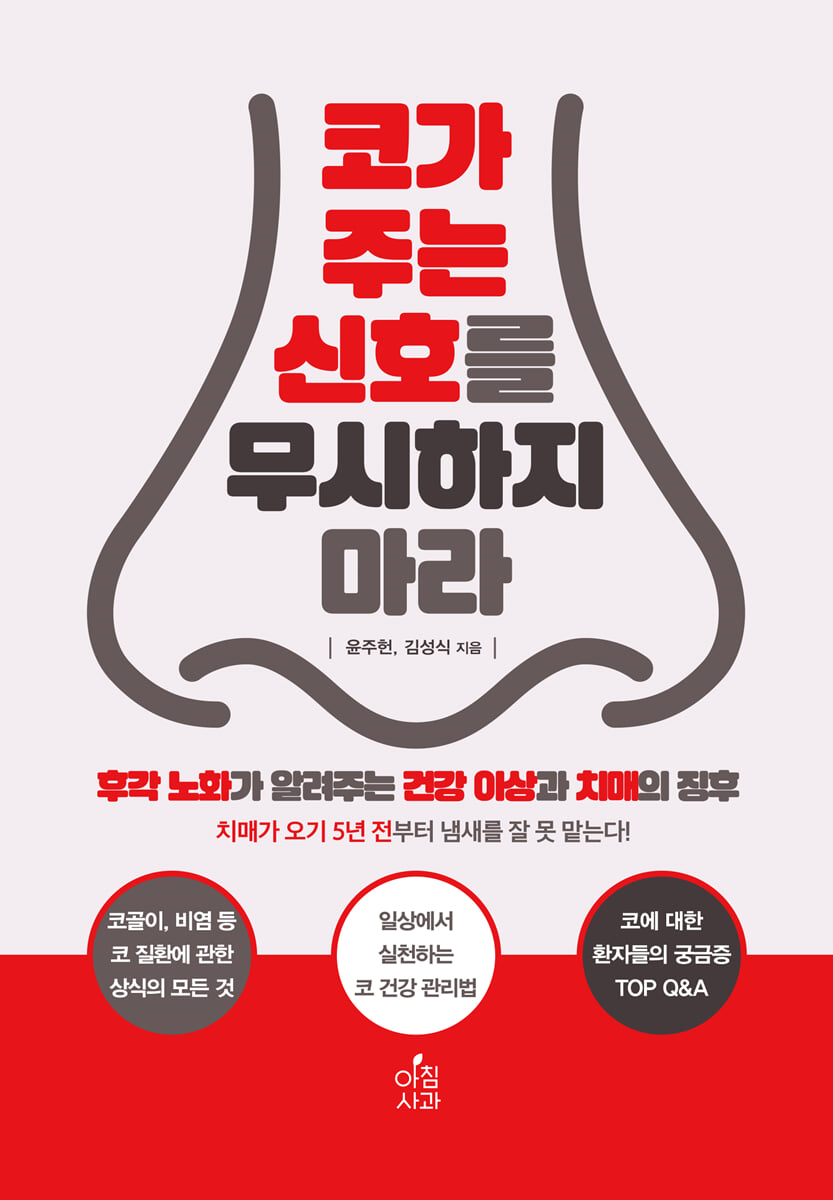
Don't ignore the signals your nose is giving you.
 |
Description
Book Introduction
Don't ignore the signals your nose is giving you.
Signals from your nose are the first step to protecting your health.
This book, written by Korea's top ENT specialists with 41 years of experience, provides information on the nose and the sense of smell. It covers the principles of smell, the functions of the nose, and the causes and treatments of various nasal diseases.
It provides practical information on interesting topics such as smell and memory, taste and olfaction, dementia and the relationship between olfaction, autism spectrum disorder and olfactory training, how to maintain nasal health as you age, how to prevent and treat common nasal conditions such as colds, allergic rhinitis, snoring, and sinusitis, and tips for maintaining nasal health in everyday life.
In particular, the link between olfactory aging and dementia will serve as an opportunity to rediscover the importance of nasal health.
Signals from your nose are the first step to protecting your health.
This book, written by Korea's top ENT specialists with 41 years of experience, provides information on the nose and the sense of smell. It covers the principles of smell, the functions of the nose, and the causes and treatments of various nasal diseases.
It provides practical information on interesting topics such as smell and memory, taste and olfaction, dementia and the relationship between olfaction, autism spectrum disorder and olfactory training, how to maintain nasal health as you age, how to prevent and treat common nasal conditions such as colds, allergic rhinitis, snoring, and sinusitis, and tips for maintaining nasal health in everyday life.
In particular, the link between olfactory aging and dementia will serve as an opportunity to rediscover the importance of nasal health.
- You can preview some of the book's contents.
Preview
index
Author's Preface 1 004
Author's Preface 2 007
Chapter 1: Olfaction and Smell
1. Principles of Olfaction 017
Smell and Memory 017 | The smells we experience are stored in our brains 019 | What if you had to give up your cell phone or your sense of smell? 021 | The Nobel Prize winner who discovered the principles of olfaction 023 | How we learn to smell 025
2. Even the nose needs a break sometimes 028
Even your sense of smell gets tired 028 | Even your sense of smell ages 029 | When you lose your sense of smell, you also lose your appetite 030
3. Good smell, bad smell 032
The Diverse Smells Around Us 032 | The Origin of Smell 033 | Preferred Body Odors 035 | Standardization of Olfaction: Bio-Nano Electronic Nose 037
4. Does training your sense of smell improve cognitive function? 039
Causes of Olfactory Disorders 039 | Types and Classification of Olfactory Disorders 040 | Tests Performed When Olfactory Disorders Are Suspected 041 | Olfactory Training and Cognitive Function Improvement 044
Chapter 2: Fragrance and Perfume
1. History of Incense 049
The First Fragrances 049 | Incense from Ancient India and China 052 | The Development of Modern Perfume 053 | The History of Perfume in Korea 056
2. Olfactory Research for Therapy 058
Aromatherapy 058 | Dementia and Olfactory Training 060 | Korea's First Olfactory Testing Medical Device 061
Chapter 3 Taste and Smell
1. The sense of smell, which perceives more tastes than the tongue 067
There's a separate sense of true taste 067 | Why you can't taste when you lose your sense of smell 068
2. Five Flavors 070
The Truth of Taste 070 | Sweet 071 | Salty 073 | Sour 075 | Bitter 076 | Savory 077
3. Surprising Facts About Taste 080
Flavors That Affect Our Sense of Taste 080 | Spicy Flavor is Not a Taste, It's a Pain 081 | Do Animals Feel Taste? 083
Chapter 4 Dementia and the Sense of Smell
1. Does losing your sense of smell cause dementia to develop sooner? 089
The Relationship Between Odor Recognition and Cognitive Impairment 089 | Suffering from Dementia 090 | Dementia and the Sense of Smell 093 | If You Are 65 or Older, Have Your Smell Tested Regularly 094
2. Autism Spectrum Disorder and Olfactory Disorder 096
Why People with Autism Spectrum Disorder React to Certain Smells 096 | Customized Olfactory Training Tools for People with Autism Spectrum Disorder 097
3. Why Depression Reduces Your Sense of Smell 099
Depression and Olfactory Disorders 099
4. Does Olfactory Training Really Work? 101
Predicting Brain Damage Recovery Through Odor Responses 101 | Customized Olfactory Training for Dementia Patients 103
Chapter 5: How to Maintain Nasal Health in Everyday Life
1. Washing your nose 107
Let's Use Saline Solution 107 | How to Wash Your Nose 108
2. 111 Daily Life Rules for a Healthy Nose
Let's make humidifier use a part of our daily lives 111 | Avoid caffeinated beverages 112 | Wear a mask on days with heavy yellow dust or fine dust 113 | Don't pluck or cut your nose hairs short 116
3. There are manners even when coughing 118
Changes Due to COVID-19 118 | Four Rules for Practicing Cough Etiquette 119
4. Don't ignore the signals your nose gives you 121
Runny nose and sneezing 121 | Dryness and scratchiness in the throat 122 | Snoring 123 | Persistent nasal congestion in one nostril 124 | Loss of smell or taste 125 | Antibiotic treatment 125
Chapter 6: Functions of the Nose
1. Five Functions of the Nose 131
Temperature and humidity control function 131 | Filtration and immune response function 133 | Resonance function 134 | Olfactory function 135 | Respiratory function 137
2. We breathe alternately using the left and right nostrils 138
Nasal Cycle 138 | The Aging Nose 140 | Keeping Your Nasal Mucous Membrane Moisturized 141
Chapter 7 Diseases Related to the Nose
1. Snoring 145
Causes of Snoring 145 | Sleep Apnea and Treatment 147
2. Sinusitis (sinusitis) 150
The Process of Sinusitis 150 | Symptoms and Treatment 152 | When Surgery Is Required 154 | Drug Treatment and Side Effects of Sinusitis 156
3. Rhinitis and Allergies 158
Causes of Rhinitis 158 | Allergic Rhinitis and House Dust Mites 159 | Allergic Rhinitis and Pollen 160 | When Does Allergic Rhinitis Get Worse? 162 | Treatment Method 1: Avoidance Therapy 163 | Treatment Method 2: Drug Therapy 166 | Treatment Method 3: Immunotherapy 170 | Food Allergy 171 | Eosinophilic Rhinitis 172 | Drug-Induced Rhinitis 173 | Atrophic Rhinitis 175 | Vasomotor Rhinitis 176
4. Colds and Flu 178
Why do we catch colds? 178 | Washing your hands well can help prevent colds? 180 | Good lifestyle habits to prevent the flu 181
5. Septal deviation 183
Septal Deviation During Puberty 183 | Two Causes of Nasal Obstruction 184
6. Tumors in the nose (sinus tumors) 186
Can You Get Nasal Cancer? 186 | Cigarettes: Causes of Nasal and Sinus Cancer 187 | Cancer Treatments 189
Chapter 8: What Patients Most Want to Know About Their Noses: Q&A
1. Smell and Olfaction 194
2. Taste and Smell 198
3. Dementia and the Sense of Smell 201
4. Functions and Diseases of the Nose 203
Reference 238
Author's Preface 2 007
Chapter 1: Olfaction and Smell
1. Principles of Olfaction 017
Smell and Memory 017 | The smells we experience are stored in our brains 019 | What if you had to give up your cell phone or your sense of smell? 021 | The Nobel Prize winner who discovered the principles of olfaction 023 | How we learn to smell 025
2. Even the nose needs a break sometimes 028
Even your sense of smell gets tired 028 | Even your sense of smell ages 029 | When you lose your sense of smell, you also lose your appetite 030
3. Good smell, bad smell 032
The Diverse Smells Around Us 032 | The Origin of Smell 033 | Preferred Body Odors 035 | Standardization of Olfaction: Bio-Nano Electronic Nose 037
4. Does training your sense of smell improve cognitive function? 039
Causes of Olfactory Disorders 039 | Types and Classification of Olfactory Disorders 040 | Tests Performed When Olfactory Disorders Are Suspected 041 | Olfactory Training and Cognitive Function Improvement 044
Chapter 2: Fragrance and Perfume
1. History of Incense 049
The First Fragrances 049 | Incense from Ancient India and China 052 | The Development of Modern Perfume 053 | The History of Perfume in Korea 056
2. Olfactory Research for Therapy 058
Aromatherapy 058 | Dementia and Olfactory Training 060 | Korea's First Olfactory Testing Medical Device 061
Chapter 3 Taste and Smell
1. The sense of smell, which perceives more tastes than the tongue 067
There's a separate sense of true taste 067 | Why you can't taste when you lose your sense of smell 068
2. Five Flavors 070
The Truth of Taste 070 | Sweet 071 | Salty 073 | Sour 075 | Bitter 076 | Savory 077
3. Surprising Facts About Taste 080
Flavors That Affect Our Sense of Taste 080 | Spicy Flavor is Not a Taste, It's a Pain 081 | Do Animals Feel Taste? 083
Chapter 4 Dementia and the Sense of Smell
1. Does losing your sense of smell cause dementia to develop sooner? 089
The Relationship Between Odor Recognition and Cognitive Impairment 089 | Suffering from Dementia 090 | Dementia and the Sense of Smell 093 | If You Are 65 or Older, Have Your Smell Tested Regularly 094
2. Autism Spectrum Disorder and Olfactory Disorder 096
Why People with Autism Spectrum Disorder React to Certain Smells 096 | Customized Olfactory Training Tools for People with Autism Spectrum Disorder 097
3. Why Depression Reduces Your Sense of Smell 099
Depression and Olfactory Disorders 099
4. Does Olfactory Training Really Work? 101
Predicting Brain Damage Recovery Through Odor Responses 101 | Customized Olfactory Training for Dementia Patients 103
Chapter 5: How to Maintain Nasal Health in Everyday Life
1. Washing your nose 107
Let's Use Saline Solution 107 | How to Wash Your Nose 108
2. 111 Daily Life Rules for a Healthy Nose
Let's make humidifier use a part of our daily lives 111 | Avoid caffeinated beverages 112 | Wear a mask on days with heavy yellow dust or fine dust 113 | Don't pluck or cut your nose hairs short 116
3. There are manners even when coughing 118
Changes Due to COVID-19 118 | Four Rules for Practicing Cough Etiquette 119
4. Don't ignore the signals your nose gives you 121
Runny nose and sneezing 121 | Dryness and scratchiness in the throat 122 | Snoring 123 | Persistent nasal congestion in one nostril 124 | Loss of smell or taste 125 | Antibiotic treatment 125
Chapter 6: Functions of the Nose
1. Five Functions of the Nose 131
Temperature and humidity control function 131 | Filtration and immune response function 133 | Resonance function 134 | Olfactory function 135 | Respiratory function 137
2. We breathe alternately using the left and right nostrils 138
Nasal Cycle 138 | The Aging Nose 140 | Keeping Your Nasal Mucous Membrane Moisturized 141
Chapter 7 Diseases Related to the Nose
1. Snoring 145
Causes of Snoring 145 | Sleep Apnea and Treatment 147
2. Sinusitis (sinusitis) 150
The Process of Sinusitis 150 | Symptoms and Treatment 152 | When Surgery Is Required 154 | Drug Treatment and Side Effects of Sinusitis 156
3. Rhinitis and Allergies 158
Causes of Rhinitis 158 | Allergic Rhinitis and House Dust Mites 159 | Allergic Rhinitis and Pollen 160 | When Does Allergic Rhinitis Get Worse? 162 | Treatment Method 1: Avoidance Therapy 163 | Treatment Method 2: Drug Therapy 166 | Treatment Method 3: Immunotherapy 170 | Food Allergy 171 | Eosinophilic Rhinitis 172 | Drug-Induced Rhinitis 173 | Atrophic Rhinitis 175 | Vasomotor Rhinitis 176
4. Colds and Flu 178
Why do we catch colds? 178 | Washing your hands well can help prevent colds? 180 | Good lifestyle habits to prevent the flu 181
5. Septal deviation 183
Septal Deviation During Puberty 183 | Two Causes of Nasal Obstruction 184
6. Tumors in the nose (sinus tumors) 186
Can You Get Nasal Cancer? 186 | Cigarettes: Causes of Nasal and Sinus Cancer 187 | Cancer Treatments 189
Chapter 8: What Patients Most Want to Know About Their Noses: Q&A
1. Smell and Olfaction 194
2. Taste and Smell 198
3. Dementia and the Sense of Smell 201
4. Functions and Diseases of the Nose 203
Reference 238
Detailed image

Into the book
When we first perceive an odor molecule through the olfactory receptors in the nasal mucosa, it travels to the olfactory bulb, a part of the brain just behind the forehead bone, where the identity of the odor is determined and the odor is stored in the brain associated with emotion and memory.
Through this process, when you smell that smell again, the emotions and memories associated with that smell are immediately recalled.
--- p.19
The sense of smell is very sophisticated and accurate.
Humans have about 400 olfactory receptors, allowing them to accurately distinguish tens of thousands of smells.
Because olfactory disorders usually develop gradually, many people live without knowing that their sense of smell is impaired.
--- p.20
Because symptoms of poor sense of smell can appear several years before dementia occurs, it is recommended to have your sense of smell tested regularly every year after the age of 65.
In 2024, Professor Pinto of the University of Chicago in the United States stated that if the decline in smell progresses rapidly in three or more olfactory tests conducted at regular intervals, there is a high possibility of cognitive impairment and dementia.
When olfactory impairment occurs in an elderly person over 65 years of age without dementia, it means that neurodegenerative changes are occurring in the brain.
Regular olfactory tests can tell you how quickly your sense of smell is declining, which can indirectly tell you how high your risk of dementia is.
--- p.96
There are also reports that when dementia patients were given 40 scents to smell twice a day for 15 days, their depression was reduced and their cognitive function improved.
This provides evidence that specific olfactory training can improve cognitive function in dementia patients and have a positive effect on the brain's ability to think in an integrated manner.
--- p.105
People cannot live without breathing.
Although we know that breathing is the most basic and important function for sustaining life, many people are unaware of the importance of the nose, the first gateway to breathing.
People are generally more concerned with the appearance of their nose than with its important functions.
Although the nose is only 7 to 8 centimeters long from front to back, it plays a very important role in maintaining respiratory homeostasis.
Even in the cold Arctic or dry desert, our bodies can survive and stay healthy even when we breathe cold, dry air, thanks to our nose.
As explained earlier, the nose raises the temperature of the air to over 30 degrees and the humidity to over 80 percent as the air from outside passes through the nose.
Healthy lungs are maintained thanks to the nose's ability to regulate temperature and humidity.
--- p.132
To relieve dryness of the nasal mucosa, it is helpful to develop good habits in your daily life.
First, avoid drinks with a lot of caffeine, such as coffee, black tea, green tea, oolong tea, Bacchus, and energy drinks.
Second, drink warm barley tea or corn tea often.
Third, wash your nose thoroughly with saline solution and turn on a humidifier when you sleep at night.
Through this process, when you smell that smell again, the emotions and memories associated with that smell are immediately recalled.
--- p.19
The sense of smell is very sophisticated and accurate.
Humans have about 400 olfactory receptors, allowing them to accurately distinguish tens of thousands of smells.
Because olfactory disorders usually develop gradually, many people live without knowing that their sense of smell is impaired.
--- p.20
Because symptoms of poor sense of smell can appear several years before dementia occurs, it is recommended to have your sense of smell tested regularly every year after the age of 65.
In 2024, Professor Pinto of the University of Chicago in the United States stated that if the decline in smell progresses rapidly in three or more olfactory tests conducted at regular intervals, there is a high possibility of cognitive impairment and dementia.
When olfactory impairment occurs in an elderly person over 65 years of age without dementia, it means that neurodegenerative changes are occurring in the brain.
Regular olfactory tests can tell you how quickly your sense of smell is declining, which can indirectly tell you how high your risk of dementia is.
--- p.96
There are also reports that when dementia patients were given 40 scents to smell twice a day for 15 days, their depression was reduced and their cognitive function improved.
This provides evidence that specific olfactory training can improve cognitive function in dementia patients and have a positive effect on the brain's ability to think in an integrated manner.
--- p.105
People cannot live without breathing.
Although we know that breathing is the most basic and important function for sustaining life, many people are unaware of the importance of the nose, the first gateway to breathing.
People are generally more concerned with the appearance of their nose than with its important functions.
Although the nose is only 7 to 8 centimeters long from front to back, it plays a very important role in maintaining respiratory homeostasis.
Even in the cold Arctic or dry desert, our bodies can survive and stay healthy even when we breathe cold, dry air, thanks to our nose.
As explained earlier, the nose raises the temperature of the air to over 30 degrees and the humidity to over 80 percent as the air from outside passes through the nose.
Healthy lungs are maintained thanks to the nose's ability to regulate temperature and humidity.
--- p.132
To relieve dryness of the nasal mucosa, it is helpful to develop good habits in your daily life.
First, avoid drinks with a lot of caffeine, such as coffee, black tea, green tea, oolong tea, Bacchus, and energy drinks.
Second, drink warm barley tea or corn tea often.
Third, wash your nose thoroughly with saline solution and turn on a humidifier when you sleep at night.
--- p.141
Publisher's Review
Olfactory impairment may be the first sign of dementia and a decline in quality of life.
This book covers everything about nose and olfactory health, emphasizing the importance of the nose, which is often overlooked in everyday life.
Based on the author's experience as an otolaryngologist, he has organized knowledge on the prevention and treatment of nasal diseases in a way that is easily understandable to the general public.
We specialize in treating various nasal conditions, including snoring and allergic rhinitis, and introduce ways to recognize early symptoms and prevent them from developing into larger health problems.
Additionally, it helps readers understand specific ways to maintain nasal health through scientific explanations of the structure and function of the nose.
It details diseases associated with the various functions of the nose and provides information necessary for prevention and self-diagnosis.
This book is more than just a health guide; it sheds new light on the deeply intertwined role of the nose in our lives and offers practical guidelines for a healthy lifestyle.
Don't miss the health signals your nose is giving you.
This book covers everything about nose and olfactory health, emphasizing the importance of the nose, which is often overlooked in everyday life.
Based on the author's experience as an otolaryngologist, he has organized knowledge on the prevention and treatment of nasal diseases in a way that is easily understandable to the general public.
We specialize in treating various nasal conditions, including snoring and allergic rhinitis, and introduce ways to recognize early symptoms and prevent them from developing into larger health problems.
Additionally, it helps readers understand specific ways to maintain nasal health through scientific explanations of the structure and function of the nose.
It details diseases associated with the various functions of the nose and provides information necessary for prevention and self-diagnosis.
This book is more than just a health guide; it sheds new light on the deeply intertwined role of the nose in our lives and offers practical guidelines for a healthy lifestyle.
Don't miss the health signals your nose is giving you.
GOODS SPECIFICS
- Date of issue: May 20, 2024
- Page count, weight, size: 248 pages | 150*210*20mm
- ISBN13: 9791159434440
- ISBN10: 1159434441
You may also like
카테고리
korean


korean

![GQ KOREA Mark (Monthly): December [2025]](http://librairie.coreenne.fr/cdn/shop/files/8ef265dbbfbf186523ed75ba7319009d.jpg?v=1765340328&width=3840)


