

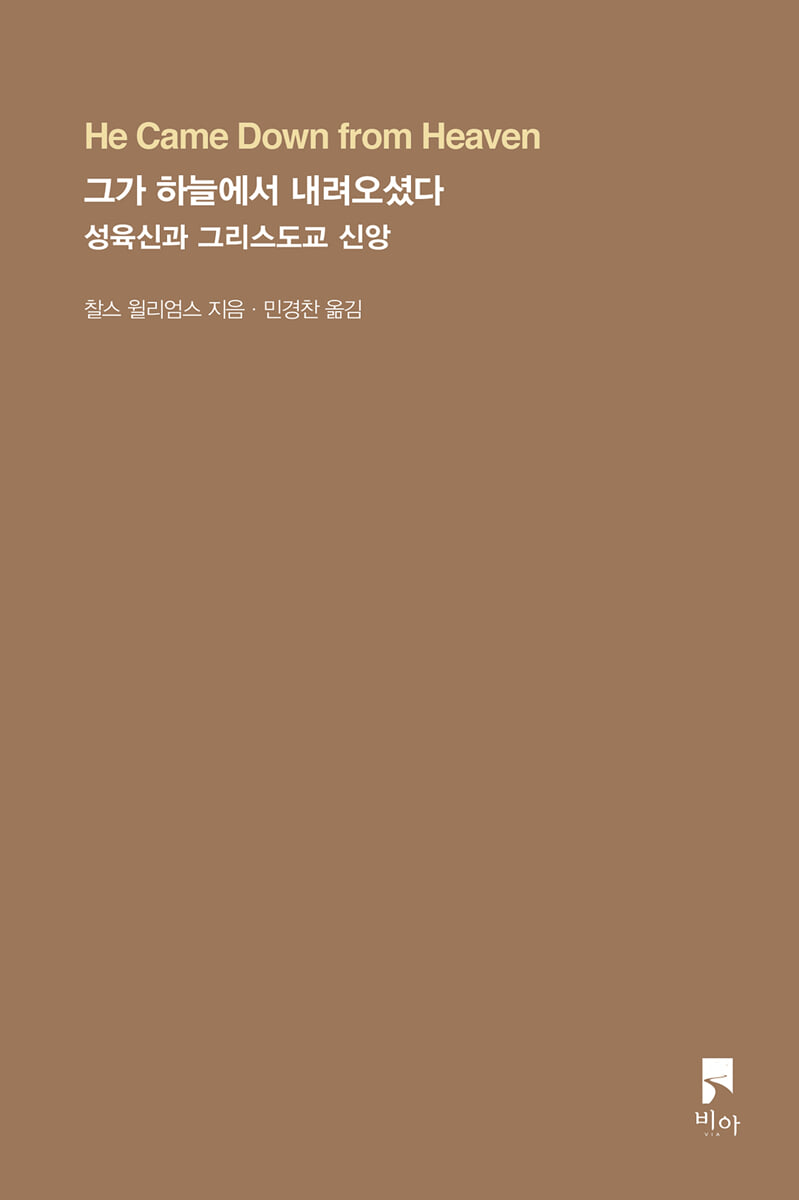
He came down from heaven
 |
Description
Book Introduction
The representative theological work of Charles Williams, the "Third Inkling," introduced for the first time in Korea.
A modern Christian classic that makes us ponder the meaning of the incarnation.
Charles Williams is a unique individual.
He was a poet, novelist, literary critic, and theologian.
Christianity Today, a leading Protestant evangelical media outlet in the United States, selected his novel "Descent into Hell" as one of the 100 Christian books that illuminated the 20th century, and Church Times, a media outlet representing the Church of England, selected his theological book "The Doves Came Down" as one of the 100 classic books that illuminated Christianity in 2000.
But he was neither a full-time writer nor a professional theologian.
He studied classics but never completed his degree, and from an early age began working as an editor at Oxford University Press.
Outside of his degree program, he explored the boundaries between literature, theology, and spirituality.
Published in 1938, He Came Down from Heaven is the book that best reveals Williams's side.
A modern Christian classic that makes us ponder the meaning of the incarnation.
Charles Williams is a unique individual.
He was a poet, novelist, literary critic, and theologian.
Christianity Today, a leading Protestant evangelical media outlet in the United States, selected his novel "Descent into Hell" as one of the 100 Christian books that illuminated the 20th century, and Church Times, a media outlet representing the Church of England, selected his theological book "The Doves Came Down" as one of the 100 classic books that illuminated Christianity in 2000.
But he was neither a full-time writer nor a professional theologian.
He studied classics but never completed his degree, and from an early age began working as an editor at Oxford University Press.
Outside of his degree program, he explored the boundaries between literature, theology, and spirituality.
Published in 1938, He Came Down from Heaven is the book that best reveals Williams's side.
- You can preview some of the book's contents.
Preview
index
1.
Heaven and the Bible
2.
The Myth of the Fall of Knowledge
3.
The Mystery of Forgiveness and the Paradox of Vanity
4.
The Forerunner of the Kingdom of God and the Incarnation
5.
Romantic Love from a Theological Perspective
6.
The practice of redeeming love
7.
City
Charles Williams's bibliography
Heaven and the Bible
2.
The Myth of the Fall of Knowledge
3.
The Mystery of Forgiveness and the Paradox of Vanity
4.
The Forerunner of the Kingdom of God and the Incarnation
5.
Romantic Love from a Theological Perspective
6.
The practice of redeeming love
7.
City
Charles Williams's bibliography
Into the book
In heaven, past, present, and future exist simultaneously, so in some ways, our prayers now have already been answered.
All that remains for us is to discover how that answer unfolds as we live through time.
From this perspective, the phrase “Your will be done on earth as it is in heaven” means, “Your will is already fully accomplished and known in heaven, that is, in you.
It can be engraved with the meaning, 'Now let us know how your will is done on this earth.'
Faith is completed as we believe that God's will has already been accomplished and wait for its realization.
Therefore, heaven is a blessing and the eternal and complete fulfillment of God's will, encompassing past, present, and future.
God created heaven as a state (or place) in which we can relate (remember the “Creator of heaven and earth” in the Nicene Creed).
The Nicene Creed uses the metaphor of space to declare the relationship between 'earth' and 'heaven' and to describe the process.
For us humans, for our salvation, he came down from heaven...
He ascended into heaven.
Something or someone with special intentions toward humanity appears in a state of eternal bliss and then returns.
And this existence is related to God's will, that is, to God.
(According to the general definition) there is no being other than God who can come out of such a state and return to it.
How God's will, that is, how God can appear on earth and how he can return to heaven, is not the subject to be discussed here.
However, just as the heaven mentioned in the Creed and the Lord's Prayer can be seen as a spiritual state and a physical space, it is clear that the earth mentioned in the Creed and the Lord's Prayer also contains both meanings.
The earth is both the physical place where we live and the only state we can know, our spiritual state within a certain space.
If we understand that the earth has physical and spiritual properties, we can naturally understand that the sky also has physical and spiritual properties.
Of course, heaven and earth are distinct.
The earth is a place that does not contain the eternity that the sky contains, a state that lacks eternity.
If the earth has perfection, it is a perfection that is achieved and known through the passage of time.
God's will descends from the highest heaven (and the blessed state enjoyed by all creatures who are in perfect relationship with God's will) and ascends there again.
When Jesus said, “The kingdom of heaven is at hand,” he was referring to the movement of God’s will between heaven and earth.
And in some ways, that very movement itself is heaven.
--- pp.12-14
What makes the Old Testament great is that it shows not only the hope of prophecy, but also the dark side of human existence.
From a human perspective, since the first choice in the Garden of Eden, humanity has experienced endless monotony.
The prophets are so concerned with righteousness that they ignore this, but Ecclesiastes confronts this very human reality head-on.
In some ways, Ecclesiastes is a classic about the boredom that humans face in life.
Paradoxically, this book is incredibly interesting because the author has demonstrated outstanding literary skills.
So, those who read Ecclesiastes do not feel as deep a weariness as the speaker in Ecclesiastes does.
The word 'boredom' seems inadequate to describe the state of life that all humans experience, but it is also difficult to call it 'despair'.
Even if it is despair, it is closer to a special kind of despair.
All that remains for us is to discover how that answer unfolds as we live through time.
From this perspective, the phrase “Your will be done on earth as it is in heaven” means, “Your will is already fully accomplished and known in heaven, that is, in you.
It can be engraved with the meaning, 'Now let us know how your will is done on this earth.'
Faith is completed as we believe that God's will has already been accomplished and wait for its realization.
Therefore, heaven is a blessing and the eternal and complete fulfillment of God's will, encompassing past, present, and future.
God created heaven as a state (or place) in which we can relate (remember the “Creator of heaven and earth” in the Nicene Creed).
The Nicene Creed uses the metaphor of space to declare the relationship between 'earth' and 'heaven' and to describe the process.
For us humans, for our salvation, he came down from heaven...
He ascended into heaven.
Something or someone with special intentions toward humanity appears in a state of eternal bliss and then returns.
And this existence is related to God's will, that is, to God.
(According to the general definition) there is no being other than God who can come out of such a state and return to it.
How God's will, that is, how God can appear on earth and how he can return to heaven, is not the subject to be discussed here.
However, just as the heaven mentioned in the Creed and the Lord's Prayer can be seen as a spiritual state and a physical space, it is clear that the earth mentioned in the Creed and the Lord's Prayer also contains both meanings.
The earth is both the physical place where we live and the only state we can know, our spiritual state within a certain space.
If we understand that the earth has physical and spiritual properties, we can naturally understand that the sky also has physical and spiritual properties.
Of course, heaven and earth are distinct.
The earth is a place that does not contain the eternity that the sky contains, a state that lacks eternity.
If the earth has perfection, it is a perfection that is achieved and known through the passage of time.
God's will descends from the highest heaven (and the blessed state enjoyed by all creatures who are in perfect relationship with God's will) and ascends there again.
When Jesus said, “The kingdom of heaven is at hand,” he was referring to the movement of God’s will between heaven and earth.
And in some ways, that very movement itself is heaven.
--- pp.12-14
What makes the Old Testament great is that it shows not only the hope of prophecy, but also the dark side of human existence.
From a human perspective, since the first choice in the Garden of Eden, humanity has experienced endless monotony.
The prophets are so concerned with righteousness that they ignore this, but Ecclesiastes confronts this very human reality head-on.
In some ways, Ecclesiastes is a classic about the boredom that humans face in life.
Paradoxically, this book is incredibly interesting because the author has demonstrated outstanding literary skills.
So, those who read Ecclesiastes do not feel as deep a weariness as the speaker in Ecclesiastes does.
The word 'boredom' seems inadequate to describe the state of life that all humans experience, but it is also difficult to call it 'despair'.
Even if it is despair, it is closer to a special kind of despair.
--- pp.87-88
Publisher's Review
The representative theological work of Charles Williams, the "Third Inkling," introduced for the first time in Korea.
A modern Christian classic that makes us ponder the meaning of the incarnation.
Charles Williams is a unique individual.
He was a poet, novelist, literary critic, and theologian.
Christianity Today, a leading Protestant evangelical media outlet in the United States, selected his novel "Descent into Hell" as one of the 100 Christian books that illuminated the 20th century, and Church Times, a media outlet representing the Church of England, selected his theological book "The Doves Came Down" as one of the 100 classic books that illuminated Christianity in 2000.
But he was neither a full-time writer nor a professional theologian.
He studied classics but never completed his degree, and from an early age began working as an editor at Oxford University Press.
Outside of his degree program, he explored the boundaries between literature, theology, and spirituality.
Published in 1938, He Came Down from Heaven is the book that best reveals Williams's side.
In a time when the ruins of World War I intersected with the anxiety of the Cold War, when the relationship between God and humanity, between the soul and the world, was shaken.
Williams seized on a passage from the Nicene Creed: “He came down from heaven.”
Based on that passage, the entire history of mankind, encompassing past, present, and future, was depicted as a meeting between heaven and earth.
What is interesting is that he connects the incarnation with the atonement.
The fundamental connection between the Incarnation, the Crucifixion, and the Resurrection is acknowledged by all theologies faithful to the Christian tradition, but few books have depicted this so forcefully and persistently, and have extended it to the principles of life.
Just as heaven comes down to earth, and God comes down to humans and dwells in their lives, and when that happens, the heavenliness of heaven and the Godliness of God are revealed, so humans become themselves only when they dwell in the lives of others, and even more so when they bear them.
Jesus Christ is the one who accomplished that ultimate exchange.
Because he 'came down from heaven' and bore with him the weight of our darkness, our suffering, our evil.
The incarnation is the event in which God entered into humanity, and at the same time, it is the event in which humanity was invited to enter into God's life.
This is not limited to the relationship between God and man, but extends to the relationship between man and man, and between the world and the church.
In this, the church is fundamentally a form of spiritual solidarity in which people take responsibility for each other's existence before it becomes an institution or organization.
Whether it is modern systematic theology or classical dogmatics, his language is far from the language of strict systematic theology.
Instead, he reexamines elements of the Christian tradition, rereads the Bible, and combines them in ways that cannot be seen or imagined through the eyes of such theology.
So, while 『He Came Down from Heaven』 is composed of extremely traditional Korean words, it is full of unique experiments in thought that intertwine literature, spirituality, and philosophy without being confined by the name of traditionalism.
Perhaps this is why, despite his absence from formal theological scholarship, modern theologians such as Rowan Williams and John Milbank have cited him as a major inspiration.
As the Nicene Creed celebrates its 1700th anniversary, this book can be a source of new inspiration in a time when traditional religious language is constantly being questioned for its "usefulness," a time of increasing anxiety and depression, no less than during the World Wars, and a time when the relationship between God and humanity, the soul and the world, is shaken.
In a time when the ruins of World War I intersected with the anxiety of the Cold War, when the relationship between God and humanity, between the soul and the world, was shaken.
Williams seized on a passage from the Nicene Creed: “He came down from heaven.”
Based on that passage, the entire history of mankind, encompassing past, present, and future, was depicted as a meeting between heaven and earth.
What is interesting is that he connects the incarnation with the atonement.
The fundamental connection between the Incarnation, the Crucifixion, and the Resurrection is acknowledged by all theologies faithful to the Christian tradition, but few books have depicted this so forcefully and persistently, and have extended it to the principles of life.
Just as heaven comes down to earth, and God comes down to humans and dwells in their lives, and when that happens, the heavenliness of heaven and the Godliness of God are revealed, so humans become themselves only when they dwell in the lives of others, and even more so when they bear them.
Jesus Christ is the one who accomplished that ultimate exchange.
Because he 'came down from heaven' and bore with him the weight of our darkness, our suffering, our evil.
The incarnation is the event in which God entered into humanity, and at the same time, it is the event in which humanity was invited to enter into God's life.
This is not limited to the relationship between God and man, but extends to the relationship between man and man, and between the world and the church.
In this, the church is fundamentally a form of spiritual solidarity in which people take responsibility for each other's existence before it becomes an institution or organization.
Whether it is modern systematic theology or classical dogmatics, his language is far from the language of strict systematic theology.
Instead, he reexamines elements of the Christian tradition, rereads the Bible, and combines them in ways that cannot be seen or imagined through the eyes of such theology.
So, while 『He Came Down from Heaven』 is composed of extremely traditional Korean words, it is full of unique experiments in thought that intertwine literature, spirituality, and philosophy without being confined by the name of traditionalism.
Perhaps this is why, despite his absence from formal theological scholarship, modern theologians such as Rowan Williams and John Milbank have cited him as a major inspiration.
As the Nicene Creed celebrates its 1700th anniversary, this book can be a source of new inspiration in a time when traditional religious language is constantly being questioned for its "usefulness," a time of increasing anxiety and depression, no less than during the World Wars, and a time when the relationship between God and humanity, the soul and the world, is shaken.
A modern Christian classic that makes us ponder the meaning of the incarnation.
Charles Williams is a unique individual.
He was a poet, novelist, literary critic, and theologian.
Christianity Today, a leading Protestant evangelical media outlet in the United States, selected his novel "Descent into Hell" as one of the 100 Christian books that illuminated the 20th century, and Church Times, a media outlet representing the Church of England, selected his theological book "The Doves Came Down" as one of the 100 classic books that illuminated Christianity in 2000.
But he was neither a full-time writer nor a professional theologian.
He studied classics but never completed his degree, and from an early age began working as an editor at Oxford University Press.
Outside of his degree program, he explored the boundaries between literature, theology, and spirituality.
Published in 1938, He Came Down from Heaven is the book that best reveals Williams's side.
In a time when the ruins of World War I intersected with the anxiety of the Cold War, when the relationship between God and humanity, between the soul and the world, was shaken.
Williams seized on a passage from the Nicene Creed: “He came down from heaven.”
Based on that passage, the entire history of mankind, encompassing past, present, and future, was depicted as a meeting between heaven and earth.
What is interesting is that he connects the incarnation with the atonement.
The fundamental connection between the Incarnation, the Crucifixion, and the Resurrection is acknowledged by all theologies faithful to the Christian tradition, but few books have depicted this so forcefully and persistently, and have extended it to the principles of life.
Just as heaven comes down to earth, and God comes down to humans and dwells in their lives, and when that happens, the heavenliness of heaven and the Godliness of God are revealed, so humans become themselves only when they dwell in the lives of others, and even more so when they bear them.
Jesus Christ is the one who accomplished that ultimate exchange.
Because he 'came down from heaven' and bore with him the weight of our darkness, our suffering, our evil.
The incarnation is the event in which God entered into humanity, and at the same time, it is the event in which humanity was invited to enter into God's life.
This is not limited to the relationship between God and man, but extends to the relationship between man and man, and between the world and the church.
In this, the church is fundamentally a form of spiritual solidarity in which people take responsibility for each other's existence before it becomes an institution or organization.
Whether it is modern systematic theology or classical dogmatics, his language is far from the language of strict systematic theology.
Instead, he reexamines elements of the Christian tradition, rereads the Bible, and combines them in ways that cannot be seen or imagined through the eyes of such theology.
So, while 『He Came Down from Heaven』 is composed of extremely traditional Korean words, it is full of unique experiments in thought that intertwine literature, spirituality, and philosophy without being confined by the name of traditionalism.
Perhaps this is why, despite his absence from formal theological scholarship, modern theologians such as Rowan Williams and John Milbank have cited him as a major inspiration.
As the Nicene Creed celebrates its 1700th anniversary, this book can be a source of new inspiration in a time when traditional religious language is constantly being questioned for its "usefulness," a time of increasing anxiety and depression, no less than during the World Wars, and a time when the relationship between God and humanity, the soul and the world, is shaken.
In a time when the ruins of World War I intersected with the anxiety of the Cold War, when the relationship between God and humanity, between the soul and the world, was shaken.
Williams seized on a passage from the Nicene Creed: “He came down from heaven.”
Based on that passage, the entire history of mankind, encompassing past, present, and future, was depicted as a meeting between heaven and earth.
What is interesting is that he connects the incarnation with the atonement.
The fundamental connection between the Incarnation, the Crucifixion, and the Resurrection is acknowledged by all theologies faithful to the Christian tradition, but few books have depicted this so forcefully and persistently, and have extended it to the principles of life.
Just as heaven comes down to earth, and God comes down to humans and dwells in their lives, and when that happens, the heavenliness of heaven and the Godliness of God are revealed, so humans become themselves only when they dwell in the lives of others, and even more so when they bear them.
Jesus Christ is the one who accomplished that ultimate exchange.
Because he 'came down from heaven' and bore with him the weight of our darkness, our suffering, our evil.
The incarnation is the event in which God entered into humanity, and at the same time, it is the event in which humanity was invited to enter into God's life.
This is not limited to the relationship between God and man, but extends to the relationship between man and man, and between the world and the church.
In this, the church is fundamentally a form of spiritual solidarity in which people take responsibility for each other's existence before it becomes an institution or organization.
Whether it is modern systematic theology or classical dogmatics, his language is far from the language of strict systematic theology.
Instead, he reexamines elements of the Christian tradition, rereads the Bible, and combines them in ways that cannot be seen or imagined through the eyes of such theology.
So, while 『He Came Down from Heaven』 is composed of extremely traditional Korean words, it is full of unique experiments in thought that intertwine literature, spirituality, and philosophy without being confined by the name of traditionalism.
Perhaps this is why, despite his absence from formal theological scholarship, modern theologians such as Rowan Williams and John Milbank have cited him as a major inspiration.
As the Nicene Creed celebrates its 1700th anniversary, this book can be a source of new inspiration in a time when traditional religious language is constantly being questioned for its "usefulness," a time of increasing anxiety and depression, no less than during the World Wars, and a time when the relationship between God and humanity, the soul and the world, is shaken.
GOODS SPECIFICS
- Date of issue: November 21, 2025
- Page count, weight, size: 240 pages | 180*120*15mm
- ISBN13: 9791199437661
- ISBN10: 1199437662
You may also like
카테고리
korean


korean

![GQ KOREA Mark (Monthly): December [2025]](http://librairie.coreenne.fr/cdn/shop/files/8ef265dbbfbf186523ed75ba7319009d.jpg?v=1765340328&width=3840)


