

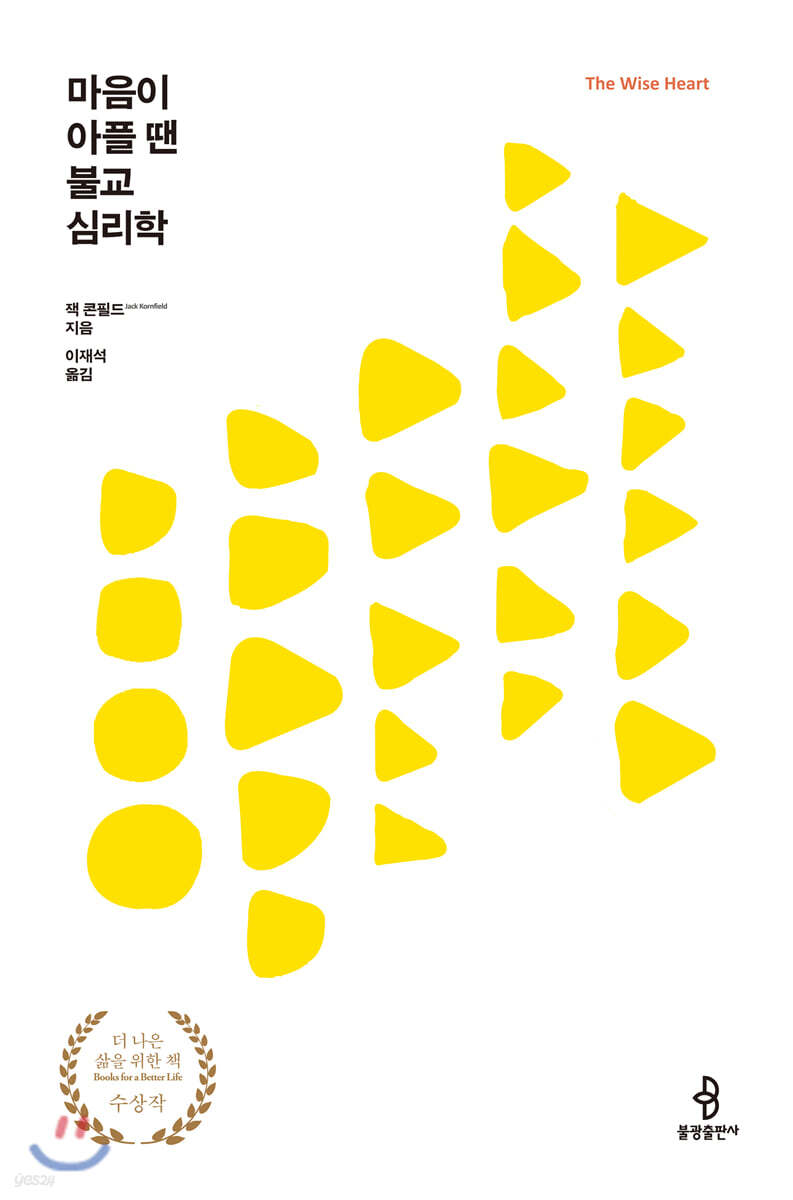
Buddhist Psychology for When Your Heart Hurts
 |
Description
Book Introduction
This book is a complete translation of 『The Wise Heart』, a masterpiece by Jack Kornfield, the 'master' of Western meditation leaders.
It is on the 'Must Read' list for meditation and mindfulness in the United States, and has been a steady seller on Amazon.com for 10 years since its publication in 2009.
You can see at a glance the characteristics and cases of Buddhist psychology that distinguish it from Western psychology.
Additionally, it excludes unfamiliar psychological terms and explains them in a friendly manner using familiar terms, and increases readability by presenting over 100 cases of the author's own experience or counseling and healing.
It is on the 'Must Read' list for meditation and mindfulness in the United States, and has been a steady seller on Amazon.com for 10 years since its publication in 2009.
You can see at a glance the characteristics and cases of Buddhist psychology that distinguish it from Western psychology.
Additionally, it excludes unfamiliar psychological terms and explains them in a friendly manner using familiar terms, and increases readability by presenting over 100 cases of the author's own experience or counseling and healing.
- You can preview some of the book's contents.
Preview
index
PART 1 Who Are You Really?
Chapter 1 Nobility: Our Innate Goodness
Chapter 2: Embracing the World with Kindness: The Psychology of Compassion
Chapter 3: Who is looking in the mirror?: The nature of consciousness.
Chapter 4: Coloring Consciousness
Chapter 5: The Illusion of the Mystery of the Self
Chapter 6 From the Universal to the Personal: The Psychology of Paradox
PART 2 Mindfulness: The Art of Great Medicine
Chapter 7: The Liberating Power of Mindfulness
Chapter 8: The Precious Body Born as a Human
Chapter 9: The River of Feelings
Chapter 10: The Heart that Makes Up Stories
Chapter 11: The Very Old Unconscious
PART 3: Transforming the Roots of Suffering
Chapter 12 Personality Types in Buddhism
Chapter 13: Transforming Desire into Abundance
Chapter 14: Beyond Hatred, with a Heart that Doesn't Fight
Chapter 15: From Widowhood to Wisdom: Waking Up from the Dream
PART 4 DISCOVERING FREEDOM
Chapter 16: Suffering and Letting Go
Chapter 17: The Compass of the Heart: Intention and Karma
Chapter 18: Sacred Vision: Imagination, Ritual, and Refuge
Chapter 19: Behaviorism with a Heart: Buddhist Cognitive Training
Chapter 20: The Mysterious Dimensions of Concentration and the Mind
PART 5: Embodiment of a Wise Heart
Chapter 21: The Psychology of Virtue, Salvation, and Forgiveness
Chapter 22: Bodhisattva: Caring for the World
Chapter 23: The Wisdom of the Middle Way
Chapter 24: The Awakened Heart
Chapter 1 Nobility: Our Innate Goodness
Chapter 2: Embracing the World with Kindness: The Psychology of Compassion
Chapter 3: Who is looking in the mirror?: The nature of consciousness.
Chapter 4: Coloring Consciousness
Chapter 5: The Illusion of the Mystery of the Self
Chapter 6 From the Universal to the Personal: The Psychology of Paradox
PART 2 Mindfulness: The Art of Great Medicine
Chapter 7: The Liberating Power of Mindfulness
Chapter 8: The Precious Body Born as a Human
Chapter 9: The River of Feelings
Chapter 10: The Heart that Makes Up Stories
Chapter 11: The Very Old Unconscious
PART 3: Transforming the Roots of Suffering
Chapter 12 Personality Types in Buddhism
Chapter 13: Transforming Desire into Abundance
Chapter 14: Beyond Hatred, with a Heart that Doesn't Fight
Chapter 15: From Widowhood to Wisdom: Waking Up from the Dream
PART 4 DISCOVERING FREEDOM
Chapter 16: Suffering and Letting Go
Chapter 17: The Compass of the Heart: Intention and Karma
Chapter 18: Sacred Vision: Imagination, Ritual, and Refuge
Chapter 19: Behaviorism with a Heart: Buddhist Cognitive Training
Chapter 20: The Mysterious Dimensions of Concentration and the Mind
PART 5: Embodiment of a Wise Heart
Chapter 21: The Psychology of Virtue, Salvation, and Forgiveness
Chapter 22: Bodhisattva: Caring for the World
Chapter 23: The Wisdom of the Middle Way
Chapter 24: The Awakened Heart
Into the book
Alan Wallace, a leading figure in Tibetan Buddhism in the West, said:
“You’re walking down the sidewalk with a full shopping cart in your arms, and someone bumps into you hard.
You fall to the floor and your belongings scatter across the floor.
The floor was covered in broken eggs and tomato juice.
You get up from the floor and decide to shout:
"What an idiot! What the hell is this? Are you blind?" Just as you're about to blurt out this, you realize that the person you bumped into is actually blind.
The other person also bumped into you, causing his shopping cart to burst and fall to the floor.
In an instant, your anger disappears.
Instead, a feeling of empathy and concern arises.
"Are you hurt? Can I help you?" Our situation is similar.
The root of all the discord and misery in the world is ignorance.
“When we clearly realize this, we can open the door to wisdom and compassion.”
People who come to us for spiritual guidance and psychotherapy all have their own level of confusion and sadness.
Buddhism does not believe that the cause of our suffering is sin.
Rather, I think it is because we cannot see properly.
What is the natural response to this blindness we possess? It is compassion.
Whenever we see clearly the human condition, compassion wells up within us.
In Buddhist scriptures, compassion is described as a heart that trembles in the face of suffering.
Or, it is described as the ability to look at the hardships we go through with 'warm eyes'.
To respond gently to the difficulties we face and not close our hearts to them in fear, we need compassion, not anger.
This is how healing happens.
---From "Embracing the World with Kindness"
When we have mindfulness, we can wake up from delusion.
The U.S. military also receives mindfulness training based on Jon Kabat-Zinn's Mindfulness-Based Stress Reduction (MBSR) program, which has been used successfully in hospitals and businesses.
A young, short-tempered army officer once had problems with anger and stress.
He was ordered by his regimental commander to attend an eight-week mindfulness training class.
The purpose was to lower stress levels.
After attending a stress reduction class for a few weeks, he stopped by a supermarket on his way home one day.
As always, he was in a hurry and a little irritated.
I pushed my cart to the checkout counter, but the line was too long.
The woman standing right in front of me was holding only one item and was stalling at the checkout counter for a long time.
She was even talking to the cashier while holding the baby.
The young officer was impatient.
The woman in front chatted with the cashier and made the people behind her wait.
Even the woman gave the baby she was holding to the cashier.
The cashier whispered something politely to the baby for a moment.
At that moment, the young officer became angry as was his habit.
But because I practiced mindfulness, I became aware of the heat and tension in my body.
I felt that pain.
I relaxed while breathing.
When I looked again, the baby boy smiled.
The officer who arrived at the checkout counter spoke to the cashier.
“What a cute baby,” the cashier said.
“Oh, do you like babies? It’s our baby.
The baby's father served in the Air Force and passed away last winter.
Now I have to work full-time.
“My mother brings her grandson once or twice a day and shows me his baby face.”
When we live in delusion, we make rash judgments about others.
And they fail to recognize their inner beauty.
We fail to recognize their suffering and treat them with compassion.
If we are not paying attention, we do not notice the meal right in front of us, the passersby, or the constantly changing scenery.
They don't even recognize the connection with the world that comes from an open mind.
---From "From Wisdom to Wisdom"
The color of our experiences changes depending on what we think about all day, every day.
But once you start observing these thoughts, you realize that most of them are just 'reruns'.
If it's not a rerun, it's a thought about a problem we need to solve.
“I need to call John again about the roof problem.
“John can fix it.” Or it could be a thought about something you like.
“I like the way this person talks.” “I really hate traffic.” Many other thoughts are about self-evaluation.
“Oh, I messed up again.
“How did I end up like this?” “Wow, look how well I did.
“At this point, people will recognize me!”
Buddhist scriptures ask:
“What is thought? Thought can be your friend or your enemy.
Nothing harms you more than unwise thoughts.
Nothing will help you as much as wise thinking.
Even parents who love their children deeply cannot help them to that extent.” Life is created and determined by the thoughts we have.
Usually we are only vaguely aware of how our thoughts guide our lives.
We live in our thoughts, taking them for reality.
We take the thoughts we create in our heads so seriously that we side with them without any hesitation.
“You’re walking down the sidewalk with a full shopping cart in your arms, and someone bumps into you hard.
You fall to the floor and your belongings scatter across the floor.
The floor was covered in broken eggs and tomato juice.
You get up from the floor and decide to shout:
"What an idiot! What the hell is this? Are you blind?" Just as you're about to blurt out this, you realize that the person you bumped into is actually blind.
The other person also bumped into you, causing his shopping cart to burst and fall to the floor.
In an instant, your anger disappears.
Instead, a feeling of empathy and concern arises.
"Are you hurt? Can I help you?" Our situation is similar.
The root of all the discord and misery in the world is ignorance.
“When we clearly realize this, we can open the door to wisdom and compassion.”
People who come to us for spiritual guidance and psychotherapy all have their own level of confusion and sadness.
Buddhism does not believe that the cause of our suffering is sin.
Rather, I think it is because we cannot see properly.
What is the natural response to this blindness we possess? It is compassion.
Whenever we see clearly the human condition, compassion wells up within us.
In Buddhist scriptures, compassion is described as a heart that trembles in the face of suffering.
Or, it is described as the ability to look at the hardships we go through with 'warm eyes'.
To respond gently to the difficulties we face and not close our hearts to them in fear, we need compassion, not anger.
This is how healing happens.
---From "Embracing the World with Kindness"
When we have mindfulness, we can wake up from delusion.
The U.S. military also receives mindfulness training based on Jon Kabat-Zinn's Mindfulness-Based Stress Reduction (MBSR) program, which has been used successfully in hospitals and businesses.
A young, short-tempered army officer once had problems with anger and stress.
He was ordered by his regimental commander to attend an eight-week mindfulness training class.
The purpose was to lower stress levels.
After attending a stress reduction class for a few weeks, he stopped by a supermarket on his way home one day.
As always, he was in a hurry and a little irritated.
I pushed my cart to the checkout counter, but the line was too long.
The woman standing right in front of me was holding only one item and was stalling at the checkout counter for a long time.
She was even talking to the cashier while holding the baby.
The young officer was impatient.
The woman in front chatted with the cashier and made the people behind her wait.
Even the woman gave the baby she was holding to the cashier.
The cashier whispered something politely to the baby for a moment.
At that moment, the young officer became angry as was his habit.
But because I practiced mindfulness, I became aware of the heat and tension in my body.
I felt that pain.
I relaxed while breathing.
When I looked again, the baby boy smiled.
The officer who arrived at the checkout counter spoke to the cashier.
“What a cute baby,” the cashier said.
“Oh, do you like babies? It’s our baby.
The baby's father served in the Air Force and passed away last winter.
Now I have to work full-time.
“My mother brings her grandson once or twice a day and shows me his baby face.”
When we live in delusion, we make rash judgments about others.
And they fail to recognize their inner beauty.
We fail to recognize their suffering and treat them with compassion.
If we are not paying attention, we do not notice the meal right in front of us, the passersby, or the constantly changing scenery.
They don't even recognize the connection with the world that comes from an open mind.
---From "From Wisdom to Wisdom"
The color of our experiences changes depending on what we think about all day, every day.
But once you start observing these thoughts, you realize that most of them are just 'reruns'.
If it's not a rerun, it's a thought about a problem we need to solve.
“I need to call John again about the roof problem.
“John can fix it.” Or it could be a thought about something you like.
“I like the way this person talks.” “I really hate traffic.” Many other thoughts are about self-evaluation.
“Oh, I messed up again.
“How did I end up like this?” “Wow, look how well I did.
“At this point, people will recognize me!”
Buddhist scriptures ask:
“What is thought? Thought can be your friend or your enemy.
Nothing harms you more than unwise thoughts.
Nothing will help you as much as wise thinking.
Even parents who love their children deeply cannot help them to that extent.” Life is created and determined by the thoughts we have.
Usually we are only vaguely aware of how our thoughts guide our lives.
We live in our thoughts, taking them for reality.
We take the thoughts we create in our heads so seriously that we side with them without any hesitation.
---From "Activism with Heart"
Publisher's Review
- A complete translation of 'The Wise Heart,' a masterpiece by Jack Kornfield, the 'master' of Western meditation leaders.
- A book on the 'Must Read' list on meditation and mind healing in the United States
-A steady seller on Amazon.com for 10 years since its publication in 2009.
-A glance at the characteristics and cases of Buddhist psychology that distinguish it from Western psychology.
- It excludes unfamiliar psychological terms and explains them in a friendly manner using familiar terms, and increases readability by presenting the author's experience or over 100 cases in which the author has counseled or healed.
150 years vs.
2600 years
Western psychology and Buddhist psychology
Herman Ebbinghaus, a Western psychologist famous for the forgetting curve, said, “Psychology has a long past, but its true history is short.”
What Ebbinghaus meant between the lines is that although the roots of Western psychology can be traced back to Plato and Aristotle, their primary interest was not the 'mind'.
So, most 'Introduction to Psychology' books date the birth of psychology to 1879, when Wilhelm Wundt established a psychology laboratory at the University of Leipzig.
On the other hand, there is a group that has dealt only with the 'mind' for 2600 years.
It is Buddhism.
Buddhism emphasizes awareness in the here and now as the ultimate cure for suffering caused by the mind.
Western psychology, which started late, had no choice but to borrow some of the theories of Buddhism, a pioneer in the study of the 'mind'.
Open forms of awareness are considered a major healing tool in Western psychology, ranging from the "even hovering attention" that Freud recommended to psychoanalysts, to the "unconditional positive regard" mentioned by humanistic psychologists including Carl Rogers, to the "present-centered awareness" of Gestalt psychology.
Recently, mindfulness practice, which originated in Buddhism, has expanded into areas such as stress and pain relief, anger management disorders, and loss treatment.
There is already a survey in the United States showing that 60% of psychotherapy is based on mindfulness therapy.
So, how specifically does Buddhism heal the mind?
Focus on the here and now
Western psychology tells us to treat pain and accept suffering.
Freud called the suffering we experience everyday neurosis.
Like Freud, great existential philosophers like Sartre and Camus focused on the inevitability of our suffering.
But simply accepting our everyday misfortunes on a philosophical or psychological level is not the way to conclude the story.
Buddhist psychology says that this method is not desirable.
Buddhism tells us to 'face' shame, depression, anxiety, sadness, etc. instead of accepting them.
When Gotami lost her mind and wandered around after her son died, the Buddha promised to save her child.
The condition was that he had to obtain a mustard seed, but it had to come from a house where no one had ever died.
Gotami, who had been wandering from house to house in the hope of saving her child, finds that there is no such house anywhere.
Death is painful, but it cannot be avoided.
If you can't avoid it, you have to 'face it'.
When we face suffering, the first things we encounter are greed, anger, and foolishness.
These are things that arise from obsession.
All we can do in the face of it is to stand together as witnesses.
This witnessing is mindful awareness, awareness filled with compassion.
If you face it like this, the next thing is destruction.
In Buddhist scriptures, it is often expressed as ‘the cessation of suffering.’
The way to eliminate suffering is not to cling or reject it.
The more you hold on to, the more suffering you experience.
We suffer when we try to own and control those around us.
The same is true when trying to control your body and feelings.
This is why Buddhism places special emphasis on acceptance and letting go.
When Buddha said, “There is an end to suffering,” he did not mean that there is no more suffering.
It means that you can escape the influence of pain.
Ego: What exists in Western psychology but not in Buddhist psychology
As I mentioned before, Western psychology also recommends examining the 'here and now'.
The most dramatic is Gestalt therapy.
It is known to have been greatly inspired by Zen Buddhism.
However, although they address the same issues and sometimes cross-reference each other, Western psychology and Buddhist psychology have fundamental differences.
Freud considered 'ego' to be one of the most important concepts in defining mental health.
However, Buddhism does not recognize a fixed and unchanging 'self (ego).'
Accordingly, the treatment method also differs.
In typical Western culture, we are taught that the way to achieve happiness is to change our external circumstances to suit our own desires.
However, this method is not very effective.
In anyone's life, joy and sorrow, gain and loss, praise and blame constantly appear.
No matter how much you struggle to only have pleasure, gain, and praise.
Buddhist psychology offers a different approach to happiness.
It teaches that one's own state of consciousness is more important than the external environment.
Western psychology has produced numerous creative therapies that focus on the content of consciousness.
However, this method makes it difficult to escape from the thoughts and emotions that constantly arise.
At this point, Buddhist psychology brings about a shift that sets us free.
That is, stepping back from the content of thoughts and observing with an conscious mind the process by which the mental state itself arises.
This method teaches us to let go of mental states that create sadness and cultivate mental states that create joy.
If you feel pain, go to the hospital. If you feel suffering, go to the hospital.
We inevitably encounter pain as we live.
In that case, it is better to go to the hospital.
The author also agrees with Western therapies that do not hesitate to use drugs to treat the mind, even if they cannot be avoided.
However, the author also advises that pain and suffering should be distinguished.
The state of sublimating pain into confusion, loss, frustration, fear, and shame is already a stage of suffering.
At that time, the correct treatment would be to climb up on a cushion, observe your breathing, and 'focus on the present' rather than going to a hospital.
In this book, the author shares stories of people he has met who are struggling with loss, fear, and frustration.
There are close to 100 people.
There were various methods of healing.
Letting go, forgiveness, compassion, and loving-kindness.
At the end of each chapter, practical, concrete training methods are written so that you can put them into practice.
You don't have to go to the hospital.
There will certainly be stories of your own or those of someone close to you in these cases and treatment methods.
I encourage you to find a method that works for you and the people around you and put it into practice.
Twenty-Six Principles of Buddhist Psychology by Jack Kornfield
1.
Let us see the inner nobility and beauty that every human being possesses.
2.
Compassion is our deepest nature.
Compassion arises when we recognize our connection to all beings.
3.
Wisdom arises when attention shifts from experience to the vast consciousness that knows experience.
4.
Become aware of the state of mind that fills your consciousness.
Move from an unhealthy state of mind to a healthy state of mind.
5.
The sense of self we have is created through identification.
The less you cling to your ego, the happier and freer you are.
6.
Our lives have both universal and individual characteristics.
If we are to be happy, we must respect both of these dimensions.
7.
When we pay mindful, awake attention to our experiences, we are free from suffering and ignorance.
Mindfulness brings a sense of wholeness, balance, and freedom.
8.
Mindfulness of our bodies allows us to live fully.
Mindfulness of the body brings healing, wisdom, and freedom.
9.
Wisdom is knowing what feelings exist in the here and now, yet not getting lost in them.
10.
Thoughts are often one-sided and often not true.
What we must learn is not to get lost in our thoughts, but to become aware of them.
11.
There is a personal unconscious and a universal unconscious.
When we bring awareness to the unconscious, understanding and freedom arise.
12.
By recognizing unhealthy patterns in your personality, you can change them into healthy expressions of your innate temperament.
13.
There are healthy desires and unhealthy desires.
You need to know the difference between the two.
Then you can find freedom in the midst of desire.
14.
When we cling to anger and hatred, we suffer.
We can respond to anger and hatred with strength, wisdom, and compassion, without harboring hatred.
15.
Widowhood causes us to misunderstand the world and forget who we are.
Widowhood gives rise to all sorts of unhealthy states of mind.
Free yourself from delusion.
Look at the world with a wise mind.
16.
Pain cannot be avoided, but suffering can be avoided.
Suffering arises from attachment.
Therefore, if you let go of your attachments, you can escape suffering.
17.
Notice the intention.
Intention is the seed that creates the future.
18.
What we repeatedly visualize in our minds changes our body and consciousness.
So picture freedom and compassion in your mind.
19.
The world we live in is created by the thoughts we frequently have.
Be compassionate and replace unhealthy thoughts with healthy ones.
20.
Concentration can be developed through inner training.
Through concentration, consciousness opens to profound levels of healing and understanding.
21.
True happiness requires virtue and wholeness.
Protect your integrity carefully.
22.
Forgiveness is necessary.
Again, forgiveness is possible.
It's never too late to forgive and start over.
23.
It is impossible to separate inner and outer, self and other.
Taking care of yourself is taking care of the world.
Caring for the world is caring for yourself.
24.
Between opposites, you can find a middle way, a middle path.
If we stay on the middle path, we can find peace wherever we are.
25.
Put aside your opinions and free yourself from views.
Open your heart to the mystery.
26.
A peaceful heart gives birth to love.
When love meets pain, it turns into compassion, and when love meets happiness, it turns into joy.
- A book on the 'Must Read' list on meditation and mind healing in the United States
-A steady seller on Amazon.com for 10 years since its publication in 2009.
-A glance at the characteristics and cases of Buddhist psychology that distinguish it from Western psychology.
- It excludes unfamiliar psychological terms and explains them in a friendly manner using familiar terms, and increases readability by presenting the author's experience or over 100 cases in which the author has counseled or healed.
150 years vs.
2600 years
Western psychology and Buddhist psychology
Herman Ebbinghaus, a Western psychologist famous for the forgetting curve, said, “Psychology has a long past, but its true history is short.”
What Ebbinghaus meant between the lines is that although the roots of Western psychology can be traced back to Plato and Aristotle, their primary interest was not the 'mind'.
So, most 'Introduction to Psychology' books date the birth of psychology to 1879, when Wilhelm Wundt established a psychology laboratory at the University of Leipzig.
On the other hand, there is a group that has dealt only with the 'mind' for 2600 years.
It is Buddhism.
Buddhism emphasizes awareness in the here and now as the ultimate cure for suffering caused by the mind.
Western psychology, which started late, had no choice but to borrow some of the theories of Buddhism, a pioneer in the study of the 'mind'.
Open forms of awareness are considered a major healing tool in Western psychology, ranging from the "even hovering attention" that Freud recommended to psychoanalysts, to the "unconditional positive regard" mentioned by humanistic psychologists including Carl Rogers, to the "present-centered awareness" of Gestalt psychology.
Recently, mindfulness practice, which originated in Buddhism, has expanded into areas such as stress and pain relief, anger management disorders, and loss treatment.
There is already a survey in the United States showing that 60% of psychotherapy is based on mindfulness therapy.
So, how specifically does Buddhism heal the mind?
Focus on the here and now
Western psychology tells us to treat pain and accept suffering.
Freud called the suffering we experience everyday neurosis.
Like Freud, great existential philosophers like Sartre and Camus focused on the inevitability of our suffering.
But simply accepting our everyday misfortunes on a philosophical or psychological level is not the way to conclude the story.
Buddhist psychology says that this method is not desirable.
Buddhism tells us to 'face' shame, depression, anxiety, sadness, etc. instead of accepting them.
When Gotami lost her mind and wandered around after her son died, the Buddha promised to save her child.
The condition was that he had to obtain a mustard seed, but it had to come from a house where no one had ever died.
Gotami, who had been wandering from house to house in the hope of saving her child, finds that there is no such house anywhere.
Death is painful, but it cannot be avoided.
If you can't avoid it, you have to 'face it'.
When we face suffering, the first things we encounter are greed, anger, and foolishness.
These are things that arise from obsession.
All we can do in the face of it is to stand together as witnesses.
This witnessing is mindful awareness, awareness filled with compassion.
If you face it like this, the next thing is destruction.
In Buddhist scriptures, it is often expressed as ‘the cessation of suffering.’
The way to eliminate suffering is not to cling or reject it.
The more you hold on to, the more suffering you experience.
We suffer when we try to own and control those around us.
The same is true when trying to control your body and feelings.
This is why Buddhism places special emphasis on acceptance and letting go.
When Buddha said, “There is an end to suffering,” he did not mean that there is no more suffering.
It means that you can escape the influence of pain.
Ego: What exists in Western psychology but not in Buddhist psychology
As I mentioned before, Western psychology also recommends examining the 'here and now'.
The most dramatic is Gestalt therapy.
It is known to have been greatly inspired by Zen Buddhism.
However, although they address the same issues and sometimes cross-reference each other, Western psychology and Buddhist psychology have fundamental differences.
Freud considered 'ego' to be one of the most important concepts in defining mental health.
However, Buddhism does not recognize a fixed and unchanging 'self (ego).'
Accordingly, the treatment method also differs.
In typical Western culture, we are taught that the way to achieve happiness is to change our external circumstances to suit our own desires.
However, this method is not very effective.
In anyone's life, joy and sorrow, gain and loss, praise and blame constantly appear.
No matter how much you struggle to only have pleasure, gain, and praise.
Buddhist psychology offers a different approach to happiness.
It teaches that one's own state of consciousness is more important than the external environment.
Western psychology has produced numerous creative therapies that focus on the content of consciousness.
However, this method makes it difficult to escape from the thoughts and emotions that constantly arise.
At this point, Buddhist psychology brings about a shift that sets us free.
That is, stepping back from the content of thoughts and observing with an conscious mind the process by which the mental state itself arises.
This method teaches us to let go of mental states that create sadness and cultivate mental states that create joy.
If you feel pain, go to the hospital. If you feel suffering, go to the hospital.
We inevitably encounter pain as we live.
In that case, it is better to go to the hospital.
The author also agrees with Western therapies that do not hesitate to use drugs to treat the mind, even if they cannot be avoided.
However, the author also advises that pain and suffering should be distinguished.
The state of sublimating pain into confusion, loss, frustration, fear, and shame is already a stage of suffering.
At that time, the correct treatment would be to climb up on a cushion, observe your breathing, and 'focus on the present' rather than going to a hospital.
In this book, the author shares stories of people he has met who are struggling with loss, fear, and frustration.
There are close to 100 people.
There were various methods of healing.
Letting go, forgiveness, compassion, and loving-kindness.
At the end of each chapter, practical, concrete training methods are written so that you can put them into practice.
You don't have to go to the hospital.
There will certainly be stories of your own or those of someone close to you in these cases and treatment methods.
I encourage you to find a method that works for you and the people around you and put it into practice.
Twenty-Six Principles of Buddhist Psychology by Jack Kornfield
1.
Let us see the inner nobility and beauty that every human being possesses.
2.
Compassion is our deepest nature.
Compassion arises when we recognize our connection to all beings.
3.
Wisdom arises when attention shifts from experience to the vast consciousness that knows experience.
4.
Become aware of the state of mind that fills your consciousness.
Move from an unhealthy state of mind to a healthy state of mind.
5.
The sense of self we have is created through identification.
The less you cling to your ego, the happier and freer you are.
6.
Our lives have both universal and individual characteristics.
If we are to be happy, we must respect both of these dimensions.
7.
When we pay mindful, awake attention to our experiences, we are free from suffering and ignorance.
Mindfulness brings a sense of wholeness, balance, and freedom.
8.
Mindfulness of our bodies allows us to live fully.
Mindfulness of the body brings healing, wisdom, and freedom.
9.
Wisdom is knowing what feelings exist in the here and now, yet not getting lost in them.
10.
Thoughts are often one-sided and often not true.
What we must learn is not to get lost in our thoughts, but to become aware of them.
11.
There is a personal unconscious and a universal unconscious.
When we bring awareness to the unconscious, understanding and freedom arise.
12.
By recognizing unhealthy patterns in your personality, you can change them into healthy expressions of your innate temperament.
13.
There are healthy desires and unhealthy desires.
You need to know the difference between the two.
Then you can find freedom in the midst of desire.
14.
When we cling to anger and hatred, we suffer.
We can respond to anger and hatred with strength, wisdom, and compassion, without harboring hatred.
15.
Widowhood causes us to misunderstand the world and forget who we are.
Widowhood gives rise to all sorts of unhealthy states of mind.
Free yourself from delusion.
Look at the world with a wise mind.
16.
Pain cannot be avoided, but suffering can be avoided.
Suffering arises from attachment.
Therefore, if you let go of your attachments, you can escape suffering.
17.
Notice the intention.
Intention is the seed that creates the future.
18.
What we repeatedly visualize in our minds changes our body and consciousness.
So picture freedom and compassion in your mind.
19.
The world we live in is created by the thoughts we frequently have.
Be compassionate and replace unhealthy thoughts with healthy ones.
20.
Concentration can be developed through inner training.
Through concentration, consciousness opens to profound levels of healing and understanding.
21.
True happiness requires virtue and wholeness.
Protect your integrity carefully.
22.
Forgiveness is necessary.
Again, forgiveness is possible.
It's never too late to forgive and start over.
23.
It is impossible to separate inner and outer, self and other.
Taking care of yourself is taking care of the world.
Caring for the world is caring for yourself.
24.
Between opposites, you can find a middle way, a middle path.
If we stay on the middle path, we can find peace wherever we are.
25.
Put aside your opinions and free yourself from views.
Open your heart to the mystery.
26.
A peaceful heart gives birth to love.
When love meets pain, it turns into compassion, and when love meets happiness, it turns into joy.
GOODS SPECIFICS
- Date of issue: May 18, 2020
- Format: Hardcover book binding method guide
- Page count, weight, size: 608 pages | 996g | 152*225*35mm
- ISBN13: 9788974798123
- ISBN10: 8974798123
You may also like
카테고리
korean


korean

![GQ KOREA Mark (Monthly): December [2025]](http://librairie.coreenne.fr/cdn/shop/files/8ef265dbbfbf186523ed75ba7319009d.jpg?v=1765340328&width=3840)


