

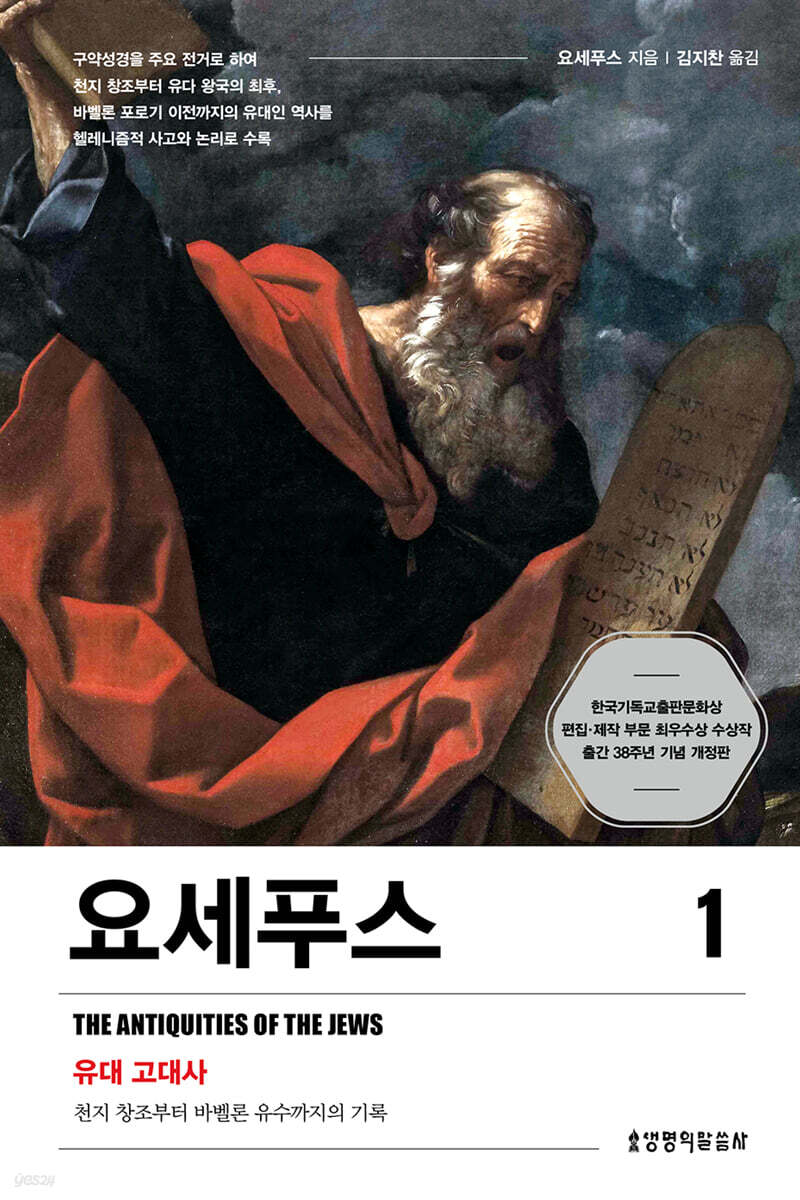
Josephus 1
 |
Description
Book Introduction
A Pharisee from a priestly family well-versed in Jewish law, a man of letters well-versed in Greek classics, A.
D. The complete works of Flavius Josephus, the greatest scholar, historian, military leader, politician, and writer of his time, a commander of the Jewish resistance who witnessed the destruction of Jerusalem in 70 AD, but who also served three Roman emperors and suffered the stigma of being a traitor.
D. The complete works of Flavius Josephus, the greatest scholar, historian, military leader, politician, and writer of his time, a commander of the Jewish resistance who witnessed the destruction of Jerusalem in 70 AD, but who also served three Roman emperors and suffered the stigma of being a traitor.
- You can preview some of the book's contents.
Preview
index
Translator's Preface
introduction
THE ANTIQUITIES OF THE JEWS
Ancient Jewish History
Records from the creation of heaven and earth to the Babylonian exile
introduction
Book 1: 3,833 Years of Historical Record: From Creation to the Death of Isaac
Chapter 1: The Creation of the World and the Arrangement of Nature
Chapter 2: Concerning Adam's Descendants and the Ten Generations from Adam to Noah
Chapter 3: Concerning the Flood and the Rescue of Noah and His Family in the Ark, and Their Later Dwelling in the Plains of Shinar
Chapter 4: The Tower of Babel and the Confusion of Languages
Chapter 5: How Noah's Descendants Founded Colonies and Dwelt Throughout the Earth
Chapter 6: How the Founders of Each Country Named Their Country
Chapter 7: How our ancestor Abram left the land of Chaldea and settled in the land then called Canaan, now called Judea.
Chapter 8: When a famine struck Canaan, Abram went down to Egypt, lived there for a considerable period, and then returned.
Chapter 9: The Destruction of Sodomites Due to the Assyrian War
Chapter 10: How Abram defeated the Assyrian army and recovered the captive Sodomites and their spoils.
Chapter 11: How God became angry and destroyed Sodom because of the sins of the Sodomites.
Chapter 12: Abimelech and Ishmael, Abraham's son, and his descendants, the Arabians
Chapter 13: Abraham's Son Isaac
Chapter 14: Sarah, Abraham's Wife, and Her End
Chapter 15: The Origin of the Troglodytes Kingdom from Abraham and Keturah
Chapter 16: How Isaac took Rebekah as his wife
Chapter 17: The Death of Abraham
Chapter 18: The Birth and Education of Isaac's Sons, Esau and Jacob
Chapter 19: How Jacob Flees to Mesopotamia Out of Fear of His Brother
Chapter 20: Jacob and Esau's Meeting
Chapter 21: Dinah's Loss of Virginity
Chapter 22: The Death of Isaac and His Burial in Hebron
Book 2: 220 Years of History: From the Death of Isaac to the Exodus
Chapter 1: How Isaac's sons Esau and Jacob settled in different places, Esau in Idumea and Jacob in Canaan.
Chapter 2: How Jacob's son Joseph became jealous of his brothers when his dream foreshadowed a happy future.
Chapter 3: Joseph was sold into Egypt because he incurred the hatred of his brothers, and after he became a powerful man, his brothers came to submit to him.
Chapter 4: Joseph's Outstanding Purity
Chapter 5: What Happened to Joseph in Prison
Chapter 6: How Joseph, who became famous in Egypt, subdued his brothers.
Chapter 7: Joseph's Father and His Family's Migration Due to Famine
Chapter 8: The Death of Jacob and Joseph
Chapter 9: The Sufferings of the Hebrews in Egypt for 400 Years
Chapter 10: Moses' Fight with the Ethiopians
Chapter 11: How Moses Fleeed from Egypt to Midian
Chapter 12: The Burning Bush and the Rod of Moses
Chapter 13: How Moses and Aaron Returned to Pharaoh in Egypt
Chapter 14: The Ten Plagues on the Egyptians
Chapter 15: The Exodus of the Hebrews Led by Moses
Chapter 16: How the Sea Parted and the Hebrews Fleeed from the Egyptians
Book 3: Two Years of History: From the Exodus to the Abandonment of That Generation
Chapter 1: Moses led the people out of Egypt and to Mount Sinai, but they had not yet encountered many hardships on the journey.
Chapter 2: How the Amalekites and the neighboring nations fought against the Hebrews, were defeated, and most of their soldiers were killed.
Chapter 3 Moses Welcomes His Father-in-Law Jethro on Mount Sinai
Chapter 4: How Moses agreed to his father-in-law's advice when Raguel suggested that the Israelites, who had no chain of command, be organized under the system of captains of thousands and centurions.
Chapter 5: Moses ascended Mount Sinai, received the Law from God, and delivered it to the Hebrews.
Chapter 6: The Tabernacle Moses Built for God's Glory in the Wilderness
Chapter 7: The Garments of the Priests and High Priests
Chapter 8: Aaron's Priesthood
Chapter 9: Method of Sacrificing
Chapter 10: The Seasons and How to Observe Them
Chapter 11 Purification
Chapter 12 Various Laws
Chapter 13: Moses' departure from Mount Sinai and his leadership of the people to the border of Canaan
Chapter 14: Moses sent some men to spy out the land of Canaan and the size of its cities. After 40 days, the spies returned and praised the Canaanites' military strength and reported that they were no match for them. The people were so shocked and disheartened by this that they tried to stone Moses and decided to return to Egypt and serve the Egyptians.
Chapter 15: Moses was enraged by this and prophesied that God would be angry and that the Israelites would have to live in the wilderness for 40 years, during which time they would neither return to Egypt nor take possession of the land of Canaan.
Book 4: A Record of the History of the Thirty-Eight Years: From the Rejection of That Generation to the Death of Moses
Chapter 1: How the Hebrews were defeated in battle against the Canaanites without Moses' permission.
Chapter 2: Korah and the People Rebelling Against Moses and Aaron Regarding the Priesthood
Chapter 3: How the rebels were put to death by God's will and how Moses' brother Aaron and his descendants retained the priesthood.
Chapter 4: What Happened to the Hebrews During Their 38 Years in the Wilderness
Chapter 5: How Moses conquered Sihon and Og, the kings of the Amorites, annihilated the Amorite army, and divided the land by lot among the two and a half tribes.
Chapter 6: The Prophet Balaam and His Human Character
Chapter 7: How the Hebrews Won the Battle Against the Midianites
Chapter 8: The Government Established by Moses and the Death of Moses
Book 5: 476 Years of Historical Records: From the Death of Moses to the Death of Eli
Chapter 1: Joshua, the commander of the Hebrews, fought against the Canaanites, defeated them, and killed them. Then he divided the land among the tribes of Israel by lot.
Chapter 2: How the Israelites broke the law and suffered greatly after the death of their leader, Joshua, and how the uproar that ensued led to the annihilation of all but 600 members of the tribe of Benjamin.
Chapter 3: The story of how the Israelites, after suffering calamity, became wicked and eventually served the Assyrians, and how God finally saved them through Othniel, and how Othniel came to rule Israel for 40 years.
Chapter 4: After the Israelites had served the Moabites for 18 years, Ehud freed them from slavery and ruled Israel for 80 years.
Chapter 5: How Barak and Deborah delivered the Israelites from their 20-year slavery to the Canaanites and then ruled them for 40 years.
Chapter 6: The Midianites and other nations conquered Israel and harassed them for seven years. Gideon rose up, defeated them, and ruled Israel for forty years.
Chapter 7: The long wars waged by the judges who succeeded Gideon against neighboring nations
Chapter 8: Samson's Courage and the Harm He Caused Against the Philistines
Chapter 9: How Boaz married Ruth and gave birth to Obed, the grandfather of David, while Eli ruled over Israel.
Chapter 10: The Birth of Samuel and His Prophecy of the Trouble That Would Befall Eli's Sons
Chapter 11: The Disasters That Befell Eli's Sons, the Ark of God, and the People, and Eli's Tragic Death
Book 6: A Record of the Thirty-Two Years: From the Death of Eli to the Death of Saul
Chapter 1: The Philistines captured the Ark of God, and after suffering the terrible punishment of God's wrath, the Ark was returned to the Hebrews.
Chapter 2: The Philistines attacked the Hebrews, but they were defeated under the leadership of the prophet Samuel.
Chapter 3: When Samuel became too old to manage his affairs, he handed them over to his sons. However, when they mistreated him, the people became enraged and demanded a king, despite Samuel's opposition.
Chapter 4: How Saul was appointed king of Israel according to God's command
Chapter 5: How Saul Conquered the Ammonites and Obtained Their Spoils
Chapter 6: The Philistines Attack the Hebrews Again and Are Defeated
Chapter 7: Saul's Victory over the Amalekites
Chapter 8: When Saul disobeyed the prophet's command, Samuel secretly appointed David king at God's command.
Chapter 9: The Philistines attacked Israel during the reign of King Saul, but David defeated them by defeating Goliath in a single blow.
Chapter 10: How Saul, jealous of David's military exploits, plotted to put David in danger by offering him his daughter as a wife in exchange for 600 Philistine heads.
Chapter 11: How David, through the love and care of Jonathan and the schemes of his wife Michal, escaped from the snare set for him by Saul and went to the prophet Samuel.
Chapter 12: David fled first to Ahimelech, and then to the kings of the Philistines and Moab, and Saul murdered Ahimelech and his family.
Chapter 13: David's failure to kill Saul despite having two opportunities to do so, and the deaths of Samuel and Nabal.
Chapter 14: How, when God did not answer Saul's questions about the war with the Philistines, he finally sought out a medium and asked her to bring up Samuel's spirit, and how the Hebrews were defeated in battle and Saul and his sons were killed in battle.
Book 7: Forty Years of History: From the Death of Saul to the Death of David
Chapter 1: How David came to rule over one tribe in Hebron, while Saul's son ruled over the others, and how Asahel and Abner were killed in the civil war that followed.
Chapter 2: How David came to rule the entire kingdom after Ishbosheth was murdered by his friends in rebellion.
Chapter 3: How David Besieged and Conquered Jerusalem, Drives Out the Canaanites, and Settles the Jews There
Chapter 4: David's desire to move the Ark to Jerusalem and build the Temple after defeating the Philistines who were attacking Jerusalem
Chapter 5: How David fought and won against the kings of Philistia, Moab, Zobah, Damascus, Syria, and Idumea, how he formed an alliance with the king of Hamath, and how he remembered his friendship with Jonathan, Saul's son.
Chapter 6: How the Battle Against the Ammonites Went Wrong
Chapter 7: David fell in love with Bathsheba and murdered her husband Uriah, which led to Nathan's rebuke.
Chapter 8: How Absalom was banished by David for murdering Amnon, who had raped his sister, and then returned.
Chapter 9: How Absalom rebelled against David, and how Ahithophel, Hushai, Ziba, and Shimei, and how Ahithophel hanged himself
Chapter 10: How Absalom was killed when his hair got caught in a tree branch during his escape.
Chapter 11: How David, after restoring his kingdom, made peace with Shimei and Ziba, how he showed great kindness to Barzillai, and how, when a rebellion broke out, he appointed Amasa commander of the army to punish Ziba, but this resulted in Amasa being killed by Joab.
Chapter 12: How the Hebrews were freed from famine and how David and his brave men defeated the Philistines and achieved great success.
Chapter 13: David Numbers the People, and He Is Punished by God, But God Takes Pity and Stops the Punishment
Chapter 14: How David thoroughly prepared to build the temple of God and how he designated Solomon as his successor when Adonijah attempted to seize the throne.
Chapter 15: David's words to his son Solomon as he neared death and the circumstances surrounding his preparations for building the temple.
Book 8: 163 Years of History: From the Death of David to the Death of Ahab
Chapter 1: How Solomon Eliminated His Enemies After He Succeeding to the Throne
Chapter 2: Solomon's Wife, Wisdom, and Wealth, and How He Seeked Hiram's Assistance in Building the Temple
Chapter 3: History of the Temple Construction
Chapter 4: How Solomon brought the Ark to Jerusalem and offered public sacrifices and petitioned God
Chapter 5: How Solomon Built a Luxurious and Magnificent Palace and Solved Hiram's Riddle
Chapter 6: How Solomon fortified the city of Jerusalem, built great cities, subdued the Canaanites, and welcomed the queens of Egypt and Ethiopia.
Chapter 7: After Solomon became wealthy, he fell deeply in love with women. God was angry at this and raised Adele and Jeroboam to rebel against Solomon. The story of Solomon's death.
Chapter 8: When Solomon died, the people rejected his son Rehoboam and made Jeroboam king of the ten tribes.
Chapter 9: The incident in which the prophet Yadon was deceived by a false prophet and returned to Bethel, only to be killed by a lion, and how the wicked prophets persuaded Jeroboam to turn away from God.
Chapter 10: How Rehoboam's impiety led to his suffering under the invasion of Shishak, king of Egypt.
Chapter 11: The death of Jeroboam's son, his defeat by Abijam, and how Asa succeeded him as king after Abijam's death; and how, after Jeroboam's death, Baasha annihilated Jeroboam's son Nadab and his entire family.
Chapter 12. How Asa, after defeating Zerah, king of Ethiopia, sought aid from the king of Damascus when Baasha invaded; how Zimri seized the kingdom after the fall of Baasha's house; and how, after his death, his son Ahab succeeded him to the throne.
Chapter 13: How Ahab became more wicked than any king before him after taking Jezebel as his wife, the activities of the prophet Elijah, and the full story of the Naboth incident.
Chapter 14: How Hadad, king of Damascus and Syria, attacked Ahab twice, but was defeated both times.
Chapter 15: The history of Jehoshaphat, king of Jerusalem, and the circumstances under which Ahab, with Jehoshaphat's help, attacked Syria, but was ultimately defeated in battle and subsequently destroyed.
Book 9: 157 Years of History: From the Death of Ahab to the Captivity of the Ten Tribes
Chapter 1: The story of Jehoshaphat continues, how he appointed judges and, with God's help, defeated his enemies.
Chapter 2: The History of King Ahaziah of Israel and the Prophet Elijah
Chapter 3: The history of the expedition of Jehoram and Jehoshaphat to Moab, the account of Elisha's miracles, and the circumstances of Jehoshaphat's death.
Chapter 4: How Jehoram succeeded Jehoshaphat as king, and the full story of the war waged by King Joram of Israel against the Syrians, and the miracles performed by the prophet Elisha.
Chapter 5: The Sins, Defeat, and Death of Jehoram, King of Jerusalem
Chapter 6: After Jehu ascended to the throne, he put both Joram and Ahaziah to death and punished the wicked.
Chapter 7: Athaliah ruled Jerusalem for 5 (6) years, but Jehoiada the high priest murdered her and installed Joash, son of Ahaziah, as king.
Chapter 8: The story of Hazael's attack on the Israelites and the inhabitants of Jerusalem, the death of Jehu, and the subsequent ascension of Jehoahaz to the throne; the story of how King Joash of Jerusalem, who at first served God faithfully, later became an impious man and ordered Zechariah to be stoned to death; and the story of Amaziah's succession to the throne after the death of King Joash (of Judah).
Chapter 9: Amaziah attacked Edom and Amalek and was victorious, but was later defeated in battle by Joash and was killed shortly thereafter. Uzziah succeeded him as king.
Chapter 10: The story of Jeroboam, king of Israel, and of the prophet Jonah; how his son Zechariah ascended the throne after Jeroboam's death; and what happened to Uzziah, king of Jerusalem, when he conquered the neighboring nations and sought to burn incense to God.
Chapter 11: How Zechariah, Shallum, Menahem, and Pekahiah succeeded in ruling Israel; how Pul and Tiglath-pileser attacked Israel; how Jotham, son of Uzziah, ruled over the tribe of Judah; and what the prophet Nahum prophesied about Assyria.
Chapter 12: When Jotham died, Ahaz succeeded to the throne, but King Rezin of Syria and King Pekah of Israel formed an alliance and attacked him. At that time, Tiglath-pileser, king of Assyria, came to Ahaz's aid, laid waste Syria, carried the people of Damascus away to Media, and installed other nations in their place.
Chapter 13: How Bekah was killed for Hosea's rebellion, how Hosea was soon conquered by Shalmaneser, and how Hezekiah succeeded Ahaz as king and ruled the nation with justice and piety.
Chapter 14: After Shalmaneser captured Samaria by force, he carried the ten tribes into exile in Media and brought the Cuthites to settle in Samaria.
Book 10: A Record of the Year 182 and Six Months: From the Captivity of the Ten Tribes to the First Year of Cyrus
Chapter 1: How Sennacherib attacked Hezekiah, and how the prophet Isaiah encouraged Hezekiah when Rabshakeh threatened and intimidated him after Sennacherib left for war with Egypt; how Sennacherib returned to Jerusalem after the failure of his expedition to Egypt, but when he saw that his army was defeated there too, he returned home, and what happened to him soon after his return.
Chapter 2: Hezekiah became ill and was at the point of death, but God promised to extend his life by fifteen years and moved the sundial backward, thus instilling confidence in Hezekiah's heart.
Chapter 3: Manasseh, who succeeded Hezekiah as king, committed evil, but after being taken captive, he returned to God, and God brought him back to his homeland. The story of how Amon (his son) succeeded him as king.
Chapter 4: The story of how Amon succeeded Manasseh to the throne, and how Josiah, a man of strong faith and righteousness, succeeded him, and the story of the prophetess Huldah.
Chapter 5: How Josiah was wounded in battle with Necho (king of Egypt) and died shortly thereafter; how Necho took Jehoahaz, who had already been appointed king, captive to Egypt and handed the kingdom over to Jehoiakim; and (finally) the history of Jeremiah and Ezekiel.
Chapter 6: How Nebuchadnezzar defeated the king of Egypt, attacked Judah, murdered Jehoiakim, and made his son Jehoiachin king.
Chapter 7. How the king of Babylon regretted making Jehoiachin king, took him captive to Babylon, and handed over the kingdom to Zedekiah; how Zedekiah refused to believe the prophecies of Jeremiah and Ezekiel and formed an alliance with Egypt, but the Egyptian army was destroyed by the king of Babylon; and how the prophet Jeremiah suffered.
Chapter 8: The story of how the king of Babylon captured Jerusalem and burned the temple, then carried the people of Jerusalem and Zedekiah away to Babylon, and the history of those who succeeded the high priesthood under the kings.
Chapter 9. How Nebuzaradan appointed Gedaliah as ruler of the Jewish people he had left in Judea, but how Gedaliah was soon killed by Ishmael; how Jonathan went down to Egypt with the people after Ishmael was driven out; how, after Nebuzaradan conquered Egypt, he again took these people captive and deported them to Babylon.
Chapter 10: The History of Daniel and His Experience in Babylon
Chapter 11: The history of Nebuchadnezzar and his successors to the throne, the fall of the Babylonian kingdom to the Persians, and the experiences and prophecies of Daniel in Media.
introduction
THE ANTIQUITIES OF THE JEWS
Ancient Jewish History
Records from the creation of heaven and earth to the Babylonian exile
introduction
Book 1: 3,833 Years of Historical Record: From Creation to the Death of Isaac
Chapter 1: The Creation of the World and the Arrangement of Nature
Chapter 2: Concerning Adam's Descendants and the Ten Generations from Adam to Noah
Chapter 3: Concerning the Flood and the Rescue of Noah and His Family in the Ark, and Their Later Dwelling in the Plains of Shinar
Chapter 4: The Tower of Babel and the Confusion of Languages
Chapter 5: How Noah's Descendants Founded Colonies and Dwelt Throughout the Earth
Chapter 6: How the Founders of Each Country Named Their Country
Chapter 7: How our ancestor Abram left the land of Chaldea and settled in the land then called Canaan, now called Judea.
Chapter 8: When a famine struck Canaan, Abram went down to Egypt, lived there for a considerable period, and then returned.
Chapter 9: The Destruction of Sodomites Due to the Assyrian War
Chapter 10: How Abram defeated the Assyrian army and recovered the captive Sodomites and their spoils.
Chapter 11: How God became angry and destroyed Sodom because of the sins of the Sodomites.
Chapter 12: Abimelech and Ishmael, Abraham's son, and his descendants, the Arabians
Chapter 13: Abraham's Son Isaac
Chapter 14: Sarah, Abraham's Wife, and Her End
Chapter 15: The Origin of the Troglodytes Kingdom from Abraham and Keturah
Chapter 16: How Isaac took Rebekah as his wife
Chapter 17: The Death of Abraham
Chapter 18: The Birth and Education of Isaac's Sons, Esau and Jacob
Chapter 19: How Jacob Flees to Mesopotamia Out of Fear of His Brother
Chapter 20: Jacob and Esau's Meeting
Chapter 21: Dinah's Loss of Virginity
Chapter 22: The Death of Isaac and His Burial in Hebron
Book 2: 220 Years of History: From the Death of Isaac to the Exodus
Chapter 1: How Isaac's sons Esau and Jacob settled in different places, Esau in Idumea and Jacob in Canaan.
Chapter 2: How Jacob's son Joseph became jealous of his brothers when his dream foreshadowed a happy future.
Chapter 3: Joseph was sold into Egypt because he incurred the hatred of his brothers, and after he became a powerful man, his brothers came to submit to him.
Chapter 4: Joseph's Outstanding Purity
Chapter 5: What Happened to Joseph in Prison
Chapter 6: How Joseph, who became famous in Egypt, subdued his brothers.
Chapter 7: Joseph's Father and His Family's Migration Due to Famine
Chapter 8: The Death of Jacob and Joseph
Chapter 9: The Sufferings of the Hebrews in Egypt for 400 Years
Chapter 10: Moses' Fight with the Ethiopians
Chapter 11: How Moses Fleeed from Egypt to Midian
Chapter 12: The Burning Bush and the Rod of Moses
Chapter 13: How Moses and Aaron Returned to Pharaoh in Egypt
Chapter 14: The Ten Plagues on the Egyptians
Chapter 15: The Exodus of the Hebrews Led by Moses
Chapter 16: How the Sea Parted and the Hebrews Fleeed from the Egyptians
Book 3: Two Years of History: From the Exodus to the Abandonment of That Generation
Chapter 1: Moses led the people out of Egypt and to Mount Sinai, but they had not yet encountered many hardships on the journey.
Chapter 2: How the Amalekites and the neighboring nations fought against the Hebrews, were defeated, and most of their soldiers were killed.
Chapter 3 Moses Welcomes His Father-in-Law Jethro on Mount Sinai
Chapter 4: How Moses agreed to his father-in-law's advice when Raguel suggested that the Israelites, who had no chain of command, be organized under the system of captains of thousands and centurions.
Chapter 5: Moses ascended Mount Sinai, received the Law from God, and delivered it to the Hebrews.
Chapter 6: The Tabernacle Moses Built for God's Glory in the Wilderness
Chapter 7: The Garments of the Priests and High Priests
Chapter 8: Aaron's Priesthood
Chapter 9: Method of Sacrificing
Chapter 10: The Seasons and How to Observe Them
Chapter 11 Purification
Chapter 12 Various Laws
Chapter 13: Moses' departure from Mount Sinai and his leadership of the people to the border of Canaan
Chapter 14: Moses sent some men to spy out the land of Canaan and the size of its cities. After 40 days, the spies returned and praised the Canaanites' military strength and reported that they were no match for them. The people were so shocked and disheartened by this that they tried to stone Moses and decided to return to Egypt and serve the Egyptians.
Chapter 15: Moses was enraged by this and prophesied that God would be angry and that the Israelites would have to live in the wilderness for 40 years, during which time they would neither return to Egypt nor take possession of the land of Canaan.
Book 4: A Record of the History of the Thirty-Eight Years: From the Rejection of That Generation to the Death of Moses
Chapter 1: How the Hebrews were defeated in battle against the Canaanites without Moses' permission.
Chapter 2: Korah and the People Rebelling Against Moses and Aaron Regarding the Priesthood
Chapter 3: How the rebels were put to death by God's will and how Moses' brother Aaron and his descendants retained the priesthood.
Chapter 4: What Happened to the Hebrews During Their 38 Years in the Wilderness
Chapter 5: How Moses conquered Sihon and Og, the kings of the Amorites, annihilated the Amorite army, and divided the land by lot among the two and a half tribes.
Chapter 6: The Prophet Balaam and His Human Character
Chapter 7: How the Hebrews Won the Battle Against the Midianites
Chapter 8: The Government Established by Moses and the Death of Moses
Book 5: 476 Years of Historical Records: From the Death of Moses to the Death of Eli
Chapter 1: Joshua, the commander of the Hebrews, fought against the Canaanites, defeated them, and killed them. Then he divided the land among the tribes of Israel by lot.
Chapter 2: How the Israelites broke the law and suffered greatly after the death of their leader, Joshua, and how the uproar that ensued led to the annihilation of all but 600 members of the tribe of Benjamin.
Chapter 3: The story of how the Israelites, after suffering calamity, became wicked and eventually served the Assyrians, and how God finally saved them through Othniel, and how Othniel came to rule Israel for 40 years.
Chapter 4: After the Israelites had served the Moabites for 18 years, Ehud freed them from slavery and ruled Israel for 80 years.
Chapter 5: How Barak and Deborah delivered the Israelites from their 20-year slavery to the Canaanites and then ruled them for 40 years.
Chapter 6: The Midianites and other nations conquered Israel and harassed them for seven years. Gideon rose up, defeated them, and ruled Israel for forty years.
Chapter 7: The long wars waged by the judges who succeeded Gideon against neighboring nations
Chapter 8: Samson's Courage and the Harm He Caused Against the Philistines
Chapter 9: How Boaz married Ruth and gave birth to Obed, the grandfather of David, while Eli ruled over Israel.
Chapter 10: The Birth of Samuel and His Prophecy of the Trouble That Would Befall Eli's Sons
Chapter 11: The Disasters That Befell Eli's Sons, the Ark of God, and the People, and Eli's Tragic Death
Book 6: A Record of the Thirty-Two Years: From the Death of Eli to the Death of Saul
Chapter 1: The Philistines captured the Ark of God, and after suffering the terrible punishment of God's wrath, the Ark was returned to the Hebrews.
Chapter 2: The Philistines attacked the Hebrews, but they were defeated under the leadership of the prophet Samuel.
Chapter 3: When Samuel became too old to manage his affairs, he handed them over to his sons. However, when they mistreated him, the people became enraged and demanded a king, despite Samuel's opposition.
Chapter 4: How Saul was appointed king of Israel according to God's command
Chapter 5: How Saul Conquered the Ammonites and Obtained Their Spoils
Chapter 6: The Philistines Attack the Hebrews Again and Are Defeated
Chapter 7: Saul's Victory over the Amalekites
Chapter 8: When Saul disobeyed the prophet's command, Samuel secretly appointed David king at God's command.
Chapter 9: The Philistines attacked Israel during the reign of King Saul, but David defeated them by defeating Goliath in a single blow.
Chapter 10: How Saul, jealous of David's military exploits, plotted to put David in danger by offering him his daughter as a wife in exchange for 600 Philistine heads.
Chapter 11: How David, through the love and care of Jonathan and the schemes of his wife Michal, escaped from the snare set for him by Saul and went to the prophet Samuel.
Chapter 12: David fled first to Ahimelech, and then to the kings of the Philistines and Moab, and Saul murdered Ahimelech and his family.
Chapter 13: David's failure to kill Saul despite having two opportunities to do so, and the deaths of Samuel and Nabal.
Chapter 14: How, when God did not answer Saul's questions about the war with the Philistines, he finally sought out a medium and asked her to bring up Samuel's spirit, and how the Hebrews were defeated in battle and Saul and his sons were killed in battle.
Book 7: Forty Years of History: From the Death of Saul to the Death of David
Chapter 1: How David came to rule over one tribe in Hebron, while Saul's son ruled over the others, and how Asahel and Abner were killed in the civil war that followed.
Chapter 2: How David came to rule the entire kingdom after Ishbosheth was murdered by his friends in rebellion.
Chapter 3: How David Besieged and Conquered Jerusalem, Drives Out the Canaanites, and Settles the Jews There
Chapter 4: David's desire to move the Ark to Jerusalem and build the Temple after defeating the Philistines who were attacking Jerusalem
Chapter 5: How David fought and won against the kings of Philistia, Moab, Zobah, Damascus, Syria, and Idumea, how he formed an alliance with the king of Hamath, and how he remembered his friendship with Jonathan, Saul's son.
Chapter 6: How the Battle Against the Ammonites Went Wrong
Chapter 7: David fell in love with Bathsheba and murdered her husband Uriah, which led to Nathan's rebuke.
Chapter 8: How Absalom was banished by David for murdering Amnon, who had raped his sister, and then returned.
Chapter 9: How Absalom rebelled against David, and how Ahithophel, Hushai, Ziba, and Shimei, and how Ahithophel hanged himself
Chapter 10: How Absalom was killed when his hair got caught in a tree branch during his escape.
Chapter 11: How David, after restoring his kingdom, made peace with Shimei and Ziba, how he showed great kindness to Barzillai, and how, when a rebellion broke out, he appointed Amasa commander of the army to punish Ziba, but this resulted in Amasa being killed by Joab.
Chapter 12: How the Hebrews were freed from famine and how David and his brave men defeated the Philistines and achieved great success.
Chapter 13: David Numbers the People, and He Is Punished by God, But God Takes Pity and Stops the Punishment
Chapter 14: How David thoroughly prepared to build the temple of God and how he designated Solomon as his successor when Adonijah attempted to seize the throne.
Chapter 15: David's words to his son Solomon as he neared death and the circumstances surrounding his preparations for building the temple.
Book 8: 163 Years of History: From the Death of David to the Death of Ahab
Chapter 1: How Solomon Eliminated His Enemies After He Succeeding to the Throne
Chapter 2: Solomon's Wife, Wisdom, and Wealth, and How He Seeked Hiram's Assistance in Building the Temple
Chapter 3: History of the Temple Construction
Chapter 4: How Solomon brought the Ark to Jerusalem and offered public sacrifices and petitioned God
Chapter 5: How Solomon Built a Luxurious and Magnificent Palace and Solved Hiram's Riddle
Chapter 6: How Solomon fortified the city of Jerusalem, built great cities, subdued the Canaanites, and welcomed the queens of Egypt and Ethiopia.
Chapter 7: After Solomon became wealthy, he fell deeply in love with women. God was angry at this and raised Adele and Jeroboam to rebel against Solomon. The story of Solomon's death.
Chapter 8: When Solomon died, the people rejected his son Rehoboam and made Jeroboam king of the ten tribes.
Chapter 9: The incident in which the prophet Yadon was deceived by a false prophet and returned to Bethel, only to be killed by a lion, and how the wicked prophets persuaded Jeroboam to turn away from God.
Chapter 10: How Rehoboam's impiety led to his suffering under the invasion of Shishak, king of Egypt.
Chapter 11: The death of Jeroboam's son, his defeat by Abijam, and how Asa succeeded him as king after Abijam's death; and how, after Jeroboam's death, Baasha annihilated Jeroboam's son Nadab and his entire family.
Chapter 12. How Asa, after defeating Zerah, king of Ethiopia, sought aid from the king of Damascus when Baasha invaded; how Zimri seized the kingdom after the fall of Baasha's house; and how, after his death, his son Ahab succeeded him to the throne.
Chapter 13: How Ahab became more wicked than any king before him after taking Jezebel as his wife, the activities of the prophet Elijah, and the full story of the Naboth incident.
Chapter 14: How Hadad, king of Damascus and Syria, attacked Ahab twice, but was defeated both times.
Chapter 15: The history of Jehoshaphat, king of Jerusalem, and the circumstances under which Ahab, with Jehoshaphat's help, attacked Syria, but was ultimately defeated in battle and subsequently destroyed.
Book 9: 157 Years of History: From the Death of Ahab to the Captivity of the Ten Tribes
Chapter 1: The story of Jehoshaphat continues, how he appointed judges and, with God's help, defeated his enemies.
Chapter 2: The History of King Ahaziah of Israel and the Prophet Elijah
Chapter 3: The history of the expedition of Jehoram and Jehoshaphat to Moab, the account of Elisha's miracles, and the circumstances of Jehoshaphat's death.
Chapter 4: How Jehoram succeeded Jehoshaphat as king, and the full story of the war waged by King Joram of Israel against the Syrians, and the miracles performed by the prophet Elisha.
Chapter 5: The Sins, Defeat, and Death of Jehoram, King of Jerusalem
Chapter 6: After Jehu ascended to the throne, he put both Joram and Ahaziah to death and punished the wicked.
Chapter 7: Athaliah ruled Jerusalem for 5 (6) years, but Jehoiada the high priest murdered her and installed Joash, son of Ahaziah, as king.
Chapter 8: The story of Hazael's attack on the Israelites and the inhabitants of Jerusalem, the death of Jehu, and the subsequent ascension of Jehoahaz to the throne; the story of how King Joash of Jerusalem, who at first served God faithfully, later became an impious man and ordered Zechariah to be stoned to death; and the story of Amaziah's succession to the throne after the death of King Joash (of Judah).
Chapter 9: Amaziah attacked Edom and Amalek and was victorious, but was later defeated in battle by Joash and was killed shortly thereafter. Uzziah succeeded him as king.
Chapter 10: The story of Jeroboam, king of Israel, and of the prophet Jonah; how his son Zechariah ascended the throne after Jeroboam's death; and what happened to Uzziah, king of Jerusalem, when he conquered the neighboring nations and sought to burn incense to God.
Chapter 11: How Zechariah, Shallum, Menahem, and Pekahiah succeeded in ruling Israel; how Pul and Tiglath-pileser attacked Israel; how Jotham, son of Uzziah, ruled over the tribe of Judah; and what the prophet Nahum prophesied about Assyria.
Chapter 12: When Jotham died, Ahaz succeeded to the throne, but King Rezin of Syria and King Pekah of Israel formed an alliance and attacked him. At that time, Tiglath-pileser, king of Assyria, came to Ahaz's aid, laid waste Syria, carried the people of Damascus away to Media, and installed other nations in their place.
Chapter 13: How Bekah was killed for Hosea's rebellion, how Hosea was soon conquered by Shalmaneser, and how Hezekiah succeeded Ahaz as king and ruled the nation with justice and piety.
Chapter 14: After Shalmaneser captured Samaria by force, he carried the ten tribes into exile in Media and brought the Cuthites to settle in Samaria.
Book 10: A Record of the Year 182 and Six Months: From the Captivity of the Ten Tribes to the First Year of Cyrus
Chapter 1: How Sennacherib attacked Hezekiah, and how the prophet Isaiah encouraged Hezekiah when Rabshakeh threatened and intimidated him after Sennacherib left for war with Egypt; how Sennacherib returned to Jerusalem after the failure of his expedition to Egypt, but when he saw that his army was defeated there too, he returned home, and what happened to him soon after his return.
Chapter 2: Hezekiah became ill and was at the point of death, but God promised to extend his life by fifteen years and moved the sundial backward, thus instilling confidence in Hezekiah's heart.
Chapter 3: Manasseh, who succeeded Hezekiah as king, committed evil, but after being taken captive, he returned to God, and God brought him back to his homeland. The story of how Amon (his son) succeeded him as king.
Chapter 4: The story of how Amon succeeded Manasseh to the throne, and how Josiah, a man of strong faith and righteousness, succeeded him, and the story of the prophetess Huldah.
Chapter 5: How Josiah was wounded in battle with Necho (king of Egypt) and died shortly thereafter; how Necho took Jehoahaz, who had already been appointed king, captive to Egypt and handed the kingdom over to Jehoiakim; and (finally) the history of Jeremiah and Ezekiel.
Chapter 6: How Nebuchadnezzar defeated the king of Egypt, attacked Judah, murdered Jehoiakim, and made his son Jehoiachin king.
Chapter 7. How the king of Babylon regretted making Jehoiachin king, took him captive to Babylon, and handed over the kingdom to Zedekiah; how Zedekiah refused to believe the prophecies of Jeremiah and Ezekiel and formed an alliance with Egypt, but the Egyptian army was destroyed by the king of Babylon; and how the prophet Jeremiah suffered.
Chapter 8: The story of how the king of Babylon captured Jerusalem and burned the temple, then carried the people of Jerusalem and Zedekiah away to Babylon, and the history of those who succeeded the high priesthood under the kings.
Chapter 9. How Nebuzaradan appointed Gedaliah as ruler of the Jewish people he had left in Judea, but how Gedaliah was soon killed by Ishmael; how Jonathan went down to Egypt with the people after Ishmael was driven out; how, after Nebuzaradan conquered Egypt, he again took these people captive and deported them to Babylon.
Chapter 10: The History of Daniel and His Experience in Babylon
Chapter 11: The history of Nebuchadnezzar and his successors to the throne, the fall of the Babylonian kingdom to the Persians, and the experiences and prophecies of Daniel in Media.
Detailed image

Into the book
Few people in human history have received as much praise and criticism as Josephus.
While he is still condemned by his Jewish compatriots as a traitor and apostate, he is renowned among Christians, especially among the early apologists and during the Middle Ages as a great writer in both the East and the West.
It is clear that Josephus was not a conscientious and fair seeker of truth, but a writer with a high purpose of creating a certain impression.
Moreover, Josephus shares the flaws of most ancient writers.
His analysis is superficial, his chronology is riddled with errors, his sources are exaggerated, and his speech is reeks of mold.
Especially when it comes to matters that affect his reputation, he does not hesitate to make deliberate statements.
Despite these flaws, however, it cannot be denied that Josephus was an outstanding historian.
Josephus, while standing on the foundation of the Old Testament and the Law, sought to break free from the narrow confines of Judaism at the time, and he shared similarities with Christian writers in interpreting the destruction of Jerusalem and the Temple as God's punishment.
Josephus integrated both Jewish and Hellenistic traditions, connecting the Roman secular world with the religious heritage of the Bible, and providing a wealth of information essential for understanding the mentality of the various peoples under the Roman Empire.
Josephus's position is almost absolute, especially in that it is the only historical book that tells the history of Palestine and the Diaspora Jews from the time before the birth of Jesus to the first century when Christianity was born.
--- From the preface by translator Professor Kim Ji-chan
Josephus's writings, valuable not only as relics of ancient classical works but also as immortal monuments of ancient scholarship, can be divided into two categories: historical and polemical.
The former includes 『Jewish Antiquities』 and 『The Jewish Wars』, and the latter includes 『Against Apion』 and several essays.
Above all, A.
D. It is very important to be able to hear the story of what happened after the fall of Jerusalem in 70 AD from reliable witnesses of that time.
Events that occurred after the period in which we are particularly interested often eloquently illustrate the preceding period.
Therefore, what Josephus ultimately describes helps us understand not only the character of the Jewish people in Josephus' time, but also the character of the Jewish people in the era associated with the forces that crucified the Savior.
Ultimately, Josephus's works are not read merely as a means of satisfying curiosity about facts.
These books will open the way to studying issues closely related to Christian history and will help us understand what was the greatest cause of the corruption and depravity of God's ancient people.
Those who have repeatedly experienced the clarification of previously obscure points when they learn the prevailing sentiments of the time in which an article was written will never ignore new facts emerging from the storehouse of traditional evidence, traditional interpretations, and national memory.
--- From the introduction by Dr. Henry Stebbing, a renowned 19th-century British literary editor
1.
I don't think all those who try to write history do so with the same goal in mind.
The purpose of writing history varies from person to person, as there are many reasons for doing so.
Some people write history to show off their writing skills and receive praise from others.
Some people go to great lengths to write history in order to look good to the characters who appear in that history, and thus they sometimes go beyond their abilities.
There are also some who were so caught up in the incident that they had no choice but to write history, because they had no choice but to reveal the whole story for the sake of their descendants.
Others write history because they believe the events they are involved in are significant and want to reveal historical facts for the benefit of the public.
Of these many reasons for writing history, I must honestly confess that the last two are the reasons why I write history.
Because I myself was deeply interested in the war between Judea and Rome, and because I knew the whole story and the outcome of the war well, and because I had seen some people distort the history of that war, I could not help but write the history of the Jewish war.
2.
I wrote this book believing that it would be a book worth studying by all Hellenes.
Because this book contains the ancient history and political system of our Jewish people as interpreted by the Hebrew Bible.
When I wrote the history of wars before, I tried to describe who the Jews originally were, what their fate was, what legislators they were educated by to piety and other virtues, and what wars they had fought before they were inevitably drawn into this last war with Rome.
However, since this book is likely to be so extensive, I have divided it into a series of treatises, each with a beginning and an end.
But as is often the case when planning a masterpiece, as time went on, I began to get bored.
Moreover, translating our history into a foreign language unfamiliar to us was no easy task, so we had no choice but to take our time.
However, some people who wanted to know our history advised me not to lose heart and to continue.
Among these, Epaphroditus was the most adept, a man who loved all kinds of knowledge and especially valued historical knowledge.
Epaphroditus was a man of great passion and will, who was not only interested in important events and the various twists and turns of life.
I couldn't help but fall for the persuasion of this man who always encouraged capable people to do something.
I was also deeply ashamed of myself for being so lazy and neglecting the joy I gained from doing such hard work.
So I came to my senses again and started doing this with a happy heart.
But besides these external motivations, I had another motivation.
That is, realizing that our ancestors loved to tell others about such things and that it was no easy task for the Hellenes to know our people, I could not just sit idly by.
3.
I learned that the second king of the Ptolemaic dynasty was not only zealous for knowledge and the collection of books, but was particularly interested in translating our laws and the political system contained therein into Greek.
Eleazar, who was a nobleman and high priest at that time, did not envy the above-mentioned king, namely, Ptolemy II Philadelphus, for participating in such a privilege (if he had been envious, he would not have complied with the king's request), and he knew that he did not forbid the customs of our people, which we cherish, to be made known to others.
So I thought I should follow the example of the high priest Eleazar and realize that there are still many people today who love knowledge like that king.
Ptolemy II did not obtain all our documents at that time.
For those who were sent to Alexandria as translators gave him only the Book of the Law, although there were many other materials among our sacred writings.
These sacred texts contain five thousand years of history.
During those five thousand years, many strange events, wars, great actions of leaders, and changes in the political form of our people took place.
In general, as you read this history, you will learn the great lesson that all events were fulfilled with incredible accuracy, that God gave promises of blessings only to those who follow His will and keep His law, and that when people do not keep the law, what was once possible becomes impossible, and what began well later turns into irreversible disaster.
I would like to urge all who read these scriptures to dedicate themselves to God.
I would also encourage you to read these writings, examining whether our legislator (Moses - translator's note) understood God's nature properly and whether he properly attributed God's authoritative acts to Him.
Even if he lied, he lived 2,000 years ago, so we have no way of knowing, but it would be good to consider whether he preserved God's writings purely from the vulgar fables formed by other documents.
Therefore, I will describe in detail only what is contained in these scriptures, in a certain chronological order.
I have already sworn that I will neither add to nor subtract from the contents of these holy documents.
[omitted]
--- From the introduction to “Ancient Jewish History: Records from the Creation of Heaven and Earth to the Babylonian Exile”
Chapter 1.
The creation of the world and the arrangement of nature
1.
In the beginning God created the heavens and the earth.
But when the earth could not be seen, and thick darkness covered it, and a wind was blowing over its surface, God commanded, “Let there be light.”
Then there was light, and God looked at the whole mass and separated the light from the darkness.
God called the light “day,” and the darkness he called “night.” And God called the beginning of the light and the rest “evening” and “morning.”
This was the first day.
But Moses says it was one day.
I could reveal the reason right now, but I've promised to compile the reasons separately and make a book, so I'll put it off until then.
On the second day, God placed the heavens above the entire world and commanded it to stand alone, separating it from the other parts.
God also placed a firmament (crystalline, firmament) around the heavens, joining them together in harmony with the earth, and making them suitable not only for the sending of water and rain, but also for the benefit of dew.
On the third day, God caused dry land to appear, and seas appeared around the dry land.
On the same day God caused trees and seeds to sprout from the ground.
On the fourth day, God decorated the sky with the sun, moon, and other stars, and established their movements and paths so that the changes of the four seasons would be clearly visible.
On the fifth day, God created living creatures, both those that swim and those that fly, to inhabit the sea and the air.
God also divided the animals into groups, male and female, for the purpose of reproduction, that is, to increase and multiply according to their kinds.
On the sixth day, God created four-footed animals and made them male and female.
On the same day, God also created man.
In the end, Moses is saying that the world and everything in it were created in just six days, and that the seventh day was a day of rest, a day of liberation from the labor of such work.
This is where our celebration of rest from labor on the seventh day and our calling that day the Sabbath (Hebrew for 'rest') comes from.
2.
After the seventh day, Moses begins to speak philosophically.
Moses says about the creation of man that God took dust from the ground, formed man, and put spirit and soul into him.
This man was called Adam, and because he was made from red clay, his name in Hebrew means 'one that is red.'
The soil must be red to be pure and true soil.
God also gave Adam the living creatures he had created, male and female, each according to its kind.
Then Adam gave them names, and they have been called by those names ever since.
But God saw that Adam had no female companion, no companion for him (for such a being had not been created), and considering that other creatures were male and female, He put Adam to sleep, and then He took one of his ribs and made a woman out of it.
When Adam saw the woman coming to him, he realized that she had been created from him.
The woman's name in Hebrew is Issa, but her name was Eve, which means 'mother of all living.'
3.
Moses continues:
God created a paradise in the east, filled with all kinds of trees.
Among them was the tree of life and the tree of knowledge, through which one could know good and evil.
God brought Adam and his wife into the garden and commanded them to take care of the trees.
There was a river that watered the garden, and this river flowed throughout the land and divided into four tributaries.
The Phison River, which means 'crowd', flows into India and into the sea, and the Greeks call it the Ganges River.
Not only the Tigris River but also the Euphrates River flows into the Red Sea.
The name Euphrates or Phrath means 'dispersion' or 'flower', the name Tigris or Diglath means 'narrow and swift', and the Geon River that runs through Egypt means 'originating from the east' and is called the Nile by the Greeks.
[omitted]
--- 「〈Volume 1.
From "3,833 Years of Historical Records: From Creation to the Death of Isaac"
Chapter 11.
The history of Nebuchadnezzar and his successors to the throne, the fall of the Babylonian kingdom to the Persians, and the experiences and prophecies of Daniel in Media.
1.
King Nebuchadnezzar died after reigning for 43 years.
He was a very active man and had better luck than his predecessors.
Berosus, in Book III of his Chaldean History, speaks thus of Nebuchadnezzar:
“When his father Nebuchodonosor (Nabopolassar) heard that the governors he had appointed over Egypt, Coelesyria, and Phoenicia had rebelled, he was unable to wage war himself, so he gave part of his forces to his son Nebuchadnezzar to suppress the rebellion.
At that time Nebuchadnezzar was a young man.
After Nebuchadnezzar defeated the rebels and subdued them, he annexed the region directly to his kingdom.
It was around this time that his father, Nebuchadnezzar (Nabopolassar), became ill and died after reigning for 21 years.
After learning that his father, Nebuchadnezzar, had pacified Egypt and other countries, Nebuchadnezzar left the transport of Jewish, Phoenician, Syrian, and Egyptian captives, as well as the transport of most of the troops, supplies, and food to his friends, and returned to Babylon in a hurry across the desert with only a small group of his men.
He then ascended the throne, which had been well protected for him by a prominent Chaldean figure, and began to administer state affairs.
He assumed the previous authority of his father and instructed the captives to be stationed in various colonies throughout Babylon when they arrived.
He adorned the temple of Belus and other temples with the spoils of war.
He also annexed, expanded, and rebuilt the new city into the old one, making it impossible for enemies to divert the river and attack the city.
He built a triple wall around the inner city and a triple wall around the outer city, all of which were made of baked bricks.
After surrounding the city with a wall and decorating the gates splendidly, another palace was built in front of the king's palace and connected to it.
I cannot even begin to describe in words how magnificent and splendid this palace was.
However, despite the grandeur and immense scale of these buildings, they took only 15 days to complete.
He also created a hill in the shape of a mountain out of stone for people to walk on, and planted it with all kinds of trees.
He also built for his wife, who had grown up in the palace of the Medes, what he called a "pensile paradise" for her, as she longed for something resembling her homeland.” Megasthenes also mentions Nebuchadnezzar in Book IV of his Indian History, emphasizing that Nebuchadnezzar surpassed Hercules in courage and achievements, as he conquered most of Libya.
Diocles also mentions Nebuchadnezzar in Book II of his History of Persia, and Philostratus, in his History of India and Phoenicia, records that Ethbaal besieged Tyre at the age of thirteen when this king was still ruling there.
These are the historical records of King Nebuchadnezzar.
2.
After Nebuchadnezzar's death, Evil-Merodach succeeded his father to the throne.
As soon as he ascended to the throne, he released Jeconiah and made him his closest friend.
He gave Jeconiah many gifts and favored him more than any other king who had been taken captive to Babylon.
It was because his father had betrayed the faith of Yeogo.
As we have already seen, although Jeconiah surrendered to Nebuchadnezzar along with his wife, children, and all his relatives for the sake of his country, Nebuchadnezzar broke his promise and took over the country by force, reducing it to ruins.
When Evil-Merodach died after reigning for 18 years, his son Neglissar ascended the throne and ruled for 40 years before passing away.
The throne then passed to his son Labosordacus, who held the throne for only nine months.
After his death, the throne passed to Belshazzar (Baltasar), whom the Babylonians called Naboandelus.
Against him came Cyrus king of Persia and Darius king of Media, who declared war.
When he was besieged in Babylon by these two kings, he had a strange and wonderful vision.
He was having a meal in the large room.
Many of his concubines and friends were also present there.
Although he had numerous silver vessels made for royal use, he decided to use the vessels of God that Nebuchadnezzar had plundered from Jerusalem and had kept in the temple of his god, unused, and ordered his men to go and bring them out.
He went one step further and arrogantly used the vessel as a drinking cup, blaspheming God directly.
Then suddenly a hand came out of the wall and began writing something on the wall.
He was so terrified by this sight that he summoned all the magicians, the Chaldeans, and those who could interpret such dreams and signs as were common among the barbarians, and commanded them to interpret the meaning of the writing.
But the wizards had no idea what the writing meant.
They confessed that they had no ability to interpret it no matter what they did.
Then the king was unable to come to his senses at this astonishing incident and was so distressed that he could not bear it any longer.
He then issued a proclamation throughout his kingdom, promising that anyone who could interpret the meaning of the writing would be given a gold necklace like the kings of the Chaldeans, would be clothed in purple, and would be given a third of his kingdom.
When this royal proclamation was posted, the magicians raced to decipher its meaning, but as before, they were unable to do so.
At this time, the king's grandmother saw that the king was greatly discouraged by this incident and encouraged him, saying this:
“Among the captives taken by King Nebuchadnezzar after the fall of Jerusalem, there was a man named Daniel, a Jewish man. He was a man of extraordinary wisdom who could find out things known only to God and not to man.
When Nebuchadnezzar had a difficult problem to solve, no one could solve it, but he solved it.
Therefore, the king should drive away those who do not know the meaning of the writing, and summon that person and ask him what the writing means.
Even if God tells you something depressing through him, it would be better to ask him without hesitation.” [omitted]
While he is still condemned by his Jewish compatriots as a traitor and apostate, he is renowned among Christians, especially among the early apologists and during the Middle Ages as a great writer in both the East and the West.
It is clear that Josephus was not a conscientious and fair seeker of truth, but a writer with a high purpose of creating a certain impression.
Moreover, Josephus shares the flaws of most ancient writers.
His analysis is superficial, his chronology is riddled with errors, his sources are exaggerated, and his speech is reeks of mold.
Especially when it comes to matters that affect his reputation, he does not hesitate to make deliberate statements.
Despite these flaws, however, it cannot be denied that Josephus was an outstanding historian.
Josephus, while standing on the foundation of the Old Testament and the Law, sought to break free from the narrow confines of Judaism at the time, and he shared similarities with Christian writers in interpreting the destruction of Jerusalem and the Temple as God's punishment.
Josephus integrated both Jewish and Hellenistic traditions, connecting the Roman secular world with the religious heritage of the Bible, and providing a wealth of information essential for understanding the mentality of the various peoples under the Roman Empire.
Josephus's position is almost absolute, especially in that it is the only historical book that tells the history of Palestine and the Diaspora Jews from the time before the birth of Jesus to the first century when Christianity was born.
--- From the preface by translator Professor Kim Ji-chan
Josephus's writings, valuable not only as relics of ancient classical works but also as immortal monuments of ancient scholarship, can be divided into two categories: historical and polemical.
The former includes 『Jewish Antiquities』 and 『The Jewish Wars』, and the latter includes 『Against Apion』 and several essays.
Above all, A.
D. It is very important to be able to hear the story of what happened after the fall of Jerusalem in 70 AD from reliable witnesses of that time.
Events that occurred after the period in which we are particularly interested often eloquently illustrate the preceding period.
Therefore, what Josephus ultimately describes helps us understand not only the character of the Jewish people in Josephus' time, but also the character of the Jewish people in the era associated with the forces that crucified the Savior.
Ultimately, Josephus's works are not read merely as a means of satisfying curiosity about facts.
These books will open the way to studying issues closely related to Christian history and will help us understand what was the greatest cause of the corruption and depravity of God's ancient people.
Those who have repeatedly experienced the clarification of previously obscure points when they learn the prevailing sentiments of the time in which an article was written will never ignore new facts emerging from the storehouse of traditional evidence, traditional interpretations, and national memory.
--- From the introduction by Dr. Henry Stebbing, a renowned 19th-century British literary editor
1.
I don't think all those who try to write history do so with the same goal in mind.
The purpose of writing history varies from person to person, as there are many reasons for doing so.
Some people write history to show off their writing skills and receive praise from others.
Some people go to great lengths to write history in order to look good to the characters who appear in that history, and thus they sometimes go beyond their abilities.
There are also some who were so caught up in the incident that they had no choice but to write history, because they had no choice but to reveal the whole story for the sake of their descendants.
Others write history because they believe the events they are involved in are significant and want to reveal historical facts for the benefit of the public.
Of these many reasons for writing history, I must honestly confess that the last two are the reasons why I write history.
Because I myself was deeply interested in the war between Judea and Rome, and because I knew the whole story and the outcome of the war well, and because I had seen some people distort the history of that war, I could not help but write the history of the Jewish war.
2.
I wrote this book believing that it would be a book worth studying by all Hellenes.
Because this book contains the ancient history and political system of our Jewish people as interpreted by the Hebrew Bible.
When I wrote the history of wars before, I tried to describe who the Jews originally were, what their fate was, what legislators they were educated by to piety and other virtues, and what wars they had fought before they were inevitably drawn into this last war with Rome.
However, since this book is likely to be so extensive, I have divided it into a series of treatises, each with a beginning and an end.
But as is often the case when planning a masterpiece, as time went on, I began to get bored.
Moreover, translating our history into a foreign language unfamiliar to us was no easy task, so we had no choice but to take our time.
However, some people who wanted to know our history advised me not to lose heart and to continue.
Among these, Epaphroditus was the most adept, a man who loved all kinds of knowledge and especially valued historical knowledge.
Epaphroditus was a man of great passion and will, who was not only interested in important events and the various twists and turns of life.
I couldn't help but fall for the persuasion of this man who always encouraged capable people to do something.
I was also deeply ashamed of myself for being so lazy and neglecting the joy I gained from doing such hard work.
So I came to my senses again and started doing this with a happy heart.
But besides these external motivations, I had another motivation.
That is, realizing that our ancestors loved to tell others about such things and that it was no easy task for the Hellenes to know our people, I could not just sit idly by.
3.
I learned that the second king of the Ptolemaic dynasty was not only zealous for knowledge and the collection of books, but was particularly interested in translating our laws and the political system contained therein into Greek.
Eleazar, who was a nobleman and high priest at that time, did not envy the above-mentioned king, namely, Ptolemy II Philadelphus, for participating in such a privilege (if he had been envious, he would not have complied with the king's request), and he knew that he did not forbid the customs of our people, which we cherish, to be made known to others.
So I thought I should follow the example of the high priest Eleazar and realize that there are still many people today who love knowledge like that king.
Ptolemy II did not obtain all our documents at that time.
For those who were sent to Alexandria as translators gave him only the Book of the Law, although there were many other materials among our sacred writings.
These sacred texts contain five thousand years of history.
During those five thousand years, many strange events, wars, great actions of leaders, and changes in the political form of our people took place.
In general, as you read this history, you will learn the great lesson that all events were fulfilled with incredible accuracy, that God gave promises of blessings only to those who follow His will and keep His law, and that when people do not keep the law, what was once possible becomes impossible, and what began well later turns into irreversible disaster.
I would like to urge all who read these scriptures to dedicate themselves to God.
I would also encourage you to read these writings, examining whether our legislator (Moses - translator's note) understood God's nature properly and whether he properly attributed God's authoritative acts to Him.
Even if he lied, he lived 2,000 years ago, so we have no way of knowing, but it would be good to consider whether he preserved God's writings purely from the vulgar fables formed by other documents.
Therefore, I will describe in detail only what is contained in these scriptures, in a certain chronological order.
I have already sworn that I will neither add to nor subtract from the contents of these holy documents.
[omitted]
--- From the introduction to “Ancient Jewish History: Records from the Creation of Heaven and Earth to the Babylonian Exile”
Chapter 1.
The creation of the world and the arrangement of nature
1.
In the beginning God created the heavens and the earth.
But when the earth could not be seen, and thick darkness covered it, and a wind was blowing over its surface, God commanded, “Let there be light.”
Then there was light, and God looked at the whole mass and separated the light from the darkness.
God called the light “day,” and the darkness he called “night.” And God called the beginning of the light and the rest “evening” and “morning.”
This was the first day.
But Moses says it was one day.
I could reveal the reason right now, but I've promised to compile the reasons separately and make a book, so I'll put it off until then.
On the second day, God placed the heavens above the entire world and commanded it to stand alone, separating it from the other parts.
God also placed a firmament (crystalline, firmament) around the heavens, joining them together in harmony with the earth, and making them suitable not only for the sending of water and rain, but also for the benefit of dew.
On the third day, God caused dry land to appear, and seas appeared around the dry land.
On the same day God caused trees and seeds to sprout from the ground.
On the fourth day, God decorated the sky with the sun, moon, and other stars, and established their movements and paths so that the changes of the four seasons would be clearly visible.
On the fifth day, God created living creatures, both those that swim and those that fly, to inhabit the sea and the air.
God also divided the animals into groups, male and female, for the purpose of reproduction, that is, to increase and multiply according to their kinds.
On the sixth day, God created four-footed animals and made them male and female.
On the same day, God also created man.
In the end, Moses is saying that the world and everything in it were created in just six days, and that the seventh day was a day of rest, a day of liberation from the labor of such work.
This is where our celebration of rest from labor on the seventh day and our calling that day the Sabbath (Hebrew for 'rest') comes from.
2.
After the seventh day, Moses begins to speak philosophically.
Moses says about the creation of man that God took dust from the ground, formed man, and put spirit and soul into him.
This man was called Adam, and because he was made from red clay, his name in Hebrew means 'one that is red.'
The soil must be red to be pure and true soil.
God also gave Adam the living creatures he had created, male and female, each according to its kind.
Then Adam gave them names, and they have been called by those names ever since.
But God saw that Adam had no female companion, no companion for him (for such a being had not been created), and considering that other creatures were male and female, He put Adam to sleep, and then He took one of his ribs and made a woman out of it.
When Adam saw the woman coming to him, he realized that she had been created from him.
The woman's name in Hebrew is Issa, but her name was Eve, which means 'mother of all living.'
3.
Moses continues:
God created a paradise in the east, filled with all kinds of trees.
Among them was the tree of life and the tree of knowledge, through which one could know good and evil.
God brought Adam and his wife into the garden and commanded them to take care of the trees.
There was a river that watered the garden, and this river flowed throughout the land and divided into four tributaries.
The Phison River, which means 'crowd', flows into India and into the sea, and the Greeks call it the Ganges River.
Not only the Tigris River but also the Euphrates River flows into the Red Sea.
The name Euphrates or Phrath means 'dispersion' or 'flower', the name Tigris or Diglath means 'narrow and swift', and the Geon River that runs through Egypt means 'originating from the east' and is called the Nile by the Greeks.
[omitted]
--- 「〈Volume 1.
From "3,833 Years of Historical Records: From Creation to the Death of Isaac"
Chapter 11.
The history of Nebuchadnezzar and his successors to the throne, the fall of the Babylonian kingdom to the Persians, and the experiences and prophecies of Daniel in Media.
1.
King Nebuchadnezzar died after reigning for 43 years.
He was a very active man and had better luck than his predecessors.
Berosus, in Book III of his Chaldean History, speaks thus of Nebuchadnezzar:
“When his father Nebuchodonosor (Nabopolassar) heard that the governors he had appointed over Egypt, Coelesyria, and Phoenicia had rebelled, he was unable to wage war himself, so he gave part of his forces to his son Nebuchadnezzar to suppress the rebellion.
At that time Nebuchadnezzar was a young man.
After Nebuchadnezzar defeated the rebels and subdued them, he annexed the region directly to his kingdom.
It was around this time that his father, Nebuchadnezzar (Nabopolassar), became ill and died after reigning for 21 years.
After learning that his father, Nebuchadnezzar, had pacified Egypt and other countries, Nebuchadnezzar left the transport of Jewish, Phoenician, Syrian, and Egyptian captives, as well as the transport of most of the troops, supplies, and food to his friends, and returned to Babylon in a hurry across the desert with only a small group of his men.
He then ascended the throne, which had been well protected for him by a prominent Chaldean figure, and began to administer state affairs.
He assumed the previous authority of his father and instructed the captives to be stationed in various colonies throughout Babylon when they arrived.
He adorned the temple of Belus and other temples with the spoils of war.
He also annexed, expanded, and rebuilt the new city into the old one, making it impossible for enemies to divert the river and attack the city.
He built a triple wall around the inner city and a triple wall around the outer city, all of which were made of baked bricks.
After surrounding the city with a wall and decorating the gates splendidly, another palace was built in front of the king's palace and connected to it.
I cannot even begin to describe in words how magnificent and splendid this palace was.
However, despite the grandeur and immense scale of these buildings, they took only 15 days to complete.
He also created a hill in the shape of a mountain out of stone for people to walk on, and planted it with all kinds of trees.
He also built for his wife, who had grown up in the palace of the Medes, what he called a "pensile paradise" for her, as she longed for something resembling her homeland.” Megasthenes also mentions Nebuchadnezzar in Book IV of his Indian History, emphasizing that Nebuchadnezzar surpassed Hercules in courage and achievements, as he conquered most of Libya.
Diocles also mentions Nebuchadnezzar in Book II of his History of Persia, and Philostratus, in his History of India and Phoenicia, records that Ethbaal besieged Tyre at the age of thirteen when this king was still ruling there.
These are the historical records of King Nebuchadnezzar.
2.
After Nebuchadnezzar's death, Evil-Merodach succeeded his father to the throne.
As soon as he ascended to the throne, he released Jeconiah and made him his closest friend.
He gave Jeconiah many gifts and favored him more than any other king who had been taken captive to Babylon.
It was because his father had betrayed the faith of Yeogo.
As we have already seen, although Jeconiah surrendered to Nebuchadnezzar along with his wife, children, and all his relatives for the sake of his country, Nebuchadnezzar broke his promise and took over the country by force, reducing it to ruins.
When Evil-Merodach died after reigning for 18 years, his son Neglissar ascended the throne and ruled for 40 years before passing away.
The throne then passed to his son Labosordacus, who held the throne for only nine months.
After his death, the throne passed to Belshazzar (Baltasar), whom the Babylonians called Naboandelus.
Against him came Cyrus king of Persia and Darius king of Media, who declared war.
When he was besieged in Babylon by these two kings, he had a strange and wonderful vision.
He was having a meal in the large room.
Many of his concubines and friends were also present there.
Although he had numerous silver vessels made for royal use, he decided to use the vessels of God that Nebuchadnezzar had plundered from Jerusalem and had kept in the temple of his god, unused, and ordered his men to go and bring them out.
He went one step further and arrogantly used the vessel as a drinking cup, blaspheming God directly.
Then suddenly a hand came out of the wall and began writing something on the wall.
He was so terrified by this sight that he summoned all the magicians, the Chaldeans, and those who could interpret such dreams and signs as were common among the barbarians, and commanded them to interpret the meaning of the writing.
But the wizards had no idea what the writing meant.
They confessed that they had no ability to interpret it no matter what they did.
Then the king was unable to come to his senses at this astonishing incident and was so distressed that he could not bear it any longer.
He then issued a proclamation throughout his kingdom, promising that anyone who could interpret the meaning of the writing would be given a gold necklace like the kings of the Chaldeans, would be clothed in purple, and would be given a third of his kingdom.
When this royal proclamation was posted, the magicians raced to decipher its meaning, but as before, they were unable to do so.
At this time, the king's grandmother saw that the king was greatly discouraged by this incident and encouraged him, saying this:
“Among the captives taken by King Nebuchadnezzar after the fall of Jerusalem, there was a man named Daniel, a Jewish man. He was a man of extraordinary wisdom who could find out things known only to God and not to man.
When Nebuchadnezzar had a difficult problem to solve, no one could solve it, but he solved it.
Therefore, the king should drive away those who do not know the meaning of the writing, and summon that person and ask him what the writing means.
Even if God tells you something depressing through him, it would be better to ask him without hesitation.” [omitted]
--- From “〈Book 10, 182 Years and 6 Months of Historical Records: From the Time the Ten Tribes Were Taken Captive to the First Year of Cyrus〉
Publisher's Review
Volume 1: The Antiquities of the Jews
Records from the creation of heaven and earth to the Babylonian exile
- Interpretation and reconstruction of the biblical text from the non-religious, historical-narrative perspective of intellectuals in the Greco-Roman cultural sphere of the first century.
- Secondary literature that shows that the Old Testament text existed and was in use.
- Using the Old Testament as its main source, it covers Jewish history from the creation of heaven and earth to the end of the Kingdom of Judah and before the Babylonian captivity, using Hellenistic thought and logic.
Volume 2: The Antiquities of the Jews
Records from the return from Babylon to the reign of Emperor Nero in Rome
- One of the oldest non-Christian documents outside the Bible that records the existence of Jesus.
- A collection of Jewish history and changes in Jewish society from the return from Babylon by the decree of King Cyrus to the time when they came under the influence of the Roman Empire, using non-biblical sources as the main source.
Volume 3: The Wars of the Jews
Records of the Jewish-Roman War and the Fall of Jerusalem
- A historical record of a naturalized Roman from the Jewish resistance who participated in the First Jewish-Roman War and witnessed the destruction of Judea and the Temple of Jerusalem in real time.
- A social, political, military, and cultural history of the 1st-century Mediterranean world, drawing on a wealth of classical literature to describe the historical conflicts and religious clashes between the Jewish and Roman Empires, as well as the Jewish resistance and its final fall.
Book IV: The Life of Flavius Josephus
AGAINST APION
- An autobiographical account in which he sought to secure political standing and moral legitimacy by emphasizing his role as a mediator and prophet against the stigma of being a traitor.
- A national defense by a genius with many twists and turns who, although a surrenderer, emphasized the excellence of Jewish history and religion, the rationality and morality of Jewish law, and pointed out the barbarism and absurdity of the Gentiles to the end, thereby defending the legitimacy of the Jews within the Roman Empire.
Records from the creation of heaven and earth to the Babylonian exile
- Interpretation and reconstruction of the biblical text from the non-religious, historical-narrative perspective of intellectuals in the Greco-Roman cultural sphere of the first century.
- Secondary literature that shows that the Old Testament text existed and was in use.
- Using the Old Testament as its main source, it covers Jewish history from the creation of heaven and earth to the end of the Kingdom of Judah and before the Babylonian captivity, using Hellenistic thought and logic.
Volume 2: The Antiquities of the Jews
Records from the return from Babylon to the reign of Emperor Nero in Rome
- One of the oldest non-Christian documents outside the Bible that records the existence of Jesus.
- A collection of Jewish history and changes in Jewish society from the return from Babylon by the decree of King Cyrus to the time when they came under the influence of the Roman Empire, using non-biblical sources as the main source.
Volume 3: The Wars of the Jews
Records of the Jewish-Roman War and the Fall of Jerusalem
- A historical record of a naturalized Roman from the Jewish resistance who participated in the First Jewish-Roman War and witnessed the destruction of Judea and the Temple of Jerusalem in real time.
- A social, political, military, and cultural history of the 1st-century Mediterranean world, drawing on a wealth of classical literature to describe the historical conflicts and religious clashes between the Jewish and Roman Empires, as well as the Jewish resistance and its final fall.
Book IV: The Life of Flavius Josephus
AGAINST APION
- An autobiographical account in which he sought to secure political standing and moral legitimacy by emphasizing his role as a mediator and prophet against the stigma of being a traitor.
- A national defense by a genius with many twists and turns who, although a surrenderer, emphasized the excellence of Jewish history and religion, the rationality and morality of Jewish law, and pointed out the barbarism and absurdity of the Gentiles to the end, thereby defending the legitimacy of the Jews within the Roman Empire.
GOODS SPECIFICS
- Date of issue: June 30, 2025
- Page count, weight, size: 696 pages | 984g | 151*224*36mm
- ISBN13: 9788904060344
- ISBN10: 8904060346
You may also like
카테고리
korean


korean

![ELLE 엘르 스페셜 에디션 A형 : 12월 [2025]](http://librairie.coreenne.fr/cdn/shop/files/b8e27a3de6c9538896439686c6b0e8fb.jpg?v=1766436872&width=3840)


