

Bhagavad Gita
 |
Description
Book Introduction
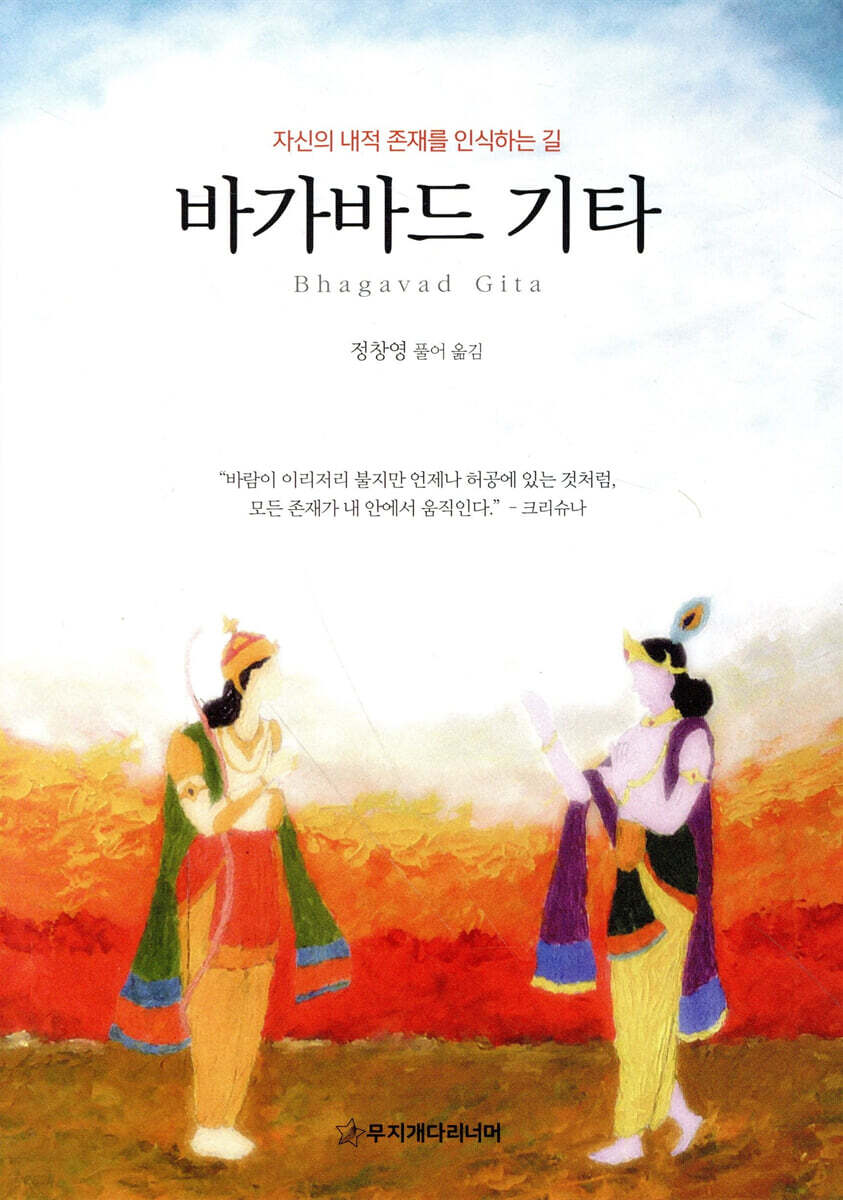
The wind blows here and there, but it always seems to be in the air,
All beings move within me
The ancient scripture, Bhagavad Gita, which has been read and influenced by many people throughout the East and the West, has been newly translated and published.
Gandhi said, “When I see no ray of hope, I turn the pages of the Bhagavad Gita and find comforting words,” and Hermann Hesse said, “It is a wonderful revelation containing the wisdom of life that makes philosophy blossom into religion.”
The literal meaning of the Bhagavad Gita, which is believed to have been composed in the 4th or 5th century BC, is 'the song of the holy one.'
It is loved across time and denominations and is called the living temple of humanity.
The story begins with Arjuna, who is in a crisis that shakes his very existence, complaining to Krishna about his suffering.
Through the philosophical and spiritual conversation between Arjuna and Krishna, we come to recognize our own nature.
All beings move within me
The ancient scripture, Bhagavad Gita, which has been read and influenced by many people throughout the East and the West, has been newly translated and published.
Gandhi said, “When I see no ray of hope, I turn the pages of the Bhagavad Gita and find comforting words,” and Hermann Hesse said, “It is a wonderful revelation containing the wisdom of life that makes philosophy blossom into religion.”
The literal meaning of the Bhagavad Gita, which is believed to have been composed in the 4th or 5th century BC, is 'the song of the holy one.'
It is loved across time and denominations and is called the living temple of humanity.
The story begins with Arjuna, who is in a crisis that shakes his very existence, complaining to Krishna about his suffering.
Through the philosophical and spiritual conversation between Arjuna and Krishna, we come to recognize our own nature.
index
Translation process
Chapter 1: The Background of the Bhagavad Gita - The Prelude to War
Chapter 2: An Overview of the Complete Teachings of the Bhagavad Gita
Chapter 3: Acts that Lead to Transcendent Freedom
Chapter 4: Knowledge Leading to Transcendent Freedom
Chapter 5 Renunciation of Acts and Freedom
Chapter 6: The Path of Meditation
Chapter 7: The Phenomenal World and Ultimate Reality
Chapter 8: The Development of the Universe and Death
Chapter 9: The Secret of Devotion
Chapter 10: The Manifestation of the Divine
Chapter 11: The Lord of the Universe, His Majestic Form
Chapter 12: The Path of Devotion
Chapter 13: Matter and Divine Spirit
Chapter 14: The Three Forces That Move the Phenomena
Chapter 15: The True Self Transcending Birth, Death, and Immortality
Chapter 16: The Divine Way and the Demonic Way
Chapter 17: Three Kinds of Faith
Chapter 18: Conclusion - Renunciation and Freedom
Key contents of each chapter
About the Bhagavad Gita
Translation Notes
Chapter 1: The Background of the Bhagavad Gita - The Prelude to War
Chapter 2: An Overview of the Complete Teachings of the Bhagavad Gita
Chapter 3: Acts that Lead to Transcendent Freedom
Chapter 4: Knowledge Leading to Transcendent Freedom
Chapter 5 Renunciation of Acts and Freedom
Chapter 6: The Path of Meditation
Chapter 7: The Phenomenal World and Ultimate Reality
Chapter 8: The Development of the Universe and Death
Chapter 9: The Secret of Devotion
Chapter 10: The Manifestation of the Divine
Chapter 11: The Lord of the Universe, His Majestic Form
Chapter 12: The Path of Devotion
Chapter 13: Matter and Divine Spirit
Chapter 14: The Three Forces That Move the Phenomena
Chapter 15: The True Self Transcending Birth, Death, and Immortality
Chapter 16: The Divine Way and the Demonic Way
Chapter 17: Three Kinds of Faith
Chapter 18: Conclusion - Renunciation and Freedom
Key contents of each chapter
About the Bhagavad Gita
Translation Notes
Publisher's Review
As dust covers a mirror
True wisdom is obscured by selfish desires.
Arjuna is disheartened and distressed by having to fight a war between his brothers over the throne, but Krishna tells him that this is not a reason to be sad.
Because, “just as a soul in a body passes through the body of a boy, the body of a young man, and the body of an old man, so after death it takes on the body of the next person after death.
“Because a wise person is not deceived by such changes.”
Humans experience pleasure and pain through contact with sense objects, but these experiences are temporary and come and go.
Krishna says that this world is a virtual reality created by three energies, and that what is temporary does not exist.
The ever-present reality encourages Arjuna to go out and fight without any worries and to practice the dharma of a warrior, knowing that its existence will never end.
Through the dialogue between Arjuna and Krishna, which runs from Chapter 1 to Chapter 18, we gain a deep insight into the contradictions, conflicts, and selfishness that arise in the inner world of human beings.
Before we knew it, this place was no longer a battlefield, but a place where gods and humans communicated.
If you study the Bhagavad Gita after your day's work, true wisdom, which has been obscured by selfish desires, will reveal itself, just as dust covers a mirror.
Only the wise who understand the truth are free from desire.
Krishna says that such people perform actions but are not bound by them.
Even if there are mistakes and shortcomings
Practice your dharma
Our dharma is to do what the truth has given us.
The outcome is none of our business.
Krishna also says that we should not act with the expectation of a result.
Krishna tells us that it is better to practice one's own dharma with mistakes and shortcomings than to practice someone else's dharma perfectly.
For the entire being to be transformed, a metaphysical system capable of changing one's thoughts and the training to support that system are needed.
Krishna tells us all about it.
We can now enter the beginning of the path to entering our own true Atman.
The way to build oneself in a materialistic civilization that is almost violent is through spiritual practice.
The Bhagavad Gita is a book that is perfect for a journey of spiritual exploration that invites deep contemplation and meditation.
This is especially true because it is a translation that was painstakingly done by a translator with many years of experience.
True wisdom is obscured by selfish desires.
Arjuna is disheartened and distressed by having to fight a war between his brothers over the throne, but Krishna tells him that this is not a reason to be sad.
Because, “just as a soul in a body passes through the body of a boy, the body of a young man, and the body of an old man, so after death it takes on the body of the next person after death.
“Because a wise person is not deceived by such changes.”
Humans experience pleasure and pain through contact with sense objects, but these experiences are temporary and come and go.
Krishna says that this world is a virtual reality created by three energies, and that what is temporary does not exist.
The ever-present reality encourages Arjuna to go out and fight without any worries and to practice the dharma of a warrior, knowing that its existence will never end.
Through the dialogue between Arjuna and Krishna, which runs from Chapter 1 to Chapter 18, we gain a deep insight into the contradictions, conflicts, and selfishness that arise in the inner world of human beings.
Before we knew it, this place was no longer a battlefield, but a place where gods and humans communicated.
If you study the Bhagavad Gita after your day's work, true wisdom, which has been obscured by selfish desires, will reveal itself, just as dust covers a mirror.
Only the wise who understand the truth are free from desire.
Krishna says that such people perform actions but are not bound by them.
Even if there are mistakes and shortcomings
Practice your dharma
Our dharma is to do what the truth has given us.
The outcome is none of our business.
Krishna also says that we should not act with the expectation of a result.
Krishna tells us that it is better to practice one's own dharma with mistakes and shortcomings than to practice someone else's dharma perfectly.
For the entire being to be transformed, a metaphysical system capable of changing one's thoughts and the training to support that system are needed.
Krishna tells us all about it.
We can now enter the beginning of the path to entering our own true Atman.
The way to build oneself in a materialistic civilization that is almost violent is through spiritual practice.
The Bhagavad Gita is a book that is perfect for a journey of spiritual exploration that invites deep contemplation and meditation.
This is especially true because it is a translation that was painstakingly done by a translator with many years of experience.
GOODS SPECIFICS
- Date of issue: September 25, 2019
- Page count, weight, size: 263 pages | 426g | 148*210*20mm
- ISBN13: 9791190025010
- ISBN10: 1190025019
You may also like
카테고리
korean


korean

![ELLE 엘르 스페셜 에디션 A형 : 12월 [2025]](http://librairie.coreenne.fr/cdn/shop/files/b8e27a3de6c9538896439686c6b0e8fb.jpg?v=1766436872&width=3840)


