

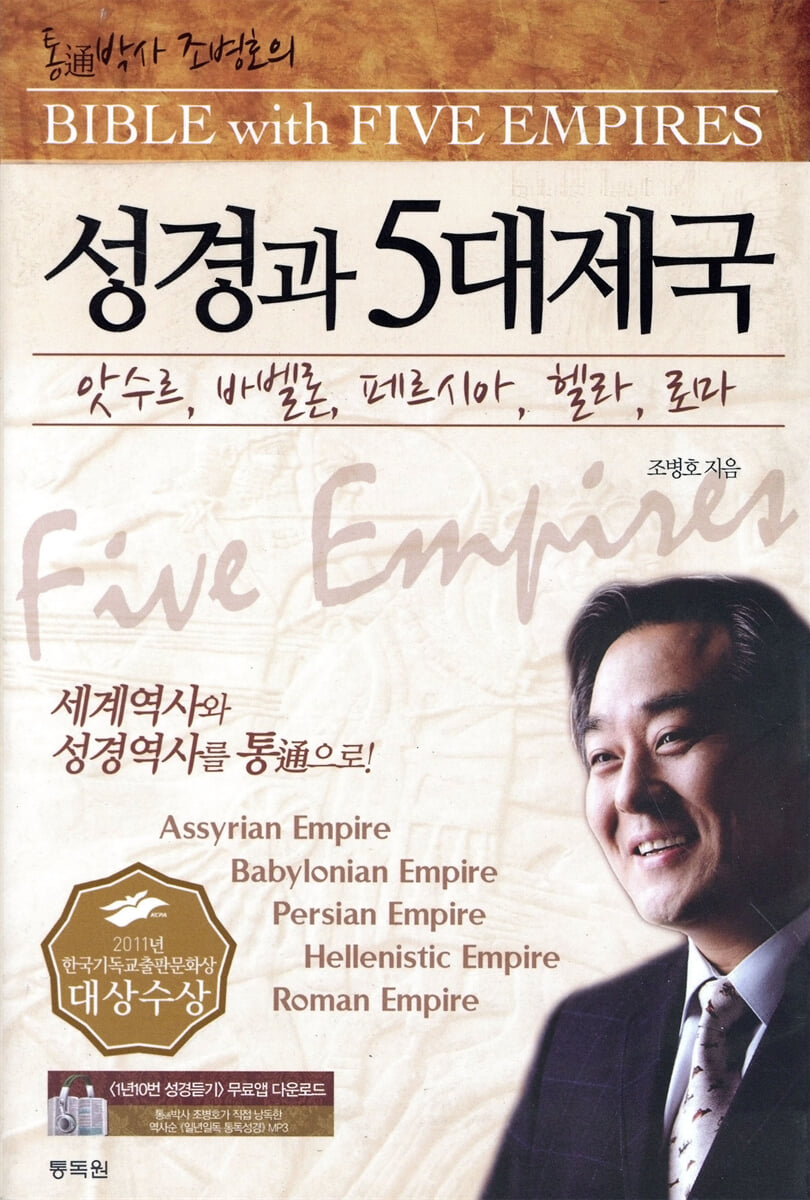
The Bible and the Five Empires
 |
Description
Book Introduction
『The Bible and the Five Great Empires』, published by Dr. Cho Byeong-ho, a historian and expert in reading the Bible, is a book that combines world history and biblical history.
It contains the history of the five great empires of Egypt, Assyria, Babylon, Persia, Greece, and Rome, along with the history of the Bible.
Based on his experience studying in England, he combined his knowledge of Western history with Eastern methodologies to create the "Tong" methodology, offering a glimpse into his insights.
In this book, the author describes each empire using keywords.
The keywords for managing the empire in Egypt were nature, in Assyria they were boundaries, and in Babylon, Persia, Greece, and Rome they were education, numbers, integration, and tolerance.
However, what the author emphasizes above all else in this book is ‘God’s world management.’
It reveals that everything is not a device that can be manipulated by humans at will and used to dominate someone, but an implicit device of God's world management.
He also attempted to view the story of the priestly nation and empire as a whole, and the prophetic and historical books as a whole.
Based on the author's unique philosophy of history, you will have the opportunity to see the Bible from a new perspective, as personal, domestic, national, and at the same time, universal.
It contains the history of the five great empires of Egypt, Assyria, Babylon, Persia, Greece, and Rome, along with the history of the Bible.
Based on his experience studying in England, he combined his knowledge of Western history with Eastern methodologies to create the "Tong" methodology, offering a glimpse into his insights.
In this book, the author describes each empire using keywords.
The keywords for managing the empire in Egypt were nature, in Assyria they were boundaries, and in Babylon, Persia, Greece, and Rome they were education, numbers, integration, and tolerance.
However, what the author emphasizes above all else in this book is ‘God’s world management.’
It reveals that everything is not a device that can be manipulated by humans at will and used to dominate someone, but an implicit device of God's world management.
He also attempted to view the story of the priestly nation and empire as a whole, and the prophetic and historical books as a whole.
Based on the author's unique philosophy of history, you will have the opportunity to see the Bible from a new perspective, as personal, domestic, national, and at the same time, universal.
- You can preview some of the book's contents.
Preview
index
Recommendation
Entering
Prerequisites - Egypt and the Bible
Egypt 3,400 years ago, and Egypt in the spotlight again in 2011
Nation, Nationalism, Imperialism, and Empire
Empire and Priestly Nation
Joseph, Prime Minister of Egypt and Egypt
Moses, the Prince of Egypt and Egypt
The Fall of Empire Egypt: The Red Sea Incident
Solomon took an Egyptian princess as his wife
Josiah, who decided the fate of Egypt
Battle of Megiddo (609 BC) and Battle of Carchemish (605 BC)
The fall of Egypt
God's World Management
The Assyrian Empire and the Bible
Assyria, the ruler of Upper Asia for 520 years
British Museum and Assyrian ruins
Prophet Jonah (BC)
8th century) and Assyria
Northern Israel and Assyria
Elijah, Elisha, Amos, Hosea and the prophets of Assyria
Assyria's colonial policy and the Samaritans
Judah's foreign policy and Assyria's imperialism
The fatal mistake of King Ahaz of Judah
Prophet Isaiah (BC)
8th century) and Hezekiah's defense and foreign policy confrontation
The ignorance of Rabshakeh, the Assyrian linguistic genius
Herodotus' account of the deaths of 185,000 Assyrian soldiers
Prophet Nahum (BC)
7th century) and Assyria
Fall of the Assyrian Empire (609 BC)
God's World Management
The Babylonian Empire and the Bible
King Hezekiah and the Babylonian envoy
The Prophet Isaiah and Babylon
Babylonian Empire Policies and the First and Second Captivity (605 BC/598 BC)
Captive Daniel and Captive Ezekiel
Prophet Jeremiah and the false prophet Hananiah
The Secret of Leviticus' Land Policy and the 70 Years of Captivity
Secret Meeting between the King and the Prophet
The tragic end of King Zedekiah and his sons
The Destruction of the Temple of Jerusalem and Ezekiel's Drawing of the Temple: The Third Exile (586 BC)
Jeremiah's Letter to Babylon
Sketch of the city of Babylon
Two Projects: Cultivating God's Talent and the Nebuchadnezzar School in Babylon
Fall of the Babylonian Empire (539 BC)
God's World Management
The Persian Empire and the Bible
The Persian Empire and the Seven Books of the Old Testament
Pharaoh of Egypt and Cyrus II of Persia
The two city-states of Persia: Media and Persia
Solon, king of Persia, king of Lydia, and wise man of Greece
King Cyrus (Cyrus II), father of Persia
Cambyses, son of Cyrus (Cyrus II)
The cupbearer of Egypt and the cupbearer of Persia
Persian Governor Zerubbabel: First Return of Captives (537 BC)
Queen Esther of Persia and King Ahasuerus (Xerxes)
King Ahasuerus (Xerxes) covered in world history
Ezra, a scholar and priest who advised the Persian king: Second return from exile (458 BC)
Nehemiah, Governor of Persia: Third Return of Captives (445 BC)
Fall of the Persian Empire (331 BC)
God's World Management
The Hellenic Empire and the Bible
The Hellenic Empire and the Intertestamental Period
Daniel's Empire Painting and the Rise of Macedonia
Philippi (Philippo): The economic powerhouse of the Hellenistic Empire and the birthplace of the gospel in Europe.
Aristotle, Alexander's teacher
Ezekiel 27, the maritime city of Tyre, and Alexander
Alexander's visit to Jerusalem
Alexander and the Trojan hero Achilles
The death of Alexander and the division of the Hellenic Empire
The Battle for Jerusalem Between the Ptolemies and the Seleucids
Queen Cleopatra of Egypt and Herod the Great of Judea
The Maccabean Revolt and the Hasmonean Dynasty
Hellenistic policies and Jewish sects: Pharisees, Sadducees, and Essenes
The fall of the Hellenic Empire
God's World Management
The Roman Empire and the Bible
From Matthew to Revelation
The Beginning of the Roman Empire and Caesar
The Fox Herods and the Roman Empire
Octavian, the first emperor of Rome, and the Bethlehem stables
The second Roman emperor Tiberius and the governor Pontius Pilate
Passover in the Egyptian Empire and Passover in the Roman Empire
The Trial of the Roman Governor and High Priest: Crucifixion and Stoning
The Cross of Jesus Christ: The Fulfillment of the Prophets and the Law
Diaspora Jews and Diaspora Greeks
Philo, a Jew who met Caligula, the third emperor of Rome
Priscilla and Aquila, exiled by Claudius, the fourth emperor of Rome
Jerusalem, the Millennial City, and the New City, Caesarea
Felix, the Roman governor who expected a bribe from Paul
The Administration of the Roman Governor and the Jewish Sanhedrin: Gamaliel
Roman slavery and American President Lincoln
The Gracchi Brothers' Reform Law and Paul's Request for Imperial Trial
The Singer Emperor Nero, the Great Fire of Rome, and the Martyrdom of Paul
Jewish Obstruction and Roman Persecution
Christianity was recognized as the state religion of the Roman Empire (AD 313) and became the official religion (AD 392).
Fall of the Roman Empire (AD 476)
God's World Management
God's World Management Seen Through the Eyes
Entering
Prerequisites - Egypt and the Bible
Egypt 3,400 years ago, and Egypt in the spotlight again in 2011
Nation, Nationalism, Imperialism, and Empire
Empire and Priestly Nation
Joseph, Prime Minister of Egypt and Egypt
Moses, the Prince of Egypt and Egypt
The Fall of Empire Egypt: The Red Sea Incident
Solomon took an Egyptian princess as his wife
Josiah, who decided the fate of Egypt
Battle of Megiddo (609 BC) and Battle of Carchemish (605 BC)
The fall of Egypt
God's World Management
The Assyrian Empire and the Bible
Assyria, the ruler of Upper Asia for 520 years
British Museum and Assyrian ruins
Prophet Jonah (BC)
8th century) and Assyria
Northern Israel and Assyria
Elijah, Elisha, Amos, Hosea and the prophets of Assyria
Assyria's colonial policy and the Samaritans
Judah's foreign policy and Assyria's imperialism
The fatal mistake of King Ahaz of Judah
Prophet Isaiah (BC)
8th century) and Hezekiah's defense and foreign policy confrontation
The ignorance of Rabshakeh, the Assyrian linguistic genius
Herodotus' account of the deaths of 185,000 Assyrian soldiers
Prophet Nahum (BC)
7th century) and Assyria
Fall of the Assyrian Empire (609 BC)
God's World Management
The Babylonian Empire and the Bible
King Hezekiah and the Babylonian envoy
The Prophet Isaiah and Babylon
Babylonian Empire Policies and the First and Second Captivity (605 BC/598 BC)
Captive Daniel and Captive Ezekiel
Prophet Jeremiah and the false prophet Hananiah
The Secret of Leviticus' Land Policy and the 70 Years of Captivity
Secret Meeting between the King and the Prophet
The tragic end of King Zedekiah and his sons
The Destruction of the Temple of Jerusalem and Ezekiel's Drawing of the Temple: The Third Exile (586 BC)
Jeremiah's Letter to Babylon
Sketch of the city of Babylon
Two Projects: Cultivating God's Talent and the Nebuchadnezzar School in Babylon
Fall of the Babylonian Empire (539 BC)
God's World Management
The Persian Empire and the Bible
The Persian Empire and the Seven Books of the Old Testament
Pharaoh of Egypt and Cyrus II of Persia
The two city-states of Persia: Media and Persia
Solon, king of Persia, king of Lydia, and wise man of Greece
King Cyrus (Cyrus II), father of Persia
Cambyses, son of Cyrus (Cyrus II)
The cupbearer of Egypt and the cupbearer of Persia
Persian Governor Zerubbabel: First Return of Captives (537 BC)
Queen Esther of Persia and King Ahasuerus (Xerxes)
King Ahasuerus (Xerxes) covered in world history
Ezra, a scholar and priest who advised the Persian king: Second return from exile (458 BC)
Nehemiah, Governor of Persia: Third Return of Captives (445 BC)
Fall of the Persian Empire (331 BC)
God's World Management
The Hellenic Empire and the Bible
The Hellenic Empire and the Intertestamental Period
Daniel's Empire Painting and the Rise of Macedonia
Philippi (Philippo): The economic powerhouse of the Hellenistic Empire and the birthplace of the gospel in Europe.
Aristotle, Alexander's teacher
Ezekiel 27, the maritime city of Tyre, and Alexander
Alexander's visit to Jerusalem
Alexander and the Trojan hero Achilles
The death of Alexander and the division of the Hellenic Empire
The Battle for Jerusalem Between the Ptolemies and the Seleucids
Queen Cleopatra of Egypt and Herod the Great of Judea
The Maccabean Revolt and the Hasmonean Dynasty
Hellenistic policies and Jewish sects: Pharisees, Sadducees, and Essenes
The fall of the Hellenic Empire
God's World Management
The Roman Empire and the Bible
From Matthew to Revelation
The Beginning of the Roman Empire and Caesar
The Fox Herods and the Roman Empire
Octavian, the first emperor of Rome, and the Bethlehem stables
The second Roman emperor Tiberius and the governor Pontius Pilate
Passover in the Egyptian Empire and Passover in the Roman Empire
The Trial of the Roman Governor and High Priest: Crucifixion and Stoning
The Cross of Jesus Christ: The Fulfillment of the Prophets and the Law
Diaspora Jews and Diaspora Greeks
Philo, a Jew who met Caligula, the third emperor of Rome
Priscilla and Aquila, exiled by Claudius, the fourth emperor of Rome
Jerusalem, the Millennial City, and the New City, Caesarea
Felix, the Roman governor who expected a bribe from Paul
The Administration of the Roman Governor and the Jewish Sanhedrin: Gamaliel
Roman slavery and American President Lincoln
The Gracchi Brothers' Reform Law and Paul's Request for Imperial Trial
The Singer Emperor Nero, the Great Fire of Rome, and the Martyrdom of Paul
Jewish Obstruction and Roman Persecution
Christianity was recognized as the state religion of the Roman Empire (AD 313) and became the official religion (AD 392).
Fall of the Roman Empire (AD 476)
God's World Management
God's World Management Seen Through the Eyes
Publisher's Review
Even in an age where smartphones and electronic devices are the norm, rethinking the past is essential for moving toward the right future.
This is why many people talk about the value of 'classics'.
The classic of these classics is the Bible.
The most effective way to outpace the pace of change in the 21st century is to hold on to the unchanging 'Bible.'
Dr. Cho Byeong-ho, a historian and expert on reading the Bible, has published “The Bible and the Five Empires,” which comprehensively links the Bible with the five empires of Assyria, Babylon, Persia, Greece, and Rome.
The author majored in historical theology at the University of Birmingham in England, presented “The Student YMCA in Korea, 1900-1945” at a conference jointly sponsored by the Royal Historical Society and the YMCA England, and is a world-renowned historian who published the article “Studentische Missionbewegung” in the German theological dictionary RGG (Religion in Geschichte und Gegenwart 4.Auflage).
At the same time, he is also an expert in Bible reading who has led the popularization, academicization, and globalization of Bible reading for the past 23 years.
The recently published 『The Bible and the Five Empires』 is a book that, as the author's history shows, 'interweaves world history and biblical history together.'
Including the 'Egyptian Empire' covered in prior studies, the history of the five great empires of Assyria, Babylon, Persia, Greece, and Rome is comprehensively covered along with the history of the Bible.
This book offers a glimpse into the author's insight and foresight, having studied abroad in England for eight years, gained knowledge and understanding of Western history, and later developed a "Tong" methodology that combines Eastern and Western methodologies.
This book also has great advantages in that it can 1) examine the Bible and the Five Empires in one volume, 2) examine the Bible and the Five Empires in one volume, and 3) examine the Bible and the Five Empires in one night.
In this book, the author clearly presents the keywords for imperial management of each empire.
The keyword for managing the empire of Egypt was 'nature', for Assyria it was 'boundary', and for Babylon, Persia, Greece, and Rome it was 'education', 'numbers', 'fusion', and 'tolerance'.
However, what the author emphasizes above all else in this book is ‘God’s world management.’
Even the empires that shouted the slogan, “Long live the empire,” eventually perished.
The author makes it clear that nature, boundaries, education, numbers, integration, and tolerance are not tools that humans can manipulate or use to dominate others, but rather are implicit devices for God's world management.
Moreover, through this book, the author attempted to view the story of the priestly nation and empire as a whole, and the prophetic and historical books as a whole.
And based on the author's unique philosophy of history, it examines the history of Egypt and the five great empires.
Through this, readers will come to realize that the value of an individual is valued more highly than the entire world, and that the nation and the state are given as a 'gift' to that individual who is valued more highly than the entire world.
In his recommendation, Professor Lee Man-yeol (former chairman of the National Institute of Korean History) praised the book as “a work that illuminates the history, geography, people, and culture of Egypt, Assyria, Babylon, Persia, Greece, and Rome, which serve as the humanities background of the Bible,” and Professor Kang Sa-moon (professor emeritus at Presbyterian University and Theological Seminary) recommended it as “a book that testifies to the fact that Jehovah God is the Lord of History who governed the many great empires of the world.”
Also, Father Cha Dong-yeop (professor at Incheon Catholic University), who is well known to readers for his book “Rainbow Principle,” commented on this book, saying, “It clearly presents the foresight to read the ‘global megatrends’ that are considered important in futurology these days through research into the past.”
Novelist Yoo Hyeon-jong (author of 『Daejoyeong』 and 『Yeon Gaesomun』) said, “I would like to express my gratitude and praise for this new book by Dr. Jo Byeong-ho, a wise man of wisdom and spirit who has opened the blinded spiritual eyes of all believers, saying that the Bible must be read in its entirety,” and recommended the book, saying, “It depicts the image of the Messiah obtained through the contrast between the Bible and war.”
In conclusion, through “The Bible and the Five Empires,” the author reveals that the Bible is a personal, domestic, national, and at the same time, universal book.
This is why many people talk about the value of 'classics'.
The classic of these classics is the Bible.
The most effective way to outpace the pace of change in the 21st century is to hold on to the unchanging 'Bible.'
Dr. Cho Byeong-ho, a historian and expert on reading the Bible, has published “The Bible and the Five Empires,” which comprehensively links the Bible with the five empires of Assyria, Babylon, Persia, Greece, and Rome.
The author majored in historical theology at the University of Birmingham in England, presented “The Student YMCA in Korea, 1900-1945” at a conference jointly sponsored by the Royal Historical Society and the YMCA England, and is a world-renowned historian who published the article “Studentische Missionbewegung” in the German theological dictionary RGG (Religion in Geschichte und Gegenwart 4.Auflage).
At the same time, he is also an expert in Bible reading who has led the popularization, academicization, and globalization of Bible reading for the past 23 years.
The recently published 『The Bible and the Five Empires』 is a book that, as the author's history shows, 'interweaves world history and biblical history together.'
Including the 'Egyptian Empire' covered in prior studies, the history of the five great empires of Assyria, Babylon, Persia, Greece, and Rome is comprehensively covered along with the history of the Bible.
This book offers a glimpse into the author's insight and foresight, having studied abroad in England for eight years, gained knowledge and understanding of Western history, and later developed a "Tong" methodology that combines Eastern and Western methodologies.
This book also has great advantages in that it can 1) examine the Bible and the Five Empires in one volume, 2) examine the Bible and the Five Empires in one volume, and 3) examine the Bible and the Five Empires in one night.
In this book, the author clearly presents the keywords for imperial management of each empire.
The keyword for managing the empire of Egypt was 'nature', for Assyria it was 'boundary', and for Babylon, Persia, Greece, and Rome it was 'education', 'numbers', 'fusion', and 'tolerance'.
However, what the author emphasizes above all else in this book is ‘God’s world management.’
Even the empires that shouted the slogan, “Long live the empire,” eventually perished.
The author makes it clear that nature, boundaries, education, numbers, integration, and tolerance are not tools that humans can manipulate or use to dominate others, but rather are implicit devices for God's world management.
Moreover, through this book, the author attempted to view the story of the priestly nation and empire as a whole, and the prophetic and historical books as a whole.
And based on the author's unique philosophy of history, it examines the history of Egypt and the five great empires.
Through this, readers will come to realize that the value of an individual is valued more highly than the entire world, and that the nation and the state are given as a 'gift' to that individual who is valued more highly than the entire world.
In his recommendation, Professor Lee Man-yeol (former chairman of the National Institute of Korean History) praised the book as “a work that illuminates the history, geography, people, and culture of Egypt, Assyria, Babylon, Persia, Greece, and Rome, which serve as the humanities background of the Bible,” and Professor Kang Sa-moon (professor emeritus at Presbyterian University and Theological Seminary) recommended it as “a book that testifies to the fact that Jehovah God is the Lord of History who governed the many great empires of the world.”
Also, Father Cha Dong-yeop (professor at Incheon Catholic University), who is well known to readers for his book “Rainbow Principle,” commented on this book, saying, “It clearly presents the foresight to read the ‘global megatrends’ that are considered important in futurology these days through research into the past.”
Novelist Yoo Hyeon-jong (author of 『Daejoyeong』 and 『Yeon Gaesomun』) said, “I would like to express my gratitude and praise for this new book by Dr. Jo Byeong-ho, a wise man of wisdom and spirit who has opened the blinded spiritual eyes of all believers, saying that the Bible must be read in its entirety,” and recommended the book, saying, “It depicts the image of the Messiah obtained through the contrast between the Bible and war.”
In conclusion, through “The Bible and the Five Empires,” the author reveals that the Bible is a personal, domestic, national, and at the same time, universal book.
GOODS SPECIFICS
- Date of publication: March 7, 2011
- Page count, weight, size: 352 pages | 550g | 153*224*30mm
- ISBN13: 9788992247511
- ISBN10: 8992247516
You may also like
카테고리
korean


korean

![GQ KOREA Mark (Monthly): December [2025]](http://librairie.coreenne.fr/cdn/shop/files/8ef265dbbfbf186523ed75ba7319009d.jpg?v=1765340328&width=3840)


