

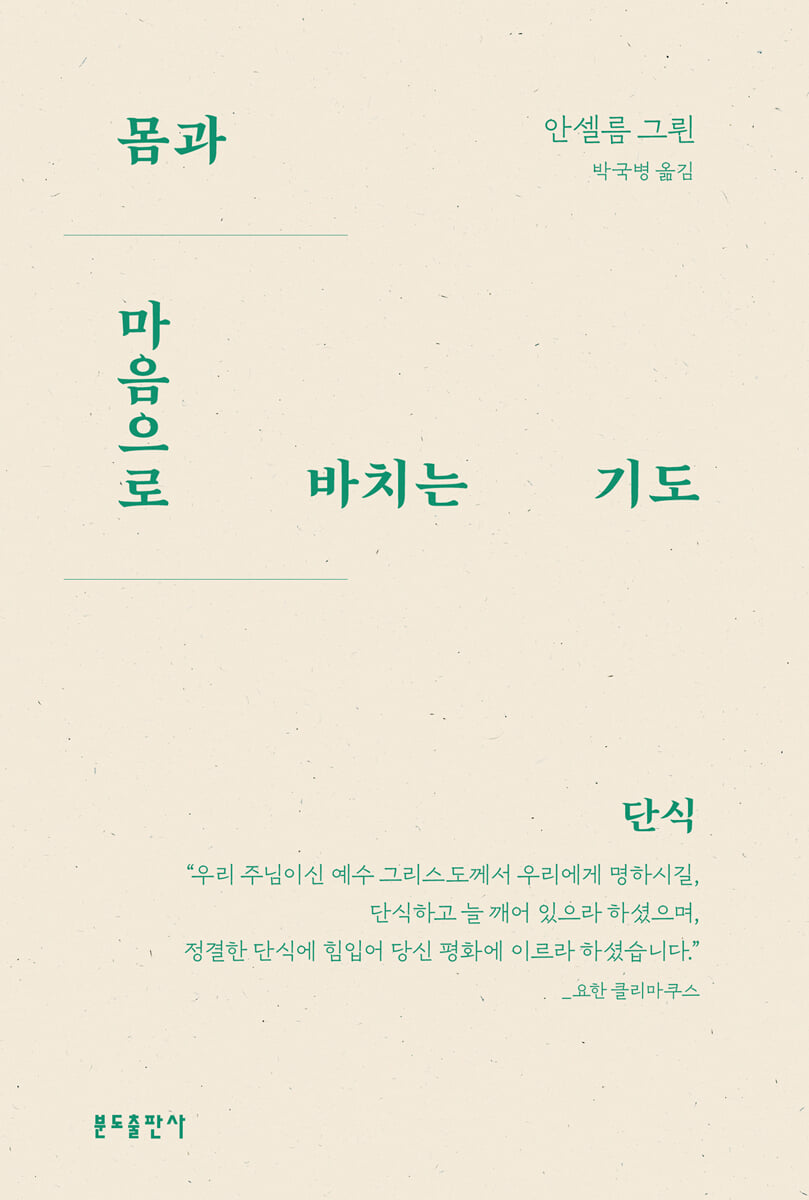
Prayer offered with body and mind
 |
Description
Book Introduction
'Fasting', along with 'prayer' and 'charity', is a proven means on the path of spiritual practice, and it is a tool that guides us to treat God and our neighbors with the right attitude.
To properly understand fasting, we must not view it in isolation from other practices, but rather in connection with them, especially prayer.
By examining the experiences of the early church and the writings of ancient monks, this book leads us to a new understanding of fasting as a form of prayer, a prayer offered with both body and spirit.
Through fasting, we fully realize our existence as creatures created by God's hands.
We are creatures who find our fulfillment only in Him, creatures who do not rest on the grace we have received, but long for and pursue Him who gave us grace.
Through fasting, we stretch ourselves out to God with all our body and soul, and we bow down before God with all our body and soul.
Fasting is the flesh's cry to God.
It is a cry that bursts from the depths, from the abyss.
To properly understand fasting, we must not view it in isolation from other practices, but rather in connection with them, especially prayer.
By examining the experiences of the early church and the writings of ancient monks, this book leads us to a new understanding of fasting as a form of prayer, a prayer offered with both body and spirit.
Through fasting, we fully realize our existence as creatures created by God's hands.
We are creatures who find our fulfillment only in Him, creatures who do not rest on the grace we have received, but long for and pursue Him who gave us grace.
Through fasting, we stretch ourselves out to God with all our body and soul, and we bow down before God with all our body and soul.
Fasting is the flesh's cry to God.
It is a cry that bursts from the depths, from the abyss.
- You can preview some of the book's contents.
Preview
index
Entering
Fasting practices in the early church
Healer of the flesh and spirit
The fight against desires and vices
Fasting and prayer
The path of illumination
Fasting today
Coming out
main
Fasting practices in the early church
Healer of the flesh and spirit
The fight against desires and vices
Fasting and prayer
The path of illumination
Fasting today
Coming out
main
Into the book
If you deny yourself all pleasures and become unpleasant to others, that is certainly not a desirable thing.
That's not what fasting is.
The key is to discover 'what is holding me back' and 'what is it that I am living from that source'.
Only when I consciously let go of all the vicarious gratifications that block my ears and blind my eyes during fasting do I finally realize the deep truth within me.
During fasting, I remove the covering that lies over my seething thoughts and emotions.
This allows everything within me to emerge.
My unfulfilled desires and longings, my desires, rise up, as well as my obsession with myself, my success, my possessions, my health, my need for recognition.
While fasting, I encounter negative emotions, such as sadness or anger, that hide behind a kind facade.
By engaging in various activities, eating and drinking this and that, and comforting yourself, the wounds that you have tried to cover up burst.
Everything that has been suppressed until now is revealed.
Fasting strips me of who I am.
Fasting tells me what dangers I face and where I must fight.
--- pp.49-59
Those who practice fasting correctly become humble.
How should we understand this? Humility means having the courage to descend into one's own human nature, into the dirt of one's own existence.
In Latin, the word 'humility' (humilitas) comes from the word 'earth' (humus).
First of all, fasting forces us to face ourselves.
Soon, we will face our hopes and desires, our thoughts and feelings, our shadows.
Just recognizing our own shadows can make us a little more humble.
Moreover, fasting pushes us to our limits.
This experience clearly shows that we are human beings with both body and soul, and that we cannot escape our bodies.
It also reminds us that we cannot abandon our bodies and do whatever we want with them.
We must accept our bodies, and above all, we must accept their deficiencies, their inadequacies.
We must acknowledge our bodies.
During fasting, we face our own deficiencies.
--- pp.63-64
There is a thin line between being enlightened by God and being blinded and deluded.
Fasting can lead to either.
We must not confuse the natural effects of fasting, which sharpen the senses and make the mind more alert, with this enlightenment spoken of by Philoxenus.
Such effects can certainly help us reach enlightenment through God.
However, it can also be an end in itself or be identified with seeing God directly, or meeting Him face to face.
Fasting can only lead to true enlightenment when it leads us to helplessness.
For monks, fasting is merely a path into their own powerlessness, not a means to achieve any feat or effect on their own.
Fasting plunges us into the abyss of our weakness.
And in this abyss of ours we meet the abyss of God.
The abyss of our helplessness cries out to the abyss of God.
This is as expressed in the Psalms:
“Abyss calls to abyss” (abyssus abyssum invocat, Psalm 42:8).
That's not what fasting is.
The key is to discover 'what is holding me back' and 'what is it that I am living from that source'.
Only when I consciously let go of all the vicarious gratifications that block my ears and blind my eyes during fasting do I finally realize the deep truth within me.
During fasting, I remove the covering that lies over my seething thoughts and emotions.
This allows everything within me to emerge.
My unfulfilled desires and longings, my desires, rise up, as well as my obsession with myself, my success, my possessions, my health, my need for recognition.
While fasting, I encounter negative emotions, such as sadness or anger, that hide behind a kind facade.
By engaging in various activities, eating and drinking this and that, and comforting yourself, the wounds that you have tried to cover up burst.
Everything that has been suppressed until now is revealed.
Fasting strips me of who I am.
Fasting tells me what dangers I face and where I must fight.
--- pp.49-59
Those who practice fasting correctly become humble.
How should we understand this? Humility means having the courage to descend into one's own human nature, into the dirt of one's own existence.
In Latin, the word 'humility' (humilitas) comes from the word 'earth' (humus).
First of all, fasting forces us to face ourselves.
Soon, we will face our hopes and desires, our thoughts and feelings, our shadows.
Just recognizing our own shadows can make us a little more humble.
Moreover, fasting pushes us to our limits.
This experience clearly shows that we are human beings with both body and soul, and that we cannot escape our bodies.
It also reminds us that we cannot abandon our bodies and do whatever we want with them.
We must accept our bodies, and above all, we must accept their deficiencies, their inadequacies.
We must acknowledge our bodies.
During fasting, we face our own deficiencies.
--- pp.63-64
There is a thin line between being enlightened by God and being blinded and deluded.
Fasting can lead to either.
We must not confuse the natural effects of fasting, which sharpen the senses and make the mind more alert, with this enlightenment spoken of by Philoxenus.
Such effects can certainly help us reach enlightenment through God.
However, it can also be an end in itself or be identified with seeing God directly, or meeting Him face to face.
Fasting can only lead to true enlightenment when it leads us to helplessness.
For monks, fasting is merely a path into their own powerlessness, not a means to achieve any feat or effect on their own.
Fasting plunges us into the abyss of our weakness.
And in this abyss of ours we meet the abyss of God.
The abyss of our helplessness cries out to the abyss of God.
This is as expressed in the Psalms:
“Abyss calls to abyss” (abyssus abyssum invocat, Psalm 42:8).
--- pp.117-118
Publisher's Review
Fasting is the flesh's cry to God!
“Fasting strengthens prayer, and prayer strengthens fasting and brings it before the Lord.”
Bernard of Clairvaux
In the spiritual path that Christians follow in Christ's footsteps, 'fasting' is a proven means, along with 'prayer' and 'charity'.
The Church has known and practiced fasting since its inception, and even established rules for it in the early centuries.
For example, they set aside Wednesdays and Fridays as fasting days to remember the arrest and crucifixion of Jesus.
However, in modern times, the rules of fasting have become increasingly narrow and almost meaningless.
Over the past several decades, the Church has merely maintained the tradition of fasting in appearance, while gradually forgetting its meaning.
This book reminds us that fasting is not a dead tradition, but rather a tool that remains as effective today as ever.
To properly understand fasting, we must not view it separately from other practices such as prayer, meditation, silence, work, and charity, but must examine it in connection with them, especially with prayer.
Today, most people think of prayer as a conversation with God and a purely spiritual act.
However, the ancients always understood prayer as an act of offering both body and spirit.
In one way, this was revealed in the gesture of prayer.
They did not just pray in their heads, they prayed to God with their whole body.
He stretched both hands upwards, opened his body wide, and prayed.
To them, prayer meant 'raising both hands toward God.'
Fasting shows us that our devotion must be incarnated.
Just as the Word of God became flesh in Christ, so too must our devotion become flesh.
Prayer becomes incarnate when it is expressed in fasting, and this also happens to us.
At that time, the relationship with God does not remain only in the mind.
At that time, we will not only pray to Him with our mouths, but also confess our longing for Him with our whole body.
We confess that without Him we are empty shells, that we depend on His grace, that we live by His love, and that our hungry stomachs are ultimately filled by Him, and only “by every word that proceeds from His mouth” (Matthew 4:4).
During fasting, we humans surrender ourselves to God.
We offer ourselves to the Almighty in our helpless state and worship Him.
Fasting is worship.
We desire nothing for ourselves, but only bow down before Him who is greater.
We fall down before the infinite One, our bodies exhausted from hunger.
Only He can satisfy the deepest hunger of humanity.
Fasting is the flesh's cry to God.
It is a cry that bursts from the depths, from the abyss.
In this abyss, we face our own helplessness, our own wounds and shortcomings, as in the words of the Psalms, and thus we are completely entrusted to His abyss.
“Abyss calls to abyss” (abyssus abyssum invocat, Psalm 42:8).
“Fasting strengthens prayer, and prayer strengthens fasting and brings it before the Lord.”
Bernard of Clairvaux
In the spiritual path that Christians follow in Christ's footsteps, 'fasting' is a proven means, along with 'prayer' and 'charity'.
The Church has known and practiced fasting since its inception, and even established rules for it in the early centuries.
For example, they set aside Wednesdays and Fridays as fasting days to remember the arrest and crucifixion of Jesus.
However, in modern times, the rules of fasting have become increasingly narrow and almost meaningless.
Over the past several decades, the Church has merely maintained the tradition of fasting in appearance, while gradually forgetting its meaning.
This book reminds us that fasting is not a dead tradition, but rather a tool that remains as effective today as ever.
To properly understand fasting, we must not view it separately from other practices such as prayer, meditation, silence, work, and charity, but must examine it in connection with them, especially with prayer.
Today, most people think of prayer as a conversation with God and a purely spiritual act.
However, the ancients always understood prayer as an act of offering both body and spirit.
In one way, this was revealed in the gesture of prayer.
They did not just pray in their heads, they prayed to God with their whole body.
He stretched both hands upwards, opened his body wide, and prayed.
To them, prayer meant 'raising both hands toward God.'
Fasting shows us that our devotion must be incarnated.
Just as the Word of God became flesh in Christ, so too must our devotion become flesh.
Prayer becomes incarnate when it is expressed in fasting, and this also happens to us.
At that time, the relationship with God does not remain only in the mind.
At that time, we will not only pray to Him with our mouths, but also confess our longing for Him with our whole body.
We confess that without Him we are empty shells, that we depend on His grace, that we live by His love, and that our hungry stomachs are ultimately filled by Him, and only “by every word that proceeds from His mouth” (Matthew 4:4).
During fasting, we humans surrender ourselves to God.
We offer ourselves to the Almighty in our helpless state and worship Him.
Fasting is worship.
We desire nothing for ourselves, but only bow down before Him who is greater.
We fall down before the infinite One, our bodies exhausted from hunger.
Only He can satisfy the deepest hunger of humanity.
Fasting is the flesh's cry to God.
It is a cry that bursts from the depths, from the abyss.
In this abyss, we face our own helplessness, our own wounds and shortcomings, as in the words of the Psalms, and thus we are completely entrusted to His abyss.
“Abyss calls to abyss” (abyssus abyssum invocat, Psalm 42:8).
GOODS SPECIFICS
- Date of issue: November 20, 2025
- Page count, weight, size: 160 pages | 204g | 135*200*8mm
- ISBN13: 9788941925194
- ISBN10: 8941925193
You may also like
카테고리
korean


korean

![GQ KOREA Mark (Monthly): December [2025]](http://librairie.coreenne.fr/cdn/shop/files/8ef265dbbfbf186523ed75ba7319009d.jpg?v=1765340328&width=3840)


