

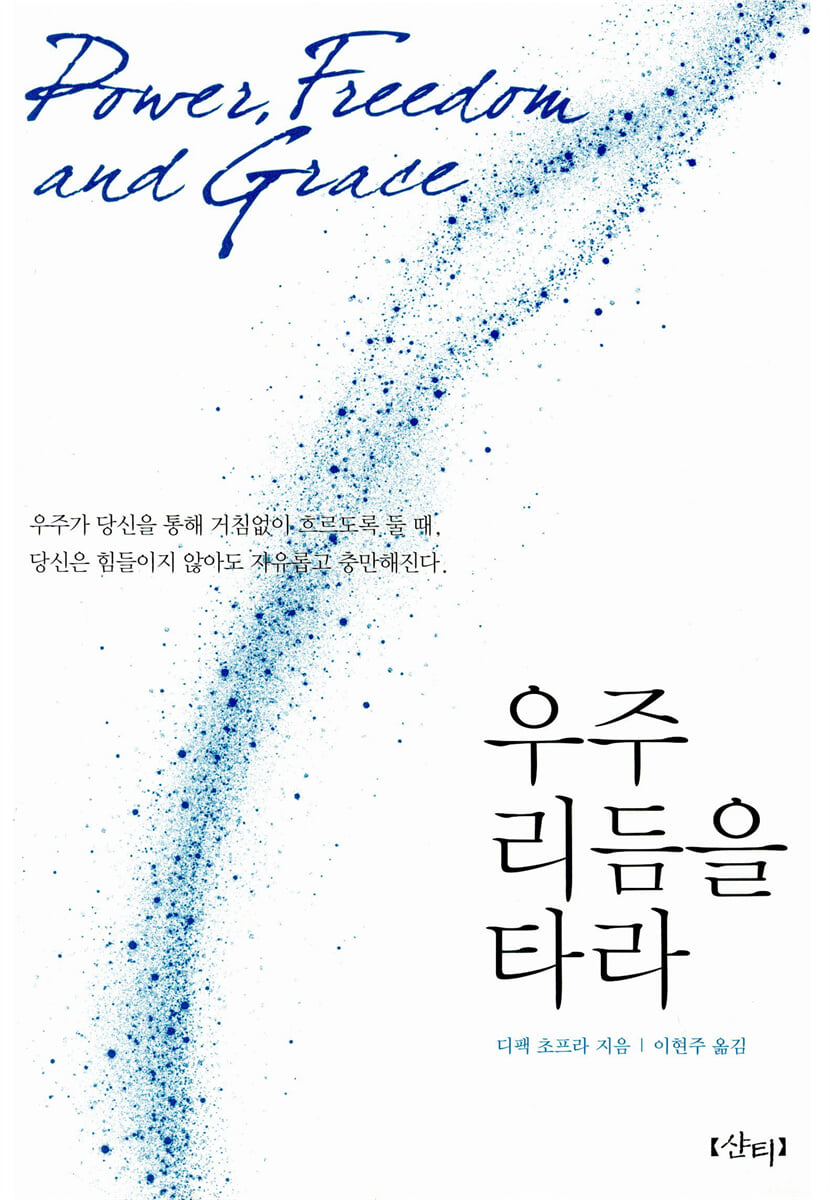
Ride the cosmic rhythm
 |
Description
Book Introduction
Recently, people's interest in 'happiness' has been growing again.
Our standard of living has improved significantly, and the Internet allows us to instantly find the information we need and easily make friends and communicate with people around the world. However, this alone is not enough to define happiness.
In this age of material abundance, it seems like a great paradox that the words 'healing' and 'happiness' are once again becoming issues and captivating people's hearts.
But if we look deeper, it may mean that we are finally beginning to look at the unhealed wounds within us and realize that material abundance alone is not enough to achieve true happiness.
People often show a paradoxical attitude of not making happiness their first goal, but pursuing it through other secondary things.
But if we make happiness our first goal instead of secondary means, we can more easily achieve the secondary things we desire, like money, health, and friends.
The happiness we truly desire is a happiness without a cause, and it already exists within us as a ‘state of consciousness.’
If happiness is not something we can seek from outside ourselves, but a state of consciousness that already exists within us, then all we have to do to become truly happy is to know who we are.
Deepak Chopra says that knowing it is knowing the mystery of our existence.
Our standard of living has improved significantly, and the Internet allows us to instantly find the information we need and easily make friends and communicate with people around the world. However, this alone is not enough to define happiness.
In this age of material abundance, it seems like a great paradox that the words 'healing' and 'happiness' are once again becoming issues and captivating people's hearts.
But if we look deeper, it may mean that we are finally beginning to look at the unhealed wounds within us and realize that material abundance alone is not enough to achieve true happiness.
People often show a paradoxical attitude of not making happiness their first goal, but pursuing it through other secondary things.
But if we make happiness our first goal instead of secondary means, we can more easily achieve the secondary things we desire, like money, health, and friends.
The happiness we truly desire is a happiness without a cause, and it already exists within us as a ‘state of consciousness.’
If happiness is not something we can seek from outside ourselves, but a state of consciousness that already exists within us, then all we have to do to become truly happy is to know who we are.
Deepak Chopra says that knowing it is knowing the mystery of our existence.
- You can preview some of the book's contents.
Preview
index
Translator's Note
Part 1: Problem: Not knowing who you are
1.
What do I want?
2.
Who am I?
3.
Why did I forget who I was?
4.
How can I participate in creating my own reality?
Part 2: Prescription: Remember Who You Are
5.
Where do I go when I die?
6.
What is the key to lasting happiness?
7.
How can one live easily without effort?
8.
When will I wake up?
Part 3: Experiencing Who You Are
9.
What is power and how do you get it?
10.
What is freedom and how to experience it?
11.
What is grace and how to live it?
12.
infinity
Appendix: Old Paradigms and New Paradigms
About Vedanta
Part 1: Problem: Not knowing who you are
1.
What do I want?
2.
Who am I?
3.
Why did I forget who I was?
4.
How can I participate in creating my own reality?
Part 2: Prescription: Remember Who You Are
5.
Where do I go when I die?
6.
What is the key to lasting happiness?
7.
How can one live easily without effort?
8.
When will I wake up?
Part 3: Experiencing Who You Are
9.
What is power and how do you get it?
10.
What is freedom and how to experience it?
11.
What is grace and how to live it?
12.
infinity
Appendix: Old Paradigms and New Paradigms
About Vedanta
Into the book
# Although happiness is the goal of all goals, what we truly desire is to go beyond happiness and to know the mystery of our existence.
No matter how many desires are fulfilled until we reach that point, there are still remaining dissatisfactions.
Because the voice that makes our life miserable keeps asking questions inside us.
Who am I? Where did I come from? What is the meaning and purpose of my life? Where do I go when I die?
There is no one who can answer these questions for us.
If there are answers given by parents, culture, or religion, then they are simply accepting what was taught based on blind faith.
Even if you don't know anything for sure and just hope it's true, you still end up believing it because someone in authority told you to believe it.
Such beliefs are covered with a shaky lid and seem too naive in our day and age.
Science has given us a great deal of knowledge about the laws and workings of nature.
We don't 'believe' in electricity.
Its existence is proven by a small light.
There is no need to believe in other natural forces, such as gravity.
Because you can experience gravity directly.
Likewise, if there is a soul and an afterlife, we do not have to believe in such things.
What we need is not belief.
It is understanding.
It takes experience.
Why must we address the profound questions of our existence on the basis of faith? Is there no way for us to find the answers ourselves? ---pp.
19~20
# Separating our body-mind from the rest of the universe means not seeing things as they really are.
Our body-mind is part of a larger body-mind and part of the universe.
Therefore, cosmic rhythms circulate within the physiology of our body.
The universe is truly a symphony of stars.
When our body and mind are in sync with this symphony, everything happens effortlessly.
The fullness of the universe flows within us as ecstatic joy.
---p.
53
# When you reveal both your positive and negative sides, you become whole, not broken.
When you embrace your own shadow without feeling uncomfortable, you become indescribably attractive and your life becomes a great adventure.
When you are comfortable with your own ambiguity and awkwardness, you become natural.
---p.
107
# If something in life makes you unhappy, you know that it is your own creation.
Because people do not know this, they become victims and make excuses.
"My poor fate! Why did this happen to me? But I'm incompetent, so there's nothing I can do!" Why wait for the world to change when you live in a world of your own making? Whatever happens to you is because you created it.
So ask yourself:
“What do I need to clear out inside me to prevent this from happening?”
No matter how many desires are fulfilled until we reach that point, there are still remaining dissatisfactions.
Because the voice that makes our life miserable keeps asking questions inside us.
Who am I? Where did I come from? What is the meaning and purpose of my life? Where do I go when I die?
There is no one who can answer these questions for us.
If there are answers given by parents, culture, or religion, then they are simply accepting what was taught based on blind faith.
Even if you don't know anything for sure and just hope it's true, you still end up believing it because someone in authority told you to believe it.
Such beliefs are covered with a shaky lid and seem too naive in our day and age.
Science has given us a great deal of knowledge about the laws and workings of nature.
We don't 'believe' in electricity.
Its existence is proven by a small light.
There is no need to believe in other natural forces, such as gravity.
Because you can experience gravity directly.
Likewise, if there is a soul and an afterlife, we do not have to believe in such things.
What we need is not belief.
It is understanding.
It takes experience.
Why must we address the profound questions of our existence on the basis of faith? Is there no way for us to find the answers ourselves? ---pp.
19~20
# Separating our body-mind from the rest of the universe means not seeing things as they really are.
Our body-mind is part of a larger body-mind and part of the universe.
Therefore, cosmic rhythms circulate within the physiology of our body.
The universe is truly a symphony of stars.
When our body and mind are in sync with this symphony, everything happens effortlessly.
The fullness of the universe flows within us as ecstatic joy.
---p.
53
# When you reveal both your positive and negative sides, you become whole, not broken.
When you embrace your own shadow without feeling uncomfortable, you become indescribably attractive and your life becomes a great adventure.
When you are comfortable with your own ambiguity and awkwardness, you become natural.
---p.
107
# If something in life makes you unhappy, you know that it is your own creation.
Because people do not know this, they become victims and make excuses.
"My poor fate! Why did this happen to me? But I'm incompetent, so there's nothing I can do!" Why wait for the world to change when you live in a world of your own making? Whatever happens to you is because you created it.
So ask yourself:
“What do I need to clear out inside me to prevent this from happening?”
---p.
161
161
Publisher's Review
World-renowned spiritual master Deepak Chopra tells
A new paradigm on freedom and happiness, and the true nature of humanity and the universe.
“Let your body dance with the universe.
The tension and bondage within you
Let it all go, let your body relax and follow the rhythm of the universe.
Move and exercise your body
Keep moving like that.
The more your body dances with the universe, the more you
You will experience joy, vitality, energy, creativity, synchronicity, and harmony.” - From the text
Why don't people make happiness their first goal if they want to be happy?
Oprah Winfrey, Lady Gaga, Demi Moore, Michael Jackson… … These world-class stars have something in common.
That is, he considers Deepak Chopra as his spiritual mentor.
Deepak Chopra's books have already been translated into several volumes in Korea, and he has even given a lecture on a Korean TV program, so many people have likely heard his message.
Why do these stars, who have lived and are living 'successful' lives, with both wealth and fame, and who seem to have nothing to regret, consider Deepak Chopra their spiritual mentor?
In our society, the word 'healing' has been spreading like wildfire for some time now, and recently, books asking and answering questions about 'happiness' have been flooding the market.
Our standard of living has improved significantly, and the Internet allows us to instantly find the information we need and easily make friends and communicate with people from all over the world.
In this age of material abundance, it seems like a great paradox that the words 'healing' and 'happiness' are once again becoming issues and captivating people's hearts.
But if we look deeper, it may mean that we are finally beginning to look at the unhealed wounds within us and realize that material abundance alone is not enough to achieve true happiness.
Perhaps this is what has inspired global stars to turn to Deepak Chopra, one of the most influential spiritual leaders of our time, as their life mentor and explore their paths to a better life.
Deepak Chopra was originally an endocrinologist and physician who trained at Harvard Medical School.
Thanks to this, he met many people who came to him because they were sick.
The book begins with a conversation with a heart disease patient who came to see the doctor.
One day, he asks a random question to the patient sitting in front of him.
“Why do you want to get better?”
The patient is puzzled and asks, “Wouldn’t anyone who is sick want to get better?”
Deepak Chopra kept asking him, “Why?” and the patient, who used to reply, “I need to get better so I can go back to work and earn money,” or “I need to earn money so I can send my son to a good university,” finally answered, “Because I want to be a happy person.”
Deepak Chopra asks this question to other patients as well.
And it makes you wonder, “Why don’t people make happiness their first goal, but instead pursue it through other secondary things?”
What he found even more interesting was that if we set happiness as our primary goal instead of secondary means, we more easily achieve the secondary things we desire, like money, health, and friends.
He says that superficial reasons for happiness never create true happiness.
Happiness with a reason is just another form of misery, in that the reason can disappear at any time.
He says that the happiness we desire is a happiness without a reason, and that it already exists within us as a 'state of consciousness'.
If happiness is not something we can seek from outside ourselves, but a state of consciousness that already exists within us, then all we have to do to become truly happy is to know who we are.
Deepak Chopra says that knowing it is knowing the mystery of our existence.
This book is the answer to that very question, “Who am I?” and guides us to true knowledge about ourselves.
When you know who you truly are, your perspective on happiness and the way you see the world fundamentally changes.
Why have we forgotten who I am?
This book is largely divided into three parts.
The first chapters reveal our own problem of 'not knowing who we are'.
The second chapter is about finding the answer to the question by 'remembering who you are'.
And the third is a chapter where you try out some exercises to 'really experience who you are.'
First, Deepak Chopra says that people spend their entire lives thinking that this real world is 'real', but that is our illusion due to 'intellectual error' and is in fact nothing more than an 'image of reality'.
“Intelligence has imprisoned us within a fence of false images, within a suffocating web of space, time, and causality, so that we cannot encounter our true reality, which is powerful, infinite, eternally imperishable, and free.” The result is that we forget who we are, and mistake our bodies, thoughts, and feelings for ‘me.’
From this ignorance of our true selves, he says, fear arises and suffering sprouts.
But when that ignorance is broken, the powerful, infinite, and bright nature of the inner self comes alive.
The truth is that we are not separate from the field of intelligence that created the entire universe.
Deepak Chopra says, “The infinite consciousness observing itself creates the observer or soul, the observing process or mind, the observed thing or body and the world.
The observer and the observed create relationships between each other, and that is space.
The movement of that relationship creates events, and that is time.
But all of this is nothing but the infinite consciousness itself.
In other words, we are “infinite consciousness, each with its own perspective.”
A human being is “an infinite consciousness that momentarily expresses itself in a specific form.”
Knowing this truth frees us from the hypnosis of being separate selves living in separate bodies, and allows us to enter a world of infinite, boundless freedom, realizing that we are the consciousness or spirit of mind and body.
To do this, he emphasizes, we must strive to discover the “small gap of silence” that exists “between every thought and every thought.”
Because in that gap, the 'thinker behind the thoughts', the silent witness who watches everything beyond the body and mind, the true self, is always awake and watching over our small self.
This gap is where we can discover our true selves and connect with the 'Mind of the Universe'.
When we encounter this 'unchanging' part, then change and transformation can occur in our 'changing' part.
Ride the cosmic rhythm, and life will flow naturally without you having to try.
When we know with our whole being that the unchanging nature of our inner self, our source, is our true self, we no longer seek happiness.
Because we already know that we have it.
By not hindering the universal intelligence that flows through us, the infinite consciousness, with fear, resistance, or attachment, we can live easily and effortlessly.
If something stresses you out, if something is wrong, if you feel overwhelmed, it is because you are interfering with the cosmic intelligence that moves and flows from the invisible to the visible.
By allowing infinite consciousness to flow through us, we joyfully participate in the creation and evolution of the universe.
That is riding the cosmic rhythm and dancing together with the play of consciousness, the cosmic dance, 'leela'.
This play of consciousness, this process of creation, is made up of contrast, tension, and divine lack.
“If only truth, goodness, harmony, and beauty existed, the universe would continue to expand and eventually disappear.
Conversely, if only destructive forces were at work, the universe would rapidly burn itself out and disappear into a black hole of absolute zero.
So there are two ends and there is a 'play' between them.
Otherwise this world would not exist.
Just as the universe creates through contrasts—light and darkness, pleasure and pain, birth and death, heat and cold—everything in our lives is experienced through contrast.
Without contrast, there is no human experience.
“If you don’t know both, neither one is meaningful nor can you experience the other.”
Creation is “the life force that is not subject to any conditions, manifesting itself in various forms and phenomena through an infinite process of transformation, appearing and disappearing.
It is the life force of the universe that expresses itself in an exquisite dance of creation, preservation, destruction, and regeneration while interacting with itself.
But life itself is eternal.
It doesn't change with anything.
We are that life force.” In this way, the universe flows through us and plays through us in many different waves simultaneously.
When we connect with our true self, which dances this dance of life force, this cosmic dance, we are no longer dependent on objects, but on ourselves.
Knowing that the source of strength lies within oneself, one no longer feels fear or experiences pain.
Moreover, by flowing comfortably between the banks of pleasure and pain, joy and sorrow, happiness and unhappiness, and experiencing both without being caught up in either, we enjoy true freedom.
The happiness of this time is not a temporary happiness bound by time, but an eternal and unchanging supreme happiness that is free from the play of these opposites.
When we come to know with our whole body and through experience who we truly are, we can become enlightened in everything we experience in life.
Once the mind is absorbed into the boundless nature of pure consciousness, we are no longer swayed by the roles of two extremes.
Living in the world of duality, without sinking, living in the field of pure consciousness.
This is living from the source of lasting happiness—the source of strength, freedom, and grace.
When we live in harmony with the universe, when our biological rhythms align with nature's, then life flows on its own without any effort.
In this book, Deepak Chopra offers surprising insights into not only fundamental happiness but also how our perceptions and paradigms of humanity and the universe are changing in the 21st century, the so-called age of spirituality. To prove these truths, he draws on the scientific knowledge he learned as a doctor and cites a wealth of beautiful and poetic metaphors.
Through this scientific yet mystical knowledge, Deepak Chopra invites readers to understand and embrace the spirituality of the 21st century.
Anyone curious about how the paradigm of our perception of humanity and the universe will shift as Earth transforms into a place of true happiness and peace will find important hints in this book.
A new paradigm on freedom and happiness, and the true nature of humanity and the universe.
“Let your body dance with the universe.
The tension and bondage within you
Let it all go, let your body relax and follow the rhythm of the universe.
Move and exercise your body
Keep moving like that.
The more your body dances with the universe, the more you
You will experience joy, vitality, energy, creativity, synchronicity, and harmony.” - From the text
Why don't people make happiness their first goal if they want to be happy?
Oprah Winfrey, Lady Gaga, Demi Moore, Michael Jackson… … These world-class stars have something in common.
That is, he considers Deepak Chopra as his spiritual mentor.
Deepak Chopra's books have already been translated into several volumes in Korea, and he has even given a lecture on a Korean TV program, so many people have likely heard his message.
Why do these stars, who have lived and are living 'successful' lives, with both wealth and fame, and who seem to have nothing to regret, consider Deepak Chopra their spiritual mentor?
In our society, the word 'healing' has been spreading like wildfire for some time now, and recently, books asking and answering questions about 'happiness' have been flooding the market.
Our standard of living has improved significantly, and the Internet allows us to instantly find the information we need and easily make friends and communicate with people from all over the world.
In this age of material abundance, it seems like a great paradox that the words 'healing' and 'happiness' are once again becoming issues and captivating people's hearts.
But if we look deeper, it may mean that we are finally beginning to look at the unhealed wounds within us and realize that material abundance alone is not enough to achieve true happiness.
Perhaps this is what has inspired global stars to turn to Deepak Chopra, one of the most influential spiritual leaders of our time, as their life mentor and explore their paths to a better life.
Deepak Chopra was originally an endocrinologist and physician who trained at Harvard Medical School.
Thanks to this, he met many people who came to him because they were sick.
The book begins with a conversation with a heart disease patient who came to see the doctor.
One day, he asks a random question to the patient sitting in front of him.
“Why do you want to get better?”
The patient is puzzled and asks, “Wouldn’t anyone who is sick want to get better?”
Deepak Chopra kept asking him, “Why?” and the patient, who used to reply, “I need to get better so I can go back to work and earn money,” or “I need to earn money so I can send my son to a good university,” finally answered, “Because I want to be a happy person.”
Deepak Chopra asks this question to other patients as well.
And it makes you wonder, “Why don’t people make happiness their first goal, but instead pursue it through other secondary things?”
What he found even more interesting was that if we set happiness as our primary goal instead of secondary means, we more easily achieve the secondary things we desire, like money, health, and friends.
He says that superficial reasons for happiness never create true happiness.
Happiness with a reason is just another form of misery, in that the reason can disappear at any time.
He says that the happiness we desire is a happiness without a reason, and that it already exists within us as a 'state of consciousness'.
If happiness is not something we can seek from outside ourselves, but a state of consciousness that already exists within us, then all we have to do to become truly happy is to know who we are.
Deepak Chopra says that knowing it is knowing the mystery of our existence.
This book is the answer to that very question, “Who am I?” and guides us to true knowledge about ourselves.
When you know who you truly are, your perspective on happiness and the way you see the world fundamentally changes.
Why have we forgotten who I am?
This book is largely divided into three parts.
The first chapters reveal our own problem of 'not knowing who we are'.
The second chapter is about finding the answer to the question by 'remembering who you are'.
And the third is a chapter where you try out some exercises to 'really experience who you are.'
First, Deepak Chopra says that people spend their entire lives thinking that this real world is 'real', but that is our illusion due to 'intellectual error' and is in fact nothing more than an 'image of reality'.
“Intelligence has imprisoned us within a fence of false images, within a suffocating web of space, time, and causality, so that we cannot encounter our true reality, which is powerful, infinite, eternally imperishable, and free.” The result is that we forget who we are, and mistake our bodies, thoughts, and feelings for ‘me.’
From this ignorance of our true selves, he says, fear arises and suffering sprouts.
But when that ignorance is broken, the powerful, infinite, and bright nature of the inner self comes alive.
The truth is that we are not separate from the field of intelligence that created the entire universe.
Deepak Chopra says, “The infinite consciousness observing itself creates the observer or soul, the observing process or mind, the observed thing or body and the world.
The observer and the observed create relationships between each other, and that is space.
The movement of that relationship creates events, and that is time.
But all of this is nothing but the infinite consciousness itself.
In other words, we are “infinite consciousness, each with its own perspective.”
A human being is “an infinite consciousness that momentarily expresses itself in a specific form.”
Knowing this truth frees us from the hypnosis of being separate selves living in separate bodies, and allows us to enter a world of infinite, boundless freedom, realizing that we are the consciousness or spirit of mind and body.
To do this, he emphasizes, we must strive to discover the “small gap of silence” that exists “between every thought and every thought.”
Because in that gap, the 'thinker behind the thoughts', the silent witness who watches everything beyond the body and mind, the true self, is always awake and watching over our small self.
This gap is where we can discover our true selves and connect with the 'Mind of the Universe'.
When we encounter this 'unchanging' part, then change and transformation can occur in our 'changing' part.
Ride the cosmic rhythm, and life will flow naturally without you having to try.
When we know with our whole being that the unchanging nature of our inner self, our source, is our true self, we no longer seek happiness.
Because we already know that we have it.
By not hindering the universal intelligence that flows through us, the infinite consciousness, with fear, resistance, or attachment, we can live easily and effortlessly.
If something stresses you out, if something is wrong, if you feel overwhelmed, it is because you are interfering with the cosmic intelligence that moves and flows from the invisible to the visible.
By allowing infinite consciousness to flow through us, we joyfully participate in the creation and evolution of the universe.
That is riding the cosmic rhythm and dancing together with the play of consciousness, the cosmic dance, 'leela'.
This play of consciousness, this process of creation, is made up of contrast, tension, and divine lack.
“If only truth, goodness, harmony, and beauty existed, the universe would continue to expand and eventually disappear.
Conversely, if only destructive forces were at work, the universe would rapidly burn itself out and disappear into a black hole of absolute zero.
So there are two ends and there is a 'play' between them.
Otherwise this world would not exist.
Just as the universe creates through contrasts—light and darkness, pleasure and pain, birth and death, heat and cold—everything in our lives is experienced through contrast.
Without contrast, there is no human experience.
“If you don’t know both, neither one is meaningful nor can you experience the other.”
Creation is “the life force that is not subject to any conditions, manifesting itself in various forms and phenomena through an infinite process of transformation, appearing and disappearing.
It is the life force of the universe that expresses itself in an exquisite dance of creation, preservation, destruction, and regeneration while interacting with itself.
But life itself is eternal.
It doesn't change with anything.
We are that life force.” In this way, the universe flows through us and plays through us in many different waves simultaneously.
When we connect with our true self, which dances this dance of life force, this cosmic dance, we are no longer dependent on objects, but on ourselves.
Knowing that the source of strength lies within oneself, one no longer feels fear or experiences pain.
Moreover, by flowing comfortably between the banks of pleasure and pain, joy and sorrow, happiness and unhappiness, and experiencing both without being caught up in either, we enjoy true freedom.
The happiness of this time is not a temporary happiness bound by time, but an eternal and unchanging supreme happiness that is free from the play of these opposites.
When we come to know with our whole body and through experience who we truly are, we can become enlightened in everything we experience in life.
Once the mind is absorbed into the boundless nature of pure consciousness, we are no longer swayed by the roles of two extremes.
Living in the world of duality, without sinking, living in the field of pure consciousness.
This is living from the source of lasting happiness—the source of strength, freedom, and grace.
When we live in harmony with the universe, when our biological rhythms align with nature's, then life flows on its own without any effort.
In this book, Deepak Chopra offers surprising insights into not only fundamental happiness but also how our perceptions and paradigms of humanity and the universe are changing in the 21st century, the so-called age of spirituality. To prove these truths, he draws on the scientific knowledge he learned as a doctor and cites a wealth of beautiful and poetic metaphors.
Through this scientific yet mystical knowledge, Deepak Chopra invites readers to understand and embrace the spirituality of the 21st century.
Anyone curious about how the paradigm of our perception of humanity and the universe will shift as Earth transforms into a place of true happiness and peace will find important hints in this book.
GOODS SPECIFICS
- Date of publication: July 25, 2013
- Format: Hardcover book binding method guide
- Page count, weight, size: 232 pages | 328g | 130*195*20mm
- ISBN13: 9788991075832
- ISBN10: 8991075835
You may also like
카테고리
korean


korean

![ELLE 엘르 스페셜 에디션 A형 : 12월 [2025]](http://librairie.coreenne.fr/cdn/shop/files/b8e27a3de6c9538896439686c6b0e8fb.jpg?v=1766436872&width=3840)


