

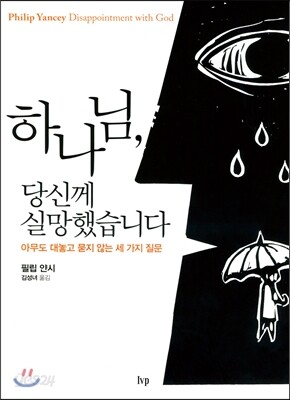
God, I am disappointed in you.
 |
Description
Book Introduction
In moments of disappointment and doubt, three questions dig into our hearts!
The absurd reality that is difficult to explain with the concepts of God learned in church brings about deep doubt and disappointment about God within us.
And in the process, these questions take root within us.
Is God really fair?
Is God silent?
Is God hiding?
In this book, Philip Yancey, a self-proclaimed mentor to skeptics, explores these three questions that plague skeptics more candidly and deeply than anyone else.
Instead of teaching them the answers he knows, he thinks with them and finds the answers.
And through various examples and Bible stories, it guides us to look not only to our suffering or solutions to our problems, but also to God Himself.
It broadens our perspective to see a God who suffers with us and is willing to risk rejection for his love.
The absurd reality that is difficult to explain with the concepts of God learned in church brings about deep doubt and disappointment about God within us.
And in the process, these questions take root within us.
Is God really fair?
Is God silent?
Is God hiding?
In this book, Philip Yancey, a self-proclaimed mentor to skeptics, explores these three questions that plague skeptics more candidly and deeply than anyone else.
Instead of teaching them the answers he knows, he thinks with them and finds the answers.
And through various examples and Bible stories, it guides us to look not only to our suffering or solutions to our problems, but also to God Himself.
It broadens our perspective to see a God who suffers with us and is willing to risk rejection for his love.
- You can preview some of the book's contents.
Preview
index
Volume 1.
God in the Shadows
introduction
Part 1.
Listen to silence
1.
Fatal error
2.
Faith flies away like smoke
3.
A question no one asks outright
4.
If
5.
reason
Part 2.
Connect: Meet the Father
6.
God who takes risks
7.
How to Become a Parent
8.
unfiltered sunlight
9.
A shining moment
10.
Fire and Word
11.
wounded lover
12.
An incredibly beautiful truth
Part 3.
Closer: Son
13.
Come down
14.
Great Legacy
15.
God who hesitates
16.
Postponing a miracle
17.
advance
Part 4.
Delegation of Mission: The Holy Spirit
18.
change
19.
Change in the Wind
20.
At the top
Volume 2.
See in the dark
21.
In the intermission
22.
The only problem
23.
Role in space
24.
Is God unfair?
25.
Why doesn't God explain?
26.
Is God silent?
27.
Why doesn't God intervene?
28.
Is God Hidden?
29.
Why did Job die happily?
30.
Two bettors, two parables
Acknowledgements
References
God in the Shadows
introduction
Part 1.
Listen to silence
1.
Fatal error
2.
Faith flies away like smoke
3.
A question no one asks outright
4.
If
5.
reason
Part 2.
Connect: Meet the Father
6.
God who takes risks
7.
How to Become a Parent
8.
unfiltered sunlight
9.
A shining moment
10.
Fire and Word
11.
wounded lover
12.
An incredibly beautiful truth
Part 3.
Closer: Son
13.
Come down
14.
Great Legacy
15.
God who hesitates
16.
Postponing a miracle
17.
advance
Part 4.
Delegation of Mission: The Holy Spirit
18.
change
19.
Change in the Wind
20.
At the top
Volume 2.
See in the dark
21.
In the intermission
22.
The only problem
23.
Role in space
24.
Is God unfair?
25.
Why doesn't God explain?
26.
Is God silent?
27.
Why doesn't God intervene?
28.
Is God Hidden?
29.
Why did Job die happily?
30.
Two bettors, two parables
Acknowledgements
References
Into the book
Is God hidden? This question, more than anything, was troubling Richard.
He believed that God had to prove himself in some way, and that this was the absolute minimum theological foundation that could never be compromised.
“How can you have a relationship with someone whose existence you can’t even be sure of?” he thought.
It seemed as if God had hidden himself on purpose.
Even from those who diligently sought God, he seemed to be hidden.
He prayed all night but received no answer from God, so he gave up on God. ---Chapter 3.
A question no one asks outright
But does the fact that God spoke clearly make us more likely to obey? Not at all.
God said:
“Do not go up and fight against the Amorites.
Because I will not be with you.
You will be defeated by your enemies.” But the Israelites went up and fought against the Amorites, and were ultimately defeated.
When told to sit still, they went forward; when told to fight, they ran away; when told to proclaim peace, they fought; when told to fight, they proclaimed peace.
The whole nation enjoyed breaking the 613 articles of command.
If unclear guidance was a wound to us, such clear guidance was a wound to them. ---Chapter 4.
If
God spoke back, defending the way he ran the world.
He exploded in anger, shouted, and cried.
And he said this:
I am not silent.
I have spoken through the prophets.
We tend to rank God's revelations according to their dramatic effect.
Flashy appearances are the highest grade, supernatural miracles are the next highest, and the words of prophets are the lowest grade.
For example, the fire on Mount Carmel is more persuasive than Jeremiah's heartbreaking sermon.
But God does not recognize such ranks.
Ironically, God clearly states that the very prophets who questioned His silence were proof that He cares about us.
How can a nation with people like Ezekiel, Jeremiah, Daniel, and Isaiah complain that God is silent?
God did not consider 'mere words' to be inferior evidence to miracles.
In any case, miracles did not have a lasting impact on the faith of the Israelites.
But the prophets were to record God's proposals to the people permanently and pass them on to future generations---Chapter 11.
wounded lover
God steps back.
Hide.
And it cries.
Why? Because what He desires can never be achieved by force.
He is a king who desires love, not submission.
So rather than trying to force through Jerusalem, Rome, and all the worldly powers, he chose the slow and difficult path of incarnation, love, and death.
It was a conquest from within.
George MacDonald summarized Christ's approach:
“He did not trample on the forces of evil with divine power.
He did not enforce justice and destroy the wicked, nor did he bring peace to the earth through the rule of a perfect king.
He did not gather the children of Jerusalem under His wings against their will and save them from all the calamities that tormented Him who had the spirit of a prophet.
Rather, Jesus allowed evil to run wild while it was still alive.
He was content, in a slow and unwelcome way, to help with the essentials: making humans good, and not just controlling but driving out Satan.
To love righteousness is to grow in righteousness, not to be vengeful.… While Christ lived on earth, he resisted the impulse to work hastily for lower-level good.
Even when he saw his old age, purity, and righteousness being trampled upon, he refused that hasty impulse. ---Chapter 15.
God who hesitates
No one is exempt from tragedy or disappointment.
Even God himself was not exempt.
Jesus does not offer us an exemption or escape from injustice.
Rather, it shows us a way to break through the unfairness and move on to the other side.
Just as Good Friday shattered our instinctive belief that life should be fair, the Easter Sunday that followed was a surprising clue to solving the mysteries of the universe.
A bright light shines in the darkness.
The primal yearning for fairness does not die easily, but it must die.
Who among us doesn't yearn for more justice to be spread here and now in this world? I, too, secretly yearn for a "flawless" world that won't disappoint us.
I long for a world where my articles in magazines are always recognized, where my body never ages or becomes weak, where my sister-in-law doesn't have to give birth to a brain-damaged child, and where Peggy Woodson lives a healthy life into old age.
But if I were to place my faith in such a flawless world, that faith would disappoint me.
Even the greatest miracles cannot solve the problems of this world.
Don't people who have experienced healing eventually die someday?
We need more than a miracle.
We need a new heaven and a new earth, and until we get them, injustice will not go away.
He believed that God had to prove himself in some way, and that this was the absolute minimum theological foundation that could never be compromised.
“How can you have a relationship with someone whose existence you can’t even be sure of?” he thought.
It seemed as if God had hidden himself on purpose.
Even from those who diligently sought God, he seemed to be hidden.
He prayed all night but received no answer from God, so he gave up on God. ---Chapter 3.
A question no one asks outright
But does the fact that God spoke clearly make us more likely to obey? Not at all.
God said:
“Do not go up and fight against the Amorites.
Because I will not be with you.
You will be defeated by your enemies.” But the Israelites went up and fought against the Amorites, and were ultimately defeated.
When told to sit still, they went forward; when told to fight, they ran away; when told to proclaim peace, they fought; when told to fight, they proclaimed peace.
The whole nation enjoyed breaking the 613 articles of command.
If unclear guidance was a wound to us, such clear guidance was a wound to them. ---Chapter 4.
If
God spoke back, defending the way he ran the world.
He exploded in anger, shouted, and cried.
And he said this:
I am not silent.
I have spoken through the prophets.
We tend to rank God's revelations according to their dramatic effect.
Flashy appearances are the highest grade, supernatural miracles are the next highest, and the words of prophets are the lowest grade.
For example, the fire on Mount Carmel is more persuasive than Jeremiah's heartbreaking sermon.
But God does not recognize such ranks.
Ironically, God clearly states that the very prophets who questioned His silence were proof that He cares about us.
How can a nation with people like Ezekiel, Jeremiah, Daniel, and Isaiah complain that God is silent?
God did not consider 'mere words' to be inferior evidence to miracles.
In any case, miracles did not have a lasting impact on the faith of the Israelites.
But the prophets were to record God's proposals to the people permanently and pass them on to future generations---Chapter 11.
wounded lover
God steps back.
Hide.
And it cries.
Why? Because what He desires can never be achieved by force.
He is a king who desires love, not submission.
So rather than trying to force through Jerusalem, Rome, and all the worldly powers, he chose the slow and difficult path of incarnation, love, and death.
It was a conquest from within.
George MacDonald summarized Christ's approach:
“He did not trample on the forces of evil with divine power.
He did not enforce justice and destroy the wicked, nor did he bring peace to the earth through the rule of a perfect king.
He did not gather the children of Jerusalem under His wings against their will and save them from all the calamities that tormented Him who had the spirit of a prophet.
Rather, Jesus allowed evil to run wild while it was still alive.
He was content, in a slow and unwelcome way, to help with the essentials: making humans good, and not just controlling but driving out Satan.
To love righteousness is to grow in righteousness, not to be vengeful.… While Christ lived on earth, he resisted the impulse to work hastily for lower-level good.
Even when he saw his old age, purity, and righteousness being trampled upon, he refused that hasty impulse. ---Chapter 15.
God who hesitates
No one is exempt from tragedy or disappointment.
Even God himself was not exempt.
Jesus does not offer us an exemption or escape from injustice.
Rather, it shows us a way to break through the unfairness and move on to the other side.
Just as Good Friday shattered our instinctive belief that life should be fair, the Easter Sunday that followed was a surprising clue to solving the mysteries of the universe.
A bright light shines in the darkness.
The primal yearning for fairness does not die easily, but it must die.
Who among us doesn't yearn for more justice to be spread here and now in this world? I, too, secretly yearn for a "flawless" world that won't disappoint us.
I long for a world where my articles in magazines are always recognized, where my body never ages or becomes weak, where my sister-in-law doesn't have to give birth to a brain-damaged child, and where Peggy Woodson lives a healthy life into old age.
But if I were to place my faith in such a flawless world, that faith would disappoint me.
Even the greatest miracles cannot solve the problems of this world.
Don't people who have experienced healing eventually die someday?
We need more than a miracle.
We need a new heaven and a new earth, and until we get them, injustice will not go away.
---Chapter 24.
Is God unfair?
Is God unfair?
Publisher's Review
Why is life so unfair? Why does God allow injustice and suffering to run rampant in this world?
Come face to face with God with world-renowned bestselling author Philip Yancey!
The life of a Christian after salvation does not unfold like a fairy tale with a happy ending, such as “they lived happily ever after.”
Rather, the conflict between the lofty ideals that we as saved Christians should hold and the evil forces that still dominate the world becomes more intense, and the problems of injustice and suffering become more acute.
Bestselling author Philip Yancey has written about the issues of grace and faith in books such as "God's Amazing Grace" and "Where Is God When We Suffer?" in a way that is different from the traditional approach used in the church.
Unlike the institutional church, which offers uniform, doctrinal answers to every problem, he addresses the spiritual crises and emotional disappointments with God that each of us faces in our lives with sincerity and personality.
Among them, it speaks of God's grace not only appearing in the Bible or in stories of great Christian figures, but also present in the lives of ordinary Christians struggling amidst the inconveniences and structural evils of this world.
First published in the United States in 1988 and still loved by people around the world, "God, I'm Disappointed in You" delves into the subject of disappointment in God, drawing on empathy and understanding, one of Yancey's strengths.
Yancey, who has been a columnist for Christianity Today and other magazines for many years, candidly reveals the frustrating reality that faith cannot be applied to every problem as taught in the church, through the stories of the various people he has met.
He looks at the doubts, skepticism, and despair of those in pain not through the eyes of a critic, but as an empathetic colleague and explorer who searches for answers together.
This book, born from a friendship with a young man named Richard, who was writing a dissertation on the Book of Job, and from observing his doubts and despair about God, reveals the deep doubts that all Christians experience at some point in their journey of faith.
Why does a loving God simply watch us suffer? If God is just, why does evil still run rampant in the world? These uncomfortable questions, posed by modern people, are in fact the very same questions the prophets of the Bible, faced with grim realities, asked God.
The church, which has been struggling with these painful questions that gnaw at our souls and has been giving uniform answers,
Unlike others, God is neither uncomfortable nor silent.
Yancey shows us that God appeared on this earth in the form of a weak human being, a being we can doubt and reject, and answered our questions.
In this book, we meet a God who, for the sake of love, gave up His power, yet because of that humility, He is constantly questioned and rejected by us.
For Christians who want to ask God why the world is so unfair, Yancey helps us realize that God has given us an incredible love that is beyond miracles.
And the very fact that we doubt and are skeptical shows us that it is God's great love that gives us the freedom to reject His love.
Christianity Today Gold Medal Winner, Book of the Year
The Skeptic's Mentor, Philip Yancey, Addresses Disappointment with God Head-on!
Philip Yancey, a writer who writes about doubt and skepticism about God in a way that the public can most easily relate to, addresses issues of faith that Christians have not been able to properly express.
Faced with the church's one-sided teaching that faith alone was the answer to all problems, many Christians tried to deny reality, suppressing their ever-rising doubts and disappointments.
However, Yancey says that doubt and skepticism are normal in the journey of faith and can serve as a stepping stone to maturity and a closer approach to God.
His writings resonate with countless readers around the world because he doesn't simply teach theories or answers found in the Bible, but rather walks the path with all skeptics, guiding them to peer into God's heart.
As you read his writings, you will come across countless people who are disappointed and even angry and turn against God.
He encourages us to see ourselves in God's shoes, including Job and the prophets of the Old Testament who poured out their anger and despair on God, and countless others in this age who cry out about the world's injustice.
This book helps us understand how God feels about the despair and unfairness we face.
Come face to face with God with world-renowned bestselling author Philip Yancey!
The life of a Christian after salvation does not unfold like a fairy tale with a happy ending, such as “they lived happily ever after.”
Rather, the conflict between the lofty ideals that we as saved Christians should hold and the evil forces that still dominate the world becomes more intense, and the problems of injustice and suffering become more acute.
Bestselling author Philip Yancey has written about the issues of grace and faith in books such as "God's Amazing Grace" and "Where Is God When We Suffer?" in a way that is different from the traditional approach used in the church.
Unlike the institutional church, which offers uniform, doctrinal answers to every problem, he addresses the spiritual crises and emotional disappointments with God that each of us faces in our lives with sincerity and personality.
Among them, it speaks of God's grace not only appearing in the Bible or in stories of great Christian figures, but also present in the lives of ordinary Christians struggling amidst the inconveniences and structural evils of this world.
First published in the United States in 1988 and still loved by people around the world, "God, I'm Disappointed in You" delves into the subject of disappointment in God, drawing on empathy and understanding, one of Yancey's strengths.
Yancey, who has been a columnist for Christianity Today and other magazines for many years, candidly reveals the frustrating reality that faith cannot be applied to every problem as taught in the church, through the stories of the various people he has met.
He looks at the doubts, skepticism, and despair of those in pain not through the eyes of a critic, but as an empathetic colleague and explorer who searches for answers together.
This book, born from a friendship with a young man named Richard, who was writing a dissertation on the Book of Job, and from observing his doubts and despair about God, reveals the deep doubts that all Christians experience at some point in their journey of faith.
Why does a loving God simply watch us suffer? If God is just, why does evil still run rampant in the world? These uncomfortable questions, posed by modern people, are in fact the very same questions the prophets of the Bible, faced with grim realities, asked God.
The church, which has been struggling with these painful questions that gnaw at our souls and has been giving uniform answers,
Unlike others, God is neither uncomfortable nor silent.
Yancey shows us that God appeared on this earth in the form of a weak human being, a being we can doubt and reject, and answered our questions.
In this book, we meet a God who, for the sake of love, gave up His power, yet because of that humility, He is constantly questioned and rejected by us.
For Christians who want to ask God why the world is so unfair, Yancey helps us realize that God has given us an incredible love that is beyond miracles.
And the very fact that we doubt and are skeptical shows us that it is God's great love that gives us the freedom to reject His love.
Christianity Today Gold Medal Winner, Book of the Year
The Skeptic's Mentor, Philip Yancey, Addresses Disappointment with God Head-on!
Philip Yancey, a writer who writes about doubt and skepticism about God in a way that the public can most easily relate to, addresses issues of faith that Christians have not been able to properly express.
Faced with the church's one-sided teaching that faith alone was the answer to all problems, many Christians tried to deny reality, suppressing their ever-rising doubts and disappointments.
However, Yancey says that doubt and skepticism are normal in the journey of faith and can serve as a stepping stone to maturity and a closer approach to God.
His writings resonate with countless readers around the world because he doesn't simply teach theories or answers found in the Bible, but rather walks the path with all skeptics, guiding them to peer into God's heart.
As you read his writings, you will come across countless people who are disappointed and even angry and turn against God.
He encourages us to see ourselves in God's shoes, including Job and the prophets of the Old Testament who poured out their anger and despair on God, and countless others in this age who cry out about the world's injustice.
This book helps us understand how God feels about the despair and unfairness we face.
GOODS SPECIFICS
- Date of publication: April 27, 2013
- Page count, weight, size: 339 pages | 478g | 152*212*30mm
- ISBN13: 9788932812953
- ISBN10: 8932812950
You may also like
카테고리
korean


korean

![ELLE 엘르 스페셜 에디션 A형 : 12월 [2025]](http://librairie.coreenne.fr/cdn/shop/files/b8e27a3de6c9538896439686c6b0e8fb.jpg?v=1766436872&width=3840)


