

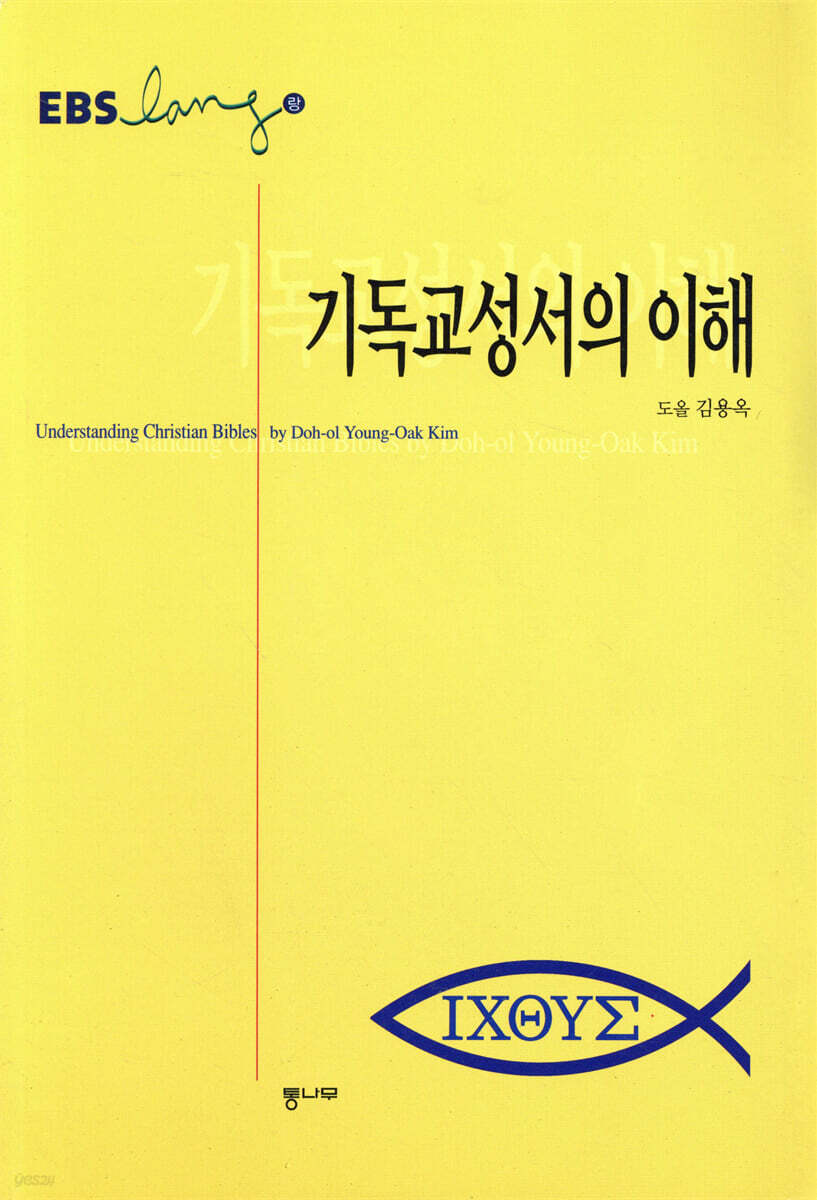
Understanding the Christian Bible
 |
Description
Book Introduction
Since entering Korea Theological Seminary in 1967, author Dool has spent the past 40 years studying every possible foundation of Christian theology, developing insights that integrate reason and faith, nature and the supernatural, and analyzing all aspects of the Christian Bible.
The contents of this book are filled only with very basic facts that reveal what the church and the Bible were like in the history of the early Christian movement from the 1st to the 4th centuries.
The contents of this book are filled only with very basic facts that reveal what the church and the Bible were like in the history of the early Christian movement from the 1st to the 4th centuries.
index
Chapter 1: The Miracles of Jesus
The agony of a scientific worldview
Characteristics of Jesus' miracles
Six Meaningful Contexts of Transfer
Chapter 2 Myth and Philosophy
The mythological worldview of the Greeks
Orpheus and Bacchus
Pythagoras and Siddhartha
The Meaning of Alexander the Great's Conquest of the World
Chapter 3: Hellenistic Thought
Ataraxia
Cynic values
Stoic thought
Epicurean school
skepticism
Apostle Paul's Challenge
Chapter 4: Until Constantine's Recognition
Two Major Events in Biblical Archaeology: Qumran and Nag Hammadi
Qumran and Essenes
The historical significance of the Qumran excavations
Alexandria
Modern History of Jesus
Jews of Alexandria
Septuagint: A Text from the Old Testament
Septuagint and Qumran Texts
Pax Romana and the Early Church
The truth about Nero's persecution
Resources for Martyrdom
Edict of Milan
Emperorism and Monotheism
Chapter 5: The Trinity Controversy
The beginning of the dark Middle Ages
Arius of Alexandria
Neoplatonism
Arius's anthropology of Jesus
The dangers of hypothetical theory
Homousion
General sentiment of the Eastern Church
Athanasius
The Identity of the Trinity
The Trinity is an unbiblical argument
God the Father cannot exist
Absoluteness of relationships
The concept of substance has nothing to do with Christianity.
Christianity is not a religion of the emperor.
It's not even ontology
Chapter 6: The Christian Movement of Proportions
Rediscovering Early Church History: Nag Hammadi
Coptic Christian
Coptic
Formative Christianity: No Exclusivity
What is a spirit?
Paul's problem awareness
The Reality of Paul's Missionary Journeys
The Judaizing Problem in the Early Church
Circumcision and Christians
The political and historical context of the Messiah
Paul's Ambivalence
Goodbye, Judaism: God's Righteousness
Chapter 7: The Appearance of Marcion
Jewish denial of the Bible
Old and New Testaments
Early Christianity without the Bible
Literary Forms of the New Testament
The difficulty of standing alone
The red logic of spiritualism
Disconnection from the Old Testament
Marcion's worldview
Docetism
The result of the scandal
Marcion Community
Marcion Church in Syria
Old Testament vs. New Testament: Apostolikon
The Selection of the Gospel of Luke: The International Character
Marcion's Canon: The First Moment of Canonization
The Bible was editable by anyone.
The early church had no Bible.
Muratori Jeonggyeong
The beginning of the Catholic Church's canonization process
Jesus' works
Jesus' words
Buddha and Jesus
People who follow Jesus
Christianity was not a scripture religion.
Paul's view of Jesus
What Paul left behind
Marcion's 11-Writing System
The formation of a thesis is faster than that of a scripture.
Stage 1 and Stage 3
Jesus's Dharma Body and Color Body
The beginning of Mahayana Buddhism
Chapter 8: The Appearance of the Gospels
The Gospel and Mahayana Christianity
A human named Maga
The literary genre of the Gospel and Greek tragedy
Logion and the Analects
The public position of fraud
The process of forming aphorisms
The Gospel of Mark and Confucius
Mark's depiction of Jesus in color
kerygma
intended ending
The core of Mark's Gospel
Passion Gospel
A smash hit
Paul and Jesus
Saul's conversion experience
The Apostle Paul and the Arabian Desert
Paul's apostolic authority is independent of Jesus' disciples.
The uniqueness of Paul's vision
Traditions and Gospel Forms of the Church of Jerusalem
Masada Fortress
The Writing of the Gospel of Mark and the Sorrows of the Israelites
Jesus had no self-awareness as the Messiah.
Jesus in the Gospel of John
The Pharisees after the destruction of the Temple in Jerusalem
Bar Kokhba
Rabbi Akiva
Diaspora's fate
Chapter 9: Recitation Culture and the Gospel
Basic facts
Physical Facts of the Gospel Writing: Paper
Parchment and papyrus
The Holy Spirit, ignorant of the facts, only promotes human prejudice.
Visual and auditory literature
The actual circumstances of the letter
Kerix
Church in the Culture of Recitation
Timothy is also a singer
Pansori and the Gospel
Simcheong's Cross
The Gospel of Mark was recited
Evidence from the Gospel of Mark itself for the recitation of the Gospel of Mark
Recitation Literature: The Book of Revelation Fantasia
The crossroads of betrayal and martyrdom
The transmission style of Sanjo and the transmission style of the Gospel
Big Hit Mark
The Golden Age of Euangelion
Space Gospel
Matthew and Luke are more popular than Mark
Mark's honesty
Formation of tradition
Harmony between public facts and traditional discourse
Israeli social hierarchy
The story of the birth of the Virgin Mary and the story of her birth
Misquotation: Unrelated to Isaiah's prophecy
The virgin is a young woman
Almaa and Parthenos
From context to text
Woman! Distance from home
Maria is not a virgin anyway
James and Jesus
Distortion of the Bible
Maria Cult
Removal of the birth story from the Gospel of John
Jesus' patrilineal genealogy and the virgin birth that denied his patrilineage
Koreans who are well-versed in genealogy: Why do they have problems with Biblical genealogy?
Two completely different genealogies, starting from the grandfather
The world's census
There can be no census of the place of origin
The Fiction of Herod's Infanticide and Matthew's Concerns
The essential nature of kerygma
The Form of the Kerygma
Deconstruction of the Bible
Date of Writing of the Four Gospels
Mark's attitude toward collecting data
Chapter 10: Matthew and Luke
The Gospel of Matthew as a Fulfillment of the Old Testament
Luke's world-historical horizon
Oral and Seon traditions
Who is Theophilus?
This is not a letter format for one person to read.
Theophilus, the lover of God
Tribute Operation
Luke's international sensibility language
The Universalism of Paul and Luke
Korea's first Korean-language Bible
Dinner table in the heart of the city
Chapter 11: The Gospel of John and Logos Christology
Christianity Breaks Away from Judaism: AD 100
The wise old man of Ephesus
Mixed elements of Gnosticism
symposium
The decadence of the Greek gods
Towards the pinnacle of Mahayana Christianity
Horizon of the 4th stage
Logos Christology
Gnosticism cannot be embodied
Common uses of logos
Words and the World
Einstein as the embodiment of Logos
Incarnation of the Logos
The absolute other that breaks time and space
Details of the scene where Lazarus is raised
It cannot be the emotion of the body
Fact or fiction
The Lazarus of Siberia
In modern times, it is possible to sue a pastor who forces miracles into reality.
7 matrices
Jesus' path
Leader of the international city of Jerusalem
Beyond the family line
The first appearance of the temple purification incident
John read all three gospels.
Reinterpreting the Second Coming
Jesus was not allowed to enter the temple.
I am… (ego Amy) discourse
The originality and historicity of the Johannine materials
Three People Who Shaped Early Christianity
Only the recognition of facts is revolutionary
Religion is not hate
Chapter 12: Diatessaron and Montanism
After Constantine and after Emperor Wu of Han
Pope and Emperor
Diatessaron
Tatian
God's mind and human reason are one
Socrates was also a Christian
Do not keep the Law of Moses
The Influence of the Gospel of John
The dichotomy between reason and faith is heresy and error.
After Justin's martyrdom
Montanism and the Pyeongchang-dong Rapture Sect
Algorithm
The barbarism of spiritualism, adventism, and asceticism
Algorithm
The barbarism of spiritualism, adventism, and asceticism
Chapter 13: Athanasius' Easter Message
- An era without canonical or apocryphal scriptures -
Alexandria, AD 367
Gibbon's technology
The orthodoxy of today is the heresy of the past
Without orthodoxy, there is no heresy.
There is no standard in terms of content.
The one with the loudest voice is the one with the most authority
Support of the Roman Catholic Church
Use of the Old Testament
The conservatism of the Roman Catholic Church and the 27 Letters System
Athanasius's study in Rome
Constantine's three sons and four nephews
Constance and Athanasius
Constantius and Athanasius
The Glory and Passion of Athanasius
The tragic meaning of the word paganism
Julian, the fair emperor, not an apostate
Monopoly of faith
Julian's life turnaround
Restoration of beautiful indigenous traditions
The End of Julian
Jesus' words and human language
Martyrdom is a glory, not a fear.
The nature of the Greek temple: the absence of a full-time priesthood
Inter-worldly religion
The development of a professional clergy class: Christianity
Constantine's groundbreaking favoritism of Christians
The collapse of Roman society
Order to close Greek and Roman temples
The vested interests of the Trinity debate
Athanasius's Magnificent Entry: Easter Message
27 Books and Tripitaka: Sutras, Vinaya, and Treatises
Differences in Buddhist and Christian positions on the editing of scriptures
A complete collection, not a compilation
The meaning of canon
Chapter 14 Jerome's Latin Vulgate
After Athanasius
Syrian churches' opposition
Luther's position
A new understanding of the literature called the Bible
There is no single authentic Greek Bible.
For the King James Bible
There is no fixed version
Eusebius Jerome
Jerome's Dream
The Life of a Great Translator Through Dream Revelation
The emergence of Latin manuscripts
Jerome's Bible Class
Jerome settled in Bethlehem
Blasphemy of the Holy Spirit Sect
Jerome and Augustine
Council of Trent
The popularization of the Bible is the work of the runner.
Later than 『Saseojipju』
Propositions and Words
Chapter 15: Egyptian Religious Ideas
Schistosoma
Coptic-speaking Christians
Monk-centered
A mixture of cultural traditions
eclecticism
Tolerance of sun worship
Osiris cult
Chaos and Order
The truth of the afterlife
Maat
Jesus' optimism
Arc
Moses, the founder of Yahwehism, grew up in Egyptian religious tradition.
Chapter 16: Monastic Culture in the Nile Valley
- Antony and Pachomius
The origins of monasticism
Denial of Jesus' worldly values
Exploited Palestinian Farmers and Jesus
Jesus' view of food and drink
Denial of Secular Values: Buddhism and Christianity
Lay movement
Anthony's Life
The reunion of Pachomius and Athanasius
The first Christian monastery in human history
Hegumen
Constantius's persecution of Athanasius
Protection of Pachomius
Books seen by the monks of Pachomius
Get rid of the external world
Library Concealment
Chapter 17: The Curse and Blessing of Sabbath
- Discovery of the Nag Hammadi Documents -
Shivak Hunting
Fear of Jin
Untie and roll up one's turban
Family Feud
Tinder
Elijah's barbarism
Swapping cigarettes for tangerines
In the case of the 3rd Codex
Tano and Datari
For the first codex
Complete list of Nag Hammadi libraries
Chapter 18: Epilogue
The Chronic Waiting for the Process of Polishing: The Continuity of Qumran and Nag Hammadi
The Importance of the Gospel of Thomas
This book is the preface to 『Commentary on the Gospel of John』
my parents
Virgin of Zion
Search
The agony of a scientific worldview
Characteristics of Jesus' miracles
Six Meaningful Contexts of Transfer
Chapter 2 Myth and Philosophy
The mythological worldview of the Greeks
Orpheus and Bacchus
Pythagoras and Siddhartha
The Meaning of Alexander the Great's Conquest of the World
Chapter 3: Hellenistic Thought
Ataraxia
Cynic values
Stoic thought
Epicurean school
skepticism
Apostle Paul's Challenge
Chapter 4: Until Constantine's Recognition
Two Major Events in Biblical Archaeology: Qumran and Nag Hammadi
Qumran and Essenes
The historical significance of the Qumran excavations
Alexandria
Modern History of Jesus
Jews of Alexandria
Septuagint: A Text from the Old Testament
Septuagint and Qumran Texts
Pax Romana and the Early Church
The truth about Nero's persecution
Resources for Martyrdom
Edict of Milan
Emperorism and Monotheism
Chapter 5: The Trinity Controversy
The beginning of the dark Middle Ages
Arius of Alexandria
Neoplatonism
Arius's anthropology of Jesus
The dangers of hypothetical theory
Homousion
General sentiment of the Eastern Church
Athanasius
The Identity of the Trinity
The Trinity is an unbiblical argument
God the Father cannot exist
Absoluteness of relationships
The concept of substance has nothing to do with Christianity.
Christianity is not a religion of the emperor.
It's not even ontology
Chapter 6: The Christian Movement of Proportions
Rediscovering Early Church History: Nag Hammadi
Coptic Christian
Coptic
Formative Christianity: No Exclusivity
What is a spirit?
Paul's problem awareness
The Reality of Paul's Missionary Journeys
The Judaizing Problem in the Early Church
Circumcision and Christians
The political and historical context of the Messiah
Paul's Ambivalence
Goodbye, Judaism: God's Righteousness
Chapter 7: The Appearance of Marcion
Jewish denial of the Bible
Old and New Testaments
Early Christianity without the Bible
Literary Forms of the New Testament
The difficulty of standing alone
The red logic of spiritualism
Disconnection from the Old Testament
Marcion's worldview
Docetism
The result of the scandal
Marcion Community
Marcion Church in Syria
Old Testament vs. New Testament: Apostolikon
The Selection of the Gospel of Luke: The International Character
Marcion's Canon: The First Moment of Canonization
The Bible was editable by anyone.
The early church had no Bible.
Muratori Jeonggyeong
The beginning of the Catholic Church's canonization process
Jesus' works
Jesus' words
Buddha and Jesus
People who follow Jesus
Christianity was not a scripture religion.
Paul's view of Jesus
What Paul left behind
Marcion's 11-Writing System
The formation of a thesis is faster than that of a scripture.
Stage 1 and Stage 3
Jesus's Dharma Body and Color Body
The beginning of Mahayana Buddhism
Chapter 8: The Appearance of the Gospels
The Gospel and Mahayana Christianity
A human named Maga
The literary genre of the Gospel and Greek tragedy
Logion and the Analects
The public position of fraud
The process of forming aphorisms
The Gospel of Mark and Confucius
Mark's depiction of Jesus in color
kerygma
intended ending
The core of Mark's Gospel
Passion Gospel
A smash hit
Paul and Jesus
Saul's conversion experience
The Apostle Paul and the Arabian Desert
Paul's apostolic authority is independent of Jesus' disciples.
The uniqueness of Paul's vision
Traditions and Gospel Forms of the Church of Jerusalem
Masada Fortress
The Writing of the Gospel of Mark and the Sorrows of the Israelites
Jesus had no self-awareness as the Messiah.
Jesus in the Gospel of John
The Pharisees after the destruction of the Temple in Jerusalem
Bar Kokhba
Rabbi Akiva
Diaspora's fate
Chapter 9: Recitation Culture and the Gospel
Basic facts
Physical Facts of the Gospel Writing: Paper
Parchment and papyrus
The Holy Spirit, ignorant of the facts, only promotes human prejudice.
Visual and auditory literature
The actual circumstances of the letter
Kerix
Church in the Culture of Recitation
Timothy is also a singer
Pansori and the Gospel
Simcheong's Cross
The Gospel of Mark was recited
Evidence from the Gospel of Mark itself for the recitation of the Gospel of Mark
Recitation Literature: The Book of Revelation Fantasia
The crossroads of betrayal and martyrdom
The transmission style of Sanjo and the transmission style of the Gospel
Big Hit Mark
The Golden Age of Euangelion
Space Gospel
Matthew and Luke are more popular than Mark
Mark's honesty
Formation of tradition
Harmony between public facts and traditional discourse
Israeli social hierarchy
The story of the birth of the Virgin Mary and the story of her birth
Misquotation: Unrelated to Isaiah's prophecy
The virgin is a young woman
Almaa and Parthenos
From context to text
Woman! Distance from home
Maria is not a virgin anyway
James and Jesus
Distortion of the Bible
Maria Cult
Removal of the birth story from the Gospel of John
Jesus' patrilineal genealogy and the virgin birth that denied his patrilineage
Koreans who are well-versed in genealogy: Why do they have problems with Biblical genealogy?
Two completely different genealogies, starting from the grandfather
The world's census
There can be no census of the place of origin
The Fiction of Herod's Infanticide and Matthew's Concerns
The essential nature of kerygma
The Form of the Kerygma
Deconstruction of the Bible
Date of Writing of the Four Gospels
Mark's attitude toward collecting data
Chapter 10: Matthew and Luke
The Gospel of Matthew as a Fulfillment of the Old Testament
Luke's world-historical horizon
Oral and Seon traditions
Who is Theophilus?
This is not a letter format for one person to read.
Theophilus, the lover of God
Tribute Operation
Luke's international sensibility language
The Universalism of Paul and Luke
Korea's first Korean-language Bible
Dinner table in the heart of the city
Chapter 11: The Gospel of John and Logos Christology
Christianity Breaks Away from Judaism: AD 100
The wise old man of Ephesus
Mixed elements of Gnosticism
symposium
The decadence of the Greek gods
Towards the pinnacle of Mahayana Christianity
Horizon of the 4th stage
Logos Christology
Gnosticism cannot be embodied
Common uses of logos
Words and the World
Einstein as the embodiment of Logos
Incarnation of the Logos
The absolute other that breaks time and space
Details of the scene where Lazarus is raised
It cannot be the emotion of the body
Fact or fiction
The Lazarus of Siberia
In modern times, it is possible to sue a pastor who forces miracles into reality.
7 matrices
Jesus' path
Leader of the international city of Jerusalem
Beyond the family line
The first appearance of the temple purification incident
John read all three gospels.
Reinterpreting the Second Coming
Jesus was not allowed to enter the temple.
I am… (ego Amy) discourse
The originality and historicity of the Johannine materials
Three People Who Shaped Early Christianity
Only the recognition of facts is revolutionary
Religion is not hate
Chapter 12: Diatessaron and Montanism
After Constantine and after Emperor Wu of Han
Pope and Emperor
Diatessaron
Tatian
God's mind and human reason are one
Socrates was also a Christian
Do not keep the Law of Moses
The Influence of the Gospel of John
The dichotomy between reason and faith is heresy and error.
After Justin's martyrdom
Montanism and the Pyeongchang-dong Rapture Sect
Algorithm
The barbarism of spiritualism, adventism, and asceticism
Algorithm
The barbarism of spiritualism, adventism, and asceticism
Chapter 13: Athanasius' Easter Message
- An era without canonical or apocryphal scriptures -
Alexandria, AD 367
Gibbon's technology
The orthodoxy of today is the heresy of the past
Without orthodoxy, there is no heresy.
There is no standard in terms of content.
The one with the loudest voice is the one with the most authority
Support of the Roman Catholic Church
Use of the Old Testament
The conservatism of the Roman Catholic Church and the 27 Letters System
Athanasius's study in Rome
Constantine's three sons and four nephews
Constance and Athanasius
Constantius and Athanasius
The Glory and Passion of Athanasius
The tragic meaning of the word paganism
Julian, the fair emperor, not an apostate
Monopoly of faith
Julian's life turnaround
Restoration of beautiful indigenous traditions
The End of Julian
Jesus' words and human language
Martyrdom is a glory, not a fear.
The nature of the Greek temple: the absence of a full-time priesthood
Inter-worldly religion
The development of a professional clergy class: Christianity
Constantine's groundbreaking favoritism of Christians
The collapse of Roman society
Order to close Greek and Roman temples
The vested interests of the Trinity debate
Athanasius's Magnificent Entry: Easter Message
27 Books and Tripitaka: Sutras, Vinaya, and Treatises
Differences in Buddhist and Christian positions on the editing of scriptures
A complete collection, not a compilation
The meaning of canon
Chapter 14 Jerome's Latin Vulgate
After Athanasius
Syrian churches' opposition
Luther's position
A new understanding of the literature called the Bible
There is no single authentic Greek Bible.
For the King James Bible
There is no fixed version
Eusebius Jerome
Jerome's Dream
The Life of a Great Translator Through Dream Revelation
The emergence of Latin manuscripts
Jerome's Bible Class
Jerome settled in Bethlehem
Blasphemy of the Holy Spirit Sect
Jerome and Augustine
Council of Trent
The popularization of the Bible is the work of the runner.
Later than 『Saseojipju』
Propositions and Words
Chapter 15: Egyptian Religious Ideas
Schistosoma
Coptic-speaking Christians
Monk-centered
A mixture of cultural traditions
eclecticism
Tolerance of sun worship
Osiris cult
Chaos and Order
The truth of the afterlife
Maat
Jesus' optimism
Arc
Moses, the founder of Yahwehism, grew up in Egyptian religious tradition.
Chapter 16: Monastic Culture in the Nile Valley
- Antony and Pachomius
The origins of monasticism
Denial of Jesus' worldly values
Exploited Palestinian Farmers and Jesus
Jesus' view of food and drink
Denial of Secular Values: Buddhism and Christianity
Lay movement
Anthony's Life
The reunion of Pachomius and Athanasius
The first Christian monastery in human history
Hegumen
Constantius's persecution of Athanasius
Protection of Pachomius
Books seen by the monks of Pachomius
Get rid of the external world
Library Concealment
Chapter 17: The Curse and Blessing of Sabbath
- Discovery of the Nag Hammadi Documents -
Shivak Hunting
Fear of Jin
Untie and roll up one's turban
Family Feud
Tinder
Elijah's barbarism
Swapping cigarettes for tangerines
In the case of the 3rd Codex
Tano and Datari
For the first codex
Complete list of Nag Hammadi libraries
Chapter 18: Epilogue
The Chronic Waiting for the Process of Polishing: The Continuity of Qumran and Nag Hammadi
The Importance of the Gospel of Thomas
This book is the preface to 『Commentary on the Gospel of John』
my parents
Virgin of Zion
Search
GOODS SPECIFICS
- Date of issue: March 4, 2007
- Pages, weight, size: 479 pages | 778g | 153*224*30mm
- ISBN13: 9788982641114
- ISBN10: 8982641114
You may also like
카테고리
korean


korean

![GQ KOREA Mark (Monthly): December [2025]](http://librairie.coreenne.fr/cdn/shop/files/8ef265dbbfbf186523ed75ba7319009d.jpg?v=1765340328&width=3840)


