

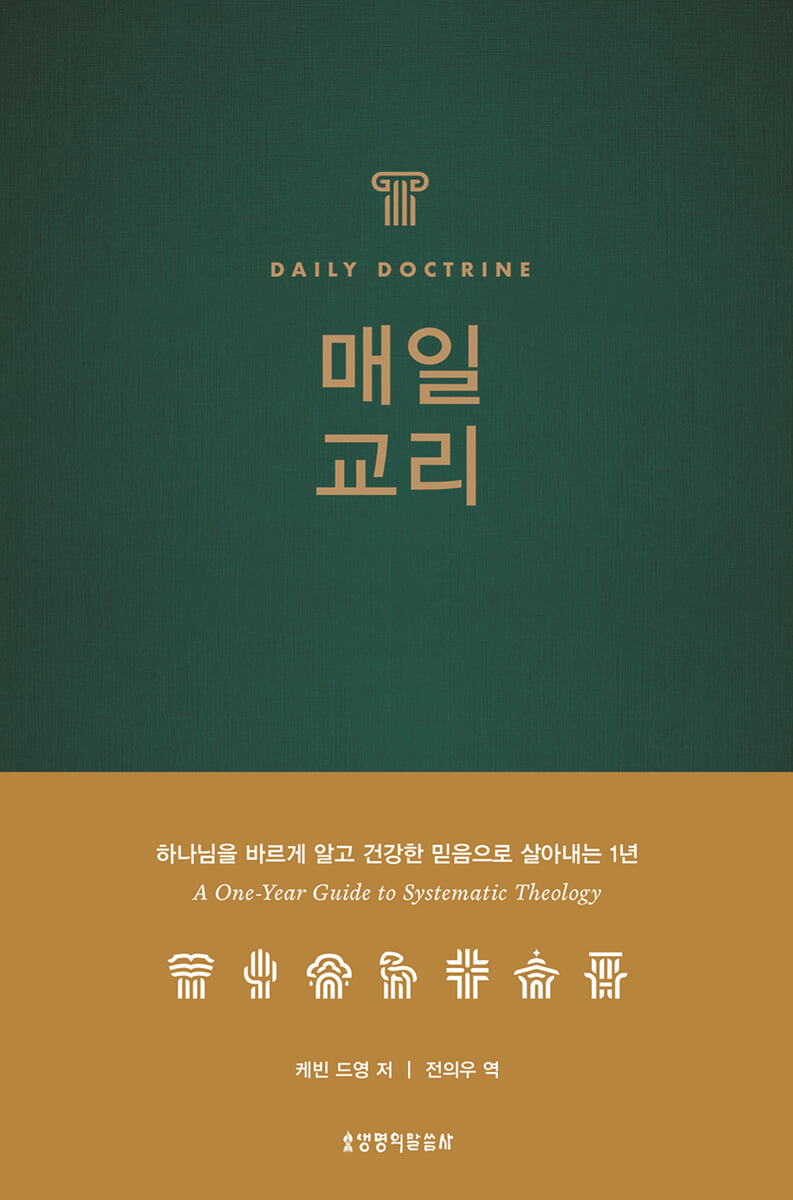
Daily Doctrine
 |
Description
Book Introduction
Highly recommended: Joel Beeke, Carl Trueman, Albert Mohler, Kevin Benhoozer, Michael Horton, Paul Park (Hapshin University), Jae-eun Park (Chongshin University), Chang-hee Seo (Hansaram Church), Shin Ho-seop (Kosin University), Jeong-gyu Lee (Sigwang Church), and Jeong-hyeon Lee (Cheongam Church)!
Doctrine is not the exclusive domain of theologians and pastors.
Every Christian's life of faith begins daily with doctrine.
Do you have healthy doctrines in your heart, in your day, and on your bookshelf?
Kevin DeYoung, one of the most influential and trusted young theologians and pastors in the evangelical and reformed camps, has published a year-long meditation collection that clearly and concisely summarizes the concepts that every Christian "must know."
The high-quality fabric suit cover enhances the joy of owning, opening, and giving.
Doctrine is not the exclusive domain of theologians and pastors.
Every Christian's life of faith begins daily with doctrine.
Do you have healthy doctrines in your heart, in your day, and on your bookshelf?
Kevin DeYoung, one of the most influential and trusted young theologians and pastors in the evangelical and reformed camps, has published a year-long meditation collection that clearly and concisely summarizes the concepts that every Christian "must know."
The high-quality fabric suit cover enhances the joy of owning, opening, and giving.
- You can preview some of the book's contents.
Preview
index
Recommendation
Entering
Prolegomena: Forethought and Biblical Theory
WEEK 1
DAY 1 Theology
DAY 2 Systematic Theology
DAY 3 Theological Distinctions
DAY 4 Religion
DAY 5 SCIENCE
WEEK 2
DAY 6 Speculative or Practical?
DAY 7 Ad Fontes
DAY 8 Principia
DAY 9 Faith and Reason
DAY 10 The Inner Witness of the Holy Spirit
WEEK 3
DAY 11 Basic Items
DAY 12 Knowledge of God
DAY 13 Natural Law and Natural Theology
DAY 14 GENERAL AND SPECIAL REVELATION
DAY 15 INSPIRATION
WEEK 4
DAY 16 Collaboration
DAY 17 THE COMPLETENESS OF THE BIBLE
DAY 18 THE INERRANCY OF THE BIBLE
DAY 19: The Political Problem
DAY 20 Which book fits the Bible?
Theology: God's Existence and God's Work
WEEK 5
DAY 21 The Existence of God
DAY 22 Can You Know God?
DAY 23 Words Used for God
DAY 24 The Unity of God
DAY 25 God the Spirit
WEEK 6
DAY 26 God's Name
DAY 27 God's Attributes
DAY 28 Non-shared and shared properties
DAY 29: Substance and Chance
DAY 30 Christian Theology and Greco-Roman Philosophy
WEEK 7
DAY 31 God's Simplicity
DAY 32 God's Self-Existence
DAY 33 God's Infinity
DAY 34 God's Immutability
DAY 35 God's Insensibility
WEEK 8
DAY 36 The New Passion and the Passion of the Father
DAY 37 Intellectual Attributes
DAY 38 Volitional Attributes
DAY 39 Attributes of Abilities
DAY 40 Transcendence and Immanence
WEEK 9
DAY 41 The Trinity
DAY 42 THE BIBLE AND THE TRINITY
DAY 43 Trinity Terminology
DAY 44 One and Three
DAY 45 Eternal Birth
WEEK 10
DAY 46 Filioque Clause
DAY 47 Perichoresis
DAY 48 Taxis
DAY 49 Indivisible Activities
DAY 50 Our Trinity and the Christian Life
WEEK 11
DAY 51 God's Plan
DAY 52 God's Will
DAY 53 Freedom of Will
DAY 54 God's Permission
DAY 55 CHOICE AND ABOVE
WEEK 12
DAY 56 Is the schedule fair?
DAY 57 Order of Resolution
DAY 58 Amirutism
DAY 59 Intermediate Knowledge
DAY 60 Preaching the Gospel and God's Sovereignty
WEEK 13
DAY 61 Our Creator God
DAY 62 Creation from Nothing
DAY 63 Days of Creation
DAY 64 The Historical Adam
DAY 65 God's Purpose in Creating the World
WEEK 14
DAY 66 ANGEL
DAY 67 Ghost
DAY 68 Providence
DAY 69 Miracle
DAY 70 PRAYER
Anthropology: Creation and Fall of Man
WEEK 15
DAY 71 The Created Being and the Peak
DAY 72 People, Body and Soul
DAY 73 Where does our soul come from?
DAY 74 Ability Psychology
DAY 75 Man and Woman
WEEK 16
DAY 76 MARRIAGE
DAY 77 Transgenderism
DAY 78 The Image of God
DAY 79 What does it mean to be created in the image of God?
DAY 80 What does it mean to be created in the image of God?
WEEK 17
DAY 81 The Nature of Sin
DAY 82 THE ORIGIN OF SIN
DAY 83 The Transmission of Sin
DAY 84 Total Incompetence
DAY 85 The Fourfold State of Human Nature
WEEK 18
DAY 86 Are all sins equal in God's eyes?
DAY 87 A More Heinous Sin
DAY 88 Lust
DAY 89 Temptation
DAY 90 What difference does the doctrine of sin make?
Covenant Theology: How Does God Treat His Creation?
WEEK 19
DAY 91 The Covenant is Central
DAY 92 DEFINITION OF THE COVENANT
DAY 93 Berith and Diadeke
DAY 94 Worship as Covenant Renewal
DAY 95 Covenant of Redemption
WEEK 20
DAY 96 COVENANT OF WORKS
DAY 97 THE COVENANT OF GRACE
DAY 98 Noah's Covenant
DAY 99 The Abrahamic Covenant
DAY 100 The Mosaic Covenant
WEEK 21
DAY 101 Re-announcement
DAY 102 THE DAVIDIC COVENANT
DAY 103 THE NEW COVENANT
DAY 104 Because my father ate sour grapes
DAY 105 The Newness of the New Covenant
WEEK 22
DAY 106 The Law and the Christian
DAY 107 The Threefold Distinction of the Law
DAY 108 Generationism
DAY 109 BAPTIST COVENANT THEOLOGY
DAY 110 The Israel of God
Christology 1: The Person of Christ
WEEK 23
DAY 111 Logos
DAY 112 The Birth of the Virgin
DAY 113 Messianic Prophecy
DAY 114 The Names and Titles of Jesus
DAY 115 Jesus' Self-Testimony
WEEK 24
DAY 116 Autotheos
DAY 117 THE DIVINITY OF CHRIST
DAY 118 The Humanity of Christ
DAY 119 Becoming the Eternal Son
DAY 120 The Incarnation
WEEK 25
DAY 121 Hypostatic Union
DAY 122 Communicatio Idiomatum
DAY 123 How are the two natures connected?
DAY 124 Extra Calvinisticum
DAY 125 Christological Heresies
WEEK 26
DAY 126 Arianism
DAY 127 The Hypothesis
DAY 128 Nestorianism
DAY 129 Eutychesism
DAY 130 The Chalcedonian Creed
WEEK 27
DAY 131 “Whatever is not taken cannot be healed.”
DAY 132 Christ's Divine Self-Consciousness
DAY 133 Kenosis
DAY 134 Holy Spirit Christology
DAY 135 The Impossibility of Crime
Christology 2: The Ministry of Christ
WEEK 28
DAY 136 Two States
DAY 137 Incarnation and Suffering
DAY 138 Cries of Abandonment
DAY 139 Death and Burial
DAY 140 Descent into Hell
WEEK 29
DAY 141 Resurrection
DAY 142 Ascension
DAY 143 Sitting
DAY 144 The Second Coming
DAY 145 THE PROPHET
WEEK 30
DAY 146 Priest
DAY 147 The King
DAY 148 The Kingdom of Christ
DAY 149 What is Atonement?
DAY 150 The Need for Atonement
WEEK 31
DAY 151 The Perfection of the Atonement
DAY 152 Atonement 1
DAY 153 Atonement 2
DAY 154 OBEDIENCE AND CONQUEST
DAY 155 Reconciliation and Redemption
WEEK 32
DAY 156 Sacrifice and Satisfaction
DAY 157 Atonement and Peace Offering
DAY 158 LIMITED Atonement
DAY 159 Dort and the Final Atonement
DAY 160 He was wounded for our sins
Soteriology: Salvation in Christ
WEEK 33
DAY 161 Ordo Salutis
DAY 162 The Ministry of the Holy Spirit 1
DAY 163 The Ministry of the Holy Spirit 2
DAY 164 Union with Christ
DAY 165 General Calling
WEEK 34
DAY 166 A Valid Calling
DAY 167 Irresistible Grace
DAY 168 Rebirth
DAY 169 Solo Theory
DAY 170 Conversion
WEEK 35
DAY 171 REPENTANCE
DAY 172 FAITH
DAY 173 Acts of Faith
DAY 174 Faith and Confidence
DAY 175 JUSTIFICATION
WEEK 36
DAY 176 Transfer
DAY 177 Solar Fide
DAY 178 Are James and Paul contradictory?
DAY 179 Should We Accept a 'New Perspective' on Paul?
DAY 180 Time and Additional Elements
WEEK 37
DAY 181 Adoption
DAY 182 How is sanctification different from justification?
DAY 183 Three Uses of the Law
DAY 184 Trust and Effort
DAY 185 Good Deeds and Salvation
WEEK 38
DAY 186 Good Deeds and Believers
DAY 187 Good Deeds and Merit
DAY 188 Towing
DAY 189 WARNING PASSAGE
DAY 190 Movie
Ecclesiology: The Nature, Mission, and Order of the Church
WEEK 39
DAY 191 CHURCH
DAY 192 The Essence of the Church
DAY 193 Unity
DAY 194 Holiness
DAY 195 Universality
WEEK 40
DAY 196 Apostolic
DAY 197 Church Sign
DAY 198 Sermon
DAY 199 Church Members
DAY 200 Church and State
WEEK 41
DAY 201 The Nature and Scope of Church Authority
DAY 202 State Church and Free Church Principles
DAY 203 Freedom of Conscience
DAY 204 Regulatory Principles
DAY 205 The Church's Mission
WEEK 42
DAY 206 Essential and Mediatory Rule
DAY 207 The Spiritual Nature of the Church
DAY 208 Neurology and Confession of Faith
DAY 209 THE GIFTS OF THE HOLY SPIRIT
DAY 210 The Gift of Miracles
WEEK 43
DAY 211 Baptism of the Holy Spirit
DAY 212 Filled with the Holy Spirit
DAY 213 Calling
DAY 214 The Means of Grace
DAY 215 Semper Reformanda
WEEK 44
DAY 216 The Sacrament
DAY 217 How many sacraments are there?
DAY 218 Baptism
DAY 219 Who is baptized?
DAY 220 Baptism
WEEK 45
DAY 221 What does baptism signify?
DAY 222 Who Can Baptize?
DAY 223 How many times should one be baptized?
DAY 224 The Lord's Supper
DAY 225 Real Presence
WEEK 46
DAY 226 Table or Altar?
DAY 227 Who Should Receive the Lord's Supper?
DAY 228 Church Members
DAY 229 CHURCH DISCIPLINE
DAY 230 The Offices of the New Testament Church
WEEK 47
DAY 231 Service
DAY 232 What are the positions in the church?
DAY 233 Elder
DAY 234 Butler
DAY 235 Does God Command a Particular Form of Church Government?
WEEK 48
DAY 236 Does the Pope Rule the Church?
DAY 237 Do Bishops Rule the Church?
DAY 238 Does the congregation govern the church?
DAY 239 Do elders rule the church?
DAY 240 Dignified and Orderly
Eschatology: The Last Things
WEEK 49
DAY 241 Death and Hell
DAY 242 Hell, God's Punishment
DAY 243 Universal Salvation
DAY 244 Extinction Theory
DAY 245 Inclusivity
WEEK 50
DAY 246 Do believers go to heaven when they die?
DAY 247 Intermediate State
DAY 248 Judgment According to Actions
DAY 249 Heavenly Rewards
DAY 250 What is heaven like?
WEEK 51
DAY 251 Partial Past
DAY 252 THE GREAT TRIBULATION
DAY 253 144,000
DAY 254 666
DAY 255 All Israel will be saved
WEEK 52
DAY 256 The Millennium
DAY 257 When will the Millennium come?
DAY 258 What does it mean that Satan will be bound for a thousand years?
DAY 259 What does the first resurrection mean?
DAY 260 A Cinematic Appearance
Appendix: Frequently Cited Resources
References
Entering
Prolegomena: Forethought and Biblical Theory
WEEK 1
DAY 1 Theology
DAY 2 Systematic Theology
DAY 3 Theological Distinctions
DAY 4 Religion
DAY 5 SCIENCE
WEEK 2
DAY 6 Speculative or Practical?
DAY 7 Ad Fontes
DAY 8 Principia
DAY 9 Faith and Reason
DAY 10 The Inner Witness of the Holy Spirit
WEEK 3
DAY 11 Basic Items
DAY 12 Knowledge of God
DAY 13 Natural Law and Natural Theology
DAY 14 GENERAL AND SPECIAL REVELATION
DAY 15 INSPIRATION
WEEK 4
DAY 16 Collaboration
DAY 17 THE COMPLETENESS OF THE BIBLE
DAY 18 THE INERRANCY OF THE BIBLE
DAY 19: The Political Problem
DAY 20 Which book fits the Bible?
Theology: God's Existence and God's Work
WEEK 5
DAY 21 The Existence of God
DAY 22 Can You Know God?
DAY 23 Words Used for God
DAY 24 The Unity of God
DAY 25 God the Spirit
WEEK 6
DAY 26 God's Name
DAY 27 God's Attributes
DAY 28 Non-shared and shared properties
DAY 29: Substance and Chance
DAY 30 Christian Theology and Greco-Roman Philosophy
WEEK 7
DAY 31 God's Simplicity
DAY 32 God's Self-Existence
DAY 33 God's Infinity
DAY 34 God's Immutability
DAY 35 God's Insensibility
WEEK 8
DAY 36 The New Passion and the Passion of the Father
DAY 37 Intellectual Attributes
DAY 38 Volitional Attributes
DAY 39 Attributes of Abilities
DAY 40 Transcendence and Immanence
WEEK 9
DAY 41 The Trinity
DAY 42 THE BIBLE AND THE TRINITY
DAY 43 Trinity Terminology
DAY 44 One and Three
DAY 45 Eternal Birth
WEEK 10
DAY 46 Filioque Clause
DAY 47 Perichoresis
DAY 48 Taxis
DAY 49 Indivisible Activities
DAY 50 Our Trinity and the Christian Life
WEEK 11
DAY 51 God's Plan
DAY 52 God's Will
DAY 53 Freedom of Will
DAY 54 God's Permission
DAY 55 CHOICE AND ABOVE
WEEK 12
DAY 56 Is the schedule fair?
DAY 57 Order of Resolution
DAY 58 Amirutism
DAY 59 Intermediate Knowledge
DAY 60 Preaching the Gospel and God's Sovereignty
WEEK 13
DAY 61 Our Creator God
DAY 62 Creation from Nothing
DAY 63 Days of Creation
DAY 64 The Historical Adam
DAY 65 God's Purpose in Creating the World
WEEK 14
DAY 66 ANGEL
DAY 67 Ghost
DAY 68 Providence
DAY 69 Miracle
DAY 70 PRAYER
Anthropology: Creation and Fall of Man
WEEK 15
DAY 71 The Created Being and the Peak
DAY 72 People, Body and Soul
DAY 73 Where does our soul come from?
DAY 74 Ability Psychology
DAY 75 Man and Woman
WEEK 16
DAY 76 MARRIAGE
DAY 77 Transgenderism
DAY 78 The Image of God
DAY 79 What does it mean to be created in the image of God?
DAY 80 What does it mean to be created in the image of God?
WEEK 17
DAY 81 The Nature of Sin
DAY 82 THE ORIGIN OF SIN
DAY 83 The Transmission of Sin
DAY 84 Total Incompetence
DAY 85 The Fourfold State of Human Nature
WEEK 18
DAY 86 Are all sins equal in God's eyes?
DAY 87 A More Heinous Sin
DAY 88 Lust
DAY 89 Temptation
DAY 90 What difference does the doctrine of sin make?
Covenant Theology: How Does God Treat His Creation?
WEEK 19
DAY 91 The Covenant is Central
DAY 92 DEFINITION OF THE COVENANT
DAY 93 Berith and Diadeke
DAY 94 Worship as Covenant Renewal
DAY 95 Covenant of Redemption
WEEK 20
DAY 96 COVENANT OF WORKS
DAY 97 THE COVENANT OF GRACE
DAY 98 Noah's Covenant
DAY 99 The Abrahamic Covenant
DAY 100 The Mosaic Covenant
WEEK 21
DAY 101 Re-announcement
DAY 102 THE DAVIDIC COVENANT
DAY 103 THE NEW COVENANT
DAY 104 Because my father ate sour grapes
DAY 105 The Newness of the New Covenant
WEEK 22
DAY 106 The Law and the Christian
DAY 107 The Threefold Distinction of the Law
DAY 108 Generationism
DAY 109 BAPTIST COVENANT THEOLOGY
DAY 110 The Israel of God
Christology 1: The Person of Christ
WEEK 23
DAY 111 Logos
DAY 112 The Birth of the Virgin
DAY 113 Messianic Prophecy
DAY 114 The Names and Titles of Jesus
DAY 115 Jesus' Self-Testimony
WEEK 24
DAY 116 Autotheos
DAY 117 THE DIVINITY OF CHRIST
DAY 118 The Humanity of Christ
DAY 119 Becoming the Eternal Son
DAY 120 The Incarnation
WEEK 25
DAY 121 Hypostatic Union
DAY 122 Communicatio Idiomatum
DAY 123 How are the two natures connected?
DAY 124 Extra Calvinisticum
DAY 125 Christological Heresies
WEEK 26
DAY 126 Arianism
DAY 127 The Hypothesis
DAY 128 Nestorianism
DAY 129 Eutychesism
DAY 130 The Chalcedonian Creed
WEEK 27
DAY 131 “Whatever is not taken cannot be healed.”
DAY 132 Christ's Divine Self-Consciousness
DAY 133 Kenosis
DAY 134 Holy Spirit Christology
DAY 135 The Impossibility of Crime
Christology 2: The Ministry of Christ
WEEK 28
DAY 136 Two States
DAY 137 Incarnation and Suffering
DAY 138 Cries of Abandonment
DAY 139 Death and Burial
DAY 140 Descent into Hell
WEEK 29
DAY 141 Resurrection
DAY 142 Ascension
DAY 143 Sitting
DAY 144 The Second Coming
DAY 145 THE PROPHET
WEEK 30
DAY 146 Priest
DAY 147 The King
DAY 148 The Kingdom of Christ
DAY 149 What is Atonement?
DAY 150 The Need for Atonement
WEEK 31
DAY 151 The Perfection of the Atonement
DAY 152 Atonement 1
DAY 153 Atonement 2
DAY 154 OBEDIENCE AND CONQUEST
DAY 155 Reconciliation and Redemption
WEEK 32
DAY 156 Sacrifice and Satisfaction
DAY 157 Atonement and Peace Offering
DAY 158 LIMITED Atonement
DAY 159 Dort and the Final Atonement
DAY 160 He was wounded for our sins
Soteriology: Salvation in Christ
WEEK 33
DAY 161 Ordo Salutis
DAY 162 The Ministry of the Holy Spirit 1
DAY 163 The Ministry of the Holy Spirit 2
DAY 164 Union with Christ
DAY 165 General Calling
WEEK 34
DAY 166 A Valid Calling
DAY 167 Irresistible Grace
DAY 168 Rebirth
DAY 169 Solo Theory
DAY 170 Conversion
WEEK 35
DAY 171 REPENTANCE
DAY 172 FAITH
DAY 173 Acts of Faith
DAY 174 Faith and Confidence
DAY 175 JUSTIFICATION
WEEK 36
DAY 176 Transfer
DAY 177 Solar Fide
DAY 178 Are James and Paul contradictory?
DAY 179 Should We Accept a 'New Perspective' on Paul?
DAY 180 Time and Additional Elements
WEEK 37
DAY 181 Adoption
DAY 182 How is sanctification different from justification?
DAY 183 Three Uses of the Law
DAY 184 Trust and Effort
DAY 185 Good Deeds and Salvation
WEEK 38
DAY 186 Good Deeds and Believers
DAY 187 Good Deeds and Merit
DAY 188 Towing
DAY 189 WARNING PASSAGE
DAY 190 Movie
Ecclesiology: The Nature, Mission, and Order of the Church
WEEK 39
DAY 191 CHURCH
DAY 192 The Essence of the Church
DAY 193 Unity
DAY 194 Holiness
DAY 195 Universality
WEEK 40
DAY 196 Apostolic
DAY 197 Church Sign
DAY 198 Sermon
DAY 199 Church Members
DAY 200 Church and State
WEEK 41
DAY 201 The Nature and Scope of Church Authority
DAY 202 State Church and Free Church Principles
DAY 203 Freedom of Conscience
DAY 204 Regulatory Principles
DAY 205 The Church's Mission
WEEK 42
DAY 206 Essential and Mediatory Rule
DAY 207 The Spiritual Nature of the Church
DAY 208 Neurology and Confession of Faith
DAY 209 THE GIFTS OF THE HOLY SPIRIT
DAY 210 The Gift of Miracles
WEEK 43
DAY 211 Baptism of the Holy Spirit
DAY 212 Filled with the Holy Spirit
DAY 213 Calling
DAY 214 The Means of Grace
DAY 215 Semper Reformanda
WEEK 44
DAY 216 The Sacrament
DAY 217 How many sacraments are there?
DAY 218 Baptism
DAY 219 Who is baptized?
DAY 220 Baptism
WEEK 45
DAY 221 What does baptism signify?
DAY 222 Who Can Baptize?
DAY 223 How many times should one be baptized?
DAY 224 The Lord's Supper
DAY 225 Real Presence
WEEK 46
DAY 226 Table or Altar?
DAY 227 Who Should Receive the Lord's Supper?
DAY 228 Church Members
DAY 229 CHURCH DISCIPLINE
DAY 230 The Offices of the New Testament Church
WEEK 47
DAY 231 Service
DAY 232 What are the positions in the church?
DAY 233 Elder
DAY 234 Butler
DAY 235 Does God Command a Particular Form of Church Government?
WEEK 48
DAY 236 Does the Pope Rule the Church?
DAY 237 Do Bishops Rule the Church?
DAY 238 Does the congregation govern the church?
DAY 239 Do elders rule the church?
DAY 240 Dignified and Orderly
Eschatology: The Last Things
WEEK 49
DAY 241 Death and Hell
DAY 242 Hell, God's Punishment
DAY 243 Universal Salvation
DAY 244 Extinction Theory
DAY 245 Inclusivity
WEEK 50
DAY 246 Do believers go to heaven when they die?
DAY 247 Intermediate State
DAY 248 Judgment According to Actions
DAY 249 Heavenly Rewards
DAY 250 What is heaven like?
WEEK 51
DAY 251 Partial Past
DAY 252 THE GREAT TRIBULATION
DAY 253 144,000
DAY 254 666
DAY 255 All Israel will be saved
WEEK 52
DAY 256 The Millennium
DAY 257 When will the Millennium come?
DAY 258 What does it mean that Satan will be bound for a thousand years?
DAY 259 What does the first resurrection mean?
DAY 260 A Cinematic Appearance
Appendix: Frequently Cited Resources
References
Detailed image

Into the book
…If there is a doctrine that makes Christianity Christian, it is the doctrine of the Trinity.
Augustine said in On the Trinity, “There is nothing more dangerous than error, nothing more laborious than study of it, and nothing more fruitful than inquiry into it.”
Recently, Sinclair Ferguson said:
“I often have this clear thought:
At the very moment when the disciples felt that the world was about to fall apart, our Lord spoke to them for a long time in the upper room about the mystery of the Trinity.
If there is an example that shows why the doctrine of the Trinity is essential to practical Christianity, this scene is it.
However, many Christians have a poor understanding of the doctrine of the Trinity, an even poorer ability to express it, and the poorest application to practical life.
However, the doctrine of the Trinity is not meant to frustrate Christians, but rather to deepen our devotion and joy.
--- From "New Theory / DAY 41 The Trinity"
… 3.
When we understand the image of God accurately, we can understand what it means to be fully human.
We live out our deepest identities not through self-expression or sexual fulfillment, but through obedience to and love for our Maker.
The serpent's words to Adam and Eve that they would become like God on the day they ate the forbidden fruit were a lie.
Since they were created in the image of God, they were already like God.
4.
The doctrine of the image of God reminds us that the world belongs to God.
The conquering kings of the ancient world erected their own images throughout their territories to make it clear that they owned that place.
Likewise, every pagan temple in the ancient world had an image of the god who resided there.
As beings created in the image of God, we are proof that the world belongs to God.
God, who created all things, does not dwell in temples made by human hands (Acts 17:24).
We are God’s “images” spread throughout the earth (v. 26).
The earth and everything in it are God's (Psalm 24:1).
--- From "Humanity / DAY 80 What does it mean to be created in the image of God?"
…most Christians have heard these words hundreds of times.
I hear it every time the story of the Last Supper comes up and every time I participate in the Lord's Supper.
But we rarely pay attention to this very important word in the history of redemption and the church.
More specifically, we rarely pay attention to the 'one' of these words.
As Jonty Rhodes has pointed out, many people believe that hiding the word "covenant" from Jesus' declaration would not change the meaning of the passage at all.
Jesus made it very clear from a covenant theological perspective what his death meant to save sinners, yet we miss this fact.
In any systematic theology, the covenant must be the central theme.
The word covenant is used over 300 times in the Bible.
It is used in the Christmas story (Luke 1:7, 'oath') and in the story of Christ's Passion (Luke 22:20).
It is used in the first chapters of the Bible (cf. Gen. 6:18; 9:17;
6:7), and is also used in a later book of the Bible, where we learn of Christ's high priestly ministry (Heb. 8:6).
It is not surprising that the Jews are called “children of the covenant” (Acts 3:25).
We should emulate Charles Spurgeon, who was filled with nostalgia for “our good ancestors who talked about ‘covenants’ at home.”
In his introduction to the classic work Economy of the Covenants by Dutch theologian Hermann Witsius, James Packer argues that covenant theology is a hermeneutic, a way of reading the whole of Scripture.
Soon, the redemption of the Bible begins with the covenant relationship between the three persons of the Trinity.
The doctrines of the Bible relate to the covenant relationship between God and man.
Biblical ethics relate to our covenant relationship with others.
If we do not see these within the framework of the covenant, we cannot understand the gospel of God, the word of God, or the reality of God.
--- From "Covenant Theology / DAY 91 The Covenant is Central"
…it is important to emphasize that only the Son of God could become incarnate.
The Father could not become incarnate.
Because the Father is first in order, and cannot be sent by anyone, nor can he be the mediator of the Son or the Holy Spirit.
The Father could not have been born of a virgin and incarnate in human flesh without becoming the Son in a human sense, for that would have undermined his divine Fatherhood.
Likewise, the Holy Spirit could not have been sent and become human without becoming, so to speak, the second Son.
It should also be emphasized that the Divinity (the divine essence of the Father, Son, and Holy Spirit) was not incarnated.
As Aquinas says, “It is more proper to say that the divine person assumed human nature than that the divine nature assumed human nature.” …
In the incarnation, the divine nature did not undergo any essential change.
The divine nature retained its impassivity, omniscience, and immutability.
The incarnation was a personal act, through which the person of the Son became flesh.
It is better to say this than to say that the divine nature took on human flesh.
When he became man, the second person of the Trinity did not cease to be God.
The Second Person of the Trinity ceased to be what he was, but became what he was not.
This is what it means to say that he was not transformed into something new, but rather took on human nature.
To put it somewhat simply, we should think of divine nature, not human nature, as the 'base' nature.
In other words, man did not become God, but the divine person took on human nature.
Christ is not a human being who became divine (a human being who became God), but a divine being who took on human nature (God who became man).
In the person of Christ, divinity, not humanity, dominates.
--- From "Christology 1 / DAY 120 Incarnation"
…on the cross, Christ experienced the absence of God’s comfort and the weight of God’s wrath.
In His human consciousness, Christ experienced what it really felt like to be abandoned by God.
The death on the cross symbolizes that Christ became a curse for us (Deut. 21:23; Gal. 3:13).
But even under the weight of this judgment, Christ did not completely despair, for in fulfillment of Scripture he cried out to God (Psalm 22:1).
The pain and suffering contained in Christ's cry from the cross must never be minimized, but neither should it be considered an insurmountable theological problem.
According to Abrakel, Christ was not abandoned by the Father, and the union between Christ and the Father is inseparable.
Christ was not abandoned by the Holy Spirit, but was anointed with Him without measure.
Rather, we must understand that Christ experienced “the withdrawal of all light, love, help, and comfort at a particular moment when his suffering was at its height and his need for light, love, help, and comfort was most desperate.”
It may seem like a distinction without any difference.
However, Abrakel tries to avoid the notion of conflict between the Persons of the Trinity.
Later he says:
“Christ is the Son of love, and therefore God is not angry with the Son.
But God was angry with sin, and as a righteous judge, he carried out justice and made the sin bearer feel this wrath.
--- From "Christology 2 / DAY 138 The Cry of Abandonment"
…the most powerful objection to the rejection of limited atonement based on biblical interpretation focuses on the word “world” (kosmos).
The Bible says that God loves the world (John 3:16) and that Jesus is the atoning sacrifice for the sins of the whole world (1 John 2:2). How should we understand these expressions?
In most cases, the world refers to a 'fallen state' rather than a scope.
When the world refers to a range, it does not mean 'all without exception', but 'all without distinction'.
Therefore, when 1 John 2:2 says that Christ is the atoning sacrifice for the sins of “the whole world” (holou tou kosmou), the whole world refers to all regions or all peoples, not all of humanity.
In the Bible, this phrase is not used to mean all people on earth.
So Paul could say to the Roman believers, “Your faith is being proclaimed in all the world,” even though not every individual in the world knew about their faith (Romans 1:8), and Luke could say, “A decree went out from Caesar Augustus that all the world should be registered,” even though the imperial decree applied only to the Roman Empire (Luke 2:1).
The world may mean people from all places or all classes of people, but it does not mean everyone.
The doctrine of limited atonement is worth defining and defending because it connects to the heart of the gospel.
If the atonement is not specifically for the sheep, we must accept one of the following:
One is universalism (Christ died for all and therefore all are saved), and the other is something that falls short of complete atonement.
--- From "Christology 2 / DAY 158 Limited Atonement"
…there is a danger in putting repentance before faith.
It is a mistake to think that people must first feel sufficient sorrow for their sins before they will run to Christ for salvation.
But the gospel demands evangelical repentance, not legal repentance.
Repentance involves sorrow for sin and forsaking it (2 Corinthians 7:10-11), but it is not a bowing down before a stingy God, nor is it a virtue that persuades God to forgive us.
Repentance unto life is a saving grace, by which the sinner is made aware not only of his own sin, but also of the mercy of God in Christ (Westminster Shorter Catechism 87).
Repentance in the Christian life has two aspects.
Repentance is turning to Christ as an act of saving faith and is a repentance that continues to occur in the life of a disciple of Christ.
We must distinguish between these two.
When Martin Luther began his 95 Theses, he argued that the entire life of a believer should be a life of repentance.
Repentance is necessary to become a Christian and to live as a Christian.
…
Note this pair.
Repent and believe.
In the New Testament, these two are virtually synonymous.
It is not because the two words have the same meaning, but because they are both works of the Holy Spirit and lead to the same eschatological legacy.
Strictly speaking, the proper response to the gospel involves both faith and repentance (Matt. 21:32; Acts 20:21).
If only one of the two is mentioned (which is often the case in the New Testament), it should be understood that the other is naturally assumed.
If you do not repent, you do not truly believe, and if you do not believe, you do not truly repent.
Any gospel that does not speak of repentance is not true.
The gospel message is sometimes presented as a direct call to repentance.
Sometimes forgiveness is linked to a single act of repentance (Acts 5:31; Rom. 2:4; 2 Cor. 7:10).
The good news message the apostles preached was that repentance leads to life (Acts 11:18).
“Repent therefore and turn to God, so that your sins may be wiped out” (Acts 3:19).
--- From "Soteriology / DAY 171 Repentance"
…the visible church and the invisible church.
This important distinction does not point to two separate churches.
In other words, choosing to belong to the invisible church does not mean that you do not have to belong to the visible church.
Instead, this distinction directs our attention to 'the church as it is' (the visible church) and 'the church as it ought to be' (the invisible church).
This distinction also contrasts the church in its superficial and external relationship to Christ with the church in its internal and spiritual relationship to Christ.
Finally, this distinction is sometimes used to describe the visible and confessing church on earth, in contrast to the invisible church, which is made up of all the elect in heaven and on earth.
…
The church that gathers and the church that scatters.
It is a church that gathers together at a specific time and place on Sundays.
But the church does not disappear after the last service on Sunday and reappear the following Sunday.
The church exists as believers widely scattered throughout their homes, workplaces, and communities.
Many of the church's mistakes are the result of sacrificing one of the pairs we have seen so far to highlight the other.
We need both.
If both are present, the church will not become unrealistic about its direction or skeptical about the church that Christ spoke of.
The church is bigger than our physical location, but we belong to the church wherever we are.
The church is more than an institution, but it cannot be less than that.
The church needs supports and vines.
We should not expect that everything meaningful in the Christian life will happen on Sunday or within the walls of the church.
But the entire gathering is a special time to build virtue, renew covenants, and contemplate the glory of heaven.
For a realism that doesn't succumb to cynicism, for structures that don't lose their vitality, for a church that celebrates both the big picture and the small places, we need a church that has the brilliance of both.
--- From "Ecclesiology / DAY 192 The Nature of the Church"
…it has become common to describe hell as some self-chosen identity, separated from God.
Hell is not a place where God sends the wicked, but a place that the wicked choose or create for themselves.
This is C.
This is the view famously supported by S. Lewis in The Great Divorce.
For Lewis, hell is a place where our self-chosen self-absorption and idolatry run wild forever.
The gates of hell will remain locked forever, but they are locked from the inside.
That's somewhat true.
In hell, no one truly repents.
God does not punish people forever for a few sins committed in this world, nor does He imprison forever those who pour out their hearts in true faith and repentance.
Those in hell may regret their choices, like the rich man in Luke 16, but they will never truly repent.
Lewis's description of hell also serves as a good reminder that God sometimes gives us over to our sinful desires.
Part of our punishment is God saying, “Yes, follow your sinful ways.”
In this limited sense, hell is God giving us what we want.
…
It is not wrong to describe hell as eternal separation from God or an eternity without Christ.
Hell is both.
But these euphemisms should not obscure the idea that God's judgment is more than just the absence of something or someone; that hell is God's curse upon the ungodly.
One passage in Scripture describes judgment as being “separated from the presence of the Lord” and then goes on to say that such people “will be punished with everlasting destruction” (2 Thessalonians 1:9).
If we always refer to eternal punishment as “eternity without Christ,” “separation from God,” or “hell of our own choosing,” we are not being faithful to the language of the Bible.
We soften the blows that God is trying to deliver with such force and threat.
Wrath is not just a consequence.
Wrath is retribution.
Augustine said in On the Trinity, “There is nothing more dangerous than error, nothing more laborious than study of it, and nothing more fruitful than inquiry into it.”
Recently, Sinclair Ferguson said:
“I often have this clear thought:
At the very moment when the disciples felt that the world was about to fall apart, our Lord spoke to them for a long time in the upper room about the mystery of the Trinity.
If there is an example that shows why the doctrine of the Trinity is essential to practical Christianity, this scene is it.
However, many Christians have a poor understanding of the doctrine of the Trinity, an even poorer ability to express it, and the poorest application to practical life.
However, the doctrine of the Trinity is not meant to frustrate Christians, but rather to deepen our devotion and joy.
--- From "New Theory / DAY 41 The Trinity"
… 3.
When we understand the image of God accurately, we can understand what it means to be fully human.
We live out our deepest identities not through self-expression or sexual fulfillment, but through obedience to and love for our Maker.
The serpent's words to Adam and Eve that they would become like God on the day they ate the forbidden fruit were a lie.
Since they were created in the image of God, they were already like God.
4.
The doctrine of the image of God reminds us that the world belongs to God.
The conquering kings of the ancient world erected their own images throughout their territories to make it clear that they owned that place.
Likewise, every pagan temple in the ancient world had an image of the god who resided there.
As beings created in the image of God, we are proof that the world belongs to God.
God, who created all things, does not dwell in temples made by human hands (Acts 17:24).
We are God’s “images” spread throughout the earth (v. 26).
The earth and everything in it are God's (Psalm 24:1).
--- From "Humanity / DAY 80 What does it mean to be created in the image of God?"
…most Christians have heard these words hundreds of times.
I hear it every time the story of the Last Supper comes up and every time I participate in the Lord's Supper.
But we rarely pay attention to this very important word in the history of redemption and the church.
More specifically, we rarely pay attention to the 'one' of these words.
As Jonty Rhodes has pointed out, many people believe that hiding the word "covenant" from Jesus' declaration would not change the meaning of the passage at all.
Jesus made it very clear from a covenant theological perspective what his death meant to save sinners, yet we miss this fact.
In any systematic theology, the covenant must be the central theme.
The word covenant is used over 300 times in the Bible.
It is used in the Christmas story (Luke 1:7, 'oath') and in the story of Christ's Passion (Luke 22:20).
It is used in the first chapters of the Bible (cf. Gen. 6:18; 9:17;
6:7), and is also used in a later book of the Bible, where we learn of Christ's high priestly ministry (Heb. 8:6).
It is not surprising that the Jews are called “children of the covenant” (Acts 3:25).
We should emulate Charles Spurgeon, who was filled with nostalgia for “our good ancestors who talked about ‘covenants’ at home.”
In his introduction to the classic work Economy of the Covenants by Dutch theologian Hermann Witsius, James Packer argues that covenant theology is a hermeneutic, a way of reading the whole of Scripture.
Soon, the redemption of the Bible begins with the covenant relationship between the three persons of the Trinity.
The doctrines of the Bible relate to the covenant relationship between God and man.
Biblical ethics relate to our covenant relationship with others.
If we do not see these within the framework of the covenant, we cannot understand the gospel of God, the word of God, or the reality of God.
--- From "Covenant Theology / DAY 91 The Covenant is Central"
…it is important to emphasize that only the Son of God could become incarnate.
The Father could not become incarnate.
Because the Father is first in order, and cannot be sent by anyone, nor can he be the mediator of the Son or the Holy Spirit.
The Father could not have been born of a virgin and incarnate in human flesh without becoming the Son in a human sense, for that would have undermined his divine Fatherhood.
Likewise, the Holy Spirit could not have been sent and become human without becoming, so to speak, the second Son.
It should also be emphasized that the Divinity (the divine essence of the Father, Son, and Holy Spirit) was not incarnated.
As Aquinas says, “It is more proper to say that the divine person assumed human nature than that the divine nature assumed human nature.” …
In the incarnation, the divine nature did not undergo any essential change.
The divine nature retained its impassivity, omniscience, and immutability.
The incarnation was a personal act, through which the person of the Son became flesh.
It is better to say this than to say that the divine nature took on human flesh.
When he became man, the second person of the Trinity did not cease to be God.
The Second Person of the Trinity ceased to be what he was, but became what he was not.
This is what it means to say that he was not transformed into something new, but rather took on human nature.
To put it somewhat simply, we should think of divine nature, not human nature, as the 'base' nature.
In other words, man did not become God, but the divine person took on human nature.
Christ is not a human being who became divine (a human being who became God), but a divine being who took on human nature (God who became man).
In the person of Christ, divinity, not humanity, dominates.
--- From "Christology 1 / DAY 120 Incarnation"
…on the cross, Christ experienced the absence of God’s comfort and the weight of God’s wrath.
In His human consciousness, Christ experienced what it really felt like to be abandoned by God.
The death on the cross symbolizes that Christ became a curse for us (Deut. 21:23; Gal. 3:13).
But even under the weight of this judgment, Christ did not completely despair, for in fulfillment of Scripture he cried out to God (Psalm 22:1).
The pain and suffering contained in Christ's cry from the cross must never be minimized, but neither should it be considered an insurmountable theological problem.
According to Abrakel, Christ was not abandoned by the Father, and the union between Christ and the Father is inseparable.
Christ was not abandoned by the Holy Spirit, but was anointed with Him without measure.
Rather, we must understand that Christ experienced “the withdrawal of all light, love, help, and comfort at a particular moment when his suffering was at its height and his need for light, love, help, and comfort was most desperate.”
It may seem like a distinction without any difference.
However, Abrakel tries to avoid the notion of conflict between the Persons of the Trinity.
Later he says:
“Christ is the Son of love, and therefore God is not angry with the Son.
But God was angry with sin, and as a righteous judge, he carried out justice and made the sin bearer feel this wrath.
--- From "Christology 2 / DAY 138 The Cry of Abandonment"
…the most powerful objection to the rejection of limited atonement based on biblical interpretation focuses on the word “world” (kosmos).
The Bible says that God loves the world (John 3:16) and that Jesus is the atoning sacrifice for the sins of the whole world (1 John 2:2). How should we understand these expressions?
In most cases, the world refers to a 'fallen state' rather than a scope.
When the world refers to a range, it does not mean 'all without exception', but 'all without distinction'.
Therefore, when 1 John 2:2 says that Christ is the atoning sacrifice for the sins of “the whole world” (holou tou kosmou), the whole world refers to all regions or all peoples, not all of humanity.
In the Bible, this phrase is not used to mean all people on earth.
So Paul could say to the Roman believers, “Your faith is being proclaimed in all the world,” even though not every individual in the world knew about their faith (Romans 1:8), and Luke could say, “A decree went out from Caesar Augustus that all the world should be registered,” even though the imperial decree applied only to the Roman Empire (Luke 2:1).
The world may mean people from all places or all classes of people, but it does not mean everyone.
The doctrine of limited atonement is worth defining and defending because it connects to the heart of the gospel.
If the atonement is not specifically for the sheep, we must accept one of the following:
One is universalism (Christ died for all and therefore all are saved), and the other is something that falls short of complete atonement.
--- From "Christology 2 / DAY 158 Limited Atonement"
…there is a danger in putting repentance before faith.
It is a mistake to think that people must first feel sufficient sorrow for their sins before they will run to Christ for salvation.
But the gospel demands evangelical repentance, not legal repentance.
Repentance involves sorrow for sin and forsaking it (2 Corinthians 7:10-11), but it is not a bowing down before a stingy God, nor is it a virtue that persuades God to forgive us.
Repentance unto life is a saving grace, by which the sinner is made aware not only of his own sin, but also of the mercy of God in Christ (Westminster Shorter Catechism 87).
Repentance in the Christian life has two aspects.
Repentance is turning to Christ as an act of saving faith and is a repentance that continues to occur in the life of a disciple of Christ.
We must distinguish between these two.
When Martin Luther began his 95 Theses, he argued that the entire life of a believer should be a life of repentance.
Repentance is necessary to become a Christian and to live as a Christian.
…
Note this pair.
Repent and believe.
In the New Testament, these two are virtually synonymous.
It is not because the two words have the same meaning, but because they are both works of the Holy Spirit and lead to the same eschatological legacy.
Strictly speaking, the proper response to the gospel involves both faith and repentance (Matt. 21:32; Acts 20:21).
If only one of the two is mentioned (which is often the case in the New Testament), it should be understood that the other is naturally assumed.
If you do not repent, you do not truly believe, and if you do not believe, you do not truly repent.
Any gospel that does not speak of repentance is not true.
The gospel message is sometimes presented as a direct call to repentance.
Sometimes forgiveness is linked to a single act of repentance (Acts 5:31; Rom. 2:4; 2 Cor. 7:10).
The good news message the apostles preached was that repentance leads to life (Acts 11:18).
“Repent therefore and turn to God, so that your sins may be wiped out” (Acts 3:19).
--- From "Soteriology / DAY 171 Repentance"
…the visible church and the invisible church.
This important distinction does not point to two separate churches.
In other words, choosing to belong to the invisible church does not mean that you do not have to belong to the visible church.
Instead, this distinction directs our attention to 'the church as it is' (the visible church) and 'the church as it ought to be' (the invisible church).
This distinction also contrasts the church in its superficial and external relationship to Christ with the church in its internal and spiritual relationship to Christ.
Finally, this distinction is sometimes used to describe the visible and confessing church on earth, in contrast to the invisible church, which is made up of all the elect in heaven and on earth.
…
The church that gathers and the church that scatters.
It is a church that gathers together at a specific time and place on Sundays.
But the church does not disappear after the last service on Sunday and reappear the following Sunday.
The church exists as believers widely scattered throughout their homes, workplaces, and communities.
Many of the church's mistakes are the result of sacrificing one of the pairs we have seen so far to highlight the other.
We need both.
If both are present, the church will not become unrealistic about its direction or skeptical about the church that Christ spoke of.
The church is bigger than our physical location, but we belong to the church wherever we are.
The church is more than an institution, but it cannot be less than that.
The church needs supports and vines.
We should not expect that everything meaningful in the Christian life will happen on Sunday or within the walls of the church.
But the entire gathering is a special time to build virtue, renew covenants, and contemplate the glory of heaven.
For a realism that doesn't succumb to cynicism, for structures that don't lose their vitality, for a church that celebrates both the big picture and the small places, we need a church that has the brilliance of both.
--- From "Ecclesiology / DAY 192 The Nature of the Church"
…it has become common to describe hell as some self-chosen identity, separated from God.
Hell is not a place where God sends the wicked, but a place that the wicked choose or create for themselves.
This is C.
This is the view famously supported by S. Lewis in The Great Divorce.
For Lewis, hell is a place where our self-chosen self-absorption and idolatry run wild forever.
The gates of hell will remain locked forever, but they are locked from the inside.
That's somewhat true.
In hell, no one truly repents.
God does not punish people forever for a few sins committed in this world, nor does He imprison forever those who pour out their hearts in true faith and repentance.
Those in hell may regret their choices, like the rich man in Luke 16, but they will never truly repent.
Lewis's description of hell also serves as a good reminder that God sometimes gives us over to our sinful desires.
Part of our punishment is God saying, “Yes, follow your sinful ways.”
In this limited sense, hell is God giving us what we want.
…
It is not wrong to describe hell as eternal separation from God or an eternity without Christ.
Hell is both.
But these euphemisms should not obscure the idea that God's judgment is more than just the absence of something or someone; that hell is God's curse upon the ungodly.
One passage in Scripture describes judgment as being “separated from the presence of the Lord” and then goes on to say that such people “will be punished with everlasting destruction” (2 Thessalonians 1:9).
If we always refer to eternal punishment as “eternity without Christ,” “separation from God,” or “hell of our own choosing,” we are not being faithful to the language of the Bible.
We soften the blows that God is trying to deliver with such force and threat.
Wrath is not just a consequence.
Wrath is retribution.
--- From "Eschatology / DAY 242 Hell, God's Punishment"
Publisher's Review
Five days a week, the more you know, the more you love it. A daily meditation book.
As the end of the year approaches, many Christians look for a devotional book that will help them focus their day throughout the year.
Although most of it is based on biblical texts, it is primarily composed of the author's private reflections.
Have you lost interest in these meditations? Are you looking for something new?
If so, meditate on the doctrine.
When you know the doctrine, there is nothing as beautiful as the doctrine itself.
Because through doctrine I come to understand the one I love better.
Known doctrines are sweeter because they are known, and unknown doctrines are more dazzling because they are new.
Any believer who has ever experienced doctrine will never be able to turn away from “Daily Doctrine.”
As a reference book for learning the basic concepts of systematic theology.
The reason for studying theology is not simply to instill correct concepts in our heads.
To 'know' God more deeply, 'delight' in Him more fully, obey Him, and 'walk with' Him.
The minimum knowledge required to enter heaven should not be our goal.
We must move from seeing the hill of God's glory to seeing the mountain of God's glory.
This is why we learn, and this is why we need doctrine. "Daily Doctrine" is organized around the traditional major topics of systematic theology: Prolegomena (biblical studies), theology, anthropology, covenant theology, Christology, ecclesiology, and eschatology.
It will be a guide to believe in and rely on for Christians who have just started out on the mountain of God's glory.
An introductory theology book that is easily accessible to laypeople.
Even when you live a fervent life of faith, there are times when you lose your way.
Although it is my mother's faith, it is difficult to say what Christianity is.
I have a confession of faith, but I am confused as to whether I should worship, praise, pray, and live the word like this.
I want to know God better and have the right faith, but doctrine and theology feel too grand and difficult for a layperson like me.
Where to start? Berkoff, Grudem… there are so many famous names, it's overwhelming and dwindling before you even begin.
"Daily Doctrine," designed to be studied about two chapters a day, is a moderately solid fruit that provides an appropriate challenge to our souls.
During the five days of training and the two days of rest, our faith will slowly mature, and our chaotic worship will find true freedom.
▶ I recommend it!
1.
Pastors and theologians familiar with the content of systematic theology: You can enjoy the joy of meditating on doctrine every day.
2.
Seminary students beginning their theological studies: You can learn the basic framework and concepts of systematic theology.
3.
For serious laypeople who want to know God better: This will be an accessible systematic theology book.
As the end of the year approaches, many Christians look for a devotional book that will help them focus their day throughout the year.
Although most of it is based on biblical texts, it is primarily composed of the author's private reflections.
Have you lost interest in these meditations? Are you looking for something new?
If so, meditate on the doctrine.
When you know the doctrine, there is nothing as beautiful as the doctrine itself.
Because through doctrine I come to understand the one I love better.
Known doctrines are sweeter because they are known, and unknown doctrines are more dazzling because they are new.
Any believer who has ever experienced doctrine will never be able to turn away from “Daily Doctrine.”
As a reference book for learning the basic concepts of systematic theology.
The reason for studying theology is not simply to instill correct concepts in our heads.
To 'know' God more deeply, 'delight' in Him more fully, obey Him, and 'walk with' Him.
The minimum knowledge required to enter heaven should not be our goal.
We must move from seeing the hill of God's glory to seeing the mountain of God's glory.
This is why we learn, and this is why we need doctrine. "Daily Doctrine" is organized around the traditional major topics of systematic theology: Prolegomena (biblical studies), theology, anthropology, covenant theology, Christology, ecclesiology, and eschatology.
It will be a guide to believe in and rely on for Christians who have just started out on the mountain of God's glory.
An introductory theology book that is easily accessible to laypeople.
Even when you live a fervent life of faith, there are times when you lose your way.
Although it is my mother's faith, it is difficult to say what Christianity is.
I have a confession of faith, but I am confused as to whether I should worship, praise, pray, and live the word like this.
I want to know God better and have the right faith, but doctrine and theology feel too grand and difficult for a layperson like me.
Where to start? Berkoff, Grudem… there are so many famous names, it's overwhelming and dwindling before you even begin.
"Daily Doctrine," designed to be studied about two chapters a day, is a moderately solid fruit that provides an appropriate challenge to our souls.
During the five days of training and the two days of rest, our faith will slowly mature, and our chaotic worship will find true freedom.
▶ I recommend it!
1.
Pastors and theologians familiar with the content of systematic theology: You can enjoy the joy of meditating on doctrine every day.
2.
Seminary students beginning their theological studies: You can learn the basic framework and concepts of systematic theology.
3.
For serious laypeople who want to know God better: This will be an accessible systematic theology book.
GOODS SPECIFICS
- Date of issue: November 21, 2025
- Page count, weight, size: 696 pages | 1,010g | 150*225*40mm
- ISBN13: 9788904021079
- ISBN10: 8904021073
You may also like
카테고리
korean


korean

![ELLE 엘르 스페셜 에디션 A형 : 12월 [2025]](http://librairie.coreenne.fr/cdn/shop/files/b8e27a3de6c9538896439686c6b0e8fb.jpg?v=1766436872&width=3840)


