

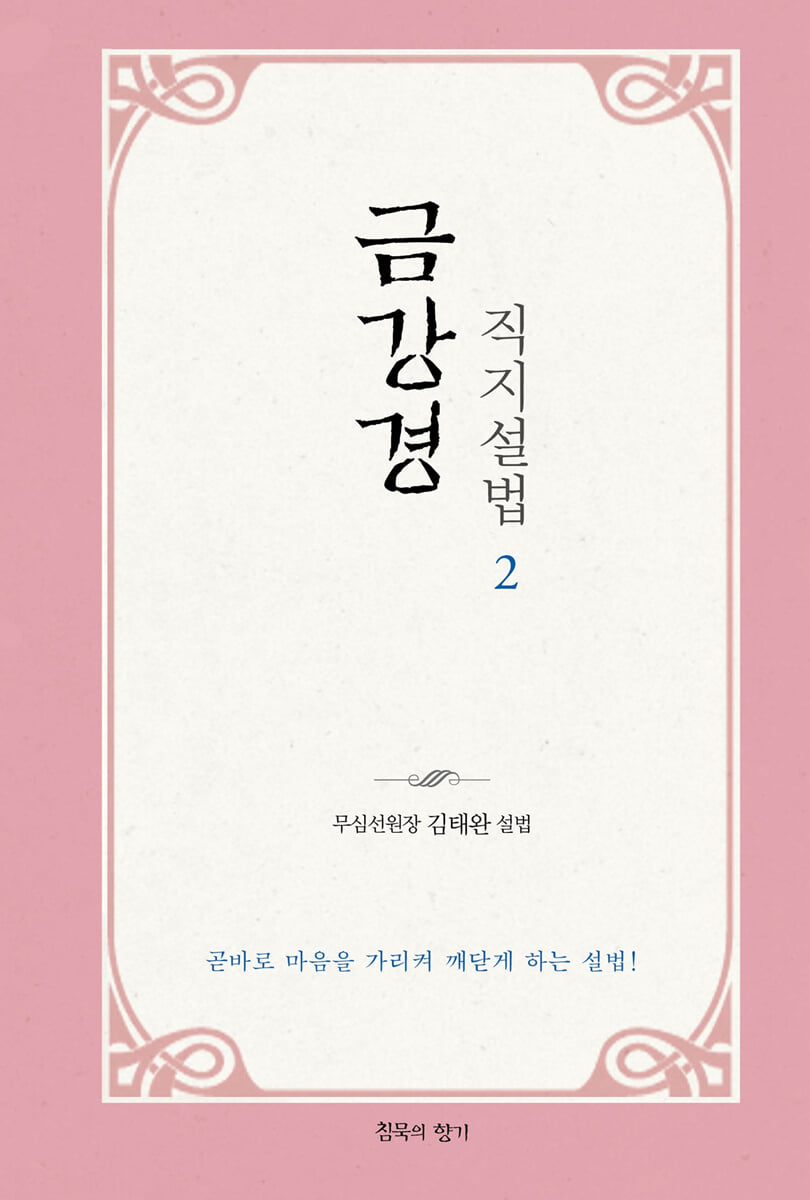
Diamond Sutra Direct Sermon 2
 |
Description
Book Introduction
A Diamond Sutra sermon that points directly to the mind and helps us realize our original nature!
A sermon optimized for enlightenment!
Kim Tae-wan, a Zen master who received a doctorate in the study of ancestral Zen and has been teaching students at Musim Zen Center since 2001 based on his own experience of studying that opened his eyes, faithfully follows the Zen Buddhist spirit of directly pointing to the human mind and leading us to enlightenment by pointing directly to our original mind.
Unlike many commentaries on the Diamond Sutra, 『Diamond Sutra Direct Commentary 2』 does not explain the passages of the Diamond Sutra to increase understanding or help readers understand it through thought.
Instead, it is a teaching optimized for enlightenment because it repeatedly points out from beginning to end what the Diamond Sutra wants to show, to help us realize and experience the original mind.
Our original mind is always evident here and now, but it is not an object of consciousness, so it cannot be found by ordinary means.
The best way and the fastest shortcut is to first listen to the teachings of an enlightened sage and receive guidance.
This book provides a correct understanding of the true nature of the mind and existence through various metaphors and explanations, and also contains detailed help for those who study.
To properly guide students, numerous misunderstandings and misconceptions must be corrected.
Even if you believe you know something well, you are often actually mistaken, and such misunderstandings are often so deep-rooted that they are not easily changed even when pointed out.
Captain Kim Tae-wan, with over 20 years of experience guiding students, offers a wealth of helpful advice and kindly guides students to stay on the right path and avoid going down the wrong path.
A sermon optimized for enlightenment!
Kim Tae-wan, a Zen master who received a doctorate in the study of ancestral Zen and has been teaching students at Musim Zen Center since 2001 based on his own experience of studying that opened his eyes, faithfully follows the Zen Buddhist spirit of directly pointing to the human mind and leading us to enlightenment by pointing directly to our original mind.
Unlike many commentaries on the Diamond Sutra, 『Diamond Sutra Direct Commentary 2』 does not explain the passages of the Diamond Sutra to increase understanding or help readers understand it through thought.
Instead, it is a teaching optimized for enlightenment because it repeatedly points out from beginning to end what the Diamond Sutra wants to show, to help us realize and experience the original mind.
Our original mind is always evident here and now, but it is not an object of consciousness, so it cannot be found by ordinary means.
The best way and the fastest shortcut is to first listen to the teachings of an enlightened sage and receive guidance.
This book provides a correct understanding of the true nature of the mind and existence through various metaphors and explanations, and also contains detailed help for those who study.
To properly guide students, numerous misunderstandings and misconceptions must be corrected.
Even if you believe you know something well, you are often actually mistaken, and such misunderstandings are often so deep-rooted that they are not easily changed even when pointed out.
Captain Kim Tae-wan, with over 20 years of experience guiding students, offers a wealth of helpful advice and kindly guides students to stay on the right path and avoid going down the wrong path.
- You can preview some of the book's contents.
Preview
index
preface
13.
The law of the land: Receive and keep it in accordance with the law.
14.
Ideal extinction: leaving form and disappearing quietly
15.
Jigyeonggongdeokbun: If you have the sutras, you will have merit.
16.
Effective karma elimination: Effectively eliminates karma
17.
Gu Gyeong-mu-a-bun: Finally, I am no more
13.
The law of the land: Receive and keep it in accordance with the law.
14.
Ideal extinction: leaving form and disappearing quietly
15.
Jigyeonggongdeokbun: If you have the sutras, you will have merit.
16.
Effective karma elimination: Effectively eliminates karma
17.
Gu Gyeong-mu-a-bun: Finally, I am no more
Into the book
There is no need to feel inferior for not realizing this, and there is no need to think you are superior for realizing it. It is all the same.
This is already happening.
I'm not asking you to realize that there isn't anything.
It happens to everyone and you don't have to worry because it's your own.
If you keep listening with interest, you will surely realize it.
There's no need to worry.
(Tapping the table) Everyone is the same.
There is one thing that is the same.
There's nothing special.
(Raising a finger) It's just this one thing that happens to everyone.
Everyone is the same.
People say that if there is something great, it is because all the people are different, but there is nothing here.
But what's so great about it? (Tapping the table) There's just this one thing.
This one.
There is only one thing.
--- p.83
We have this truth fundamentally and fundamentally.
There's no way to do it.
This is something that cannot be touched, something that cannot be done about, something that has always been like this from the beginning, something that is eternal, without beginning or end.
And if you get through here, you get through eternity.
You could say that in time we enter into an eternity where there is no time.
Living in time, past, present, future, yesterday, today, this… that is all discrimination.
If this works, there's no time here.
There is no past, no present, and no future.
It's like entering into eternity.
Eternity means there is no time.
There is no past, no present, no future, no front, no back, so there is only this one thing and no other law.
--- p.220
The mind is the foundation and origin, and from here we see, hear, smell, taste, feel cold, hot, itchy, and all kinds of feelings, good and bad feelings, all kinds of desires arise, and in any case, all kinds of things happen.
Everything happens here.
It means that one heart is real.
It has no set shape and is not a substance, so we forcefully call it a ball.
But it's not empty and there's nothing there.
Since everything is revealed here, we can't say that there is nothing.
Since there is no set shape, we have no choice but to call it a ball.
It was named that way as a convenience, but anyway, this is it.
This one.
The word ball is also a means.
The mind is empty, you can't do this.
It's just an expedient.
--- pp.222-223
(Tapping the Dharma statue) When you experience it and become properly settled in this place, you will see that it was originally in this place and will always be in this place, but it is just the six consciousnesses that are delusional and think that there is an inside and an outside, that there are living beings and Buddhas, and that they come and go.
It is nothing more than a dream-like illusion, and it has always been here from the beginning.
And dreams are like that too.
When you sleep in your room, you go to all kinds of places in your dreams, but when you wake up, you're just lying in your room.
I'm saying that there has never been a back and forth since the beginning.
If we realize the law and look at it that way, it has been here from the beginning.
--- p.272
So, as I continue to study, something happens all of a sudden: the emptiness that I had been looking at so intently and loving disappears like a soap bubble.
I'm surprised.
When the ball disappears, all that remains is the world of discrimination, color.
The world I lived in before.
Have my studies gone back to how they were before? Have they disappeared and I've returned to my old self? At first, I'm shocked.
But as time goes by and you live, you realize that it is not that, but all the different colors themselves are emptiness.
It's not that the ball is in front and the color is behind, the world of discrimination itself is just a ball.
Only then, I realized that I had nothing left to do… I had nothing to like, nothing to dislike, and nothing to pursue as if it were the law.
This is how the middle way is achieved.
There is nothing left to take and nothing to throw away.
This is illegal.
In the case of duality, the emptiness and color become exactly one.
Then there is nothing more to do.
… … It is not about abandoning form and following emptiness, it is not about abandoning the world and going beyond the world, but the world is the world beyond the world, living beings are Buddha, form is emptiness, life and death are nirvana, afflictions are Bodhi… These words are being realized as they are.
--- pp.294-295
The ball is not empty and has nothing in it; it is alive.
The ball itself, the void, is the essence.
The void, this indistinguishable thing, is the real exhaust.
This is the source of living life and it is real.
The outward appearance is a phenomenon that appears and disappears momentarily, and this thing that is empty and has nothing is the real exhaust.
The universe itself is always unchanging.
It's the same.
The outward appearance changes from moment to moment, but that is appearance, meaningless and empty.
When you become accustomed to living in the infinity, clearly through the void, in the universe itself, you start to think, 'Becoming one with the universe, the universe is our essence, this empty universe with nothing in it is the real living universe, the universe never changes in the first place, it is always the same.'
So, you have to experience it yourself.
This is already happening.
I'm not asking you to realize that there isn't anything.
It happens to everyone and you don't have to worry because it's your own.
If you keep listening with interest, you will surely realize it.
There's no need to worry.
(Tapping the table) Everyone is the same.
There is one thing that is the same.
There's nothing special.
(Raising a finger) It's just this one thing that happens to everyone.
Everyone is the same.
People say that if there is something great, it is because all the people are different, but there is nothing here.
But what's so great about it? (Tapping the table) There's just this one thing.
This one.
There is only one thing.
--- p.83
We have this truth fundamentally and fundamentally.
There's no way to do it.
This is something that cannot be touched, something that cannot be done about, something that has always been like this from the beginning, something that is eternal, without beginning or end.
And if you get through here, you get through eternity.
You could say that in time we enter into an eternity where there is no time.
Living in time, past, present, future, yesterday, today, this… that is all discrimination.
If this works, there's no time here.
There is no past, no present, and no future.
It's like entering into eternity.
Eternity means there is no time.
There is no past, no present, no future, no front, no back, so there is only this one thing and no other law.
--- p.220
The mind is the foundation and origin, and from here we see, hear, smell, taste, feel cold, hot, itchy, and all kinds of feelings, good and bad feelings, all kinds of desires arise, and in any case, all kinds of things happen.
Everything happens here.
It means that one heart is real.
It has no set shape and is not a substance, so we forcefully call it a ball.
But it's not empty and there's nothing there.
Since everything is revealed here, we can't say that there is nothing.
Since there is no set shape, we have no choice but to call it a ball.
It was named that way as a convenience, but anyway, this is it.
This one.
The word ball is also a means.
The mind is empty, you can't do this.
It's just an expedient.
--- pp.222-223
(Tapping the Dharma statue) When you experience it and become properly settled in this place, you will see that it was originally in this place and will always be in this place, but it is just the six consciousnesses that are delusional and think that there is an inside and an outside, that there are living beings and Buddhas, and that they come and go.
It is nothing more than a dream-like illusion, and it has always been here from the beginning.
And dreams are like that too.
When you sleep in your room, you go to all kinds of places in your dreams, but when you wake up, you're just lying in your room.
I'm saying that there has never been a back and forth since the beginning.
If we realize the law and look at it that way, it has been here from the beginning.
--- p.272
So, as I continue to study, something happens all of a sudden: the emptiness that I had been looking at so intently and loving disappears like a soap bubble.
I'm surprised.
When the ball disappears, all that remains is the world of discrimination, color.
The world I lived in before.
Have my studies gone back to how they were before? Have they disappeared and I've returned to my old self? At first, I'm shocked.
But as time goes by and you live, you realize that it is not that, but all the different colors themselves are emptiness.
It's not that the ball is in front and the color is behind, the world of discrimination itself is just a ball.
Only then, I realized that I had nothing left to do… I had nothing to like, nothing to dislike, and nothing to pursue as if it were the law.
This is how the middle way is achieved.
There is nothing left to take and nothing to throw away.
This is illegal.
In the case of duality, the emptiness and color become exactly one.
Then there is nothing more to do.
… … It is not about abandoning form and following emptiness, it is not about abandoning the world and going beyond the world, but the world is the world beyond the world, living beings are Buddha, form is emptiness, life and death are nirvana, afflictions are Bodhi… These words are being realized as they are.
--- pp.294-295
The ball is not empty and has nothing in it; it is alive.
The ball itself, the void, is the essence.
The void, this indistinguishable thing, is the real exhaust.
This is the source of living life and it is real.
The outward appearance is a phenomenon that appears and disappears momentarily, and this thing that is empty and has nothing is the real exhaust.
The universe itself is always unchanging.
It's the same.
The outward appearance changes from moment to moment, but that is appearance, meaningless and empty.
When you become accustomed to living in the infinity, clearly through the void, in the universe itself, you start to think, 'Becoming one with the universe, the universe is our essence, this empty universe with nothing in it is the real living universe, the universe never changes in the first place, it is always the same.'
So, you have to experience it yourself.
--- p.322
Publisher's Review
Directly pointing to the human mind, seeing one's own nature and attaining Buddhahood,
A Diamond Sutra sermon that points directly to the mind and helps us realize our original nature!
Kim Tae-wan, a Zen master who received a doctorate in the study of ancestral Zen and has been teaching students at Musim Zen Center since 2001 based on his own experience of studying that opened his eyes, faithfully follows the Zen Buddhist spirit of directly pointing to the human mind and leading us to enlightenment by pointing directly to our original mind.
The Diamond Sutra, the most widely recited scripture in East Asia, is considered the most important scripture in both Zen and Gyo Buddhism.
Before becoming a monk, the Sixth Patriarch Huineng went to the market to sell firewood and first came to enlightenment after hearing a passage of the Diamond Sutra recited by a mendicant monk. The Diamond Sutra is also the primary scripture of the Jogye Order of Korean Buddhism, which inherited the lineage of the Sixth Patriarch Huineng.
Because of this, countless commentaries on the Diamond Sutra have been published in Korea.
However, the 《Diamond Sutra Direct Commentary 2》 preached by Kim Tae-wan, the founder of Musimseonwon, is different from the majority of commentaries.
Instead of explaining passages of the Diamond Sutra to increase understanding or make people understand it through their minds, it clearly shows what the Diamond Sutra is trying to show from beginning to end, that is, the original mind that is the basis of everything.
Thus, by simply listening to the Dharma with sufficient attention, anyone can be guided to realize and experience what is always here and now.
This book is the second volume of the three-volume Diamond Sutra Direct Sermon.
The theme of the Diamond Sutra,
If you want to be enlightened, how do you surrender your mind and how do you stay?
“If one cultivates the mind of enlightenment, which is supremely righteous and equal, how should one abide in it and how should one surrender it?”
If one has set his mind on attaining the supreme, righteous, and equal enlightenment, how should he abide in that mind and how should he surrender it? This question of Subhuti is the theme of the entire Diamond Sutra.
Throughout the Diamond Sutra, the Buddha speaks about these two issues.
If someone were to ask, "How should one practice like Subori?", most practice groups would present their own methods of practice.
They are usually voluntary practices that individuals cultivate through their own efforts.
However, in the Diamond Sutra, the Buddha does not talk about such a method of practice at all.
Why is that?
“So how do we overcome all the thoughts in our minds by surrendering them? There is no way.
Because the mind cannot be objectified.
If I were to become the target, I would do something about it, but the mind cannot become the target.
… … I can’t do anything because I am my own mind.
I cannot refine my mind because I am separate and my mind is not separate.
You can only realize it.
(Tapping the Dharma table) There is a mysterious enlightenment.
This is the direct way of seeing one’s own nature and attaining Buddhahood.”
So, instead of telling the method of practice, the Buddha simply points out the truth again and again.
Because you just have to realize the unchanging truth of existence and settle into that truth.
All names are lies, all appearances are vanity.
What is truly real?
To know what is true, you must first know what is not true.
The Diamond Sutra tells us again and again to clearly recognize things that are not true.
In the previous chapter 5, it was said, “If you see that all appearances are not appearances, then you are seeing the Tathagata.” This means that if you realize that all appearances are not real in themselves and realize what the essence of all things is, then you are seeing the Tathagata.
To use a dream analogy, we see all the images and experience the world in our dreams, but when we wake up from the dream, we realize that all those images did not exist separately, but were temporary images that appeared in our mind and were created in our mind.
The world we experience while awake may actually be similar to this.
Another important thing that is dealt with in the Diamond Sutra is name.
As it says in Chapter 13, “The Tathagata said, ‘The world is not the world, but its name is the world.’” We name and differentiate not only the visible appearances but also all the perceptible appearances, such as feelings, desires, thoughts, and consciousness, and recognize all of them as me and the world (made up of countless things), but the Diamond Sutra says that all of these are in fact just names.
Moreover, he says that even Bodhisattva, Buddha, and enlightenment are just names.
Ultimately, nothing exists separately, and neither Buddha nor enlightenment is an exception.
So what really exists?
“Studying is about asking, ‘What is there in the end?’
What truly exists? Living day after day in this world, what truly exists? They say everything passes.
Everything that passes by is meaningless.
It's nonsense.
But there is something that doesn't pass.
There are things that neither come nor go, neither arise nor disappear.
That's it.
(raising hand) This.
This one is not the only one that is not in vain.
This is the only truth that will always be there.
“This one.” (Page 100)
“Enlightenment is nothing more than breaking free from vanity and uncovering the truth, and once the truth is uncovered, there is no more work to be done.
Nothing happened.
If the truth comes out, there will be no harm in the world.
Because truth is not something, it is not an object, not a mind, not a body, not a person, not something.
Naming it ‘this is the mind, this is the way’ is just a convenient way of naming it, and in fact, this cannot have any name.
… … (wagging finger) In reality, this one thing is always alive, and it thinks, speaks, acts, and does everything.
That's why we say, 'All is mind.'
If we call this mind, then everything is created by the mind, and the only thing that is not created is the mind.” (pp. 100-101)
A sermon optimized for enlightenment!
A wealth of helpful tips for students!
The only truth that always exists is our original mind, and enlightenment is realizing this mind.
The names of expedient means such as emptiness, mind, non-dualism, the way, Buddha, Bodhi, true nature, and vacuum wonderful existence are all names that refer to this.
Discernment perceives that I and the world are fragmented, but in reality there is no division at all, and only this, the only truth, exists.
Buddhism is a teaching that awakens us from the dream of discriminatory delusion and helps us realize this.
“(Tapping the Dharma statue) When you experience it and become properly settled in this place, you will see that it was originally in this place and has always been in this place, but it is just the six consciousnesses that are delusional and think that there is an inside and an outside, that there are living beings and Buddhas, and that they come and go.
It is nothing more than a dream-like illusion, and it has always been here from the beginning.
And dreams are like that too.
When you sleep in your room, you go to all kinds of places in your dreams, but when you wake up, you're just lying in your room.
I'm saying that there has never been a back and forth since the beginning.
“As we realize the law, it has always been here.” (p. 272)
Our original mind is always evident here and now, but it is not an objective object, so it cannot be found by ordinary means.
First, the best way and the fastest shortcut is to receive guidance by listening to the teachings of an enlightened sage, and it is important to pay constant attention.
The Diamond Sutra sermon by Kim Tae-wan, the founder of Musim Seonwon, is the most optimized sermon for enlightenment because it repeatedly points out how to realize and experience the original mind.
It also provides a variety of rich parables and explanations that help us understand the true nature of mind and existence.
This book also contains detailed help for students.
To properly guide students, numerous misunderstandings and misconceptions must be corrected.
Even if you believe you know something well, you are often actually mistaken, and such misunderstandings are often so deep-rooted that they are not easily changed even when pointed out.
Captain Kim Tae-wan, with over 20 years of experience guiding students, offers a wealth of helpful advice and kindly guides students to stay on the right path and avoid going down the wrong path.
A Diamond Sutra sermon that points directly to the mind and helps us realize our original nature!
Kim Tae-wan, a Zen master who received a doctorate in the study of ancestral Zen and has been teaching students at Musim Zen Center since 2001 based on his own experience of studying that opened his eyes, faithfully follows the Zen Buddhist spirit of directly pointing to the human mind and leading us to enlightenment by pointing directly to our original mind.
The Diamond Sutra, the most widely recited scripture in East Asia, is considered the most important scripture in both Zen and Gyo Buddhism.
Before becoming a monk, the Sixth Patriarch Huineng went to the market to sell firewood and first came to enlightenment after hearing a passage of the Diamond Sutra recited by a mendicant monk. The Diamond Sutra is also the primary scripture of the Jogye Order of Korean Buddhism, which inherited the lineage of the Sixth Patriarch Huineng.
Because of this, countless commentaries on the Diamond Sutra have been published in Korea.
However, the 《Diamond Sutra Direct Commentary 2》 preached by Kim Tae-wan, the founder of Musimseonwon, is different from the majority of commentaries.
Instead of explaining passages of the Diamond Sutra to increase understanding or make people understand it through their minds, it clearly shows what the Diamond Sutra is trying to show from beginning to end, that is, the original mind that is the basis of everything.
Thus, by simply listening to the Dharma with sufficient attention, anyone can be guided to realize and experience what is always here and now.
This book is the second volume of the three-volume Diamond Sutra Direct Sermon.
The theme of the Diamond Sutra,
If you want to be enlightened, how do you surrender your mind and how do you stay?
“If one cultivates the mind of enlightenment, which is supremely righteous and equal, how should one abide in it and how should one surrender it?”
If one has set his mind on attaining the supreme, righteous, and equal enlightenment, how should he abide in that mind and how should he surrender it? This question of Subhuti is the theme of the entire Diamond Sutra.
Throughout the Diamond Sutra, the Buddha speaks about these two issues.
If someone were to ask, "How should one practice like Subori?", most practice groups would present their own methods of practice.
They are usually voluntary practices that individuals cultivate through their own efforts.
However, in the Diamond Sutra, the Buddha does not talk about such a method of practice at all.
Why is that?
“So how do we overcome all the thoughts in our minds by surrendering them? There is no way.
Because the mind cannot be objectified.
If I were to become the target, I would do something about it, but the mind cannot become the target.
… … I can’t do anything because I am my own mind.
I cannot refine my mind because I am separate and my mind is not separate.
You can only realize it.
(Tapping the Dharma table) There is a mysterious enlightenment.
This is the direct way of seeing one’s own nature and attaining Buddhahood.”
So, instead of telling the method of practice, the Buddha simply points out the truth again and again.
Because you just have to realize the unchanging truth of existence and settle into that truth.
All names are lies, all appearances are vanity.
What is truly real?
To know what is true, you must first know what is not true.
The Diamond Sutra tells us again and again to clearly recognize things that are not true.
In the previous chapter 5, it was said, “If you see that all appearances are not appearances, then you are seeing the Tathagata.” This means that if you realize that all appearances are not real in themselves and realize what the essence of all things is, then you are seeing the Tathagata.
To use a dream analogy, we see all the images and experience the world in our dreams, but when we wake up from the dream, we realize that all those images did not exist separately, but were temporary images that appeared in our mind and were created in our mind.
The world we experience while awake may actually be similar to this.
Another important thing that is dealt with in the Diamond Sutra is name.
As it says in Chapter 13, “The Tathagata said, ‘The world is not the world, but its name is the world.’” We name and differentiate not only the visible appearances but also all the perceptible appearances, such as feelings, desires, thoughts, and consciousness, and recognize all of them as me and the world (made up of countless things), but the Diamond Sutra says that all of these are in fact just names.
Moreover, he says that even Bodhisattva, Buddha, and enlightenment are just names.
Ultimately, nothing exists separately, and neither Buddha nor enlightenment is an exception.
So what really exists?
“Studying is about asking, ‘What is there in the end?’
What truly exists? Living day after day in this world, what truly exists? They say everything passes.
Everything that passes by is meaningless.
It's nonsense.
But there is something that doesn't pass.
There are things that neither come nor go, neither arise nor disappear.
That's it.
(raising hand) This.
This one is not the only one that is not in vain.
This is the only truth that will always be there.
“This one.” (Page 100)
“Enlightenment is nothing more than breaking free from vanity and uncovering the truth, and once the truth is uncovered, there is no more work to be done.
Nothing happened.
If the truth comes out, there will be no harm in the world.
Because truth is not something, it is not an object, not a mind, not a body, not a person, not something.
Naming it ‘this is the mind, this is the way’ is just a convenient way of naming it, and in fact, this cannot have any name.
… … (wagging finger) In reality, this one thing is always alive, and it thinks, speaks, acts, and does everything.
That's why we say, 'All is mind.'
If we call this mind, then everything is created by the mind, and the only thing that is not created is the mind.” (pp. 100-101)
A sermon optimized for enlightenment!
A wealth of helpful tips for students!
The only truth that always exists is our original mind, and enlightenment is realizing this mind.
The names of expedient means such as emptiness, mind, non-dualism, the way, Buddha, Bodhi, true nature, and vacuum wonderful existence are all names that refer to this.
Discernment perceives that I and the world are fragmented, but in reality there is no division at all, and only this, the only truth, exists.
Buddhism is a teaching that awakens us from the dream of discriminatory delusion and helps us realize this.
“(Tapping the Dharma statue) When you experience it and become properly settled in this place, you will see that it was originally in this place and has always been in this place, but it is just the six consciousnesses that are delusional and think that there is an inside and an outside, that there are living beings and Buddhas, and that they come and go.
It is nothing more than a dream-like illusion, and it has always been here from the beginning.
And dreams are like that too.
When you sleep in your room, you go to all kinds of places in your dreams, but when you wake up, you're just lying in your room.
I'm saying that there has never been a back and forth since the beginning.
“As we realize the law, it has always been here.” (p. 272)
Our original mind is always evident here and now, but it is not an objective object, so it cannot be found by ordinary means.
First, the best way and the fastest shortcut is to receive guidance by listening to the teachings of an enlightened sage, and it is important to pay constant attention.
The Diamond Sutra sermon by Kim Tae-wan, the founder of Musim Seonwon, is the most optimized sermon for enlightenment because it repeatedly points out how to realize and experience the original mind.
It also provides a variety of rich parables and explanations that help us understand the true nature of mind and existence.
This book also contains detailed help for students.
To properly guide students, numerous misunderstandings and misconceptions must be corrected.
Even if you believe you know something well, you are often actually mistaken, and such misunderstandings are often so deep-rooted that they are not easily changed even when pointed out.
Captain Kim Tae-wan, with over 20 years of experience guiding students, offers a wealth of helpful advice and kindly guides students to stay on the right path and avoid going down the wrong path.
GOODS SPECIFICS
- Date of issue: November 24, 2025
- Page count, weight, size: 357 pages | 152*225*30mm
- ISBN13: 9791199076594
- ISBN10: 1199076597
You may also like
카테고리
korean


korean

![ELLE 엘르 스페셜 에디션 A형 : 12월 [2025]](http://librairie.coreenne.fr/cdn/shop/files/b8e27a3de6c9538896439686c6b0e8fb.jpg?v=1766436872&width=3840)


