

Buddhism, you've probably been curious about it at least once.
 |
Description
Book Introduction
In a world without answers, Buddhism offers a delightful hint of thought!
At a moment when I was lost and wandering, Buddhism spoke to me.
If we were to choose a hot field these days, we definitely cannot leave out ‘Buddhism.’
Temple stays are held year-round, the Buddha's words are read competitively, and the annual Buddhist expo is a huge success.
Now, Buddhism has gone beyond the realm of religion and has entered deeply into the daily lives of modern people.
Some people come to Buddhism to find comfort, others to find space to breathe.
But we often don't know the root of that comfort, that is, what the Buddhist teachings say.
For those who are new to Buddhism, it feels vast and difficult.
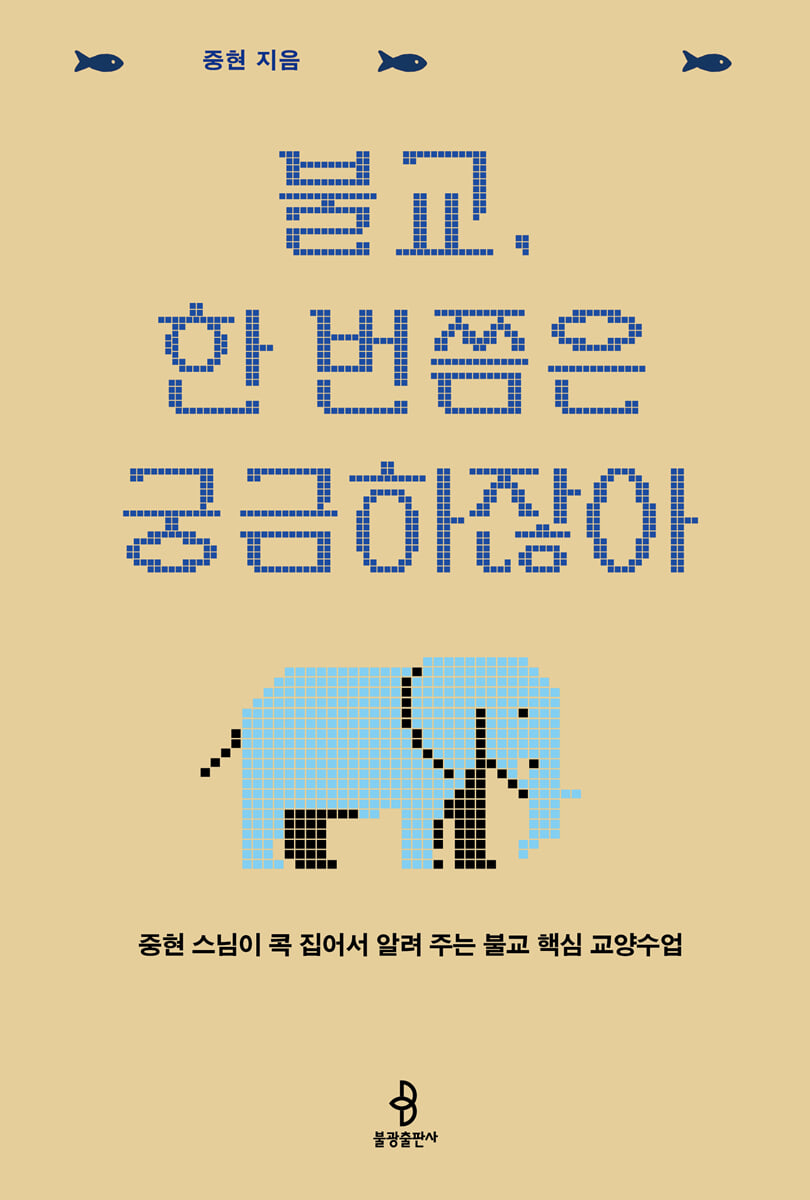
"Buddhism, You've Always Been Curious" is the first liberal arts course for "Buddhism beginners" who are on the threshold of curiosity.
Beginning with the question, "Is Buddhism a religion?", it paints a comprehensive picture of Buddhism, encompassing the life and history of the Buddha, the culture it created, and the way it views death.
In addition, the author, Monk Jung-Hyeon, does not stop at doctrine or practice, but reinterprets the various layers of Buddhism, such as faith, system, life and death, in today's language, and brings Buddhism into the concerns of modern people.
This book is a friendly and familiar guide for beginners who are new to Buddhism, and it provides an opportunity for long-time Buddhists to reflect on familiar teachings.
Let's meet the new face of Buddhism, a Buddhism closer to life than doctrine, a Buddhism for the "here and now" that has come out of the temple complex, in this book.
At a moment when I was lost and wandering, Buddhism spoke to me.
If we were to choose a hot field these days, we definitely cannot leave out ‘Buddhism.’
Temple stays are held year-round, the Buddha's words are read competitively, and the annual Buddhist expo is a huge success.
Now, Buddhism has gone beyond the realm of religion and has entered deeply into the daily lives of modern people.
Some people come to Buddhism to find comfort, others to find space to breathe.
But we often don't know the root of that comfort, that is, what the Buddhist teachings say.
For those who are new to Buddhism, it feels vast and difficult.
"Buddhism, You've Always Been Curious" is the first liberal arts course for "Buddhism beginners" who are on the threshold of curiosity.
Beginning with the question, "Is Buddhism a religion?", it paints a comprehensive picture of Buddhism, encompassing the life and history of the Buddha, the culture it created, and the way it views death.
In addition, the author, Monk Jung-Hyeon, does not stop at doctrine or practice, but reinterprets the various layers of Buddhism, such as faith, system, life and death, in today's language, and brings Buddhism into the concerns of modern people.
This book is a friendly and familiar guide for beginners who are new to Buddhism, and it provides an opportunity for long-time Buddhists to reflect on familiar teachings.
Let's meet the new face of Buddhism, a Buddhism closer to life than doctrine, a Buddhism for the "here and now" that has come out of the temple complex, in this book.
- You can preview some of the book's contents.
Preview
index
ㆍ At the beginning of the book
Part 1.
Buddhism and Religion
- Lesson 1.
Is Buddhism a religion?
Part 2.
The life of Buddha
- Lecture 2.
The Two Paths of Buddhism and the Monastic Tradition
- Lecture 3.
The life of Buddha
Part 3.
History of Buddhism
- Semifinals.
Why did Buddhism disappear from India?
- Lesson 5.
The Present and Future of Korean Buddhism
Part 4.
Buddhist culture
- 6th lecture.
Pavilion? Pagoda? Stupa
- Lesson 7.
Buddha and Bodhisattvas
Part 5.
Buddhist practice
- Quarterfinals.
Theory and Practice of Mind Control
- Lesson 9.
Does praying really make your wish come true?
Part 6.
Buddhist ethics
- Lesson 10.
Buddhist view of good and evil and precepts
- Lesson 11.
Precepts encountered in everyday life
Part 7.
Buddhist view of life and death
- Lecture 12.
Think about death
Part 1.
Buddhism and Religion
- Lesson 1.
Is Buddhism a religion?
Part 2.
The life of Buddha
- Lecture 2.
The Two Paths of Buddhism and the Monastic Tradition
- Lecture 3.
The life of Buddha
Part 3.
History of Buddhism
- Semifinals.
Why did Buddhism disappear from India?
- Lesson 5.
The Present and Future of Korean Buddhism
Part 4.
Buddhist culture
- 6th lecture.
Pavilion? Pagoda? Stupa
- Lesson 7.
Buddha and Bodhisattvas
Part 5.
Buddhist practice
- Quarterfinals.
Theory and Practice of Mind Control
- Lesson 9.
Does praying really make your wish come true?
Part 6.
Buddhist ethics
- Lesson 10.
Buddhist view of good and evil and precepts
- Lesson 11.
Precepts encountered in everyday life
Part 7.
Buddhist view of life and death
- Lecture 12.
Think about death
Detailed image

Into the book
This student's question could be rephrased as, "How can we gain a comprehensive view of Buddhism in all its diverse forms?"
This question is also the one that runs through the entire book.
To answer the above question, this book attempts to look at the overall picture of Buddhism from outside of Buddhism, rather than examining the details of Buddhism within Buddhism and using Buddhist language.
--- p.7
In the medieval West, religion was not simply a belief, but human life itself.
However, as capitalism grew, religious life and ideology became obstacles to capital accumulation.
As capitalism grew, politics, economics, philosophy, and science were successively separated from the large category called 'religion'.
After a long period of conflict between papal power and the secular state, politics became separated from religion, and as the accumulation of wealth was no longer considered a sin, economics also became separated from religion.
With the emergence of the human-centered Enlightenment ideology, philosophy also declared its independence from religion, and with the emergence of the heliocentric theory that denied the geocentric theory, the authority of religion was no longer able to gain a foothold in science.
After removing politics, economics, philosophy, and science from Western religion, what remains is faith.
--- p.18
Religion and faith are expressed in special places, at special times, and by doing special things outside of everyday life.
Even people without religion perform special rituals when they are preparing for a special event, which also reflects the aspect of seeking sacredness by breaking away from everyday life.
Why does religion not naturally emerge from everyday life, but instead seek spaces, times, and special rituals outside of everyday space and time?
--- p.22
This is why religion is necessary in modern society.
With existing values, communities, morals, and ethical systems losing their grip, and individuals forced to make choices and take responsibility for everything, we must find something that will sustain us in the weight of life.
Religion may be one of the answers.
Religious scholars distinguish this function of modern religion from that of traditional religion and express it with the word 'spirituality.'
--- p.29
Often, the criterion for dividing the two paths is 'foundation (ability to perform)'.
If you have the ability to practice, go on the first path of enlightenment, and if you lack the ability to practice, go on the second path, the path of salvation.
But this is a truly irresponsible statement.
There are never two separate paths.
--- pp.44-45
The origin of all our suffering and unhappiness is the division between ‘me’ and ‘you.’
However, in Buddha's view, the world cannot be divided into 'I' and 'you', but is all 'I'.
The true meaning of the birth verse is that living beings who do not know the way of the self-existence suffer in all three worlds: the world of desire, the world of form, and the world of formlessness [all three worlds suffer], so I should bring comfort to the suffering living beings [我當安之].
--- p.55
Where does faith come from? It comes from the insight into the reality that we are constantly wandering in this world, in pain and anxiety.
And faith is strengthened in the fierce search for a way out of suffering based on insight.
Faith comes from a clear understanding that all three worlds are suffering, and in the process, faith in the patriarchs who came before us, including Siddhartha Gautama.
--- p.60
An era has arrived in which people are rising up against the existing sacrifice-centered system and presenting diverse opinions on questions such as, “What am I?”, “What is the nature of this world?”, and “What is the relationship between me and the world?”
It is now the era of the Upanishads.
Those who led the Upanishadic era were mainly active in the northeastern region of India, and people called them 'samanas (沙門, ?rama?a)', meaning people who left home to practice asceticism.
Siddhartha Gautama was also one of these monks.
--- pp.86-87
Early Buddhism prohibited the deification of Sakyamuni Buddha.
Instead, the Buddha could be represented by symbols such as a cart wheel, a lotus flower, or a footprint.
However, as time passed and the soil became suitable for the emergence of Mahayana Buddhism in the northwestern region of India, dissatisfaction with the strict representation of the Buddha began to arise.
(…) However, it was difficult to overcome the existing sentiment that prohibited the creation of Buddha statues, as well as the fact that Sakyamuni Buddha was a real person.
In this situation, a realistic approach was to incorporate the gods of other religions into the Buddhist pantheon.
The prototype of Avalokitesvara was the Zoroastrian goddess Avalokitesvara.
--- p.103
Representative Hindu gods also appear in the new group.
Brahma, the god of creation, is called Brahma, Shiva, the god of destruction, is called Mahavairocana, Indra, the king of gods, is called Indra, the god of war, and Skanda, the god of war, is called Vitae.
This is the result of Buddhism adopting elements of Hinduism in order to popularize it within India.
The reason why all the gods were gathered together in the form of a god tank is also to lower the psychological barrier for those who do not believe in Buddhism by showing them the gods they believe in.
--- p.107
Maitreya Buddha is a messianic (savior) being.
At first, it was accepted as an object of faith in Buddhism, but because it had such a strong messianic nature, it naturally reflected the people's aspirations and their enthusiasm to change the world more strongly than the religious realm.
Accordingly, it gradually moved away from Buddhism and entered the position of the common people, and in accordance with this trend, it changed from the Maitreya Buddha to the stone guardian deity, the Great General of the World, and the General of the Earth.
--- p.172
Religious prayer can be summarized in one word: 'communication and petition.'
Communication and petition are earnest and fervent requests based on faith.
It is a common belief that if you pray earnestly, your prayer will be answered.
Communication is based on trust.
You can only convey your wishes if you can communicate with God or an absolute being.
If you cannot communicate in any way, you cannot believe that the object of your prayers will grant your wishes, nor can you expect that to happen.
In any case, faith presupposes communication.
--- pp.211-212
Correct practice is accompanied by altruism, not selfishness.
Correct practice involves a vow to save all living beings through its merits.
Any practice that does not do so will not lead to enlightenment.
Only by believing that proper practice leads to enlightenment can one accumulate merit.
When you do that, you can cultivate all good laws.
Faith is the beginning and the end of Buddhist practice.
--- p.216
There is also a saying in Buddhism:
When evil comes, good comes to overcome it.
Why? Because good and evil are not separate entities.
Because the fundamental roots are intangible and interdependent, they are interconnected, and because they are interconnected, evil can be replaced with good.
In the same vein, good can also be contaminated with evil.
So when evil comes, we overcome it with good, and we heal our afflictions with Bodhi.
It's the same context.
--- p.240
We, living in modern society, kill without even realizing that we are killing.
It makes me wonder how we can define systemic murder, structured murder, with the precepts of 2600 years ago.
In this age of increasingly complex society, we must reflect on whether the precept of not killing is losing its power.
--- pp.257-258
In Buddhism, the word 'moment' is used.
A moment is a very short moment, strictly speaking, the time when a thought arises and then disappears.
If we were to express it in units of time, it would be 1/75th of a second.
This means that we can think 75 times per second.
(…) If we think about death every moment, we can think about it 500 million times a day, but there are countless days when we don’t think about death even once.
This question is also the one that runs through the entire book.
To answer the above question, this book attempts to look at the overall picture of Buddhism from outside of Buddhism, rather than examining the details of Buddhism within Buddhism and using Buddhist language.
--- p.7
In the medieval West, religion was not simply a belief, but human life itself.
However, as capitalism grew, religious life and ideology became obstacles to capital accumulation.
As capitalism grew, politics, economics, philosophy, and science were successively separated from the large category called 'religion'.
After a long period of conflict between papal power and the secular state, politics became separated from religion, and as the accumulation of wealth was no longer considered a sin, economics also became separated from religion.
With the emergence of the human-centered Enlightenment ideology, philosophy also declared its independence from religion, and with the emergence of the heliocentric theory that denied the geocentric theory, the authority of religion was no longer able to gain a foothold in science.
After removing politics, economics, philosophy, and science from Western religion, what remains is faith.
--- p.18
Religion and faith are expressed in special places, at special times, and by doing special things outside of everyday life.
Even people without religion perform special rituals when they are preparing for a special event, which also reflects the aspect of seeking sacredness by breaking away from everyday life.
Why does religion not naturally emerge from everyday life, but instead seek spaces, times, and special rituals outside of everyday space and time?
--- p.22
This is why religion is necessary in modern society.
With existing values, communities, morals, and ethical systems losing their grip, and individuals forced to make choices and take responsibility for everything, we must find something that will sustain us in the weight of life.
Religion may be one of the answers.
Religious scholars distinguish this function of modern religion from that of traditional religion and express it with the word 'spirituality.'
--- p.29
Often, the criterion for dividing the two paths is 'foundation (ability to perform)'.
If you have the ability to practice, go on the first path of enlightenment, and if you lack the ability to practice, go on the second path, the path of salvation.
But this is a truly irresponsible statement.
There are never two separate paths.
--- pp.44-45
The origin of all our suffering and unhappiness is the division between ‘me’ and ‘you.’
However, in Buddha's view, the world cannot be divided into 'I' and 'you', but is all 'I'.
The true meaning of the birth verse is that living beings who do not know the way of the self-existence suffer in all three worlds: the world of desire, the world of form, and the world of formlessness [all three worlds suffer], so I should bring comfort to the suffering living beings [我當安之].
--- p.55
Where does faith come from? It comes from the insight into the reality that we are constantly wandering in this world, in pain and anxiety.
And faith is strengthened in the fierce search for a way out of suffering based on insight.
Faith comes from a clear understanding that all three worlds are suffering, and in the process, faith in the patriarchs who came before us, including Siddhartha Gautama.
--- p.60
An era has arrived in which people are rising up against the existing sacrifice-centered system and presenting diverse opinions on questions such as, “What am I?”, “What is the nature of this world?”, and “What is the relationship between me and the world?”
It is now the era of the Upanishads.
Those who led the Upanishadic era were mainly active in the northeastern region of India, and people called them 'samanas (沙門, ?rama?a)', meaning people who left home to practice asceticism.
Siddhartha Gautama was also one of these monks.
--- pp.86-87
Early Buddhism prohibited the deification of Sakyamuni Buddha.
Instead, the Buddha could be represented by symbols such as a cart wheel, a lotus flower, or a footprint.
However, as time passed and the soil became suitable for the emergence of Mahayana Buddhism in the northwestern region of India, dissatisfaction with the strict representation of the Buddha began to arise.
(…) However, it was difficult to overcome the existing sentiment that prohibited the creation of Buddha statues, as well as the fact that Sakyamuni Buddha was a real person.
In this situation, a realistic approach was to incorporate the gods of other religions into the Buddhist pantheon.
The prototype of Avalokitesvara was the Zoroastrian goddess Avalokitesvara.
--- p.103
Representative Hindu gods also appear in the new group.
Brahma, the god of creation, is called Brahma, Shiva, the god of destruction, is called Mahavairocana, Indra, the king of gods, is called Indra, the god of war, and Skanda, the god of war, is called Vitae.
This is the result of Buddhism adopting elements of Hinduism in order to popularize it within India.
The reason why all the gods were gathered together in the form of a god tank is also to lower the psychological barrier for those who do not believe in Buddhism by showing them the gods they believe in.
--- p.107
Maitreya Buddha is a messianic (savior) being.
At first, it was accepted as an object of faith in Buddhism, but because it had such a strong messianic nature, it naturally reflected the people's aspirations and their enthusiasm to change the world more strongly than the religious realm.
Accordingly, it gradually moved away from Buddhism and entered the position of the common people, and in accordance with this trend, it changed from the Maitreya Buddha to the stone guardian deity, the Great General of the World, and the General of the Earth.
--- p.172
Religious prayer can be summarized in one word: 'communication and petition.'
Communication and petition are earnest and fervent requests based on faith.
It is a common belief that if you pray earnestly, your prayer will be answered.
Communication is based on trust.
You can only convey your wishes if you can communicate with God or an absolute being.
If you cannot communicate in any way, you cannot believe that the object of your prayers will grant your wishes, nor can you expect that to happen.
In any case, faith presupposes communication.
--- pp.211-212
Correct practice is accompanied by altruism, not selfishness.
Correct practice involves a vow to save all living beings through its merits.
Any practice that does not do so will not lead to enlightenment.
Only by believing that proper practice leads to enlightenment can one accumulate merit.
When you do that, you can cultivate all good laws.
Faith is the beginning and the end of Buddhist practice.
--- p.216
There is also a saying in Buddhism:
When evil comes, good comes to overcome it.
Why? Because good and evil are not separate entities.
Because the fundamental roots are intangible and interdependent, they are interconnected, and because they are interconnected, evil can be replaced with good.
In the same vein, good can also be contaminated with evil.
So when evil comes, we overcome it with good, and we heal our afflictions with Bodhi.
It's the same context.
--- p.240
We, living in modern society, kill without even realizing that we are killing.
It makes me wonder how we can define systemic murder, structured murder, with the precepts of 2600 years ago.
In this age of increasingly complex society, we must reflect on whether the precept of not killing is losing its power.
--- pp.257-258
In Buddhism, the word 'moment' is used.
A moment is a very short moment, strictly speaking, the time when a thought arises and then disappears.
If we were to express it in units of time, it would be 1/75th of a second.
This means that we can think 75 times per second.
(…) If we think about death every moment, we can think about it 500 million times a day, but there are countless days when we don’t think about death even once.
--- pp.279-280
Publisher's Review
If Buddhism always seemed difficult, this time it's different!
The kind and compassionate answer offered by Buddhism
These days, when people feel mentally exhausted, they naturally turn to Buddhism.
The tranquility of the temple, the leisurely breathing of meditation, and a single word from the Buddha allow us to put down the burden on our hearts, even if only for a moment.
But the reason people seek Buddhism is not simply 'healing'.
In a rapidly changing society, relationships between people are becoming looser, and comparisons and choices are becoming more frequent.
As people increasingly had to decide for themselves what was right and how to live, they became increasingly lonely and tired.
To resolve this situation, many people began exploring various avenues of thought, including humanities, psychology, and philosophy.
And among these, Buddhism is once again receiving attention as the most profound wisdom that confronts and solves life's problems head-on.
This book, "Buddhism, You've Always Been Curious," tells us why we need to read Buddhism anew today.
The author does not confine Buddhism to the framework of faith, but simply explains how it functions in our daily lives in the language of everyday life.
After all, Buddhism is not a story from a faraway country.
It is a piece of wisdom that helps us, living in unstable times, to stand firm and a warm comfort that gives us the courage to stand up again.
If you've ever been curious about Buddhism, now is the time!
My first Buddhist class in the language of daily life
"Buddhism, You've Always Been Curious" rereads Buddhism from today's perspective.
Rather than explaining each and every one of the vast doctrines, this book is a map that provides a bird's-eye view of the vast forest that is Buddhism by tracing the context in which Buddhism was born and evolved.
Above all, what makes this book different from existing introductory books is that it conveys Buddhism through 'sensation' rather than 'knowledge'.
Rather than borrowing concepts that might seem complex to beginners, the author uncovers Buddhist wisdom hidden within the relationships, choices, and questions we encounter in our daily lives.
Therefore, this book is the most comfortable first step for those who are learning Buddhism for the first time, and it provides an opportunity for those who are already familiar with Buddhism to look at the teachings they have already understood in a new way.
From simple comfort to understanding, and from understanding to life again, this book guides you on that journey in the easiest and most friendly way.
The kind and compassionate answer offered by Buddhism
These days, when people feel mentally exhausted, they naturally turn to Buddhism.
The tranquility of the temple, the leisurely breathing of meditation, and a single word from the Buddha allow us to put down the burden on our hearts, even if only for a moment.
But the reason people seek Buddhism is not simply 'healing'.
In a rapidly changing society, relationships between people are becoming looser, and comparisons and choices are becoming more frequent.
As people increasingly had to decide for themselves what was right and how to live, they became increasingly lonely and tired.
To resolve this situation, many people began exploring various avenues of thought, including humanities, psychology, and philosophy.
And among these, Buddhism is once again receiving attention as the most profound wisdom that confronts and solves life's problems head-on.
This book, "Buddhism, You've Always Been Curious," tells us why we need to read Buddhism anew today.
The author does not confine Buddhism to the framework of faith, but simply explains how it functions in our daily lives in the language of everyday life.
After all, Buddhism is not a story from a faraway country.
It is a piece of wisdom that helps us, living in unstable times, to stand firm and a warm comfort that gives us the courage to stand up again.
If you've ever been curious about Buddhism, now is the time!
My first Buddhist class in the language of daily life
"Buddhism, You've Always Been Curious" rereads Buddhism from today's perspective.
Rather than explaining each and every one of the vast doctrines, this book is a map that provides a bird's-eye view of the vast forest that is Buddhism by tracing the context in which Buddhism was born and evolved.
Above all, what makes this book different from existing introductory books is that it conveys Buddhism through 'sensation' rather than 'knowledge'.
Rather than borrowing concepts that might seem complex to beginners, the author uncovers Buddhist wisdom hidden within the relationships, choices, and questions we encounter in our daily lives.
Therefore, this book is the most comfortable first step for those who are learning Buddhism for the first time, and it provides an opportunity for those who are already familiar with Buddhism to look at the teachings they have already understood in a new way.
From simple comfort to understanding, and from understanding to life again, this book guides you on that journey in the easiest and most friendly way.
GOODS SPECIFICS
- Date of issue: November 4, 2025
- Page count, weight, size: 304 pages | 466g | 152*225*20mm
- ISBN13: 9791172612160
- ISBN10: 1172612161
You may also like
카테고리
korean


korean

![ELLE 엘르 스페셜 에디션 A형 : 12월 [2025]](http://librairie.coreenne.fr/cdn/shop/files/b8e27a3de6c9538896439686c6b0e8fb.jpg?v=1766436872&width=3840)


