

Josephus 2 - Jewish Antiquities
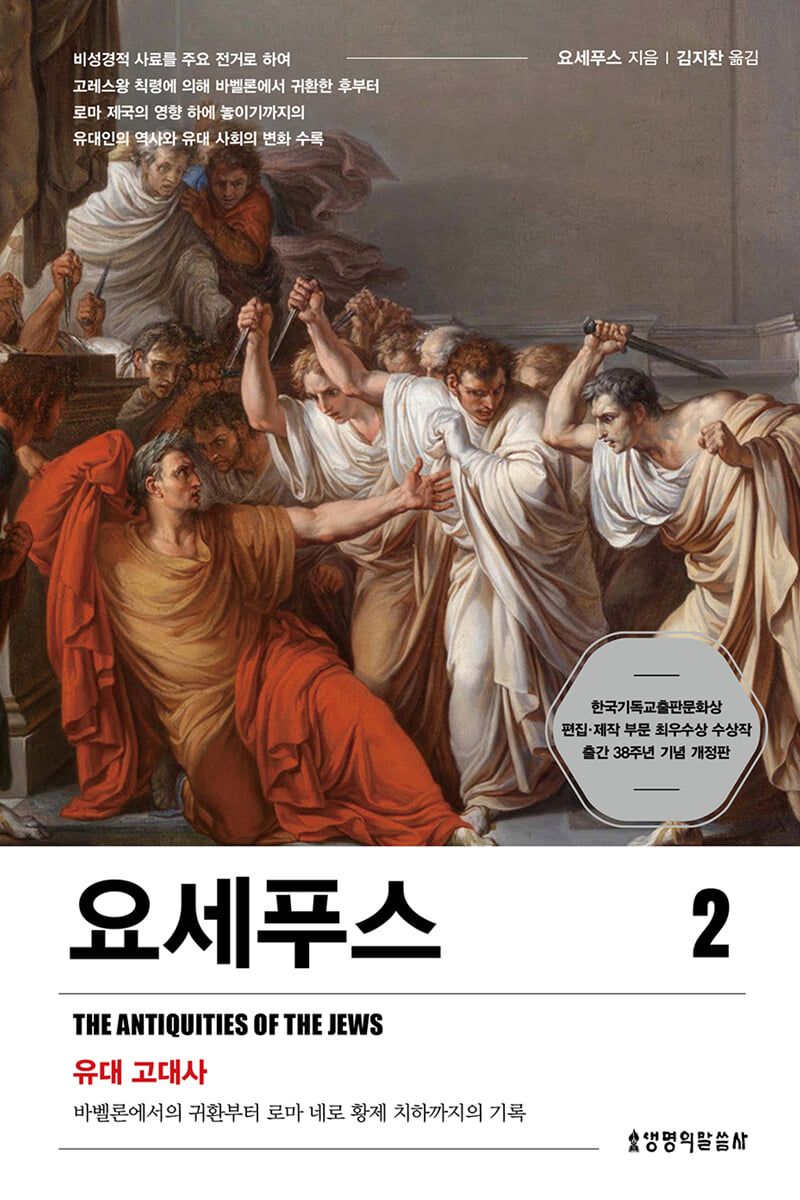 |
Description
Book Introduction
A Pharisee from a priestly family well-versed in Jewish law, a man of letters well-versed in Greek classics, A.
D. The second volume of the complete works of Flavius Josephus, a leader of the Jewish resistance who witnessed the destruction of Jerusalem in 70 AD, but who also served three generations of Roman emperors and suffered the stigma of being a surrenderer, has been published. He was the greatest scholar, historian, military leader, politician, and writer of his time.
Volume 2, "Jewish Antiquities," contains one of the oldest non-Christian documents, outside of the Bible, that records the existence of Jesus.
Using non-biblical sources as its primary source, it covers the history of the Jews and the changes in Jewish society from the return from Babylon by the decree of King Cyrus to the time when they came under the influence of the Roman Empire.
D. The second volume of the complete works of Flavius Josephus, a leader of the Jewish resistance who witnessed the destruction of Jerusalem in 70 AD, but who also served three generations of Roman emperors and suffered the stigma of being a surrenderer, has been published. He was the greatest scholar, historian, military leader, politician, and writer of his time.
Volume 2, "Jewish Antiquities," contains one of the oldest non-Christian documents, outside of the Bible, that records the existence of Jesus.
Using non-biblical sources as its primary source, it covers the history of the Jews and the changes in Jewish society from the return from Babylon by the decree of King Cyrus to the time when they came under the influence of the Roman Empire.
- You can preview some of the book's contents.
Preview
index
THE ANTIQUITIES OF THE JEWS
Ancient Jewish History
Records from the return from Babylon to the reign of Emperor Nero in Rome
Book 11: A Historical Record of 253 Years and Five Months: From the First Year of Cyrus to the Death of Alexander the Great
Chapter 1: How King Cyrus of Persia freed the Jews from Babylonian oppression, allowed them to return to their homeland, and provided the funds needed for the temple construction.
Chapter 2: When Cyrus died, the Jews were prevented from building the temple by the interference of the Cuthians and the governors of the neighboring regions, and Cambyses issued an order to stop such work.
Chapter 3: After Cambyses died and the Magi were murdered, Darius ascended to the throne. Zerubbabel, with his extraordinary problem-solving skills, won the king's favor and allowed the construction of the temple to resume.
Chapter 4: The Completion of the Temple Despite the Persistent Obstruction of Construction by the Gudains
Chapter 5: How Darius' son Xerxes showed favor to the Jews, and about Esdras and Nehemiah.
Chapter 6: The history of Esther, Mordecai, and Haman, and how the entire Jewish people were in danger of extinction during the reign of King Artaxerxes.
Chapter 7: The history of John's murder of his brother Jesus in the temple, the great harm done to the Jews by Bagoses, and the actions of Sanballat.
Chapter 8: The history of Sanballat, Manasseh, and the temple they built on Mount Gerizim; the history of Alexander's entry into Jerusalem, and the various favors he bestowed upon the Jews.
Book 12: A Record of 170 Years: From the Death of Alexander the Great to the Death of Judas Maccabaeus
Chapter 1: How Ptolemy, son of Lagus, conquered Jerusalem and Judea by fraud and treachery, and took many Jews captive and forcibly deported them to Egypt.
Chapter 2: How Ptolemy Philadelphus translated the Jewish law into Greek, freed countless captives, and offered many gifts to God.
Chapter 3: How the Kings of Asia Respected the Jewish Nation and Accepted Jews as Citizens in the Cities They Founded
Chapter 4. The history of how Antiochus entered into an alliance with Ptolemy, how Onias angered Ptolemy Euergetes, but how Joseph put things back on track and reestablished friendly relations with him, and the history of what Joseph and his son Hyrcanus did.
Chapter 5. How Antiochus attacked and captured Jerusalem, plundered the temple, and harassed the Jews while the Jews were quarreling among themselves over the high priesthood; how many Jews abandoned the laws of their ancestors; how the Samaritans followed Greek customs and came to call the temple on Mount Gerizim the temple of Jupiter Helenius.
Chapter 6. How Mattathias, son of Asmoneus, alone defied the king's command when Antiochus forbade the Jews to observe the Jewish law; how he subsequently murdered the commanders of Antiochus' army; and how Judas succeeded him after his death.
Chapter 7. How Judas defeated the armies of Apollonius and Seron, killed the military commanders, and then defeated Lysias and Gorgias, and went up to Jerusalem and purified the temple.
Chapter 8: How Judas conquered the surrounding countries, how Simon defeated the inhabitants of Tyre and Ptolemais, how Judas defeated and drove out Timotheus, and how Judas counterattacked and defeated many enemies after Joseph and Azariah were defeated by the enemy.
Chapter 9. Concerning the death of Antiochus Epiphanes, and how Antiochus Eupator attacked Judas, besieged the temple, and afterwards made peace with Judas; and concerning Alcimus and Onias.
Chapter 10. How Bacchides, the commander of Demetrius' army, returned home victorious from his attack on Judaea; how Nicanor, shortly afterwards, attacked Judas and was destroyed with his army; how Alcimus died and Judas's successors.
Chapter 11: Judas's brave fight against Bakkides's attack and his death
Book 13: Eighty-two Years of History: From the Death of Judas Maccabaeus to the Death of Queen Alexandra
Chapter 1. After the death of Judas, his brother Jonathan succeeded to the throne and waged war with his brother Simon against Bacchides.
Chapter 2. How Alexander Balas, in order to win the war against Demetrius, gave Jonathan many benefits, including the appointment of him as high priest, and brought Jonathan to his side before Demetrius, who had promised him even greater benefits, and how he brought Jonathan to his side before Demetrius, who had promised him even greater benefits, and how he died.
Chapter 3: On the friendly relations between Onias and Ptolemy Philometor, and the circumstances under which Onias built a temple in Egypt like the Temple of Jerusalem.
Chapter 4. How Alexander treated Jonathan with exceptional kindness, and how Demetrius, son of Demetrius, formed a friendly alliance with Jonathan after defeating Alexander.
Chapter 5. How Trypho, defeated by Demetrius, handed over the kingdom to Antiochus, the son of Alexander, and brought Jonathan into his support, and how Jonathan's ambassadors conducted themselves.
Chapter 6: How the Jews appointed Simon commander-in-chief and high priest after Jonathan was murdered in a conspiracy, and how Simon fought bravely thereafter, especially against Trypho.
Chapter 7. How Simon allied with Antiochus Pius and first waged war against Trypho, but soon afterwards became involved in a war with Cendebeus, the general of Antiochus's army, and how he was murdered by his son-in-law, Ptolemy, in a conspiracy.
Chapter 8. How Hyrcanus ascended to the high priesthood and banished Ptolemy from the country, and how he first made war with Antiochus, but later made an alliance and made peace.
Chapter 9. The history of Hyrcanus's attack on Syria and his alliance with Rome after the death of Antiochus, and of the deaths of Demetrius and Alexander.
Chapter 10. The history of Hyrcanus's attack on Samaria and its complete devastation during the struggle for the throne between Antiochus Gryphus and Antiochus Cyzicenus, and how Hyrcanus personally joined the Sadducees but left the Pharisees alone.
Chapter 11. The history of Aristobulus's efforts to seize the throne after he had seized control of Judea, and how he became barbarously cruel to his mother and brothers, ultimately leading to the murder of Antigonus and his own death.
Chapter 12. How Alexander, after he had seized power, attacked Ptolemais, but lifted the siege for fear of Ptolemy Lathyrus; how Ptolemy decided to attack Alexander because he had sent ambassadors to Cleopatra to persuade her to make war on him; how Ptolemy defeated the Jews in battle, despite Alexander's feigned allegiance.
Chapter 13. How Alexander, as soon as he had concluded a treaty of common defense with Cleopatra, attacked Coelesuria and laid Gaza in ruins; how he massacred tens of thousands of Jews who had plotted against him; and the history of Antiochus Gryphus, Seleucus, Antiochus Cyzicenus, Antiochus Pius, and others.
Chapter 14. How Demetrius Eucherus defeated Alexander and won the victory, but soon withdrew from Judea for fear of the Jews; how Alexander massacred a great number of Jews, and thereby resolved the many problems before him; and how Demetrius died.
Chapter 15: The story of Antiochus Dionysius and Aretas' attack on Judea; Alexander's conquest of several cities, his return to Jerusalem, and his three years of illness, followed by his death; and the advice he gave to Alexandra.
Chapter 16: How Alexandra succeeded in gaining the favor of the Pharisees, ruled the country for nine years, and left behind brilliant achievements before her death.
Book 14: A Historical Record of 32 Years: From the Death of Queen Alexandra to the Death of Antigonus
Chapter 1: How Aristobulus and Hyrcanus fought over the throne, and how they agreed that Aristobulus should become king and Hyrcanus should live a quiet life; and how Hyrcanus, at the instigation of Antipater, went to Aretas.
Chapter 2. How Aretas and Hyrcanus attacked Aristobulus and besieged Jerusalem, and how the Roman general Scaurus lifted the siege, and how Onias died.
Chapter 3. How Aristobulus and Hyrcanus appeared before Pompey to prove their legitimacy in the succession to the throne, and how Pompey, when Aristobulus fled to the fortress of Alexandrium, attacked him with his army and ordered him to surrender.
Chapter 4. How Pompey besieged and captured the city by force when the inhabitants of Jerusalem closed their gates and resisted, and how he also did things in Judea.
Chapter 5. How Scaurus concluded an alliance of mutual assistance with Aretas, and of the exploits of Gabinius in Judea after he had conquered Alexander, the son of Aristobulus.
Chapter 6. How Gabinius captured Aristobulus, who had fled from Rome, and brought him back to Rome; and how Gabinius, after his return from Egypt, defeated Alexander and the Nabataeans in battle.
Chapter 7. How Crassus, after invading Judea and sacking the temple, set out to conquer Parthia, but was annihilated along with his army; and how Cassius, after seizing Syria and stopping the expansion of Parthia, invaded Judea.
Chapter 8: How the Jews allied themselves with Caesar in his war against Egypt; of the brilliant achievements of Antipater and his friendship with Caesar; and of the honors the Jews received from the Romans and the Athenians.
Chapter 9. How Antipater entrusted Galilee to Herod and Jerusalem to Phasaelus, and how Herod was brought before Hyrcanus because of the jealousy of the Jews who envied Antipater.
Chapter 10: The Honors Received by the Jews and the Circumstances of Their Alliance with Rome and Other Nations
Chapter 11. How Murchus succeeded Sextus after he was murdered by the intrigue of Bassus; how Cassius invaded Syria and harassed Judea after Caesar's death; and how Malicus murdered Antipater, only to be murdered by Herod himself.
Chapter 12. How Herod banished Antigonus, the son of Aristobulus, from Judea, and offered Antony, who had just arrived in Syria, a large sum of money to curry favor with him; how this led to Antony's refusal to tolerate those who sought to accuse Herod; and how Antony sent a letter to the Tyrians on behalf of the Jews.
Chapter 13. How Antony appointed Herod and Phasaelus tetrarchs after he dismissed the charges against them; how the Parthians sent Antigonus into Judea to capture Hyrcanus and Phasaelus, but Herod managed to escape; and how Hyrcanus and Phasaelus suffered.
Chapter 14. How Herod fled from the king of Arabia to Egypt, and from there went hastily to Rome, where he promised Antony a large sum of money, and was appointed king of Judea by the Roman Senate and Caesar.
Chapter 15. How Herod left Italy for Judea, and then went to war with Antigonus, and what happened in Judea at that time.
Chapter 16. How Herod, after marrying Mariamne, with the support of Sosius, conquered Jerusalem by force, and how the reign of the Asmonean dynasty came to an end.
Book 15: Eighteen Years of History: From the Death of Antigonus to the Completion of Herod's Temple
Chapter 1: Concerning Pollio and Sameas, and how Herod murdered Antigonus' chief associates and sacked the city of Jerusalem, while Antony beheaded Antigonus.
Chapter 2. How Hyrcanus was delivered from the hands of the Parthians and returned to Herod, and how Alexandra behaved when she heard that Annanellus had become high priest.
Chapter 3. How Herod, shortly after appointing Aristobulus as high priest, plotted to have him murdered and made his defense before Antony; and how Joseph and Mariamne
Chapter 4. How Cleopatra, who had received a portion of Judea and Arabia from Antony, visited Judea, and Herod presented her with many gifts and guided her on her return to Egypt.
Chapter 5. How Herod attacked the king of Arabia, and after many battles finally defeated him, was elected governor of Arabia by the Arabs, and of the great earthquake.
Chapter 6. How Herod, after the murder of Hyrcanus, hastened to Caesar, and obtained from him the recognition of his sovereignty over the kingdom of Judea; and how, shortly afterwards, he received Caesar with the greatest courtesy.
Chapter 7 How Herod came to murder first Sohemus and Mariamne, then Alexandra and Costobarus, then his closest friends, and finally the sons of Barbas.
Chapter 8. How ten citizens of Jerusalem conspired against Herod for this flagrant violation of Jewish law, when he introduced foreign customs; and how he built buildings in Sebaste and Caesarea, and other structures.
Chapter 9. Concerning the severe famine that broke out in Judea and Syria, and how Herod, after marrying another wife, rebuilt Caesarea and other Greek cities.
Chapter 10 How Herod sent his sons to Rome; how Zenodorus and the Gadarenes accused Herod before Caesar, but Herod was acquitted and instead found favor with Caesar; and how the Pharisees, Essenes, and Manahem
Chapter 11: How Herod began to rebuild the temple, making it even higher and more magnificent than before, and how he came to build the Antonia Tower.
Book 16: Twelve Years of History: From the Completion of Herod's Temple to the Death of Alexander and Aristobulus
Chapter 1: Concerning Herod's Law against Robbers, how Herod rescued Alexander and Aristobulus from Rome, despite the accusations of Salome and Pheroras against them.
Chapter 2 How Herod sailed to Agrippa twice, and how Agrippa, when the Jews of Ionia brought charges against the Greeks, arranged for Jewish law to be recognized.
Chapter 3: When Herod favored his eldest son, Antipater, over his other sons, a great strife arose in Herod's family, and Alexander finally became resentful of this.
Chapter 4. How, while Antipater was living in Rome, Herod brought Alexander and Aristobulus before Caesar and accused them, and how Alexander defended himself before Caesar and was reconciled with his father.
Chapter 5: How Herod came to hold games every five years in the stadium at Caesarea, how he started a construction project that involved building huge buildings in various places, and how he accomplished other remarkable feats.
Chapter 6. How the Jews living in Cyrene and Asia sent ambassadors to Caesar complaining about the Greeks, and how Caesar and Agrippa sent letters to each city for the Jews.
Chapter 7: How Herod's Entry into David's Tomb Worsened the Discord in the Family
Chapter 8: When Herod arrested and imprisoned Alexander, Archelaus, king of Cappadocia, intervened and brought about reconciliation between Herod and Alexander.
Chapter 9. Concerning the rebellion of the Trachonites, and how Caesar became angry with Herod when Sileus brought charges against him to Caesar, and how Herod resolved to send Nicholas to Rome.
Chapter 10. How Eurycles falsely accused Herod's sons, and Herod imprisoned them, and then informed Caesar of this, and how Sileus was brought before Nicholas.
Chapter 11. How Herod, with Caesar's permission, brought charges against his sons before the judges assembled at Berytus; how Thero was punished for his blasphemies; and how Alexander and Aristobulus were executed and buried at Alexandrium.
Book 17: Fourteen Years of History: From the Death of Alexander and Aristobulus to the Exile of Archelaus
Chapter 1. How Antipater, being the man behind the murder of his brothers and thus incurring the hatred of all the Jewish people, offered many gifts to his father's friends in Rome in order to gain special favor, and also to Saturninus, the governor of Syria, and to the provincial rulers under him; and of Herod's wives and children.
Chapter 2: Concerning Zamaris, the Babylonian Jew, and the conspiracy of Antipater against his father, and concerning the Pharisees.
Chapter 3: Concerning the enmity between Herod and Pheroras, and how Herod sent Antipater to Caesar, and the death of Pheroras.
Chapter 4. When Herod's subjects accused Pheroras' wife of poisoning him, he tried to find out the truth through torture and interrogation. However, he was shocked to discover that the poison was prepared by his son Antipater to kill him. He tortured him again and discovered Antipater's plot.
Chapter 5. How Antipater, on his return from Rome by ship, was condemned to death by his father, King Herod, and Quintilius Varus, then governor of Syria, on the accusation of Nicholas of Damascus, and was imprisoned until Caesar learned of this.
Chapter 6: The story of how the Jews, upon learning of Herod's illness, attempted a rebellion, but failed and were punished.
Chapter 7: How Herod Contemplated Suicide, and Soon Afterward, Ordered Antipater's Execution
Chapter 8: Concerning Herod's Death, Testament, and Burial
Chapter 9: How the people rebelled against Archelaus and he sailed to Rome.
Chapter 10: How Varus Executed the Rebellion of the Jews Against Sabinus
Chapter 11: How the Jews sent ambassadors to Caesar, and how Caesar confirmed Herod's will.
Chapter 12: On the False Alexander
Chapter 13: How Archelaus was accused a second time and banished to Vienna.
Book 18: A Historical Record of 32 Years: From the Exile of Archelaus to the Exile of the Jews to Babylon
Chapter 1. How Cyrenius was sent by Caesar to levy taxes in Syria and Judaea, and how Coponius was sent as governor of Judaea, and of the Judaeans and Jewish sects in Galilee.
Chapter 2. How Herod and Philip built cities in honor of Caesar, and of the succession of priests and governors, and of what happened to Phraates and the Parthians.
Chapter 3: How the Jews rebelled against Pontius Pilate, and concerning Christ, and what happened to Pauline and the Jews of Rome.
Chapter 4. How Pilate slew many Samaritans when they were uproared; how Pilate was accused of this; and what Vitellius did to the Jews and Parthians.
Chapter 5. How Herod the Tetrarch fought against Aretas, king of Arabia, and was defeated; and of the death of John the Baptist; and of the visit of Vitellius to Jerusalem; and of the descendants of Agrippa and Herod the Great.
Chapter 6. How King Agrippa, when he sailed to Rome to meet Tiberius Caesar, was accused by his subjects and imprisoned, but after the death of Emperor Tiberius, he was released by Emperor Caius and appointed king of Philip's vassal state.
Chapter 7: How Herod the Tetrarch Was Exiled
Chapter 8. How the Jews sent ambassadors to the Emperor Caius, and how Caius sent Petronius to Syria to subdue the Jews by force if they did not accept his decrees.
Chapter 9: Concerning the sufferings of the Babylonian Jews on account of two brothers, Asineus and Anileus.
Book 19: A Historical Record of Three Years and Six Months: From the Exile of the Jews to the Roman Governor Fadus
Chapter 1: How Emperor Caius was murdered by Caerea
Chapter 2. How the Senate decided to restore democracy, but the army came to defend the empire; how Caius's wife and daughter were executed, and of his morality.
Chapter 3. How the Senate sent messengers to Claudius when he was forcibly taken from his home and taken to the camp.
Chapter 4. Concerning what King Agrippa did for Claudius, and how Claudius, after he had seized power, ordered the punishment of the murderers of the Emperor Caius.
Chapter 5: How Claudius restored to King Agrippa the territory that had belonged to his grandfather Herod and expanded his rule, and how he issued a decree for the Jews.
Chapter 6: Concerning what King Agrippa did in Jerusalem after his return to Judea, and the epistle which Petronius sent to the inhabitants of Dor for the Jews.
Chapter 7: Concerning Silas, how King Agrippa became angry with him, how he began to build the wall of Jerusalem, and what benefits he granted to the inhabitants of Berytus.
Chapter 8: Other Achievements of Agrippa Before His Death and the Circumstances of His Death
Chapter 9. What happened after the death of King Agrippa, and how Claudius sent Cuspius Fadus to be governor of Judea and the whole kingdom, because Agrippa II was young and incompetent.
Book 20: A Historical Record of Twenty-Two Years: From the Roman Governor Fadus to Florus
Chapter 1: How the Philadelphians Rioted Against the Jews, and Concerning the High Priest's Garments
Chapter 2: How Helena, Queen of Adiabene, and her son Izates embraced the Jewish religion, and how Helena provided food to the poor during a great famine in Jerusalem.
Chapter 3: How Artabanus, king of the Badae, fearing the secret treasonous plot of his subjects, came to Izates and asked for help, thereby solidifying his royal authority; and how Artabanus' son Vardanes declared war on Izates.
Chapter 4. How Izates was betrayed by his subjects and forced to wage war against the Arabians, but how God delivered him from all dangers.
Chapter 5: Concerning Theudas and the sons of Judas of Galilee, and the tragedy that befell the Jews on the Passover Day
Chapter 6: How the conflict between Jews and Samaritans arose and how Claudius resolved it.
Chapter 7: How Felix Became Governor of Judea, and Concerning Agrippa II and His Sisters
Chapter 8. Of the ascension of Nero to the throne after the death of Claudius, and of the barbarous acts he committed; and of the robberies, murders, and imposts which occurred during the presidency of Felix and Festus as governors of Judea.
Chapter 9. Concerning the governor Albinus, and the execution of James while Albinus was governor, and the buildings erected by Agrippa.
Chapter 10: List of High Priests
Chapter 11: How Florus, the governor of Judea, forced the Jews to take up arms against Rome, and the result.
Ancient Jewish History
Records from the return from Babylon to the reign of Emperor Nero in Rome
Book 11: A Historical Record of 253 Years and Five Months: From the First Year of Cyrus to the Death of Alexander the Great
Chapter 1: How King Cyrus of Persia freed the Jews from Babylonian oppression, allowed them to return to their homeland, and provided the funds needed for the temple construction.
Chapter 2: When Cyrus died, the Jews were prevented from building the temple by the interference of the Cuthians and the governors of the neighboring regions, and Cambyses issued an order to stop such work.
Chapter 3: After Cambyses died and the Magi were murdered, Darius ascended to the throne. Zerubbabel, with his extraordinary problem-solving skills, won the king's favor and allowed the construction of the temple to resume.
Chapter 4: The Completion of the Temple Despite the Persistent Obstruction of Construction by the Gudains
Chapter 5: How Darius' son Xerxes showed favor to the Jews, and about Esdras and Nehemiah.
Chapter 6: The history of Esther, Mordecai, and Haman, and how the entire Jewish people were in danger of extinction during the reign of King Artaxerxes.
Chapter 7: The history of John's murder of his brother Jesus in the temple, the great harm done to the Jews by Bagoses, and the actions of Sanballat.
Chapter 8: The history of Sanballat, Manasseh, and the temple they built on Mount Gerizim; the history of Alexander's entry into Jerusalem, and the various favors he bestowed upon the Jews.
Book 12: A Record of 170 Years: From the Death of Alexander the Great to the Death of Judas Maccabaeus
Chapter 1: How Ptolemy, son of Lagus, conquered Jerusalem and Judea by fraud and treachery, and took many Jews captive and forcibly deported them to Egypt.
Chapter 2: How Ptolemy Philadelphus translated the Jewish law into Greek, freed countless captives, and offered many gifts to God.
Chapter 3: How the Kings of Asia Respected the Jewish Nation and Accepted Jews as Citizens in the Cities They Founded
Chapter 4. The history of how Antiochus entered into an alliance with Ptolemy, how Onias angered Ptolemy Euergetes, but how Joseph put things back on track and reestablished friendly relations with him, and the history of what Joseph and his son Hyrcanus did.
Chapter 5. How Antiochus attacked and captured Jerusalem, plundered the temple, and harassed the Jews while the Jews were quarreling among themselves over the high priesthood; how many Jews abandoned the laws of their ancestors; how the Samaritans followed Greek customs and came to call the temple on Mount Gerizim the temple of Jupiter Helenius.
Chapter 6. How Mattathias, son of Asmoneus, alone defied the king's command when Antiochus forbade the Jews to observe the Jewish law; how he subsequently murdered the commanders of Antiochus' army; and how Judas succeeded him after his death.
Chapter 7. How Judas defeated the armies of Apollonius and Seron, killed the military commanders, and then defeated Lysias and Gorgias, and went up to Jerusalem and purified the temple.
Chapter 8: How Judas conquered the surrounding countries, how Simon defeated the inhabitants of Tyre and Ptolemais, how Judas defeated and drove out Timotheus, and how Judas counterattacked and defeated many enemies after Joseph and Azariah were defeated by the enemy.
Chapter 9. Concerning the death of Antiochus Epiphanes, and how Antiochus Eupator attacked Judas, besieged the temple, and afterwards made peace with Judas; and concerning Alcimus and Onias.
Chapter 10. How Bacchides, the commander of Demetrius' army, returned home victorious from his attack on Judaea; how Nicanor, shortly afterwards, attacked Judas and was destroyed with his army; how Alcimus died and Judas's successors.
Chapter 11: Judas's brave fight against Bakkides's attack and his death
Book 13: Eighty-two Years of History: From the Death of Judas Maccabaeus to the Death of Queen Alexandra
Chapter 1. After the death of Judas, his brother Jonathan succeeded to the throne and waged war with his brother Simon against Bacchides.
Chapter 2. How Alexander Balas, in order to win the war against Demetrius, gave Jonathan many benefits, including the appointment of him as high priest, and brought Jonathan to his side before Demetrius, who had promised him even greater benefits, and how he brought Jonathan to his side before Demetrius, who had promised him even greater benefits, and how he died.
Chapter 3: On the friendly relations between Onias and Ptolemy Philometor, and the circumstances under which Onias built a temple in Egypt like the Temple of Jerusalem.
Chapter 4. How Alexander treated Jonathan with exceptional kindness, and how Demetrius, son of Demetrius, formed a friendly alliance with Jonathan after defeating Alexander.
Chapter 5. How Trypho, defeated by Demetrius, handed over the kingdom to Antiochus, the son of Alexander, and brought Jonathan into his support, and how Jonathan's ambassadors conducted themselves.
Chapter 6: How the Jews appointed Simon commander-in-chief and high priest after Jonathan was murdered in a conspiracy, and how Simon fought bravely thereafter, especially against Trypho.
Chapter 7. How Simon allied with Antiochus Pius and first waged war against Trypho, but soon afterwards became involved in a war with Cendebeus, the general of Antiochus's army, and how he was murdered by his son-in-law, Ptolemy, in a conspiracy.
Chapter 8. How Hyrcanus ascended to the high priesthood and banished Ptolemy from the country, and how he first made war with Antiochus, but later made an alliance and made peace.
Chapter 9. The history of Hyrcanus's attack on Syria and his alliance with Rome after the death of Antiochus, and of the deaths of Demetrius and Alexander.
Chapter 10. The history of Hyrcanus's attack on Samaria and its complete devastation during the struggle for the throne between Antiochus Gryphus and Antiochus Cyzicenus, and how Hyrcanus personally joined the Sadducees but left the Pharisees alone.
Chapter 11. The history of Aristobulus's efforts to seize the throne after he had seized control of Judea, and how he became barbarously cruel to his mother and brothers, ultimately leading to the murder of Antigonus and his own death.
Chapter 12. How Alexander, after he had seized power, attacked Ptolemais, but lifted the siege for fear of Ptolemy Lathyrus; how Ptolemy decided to attack Alexander because he had sent ambassadors to Cleopatra to persuade her to make war on him; how Ptolemy defeated the Jews in battle, despite Alexander's feigned allegiance.
Chapter 13. How Alexander, as soon as he had concluded a treaty of common defense with Cleopatra, attacked Coelesuria and laid Gaza in ruins; how he massacred tens of thousands of Jews who had plotted against him; and the history of Antiochus Gryphus, Seleucus, Antiochus Cyzicenus, Antiochus Pius, and others.
Chapter 14. How Demetrius Eucherus defeated Alexander and won the victory, but soon withdrew from Judea for fear of the Jews; how Alexander massacred a great number of Jews, and thereby resolved the many problems before him; and how Demetrius died.
Chapter 15: The story of Antiochus Dionysius and Aretas' attack on Judea; Alexander's conquest of several cities, his return to Jerusalem, and his three years of illness, followed by his death; and the advice he gave to Alexandra.
Chapter 16: How Alexandra succeeded in gaining the favor of the Pharisees, ruled the country for nine years, and left behind brilliant achievements before her death.
Book 14: A Historical Record of 32 Years: From the Death of Queen Alexandra to the Death of Antigonus
Chapter 1: How Aristobulus and Hyrcanus fought over the throne, and how they agreed that Aristobulus should become king and Hyrcanus should live a quiet life; and how Hyrcanus, at the instigation of Antipater, went to Aretas.
Chapter 2. How Aretas and Hyrcanus attacked Aristobulus and besieged Jerusalem, and how the Roman general Scaurus lifted the siege, and how Onias died.
Chapter 3. How Aristobulus and Hyrcanus appeared before Pompey to prove their legitimacy in the succession to the throne, and how Pompey, when Aristobulus fled to the fortress of Alexandrium, attacked him with his army and ordered him to surrender.
Chapter 4. How Pompey besieged and captured the city by force when the inhabitants of Jerusalem closed their gates and resisted, and how he also did things in Judea.
Chapter 5. How Scaurus concluded an alliance of mutual assistance with Aretas, and of the exploits of Gabinius in Judea after he had conquered Alexander, the son of Aristobulus.
Chapter 6. How Gabinius captured Aristobulus, who had fled from Rome, and brought him back to Rome; and how Gabinius, after his return from Egypt, defeated Alexander and the Nabataeans in battle.
Chapter 7. How Crassus, after invading Judea and sacking the temple, set out to conquer Parthia, but was annihilated along with his army; and how Cassius, after seizing Syria and stopping the expansion of Parthia, invaded Judea.
Chapter 8: How the Jews allied themselves with Caesar in his war against Egypt; of the brilliant achievements of Antipater and his friendship with Caesar; and of the honors the Jews received from the Romans and the Athenians.
Chapter 9. How Antipater entrusted Galilee to Herod and Jerusalem to Phasaelus, and how Herod was brought before Hyrcanus because of the jealousy of the Jews who envied Antipater.
Chapter 10: The Honors Received by the Jews and the Circumstances of Their Alliance with Rome and Other Nations
Chapter 11. How Murchus succeeded Sextus after he was murdered by the intrigue of Bassus; how Cassius invaded Syria and harassed Judea after Caesar's death; and how Malicus murdered Antipater, only to be murdered by Herod himself.
Chapter 12. How Herod banished Antigonus, the son of Aristobulus, from Judea, and offered Antony, who had just arrived in Syria, a large sum of money to curry favor with him; how this led to Antony's refusal to tolerate those who sought to accuse Herod; and how Antony sent a letter to the Tyrians on behalf of the Jews.
Chapter 13. How Antony appointed Herod and Phasaelus tetrarchs after he dismissed the charges against them; how the Parthians sent Antigonus into Judea to capture Hyrcanus and Phasaelus, but Herod managed to escape; and how Hyrcanus and Phasaelus suffered.
Chapter 14. How Herod fled from the king of Arabia to Egypt, and from there went hastily to Rome, where he promised Antony a large sum of money, and was appointed king of Judea by the Roman Senate and Caesar.
Chapter 15. How Herod left Italy for Judea, and then went to war with Antigonus, and what happened in Judea at that time.
Chapter 16. How Herod, after marrying Mariamne, with the support of Sosius, conquered Jerusalem by force, and how the reign of the Asmonean dynasty came to an end.
Book 15: Eighteen Years of History: From the Death of Antigonus to the Completion of Herod's Temple
Chapter 1: Concerning Pollio and Sameas, and how Herod murdered Antigonus' chief associates and sacked the city of Jerusalem, while Antony beheaded Antigonus.
Chapter 2. How Hyrcanus was delivered from the hands of the Parthians and returned to Herod, and how Alexandra behaved when she heard that Annanellus had become high priest.
Chapter 3. How Herod, shortly after appointing Aristobulus as high priest, plotted to have him murdered and made his defense before Antony; and how Joseph and Mariamne
Chapter 4. How Cleopatra, who had received a portion of Judea and Arabia from Antony, visited Judea, and Herod presented her with many gifts and guided her on her return to Egypt.
Chapter 5. How Herod attacked the king of Arabia, and after many battles finally defeated him, was elected governor of Arabia by the Arabs, and of the great earthquake.
Chapter 6. How Herod, after the murder of Hyrcanus, hastened to Caesar, and obtained from him the recognition of his sovereignty over the kingdom of Judea; and how, shortly afterwards, he received Caesar with the greatest courtesy.
Chapter 7 How Herod came to murder first Sohemus and Mariamne, then Alexandra and Costobarus, then his closest friends, and finally the sons of Barbas.
Chapter 8. How ten citizens of Jerusalem conspired against Herod for this flagrant violation of Jewish law, when he introduced foreign customs; and how he built buildings in Sebaste and Caesarea, and other structures.
Chapter 9. Concerning the severe famine that broke out in Judea and Syria, and how Herod, after marrying another wife, rebuilt Caesarea and other Greek cities.
Chapter 10 How Herod sent his sons to Rome; how Zenodorus and the Gadarenes accused Herod before Caesar, but Herod was acquitted and instead found favor with Caesar; and how the Pharisees, Essenes, and Manahem
Chapter 11: How Herod began to rebuild the temple, making it even higher and more magnificent than before, and how he came to build the Antonia Tower.
Book 16: Twelve Years of History: From the Completion of Herod's Temple to the Death of Alexander and Aristobulus
Chapter 1: Concerning Herod's Law against Robbers, how Herod rescued Alexander and Aristobulus from Rome, despite the accusations of Salome and Pheroras against them.
Chapter 2 How Herod sailed to Agrippa twice, and how Agrippa, when the Jews of Ionia brought charges against the Greeks, arranged for Jewish law to be recognized.
Chapter 3: When Herod favored his eldest son, Antipater, over his other sons, a great strife arose in Herod's family, and Alexander finally became resentful of this.
Chapter 4. How, while Antipater was living in Rome, Herod brought Alexander and Aristobulus before Caesar and accused them, and how Alexander defended himself before Caesar and was reconciled with his father.
Chapter 5: How Herod came to hold games every five years in the stadium at Caesarea, how he started a construction project that involved building huge buildings in various places, and how he accomplished other remarkable feats.
Chapter 6. How the Jews living in Cyrene and Asia sent ambassadors to Caesar complaining about the Greeks, and how Caesar and Agrippa sent letters to each city for the Jews.
Chapter 7: How Herod's Entry into David's Tomb Worsened the Discord in the Family
Chapter 8: When Herod arrested and imprisoned Alexander, Archelaus, king of Cappadocia, intervened and brought about reconciliation between Herod and Alexander.
Chapter 9. Concerning the rebellion of the Trachonites, and how Caesar became angry with Herod when Sileus brought charges against him to Caesar, and how Herod resolved to send Nicholas to Rome.
Chapter 10. How Eurycles falsely accused Herod's sons, and Herod imprisoned them, and then informed Caesar of this, and how Sileus was brought before Nicholas.
Chapter 11. How Herod, with Caesar's permission, brought charges against his sons before the judges assembled at Berytus; how Thero was punished for his blasphemies; and how Alexander and Aristobulus were executed and buried at Alexandrium.
Book 17: Fourteen Years of History: From the Death of Alexander and Aristobulus to the Exile of Archelaus
Chapter 1. How Antipater, being the man behind the murder of his brothers and thus incurring the hatred of all the Jewish people, offered many gifts to his father's friends in Rome in order to gain special favor, and also to Saturninus, the governor of Syria, and to the provincial rulers under him; and of Herod's wives and children.
Chapter 2: Concerning Zamaris, the Babylonian Jew, and the conspiracy of Antipater against his father, and concerning the Pharisees.
Chapter 3: Concerning the enmity between Herod and Pheroras, and how Herod sent Antipater to Caesar, and the death of Pheroras.
Chapter 4. When Herod's subjects accused Pheroras' wife of poisoning him, he tried to find out the truth through torture and interrogation. However, he was shocked to discover that the poison was prepared by his son Antipater to kill him. He tortured him again and discovered Antipater's plot.
Chapter 5. How Antipater, on his return from Rome by ship, was condemned to death by his father, King Herod, and Quintilius Varus, then governor of Syria, on the accusation of Nicholas of Damascus, and was imprisoned until Caesar learned of this.
Chapter 6: The story of how the Jews, upon learning of Herod's illness, attempted a rebellion, but failed and were punished.
Chapter 7: How Herod Contemplated Suicide, and Soon Afterward, Ordered Antipater's Execution
Chapter 8: Concerning Herod's Death, Testament, and Burial
Chapter 9: How the people rebelled against Archelaus and he sailed to Rome.
Chapter 10: How Varus Executed the Rebellion of the Jews Against Sabinus
Chapter 11: How the Jews sent ambassadors to Caesar, and how Caesar confirmed Herod's will.
Chapter 12: On the False Alexander
Chapter 13: How Archelaus was accused a second time and banished to Vienna.
Book 18: A Historical Record of 32 Years: From the Exile of Archelaus to the Exile of the Jews to Babylon
Chapter 1. How Cyrenius was sent by Caesar to levy taxes in Syria and Judaea, and how Coponius was sent as governor of Judaea, and of the Judaeans and Jewish sects in Galilee.
Chapter 2. How Herod and Philip built cities in honor of Caesar, and of the succession of priests and governors, and of what happened to Phraates and the Parthians.
Chapter 3: How the Jews rebelled against Pontius Pilate, and concerning Christ, and what happened to Pauline and the Jews of Rome.
Chapter 4. How Pilate slew many Samaritans when they were uproared; how Pilate was accused of this; and what Vitellius did to the Jews and Parthians.
Chapter 5. How Herod the Tetrarch fought against Aretas, king of Arabia, and was defeated; and of the death of John the Baptist; and of the visit of Vitellius to Jerusalem; and of the descendants of Agrippa and Herod the Great.
Chapter 6. How King Agrippa, when he sailed to Rome to meet Tiberius Caesar, was accused by his subjects and imprisoned, but after the death of Emperor Tiberius, he was released by Emperor Caius and appointed king of Philip's vassal state.
Chapter 7: How Herod the Tetrarch Was Exiled
Chapter 8. How the Jews sent ambassadors to the Emperor Caius, and how Caius sent Petronius to Syria to subdue the Jews by force if they did not accept his decrees.
Chapter 9: Concerning the sufferings of the Babylonian Jews on account of two brothers, Asineus and Anileus.
Book 19: A Historical Record of Three Years and Six Months: From the Exile of the Jews to the Roman Governor Fadus
Chapter 1: How Emperor Caius was murdered by Caerea
Chapter 2. How the Senate decided to restore democracy, but the army came to defend the empire; how Caius's wife and daughter were executed, and of his morality.
Chapter 3. How the Senate sent messengers to Claudius when he was forcibly taken from his home and taken to the camp.
Chapter 4. Concerning what King Agrippa did for Claudius, and how Claudius, after he had seized power, ordered the punishment of the murderers of the Emperor Caius.
Chapter 5: How Claudius restored to King Agrippa the territory that had belonged to his grandfather Herod and expanded his rule, and how he issued a decree for the Jews.
Chapter 6: Concerning what King Agrippa did in Jerusalem after his return to Judea, and the epistle which Petronius sent to the inhabitants of Dor for the Jews.
Chapter 7: Concerning Silas, how King Agrippa became angry with him, how he began to build the wall of Jerusalem, and what benefits he granted to the inhabitants of Berytus.
Chapter 8: Other Achievements of Agrippa Before His Death and the Circumstances of His Death
Chapter 9. What happened after the death of King Agrippa, and how Claudius sent Cuspius Fadus to be governor of Judea and the whole kingdom, because Agrippa II was young and incompetent.
Book 20: A Historical Record of Twenty-Two Years: From the Roman Governor Fadus to Florus
Chapter 1: How the Philadelphians Rioted Against the Jews, and Concerning the High Priest's Garments
Chapter 2: How Helena, Queen of Adiabene, and her son Izates embraced the Jewish religion, and how Helena provided food to the poor during a great famine in Jerusalem.
Chapter 3: How Artabanus, king of the Badae, fearing the secret treasonous plot of his subjects, came to Izates and asked for help, thereby solidifying his royal authority; and how Artabanus' son Vardanes declared war on Izates.
Chapter 4. How Izates was betrayed by his subjects and forced to wage war against the Arabians, but how God delivered him from all dangers.
Chapter 5: Concerning Theudas and the sons of Judas of Galilee, and the tragedy that befell the Jews on the Passover Day
Chapter 6: How the conflict between Jews and Samaritans arose and how Claudius resolved it.
Chapter 7: How Felix Became Governor of Judea, and Concerning Agrippa II and His Sisters
Chapter 8. Of the ascension of Nero to the throne after the death of Claudius, and of the barbarous acts he committed; and of the robberies, murders, and imposts which occurred during the presidency of Felix and Festus as governors of Judea.
Chapter 9. Concerning the governor Albinus, and the execution of James while Albinus was governor, and the buildings erected by Agrippa.
Chapter 10: List of High Priests
Chapter 11: How Florus, the governor of Judea, forced the Jews to take up arms against Rome, and the result.
Detailed image

Into the book
Chapter 1.
Cyrus, king of Persia, freed the Jews from Babylonian oppression.
The circumstances surrounding his return to his homeland, which allowed him to build a temple, and provided him with the funds necessary for its construction.
1.
In the first year of the reign of King Cyrus, seventy years after our people were driven from their homeland and taken to Babylon, God took pity on the miserable life of this poor people in captivity and did to them as He had prophesied through the prophet Jeremiah before the fall of Jerusalem, that after serving Nebuchadnezzar and his descendants for seventy years, they would return to the land of their ancestors, rebuild the temple, and enjoy the glory of old.
God moved the heart of Cyrus to make such rooms appear throughout Asia.
“King Cyrus proclaims thus:
Almighty God has made me king of the human world, and I believe that God is the God the Israelites serve.
I believe that God is the God that the people of Israel serve.
This is very clear when we see that God prophesied my name through the prophet.
Therefore, I want to build a house for God in Jerusalem, in the land of Judah.”
2.
Perhaps Cyrus learned of this fact from the writings left behind by Isaiah.
The prophet Isaiah records in his writings that God spoke to him in a mysterious vision, saying, “My purpose is to bring my people back to their own land and build my temple through Cyrus, whom I will appoint king over many great nations.”
So, this prophecy of Isaiah was given 140 years before the fall of the temple.
When Cyrus read this prophecy, he could not help but be amazed at the power of God and was filled with a sincere passion and desire to fulfill this prophecy.
So Cyrus summoned the leading Jews in Babylon and said to them:
“I will send your people back to their own land so that they can rebuild Jerusalem and the temple of God.
Let me help you with this.
“I will send letters to the governors and governors of the surrounding regions of Judea, urging them to send gold and silver to finance the temple construction, as well as animals for the sacrifices.”
3.
When Cyrus said this to the Israelites, the leaders of the tribes of Judah and Benjamin, along with the Levites and priests, hurried to Jerusalem.
But many remained in Babylon because they had no intention of leaving their possessions behind.
When they arrived in Jerusalem, King Cyrus' friends helped them, bringing gold and silver for the construction of the temple, as well as numerous animals and horses.
So they made a vow to God and offered sacrifices to God as had been their custom since ancient times.
This meant that Jerusalem was rebuilt and the old sacrificial customs were revived.
Cyrus returned the vessels of God that King Nebuchadnezzar had taken to Babylon when he plundered the temple.
Cyrus instructed his treasurer Mithridates to transport these vessels to Judea, then meet with Sheshbazzar and convey his royal command to keep them safe until the temple was completed, and then give them to the priests and leaders of the people for use in the temple.
Cyrus also sent a letter to the governor of Syria, which read as follows:
“King Cyrus sends greetings to Sisinnes and Sathrabuzanes.
I have allowed any Jew living in my land who wishes to return to his homeland, rebuild his city, and build the temple of God on its ancient site.
I also sent Mithredath, my treasurer, and Zerubbabel, governor of Judah, to lay the foundation of the temple and to build a temple of hewn stone and wood, sixty cubits high and sixty cubits wide.
And I agreed to pay all the expenses incurred for this.
I also appointed Mithredath the treasurer and Zerubbabel the governor of Judah to take the articles that King Nebuchadnezzar had plundered from the temple and return them to the house of God in Jerusalem.
The quantity of these objects is as follows.
Fifty gold basins and 500 silver basins, forty gold basins and 500 silver basins, fifty gold basins and 500 silver basins, thirty pouring bowls and 300 silver basins, thirty gold basins and 2,400 silver basins, and 1,000 other large vessels.
I also allowed them to enjoy the honors of their ancestors, and gave them 205,500 drachmas to buy cattle, wine, and oil, and 20,500 artabas to buy flour.
I have commanded that these expenses be paid from the taxes that come from Samaria.
The priests were permitted to offer sacrifices in Jerusalem according to the Law of Moses.
I instructed them to pray to God for the kingdom of Persia, its royal family, and its king when they offered sacrifices.
“It is my will that anyone who disobeys these commands be crucified, and all his possessions shall be confiscated and given to the king.” Meanwhile, the number of those who returned to Jerusalem from the Babylonian captivity was 42,462.
Chapter 2.
After the death of Cyrus, the Jews were hindered from building the temple due to interference from the Cuthians and the governors of the surrounding regions.
The circumstances that led Cambyses to issue an order against such construction.
1.
When the foundation of the temple was laid, the Jews became very zealous in building it.
At this time, the neighboring nations, especially the Cutheans, who had brought the Israelites from Persia and Media to live in Samaria after Shalmaneser, king of Assyria, had carried them away captive, went to the governors and other officials in charge of such matters and asked them to stop the Jews from rebuilding the city and the temple.
The governors, blinded by their bribes, took advantage of the fact that King Cyrus was too busy with other matters to pay attention to them and began to delay the Jewish construction.
But coincidentally, King Cyrus died while leading his army to attack the Massagetae.
When Cambyses son of Cyrus ascended the throne, the governors of Syria, Phoenicia, Ammon, Moab, and Samaria sent letters to King Cambyses, saying:
“To our lord King Cambyses, your servants, Rathumus the historian, Semelius the scribe, and the governors of Syria and Phoenicia, we all send you greetings.
Oh, Your Majesty! There is one thing you must know.
The Jews who were taken captive to Babylon returned to our country and are rebuilding Jerusalem, a city known for its rebellion and wickedness, by building markets, walls, and temples.
When this is over, the Jews will not pay tribute, will not obey the king's commands, will rebel, and will even seek to dominate others rather than be ruled by them.
The King must be clear on this point.
Oh, Your Majesty! The construction of the temple is now in full swing.
Therefore, we felt that rather than ignoring this fact any longer, we should inform the King.
If Your Majesty will look into the books of the former kings, he will see that the Jews, along with Jerusalem, were enemies and traitors to the former kings.
For this reason it is necessary to reduce Jerusalem to ruins.
Besides this, there is another reason, which I am telling you because I am afraid that Your Majesty will not know if I do not tell you.
“Let the king know that if this Jerusalem is inhabited and fortified with walls, the road to Coelesyria and Phoenicia will be blocked.”
2.
Cambyses, who was by nature evil, was so angry and restless when he read this letter that he sent the following reply.
“I, King Cambyses, to Rathumus the historian, Beeltethemus the historian, Semelius the scribe, and all the other governors who live in Samaria and Phoenicia:
I have ordered you to read the letters you sent and to search the books of the former kings.
As a result, I learned firsthand that Jerusalem had always been hostile to the previous kings, and that its inhabitants did not hesitate to rebel and commit riots.
Moreover, we also learned that the kings of Judea had once been powerful and mighty, and had received tribute from Coelessuria and Phoenicia.
Therefore I command:
“Let them stop building in Jerusalem, so that they will not plot again the treason they committed against their predecessors.” When Latumus and the scribe Semelius and their companions read this reply, they immediately mounted horses, led a large crowd, and went to Jerusalem with great haste, forbidding the Jews to build the city and the temple.
As a result, the construction was abandoned and stopped for more than nine years until the second year of the reign of Darius.
This was because Cambyses died in Damascus after six years of reign after overthrowing Egypt and returning.
Chapter 3.
After Cambyses died and the Magi were murdered, Darius ascended to the throne.
The story of how Zerubbabel, with his extraordinary problem-solving skills, gained the king's favor and resumed the construction of the temple, which had been halted.
1.
After the death of Cambyses, the magi who had ruled the Persian Empire for a year were murdered, and the seven families of Persia, called the Seven Houses of Persia, appointed Darius, son of Hystaspes, as king.
Meanwhile, when Darius was a private citizen, he had sworn to God that if he became king, he would return all the vessels of God in Babylon to the temple in Jerusalem.
But his wish came true.
At this time, Zerubbabel, the governor of the Jews who had been taken captive to Babylon, came from Jerusalem to Darius.
This was because Darius and Zerubbabel had been friends for a long time.
Zerubbabel, along with two others, was appointed to look after the king's personal safety because he was fit for the position of bodyguard.
This was what he had hoped for.
[syncopation]
--- 『Volume 11.
From 『253 Years and Five Months of Historical Records: From the First Year of Cyrus to the Death of Alexander the Great』
7.
When Zerubbabel had finished speaking thus, all those present shouted and said that he had spoken most wisely, and acknowledged that only truth has unchanging power and never weakens.
The king then said that since his wisdom and intelligence were far greater than others, he would give him more than the promised reward, and told him to ask for whatever he wanted.
Zerubbabel reminded the king that before he ascended the throne, he had made an oath to do this and that when he ascended the throne.
“The king swore to God that when he became king he would rebuild Jerusalem and the temple of God and return the vessels of God that Nebuchadnezzar had plundered.
If Your Majesty recognizes me as a wise and intelligent man, I demand that You now put Your oath into practice.”
8.
The king was pleased with Zerubbabel's request, so he got up and kissed him.
The king sent letters to the governors, instructing them to actively support Zerubbabel and his associates in rebuilding the temple.
The king also sent letters to the governors of Syria and Phoenicia, instructing them to cut down cedar trees in Lebanon to help rebuild Jerusalem.
The king also added that they should release any captives who wished to return to Judea.
He also instructed the envoys and governors not to collect any taxes from the Jews and to allow the Jews to own any land they wanted without paying tribute.
The king also commanded the people of Idumea, Samaria, and Coele-Syria to return the villages they had taken from the Jews and to contribute 50 talents to the construction of the temple.
He also permitted them to offer sacrifices and directed that whatever the high priest or priests requested be paid for from the treasury.
In addition, he ordered that the priests be provided with sacred garments to wear during sacrifices and that the Levites be provided with musical instruments to use when praising God, using public funds.
He also commanded his officials to pay annual wages and grant some land to the guards of Jerusalem and the temple, and he returned the vessels of God to Jerusalem.
Darius put into action the plan that Cyrus had in mind to rebuild Jerusalem.
9.
After Zerubbabel received this permission from Darius, he went out of the palace and looked up to heaven, thanking God for giving him the wisdom to use in the presence of King Darius and to gain his favor.
“O Lord, if you had not shown me grace, how could I have ever thought myself worthy of this favor?” After thanking God for the grace he had received and praying for his continued grace, Zerubbabel went to Babylon and told his people the good news that King Darius had given permission for the rebuilding of the temple.
After hearing Zerubbabel's story, they gave thanks to God for allowing them to return to the land of their ancestors.
So they celebrated and drank for seven days, giving thanks for the rebuilding and restoration of their country.
After that they elected leaders.
The leaders, with their wives and children and livestock, set out for Jerusalem under the escort of soldiers sent by Darius.
They were joyful as they went to Jerusalem, singing, playing flutes and cymbals.
The rest of the Jews followed them and rejoiced with them.
[syncopation]
Chapter 11.
The circumstances and consequences of Florus, the governor of Judea, forcing the Jews to take up arms against Rome.
1.
The Jewish state suffered many misfortunes because of Gessius Florus, who was appointed as the successor to Albinus by Emperor Nero.
[Omitted] Florus's tyranny was so wicked that the Jews even came to think of Albinus as a (relatively) benefactor.
Albinus tried to hide his evil and committed corruption as much as possible without the people knowing, but Gessius Florus, as if he had been sent to show his wickedness to the people, committed all kinds of corruption openly and wielded violence as if he were bragging.
He had no compassion at all, and his greed seemed endless.
He showed his vulgarity by rushing in with his eyes fixed on not only large profits but also small profits.
He also joined hands with robbers.
The robbers committed robberies with confidence because Florus served as their shield and protected them from behind, and more and more of them began to turn into robbers.
As a result, the Jewish nation fell into endless suffering and misery.
The good Jews, unable to endure the thieves' persecution, had no choice but to leave their beloved hometown.
Even if it was a life abroad, they left their beloved hometown without any regrets, with the vague expectation that it would be better than now.
What more needs to be said about the fact that Florus forced the Jews to take up arms and revolt against Rome? We Jews believed that it would be better to be destroyed all at once than to be destroyed gradually.
This war with Rome broke out in the second year of Florus's proconsulship, that is, in the twelfth year of the reign of Emperor Nero.
Why the Jews had to revolt, and what suffering and misery they had to endure, is described in The Jewish War (as William Whiston called it).
I will omit it here as it will be easy to understand if you read the editor's note (it was mixed in accordance with the main text of Whiston's territory) carefully.
2.
Now I will conclude The Antiquities of the Jews.
The subsequent war with Rome is covered in The Jewish War.
In 『Jewish Antiquities』, the history from the creation of man to the 12th year of Nero's reign is described by referring to records handed down from ancestors.
It also describes what happened to the Jews in Egypt, Syria, and Palestine, what suffering they endured from Assyria and Babylon, and what tribulations they experienced from Persia, Macedonia, and Rome.
I would like to pride myself on having described this history accurately in general.
I have tried to examine in detail not only the high priests who served God over a period of 2,000 years, but also the kings of the past.
I have described the achievements and actions of the kings of all time, as well as the appearance of the rulers, as recorded in the Jewish Bible.
As I stated in the introduction, my purpose is to describe Jewish history as it appears in the Jewish Bible.
Therefore, having completed this book as I promised in the introduction, I can confidently say that no one, Jew or Gentile, can explain Jewish history to the Greeks as well as this book.
The Jews themselves acknowledge that I am more knowledgeable about Jewish history than any of my fellow Jews, and that I am second to none in my knowledge of Greek scholarship and language.
Although it is true that I am not able to pronounce Greek accurately because I have been immersed in my native language for a long time, I have devoted much passion to acquiring Greek and Greek studies.
In the Jewish state, learning the languages of many countries and speaking them fluently and flowerily is not encouraged.
Because they believe that anyone who wants to learn a language can easily learn it, not only free people but also slaves, they do not greatly admire the mastery of multiple languages.
Instead, in Judaism, a person who is well-versed in the laws handed down from their ancestors and knows how to interpret their meaning is considered wise.
For this reason, many people in the Jewish nation go through all kinds of hardships trying to study the Torah, but in reality, only two or three people succeed in studying the Torah to the point where the effort is immediately rewarded.
3.
I don't think it's so disgusting for me to leave a record of my family or my life history, since there are still people alive who can tell me whether what I wrote is true or false.
So I intend to conclude my Jewish Antiquities, which is nearly 60,000 verses in 20 volumes, with the promise that I will soon write about my family and my life up to this point.
[omitted]
Cyrus, king of Persia, freed the Jews from Babylonian oppression.
The circumstances surrounding his return to his homeland, which allowed him to build a temple, and provided him with the funds necessary for its construction.
1.
In the first year of the reign of King Cyrus, seventy years after our people were driven from their homeland and taken to Babylon, God took pity on the miserable life of this poor people in captivity and did to them as He had prophesied through the prophet Jeremiah before the fall of Jerusalem, that after serving Nebuchadnezzar and his descendants for seventy years, they would return to the land of their ancestors, rebuild the temple, and enjoy the glory of old.
God moved the heart of Cyrus to make such rooms appear throughout Asia.
“King Cyrus proclaims thus:
Almighty God has made me king of the human world, and I believe that God is the God the Israelites serve.
I believe that God is the God that the people of Israel serve.
This is very clear when we see that God prophesied my name through the prophet.
Therefore, I want to build a house for God in Jerusalem, in the land of Judah.”
2.
Perhaps Cyrus learned of this fact from the writings left behind by Isaiah.
The prophet Isaiah records in his writings that God spoke to him in a mysterious vision, saying, “My purpose is to bring my people back to their own land and build my temple through Cyrus, whom I will appoint king over many great nations.”
So, this prophecy of Isaiah was given 140 years before the fall of the temple.
When Cyrus read this prophecy, he could not help but be amazed at the power of God and was filled with a sincere passion and desire to fulfill this prophecy.
So Cyrus summoned the leading Jews in Babylon and said to them:
“I will send your people back to their own land so that they can rebuild Jerusalem and the temple of God.
Let me help you with this.
“I will send letters to the governors and governors of the surrounding regions of Judea, urging them to send gold and silver to finance the temple construction, as well as animals for the sacrifices.”
3.
When Cyrus said this to the Israelites, the leaders of the tribes of Judah and Benjamin, along with the Levites and priests, hurried to Jerusalem.
But many remained in Babylon because they had no intention of leaving their possessions behind.
When they arrived in Jerusalem, King Cyrus' friends helped them, bringing gold and silver for the construction of the temple, as well as numerous animals and horses.
So they made a vow to God and offered sacrifices to God as had been their custom since ancient times.
This meant that Jerusalem was rebuilt and the old sacrificial customs were revived.
Cyrus returned the vessels of God that King Nebuchadnezzar had taken to Babylon when he plundered the temple.
Cyrus instructed his treasurer Mithridates to transport these vessels to Judea, then meet with Sheshbazzar and convey his royal command to keep them safe until the temple was completed, and then give them to the priests and leaders of the people for use in the temple.
Cyrus also sent a letter to the governor of Syria, which read as follows:
“King Cyrus sends greetings to Sisinnes and Sathrabuzanes.
I have allowed any Jew living in my land who wishes to return to his homeland, rebuild his city, and build the temple of God on its ancient site.
I also sent Mithredath, my treasurer, and Zerubbabel, governor of Judah, to lay the foundation of the temple and to build a temple of hewn stone and wood, sixty cubits high and sixty cubits wide.
And I agreed to pay all the expenses incurred for this.
I also appointed Mithredath the treasurer and Zerubbabel the governor of Judah to take the articles that King Nebuchadnezzar had plundered from the temple and return them to the house of God in Jerusalem.
The quantity of these objects is as follows.
Fifty gold basins and 500 silver basins, forty gold basins and 500 silver basins, fifty gold basins and 500 silver basins, thirty pouring bowls and 300 silver basins, thirty gold basins and 2,400 silver basins, and 1,000 other large vessels.
I also allowed them to enjoy the honors of their ancestors, and gave them 205,500 drachmas to buy cattle, wine, and oil, and 20,500 artabas to buy flour.
I have commanded that these expenses be paid from the taxes that come from Samaria.
The priests were permitted to offer sacrifices in Jerusalem according to the Law of Moses.
I instructed them to pray to God for the kingdom of Persia, its royal family, and its king when they offered sacrifices.
“It is my will that anyone who disobeys these commands be crucified, and all his possessions shall be confiscated and given to the king.” Meanwhile, the number of those who returned to Jerusalem from the Babylonian captivity was 42,462.
Chapter 2.
After the death of Cyrus, the Jews were hindered from building the temple due to interference from the Cuthians and the governors of the surrounding regions.
The circumstances that led Cambyses to issue an order against such construction.
1.
When the foundation of the temple was laid, the Jews became very zealous in building it.
At this time, the neighboring nations, especially the Cutheans, who had brought the Israelites from Persia and Media to live in Samaria after Shalmaneser, king of Assyria, had carried them away captive, went to the governors and other officials in charge of such matters and asked them to stop the Jews from rebuilding the city and the temple.
The governors, blinded by their bribes, took advantage of the fact that King Cyrus was too busy with other matters to pay attention to them and began to delay the Jewish construction.
But coincidentally, King Cyrus died while leading his army to attack the Massagetae.
When Cambyses son of Cyrus ascended the throne, the governors of Syria, Phoenicia, Ammon, Moab, and Samaria sent letters to King Cambyses, saying:
“To our lord King Cambyses, your servants, Rathumus the historian, Semelius the scribe, and the governors of Syria and Phoenicia, we all send you greetings.
Oh, Your Majesty! There is one thing you must know.
The Jews who were taken captive to Babylon returned to our country and are rebuilding Jerusalem, a city known for its rebellion and wickedness, by building markets, walls, and temples.
When this is over, the Jews will not pay tribute, will not obey the king's commands, will rebel, and will even seek to dominate others rather than be ruled by them.
The King must be clear on this point.
Oh, Your Majesty! The construction of the temple is now in full swing.
Therefore, we felt that rather than ignoring this fact any longer, we should inform the King.
If Your Majesty will look into the books of the former kings, he will see that the Jews, along with Jerusalem, were enemies and traitors to the former kings.
For this reason it is necessary to reduce Jerusalem to ruins.
Besides this, there is another reason, which I am telling you because I am afraid that Your Majesty will not know if I do not tell you.
“Let the king know that if this Jerusalem is inhabited and fortified with walls, the road to Coelesyria and Phoenicia will be blocked.”
2.
Cambyses, who was by nature evil, was so angry and restless when he read this letter that he sent the following reply.
“I, King Cambyses, to Rathumus the historian, Beeltethemus the historian, Semelius the scribe, and all the other governors who live in Samaria and Phoenicia:
I have ordered you to read the letters you sent and to search the books of the former kings.
As a result, I learned firsthand that Jerusalem had always been hostile to the previous kings, and that its inhabitants did not hesitate to rebel and commit riots.
Moreover, we also learned that the kings of Judea had once been powerful and mighty, and had received tribute from Coelessuria and Phoenicia.
Therefore I command:
“Let them stop building in Jerusalem, so that they will not plot again the treason they committed against their predecessors.” When Latumus and the scribe Semelius and their companions read this reply, they immediately mounted horses, led a large crowd, and went to Jerusalem with great haste, forbidding the Jews to build the city and the temple.
As a result, the construction was abandoned and stopped for more than nine years until the second year of the reign of Darius.
This was because Cambyses died in Damascus after six years of reign after overthrowing Egypt and returning.
Chapter 3.
After Cambyses died and the Magi were murdered, Darius ascended to the throne.
The story of how Zerubbabel, with his extraordinary problem-solving skills, gained the king's favor and resumed the construction of the temple, which had been halted.
1.
After the death of Cambyses, the magi who had ruled the Persian Empire for a year were murdered, and the seven families of Persia, called the Seven Houses of Persia, appointed Darius, son of Hystaspes, as king.
Meanwhile, when Darius was a private citizen, he had sworn to God that if he became king, he would return all the vessels of God in Babylon to the temple in Jerusalem.
But his wish came true.
At this time, Zerubbabel, the governor of the Jews who had been taken captive to Babylon, came from Jerusalem to Darius.
This was because Darius and Zerubbabel had been friends for a long time.
Zerubbabel, along with two others, was appointed to look after the king's personal safety because he was fit for the position of bodyguard.
This was what he had hoped for.
[syncopation]
--- 『Volume 11.
From 『253 Years and Five Months of Historical Records: From the First Year of Cyrus to the Death of Alexander the Great』
7.
When Zerubbabel had finished speaking thus, all those present shouted and said that he had spoken most wisely, and acknowledged that only truth has unchanging power and never weakens.
The king then said that since his wisdom and intelligence were far greater than others, he would give him more than the promised reward, and told him to ask for whatever he wanted.
Zerubbabel reminded the king that before he ascended the throne, he had made an oath to do this and that when he ascended the throne.
“The king swore to God that when he became king he would rebuild Jerusalem and the temple of God and return the vessels of God that Nebuchadnezzar had plundered.
If Your Majesty recognizes me as a wise and intelligent man, I demand that You now put Your oath into practice.”
8.
The king was pleased with Zerubbabel's request, so he got up and kissed him.
The king sent letters to the governors, instructing them to actively support Zerubbabel and his associates in rebuilding the temple.
The king also sent letters to the governors of Syria and Phoenicia, instructing them to cut down cedar trees in Lebanon to help rebuild Jerusalem.
The king also added that they should release any captives who wished to return to Judea.
He also instructed the envoys and governors not to collect any taxes from the Jews and to allow the Jews to own any land they wanted without paying tribute.
The king also commanded the people of Idumea, Samaria, and Coele-Syria to return the villages they had taken from the Jews and to contribute 50 talents to the construction of the temple.
He also permitted them to offer sacrifices and directed that whatever the high priest or priests requested be paid for from the treasury.
In addition, he ordered that the priests be provided with sacred garments to wear during sacrifices and that the Levites be provided with musical instruments to use when praising God, using public funds.
He also commanded his officials to pay annual wages and grant some land to the guards of Jerusalem and the temple, and he returned the vessels of God to Jerusalem.
Darius put into action the plan that Cyrus had in mind to rebuild Jerusalem.
9.
After Zerubbabel received this permission from Darius, he went out of the palace and looked up to heaven, thanking God for giving him the wisdom to use in the presence of King Darius and to gain his favor.
“O Lord, if you had not shown me grace, how could I have ever thought myself worthy of this favor?” After thanking God for the grace he had received and praying for his continued grace, Zerubbabel went to Babylon and told his people the good news that King Darius had given permission for the rebuilding of the temple.
After hearing Zerubbabel's story, they gave thanks to God for allowing them to return to the land of their ancestors.
So they celebrated and drank for seven days, giving thanks for the rebuilding and restoration of their country.
After that they elected leaders.
The leaders, with their wives and children and livestock, set out for Jerusalem under the escort of soldiers sent by Darius.
They were joyful as they went to Jerusalem, singing, playing flutes and cymbals.
The rest of the Jews followed them and rejoiced with them.
[syncopation]
Chapter 11.
The circumstances and consequences of Florus, the governor of Judea, forcing the Jews to take up arms against Rome.
1.
The Jewish state suffered many misfortunes because of Gessius Florus, who was appointed as the successor to Albinus by Emperor Nero.
[Omitted] Florus's tyranny was so wicked that the Jews even came to think of Albinus as a (relatively) benefactor.
Albinus tried to hide his evil and committed corruption as much as possible without the people knowing, but Gessius Florus, as if he had been sent to show his wickedness to the people, committed all kinds of corruption openly and wielded violence as if he were bragging.
He had no compassion at all, and his greed seemed endless.
He showed his vulgarity by rushing in with his eyes fixed on not only large profits but also small profits.
He also joined hands with robbers.
The robbers committed robberies with confidence because Florus served as their shield and protected them from behind, and more and more of them began to turn into robbers.
As a result, the Jewish nation fell into endless suffering and misery.
The good Jews, unable to endure the thieves' persecution, had no choice but to leave their beloved hometown.
Even if it was a life abroad, they left their beloved hometown without any regrets, with the vague expectation that it would be better than now.
What more needs to be said about the fact that Florus forced the Jews to take up arms and revolt against Rome? We Jews believed that it would be better to be destroyed all at once than to be destroyed gradually.
This war with Rome broke out in the second year of Florus's proconsulship, that is, in the twelfth year of the reign of Emperor Nero.
Why the Jews had to revolt, and what suffering and misery they had to endure, is described in The Jewish War (as William Whiston called it).
I will omit it here as it will be easy to understand if you read the editor's note (it was mixed in accordance with the main text of Whiston's territory) carefully.
2.
Now I will conclude The Antiquities of the Jews.
The subsequent war with Rome is covered in The Jewish War.
In 『Jewish Antiquities』, the history from the creation of man to the 12th year of Nero's reign is described by referring to records handed down from ancestors.
It also describes what happened to the Jews in Egypt, Syria, and Palestine, what suffering they endured from Assyria and Babylon, and what tribulations they experienced from Persia, Macedonia, and Rome.
I would like to pride myself on having described this history accurately in general.
I have tried to examine in detail not only the high priests who served God over a period of 2,000 years, but also the kings of the past.
I have described the achievements and actions of the kings of all time, as well as the appearance of the rulers, as recorded in the Jewish Bible.
As I stated in the introduction, my purpose is to describe Jewish history as it appears in the Jewish Bible.
Therefore, having completed this book as I promised in the introduction, I can confidently say that no one, Jew or Gentile, can explain Jewish history to the Greeks as well as this book.
The Jews themselves acknowledge that I am more knowledgeable about Jewish history than any of my fellow Jews, and that I am second to none in my knowledge of Greek scholarship and language.
Although it is true that I am not able to pronounce Greek accurately because I have been immersed in my native language for a long time, I have devoted much passion to acquiring Greek and Greek studies.
In the Jewish state, learning the languages of many countries and speaking them fluently and flowerily is not encouraged.
Because they believe that anyone who wants to learn a language can easily learn it, not only free people but also slaves, they do not greatly admire the mastery of multiple languages.
Instead, in Judaism, a person who is well-versed in the laws handed down from their ancestors and knows how to interpret their meaning is considered wise.
For this reason, many people in the Jewish nation go through all kinds of hardships trying to study the Torah, but in reality, only two or three people succeed in studying the Torah to the point where the effort is immediately rewarded.
3.
I don't think it's so disgusting for me to leave a record of my family or my life history, since there are still people alive who can tell me whether what I wrote is true or false.
So I intend to conclude my Jewish Antiquities, which is nearly 60,000 verses in 20 volumes, with the promise that I will soon write about my family and my life up to this point.
[omitted]
--- 『Volume 20.
From 『22 Years of Historical Records: From the Roman Governor Fadus to Florus』
From 『22 Years of Historical Records: From the Roman Governor Fadus to Florus』
Publisher's Review
Few people in human history have received as much praise and criticism as Josephus.
While he is still condemned by his Jewish compatriots as a traitor and apostate, he is renowned among Christians, especially among the early apologists, and during the Middle Ages, both in the East and the West, as a great writer.
It is clear that Josephus was not a conscientious and fair seeker of truth, but a writer with a high purpose of creating a certain impression.
Moreover, Josephus shares the flaws of most ancient writers.
His analysis is superficial, his chronology is riddled with errors, his sources are exaggerated, and his speech is reeks of mold.
Especially when it comes to matters that affect his reputation, he does not hesitate to make deliberate statements.
Despite these flaws, however, it cannot be denied that Josephus was an outstanding historian.
Josephus, while standing on the foundation of the Old Testament and the Law, sought to break free from the narrow confines of Judaism at the time, and he shared similarities with Christian writers in interpreting the destruction of Jerusalem and the Temple as God's punishment.
Josephus integrated both Jewish and Hellenistic traditions, connecting the Roman secular world with the religious heritage of the Bible, and providing a wealth of information essential for understanding the mentality of the various peoples under the Roman Empire.
Josephus's position is almost absolute, especially in that it is the only historical book that tells the history of Palestine and the Diaspora Jews from the time before the birth of Jesus to the first century when Christianity was born.
- From the preface by translator Professor Kim Ji-chan
Josephus's writings, valuable not only as relics of ancient classical works but also as immortal monuments of ancient scholarship, can be divided into two categories: historical and polemical.
The former includes 『Jewish Antiquities』 and 『The Jewish Wars』, and the latter includes 『Against Apion』 and several essays.
Above all, A.
D. It is very important to be able to hear the story of what happened after the fall of Jerusalem in 70 AD from reliable witnesses of that time.
Events that occurred after the period in which we are particularly interested often eloquently illustrate the preceding period.
Therefore, what Josephus ultimately describes helps us understand not only the character of the Jewish people in Josephus' time, but also the character of the Jewish people in the era associated with the forces that crucified the Savior.
Ultimately, Josephus's works are not read merely as a means of satisfying curiosity about facts.
These books will open the way to studying issues closely related to Christian history and will help us understand what was the greatest cause of the corruption and depravity of God's ancient people.
Those who have repeatedly experienced the clarification of previously obscure points when they learn the prevailing sentiments of the time in which an article was written will never ignore new facts emerging from the storehouse of traditional evidence, traditional interpretations, and national memory.
- From the introduction by Dr. Henry Stebbing, a prominent 19th-century British literary editor
While he is still condemned by his Jewish compatriots as a traitor and apostate, he is renowned among Christians, especially among the early apologists, and during the Middle Ages, both in the East and the West, as a great writer.
It is clear that Josephus was not a conscientious and fair seeker of truth, but a writer with a high purpose of creating a certain impression.
Moreover, Josephus shares the flaws of most ancient writers.
His analysis is superficial, his chronology is riddled with errors, his sources are exaggerated, and his speech is reeks of mold.
Especially when it comes to matters that affect his reputation, he does not hesitate to make deliberate statements.
Despite these flaws, however, it cannot be denied that Josephus was an outstanding historian.
Josephus, while standing on the foundation of the Old Testament and the Law, sought to break free from the narrow confines of Judaism at the time, and he shared similarities with Christian writers in interpreting the destruction of Jerusalem and the Temple as God's punishment.
Josephus integrated both Jewish and Hellenistic traditions, connecting the Roman secular world with the religious heritage of the Bible, and providing a wealth of information essential for understanding the mentality of the various peoples under the Roman Empire.
Josephus's position is almost absolute, especially in that it is the only historical book that tells the history of Palestine and the Diaspora Jews from the time before the birth of Jesus to the first century when Christianity was born.
- From the preface by translator Professor Kim Ji-chan
Josephus's writings, valuable not only as relics of ancient classical works but also as immortal monuments of ancient scholarship, can be divided into two categories: historical and polemical.
The former includes 『Jewish Antiquities』 and 『The Jewish Wars』, and the latter includes 『Against Apion』 and several essays.
Above all, A.
D. It is very important to be able to hear the story of what happened after the fall of Jerusalem in 70 AD from reliable witnesses of that time.
Events that occurred after the period in which we are particularly interested often eloquently illustrate the preceding period.
Therefore, what Josephus ultimately describes helps us understand not only the character of the Jewish people in Josephus' time, but also the character of the Jewish people in the era associated with the forces that crucified the Savior.
Ultimately, Josephus's works are not read merely as a means of satisfying curiosity about facts.
These books will open the way to studying issues closely related to Christian history and will help us understand what was the greatest cause of the corruption and depravity of God's ancient people.
Those who have repeatedly experienced the clarification of previously obscure points when they learn the prevailing sentiments of the time in which an article was written will never ignore new facts emerging from the storehouse of traditional evidence, traditional interpretations, and national memory.
- From the introduction by Dr. Henry Stebbing, a prominent 19th-century British literary editor
GOODS SPECIFICS
- Date of issue: September 30, 2025
- Page count, weight, size: 696 pages | 984g | 150*225*35mm
- ISBN13: 9788904060351
- ISBN10: 8904060354
You may also like
카테고리
korean


korean

![ELLE 엘르 스페셜 에디션 A형 : 12월 [2025]](http://librairie.coreenne.fr/cdn/shop/files/b8e27a3de6c9538896439686c6b0e8fb.jpg?v=1766436872&width=3840)


