

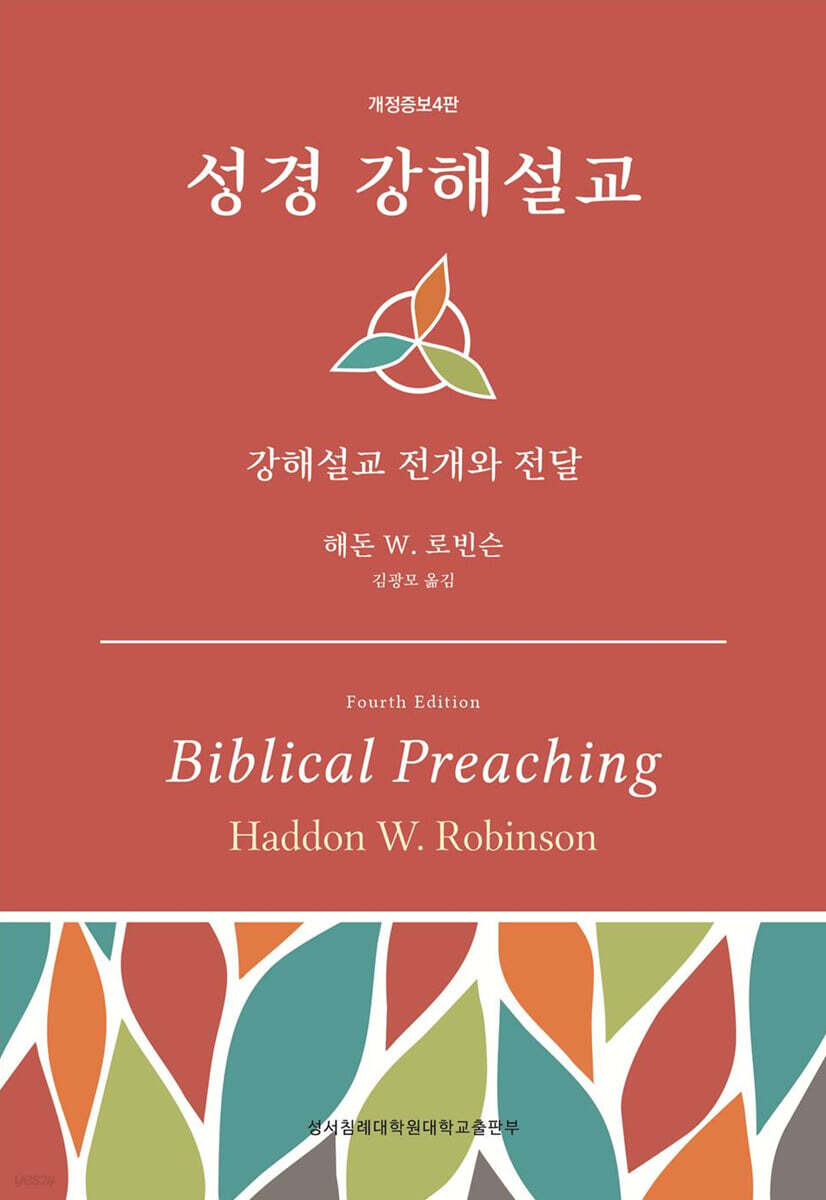
Bible Expository Sermons - Expository Sermon Development and Delivery
 |
Description
Book Introduction
“A textbook on homiletics: clear, persuasive, and witty!”
Since its first publication in 1980, it has been revised and expanded four times, and has been sold for nearly half a century, with over 400,000 copies sold. It is a textbook on homiletics and a study of homiletics that has had a positive influence on preaching candidates, preachers, and Bible teachers.
In the revised and expanded 3rd edition (2014), sermon development practice problems were added to the sermon preparation stage.
The revised and expanded 4th edition (2025) adds a "stage for expressing theological ideas," helping the next generation of preachers continue to preach the Bible in new cultures.
Now, with that help, Korean church preachers can run again.
Since its first publication in 1980, it has been revised and expanded four times, and has been sold for nearly half a century, with over 400,000 copies sold. It is a textbook on homiletics and a study of homiletics that has had a positive influence on preaching candidates, preachers, and Bible teachers.
In the revised and expanded 3rd edition (2014), sermon development practice problems were added to the sermon preparation stage.
The revised and expanded 4th edition (2025) adds a "stage for expressing theological ideas," helping the next generation of preachers continue to preach the Bible in new cultures.
Now, with that help, Korean church preachers can run again.
index
Recommended words… 11
Greetings… 23
Preface Revised and Expanded 4th Edition … 25
Preface, Revised and Expanded 3rd Edition … 27
Translator's Note … 33
1.
Still, the Case for Expository Preaching... 37
2.
Understanding the Big Idea_What's the Big Idea? … 57
3.
Equipping Yourself with the Tools to Find Big Ideas_Tools of the Trade … 77
4.
The Road from Text to Sermon … 105
5.
Setting the Direction and Goal of Your Sermon_The Arrow and the Target … 133
6.
The Shapes Sermons Take … 149
7.
Making Dry Bones Live… 177
8.
The sermon introduction starts off impressively, and the sermon conclusion concludes perfectly_Start with a Bang and Quit All Over … 209
9.
The Dress of Thought … 231
10.
How to Preach So People Will Listen … 251
Concluding Remarks … 273
Sermon Samples and Evaluations … 279
Sermon Development Practice Problems … 299
References … 367
Search for Bible texts … 379
Find people… 383
Browse Topics … 387
Find changes and additions to the revised and expanded 3rd edition… 396
Find changes and additions to the revised and expanded 4th edition… 397
Greetings… 23
Preface Revised and Expanded 4th Edition … 25
Preface, Revised and Expanded 3rd Edition … 27
Translator's Note … 33
1.
Still, the Case for Expository Preaching... 37
2.
Understanding the Big Idea_What's the Big Idea? … 57
3.
Equipping Yourself with the Tools to Find Big Ideas_Tools of the Trade … 77
4.
The Road from Text to Sermon … 105
5.
Setting the Direction and Goal of Your Sermon_The Arrow and the Target … 133
6.
The Shapes Sermons Take … 149
7.
Making Dry Bones Live… 177
8.
The sermon introduction starts off impressively, and the sermon conclusion concludes perfectly_Start with a Bang and Quit All Over … 209
9.
The Dress of Thought … 231
10.
How to Preach So People Will Listen … 251
Concluding Remarks … 273
Sermon Samples and Evaluations … 279
Sermon Development Practice Problems … 299
References … 367
Search for Bible texts … 379
Find people… 383
Browse Topics … 387
Find changes and additions to the revised and expanded 3rd edition… 396
Find changes and additions to the revised and expanded 4th edition… 397
Into the book
The 4th revised and expanded edition of 『Bible Expository Sermons』 is essentially the same as the previous edition.
We still unravel all the essential steps in creating a Big Idea expository sermon, from exegesis of the biblical text to delivery to those in desperate need of spiritual help and guidance.
Those familiar with this methodology will immediately notice that I add a theological idea step as I move from exegetical idea to expository or sermon idea generation.
Professor Haedon seamlessly connected the ideas of the theology and the sermon with intuitive clarity.
But having taught homiletics using his methodology for the past 30 years, I have come to realize that the intermediate step of formulating theological ideas is of great value in helping those studying preaching.
Another revision focuses primarily on providing up-to-date information on the changing cultural environment in which we live and on further research.
As the Lord desires, I anticipate that the 4th revised and expanded edition of "Bible Expository Sermons" will continue to play a central role in helping both men and women spread God's word.
The methodology, clarity, diction, and use of illustrations are essential for every pastor and aspiring preacher.
--- p.26
The type of sermon that best conveys the power of God's authority is expository preaching.
…a preacher who gives genuine expository preaching allows his audience to experience the power of the living God.
…Expository preaching is about communicating biblical concepts—concepts that have been extracted and transformed through historical, grammatical, and literary study of biblical passages within their context. The Holy Spirit first applies these concepts to the preacher's personality and experience, and then, through the preacher, to the audience.
--- p.42
To define an idea 'without any gaps', you need to know how ideas are formed.
If we reduce an idea to its basic structure, it is made up of a 'subject' and a 'complement'.
Both are essential elements.
The idea topic element represents a complete and clear answer to the question, “What am I talking about?”
…thematic elements cannot stand alone in a sermon idea.
Thematic elements alone are incomplete, so there must be 'explanatory elements'.
The supporting element 'completes' the topic element by answering the question, "What am I saying about what I am talking about?"
--- p.67
In each passage examined above, we determined the main theme and its supporting elements to find the 'structure' of the idea.
To think clearly, you need to separate your ideas from how you develop them.
Trying to grasp the text idea and then put it into precise words can be frustrating and irritating, but in the long run, it's the most efficient use of your time.
--- p.74
"Development Stages from the Bible Text to the Sermon"
Step 1: Choose a Bible verse to preach on… 80
Step 2: Study the selected Bible passage and gather your findings… 86
Step 3: Study the Bible passages, connecting the parts to determine the exegetical idea and its development… 94
Step 4: Present the found stone's ideas in three development questions… 108
Step 5: Abstract the found stone idea into a theological idea… 136
Step 6: State the found stone idea, abstract it into a theological idea, and then state the sermon idea… 137
Step 7: Determine Your Sermon Purpose… 142
Step 8: As you brainstorm sermon ideas, ask yourself how you can use them to achieve your sermon purpose… 151
Step 9: Develop your sermon ideas, decide how to achieve your sermon goals, and then outline your sermon… 168
Step 10: Fill in your sermon with supporting material that explains, proves, applies, or expands the main point… 178
Step 11: Preparing the Sermon Introduction and Conclusion… 210
Passages should be selected according to the natural literary divisions of the book.
We should not count them as ten or twelve verses, thinking that each verse can be treated as an individual thought.
Rather, we must seek the thoughts of the biblical author.
--- p.81
For this reason, we begin to study biblical passages by connecting them to the broader literary unit to which they belong.
Typically, to study like this, you need to read the Bible multiple times in multiple translations.
Even if you have the ability to read the Hebrew or Greek text, it is generally much easier to understand the author's extensive development of his ideas if you read it in his own translation.
--- p.86
Therefore, by placing the passages you intend to preach within a wider literary framework, you give the Bible the same opportunity you give a novelist.
We want to fit the selected paragraph into a broader unit of thought.
--- p.87
Now that we have examined the passage we have chosen to preach in context, we need to look at the details.
In the epistles and some of the gospels, this means examining the vocabulary and grammatical structure of passages to understand the author's intent.
If it's a narrative passage, you should look for statements from the author that explain what's happening.
--- p.89
It's amazing how much you can learn from the Bible just by reading it in your own words, but knowing a little about the original languages can be even more helpful.
Reading passages written in Hebrew or Greek is like watching high-definition television.
The screen stands out with its vividness and accuracy.
You don't have to be an expert in Hebrew or Greek to be able to use Hebrew or Greek effectively, and almost everyone has access to language tools that are readily available to them.
--- p.89
The Bible contains many types of literature, including parables, poetry, proverbs, prayers, speeches, allegory, history, law, contracts, biography, drama, apocalypses, and stories.
To find sermon ideas in these various literary forms, we must distinguish between the literary forms of the passages we read and also understand the unique conventions of each literary form.
--- p.97
No matter what literary genre you study, you should strive to understand the author's ideas and how they develop in the passages.
Revisit the passage as a concise statement of your idea—a statement that combines the main idea with supporting information.
--- p.99
A powerful sermon consists of ideas drawn from the Bible, but those ideas must be relevant to life.
Therefore, to preach effectively, the expository preacher must engage with three different worlds: the world of the Bible, the modern world, and the particular world to which he is called to preach.
--- p.105
When we make a declarative statement, we can only do four things: 1) restate, 2) explain, 3) prove, and 4) apply.
There is nothing else to do.
Recognizing this simple fact opens the way to understanding the dynamics of thought.
--- p.108
In the '5th step' of developing the sermon from the text, the essence of the exegetical idea discovered through studying the text is abstracted into a theological idea.
The 'theological idea' is what the author originally communicated to his audience, and the 'theological idea' is an intermediate step that helps us understand the transcultural and transhistorical intention of the text for people of all times and places.
…so to move from a theological idea to a theological idea, we must abstract the subject in order to generalize it and make it relevant to people of all times and places.
Then we come back down the ladder of abstraction to create more concrete 'sermon ideas', because our audience is made up of real men and women in a specific time and place.
--- p.136
If you have long theological and sermon ideas, let's go back down the ladder of abstract expression and state the sermon idea.
A sermon idea is a single sentence that you, as a preacher, want to convey to your audience right now.
--- p.137
No matter how excellent or biblical a sermon is, if its purpose is not clear, it is not worth preaching.
We have no proper idea why we are talking.
…the purpose of every sermon is to lead to moral action.
The preacher must know what the action is.
…the purpose of the sermon is to state to the audience what you hope will happen as a result of the sermon.
…the purpose of a sermon is different from the idea of a sermon.
… sermon ideas state biblical truths, but sermon purposes define what those truths are intended to accomplish.
--- pp.141-142
A sermon can be presented in many ways.
The three most prominent development methods are deductive development, semi-inductive development, and inductive development.
-- p.151
Once you have drawn concepts from the biblical material and shaped them to fit the needs of your congregation, it's time to draw up a blueprint—a sermon outline.
Content can exist without form, but structure gives a sermon a sense of unity, order, and progression.
Certainly, successful sermons have a solid foundation.
--- p.168
Remember, even if you have your sermon on paper in front of you so that you can see it when you preach, your audience won't hear it.
The audience only hears the gist of the story.
This obvious fact makes transition statements particularly important, because they express the relationship between parts and the whole.
--- p.172
The sermon outline serves as the framework for the sermon's ideas, and the outline, … should not be overly revealed.
The most effective way to hide the bare bones of a sermon is to cover it with flesh.
Supporting data does for the body what skin does for bone or a wall does for a framework.
…To expand, explain, prove, or apply your sermon ideas and make them understandable and engaging for your audience, you must make effective use of various supporting materials.
--- pp.178-179
The sermon introduction serves to introduce the preacher to the audience.
After all, the audience doesn't listen to the sermon, they listen to the preacher.
It has always been important for the audience to like the preacher, but it is especially important today.
In our culture, audiences value relationships, and they judge the preacher and his attitude before paying attention to what he has to say.
--- p.210
Just as a seasoned pilot knows that he must concentrate particularly on landing his plane, a competent preacher knows that he must carefully prepare his conclusion.
Like a seasoned pilot, a preacher must know where his sermon will land.
In fact, the conclusion is so important that many pastors decide on the sermon idea and purpose and then outline the conclusion.
Whether or not you use such techniques, you should write your conclusions with special care.
Otherwise, everything may be in vain.
--- p.222
A sermon conclusion can take many forms, depending on the sermon, the audience, the preacher, etc.
The element of freshness adds interest to the sermon, so let's try to make the conclusions diverse.
What are some elements that help you conclude your sermon and build a burning focus? (Summary, illustration, quote, question, prayer, specific direction, visualization, etc.) Let's look at them one by one.
[Revealed.
Translator's addition])
--- p.222~223
Not all preachers write manuscripts, and even those who do not write their entire sermons, but manuscript writing training prepares us to deliver better sermons.
Writing clears the mold from our thoughts, organizes them, and highlights important ideas.
--- p.231
The way we choose and arrange words is called style.
Everyone has a way of speaking.
It can be flat, boring, lively, or precise.
The way we handle, or mishandle, words is our speech.
The way we speak reflects the way we think and the way we view life.
The tone of speech varies depending on the speaker, and the speaker changes his or her tone depending on the audience and the situation.
--- p.234
Let's sit quietly at our desks, think, and try to express ourselves in words.
Then, what the preacher wants to write seeps into the preacher's heart.
Let's practice out loud several times without a sermon manuscript.
…let’s just try to make the flow of thought clear.
When the preacher stands on the podium, the words he has written have played a role in shaping his use of language.
When you preach, many expressions will come to mind, but not all of them will come to mind.
The passion with which you deliver your sermon can even change the structure of your sentences.
New expressions emerge, and sermons sparkle like natural conversations.
Therefore, the sermon manuscript contributes to the sermon's ideas and expression, but does not determine them.
…writing a sermon manuscript is different from writing an essay or a book.
A sermon manuscript should be written as if you were having a conversation with someone.
Just like when having a conversation, write so that the other person can understand right away.
--- p.234
The effectiveness of a sermon depends on two factors: what is said and how it is said.
Both are important.
If there is no application based on the Bible, it is not worth delivering, but if you do not have the ability to communicate skillfully, you will not be able to convey that content to the congregation.
The elements that make up a sermon, in order of importance, are thought, structure, language, voice, and gesture.
However, if you prioritize impressions, the order is reversed.
Gestures and voice stand out as the most obvious and decisive elements in a sermon.
All empirical studies on delivery and its impact on the outcome of a speech or sermon conclude the same thing.
Soon, the method of delivery will be very important.
--- p.251
Only Jesus Christ can do this by his Holy Spirit.
The preacher must offer the sermon he has prepared to Him.
Preaching is ultimately His ministry.
It is truly amazing how He increases our efforts and makes our audiences eager to hear our sermons.
We still unravel all the essential steps in creating a Big Idea expository sermon, from exegesis of the biblical text to delivery to those in desperate need of spiritual help and guidance.
Those familiar with this methodology will immediately notice that I add a theological idea step as I move from exegetical idea to expository or sermon idea generation.
Professor Haedon seamlessly connected the ideas of the theology and the sermon with intuitive clarity.
But having taught homiletics using his methodology for the past 30 years, I have come to realize that the intermediate step of formulating theological ideas is of great value in helping those studying preaching.
Another revision focuses primarily on providing up-to-date information on the changing cultural environment in which we live and on further research.
As the Lord desires, I anticipate that the 4th revised and expanded edition of "Bible Expository Sermons" will continue to play a central role in helping both men and women spread God's word.
The methodology, clarity, diction, and use of illustrations are essential for every pastor and aspiring preacher.
--- p.26
The type of sermon that best conveys the power of God's authority is expository preaching.
…a preacher who gives genuine expository preaching allows his audience to experience the power of the living God.
…Expository preaching is about communicating biblical concepts—concepts that have been extracted and transformed through historical, grammatical, and literary study of biblical passages within their context. The Holy Spirit first applies these concepts to the preacher's personality and experience, and then, through the preacher, to the audience.
--- p.42
To define an idea 'without any gaps', you need to know how ideas are formed.
If we reduce an idea to its basic structure, it is made up of a 'subject' and a 'complement'.
Both are essential elements.
The idea topic element represents a complete and clear answer to the question, “What am I talking about?”
…thematic elements cannot stand alone in a sermon idea.
Thematic elements alone are incomplete, so there must be 'explanatory elements'.
The supporting element 'completes' the topic element by answering the question, "What am I saying about what I am talking about?"
--- p.67
In each passage examined above, we determined the main theme and its supporting elements to find the 'structure' of the idea.
To think clearly, you need to separate your ideas from how you develop them.
Trying to grasp the text idea and then put it into precise words can be frustrating and irritating, but in the long run, it's the most efficient use of your time.
--- p.74
"Development Stages from the Bible Text to the Sermon"
Step 1: Choose a Bible verse to preach on… 80
Step 2: Study the selected Bible passage and gather your findings… 86
Step 3: Study the Bible passages, connecting the parts to determine the exegetical idea and its development… 94
Step 4: Present the found stone's ideas in three development questions… 108
Step 5: Abstract the found stone idea into a theological idea… 136
Step 6: State the found stone idea, abstract it into a theological idea, and then state the sermon idea… 137
Step 7: Determine Your Sermon Purpose… 142
Step 8: As you brainstorm sermon ideas, ask yourself how you can use them to achieve your sermon purpose… 151
Step 9: Develop your sermon ideas, decide how to achieve your sermon goals, and then outline your sermon… 168
Step 10: Fill in your sermon with supporting material that explains, proves, applies, or expands the main point… 178
Step 11: Preparing the Sermon Introduction and Conclusion… 210
Passages should be selected according to the natural literary divisions of the book.
We should not count them as ten or twelve verses, thinking that each verse can be treated as an individual thought.
Rather, we must seek the thoughts of the biblical author.
--- p.81
For this reason, we begin to study biblical passages by connecting them to the broader literary unit to which they belong.
Typically, to study like this, you need to read the Bible multiple times in multiple translations.
Even if you have the ability to read the Hebrew or Greek text, it is generally much easier to understand the author's extensive development of his ideas if you read it in his own translation.
--- p.86
Therefore, by placing the passages you intend to preach within a wider literary framework, you give the Bible the same opportunity you give a novelist.
We want to fit the selected paragraph into a broader unit of thought.
--- p.87
Now that we have examined the passage we have chosen to preach in context, we need to look at the details.
In the epistles and some of the gospels, this means examining the vocabulary and grammatical structure of passages to understand the author's intent.
If it's a narrative passage, you should look for statements from the author that explain what's happening.
--- p.89
It's amazing how much you can learn from the Bible just by reading it in your own words, but knowing a little about the original languages can be even more helpful.
Reading passages written in Hebrew or Greek is like watching high-definition television.
The screen stands out with its vividness and accuracy.
You don't have to be an expert in Hebrew or Greek to be able to use Hebrew or Greek effectively, and almost everyone has access to language tools that are readily available to them.
--- p.89
The Bible contains many types of literature, including parables, poetry, proverbs, prayers, speeches, allegory, history, law, contracts, biography, drama, apocalypses, and stories.
To find sermon ideas in these various literary forms, we must distinguish between the literary forms of the passages we read and also understand the unique conventions of each literary form.
--- p.97
No matter what literary genre you study, you should strive to understand the author's ideas and how they develop in the passages.
Revisit the passage as a concise statement of your idea—a statement that combines the main idea with supporting information.
--- p.99
A powerful sermon consists of ideas drawn from the Bible, but those ideas must be relevant to life.
Therefore, to preach effectively, the expository preacher must engage with three different worlds: the world of the Bible, the modern world, and the particular world to which he is called to preach.
--- p.105
When we make a declarative statement, we can only do four things: 1) restate, 2) explain, 3) prove, and 4) apply.
There is nothing else to do.
Recognizing this simple fact opens the way to understanding the dynamics of thought.
--- p.108
In the '5th step' of developing the sermon from the text, the essence of the exegetical idea discovered through studying the text is abstracted into a theological idea.
The 'theological idea' is what the author originally communicated to his audience, and the 'theological idea' is an intermediate step that helps us understand the transcultural and transhistorical intention of the text for people of all times and places.
…so to move from a theological idea to a theological idea, we must abstract the subject in order to generalize it and make it relevant to people of all times and places.
Then we come back down the ladder of abstraction to create more concrete 'sermon ideas', because our audience is made up of real men and women in a specific time and place.
--- p.136
If you have long theological and sermon ideas, let's go back down the ladder of abstract expression and state the sermon idea.
A sermon idea is a single sentence that you, as a preacher, want to convey to your audience right now.
--- p.137
No matter how excellent or biblical a sermon is, if its purpose is not clear, it is not worth preaching.
We have no proper idea why we are talking.
…the purpose of every sermon is to lead to moral action.
The preacher must know what the action is.
…the purpose of the sermon is to state to the audience what you hope will happen as a result of the sermon.
…the purpose of a sermon is different from the idea of a sermon.
… sermon ideas state biblical truths, but sermon purposes define what those truths are intended to accomplish.
--- pp.141-142
A sermon can be presented in many ways.
The three most prominent development methods are deductive development, semi-inductive development, and inductive development.
-- p.151
Once you have drawn concepts from the biblical material and shaped them to fit the needs of your congregation, it's time to draw up a blueprint—a sermon outline.
Content can exist without form, but structure gives a sermon a sense of unity, order, and progression.
Certainly, successful sermons have a solid foundation.
--- p.168
Remember, even if you have your sermon on paper in front of you so that you can see it when you preach, your audience won't hear it.
The audience only hears the gist of the story.
This obvious fact makes transition statements particularly important, because they express the relationship between parts and the whole.
--- p.172
The sermon outline serves as the framework for the sermon's ideas, and the outline, … should not be overly revealed.
The most effective way to hide the bare bones of a sermon is to cover it with flesh.
Supporting data does for the body what skin does for bone or a wall does for a framework.
…To expand, explain, prove, or apply your sermon ideas and make them understandable and engaging for your audience, you must make effective use of various supporting materials.
--- pp.178-179
The sermon introduction serves to introduce the preacher to the audience.
After all, the audience doesn't listen to the sermon, they listen to the preacher.
It has always been important for the audience to like the preacher, but it is especially important today.
In our culture, audiences value relationships, and they judge the preacher and his attitude before paying attention to what he has to say.
--- p.210
Just as a seasoned pilot knows that he must concentrate particularly on landing his plane, a competent preacher knows that he must carefully prepare his conclusion.
Like a seasoned pilot, a preacher must know where his sermon will land.
In fact, the conclusion is so important that many pastors decide on the sermon idea and purpose and then outline the conclusion.
Whether or not you use such techniques, you should write your conclusions with special care.
Otherwise, everything may be in vain.
--- p.222
A sermon conclusion can take many forms, depending on the sermon, the audience, the preacher, etc.
The element of freshness adds interest to the sermon, so let's try to make the conclusions diverse.
What are some elements that help you conclude your sermon and build a burning focus? (Summary, illustration, quote, question, prayer, specific direction, visualization, etc.) Let's look at them one by one.
[Revealed.
Translator's addition])
--- p.222~223
Not all preachers write manuscripts, and even those who do not write their entire sermons, but manuscript writing training prepares us to deliver better sermons.
Writing clears the mold from our thoughts, organizes them, and highlights important ideas.
--- p.231
The way we choose and arrange words is called style.
Everyone has a way of speaking.
It can be flat, boring, lively, or precise.
The way we handle, or mishandle, words is our speech.
The way we speak reflects the way we think and the way we view life.
The tone of speech varies depending on the speaker, and the speaker changes his or her tone depending on the audience and the situation.
--- p.234
Let's sit quietly at our desks, think, and try to express ourselves in words.
Then, what the preacher wants to write seeps into the preacher's heart.
Let's practice out loud several times without a sermon manuscript.
…let’s just try to make the flow of thought clear.
When the preacher stands on the podium, the words he has written have played a role in shaping his use of language.
When you preach, many expressions will come to mind, but not all of them will come to mind.
The passion with which you deliver your sermon can even change the structure of your sentences.
New expressions emerge, and sermons sparkle like natural conversations.
Therefore, the sermon manuscript contributes to the sermon's ideas and expression, but does not determine them.
…writing a sermon manuscript is different from writing an essay or a book.
A sermon manuscript should be written as if you were having a conversation with someone.
Just like when having a conversation, write so that the other person can understand right away.
--- p.234
The effectiveness of a sermon depends on two factors: what is said and how it is said.
Both are important.
If there is no application based on the Bible, it is not worth delivering, but if you do not have the ability to communicate skillfully, you will not be able to convey that content to the congregation.
The elements that make up a sermon, in order of importance, are thought, structure, language, voice, and gesture.
However, if you prioritize impressions, the order is reversed.
Gestures and voice stand out as the most obvious and decisive elements in a sermon.
All empirical studies on delivery and its impact on the outcome of a speech or sermon conclude the same thing.
Soon, the method of delivery will be very important.
--- p.251
Only Jesus Christ can do this by his Holy Spirit.
The preacher must offer the sermon he has prepared to Him.
Preaching is ultimately His ministry.
It is truly amazing how He increases our efforts and makes our audiences eager to hear our sermons.
--- p.275
Publisher's Review
Highly recommended by homileticians and preachers as a textbook on authentic expository preaching!
Jeffrey Arthurs, Matthew D.
Kim, Steven D.
Mathewson,
Bryan Wilkerson, Patricia Batten
Professor Kwon Ho, Pastor Kim Gwan-seong, Professor Kim Ki-hyeon, Professor Kim Dae-hyeok, President Kim Taek-su, Professor Park Seong-jin, Pastor Park Yeong-ho, Pastor Park Jeong-geun, Pastor Seo Jeong-in, Pastor Yang Seung-heon, Professor Lee Seung-jin, Professor Lee Jae-gi, Professor Im Do-gyun, Professor Jeong In-gyo, Pastor Choi Byeong-rak, Pastor Choi Ju-hoon, Professor Han Jin-hwan, Pastor Hwang Won-ha
Jeffrey Arthurs, Matthew D.
Kim, Steven D.
Mathewson,
Bryan Wilkerson, Patricia Batten
Professor Kwon Ho, Pastor Kim Gwan-seong, Professor Kim Ki-hyeon, Professor Kim Dae-hyeok, President Kim Taek-su, Professor Park Seong-jin, Pastor Park Yeong-ho, Pastor Park Jeong-geun, Pastor Seo Jeong-in, Pastor Yang Seung-heon, Professor Lee Seung-jin, Professor Lee Jae-gi, Professor Im Do-gyun, Professor Jeong In-gyo, Pastor Choi Byeong-rak, Pastor Choi Ju-hoon, Professor Han Jin-hwan, Pastor Hwang Won-ha
GOODS SPECIFICS
- Date of issue: October 3, 2025
- Page count, weight, size: 400 pages | 153*225*30mm
- ISBN13: 9791189118280
- ISBN10: 1189118289
You may also like
카테고리
korean


korean

![GQ KOREA Mark (Monthly): December [2025]](http://librairie.coreenne.fr/cdn/shop/files/8ef265dbbfbf186523ed75ba7319009d.jpg?v=1765340328&width=3840)


