

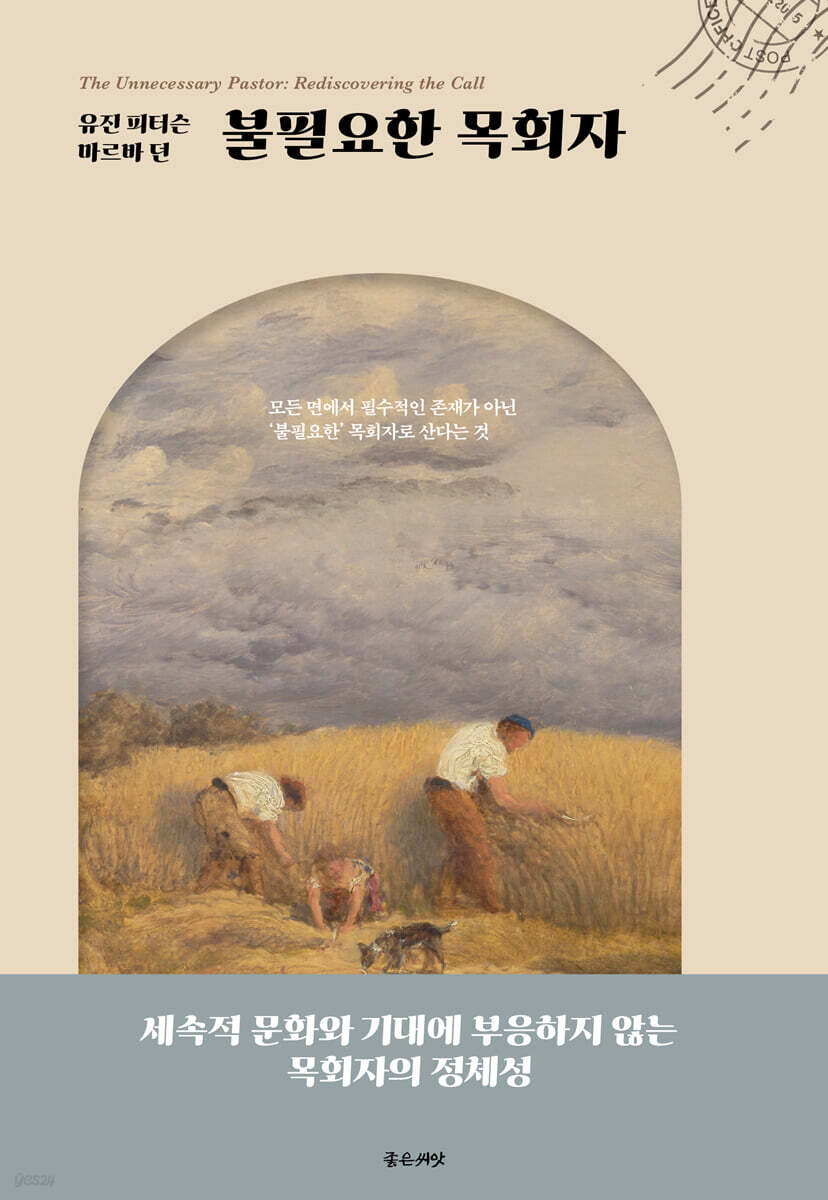
Unnecessary pastors
 |
Description
Book Introduction
"The Unnecessary Pastor" is a theological declaration that helps today's pastors redefine their identity and ministry on the foundation of the Bible and the Gospel.
Eugene Peterson and Marva Dunn emphasize that although pastors may seem "unnecessary" by worldly standards, they are absolutely necessary in the face of the gospel, posing a profound challenge to the reality of Korean churches and pastoral ministry, which is flowing toward success-oriented and managerialism.
Eugene Peterson and Marva Dunn emphasize that although pastors may seem "unnecessary" by worldly standards, they are absolutely necessary in the face of the gospel, posing a profound challenge to the reality of Korean churches and pastoral ministry, which is flowing toward success-oriented and managerialism.
- You can preview some of the book's contents.
Preview
index
Introduction: Establishing the Identity of a Biblical Pastor 9
Eugene Peterson
Chapter 1: Becoming Unnecessary 16
Eugene Peterson
Chapter 2 Prelude to Recovery 48
Marva Dunn
Chapter 3: The Call to Become a Living Song 82
Marva Dunn
Chapter 4: Paul and Rome: Restoring Biblical Pastoral Theology 118
Eugene Peterson
Chapter 5: The Call to Victory Over Rule and Power 151
Marva Dunn
Chapter 6: Timothy and Ephesus: Teaching Wisdom 220
Eugene Peterson
Chapter 7: The Call to Be Transformed by the Spirit of the Ascended Christ 248
Marva Dunn
Chapter 8 Titus and Crete: A Paradigm for Community Building 321
Eugene Peterson
Chapter 9: The Call to Build Community 356
Marva Dunn
Eugene Peterson
Chapter 1: Becoming Unnecessary 16
Eugene Peterson
Chapter 2 Prelude to Recovery 48
Marva Dunn
Chapter 3: The Call to Become a Living Song 82
Marva Dunn
Chapter 4: Paul and Rome: Restoring Biblical Pastoral Theology 118
Eugene Peterson
Chapter 5: The Call to Victory Over Rule and Power 151
Marva Dunn
Chapter 6: Timothy and Ephesus: Teaching Wisdom 220
Eugene Peterson
Chapter 7: The Call to Be Transformed by the Spirit of the Ascended Christ 248
Marva Dunn
Chapter 8 Titus and Crete: A Paradigm for Community Building 321
Eugene Peterson
Chapter 9: The Call to Build Community 356
Marva Dunn
Into the book
We want you to build your identity as a biblical pastor.
If you hold firmly to that identity, you can minister without wavering amid the complex and distracting daily lives of the souls God has entrusted to you.
---- From "Establishing the Identity of a Biblical Pastor"
We want to start with the obvious: “The gospel of Jesus Christ is quite countercultural.”
Jesus said:
“I came to bring fire on the earth, and how I wish it were already kindled!” (Luke 12:49).
---- From "Chapter 1: Becoming an Unnecessary Being"
I want you to think carefully about why you go to such lengths to present yourself in a way that makes you look good on the outside.
Don't we sometimes try to disguise ourselves as something other than who we really are? Do we act this way for the sake of our own "ministry"?
---- From "Chapter 2: Prelude to Recovery"
Furthermore, our sainthood is a calling to live in the grace and peace of the Triune God.
In other words, I am called to be one who constantly asks how I can convey that grace and peace to others.
How can we bring it to life?
---- From “Chapter 3: The Call to Become a Living Song”
But Paul gives us direction for our pastoral ministry.
Although Paul did not stay with the Roman believers, he was passionately involved in helping them live righteous and faithful lives.
The famous letter to the Romans that he sent to the Roman church is a pastoral exhortation for just such a ‘life.’
---- From “Chapter 4 Paul and Rome: Restoring Biblical Pastoral Theology”
We must remember the dual perspective with which we view government and power.
While it is true that there is much to be done on a physical/worldly/human level, we must not be indifferent to the spiritual forces that manipulate human affairs through human agents.
---- From “Chapter 5: A Call to Victory Against Rule and Power”
In the Christian community, the central ministry of a leader is teaching.
Pastors must continue to teach because all elements of the gospel must be lived out in our lives.
But what kind of teaching it is is important.
It must be a teaching of wisdom, not a teaching of knowledge.
---- From “Chapter 6 Timothy and Ephesus: Teach Wisdom”
The ministry we as pastors must practice for our congregations is to always show them Jesus Christ.
We must show that He entered the abyss for us, and that He is with us even now in that pit of despair.
---- From “Chapter 7: The Call to Be Transformed by the Spirit of the Ascended Christ”
To build a community of faith in Christ, pastors must treat people the way Jesus treated them.
At the same time, we must be careful not to treat people the way the world's culture treats them.
The world deals with people in an organized and functional way.
The gospel looks at people on a relational and personal level.
---- From “Chapter 8 Titus and Crete: A Paradigm for Community Formation”
The first step in teaching Christians about true community is to teach them that much of the Bible is written in the plural.
The next step is to prepare them to practice such plurality.
If you hold firmly to that identity, you can minister without wavering amid the complex and distracting daily lives of the souls God has entrusted to you.
---- From "Establishing the Identity of a Biblical Pastor"
We want to start with the obvious: “The gospel of Jesus Christ is quite countercultural.”
Jesus said:
“I came to bring fire on the earth, and how I wish it were already kindled!” (Luke 12:49).
---- From "Chapter 1: Becoming an Unnecessary Being"
I want you to think carefully about why you go to such lengths to present yourself in a way that makes you look good on the outside.
Don't we sometimes try to disguise ourselves as something other than who we really are? Do we act this way for the sake of our own "ministry"?
---- From "Chapter 2: Prelude to Recovery"
Furthermore, our sainthood is a calling to live in the grace and peace of the Triune God.
In other words, I am called to be one who constantly asks how I can convey that grace and peace to others.
How can we bring it to life?
---- From “Chapter 3: The Call to Become a Living Song”
But Paul gives us direction for our pastoral ministry.
Although Paul did not stay with the Roman believers, he was passionately involved in helping them live righteous and faithful lives.
The famous letter to the Romans that he sent to the Roman church is a pastoral exhortation for just such a ‘life.’
---- From “Chapter 4 Paul and Rome: Restoring Biblical Pastoral Theology”
We must remember the dual perspective with which we view government and power.
While it is true that there is much to be done on a physical/worldly/human level, we must not be indifferent to the spiritual forces that manipulate human affairs through human agents.
---- From “Chapter 5: A Call to Victory Against Rule and Power”
In the Christian community, the central ministry of a leader is teaching.
Pastors must continue to teach because all elements of the gospel must be lived out in our lives.
But what kind of teaching it is is important.
It must be a teaching of wisdom, not a teaching of knowledge.
---- From “Chapter 6 Timothy and Ephesus: Teach Wisdom”
The ministry we as pastors must practice for our congregations is to always show them Jesus Christ.
We must show that He entered the abyss for us, and that He is with us even now in that pit of despair.
---- From “Chapter 7: The Call to Be Transformed by the Spirit of the Ascended Christ”
To build a community of faith in Christ, pastors must treat people the way Jesus treated them.
At the same time, we must be careful not to treat people the way the world's culture treats them.
The world deals with people in an organized and functional way.
The gospel looks at people on a relational and personal level.
---- From “Chapter 8 Titus and Crete: A Paradigm for Community Formation”
The first step in teaching Christians about true community is to teach them that much of the Bible is written in the plural.
The next step is to prepare them to practice such plurality.
---- From “Chapter 9: The Call to Build a Community”
Publisher's Review
1.
The book's core message
● Restoration of the identity of pastors: Pastors are not simply administrators or religious experts, but rather those who build the church through the Word and sacraments.
● The paradox of ‘unnecessity’: The world may not have much need for pastors, but the essence of the gospel and the vitality of the church are revealed through pastors.
● Theological Foundation: Presents pastoral theology based on biblical foundations, focusing on Ephesians and the Pastoral Epistles.
● The meeting of spirituality and theology: Eugene Peterson's deep spirituality and Marva Dunn's thorough theological reflection come together to present a pastoral theology that embraces both ideals and reality.
2.
A Challenge to the Korean Church
● Criticism of secular successism: Criticizes the reality of pastoral care that is focused on church growth, program operation, and management skills.
● A Call to Renewal: Citing Romans 12:2, he urges the entire church to hear again the message that we should not follow the flow of the generations, but be transformed by the renewing of our minds.
● Remembering the Gifts of the Holy Spirit: As the Apostle Paul advised Timothy, pastors must renew the gifts they have received from God and continue their evangelistic ministry.
3.
Meaning
"The Unnecessary Pastor" is not simply a guidebook; it is a theological declaration and call for renewal for the Korean church and pastors.
This book invites pastors to hold fast to the essential mission of the gospel, not be swayed by cultural demands, and serve the church solely through the power of grace.
4.
Benefits of this book
1) To the pastor
● Restoring the authority of the Word: Based on 1 and 2 Timothy and Titus, it clearly states that the foundation of pastoral ministry is the gospel, not programs.
● Restoration of humility and freedom: As the word says, “If you remain silent at this time, relief and deliverance from God will arise from another place” (Esther 4:14), it acknowledges that God is the owner of the church.
● Theological direction: Helps apply the blueprint of the ‘church as the body of Christ’ presented in the Book of Ephesians to the reality of pastoral ministry.
2) To the saints
● Break the stereotype of pastors as ‘success models’ or ‘religious service providers’ and recognize them as co-workers who participate in the gospel together.
● It awakens the laity to their mission and communal calling, and helps them to anew grasp the words, “But you are a chosen people, a royal priesthood” (1 Peter 2:9) in their lives.
● Transform the relationship between pastors and believers from a superior-subordinate relationship to a communal relationship in which they bear the cross together.
The book's core message
● Restoration of the identity of pastors: Pastors are not simply administrators or religious experts, but rather those who build the church through the Word and sacraments.
● The paradox of ‘unnecessity’: The world may not have much need for pastors, but the essence of the gospel and the vitality of the church are revealed through pastors.
● Theological Foundation: Presents pastoral theology based on biblical foundations, focusing on Ephesians and the Pastoral Epistles.
● The meeting of spirituality and theology: Eugene Peterson's deep spirituality and Marva Dunn's thorough theological reflection come together to present a pastoral theology that embraces both ideals and reality.
2.
A Challenge to the Korean Church
● Criticism of secular successism: Criticizes the reality of pastoral care that is focused on church growth, program operation, and management skills.
● A Call to Renewal: Citing Romans 12:2, he urges the entire church to hear again the message that we should not follow the flow of the generations, but be transformed by the renewing of our minds.
● Remembering the Gifts of the Holy Spirit: As the Apostle Paul advised Timothy, pastors must renew the gifts they have received from God and continue their evangelistic ministry.
3.
Meaning
"The Unnecessary Pastor" is not simply a guidebook; it is a theological declaration and call for renewal for the Korean church and pastors.
This book invites pastors to hold fast to the essential mission of the gospel, not be swayed by cultural demands, and serve the church solely through the power of grace.
4.
Benefits of this book
1) To the pastor
● Restoring the authority of the Word: Based on 1 and 2 Timothy and Titus, it clearly states that the foundation of pastoral ministry is the gospel, not programs.
● Restoration of humility and freedom: As the word says, “If you remain silent at this time, relief and deliverance from God will arise from another place” (Esther 4:14), it acknowledges that God is the owner of the church.
● Theological direction: Helps apply the blueprint of the ‘church as the body of Christ’ presented in the Book of Ephesians to the reality of pastoral ministry.
2) To the saints
● Break the stereotype of pastors as ‘success models’ or ‘religious service providers’ and recognize them as co-workers who participate in the gospel together.
● It awakens the laity to their mission and communal calling, and helps them to anew grasp the words, “But you are a chosen people, a royal priesthood” (1 Peter 2:9) in their lives.
● Transform the relationship between pastors and believers from a superior-subordinate relationship to a communal relationship in which they bear the cross together.
GOODS SPECIFICS
- Date of issue: September 30, 2025
- Page count, weight, size: 428 pages | 145*210*30mm
- ISBN13: 9788958744221
- ISBN10: 8958744227
You may also like
카테고리
korean


korean

![ELLE 엘르 스페셜 에디션 A형 : 12월 [2025]](http://librairie.coreenne.fr/cdn/shop/files/b8e27a3de6c9538896439686c6b0e8fb.jpg?v=1766436872&width=3840)


